
We read and scored the AI books that actually change how you work with the technology — not just how you talk about it. Every title was ranked with the same transparent 5-point rubric: lasting impact, evidence quality, practical application, writing, and reader consensus. From Ethan Mollick’s hands-on playbook for daily AI use to Nick Bostrom’s foundational safety arguments, these 22 span the full range — practical to philosophical, optimistic to cautionary. Where a free in-depth TGR summary exists, it’s linked; the rest link straight to the book.
The 22 Best AI Books, Ranked
Counting down from #20 to our #1 pick.

The Master Algorithm
Pedro Domingos
★★★★☆4.1/5
A computer scientist’s tour of the five competing schools of machine learning — and his contested bet that they’re converging into one.
Domingos organizes the entire field of machine learning into five “tribes” — symbolists, connectionists, evolutionaries, Bayesians, and analogizers — each with its own master-algorithm candidate, and the framework alone makes this worth reading even years later, since it’s still one of the clearest maps of why AI research fractures into such different-looking approaches. His central bet, that a single unifying master algorithm is coming, hasn’t obviously panned out the way he predicted, but the taxonomy remains a genuinely useful mental model.
Best for: Readers who want the technical taxonomy of machine learning approaches, one level under the hood

Atlas of AI
Kate Crawford
★★★★☆4.0/5
The book that insists on tracing AI back to its physical costs — the mines, the data centers, the underpaid labelers — most AI books skip.
Crawford’s core contribution is a genuinely underrepresented angle on this list: AI isn’t just code and cloud compute, it’s lithium mines, warehouses of human data labelers, and power grids straining under data-center load. Where most books here treat AI as an abstraction, Atlas of AI insists on its material reality, and that grounding is valuable even when the argument tips into advocacy rather than even-handed analysis. Read it as the corrective to every book on this list that talks about AI as if it were weightless.
Best for: Readers who want the environmental and labor-cost angle no other book here covers

Weapons of Math Destruction
Cathy O’Neil
★★★★☆4.4/5
The book that made “algorithmic bias” a mainstream phrase — O’Neil’s case that badly designed models can quietly wreck lives at scale.
O’Neil, a former Wall Street quant, writes with the authority of someone who built these systems before turning against how they’re used: scoring algorithms in hiring, credit, policing, and education that are opaque, unaccountable, and often just quietly encode the biases of their training data. Published before most large language models existed, its examples focus on older scoring models rather than generative AI, but the underlying argument — that scale and opacity turn small model errors into large-scale harm — is more relevant now than when it was written.
Best for: Readers who want the accountability and bias case against automated decision-making
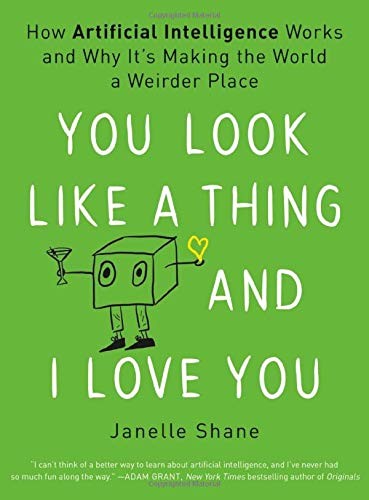
You Look Like a Thing and I Love You
Janelle Shane
★★★★☆4.2/5
The funniest book on this list, and a genuinely useful one — Shane’s neural-network failures teach AI’s limits better than most serious treatises.
Shane runs an AI-humor blog where she trains neural networks on things like paint colors and pickup lines and shares the delightfully broken results, and the book version turns that instinct into an accessible, laugh-out-loud explanation of why current AI is powerful but narrow, brittle, and easily confused. It’s the book to hand someone who finds Superintelligence intimidating — the underlying lesson (these systems pattern-match, they don’t understand) is the same one Marcus and Mitchell argue at length, delivered here with far more jokes.
Best for: Total beginners who want to understand AI’s limits without a single equation
Genius Makers
Cade Metz
★★★★☆4.3/5
The definitive narrative history of deep learning’s key researchers — part science story, part corporate thriller.
Metz, a longtime New York Times tech reporter, had access few authors get: interviews with Geoffrey Hinton, Yann LeCun, Demis Hassabis, and the small group of researchers who kept neural networks alive through decades when the field had given up on them. The result reads less like a technology book and more like a business drama, tracing how a handful of obsessive academics ended up controlling technology worth hundreds of billions of dollars at Google, Facebook, and DeepMind.
Best for: Readers who want the human story behind the technology, not another explainer

Artificial Intelligence: A Guide for Thinking Humans
Melanie Mitchell
★★★★☆4.2/5
The clearest technical primer on this list — a computer scientist explaining how deep learning, and its very real limits, actually work.
Mitchell is a working AI researcher, and this shows in the book’s core strength: it’s the most accurate plain-English explanation of how neural networks actually learn, without the breathless hype of business books or the dense formalism of academic ones. Her chapter-length case studies — on image recognition failures, game-playing systems, and language models — do more to demystify what AI can and can’t do than any other book here. Read this if you want to actually understand the technology, not just its implications.
Best for: Readers who want to understand how the models actually work, not just what they mean
Rebooting AI
Gary Marcus & Ernest Davis
★★★★☆4.0/5
The necessary skeptic’s corrective — a cognitive scientist’s case that deep learning alone won’t get us to real understanding.
Marcus has become AI’s most persistent contrarian, and Rebooting AI is where his case is made most carefully: pattern-matching systems can produce startlingly fluent output while still lacking any real model of cause, common sense, or the physical world. Written before the large-language-model wave fully hit, some specific examples feel dated, but the underlying critique — don’t mistake fluency for understanding — has aged into one of the more prescient warnings on this list. A useful counterweight to the more triumphant entries here.
Best for: Readers who want the skeptic’s case before buying fully into the hype

The Alignment Problem
Brian Christian
★★★★☆4.5/5
The best-written book on this list, full stop — Christian turns the technical history of AI alignment into gripping narrative nonfiction.
Christian is a working writer first and a technologist second, and it shows in the best possible way: this is the book that makes reinforcement learning, reward hacking, and interpretability research feel like a detective story rather than a lecture. It covers the same ground as Human Compatible and Superintelligence but is dramatically more approachable, tracing the alignment problem through real research labs and real researchers rather than abstract thought experiments. If you only read one “how do we make AI safe” book, make it this one.
Best for: Readers who want the alignment-research story told well, without a computer science degree
Superintelligence
Nick Bostrom
★★★★☆4.3/5
The academic bedrock underneath nearly every AI-safety argument published since — dense, but foundational.
Bostrom’s book did more than any other to make AI safety a legitimate research question rather than a science-fiction premise, and its core concepts — the orthogonality thesis, instrumental convergence, the treacherous turn — are still the vocabulary the field uses a decade later. It is also, by a wide margin, the hardest read on this list: dense, hedged, written for philosophers rather than general readers. Read The Alignment Problem or Human Compatible first for the accessible version of these ideas; come to Bostrom once you want the rigorous original.
Best for: Readers who want the original, rigorous argument, not the popularized version
“Before the prospect of an intelligence explosion, we humans are like small children playing with a bomb.”

The Second Machine Age
Erik Brynjolfsson & Andrew McAfee
★★★★☆4.3/5
The book that first made the economic case for AI-driven productivity growth mainstream.
Written before the deep-learning boom fully took hold, Second Machine Age’s core prediction — that digital technologies would decouple economic growth from job growth, producing “bounty” and “spread” simultaneously — has held up remarkably well. It’s less about any specific model or tool and more about the economic mechanics of automation, which makes it a useful corrective to books that treat AI as a sudden phenomenon rather than a decade-long acceleration. Occasionally dated in its examples, but the framework is durable.
Best for: Readers who want the economic foundations before the AI-specific hype

Scary Smart
Mo Gawdat
★★★★☆4.1/5
A former Google X chief business officer’s surprisingly personal case that AI’s trajectory is shaped by the humans training it.
Gawdat’s core argument is simple and a little uncomfortable: AI systems learn from us, which means an anxious, combative, short-term species is likely to raise an anxious, combative AI. His prescription — that individuals should model the values we want AI to inherit, rather than waiting for governments or labs to fix things top-down — is less rigorous than Human Compatible’s technical argument, but it’s the most emotionally direct book on the list, written by someone who left a six-figure tech career partly over these concerns.
Best for: Readers who want the ethical, personal-responsibility angle on AI, not the policy or technical one

Life 3.0
Max Tegmark
★★★★☆4.4/5
A physicist’s sweeping, scenario-driven tour of what happens after machines match and then exceed human intelligence.
Tegmark’s structure is the book’s best trick: instead of arguing for one future, he walks through a dozen plausible scenarios — from a benevolent AI “gatekeeper” to a paperclip-style catastrophe — and lets you sit with the tradeoffs of each. It’s the most imaginative book on this list, at its best when it stops predicting and starts asking what we actually want a superintelligent future to look like. The physics-of-intelligence chapters early on are a genuinely useful primer even if you skip the speculative back half.
Best for: Big-picture thinkers who want to reason through AI futures rather than be told which one is coming
“Everything we love about civilization is a product of intelligence, so amplifying our human intelligence with artificial intelligence has the potential of helping civilization flourish like never before.”

Human Compatible
Stuart Russell
★★★★☆4.5/5
Written by the author of the field’s standard AI textbook — the most technically credible case for provably beneficial AI.
Russell wrote the textbook nearly every AI researcher trained on, which gives Human Compatible an authority the pop-science alignment books can’t match. His core proposal — that AI systems should be built uncertain about human preferences and deferential to human correction, rather than optimizing a fixed objective — is the most rigorous alternative-design argument on this list, and it directly informs how labs like DeepMind and Anthropic think about safety today. Denser than Co-Intelligence or Superagency, but the payoff is a genuine framework, not just concern.
Best for: Readers who want the technical case for AI safety from an actual AI researcher, not a journalist

The Age of AI
Henry Kissinger, Eric Schmidt & Daniel Huttenlocher
★★★★☆4.2/5
An occasionally uneven pairing of a statesman, a technologist, and a computer scientist — but the geopolitical chapters are unmatched here.
No other book on this list takes as seriously the question of what AI does to diplomacy, deterrence, and the balance of power between states. Kissinger’s chapters on how AI complicates nuclear-era assumptions about escalation and attribution are genuinely novel, even if the collaboration occasionally reads like three separate essays stapled together rather than one unified argument. Read it for the foreign-policy and national-security angle no productivity or business book will give you.
Best for: Readers who want the international-relations lens on AI, not the productivity angle

Prediction Machines
Ajay Agrawal, Joshua Gans & Avi Goldfarb
★★★★☆4.4/5
Three economists reframe AI as a simple, brutal cost curve: the price of prediction just collapsed, and everything downstream gets rebuilt.
This is the book to read if the philosophical AI titles on this list feel too abstract to act on. The authors’ central move — treating machine learning purely as “cheaper prediction” — cuts through the hype and gives you an actual framework for finding AI opportunities in your own business: find the decisions currently limited by expensive human judgment, and ask what changes when prediction becomes nearly free. It’s drier than Co-Intelligence, but more rigorous, and the two make an excellent pairing: this book for strategy, that one for daily use.
Best for: Managers and founders who want a decision-making framework, not another AI trend roundup

AI Superpowers
Kai-Fu Lee
★★★★☆4.5/5
The clearest explainer of why AI’s economic winners are decided by data, capital, and implementation speed — not just algorithms.
Lee spent decades running Google China and Microsoft Research Asia before becoming a venture capitalist, and it shows: this is the most concrete, least speculative book on the list about who actually captures AI’s economic value. His argument — that the age of discovery (clever new algorithms) is ending and the age of implementation (grinding, well-resourced deployment) is beginning — has aged well, and explains why incumbents with data and capital keep winning over research labs with clever ideas. The closing chapters on job displacement and a social investment stipend are the most practical policy proposal on this list.
Best for: Anyone trying to understand the US-China AI race in business terms, not headlines

Superagency
Reid Hoffman
★★★★☆4.3/5
The most unapologetically optimistic book on this list — Hoffman’s case that AI multiplies individual capability rather than replacing it.
Where most AI books hedge, Hoffman argues plainly: the risk of moving too slowly on AI adoption is bigger than the risk of moving too fast, because AI’s default effect is to give ordinary people access to capabilities that used to require a team, a budget, or a decade of expertise. As LinkedIn’s co-founder and an early OpenAI board member, Hoffman writes from inside the industry rather than about it, and the book works best as a counterweight to the more cautionary titles on this list — read together, they map the real range of expert opinion rather than the loudest end of it.
Best for: Solopreneurs and small teams who want the case for leaning into AI rather than waiting it out

The Coming Wave
Mustafa Suleyman
★★★★★4.6/5
Written by a DeepMind and Inflection AI co-founder who has shipped the technology he’s warning about.
Suleyman’s core claim is uncomfortable precisely because he built the thing he’s describing: AI and synthetic biology are converging into a wave of cheap, dual-use, unstoppable technology, and the institutions meant to contain it — nation-states, regulators, export controls — are already too slow. What elevates this above typical AI-doom books is the second half, where Suleyman proposes actual containment mechanisms: audit trails, choke points, treaties modeled on nuclear non-proliferation. It’s the rare AI book written by a builder rather than a critic, and it reads like it.
Best for: Founders, policymakers, and operators who want AI risk explained by someone who shipped the models
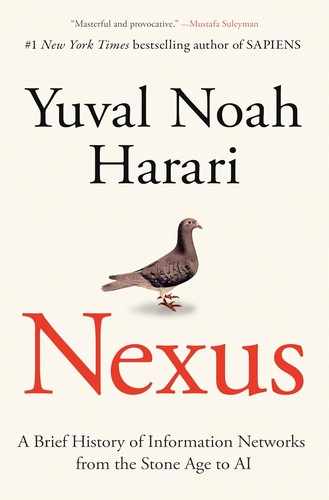
Nexus
Yuval Noah Harari
★★★★★4.6/5
Harari zooms out from “how to use AI” to “what information networks do to civilizations” — and the view is unsettling.
Nexus is less a productivity book than a warning label for everything else on this list. Harari’s argument — that every information technology from writing to print to algorithms has reshaped power before anyone agreed on the rules — reframes AI not as a tool on your desk but as the latest link in a chain that has repeatedly outpaced human wisdom. It’s the broadest, most historically grounded book here, and the one most likely to change how you think about the stakes rather than the shortcuts. Pair it with Co-Intelligence for the full picture: how to use AI well, and why it matters that we do.
Best for: Readers who want the 10,000-year context before they trust the technology

Co-Intelligence
Ethan Mollick
★★★★★4.8/5
The single best starting point for actually using AI well — practical, funny, and free of hype or doom.
No book on this list will change your Tuesday morning faster. Mollick, a Wharton professor who has spent years testing large language models against real business tasks, distills the practical rules of working with AI into four heuristics: invite AI to the table, keep a human in the loop, treat it like a person while remembering it isn’t one, and assume today’s model is the worst you’ll ever use. What separates it from the wave of “AI for business” books that followed is that Mollick actually ran the experiments — on students, on consultants, on himself — and reports what worked. This is the book that turns AI from a curiosity into a daily tool.
Best for: Anyone who wants to use ChatGPT or Claude better starting this afternoon, not in theory
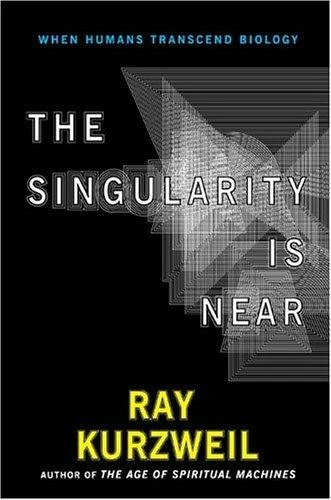
The Singularity Is Near
Ray Kurzweil
★★★★☆4.4/5
The foundational case for exponential technological change — the book that put the Singularity on the map two decades before the rest of the field caught up.
Kurzweil’s Law of Accelerating Returns reframes how progress compounds: not by adding steadily but by doubling on a shrinking cycle, one paradigm replacing the last before it plateaus. The book’s Six Epochs framework and its GNR (genetics, nanotechnology, robotics) convergence argument still shape how the field talks about long-range AI timelines, and its 2029 and 2045 predictions remain reference points two decades later. Denser than the newer titles on this list, but no book on exponential technology carries more historical weight.
Best for: Readers who want the original, most rigorous version of the exponential-technology argument, footnotes included
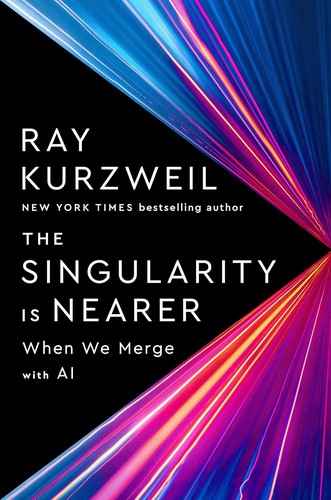
The Singularity Is Nearer
Ray Kurzweil
★★★★☆4.4/5
Kurzweil’s 2024 update revisits his 2005 predictions with two decades of new data — and argues AGI arrives by 2029, with a full human-AI merger by 2045.
This is the most directly testable timeline on the list: Kurzweil ties his 2029 and 2045 dates to measurable curves in compute, genome-sequencing cost, and model benchmarks rather than intuition. It’s also the rare Singularity book with a personal roadmap attached — the Three Bridges framework turns “the future is coming” into a health plan you can start this week.
Best for: Anyone who wants a specific, falsifiable AI timeline instead of general commentary — and a reason to take their own longevity seriously today
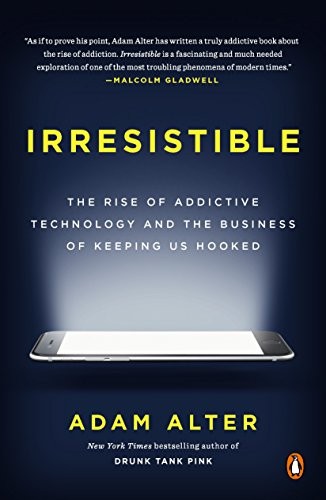
Irresistible
Adam Alter
★★★★☆4.6/5
Alter breaks down the six design ingredients — goals, feedback, progress, escalation, cliffhangers, social interaction — that turn ordinary apps and games into hard-to-quit habits.
This is the clearest field guide to why modern tech feels compulsory rather than optional: Alter reverse-engineers the same behavioral-design toolkit product teams use, then hands it back so you can redesign your own environment. It pairs naturally with the more academic entries on this list by staying practical — friction, defaults, and a 7-day plan you can start today.
Best for: Anyone who wants to understand why they can’t put their phone down — and a concrete toolkit to change that
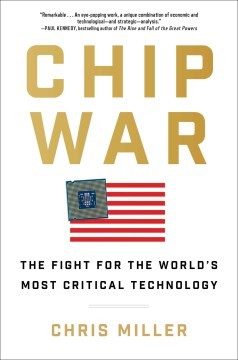
Chip War
Chris Miller
★★★★★4.6/5
Miller traces how semiconductors became the resource nations now compete over — from Cold War origins to Taiwan’s silicon shield and the 2022 US-China export controls.
This is the essential context book for understanding what actually powers the AI race: not just algorithms, but the handful of chokepoints — ASML’s EUV monopoly, TSMC’s manufacturing dominance — that decide who can build frontier AI at all.
Best for: Anyone who wants to understand the hardware and geopolitics underneath every AI headline
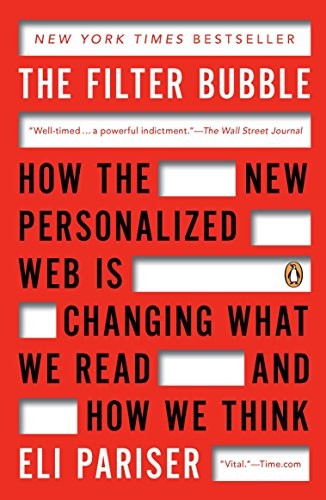
The Filter Bubble
Eli Pariser
★★★★☆4.5/5
Pariser coined the term “filter bubble” to describe how personalized search and social algorithms quietly build a unique, narrowing information universe around every user.
The founding text on algorithmic curation — essential context for why every AI-powered feed and assistant since has had to reckon with the tradeoff between relevance and a healthy, shared information diet.
Best for: Anyone who wants to understand why their feed feels like an echo chamber, and four small habits to widen it back open
How to Choose Your First AI Book
Not sure where to begin? Match the book to what actually brought you here — one book applied beats ten books skimmed.
Still unsure? Preview any book with our free in-depth summaries — test-drive the ideas in fifteen minutes before committing to three hundred pages.
Recommended Reading Paths
Not sure where to start? Pick the path that matches why you’re here.
🌱 The Beginner’s Path
Just starting to explore AI? Read these five in order.
🧠 The Safety & Alignment Path
Want to understand the risk arguments properly? This sequence goes from accessible to rigorous.
💼 The Business & Strategy Path
Trying to figure out what AI means for your work or company?
More Top-Rated Books
High-scoring AI books just outside the top 22.
 Hello World
Hannah Fry
★★★★☆ 4.3
 The Big Nine
Amy Webb
★★★★☆ 4.1
 Power and Prediction
Agrawal, Gans & Goldfarb
★★★★☆ 4.2
 AI 2041
Kai-Fu Lee & Chen Qiufan
★★★★☆ 4.3
 The Inevitable
Kevin Kelly
★★★★☆ 4.2
 The New Breed
Kate Darling
★★★★☆ 4.1
 Artificial Unintelligence
Meredith Broussard
★★★★☆ 4.0
 Novacene
James Lovelock
★★★★☆ 3.9
 Empire of AI
Karen Hao
★★★★☆ 4.4
 Deep Medicine
Eric Topol
★★★★☆ 4.2
 Machine, Platform, Crowd
Brynjolfsson & McAfee
★★★★☆ 4.1
 The Age of Surveillance Capitalism
Shoshana Zuboff
★★★★☆ 4.2
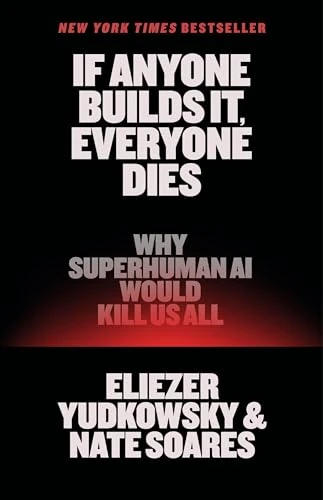 If Anyone Builds It, Everyone Dies
Yudkowsky & Soares
★★★★★ 4.5
 Gödel, Escher, Bach
Douglas Hofstadter
★★★★★ 4.7
 The Mythical Man-Month
Frederick P. Brooks Jr.
★★★★★ 4.5
 Amusing Ourselves to Death
Neil Postman
★★★★★ 4.6
Browse All Technology Summaries →
The Authors Behind These Books
The researchers, founders, and thinkers shaping how we understand AI.
Best Books by Category
Ready to go deeper on one area? Each category page ranks the best books on that topic — all with free summaries.
How We Rank: The 5-Point Rubric
Every book on The Growth Reads is evaluated against five weighted criteria. This isn’t a popularity contest — it’s a rubric designed to surface the books that actually change how people think about and use AI.
Lasting Impact
Does this book change how you think or work months and years later, or just during a motivated weekend?
Evidence Quality
Is the argument grounded in research, real experiments, and verifiable data — or just anecdotes and predictions?
Practical Application
Can you start applying the ideas today, or is it a purely theoretical read?
Writing & Originality
Is it well-written, engaging, and does it bring something new to a crowded conversation?
External Consensus
How do AI researchers, reviewers, and the broader reading community rate this book?
We re-evaluate rankings annually as new books publish and the field moves — few topics date faster than AI. Where a free in-depth TGR summary exists, it’s linked from the card above. Read the full methodology →
Frequently Asked Questions
What is the #1 best AI book to read?
Based on our five-criteria rubric — lasting impact, evidence quality, practical application, writing, and expert consensus — Co-Intelligence by Ethan Mollick is our #1 pick. Unlike more philosophical or cautionary AI books, it gives you an immediately usable framework — four simple rules — for working with AI tools well, backed by Mollick’s own classroom and business experiments rather than theory. Read our full Co-Intelligence summary →
What AI books are most recommended within the AI research community?
Researchers and technologists tend to split into two camps. On the safety side, Human Compatible by Stuart Russell (who co-authored the field’s standard textbook) and Superintelligence by Nick Bostrom are the most frequently cited foundational texts. On the applied side, Co-Intelligence by Ethan Mollick and Prediction Machines by Agrawal, Gans, and Goldfarb are the most commonly recommended for understanding how AI actually gets used in practice.
Is Co-Intelligence a good first AI book?
Yes — Co-Intelligence is one of the best possible starting points precisely because it’s practical rather than theoretical. Ethan Mollick doesn’t ask you to first understand transformer architecture or alignment theory; he gives you four rules for working with AI tools today and shows his own experiments testing them. Once you’ve built a working relationship with the tools, books like The Alignment Problem or Nexus give you the deeper context for what you’re actually using.
What’s the best AI book for complete beginners?
You Look Like a Thing and I Love You by Janelle Shane is the most accessible entry point — it’s genuinely funny, requires no technical background, and teaches AI’s real limitations through her own hands-on neural network experiments. For beginners who want something more directly useful in daily work, Co-Intelligence is the better next step.
How many AI books should I actually read?
We recommend 3–4, chosen deliberately rather than by popularity. Pair one practical/applied book (Co-Intelligence or Prediction Machines) with one on risk and safety (Human Compatible or The Alignment Problem) and one big-picture book (Nexus or Life 3.0). Reading five AI-safety books in a row, or five business books in a row, gives you a narrower view than reading one from each lane.
Should I read the AI-safety books or the AI-business books first?
Start with whichever matches why you’re reading at all. If you want to use AI better in your own work, start with Co-Intelligence or Prediction Machines. If you’re more concerned with where the technology is headed and what could go wrong, start with The Alignment Problem — it’s the most readable entry point into the safety literature, with Human Compatible and Superintelligence as the more technical follow-ups.
Are AI books already outdated given how fast the field moves?
Partially, and it depends on the book. Titles focused on a specific model’s exact capabilities age fast. But the books on this list that focus on frameworks rather than snapshots — Co-Intelligence’s four rules, Prediction Machines’ economic lens, Human Compatible’s alignment argument — have held up because they describe how to think about AI rather than what any one model can currently do.
Co-Intelligence vs Human Compatible — which should I read first?
They serve different purposes. Co-Intelligence teaches you how to actually work with today’s AI tools — prompting, delegation, workflow — and is the more immediately useful read. Human Compatible steps back to ask a harder question: how do we make sure increasingly capable AI systems stay correctable and aligned with what we actually want? Read Co-Intelligence first for practical value this week; read Human Compatible first if the safety question is what brought you here.
What is the best short AI book?
You Look Like a Thing and I Love You by Janelle Shane is the shortest, most accessible read on this list, and it doesn’t sacrifice substance for brevity. For a short, punchy safety-focused read, Scary Smart by Mo Gawdat covers a lot of ground without becoming a textbook.
Is Nexus by Yuval Noah Harari really about AI?
Only partly, and that’s intentional. Nexus spends most of its pages on the history of information networks — writing, print, bureaucracy, propaganda — before arriving at AI as the latest and most consequential entry in that story. If you want a book focused specifically on AI, look to Co-Intelligence or The Coming Wave instead; read Nexus if you want the deeper historical argument for why this moment matters more than the last one.
How we analyze books: Every book on The Growth Reads is read cover to cover, summarized in 3,000–4,000 words of original analysis, and rated against our five-criteria rubric (lasting impact, evidence quality, practical application, writing & originality, external consensus). Rankings are reviewed annually — few topics move faster than AI. We never use AI-generated summaries — every word is human-curated.
Read the full methodology →
Hooked
Nir Eyal
★★★★☆4.5/5
Eyal’s Trigger-Action-Reward-Investment loop explains why some products become daily habits and others get deleted after one use — the field manual behind most of the apps on your home screen.
This is the clearest playbook for the mechanics of habit-forming design, paired with a genuine ethics check (the Manipulation Matrix) that most growth-hacking books skip entirely.
Best for: Product managers, designers, and founders building anything people are meant to use repeatedly
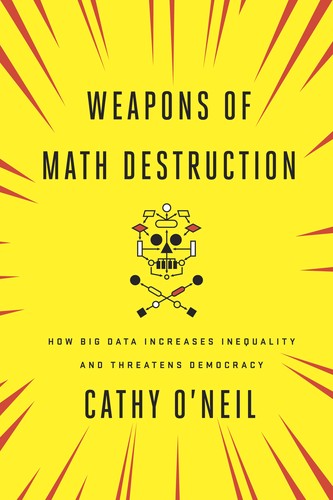
Weapons of Math Destruction
Cathy O’Neil
★★★★★4.6/5
O’Neil’s toxic-triad framework — opacity, scale, damage — is the clearest field guide yet to spotting the algorithms quietly deciding your credit, your job prospects, and your sentence.
A former Wall Street quant turned algorithmic-accountability advocate, O’Neil pairs real WMD case studies (teacher scoring, recidivism risk, hiring filters, credit and insurance pricing) with a short, repeatable checklist for telling a fair model from a dangerous one.
Best for: Managers, developers, and policy readers who want a practical framework for auditing any system that scores people
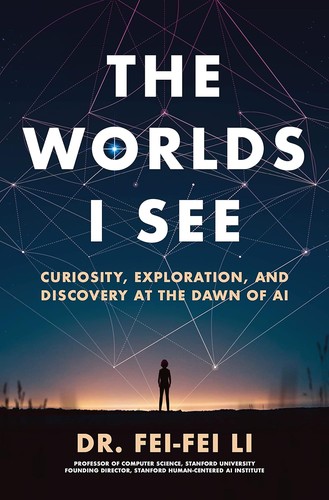
The Worlds I See
Fei-Fei Li
★★★★☆4.7/5
Li’s own account of building ImageNet — the dataset behind AlexNet’s 2012 breakthrough — braided with her immigrant childhood, told with rare candor about what the work actually cost.
This is the AI history book written by someone who was actually in the room, not a journalist’s reconstruction: Fei-Fei Li’s firsthand account of betting years on a dataset nobody else believed in. It’s also a rare AI book grounded in a hopeful, values-first argument — human-centered AI — backed by the institute she built to make it real.
Best for: Readers who want the human story behind the deep-learning boom, immigrants and aspiring scientists, and anyone drawn to a hopeful, values-driven case for AI

Algorithms to Live By
Brian Christian & Tom Griffiths
★★★★½4.6/5
The book that proves everyday decisions have mathematically provable right answers — from the 37% rule for apartment-hunting to why your messy desk might actually be optimal.
Christian and Griffiths translate 11 foundational computer science algorithms into practical frameworks for human decisions. The 37% rule, explore/exploit tradeoff, LRU caching, and Bayesian updating stop being abstract and become the sharpest decision-making tools you will find outside a math department. Rigorous, warm, and endlessly applicable.
Best for: Knowledge workers, analytical thinkers, managers, and anyone who wants a principled framework for life’s recurring choices
All Technology Book Summaries on The Growth Reads
65 in-depth summaries & reviews
A World Without Work Summary & Review: Preparing for a Smaller-Work Future
AI 2041 Summary & Review: Ten Visions for Our Future
AI Superpowers Summary & Review: China, Silicon Valley, and What AI Can’t Replace
Amusing Ourselves to Death Summary & Review: Keep a Mind That Can Still Argue
Architects of Intelligence Summary & Review: What 23 AI Pioneers Actually Disagree On
Artificial Intelligence Summary & Review: A Guide for Thinking Humans
Artificial Unintelligence Summary & Review: Why More Computing Power Isn’t the Answer
Atlas of AI Summary & Review: The True Cost Behind Every Query
Automating Inequality Summary & Review: How Algorithms Punish the Poor
Chip War Summary & Review: Why Silicon Chips Now Decide Global Power
Co-Intelligence Summary & Review: How to Actually Work With AI
Deep Medicine Summary & Review: How AI Could Give Doctors Back Their Time
Empire of AI Summary & Review: What AI’s Rise Actually Costs
Genius Makers Summary & Review: The Human Story Behind the AI Boom
Gödel, Escher, Bach Summary & Review: See How Minds Emerge From Loops
Hello World Summary & Review: When to Trust an Algorithm (and When Not To)
Homo Deus: A Brief History of Tomorrow Summary & Review (2026)
Hooked Summary & Review: The Habit Model Behind Every App You Can’t Put Down
Human + Machine Summary & Review: Redesigning Work for the AI Era
Human Compatible Summary & Review: Building AI That Stays on Our Side
Human-Centered AI Summary & Review: Turn Up Automation AND Human Control
If Anyone Builds It, Everyone Dies Summary & Review: Why Superhuman AI Wouldn’t Stay on Our Side
Irresistible Summary & Review: The Six-Ingredient Hook Behind Your Habits
Life 3.0 Summary & Review: What Happens After Superintelligence Arrives
Machine, Platform, Crowd Summary & Review: Three Shifts Reshaping Every Industry
Machines of Loving Grace Summary & Review: The Hidden Fork Behind Every AI Debate
Nexus Summary & Review: Why More Information Doesn’t Mean More Truth
Novacene Summary & Review: Why AI Might Save Earth, Not Destroy It
Our Final Invention Summary & Review: Is Superintelligent AI a Genuine Threat?
Power and Prediction Summary & Review: Redesigning Decisions, Not Just Predictions
Prediction Machines Summary & Review: The Simple Economics of Artificial Intelligence
Rebooting AI Summary & Review: Why Deep Learning Alone Won’t Get Us to Trustworthy Machines
Rise of the Robots Summary & Review: Why Automation Now Threatens Cognitive Jobs Too
Scary Smart Summary & Review: How to Shape What AI Learns From Us
Superagency Summary & Review: What Could Possibly Go Right with AI
Superintelligence Summary & Review: Paths, Dangers, and the Control Problem
Superminds Summary & Review: How People and AI Think Smarter Together
Talking to Robots by David Ewing Duncan Summary & Review
The Age of AI Summary & Review: A New Philosophical Rupture
The Age of Spiritual Machines Summary & Review: Kurzweil’s 1999 Blueprint for the AI Age
The Age of Surveillance Capitalism Summary & Review: How Big Tech Turned Your Life Into a Product
The AI-First Company Summary & Review (2026)
The Algorithmic Leader Summary & Review
The Alignment Problem Summary & Review: Why AI Does What You Say, Not What You Meant
The Attention Merchants Summary & Review: Reclaiming Your Focus
The Big Nine Summary & Review: Who Actually Controls AI’s Future
The Book of Why Summary & Review: How to Think in Causes, Not Just Correlations
The Coming Wave Summary & Review: How to Contain AI Before It Contains Us
The Creativity Code Summary & Review: Can AI Really Create?
The Ethical Algorithm Summary & Review: Building Fairness and Privacy Into Code, Not Policy
The Fourth Industrial Revolution Summary & Review: How Every Industry Is Converging
The Inevitable Summary & Review: 12 Forces Reshaping Our Future
The Master Algorithm Summary & Review: Five Tribes, One Learning Machine
The Mythical Man-Month Summary & Review: Why Extra People Make Late Work Later
The New Breed Summary & Review: What Animals Teach Us About Living with Robots
The Second Machine Age Summary & Review: The Bounty and the Spread of Digital Technology
The Shallows Summary & Review: How the Internet Is Rewiring Your Brain
The Singularity Is Near Summary & Review: Why Kurzweil Thinks 2045 Changes Everything
The Singularity Is Nearer Summary & Review: Kurzweil’s Case for 2029 and 2045
Uncanny Valley Summary & Review: Silicon Valley’s Utopia, From the Inside
Weapons of Math Destruction Summary & Review: How Algorithms Quietly Encode Bias
Weapons of Math Destruction Summary & Review: How Algorithms Quietly Punish the Poor
Working with AI Summary & Review: What 29 Real Deployments Actually Prove
You Look Like a Thing and I Love You Summary & Review: What AI’s Funniest Failures Teach Us

The Coming Wave
The most authoritative insider account of why AI containment is the defining challenge of our era — written by the co-founder of DeepMind.
Suleyman argues that AI and synthetic biology are arriving simultaneously as general-purpose, rapidly cheapening technologies. The containment problem — how to capture their benefits while preventing catastrophic misuse — has no easy answer, but his ten-step framework offers a credible starting point. Essential reading for anyone shaping policy, products, or organisations in an AI-accelerated world.
Best for: Policy thinkers, technology leaders, concerned citizens.