

★★★★½ (4.5/5) — Malone’s clearest case yet that hyperconnected people and computers, organized well, out-think any individual mind, human or AI.
Best for: Managers, team leads, and builders designing how people and AI actually work together.
Reading time: ~6 hrs to read the book · 12 min for this guide
Difficulty to apply: Moderate — the four-genes framework is simple, but redesigning how a real team or org runs takes deliberate effort.
Superminds in one minute
The smartest thing in the room usually isn’t a single genius — it’s a well-organized group. Thomas W. Malone, founding director of the MIT Center for Collective Intelligence, argues that hyperconnectivity — cheap networks, smartphones, and now AI — has made it possible to combine people and computers into “superminds”: collective systems that think more effectively than any individual member, human or machine. Every supermind runs on some mix of four basic organizing “genes” — hierarchy, democracy, market, and community — and none of them is inherently superior; the right mix depends on the task. AI’s most valuable role, Malone insists, is augmenting these groups — helping them see more, decide faster, and coordinate at greater scale — not replacing the people inside them. Get the structure wrong, and even the smartest people and the best AI produce a dumb group.
Key takeaways
- Hyperconnectivity is the enabler: cheap, ubiquitous networks and AI let people and computers combine into collective-intelligence systems at a scale that was simply impossible a generation ago.
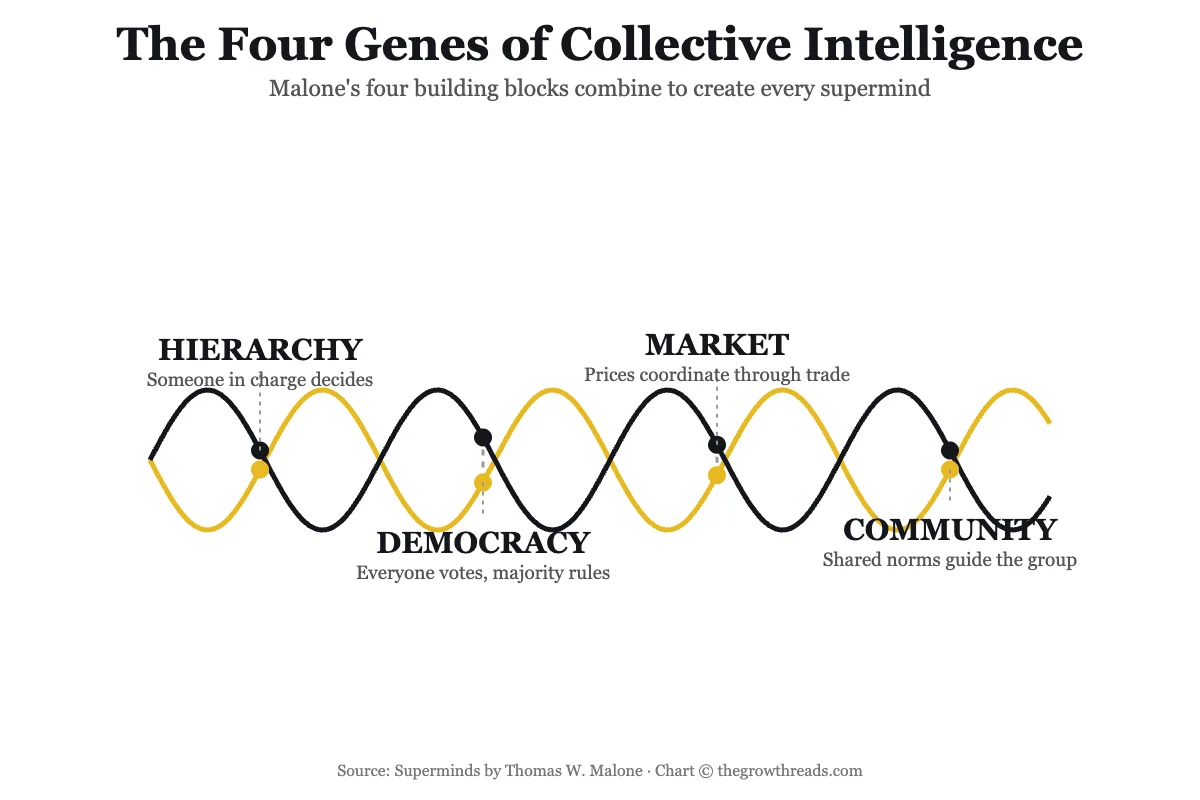
- Every supermind runs on some mix of four “genes”: hierarchy, democracy, market, and community — the basic building blocks of how any group organizes itself.
- No single gene is inherently best: the right structure depends on the task, not on ideology or habit.
- AI’s most valuable role is augmentation, not replacement: the goal is smarter groups, not fewer people in them.
- Groups can be smarter or dumber than their smartest member: smart individuals can still build a dumb group if it’s organized badly.
- Markets and communities already outperform pure hierarchy for some tasks: prediction markets, crowdfunding, and open-source projects are proof.
- The best superminds blend multiple genes at once: a single company might use hierarchy for strategy, an internal market for resource allocation, and community for culture.
- Feedback loops determine whether a supermind learns: without fast, honest feedback, groups repeat the same mistakes at scale.
- Diversity of perspective is a design requirement, not a nice-to-have: collective intelligence research consistently links varied viewpoints to better group decisions.
- Individuals still matter enormously: the framework is about designing how people plug in well — not about people mattering less.
What is Superminds about?
Superminds argues that hyperconnected groups of people and computers can think more intelligently than any individual, including individual AIs. MIT professor Thomas W. Malone maps the four basic ways groups organize — hierarchies, markets, democracies, and communities — and shows how to design smarter, AI-augmented collective intelligence at work and in society.
About the author
Thomas W. Malone is the founding director of the MIT Center for Collective Intelligence and the Patrick J. McGovern Professor of Management at the MIT Sloan School of Management. He has spent more than three decades studying how groups of people — and now people plus computers — can think more effectively together, well before “collective intelligence” became a buzzword. Malone co-edited the influential Handbook of Collective Intelligence and helped launch MIT’s Climate CoLab, a real-world experiment in crowdsourcing climate policy with thousands of volunteers. Unlike many AI commentators, Malone writes as an organizational-design researcher first: his focus is less on what AI models can do and more on how humans, computers, and institutions should be structured to think well together. Explore all Thomas W. Malone book summaries →
Key concepts at a glance
| Concept | What it means | Use it when |
|---|---|---|
| Supermind | A group of people and/or computers acting together in ways that seem intelligent | Evaluating how a team, company, or platform actually makes decisions |
| Hierarchy gene | One person or small group decides for everyone else | Fast, high-stakes decisions need a single accountable owner |
| Democracy gene | Members vote and majority rules | Decisions need broad legitimacy and buy-in |
| Market gene | Prices and trades coordinate independent actors | Resources need to flow to their highest-value use |
| Community gene | Shared norms and identity guide behavior, with no formal vote or price | Long-term culture and voluntary contribution matter more than speed |
| Augmentation | AI expands what a group can perceive, decide, or coordinate, without replacing human judgment | You want a smarter group, not just an automated process |
| Collective intelligence | The measurable “smartness” of a group’s output, independent of its smartest individual | Diagnosing why a group of smart people keeps making mediocre decisions |
| Hyperconnectivity | Cheap, ubiquitous networks connecting billions of people and machines in real time | Understanding why superminds are only possible now, not decades ago |
What Makes a Supermind?
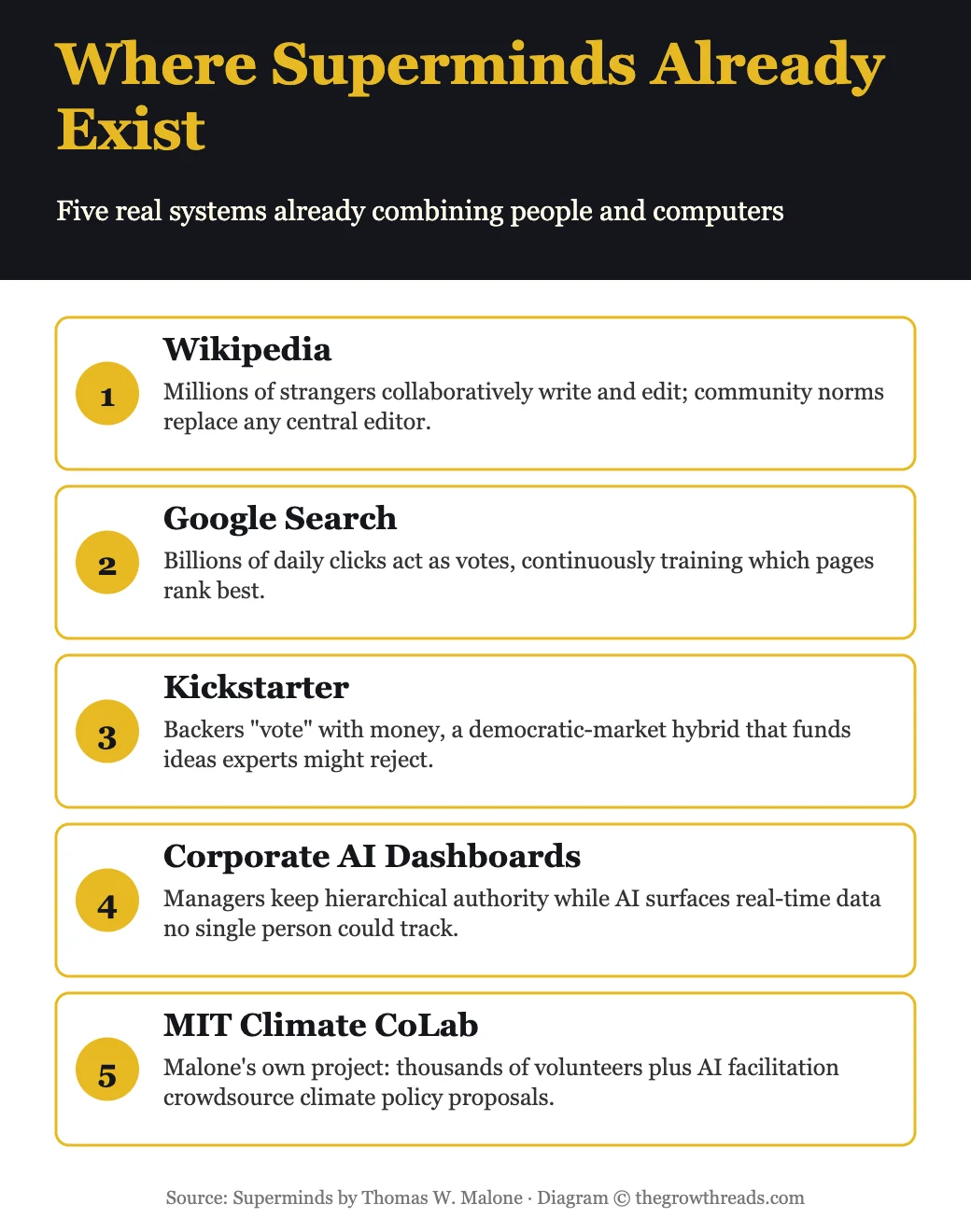
Malone opens with a simple observation: humanity has never been more connected, yet most organizations still think about intelligence the way they did before the internet — as a property of individual brains. He proposes a different unit of analysis: the supermind, any group of people and/or computers acting together in ways that seem intelligent. Corporations are superminds. Markets are superminds. Wikipedia, juries, and even entire nations are superminds. So, increasingly, are the hybrid systems where people work alongside search engines, recommendation algorithms, and now generative AI.
What changed to make this framework urgent, in Malone’s telling, is hyperconnectivity: cheap smartphones, near-universal internet access, and AI systems that can process language and images at a scale no team of humans could match. A century ago, coordinating thousands of people in real time required an army of clerks and a strict chain of command. Today a single API call can coordinate millions of people, sensors, and algorithms simultaneously. Malone’s point isn’t that this connectivity automatically makes groups smarter — Facebook mobs and stock-market flash crashes are superminds too, and not smart ones. The point is that for the first time, we can deliberately engineer group intelligence at a scale and speed that was previously impossible, and that engineering it well requires understanding the handful of organizational patterns every group, ancient or algorithmic, is built from.
The Four Genes of Group Intelligence
Every supermind, Malone argues, is built from some combination of four basic organizing “genes” — his term for the deep structural patterns that recur across human history, long before anyone called them by these names.
Hierarchy is the oldest and most familiar: one person, or a small group, makes decisions for everyone else. Armies, most corporations, and traditional governments run on hierarchy because it is fast and produces clear accountability — but it depends entirely on the judgment of whoever sits at the top, and it can be slow to incorporate information from the edges.
Democracy replaces a single decider with a vote. Elections, juries, and increasingly open-source governance (think Wikipedia’s editorial votes or Python’s steering council) use majority or consensus rules to produce decisions that carry broad legitimacy, even when they move more slowly than a hierarchy would.
Markets coordinate through prices instead of votes or orders. Nobody “decides” the price of wheat or an Uber fare during a surge — millions of independent buyers and sellers, each pursuing their own interest, produce a coordinated outcome nobody designed. Malone highlights prediction markets in particular: pooling many independent, self-interested bets has repeatedly out-forecast individual pundits and even expert panels.
Community is the least formal gene — no vote, no price, just shared norms and identity that guide behavior. Open-source projects, Reddit communities, and Wikipedia’s day-to-day editing culture (as opposed to its formal votes) run largely on community: contributors show up and follow norms because they identify with the group, not because anyone is paying or ordering them to.
The critical move in Malone’s argument is that no gene is inherently superior — each is a tool suited to particular conditions, and the most capable superminds blend more than one at once. A single company might use hierarchy to set strategy, an internal market to allocate compute or budget, and community norms to sustain its culture, all at the same time.
TGR Note: Malone’s four genes pair naturally with Ethan Mollick’s “co-intelligence” framing of human-AI collaboration — where Mollick focuses on how an individual should work with one AI, Malone zooms out to how entire organizations should be structured once many people and many AIs are all in the loop. See our Co-Intelligence summary for the individual-level playbook that complements this book’s organizational one.
Where AI Fits — Augmentation, Not Replacement
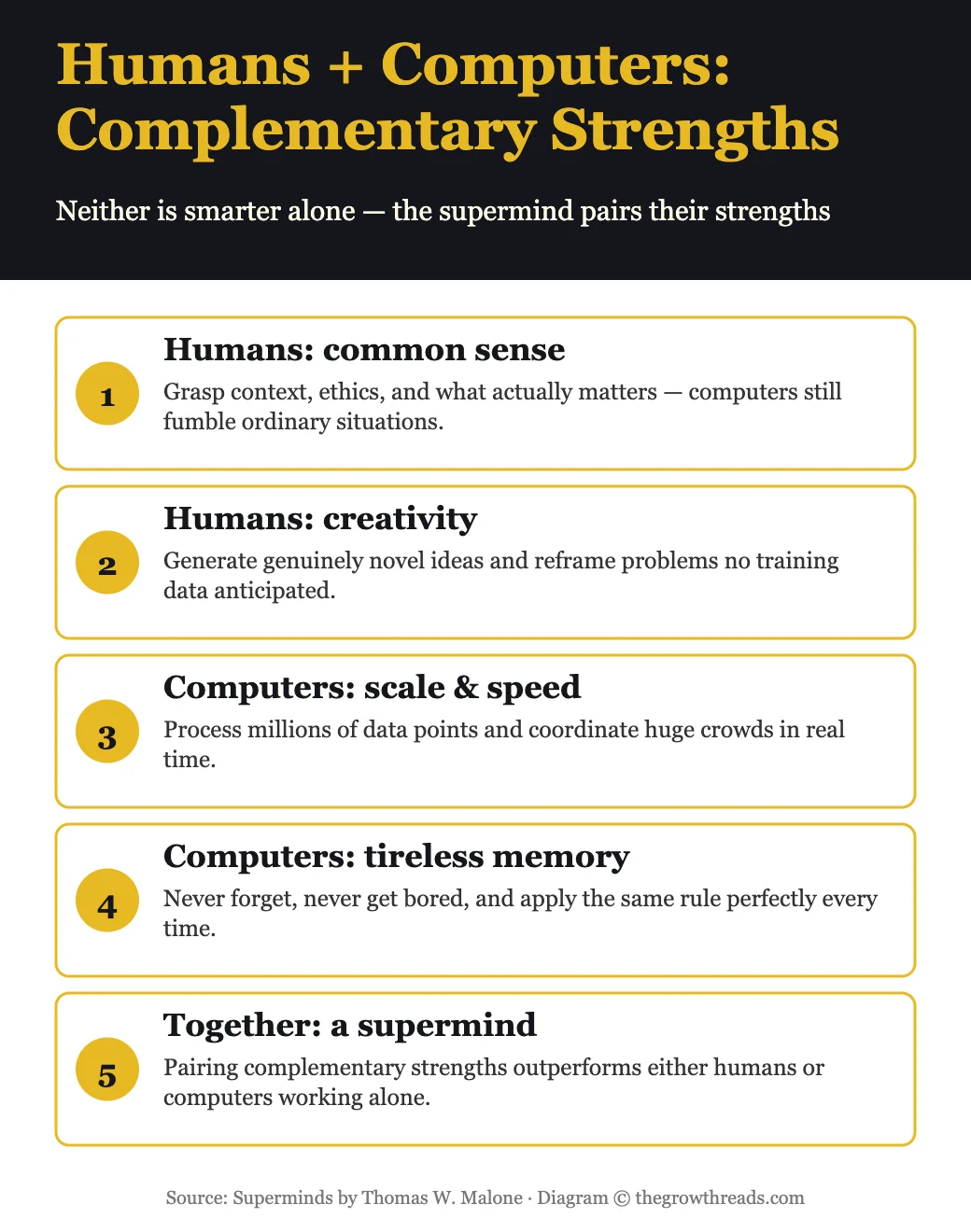
Malone is careful to separate two very different visions of AI’s role in a supermind: automation, where a machine takes over a task a person used to do, and augmentation, where a machine expands what a group of people can perceive, decide, or coordinate without removing them from the loop. His research center’s own Climate CoLab project is his favorite proof of concept: thousands of volunteers submitted climate-policy proposals, and natural-language tools helped organizers cluster, summarize, and route thousands of submissions to the right experts — something no purely human staff could do at that scale, and something no algorithm could do credibly alone, since judging which climate policies were actually promising still needed human expertise and values.
The chess world offers Malone’s clearest historical example. After Deep Blue beat Garry Kasparov in 1997, the assumption was that human chess judgment was obsolete. Instead, “freestyle” or “advanced” chess tournaments — where humans partnered with chess engines — showed that a well-organized human-plus-computer team could beat both a lone grandmaster and a lone supercomputer. The winning teams weren’t the strongest players or the strongest engines; they were the pairs with the best process for combining machine calculation with human strategic judgment. That, in miniature, is Malone’s whole thesis about AI: the technology matters less than the organizational design around it.
He also flags a real risk: because AI tends to concentrate information and decision-making power in whoever controls the model, it can quietly push organizations toward more hierarchy even when a market or community structure would serve them better. A recommendation algorithm that decides what every employee sees is a hierarchy wearing an algorithm’s clothing. Malone’s advice is to design deliberately — to ask, for any given decision, which of the four genes actually fits the task, rather than defaulting to “let the algorithm decide” because it’s available.
TGR Note: This augmentation-not-automation distinction runs through Thomas Davenport and Paul Leonardi’s Human + Machine, which offers a more implementation-focused look at redesigning specific business processes around it. If Malone gives you the “why,” Human + Machine gives you more of the “how.”
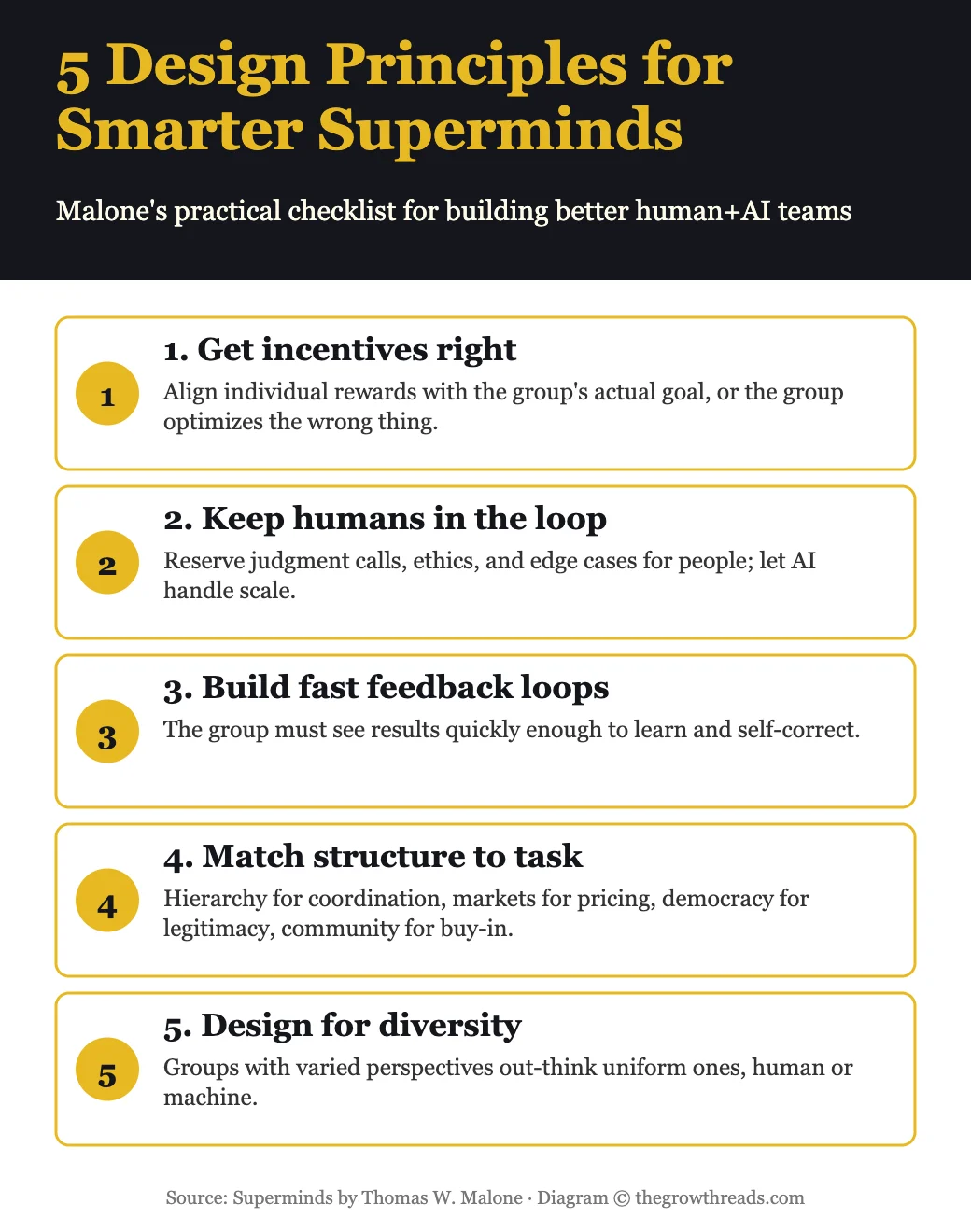
Building Your Own Supermind — Design Principles
The back half of the book turns practical: how do you actually design a supermind, rather than just recognizing one? Malone offers a repeatable sequence rather than a rigid formula. First, get specific about the task — a supermind for allocating scarce resources needs a different gene mix than one for setting long-term culture. Second, map which of the four genes already governs the decision today, often by default rather than by design; most organizations run more hierarchy than the task actually needs, simply out of habit. Third, prototype a change — introduce a market signal, open a decision to a vote, or loosen a rule to let community norms do more of the work — and measure whether the group’s actual output gets smarter, not just faster or cheaper.
He’s equally insistent about the AI layer: augmentation should be added where it removes a real bottleneck (search, summarization, pattern-detection across too much data for people to review) and kept out of decisions that depend on values, trust, or context an algorithm can’t see. A useful test he returns to repeatedly: could you explain, to the people affected by a decision, which gene made it and why? If the honest answer is “the algorithm decided and nobody quite knows how,” that’s a signal the design needs rework, regardless of how good the output looks on a dashboard.
TGR Note: Mike Walsh’s The Algorithmic Leader covers similar ground from a leadership-decision angle — worth pairing with this book if your focus is specifically on how a manager should personally change their habits, rather than how to redesign a team’s structure.
Who is Superminds best for — and who should read something else first?
Superminds rewards readers who manage or design how groups work — team leads, product managers, founders, and anyone building AI features that change how people collaborate. It’s less useful if you want tactical, day-one advice on using an AI chatbot yourself; for that, start with Co-Intelligence. If your interest is specifically the culture and attention costs of always-on connectivity rather than organizational design, Team Human makes a more skeptical companion read. And if you want a step-by-step corporate playbook rather than a framework, pair this with Human + Machine.
Questions to reflect on
- Which of the four genes — hierarchy, democracy, market, community — actually governs your team’s most important recurring decision, and is that the gene the task needs?
- Where in your organization has “the algorithm decided” replaced a decision nobody can now explain?
- What’s one process where adding a market or community mechanism (instead of another layer of approval) might produce a smarter outcome?
- Which of your AI tools are genuinely augmenting a group’s thinking, and which are just automating a task a person used to do alone?
- If you had to explain your team’s decision-making structure to a new hire in one sentence, what would you say — and would Malone agree with your diagnosis?
🔥 Ready to build smarter groups?
Get Superminds and start redesigning how your team — and its AI — actually thinks together.
How to apply Superminds (7-day plan)
- Day 1: Pick one recurring team decision and write down, honestly, which of the four genes currently governs it.
- Day 2: List every AI tool your team touches weekly and mark each one “automates a task” or “augments a decision.”
- Day 3: For one hierarchy-heavy decision, sketch what it would look like with a lightweight vote or market signal instead.
- Day 4: Find one place where “the algorithm decided” is the honest answer to “why did this happen” — flag it for review.
- Day 5: Run a small experiment: open one low-stakes decision to the group via vote or informal consensus instead of a single owner.
- Day 6: Compare the experiment’s outcome to how the decision would normally have been made — smarter, slower, both?
- Day 7: Write a one-page “supermind design note” for your team: which gene mix you’re using for which decisions, and why.
Frequently asked questions
What is the main idea of Superminds by Thomas W. Malone?
Superminds argues that groups of people and computers, organized well, can think more intelligently than any individual — including any single AI. Malone identifies four basic organizing patterns (hierarchy, democracy, market, community) that every group uses in some combination, and argues that AI’s most valuable role is augmenting these groups rather than replacing the people in them. The book is less about what AI can do on its own and more about how to structure the humans, machines, and institutions around it so the whole system thinks well.
What are the four genes in Superminds?
Malone’s four “genes” are hierarchy (one person or small group decides), democracy (majority vote), market (prices and trades coordinate independent actors), and community (shared norms and identity guide behavior with no formal vote or price). Every organization — a company, a government, an open-source project — runs on some blend of these four. No single gene is inherently best; the right mix depends on the task, and the most effective superminds combine more than one gene at once for different decisions.
Is Superminds about artificial intelligence or organizational design?
Both, but Malone’s core lens is organizational design — he’s the founding director of MIT’s Center for Collective Intelligence, not primarily an AI researcher. AI enters the book as one (increasingly important) way to help groups perceive more, decide faster, and coordinate at greater scale. Readers looking for a deep technical dive into how AI models work should look elsewhere; readers wanting to understand how to structure teams and institutions in an AI-augmented world are the right audience.
How is Superminds different from other books about AI and the future of work?
Most AI-and-work books focus on which jobs or tasks AI will automate. Superminds instead asks how any group — with or without AI — should be organized to think well, then treats AI as an addition to that existing toolkit rather than a separate topic. Its practical value is a vocabulary (the four genes) for diagnosing why a group of smart people, human or artificial, is still making mediocre decisions, which is a different and often more useful question than “will AI take this job.”
Does Superminds require a technical or AI background to understand?
No. Malone writes for a general business and policy audience, using accessible examples — chess tournaments, prediction markets, Wikipedia, crowdsourced climate policy — rather than technical AI detail. The four-genes framework is intentionally simple enough to sketch on a whiteboard. Some prior familiarity with how teams and organizations are typically structured helps you map the framework onto your own workplace, but no coding or machine-learning background is assumed anywhere in the book.
What is a real-world example of a supermind from the book?
Malone’s own MIT Climate CoLab is one of his central examples: thousands of volunteers submitted and refined climate-policy proposals online, with natural-language tools helping organizers cluster and route submissions at a scale no small human staff could manage alone, while human judgment still decided which proposals had real merit. He also uses “freestyle chess,” where human-computer pairs beat both solo grandmasters and solo chess engines, as proof that the right combination — not the strongest player or the strongest machine — wins.
Who should read Superminds?
Team leads, product managers, founders, and anyone responsible for designing how a group of people (and increasingly, AI tools) makes decisions together will get the most out of Superminds. It’s a better fit for someone redesigning team or organizational structure than for someone looking for personal, day-to-day tips on prompting an AI chatbot — for that narrower use case, a more tactical book like Co-Intelligence is a better starting point.
Related summaries
- Co-Intelligence by Ethan Mollick
- Human + Machine by Paul R. Daugherty and H. James Wilson
- The Algorithmic Leader by Mike Walsh
- Team Human by Douglas Rushkoff
- Best AI Books — full Technology silo guide
How we analyze books: we read the full text, cross-check every claim, statistic, and example against the author’s original sources and independent reporting, and rate on real-world applicability — not marketing copy. Read our full methodology.
Related Technology Summaries
Human + Machine Summary & Review: Redesigning Work for the AI Era
Irresistible Summary & Review: The Six-Ingredient Hook Behind Your Habits
The Ethical Algorithm Summary & Review: Building Fairness and Privacy Into Code, Not Policy
The Fourth Industrial Revolution Summary & Review: How Every Industry Is Converging
The New Breed Summary & Review: What Animals Teach Us About Living with Robots