

★★★★★ 4.6/5 — The cleanest test in media: if the form must entertain, the public mind gets shallower even when the topic looks serious.
Best for: People who live in news, campaigns, classrooms, or feeds and still want a mind that can finish an argument
Reading time: ~4.5 hrs for the full book · ~14 min for this guide
Difficulty to apply: Easy to quote Huxley; harder to keep one room this week from turning into a show
Amusing Ourselves to Death in one minute
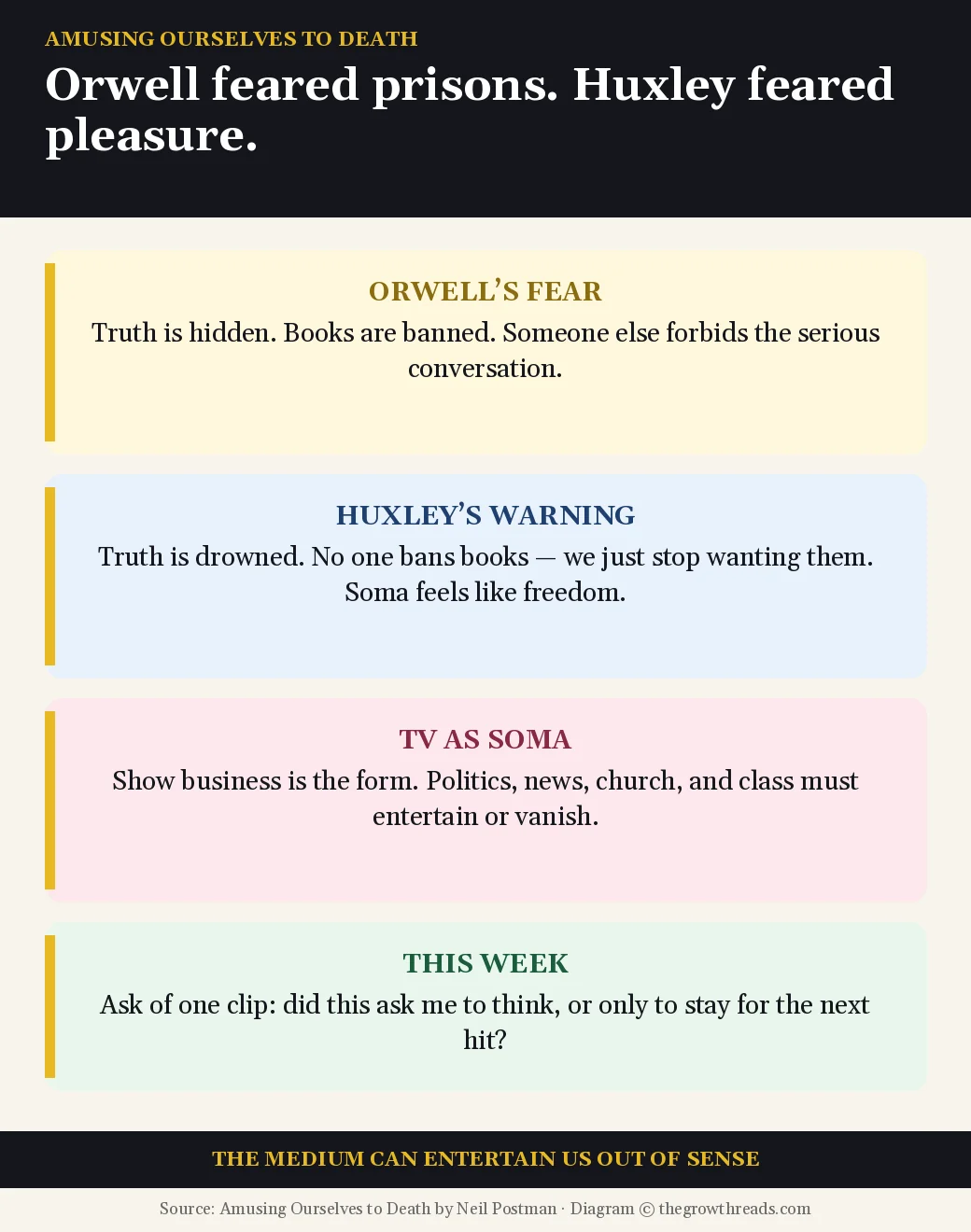
The medium is not a pipe for ideas. It is the idea’s weather. Neil Postman argues that American public talk once lived in typography — long, sequential, propositional — and then moved into television, a form that must amuse or die. Orwell feared that truth would be hidden. Huxley feared that truth would be drowned in pleasure. Postman says we got Huxley’s world: no one needs to ban a book if nobody wants the labour of reading one.
News becomes a peek-a-boo fragment. Religion learns variety-show timing. Politics becomes a look. School starts to treat difficulty as a production error. The point is not to hate screens. It is to stop letting show business set the rules for rooms that still need argument. This summary is a working pass: see the form, then protect one typographic hour this week.
Key takeaways
- Form excludes content: a medium can only carry some kinds of thought. Television carries images, speed, and mood — not sustained argument.
- The medium is the metaphor: we do not just use TV; we start to see politics, school, and faith as shows.
- Typography trained a public: a print culture rewarded sequence, definition, and delayed response. That is a mind you can still practice.
- Telegraph + photography created the peek-a-boo world: distant fragments arrive without a local next step.
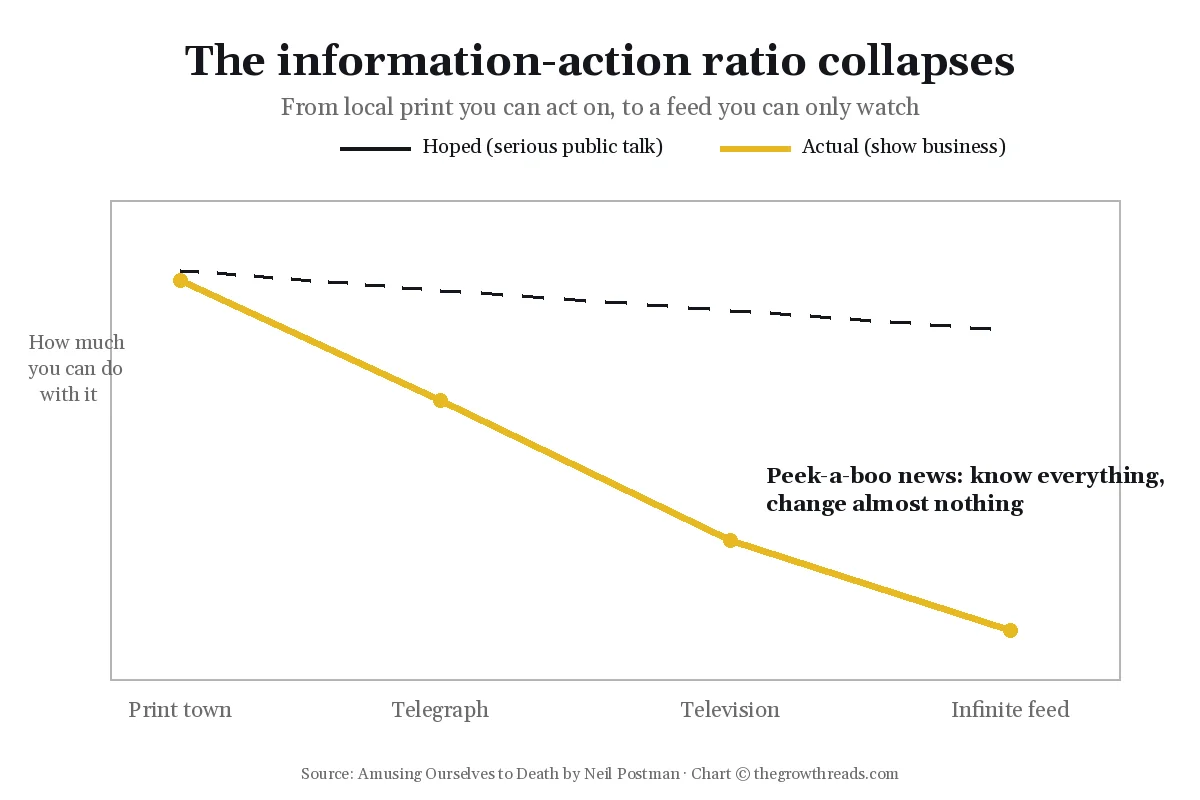
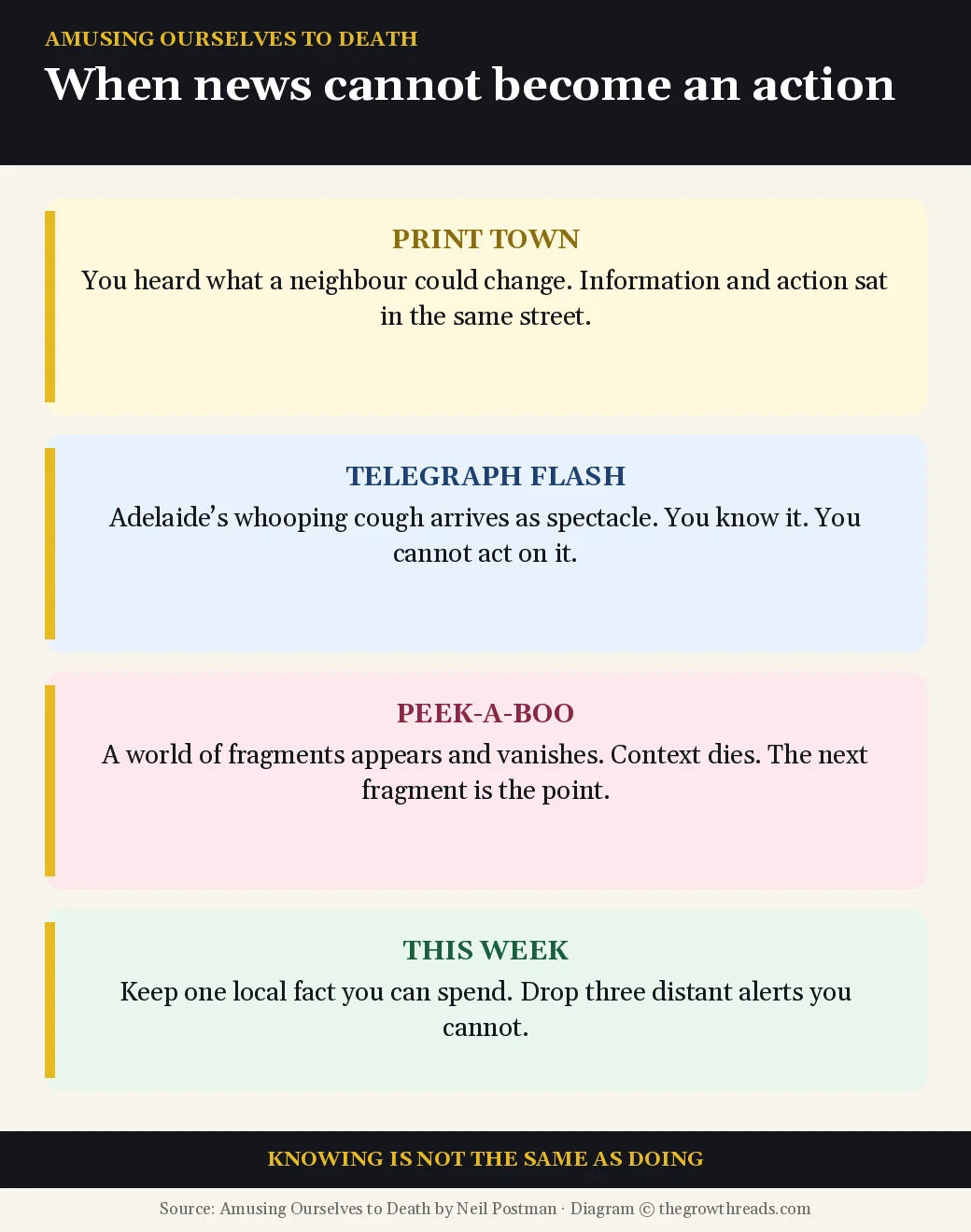
- The information-action ratio collapses: you can know Adelaide’s whooping cough and still have nothing to do. Awareness without a deed is a new kind of helplessness.
- “Now… This” is a moral join: news, disaster, and a commercial share one tone so you will not leave.
- Image politics beats proposition politics: a candidate becomes a face; a debate becomes a clip.
- Education-as-amusement teaches the wrong lesson: that learning should feel like television, so struggle looks like a glitch.
- Huxley, not only Orwell: the danger is that we love the technologies that undo our capacity to think.
- Name the room: entertainment is honest when it admits it. Briefings, classes, and votes need a different form.
What is Amusing Ourselves to Death about?
Amusing Ourselves to Death is Neil Postman’s 1985 account of how television turned American public discourse into show business. He contrasts a typographic culture that could hold argument with an image culture that must entertain, then shows the cost in news, religion, politics, and school — and why Huxley’s warning fits us better than Orwell’s.
About the author
Neil Postman (1931–2003) taught at New York University, where he helped build media ecology as a field: the study of how communication forms shape what a culture can mean. He chaired NYU’s Department of Culture and Communication, held the Paulette Goddard Chair of Media Ecology, and wrote more than twenty books, including Teaching as a Subversive Activity, The Disappearance of Childhood, Technopoly, and The End of Education. Amusing Ourselves to Death (Viking, 1985; Penguin 20th-anniversary edition, 2005, with an introduction by his son Andrew) is the book that still travels. He was not a gadget reviewer. He asked what kind of public a medium is willing to grow — and he wrote so a working adult could use the answer the same week. Explore all Neil Postman book summaries →
Key concepts at a glance
| Concept | What it means | Use it when |
|---|---|---|
| Medium as metaphor | The form teaches us what kind of world this is | A “serious” clip still feels like a show |
| Media epistemology | A culture’s way of knowing follows its way of showing | You trust a face more than a paragraph |
| Typographic mind | Sequence, definition, delayed reply | You cannot finish a page without a ping |
| Peek-a-boo world | Vivid fragments with no context and no next step | You feel informed and strangely unused |
| Information-action ratio | How much of what you know can still become a deed | The alert has no address, date, or task |
| Now… This | A join that resets tone so you never have to stay | Famine sits next to a joke and a sale |
| Image politics | The look replaces the proposition | You can describe the face, not the claim |
| Huxleyan warning | Pleasure, not a prison, undoes the public mind | You would rather be amused than briefed |
Part 1: The medium is the metaphor — form sets what can be thought
Postman opens by refusing the polite story that media are neutral pipes. A clock is not an innocent way to tell time; it is a way to think that time is chunks you can spend. A television set is not an innocent way to show a speech; it is a way to think that public life is something you watch. McLuhan said the medium is the message. Postman tightens it: the medium is the metaphor. We do not merely receive content through a form. We start to describe the rest of life in that form’s language.
That is why he spends so long on epistemology — a dry word for a practical question: what counts as knowing here? In a courtroom, a transcript counts. In a lab, a method counts. On television, a look counts. You can put a physicist on a talk show, but the show will still reward charm, speed, and a memorable image. The physicist has not failed. The form has hired them as a performer. Once you see that hire, you stop asking “was that true?” as the first question and start asking “what kind of truth can this room even hold?”
The Orwell/Huxley fork is the week’s handle. Orwell’s nightmare is a banned book. Huxley’s is that nobody wants the book because soma is easier. If your public rooms run on pleasure and discontinuity, you are in Huxley’s weather even when every clip is labelled news.
TGR Note: Nicholas Carr’s The Shallows is the neural sequel: the net does not only amuse, it trains skimming. Read Postman for the public form, Carr for the private attention it leaves behind. If the “show” is actually a business buying your gaze, Tim Wu’s The Attention Merchants names the invoice.
Part 2: Typographic America and the peek-a-boo world
The middle of the book is a contrast, not nostalgia. Postman reconstructs a United States in which public talk was written and then spoken as writing: pamphlets, sermons that could be read, the Lincoln–Douglas debates that ran for hours while crowds stood and followed propositions. That culture had vices. It also had a muscle: people expected an argument to have a beginning, definitions, and a delayed reply. A typographic mind is not smarter. It is more sequential. You can train it this week by finishing one long piece before you grant yourself a fragment.
Then the telegraph arrives, and with it the “news of the day” — a pile of facts whose main quality is that they just happened, somewhere. Photography adds the decontextualised image. Together they invent a peek-a-boo world: things appear, dazzle, and vanish. You know a fire two time zones away and you cannot cool it. Postman calls the mismatch the information-action ratio. When the ratio was tight, hearing news often implied a meeting, a vote, a visit. When the ratio collapses, you become a consumer of events. Helplessness wears the costume of being informed.
This is the most transferable chapter for a phone. The feed is telegraphy without a stop time. The move is not “read less forever.” It is: keep facts that still have a local next step, and let distant spectacle starve. One neighbourhood item you can attend beats twelve international alerts you can only rank.
TGR Note: Eli Pariser’s The Filter Bubble is the algorithmic cousin of peek-a-boo: fragments chosen for you, still without a deed. Yuval Noah Harari’s Nexus asks what happens when networks multiply information faster than truth. Postman is the older, simpler test you can run tonight: does this item have an action sitting next to it?
Part 3: News, religion, politics, and school as show business
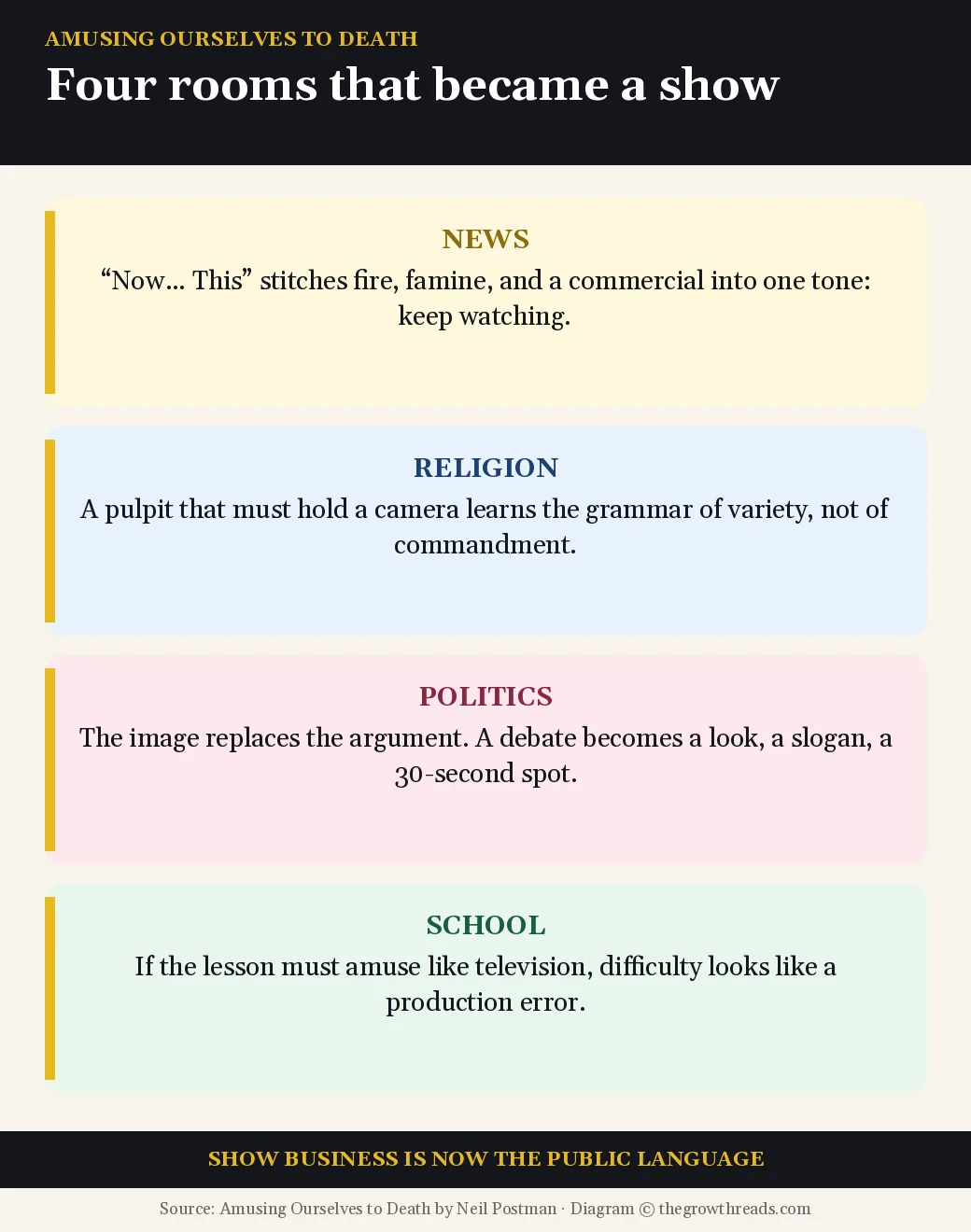
Part II of the book walks through the rooms that surrendered to entertainment’s demands. News is the clearest. A program must hold you across a fire, a famine, a joke, and a commercial. The verbal stitch is “Now… This.” It is not a transition. It is a moral reset: nothing you just saw is allowed to remain heavy enough to change your evening. The practical catch is to refuse the stitch. If you watch a briefing, watch one story to the end and write what it asks of you. If it asks for nothing, it was a show. Say so.
Religion on television, Postman says, learns the grammar of variety — intimacy with a camera, a smile that reads at a distance, a clock that cannot abide silence. He is not scoring anyone’s faith. He is noting that commandment and entertainment are different forms, and the camera will hire the second. Politics follows: the image replaces the proposition. A debate becomes a look. A 30-second spot is not a short speech. It is a different object, built to feel rather than to define. School is the unkindest room, because Sesame Street and its heirs taught that learning should feel like television. Difficulty then looks like bad production. A typographic classroom can still use a clip. It cannot let the clip set the standard for what counts as knowing.
Read this part as a facilities list. You do not have to reform the industry. You have to stop importing show-business rules into the one meeting, class, or vote you actually run.
TGR Note: Shoshana Zuboff’s The Age of Surveillance Capitalism explains who profits when attention is the product. Adam Alter’s Irresistible and Nir Eyal’s Hooked describe the small hooks inside the show. Postman is still the frame: before you tweak a cue, ask whether the whole room should have been a show at all.
Part 4: The Huxleyan warning — how to stay a typographic mind
The last chapter is the reason to read the book instead of a thread about the book. Postman does not offer a five-step detox. He offers a stance: we will not be saved by better content on a form that cannot carry seriousness. Americans, he writes in spirit, will amuse themselves to death if they do not notice the weather. Andrew Postman’s later introduction restates that warning for a world that already had the internet. The feed did not refute the book. It scaled the peek-a-boo world to a pocket.
What you can do is smaller than a crusade. Name entertainment as entertainment — then enjoy it on purpose. Protect one typographic hour: paper or a long file, a start and a stop, no “Now… This.” Ask of each public clip whether it increased your information-action ratio or only your sense of being in the know. Teach one thing this week without a video as the spine. Vote, donate, show up, or write a letter about one local fact. Huxley’s soma weakens when even one room still requires a sentence with a verb you will perform.
Not a lament for 1858. A weekly design choice about form.
Who is Amusing Ourselves to Death best for — and who should read something else first?
Read this first if you work in news, teaching, campaigns, ministry, or any feed-shaped job, and you can feel your public talk getting shorter while your alerts get louder. It is 208 pages. You can finish it on a weekend and run the seven-day plan the same week.
Read something else first if you need the internet’s effect on the reading brain — start with Carr’s The Shallows. If your problem is the industry that rents your eyes, start with Wu’s The Attention Merchants. If the hooks themselves have you, Alter’s Irresistible is the mechanics manual, then return. If you came for AI control rather than media form, Bostrom is a different silo. Postman will still wait; he is short on purpose.
Questions to reflect on
- Which room in my week (news, class, meeting, worship) is currently run as a show while pretending to be a briefing?
- What is one fact I consumed yesterday that had no possible action attached?
- When did I last follow a public argument for more than twenty minutes without a stitch to something else?
- If I muted the pictures, what claims would still be left?
- What would a typographic hour look like on tomorrow’s calendar — start, stop, and one sentence I will do?
🔥 Ready to keep one room from turning into a show?
Get Amusing Ourselves to Death and start reading.
How to apply Amusing Ourselves to Death (7-day plan)
- Day 1 — Name the form. Watch or scroll one “serious” clip twice: once as content, once as show. Write whether it asked you to think or only to stay.
- Day 2 — One typographic sitting. Read twenty pages of Postman (or one long reported piece) with the phone in another room. Write the claim in a sentence.
- Day 3 — Mute the pictures. Play a political or news clip with sound off, then with picture off. Note which version still has propositions.
- Day 4 — Kill “Now… This.” Batch news once. Stay with a single story until you can name a deed or honestly say there isn’t one.
- Day 5 — Local ratio. Pick one neighbourhood fact with an address and a next step. Ignore three distant alerts. Do the step or schedule it.
- Day 6 — Teach without a show. Explain one idea to a colleague or child using only talk and a page. No clip as the spine.
- Day 7 — Write 400 words. One public issue, beginning-middle-end, before any feed. Then decide which rooms this week stay entertainment on purpose.
Frequently asked questions
What does Postman mean by “Now… This”?
It is the grammar of a news show that can jump from famine to a commercial to a celebrity without changing tone. The phrase tells you the last item is closed and the next item is already entertainment. Nothing is allowed to stay long enough to become an argument, a duty, or a memory you could act on. Once you hear the join, you can catch it in a feed: the swipe that resets the mood. The practical move is to refuse the join for one hour and stay with a single public question until you can say what it asks of you.
Is Amusing Ourselves to Death still useful after the internet?
Yes, because Postman diagnosed a form, not a gadget. Television taught public life to amuse; the phone and the feed intensified the same peek-a-boo world. Nicholas Carr later mapped the neural half of that shift in The Shallows. You do not need to pretend 1985 predicted every app. You need the test: does this medium reward sequence and memory, or only the next hit? If the latter, treat it as show business even when the topic is serious. That test still sorts a homepage, a briefing, and a classroom clip.
What is the information-action ratio?
It is Postman’s name for how much of what you learn can still become a deed. In a print town, news was local enough that hearing it often implied a meeting, a vote, a visit, or a letter. The telegraph and then television poured in distant fragments you could not spend. A high pile of unusable facts feels like awareness and behaves like helplessness. The week’s fix is small: keep one fact that has an address, a date, and a next step. Let three viral items die without a share.
What is a “peek-a-boo world”?
A culture whose public knowledge appears and vanishes like a game of peek-a-boo: vivid, brief, and unconnected. Telegraphy began it; television perfected it; the infinite feed industrializes it. You are not failing at memory so much as swimming in a form that punishes memory. To leave the game, require context before you consume. Who is speaking, over what span, and what would a serious reader do next? If those answers are missing, you are being shown a fragment, not briefed.
Who should read Amusing Ourselves to Death first?
Anyone who lives inside news, campaigns, classrooms, or pulpits that now have to compete with entertainment — and anyone who feels informed yet oddly unable to finish a thought. It is short, clear, and built for a working week. If your problem is specifically phone addiction mechanics, start with Irresistible, then come back. If your problem is the business that buys your gaze, read The Attention Merchants alongside. If you want AI control rather than media form, Superintelligence is a different book.
How long does it take to read, and is there an audiobook?
The Penguin anniversary paperback is about 208 pages. Most readers finish in four to five hours; this guide is a fourteen-minute working pass. Andrew Postman’s 2005 introduction is worth the extra sitting because it restates the Huxley warning for a world that already had the web. An Audible edition exists; listen with a pen. The book’s point is typographic: you need to hold a sequence. If audio is how you start, pause after each chapter and write the claim in one sentence before you press play again.
How do I apply the book without quitting every screen?
Postman is not asking you to smash the television. He is asking you to stop letting show business set the rules for rooms that need argument: news you will act on, teaching, worship, and politics. Pick one room this week. Give it print-like conditions — a start, a finish, no peek-a-boo join, a question that can be answered in sentences. Leave the other rooms as entertainment on purpose. Named entertainment is honest. Entertainment that pretends to be a briefing is the trap the book exists to catch.
Related summaries
- The Shallows — what the net does to the reading brain after the show ends.
- The Attention Merchants — who buys the gaze that entertainment organises.
- The Age of Surveillance Capitalism — the extraction layer under the peek-a-boo feed.
- Irresistible — the small hooks inside a form that must amuse.
Browse every title in our Best AI Books pillar page.
How we analyze books: our summaries are built from a full read of the source text, cross-referenced against the author’s published interviews and research where relevant, and structured around practical application rather than critique. We disclose our editorial process and affiliate relationships in full. Read our full methodology.