

★★★★★ 4.6/5 — the most practical field guide to why your phone feels impossible to put down.
Best for: Anyone who checks their phone without meaning to, and parents or product people who want the design playbook behind the habit.
Reading time: ~6 hrs to read the book · ~15 min to read this guide.
Difficulty to apply: Moderate — most fixes are single settings changes, but building new defaults takes one to two weeks.
Irresistible in one minute
Your phone isn’t winning by accident — it’s winning by design. In Irresistible, NYU psychologist Adam Alter argues that the same reward circuitry that drives substance addiction can be hijacked by ordinary products: apps, games, social feeds, even fitness trackers. He calls this “behavioral addiction,” and he traces it to six specific design ingredients — goals, feedback, progress, escalation, cliffhangers, and social interaction — that engineers stack deliberately to keep you coming back. The good news buried in the bad news: because the hook is engineered, it can be re-engineered. Alter spends the second half of the book showing how individuals, parents, and companies can use the same toolkit — plus a healthy dose of friction — to break unwanted habits and build better ones.
Key takeaways
- Behavioral addiction is real and measurable: it hijacks the same dopamine-driven reward circuitry as substance addiction, without any chemical involved.
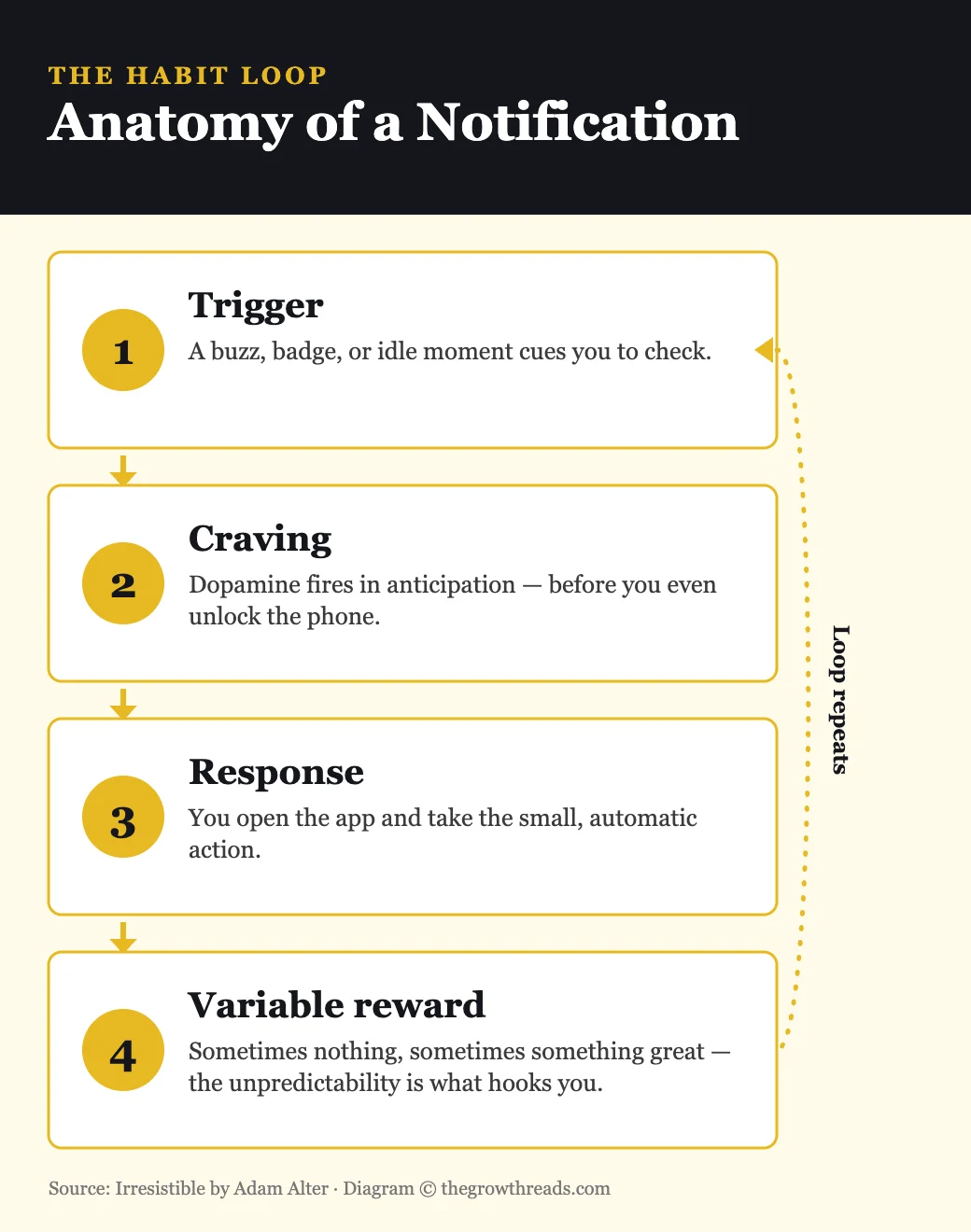
- Dopamine fires on anticipation, not reward: the craving hits before you even unlock your phone, which is why “just one check” rarely stays at one.
- Six ingredients build a habit-forming product: goals, feedback, progress, escalation, cliffhangers, and social interaction — stack more of them and the pull gets stronger.
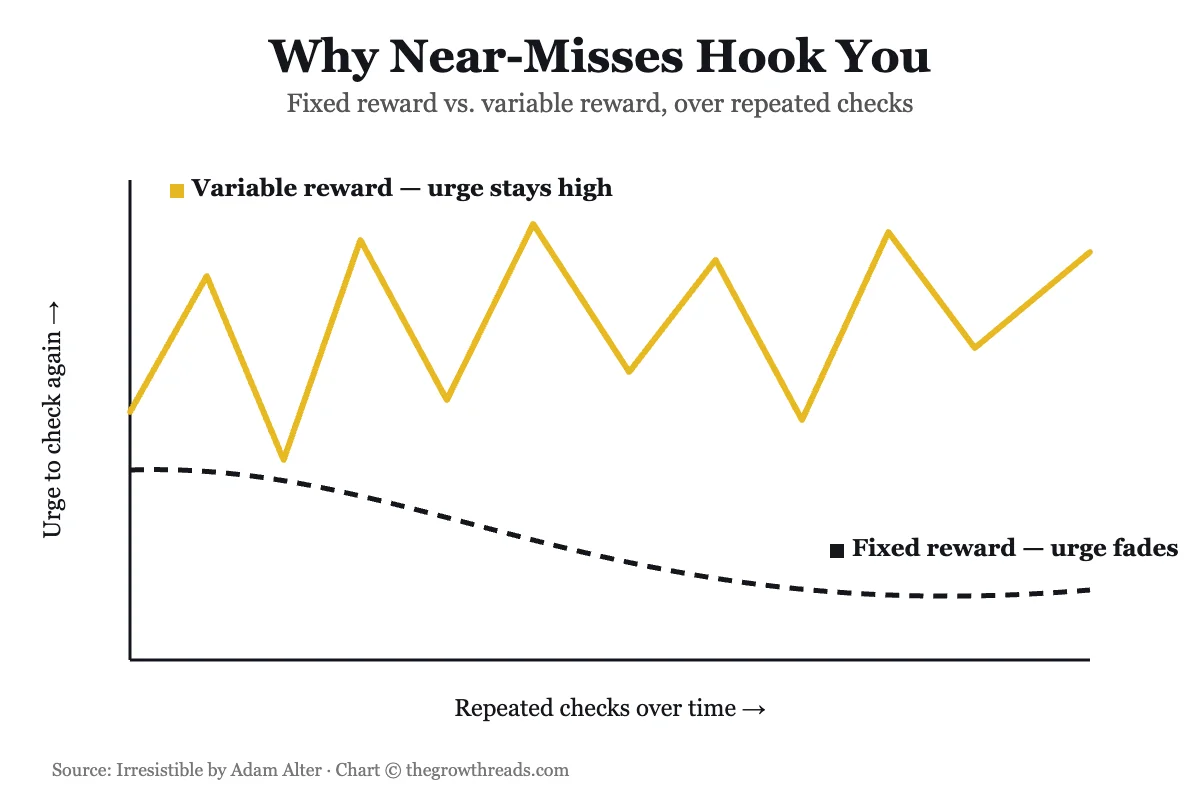
- Variable rewards beat fixed rewards: an unpredictable payoff (a great post, a match, a like) keeps people checking far longer than a reliable one ever could.
- The near-miss effect is engineered, not incidental: slot machines — and plenty of apps — are tuned so “almost winning” feels like a reason to try again.
- Autoplay and infinite scroll remove natural stopping points: the people who designed them have publicly said they regret how well that worked.
- Children are especially vulnerable: the brain circuitry that regulates impulse control isn’t fully developed until the mid-20s.
- Friction beats willpower: removing an app, greyscaling a screen, or charging your phone in another room reliably outperforms good intentions alone.
- The same toolkit can build good habits: goals, feedback, and progress can be pointed at exercise, saving, or reading instead of scrolling.
- The fix isn’t quitting technology — it’s redesigning your relationship with it: consciously choosing which loops you opt into, rather than defaulting into all of them.
What is Irresistible about?
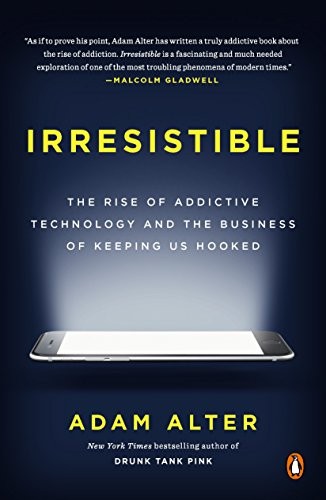
Irresistible (2017) is psychologist Adam Alter’s investigation into behavioral addiction — why apps, games, and social platforms are engineered to be compulsively checkable. He identifies six design ingredients that drive the pull, then offers friction-based, practical fixes for individuals, parents, and companies.
About the author
Adam Alter is a professor of marketing and psychology at New York University’s Stern School of Business, where he studies decision-making, judgment, and the psychology of technology. Trained at Princeton, where he earned his PhD, he built his career studying how small design choices shape big behaviors. His first book, Drunk Tank Pink, explored the hidden forces that quietly steer what we think and do; Irresistible turned that same lens on the tech industry, drawing on interviews with game designers, Silicon Valley engineers, and addiction researchers. His work has appeared in the New York Times, The Atlantic, and Wired. Explore all Adam Alter book summaries →
Key concepts at a glance
| Concept | What it means | Use it when |
|---|---|---|
| Behavioral addiction | Compulsive engagement with a non-substance experience that hijacks reward circuitry. | You check a habit and can’t fully explain why. |
| Variable reward | An unpredictable payoff schedule — like a slot machine — that intensifies compulsion. | Noticing apps whose notifications or likes arrive at random intervals. |
| Near-miss effect | Losing narrowly feels like “almost winning,” which fuels replay. | Spotting games or apps that simulate “so close” outcomes. |
| Six ingredients | Goals, feedback, progress, escalation, cliffhangers, social interaction — the design toolkit. | Auditing an app or habit for how many ingredients it stacks. |
| Friction | A physical or psychological barrier that interrupts automatic behavior. | Adding steps between impulse and access — logging out, greyscale mode. |
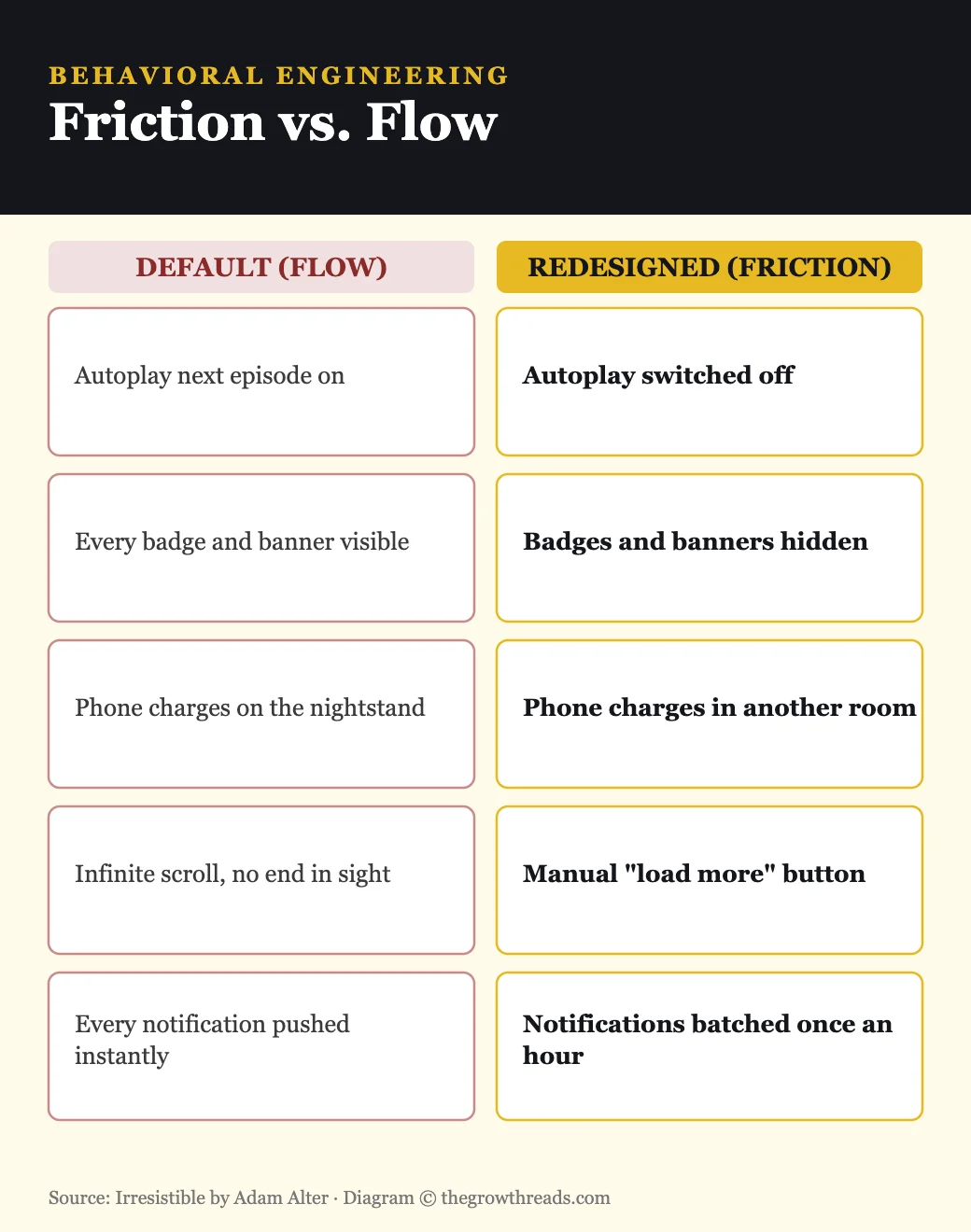
| Default settings | Pre-set options that determine behavior when no active choice is made. | Turning off autoplay, badges, and push notifications. |
| Behavioral engineering | Redesigning environment and cues instead of relying on willpower alone. | Building a “stop cue” ritual before a triggering context. |
| Gamifying childhood | Applying addictive-app design principles to kids’ products and education. | Weighing screen-time rules against a child’s developmental stage. |
Part 1: Why Your Brain Falls for Behavioral Addiction
Alter opens by drawing a hard line between two kinds of addiction that used to look very different: chemical dependency on substances like alcohol or nicotine, and compulsive engagement with experiences that involve no substance at all — gambling, gaming, shopping, scrolling. For decades, only the first counted as “real” addiction. But brain-imaging research changed that. When researchers scan the brains of people compulsively checking social media or grinding through a game, the same reward circuitry lights up as in substance addiction — and crucially, the dopamine hit arrives not when the reward is delivered, but in the anticipation of it. That’s why the craving hits before you’ve even unlocked the phone, and why “I’ll just check quickly” so rarely stays quick.
This isn’t a story about weak willpower. Alter is emphatic that the people getting hooked are, by and large, completely normal — the products are simply engineered by very smart, very well-resourced teams whose job is to maximize time on screen. He traces the timeline: as smartphones and always-on apps spread through the 2000s and 2010s, reports of compulsive checking, gaming disorder, and screen-related family conflict rose in lockstep. The American Psychiatric Association added “internet gaming disorder” to the DSM-5 as a condition warranting further study; China opened residential boot camps aimed at teenagers who couldn’t stop playing. The scale of the shift is the point — this isn’t a handful of vulnerable people, it’s a structural feature of how modern products are built.
The rest of the book is Alter’s attempt to open the hood: what, specifically, makes an experience irresistible? His answer is a six-part toolkit that shows up, in varying combinations, in nearly every habit-forming product you use.
Part 2: The Six Ingredients Engineers Use to Hook You
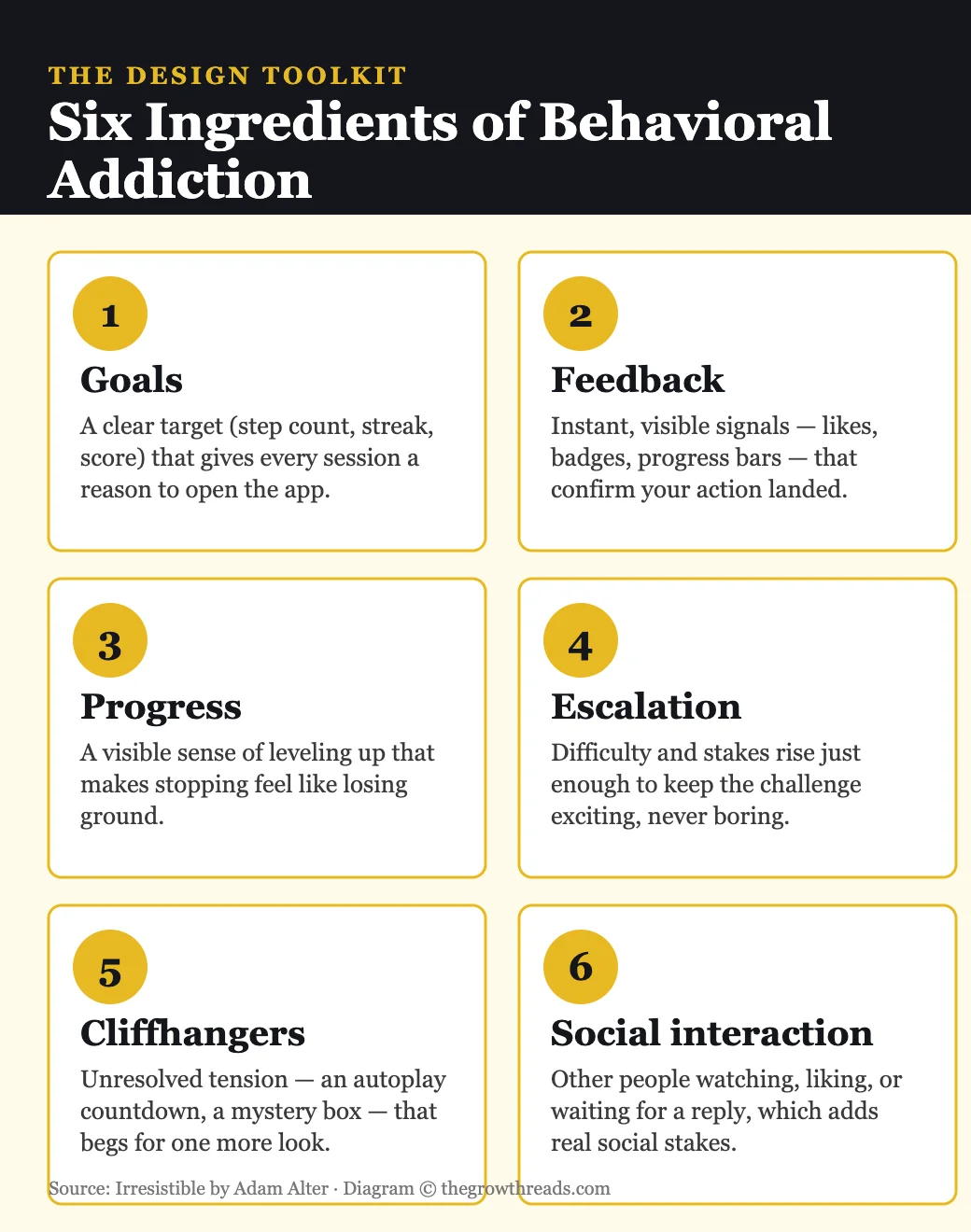
Alter’s central framework breaks the “hook” into six ingredients. Stack more of them into a single product, and the pull gets stronger.
Goals give every session a reason to exist — a step count, a streak, a score to protect. Feedback confirms instantly that an action landed: a like, a read receipt, a progress bar filling in real time. Progress creates a visible sense of leveling up, which makes stopping feel like losing ground rather than simply pausing. Escalation raises the difficulty and the stakes just enough to keep the challenge exciting without tipping into frustration. Cliffhangers leave something unresolved — an autoplay countdown, a loot box you haven’t opened — that begs for one more look. And social interaction adds real stakes: other people watching, liking, replying, or waiting on you, which turns a private habit into a social obligation.
None of these ingredients is inherently harmful on its own — a to-do list has goals and feedback, and nobody calls it addictive. The trouble starts when a product stacks four, five, or all six at once, and tunes them specifically to maximize engagement rather than to serve the user’s actual goal. Alter’s point is diagnostic as much as descriptive: once you can name the six ingredients, you can audit any app, game, or habit for how many of them are quietly at work on you.
TGR Note: If Alter’s six ingredients sound like a cousin of the classic cue–craving–response–reward habit loop, that’s not a coincidence — both describe the same underlying psychology from different angles. For the human cost of always-on connection specifically, our Team Human summary makes a good pairing: where Alter focuses on individual design mechanics, Team Human zooms out to what constant mediated interaction does to relationships.
Part 3: Case Studies — Games, Social Media, and the Business of Attention
The middle of the book turns from theory to origin stories, and some of the best material in Irresistible comes from the people who built these systems and later had second thoughts. Justin Rosenstein, who helped create Facebook’s “Like” button, has spoken publicly about restricting his own phone use after watching how the feature he helped ship reshaped behavior at scale — turning a simple social network into a stream of measurable, craveable approval. Aza Raskin, credited with inventing infinite scroll, has said openly that he regrets the design, because removing the natural stopping point of a page break — the moment where a reader used to decide “one more page or not” — was never really a neutral choice.
Alter connects this back to a much older piece of engineering: the slot machine. Casino designers have spent decades tuning payout schedules so that near-misses — two matching symbols and one blank, instead of three blanks — feel like almost-winning rather than losing, which keeps players pulling the lever. This is the near-miss effect, and it runs on the same variable-reward logic as a notifications feed you don’t fully control: most checks yield nothing interesting, but often enough one of them lands, and the unpredictability is exactly what keeps the behavior alive. Massively multiplayer games like World of Warcraft add a further layer — quests that escalate indefinitely, guilds that create real social obligations to log in, and no designed “ending” at all.
Alter is careful to note that engagement itself isn’t the villain — a fitness tracker that gamifies your daily walk with goals, feedback, and progress is using the identical toolkit in service of something you actually want more of. The difference is whose interest the design serves.
TGR Note: For the economic machinery behind attention-grabbing design, our The Attention Merchants summary traces how advertising built the incentive to maximize your time on screen in the first place. For what sustained scrolling does to how you read and think, see our The Shallows summary — the two pair naturally with Alter’s mechanics-level view.
Part 4: Breaking the Hook — Behavioral Engineering for Individuals, Kids, and Companies
The back third of Irresistible is where the book earns its keep as a practical guide rather than just a diagnosis. Alter’s core prescription is simple to state and harder to live: friction beats willpower, reliably and by a wide margin. Rather than resolving to check your phone less, change the environment so checking requires more steps — log out of the app instead of staying signed in, switch your screen to greyscale so it’s less visually rewarding, delete the app entirely and access it only through a browser, or charge your phone in another room overnight instead of on the nightstand. None of these require sustained motivation; they work because they change the default, and defaults do most of the behavioral heavy lifting whether we notice it or not.
The same six-ingredient toolkit that builds bad habits can build good ones. Goals, feedback, and progress pointed at a walking habit, a savings goal, or a reading target produce the same “just one more” pull — in a direction you actually chose. Alter calls this out explicitly: the tools are neutral, and reclaiming them for your own purposes is often more sustainable than trying to eliminate them altogether.
On parenting, Alter is careful rather than alarmist. Children and teens are especially susceptible because the prefrontal circuitry that governs impulse control isn’t fully developed until the mid-20s, which means the same design tricks land harder on a 14-year-old than a 40-year-old. His advice leans toward collaboration over restriction alone — co-deciding screen-time defaults with a child rather than only imposing them, and being honest that “gamifying childhood” through addictive app design in kids’ products carries real costs that deserve real scrutiny. On the corporate side, he argues for what’s since become known as the humane tech movement: products that build in natural stopping cues — the way a book has a final page or a movie has credits — rather than engineering away every point where a user might choose to stop.
Alter’s closing reframe is the one worth carrying with you: the goal was never to quit technology. It’s to notice which loops you’re opting into, and to make that choice on purpose instead of by default.
TGR Note: For a deeper, day-by-day framework on filtering technology use rather than just adding friction to individual apps, our Digital Minimalism summary is the natural next read — Newport’s 30-day declutter process extends Alter’s friction principle into a full operating philosophy.
Who is Irresistible best for — and who should read something else first?
Irresistible is best for anyone who’s ever picked up their phone and genuinely couldn’t remember why, parents trying to set screen-time rules that actually make sense, and product people or designers who want to understand the ethics of the toolkit they’re using. If you want a deeper, structured plan for cutting back rather than just the “why,” pair this with our Digital Minimalism summary. If you’re more interested in the attention economy’s business model than its psychology, start with The Attention Merchants instead. And if you’re looking for clinical treatment for addiction — behavioral or substance — this book is a useful mental model, but it’s not a substitute for talking to a professional.
Questions to reflect on
- Which of the six ingredients — goals, feedback, progress, escalation, cliffhangers, social interaction — shows up most in the app you check first each morning?
- When was the last time you experienced a “near miss” that kept you scrolling, playing, or refreshing?
- What’s one default setting — autoplay, badges, push notifications — you could switch off today?
- If you designed the ideal version of your most-used app, what would you remove?
- What would “gamifying” a habit you actually want — exercise, reading, saving — look like, done ethically?
🔥 Ready to see the design behind your own habits?
Get Irresistible and start redesigning your relationship with tech this week.
How to apply Irresistible (7-day plan)
- Day 1 — Audit: List your five most-used apps and count how many of the six ingredients each one uses.
- Day 2 — Cut the defaults: Turn off autoplay and badge notifications on your three most-used apps.
- Day 3 — Add friction: Pick one app to log out of, delete from your home screen, or access only via browser.
- Day 4 — Redirect the toolkit: Choose one “good” habit — a walk streak, a reading goal — and set it up with a visible goal, feedback, and progress marker.
- Day 5 — Change the environment: Set a phone-free zone or time — the first hour of your day, or the bedroom overnight.
- Day 6 — Talk it through: If you have kids or a partner, discuss one default you’ll change together, and why.
- Day 7 — Review: Note what stuck and what didn’t, then pick one more default to change next week.
Frequently asked questions
What is Irresistible by Adam Alter about?
Irresistible is a 2017 book by NYU psychologist Adam Alter about behavioral addiction — compulsive engagement with experiences like apps, games, and social media that hijacks the brain’s reward circuitry without any substance involved. Alter identifies six design ingredients (goals, feedback, progress, escalation, cliffhangers, and social interaction) that make products habit-forming, then offers practical, friction-based strategies for individuals, parents, and companies to redesign their relationship with technology. It draws on interviews with game designers, tech engineers, and addiction researchers to explain both the problem and the fix.
Is behavioral addiction a real clinical diagnosis?
It’s a genuine and growing area of research, though the clinical picture is still evolving. The DSM-5 added “internet gaming disorder” as a condition warranting further study, and brain-imaging research shows that compulsive engagement with non-substance experiences activates reward circuitry similar to substance addiction. Not every heavy user meets a clinical threshold, and Alter is careful to distinguish everyday overuse from diagnosable addiction — but the underlying psychological mechanism he describes is well supported by the research he cites.
What are the “six ingredients” of behavioral addiction?
Alter’s framework names six design elements that make a product habit-forming: goals (a clear target), feedback (instant confirmation an action landed), progress (a visible sense of leveling up), escalation (rising difficulty or stakes), cliffhangers (unresolved tension that begs for “one more”), and social interaction (other people watching, liking, or waiting on you). Products rarely use all six with equal intensity, but the more of them a product stacks, the stronger the pull tends to be.
Does Adam Alter say all technology is bad?
No — this is one of the book’s most consistent points. Alter is explicit that engagement itself is neutral; a fitness tracker or language-learning app uses the same six-ingredient toolkit as a slot machine, but in service of a goal the user actually wants. His argument is about design intent and whose interest it serves, not about technology as a category. The prescriptions in the book are about redirecting the toolkit, not abandoning it.
How is Irresistible different from Digital Minimalism or Stolen Focus?
Irresistible focuses on the mechanics of how products are engineered to be habit-forming — the designer’s-eye view. Digital Minimalism by Cal Newport offers a broader philosophy and a structured 30-day process for deciding which technologies deserve a place in your life at all. They’re complementary rather than competing: Alter explains why the hook works, and books like Digital Minimalism give you a fuller framework for opting out of the ones that don’t serve you.
What is the near-miss effect?
The near-miss effect is a psychological pattern where narrowly losing — two matching symbols and one blank on a slot machine, for example — feels more like almost-winning than losing, which encourages another attempt. Casino designers have engineered payout schedules around this effect for decades, and Alter argues the same variable-reward logic shows up in notification feeds, loot boxes, and social platforms, where most checks yield nothing interesting but the occasional big hit keeps the behavior alive.
How can parents use this book’s ideas with kids?
Alter recommends collaboration over pure restriction: involve kids in deciding screen-time defaults rather than only imposing rules, since children are especially susceptible because impulse-control circuitry isn’t fully developed until the mid-20s. Practical steps include co-deciding which notifications and autoplay settings stay on, delaying access to the most habit-forming platforms where possible, and having open conversations about why certain apps are designed to be hard to put down, rather than treating overuse as purely a discipline problem.
Related summaries
- The Shallows by Nicholas Carr — how the internet is rewiring how we read and think.
- The Attention Merchants by Tim Wu — the business model behind the fight for your attention.
- Team Human by Douglas Rushkoff — what always-on mediated connection does to relationships.
- Digital Minimalism by Cal Newport — a structured philosophy for deciding which technology deserves a place in your life.
- See all Best AI & Technology Books →
How we analyze books: our team reads each title in full, cross-checks its central claims against the author’s cited research and other reporting, and builds original diagrams, reflection questions, and application plans rather than summarizing chapter by chapter. Read our full methodology.
Related Technology Summaries
Automating Inequality Summary & Review: How Algorithms Punish the Poor
Superagency Summary & Review: What Could Possibly Go Right with AI
The AI-First Company Summary & Review (2026)
The Fourth Industrial Revolution Summary & Review: How Every Industry Is Converging
The Shallows Summary & Review: How the Internet Is Rewiring Your Brain