

Best for: Anyone who uses AI tools daily and wants to understand what stands behind them.
Reading time: ~7 hrs to read the book (this summary: about 14 minutes)
Difficulty to apply: Easy — this book changes how you think about AI more than it teaches a skill.
Atlas of AI in one minute
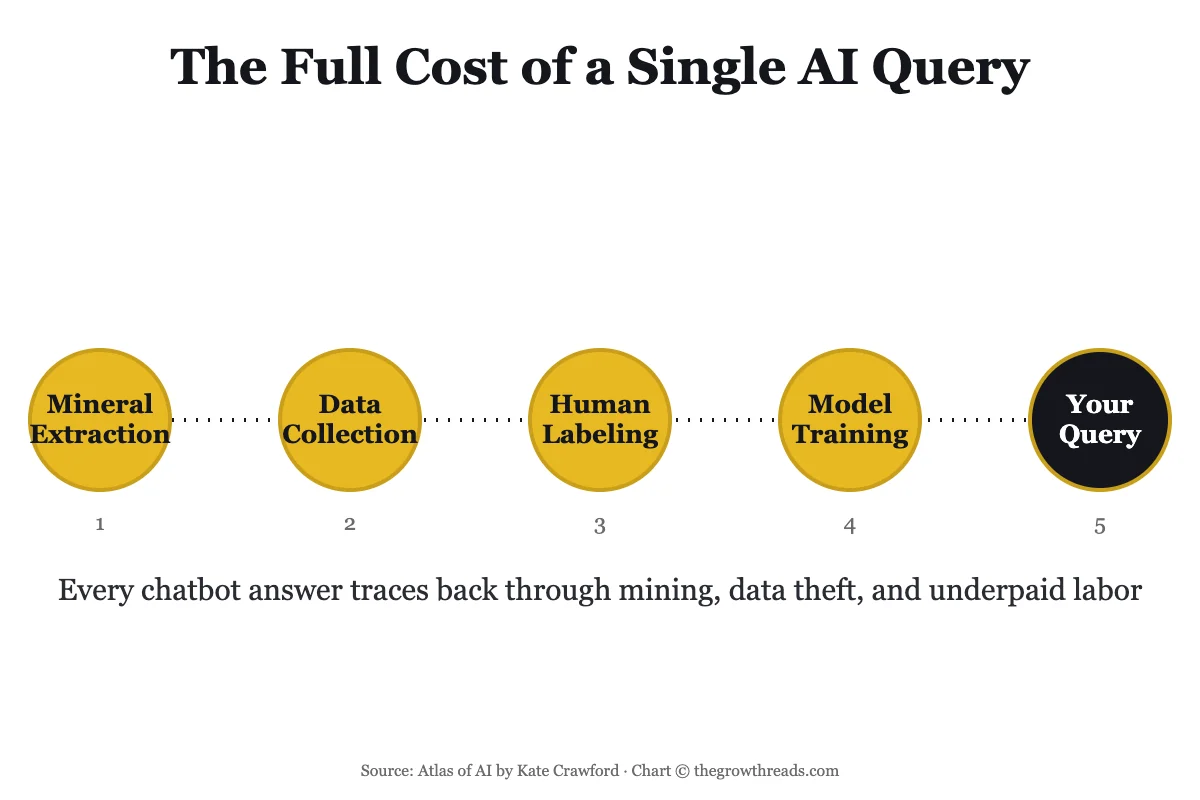
Artificial intelligence is not artificial, and it is not particularly intelligent — it is a vast, extractive industry wearing the costume of software. In Atlas of AI, media scholar Kate Crawford traces the physical supply chain behind every AI system: the lithium and rare-earth mines that supply its hardware, the fossil-fueled data centers that run it, the underpaid workers who label and moderate its data, the personal information scraped without consent to train it, and the classification systems it uses to sort people — often with real consequences for jobs, credit, and freedom. Crawford is not anti-technology; she is anti-amnesia. Her argument is that every time we forget where AI comes from, we make it easier for a handful of companies and states to make decisions about our lives with none of us in the room.
Key takeaways
- AI is a physical industry, not a virtual one: every model runs on mined minerals, fossil-fueled electricity, and racks of physical hardware in real data centers.
- Rare-earth mining carries a real human and environmental toll: lithium and cobalt extraction reshapes landscapes and, in many regions, depends on exploitative labor conditions.
- “Ghost work” keeps AI running behind the scenes: millions of underpaid click-workers label training data and moderate content so finished systems can appear fully automated.
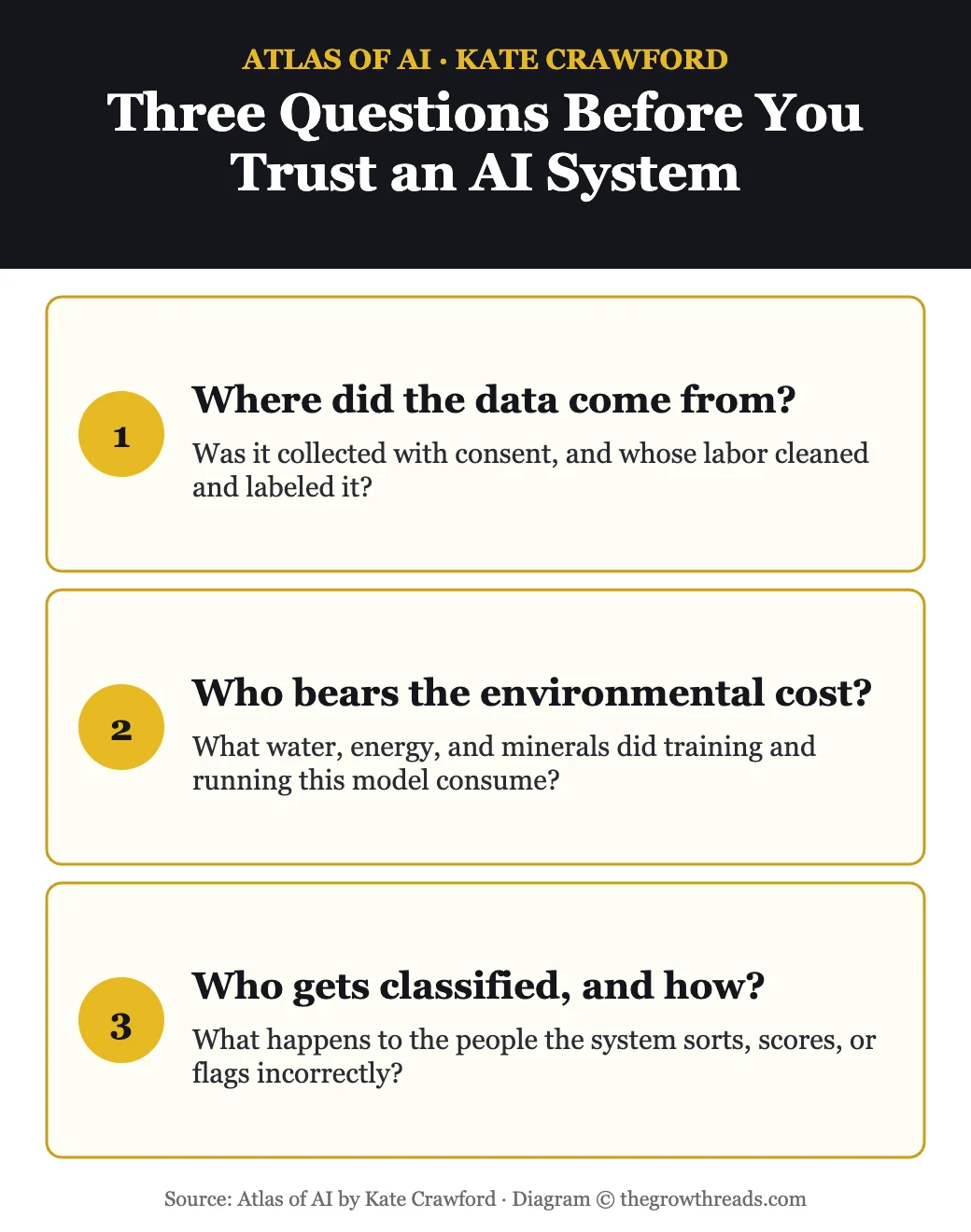
- Data collection has often bypassed consent entirely: many of the datasets behind today’s largest models were scraped from the public web without the knowledge of the people in them.
- Classification is never neutral: sorting people into categories — gender, emotion, criminality, creditworthiness — bakes in the assumptions and biases of whoever designed the system.
- Affect recognition rests on shaky scientific ground: the claim that software can reliably read emotion from a face traces back to contested 1960s psychology that many researchers have since challenged.
- AI concentrates power in a small number of companies and states: the compute, data, and capital required to build frontier systems price out almost everyone else.
- Every technical decision is also a political one: what a system is built to optimize for reveals whose interests it actually serves.
- Seeing the full stack changes how you use AI: once you can picture the mine, the workforce, and the dataset behind a tool, the tool itself looks different.
What is Atlas of AI about?
Atlas of AI is Kate Crawford’s 2021 book mapping the material, human, and political costs hidden behind artificial intelligence. Rather than treating AI as pure software, Crawford traces it as an extractive industry — from the mines that supply its hardware, to the underpaid labor that trains it, to the classification systems it imposes on the people who encounter it.
About the author
Kate Crawford is a researcher, writer, and professor who has spent over a decade studying the social and political implications of artificial intelligence. She holds a research position at Microsoft Research, is a Distinguished Research Professor at NYU, and co-founded the AI Now Institute, one of the first research centers dedicated to studying AI’s effects on society. Crawford has advised the White House, the European Parliament, and the United Nations on AI policy, and her research blends computer science with anthropology, labor history, and environmental science. Atlas of AI grew out of years of fieldwork — visiting mines, data centers, and warehouses — that most discussions of AI never go near, which is precisely what gives the book its authority. Explore all Kate Crawford book summaries →
Key concepts at a glance
| Concept | What it means | Use it when |
|---|---|---|
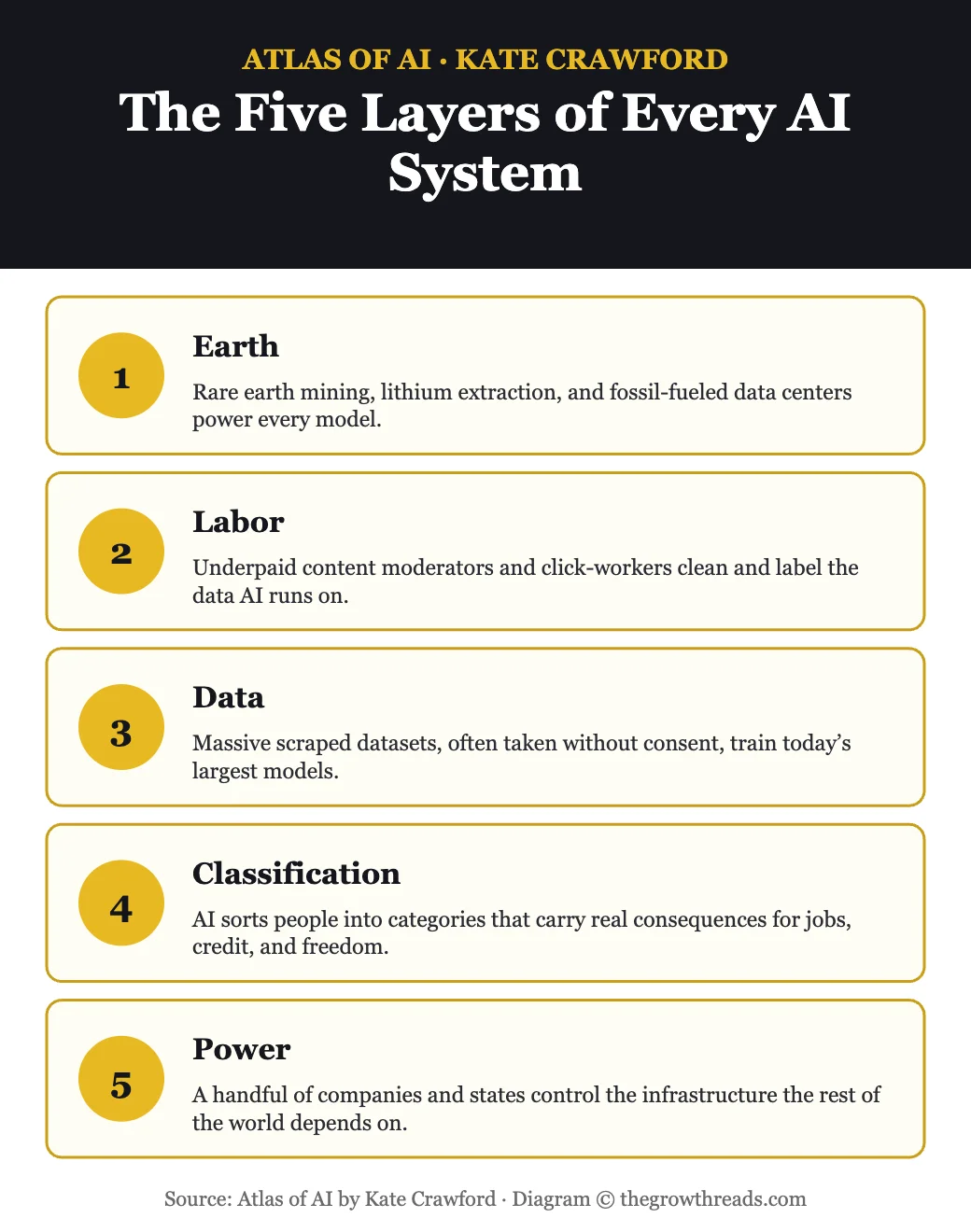
| Earth | The mineral extraction and energy consumption behind every AI system | Evaluating the environmental footprint of AI tools |
| Labor | The underpaid human work — labeling, moderating, packing — that AI depends on | Thinking about who really “does” the work AI gets credit for |
| Data colonialism | Collecting personal data at scale without meaningful consent | Assessing how a company or product sources its training data |
| Classification | Sorting people into categories that carry real-world consequences | Reviewing any system that scores, ranks, or flags people |
| Affect recognition | Software claiming to detect emotion from facial expressions | Evaluating hiring, security, or monitoring tools that claim to “read” people |
| State power | Governments using AI for surveillance, policing, and border control | Weighing the civil-liberties tradeoffs of public-sector AI |
| The planetary computer | Crawford’s term for AI as a single, interconnected extraction system spanning the globe | Zooming out from one product to the industry it belongs to |
Part 1: Earth — the material cost of intelligence
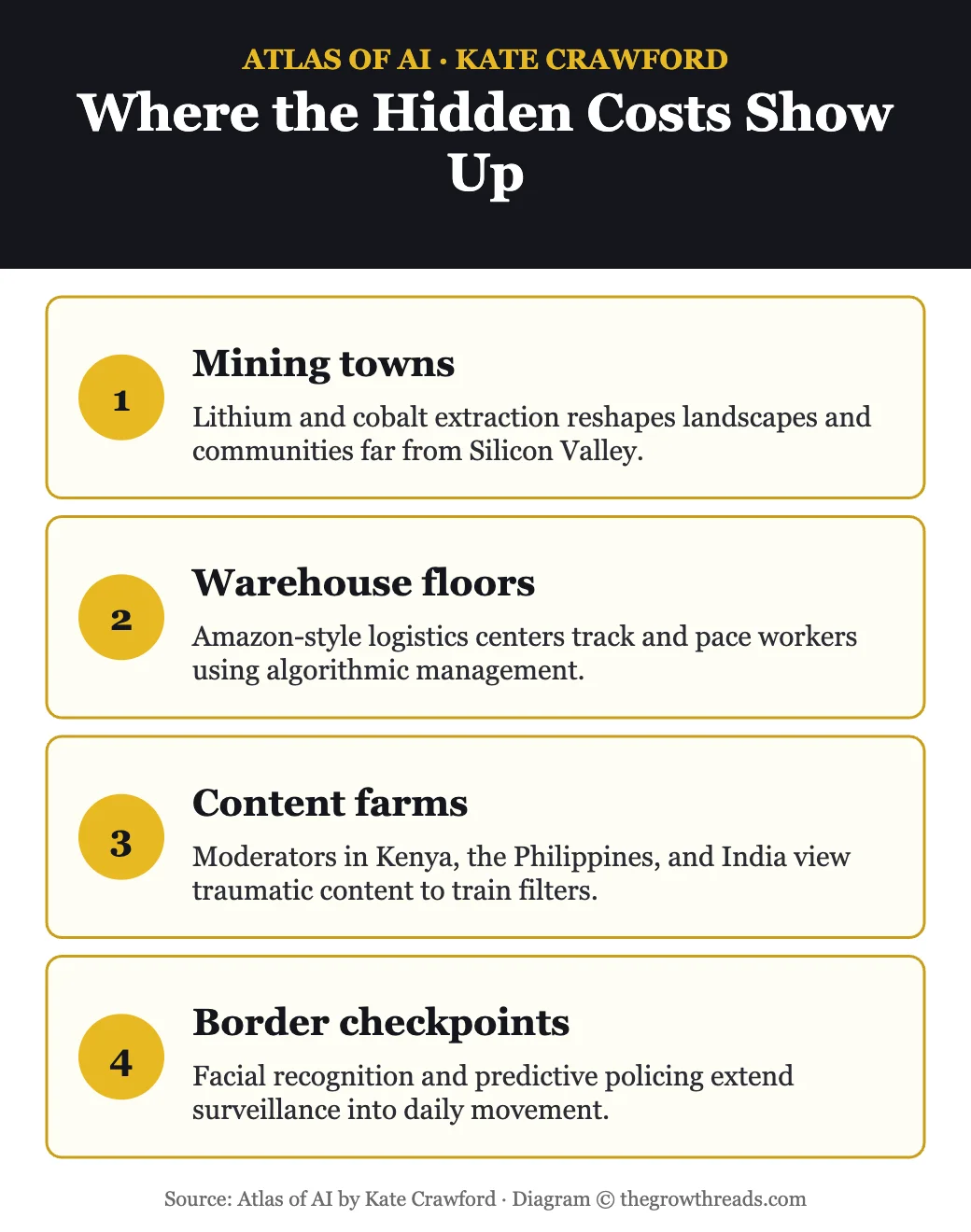
Crawford opens by traveling to a lithium mine in Nevada, one of many sites worldwide that supply the raw materials for the batteries, servers, and chips that make AI possible. The scale is staggering: a single data center can consume as much electricity as a small city, and the water used to cool it often comes from regions already facing shortages. Mining rare-earth elements — the neodymium in hard drives, the cobalt in batteries — reshapes landscapes and, in many parts of the world, relies on labor conditions that would be illegal in the countries buying the finished products.
This is the part of AI that marketing never shows. When a company describes its model as running “in the cloud,” the phrase does real rhetorical work: it makes something built from rock, diesel, and steel sound weightless. Crawford’s point is not that we should stop using AI, but that we should stop pretending it has no physical address.
Part 2: Labor — the workers AI depends on
The second cost is human. Behind every AI system that looks automated sits a workforce doing the parts machines still can’t do reliably: labeling millions of images, flagging graphic content so filters learn what to block, and correcting a model’s mistakes one example at a time. Crawford calls this “ghost work” — labor that is essential to the product but invisible in how the product is marketed. Workers in the Philippines, Kenya, and Venezuela, often paid a few dollars an hour, view some of the internet’s worst content so that the rest of us never have to.
This labor extends into physical spaces too. Amazon warehouses, which Crawford visits directly, use algorithmic systems to track worker movement down to the minute, optimizing human bodies the same way a factory optimizes machines. The workers are essential to the system’s output, but the system was not designed with their wellbeing as a goal.
Part 3: Data — collection without consent
Modern AI is trained on enormous datasets, many of them built by scraping publicly available text and images from across the internet — photos posted to social media, forum posts, articles, artwork — almost never with the explicit consent of the people who created or appeared in them. Crawford traces the history of a few infamous datasets, including facial-recognition sets built from photos never intended for that purpose, to show how “publicly available” quietly became a justification for “fair to take.”
She’s careful to distinguish this from simple data privacy concerns. The issue isn’t only that your data might be used — it’s that a handful of companies now have effectively unlimited license to define what counts as reasonable use, because no meaningful mechanism exists for the people in the data to object, correct, or opt out after the fact.
Part 4: Classification and power — who decides, and for whom
The final and most consequential cost is what AI does with all this material once it’s assembled: classify people. Crawford walks through case studies of systems that claim to detect emotion, gender, or criminal intent from a face or a voice — technology built on contested science, deployed anyway because it is profitable and because “the algorithm said so” reads as more objective than it is. She traces the philosophical roots of these classification systems back to phrenology and other pseudosciences, arguing that today’s version simply has better marketing and more processing power.
The book closes by zooming out to what Crawford calls “the planetary computer” — the idea that AI is not a collection of separate products but a single, interconnected system of extraction spanning minerals, labor, data, and computation, controlled by a strikingly small number of companies and states. Understanding AI, she argues, means understanding this whole system at once, not just the chat window on your screen.
Who is Atlas of AI best for — and who should read something else first?
Atlas of AI is best for anyone who uses AI tools regularly and wants a clear-eyed picture of what stands behind them — professionals evaluating AI vendors, policymakers, journalists, and curious readers who sense there’s more to the story than the marketing. It’s less a how-to guide than a way of seeing. If you want a more technical introduction to how machine learning actually works first, start with Pedro Domingos’s The Master Algorithm. If you want a deeper dive into how algorithmic bias plays out in specific systems like credit scoring and policing, Cathy O’Neil’s Weapons of Math Destruction is the natural next step.
Questions to reflect on
- Which AI tools do you use regularly, and could you explain — even roughly — what data trained them?
- Has this book changed how you think about the phrase “the cloud”?
- Where in your own work or life are you being classified, scored, or sorted by an automated system?
- What would meaningful consent for AI training data actually look like in practice?
- If you could ask one question of the company behind your most-used AI tool, what would it be?
🔥 Ready to see the whole system behind AI?
Get Atlas of AI and never look at a chatbot the same way again.
How to apply Atlas of AI (7-day plan)
- Day 1: Pick one AI tool you use weekly and look up who built it and what’s publicly known about its training data.
- Day 2: Read your AI provider’s privacy policy and note exactly what it says (and doesn’t say) about how your inputs are used.
- Day 3: Research where the company’s data centers are located and what powers them.
- Day 4: Identify one place in your work where an algorithm scores, ranks, or classifies people, and ask who reviews its decisions.
- Day 5: Look into the labor behind content moderation or data labeling for a platform you use often.
- Day 6: Share one thing you learned this week with a colleague who uses AI tools without thinking about their origins.
- Day 7: Write down one question you’ll ask before adopting your next AI tool at work.
Frequently asked questions
What is the main argument of Atlas of AI?
Kate Crawford argues that artificial intelligence is best understood as a physical, extractive industry rather than a purely digital one. Every AI system depends on mined minerals, fossil-fueled data centers, underpaid human labor, and personal data collected largely without consent. Because these costs are hidden from view, a small number of companies and states have been able to accumulate enormous power with little public accountability. Understanding this full supply chain, Crawford argues, is necessary before we can meaningfully evaluate or regulate the technology.
Is Atlas of AI critical of AI itself, or just how it’s built?
The book is more a critique of the current political economy of AI than of the underlying technology. Crawford isn’t arguing that machine learning shouldn’t exist; she’s arguing that the way it’s currently built, funded, and deployed concentrates costs on miners, laborers, and classified populations while concentrating benefits among a small set of companies. Her proposed fix leans toward transparency, accountability, and better distribution of both costs and benefits rather than abandoning the technology.
Do I need a technical background to understand this book?
No. Atlas of AI is written for a general audience and focuses on the social, environmental, and political dimensions of AI rather than the underlying math or code. Crawford explains any technical concepts she introduces in plain language, and the book reads more like investigative journalism than a computer science text.
What does “ghost work” mean in the book?
“Ghost work” refers to the large, often invisible workforce of people who label training data, moderate flagged content, and correct model outputs so that finished AI products can appear fully automated. Crawford documents how this work is frequently outsourced, poorly compensated, and psychologically taxing, particularly for content moderators exposed to graphic material.
Has anything changed since the book’s 2021 publication?
The rise of large language models and generative AI since 2021 has, if anything, intensified the trends Crawford describes: larger data centers, more aggressive data scraping, and continued reliance on human labelers to fine-tune model behavior. Some of her specific examples predate the current generation of chatbots, but the underlying framework — Earth, Labor, Data, Classification, Power — remains a widely cited lens for evaluating newer systems.
Does the book offer any solutions?
Crawford is more focused on diagnosis than prescription, but she does point toward directions: stronger labor protections for data workers, meaningful consent frameworks for training data, environmental accounting for AI infrastructure, and independent oversight of classification systems used in high-stakes settings like hiring, lending, and criminal justice.
Who should read Atlas of AI first — this or a more technical AI book?
If your goal is understanding what AI costs and who it affects, start here. If your goal is understanding how AI systems technically work, a book like Pedro Domingos’s The Master Algorithm is a better entry point. Many readers benefit from both: the technical grounding makes Crawford’s political and economic arguments land with more precision.
Related summaries
- Weapons of Math Destruction by Cathy O’Neil
- The Big Nine by Amy Webb
- The Coming Wave by Mustafa Suleyman
- The Master Algorithm by Pedro Domingos
- Best AI Books — The Full List
Related Technology Summaries
Artificial Unintelligence Summary & Review: Why More Computing Power Isn’t the Answer
Our Final Invention Summary & Review: Is Superintelligent AI a Genuine Threat?
The Big Nine Summary & Review: Who Actually Controls AI’s Future
The Second Machine Age Summary & Review: The Bounty and the Spread of Digital Technology
The Shallows Summary & Review: How the Internet Is Rewiring Your Brain