

★★★★☆ (4.3/5) — A sharp, deeply reported reframe of the AI story: it was never one story, but two, and the fork happened decades before anyone called it “AI safety.”
Best for: readers who want the real backstory behind today’s “human-in-the-loop” debates
Reading time: ~7 hrs to read the book · 12 min to read this guide
Difficulty to apply: Easy — this is a lens for evaluating technology, not a task list
Machines of Loving Grace in one minute
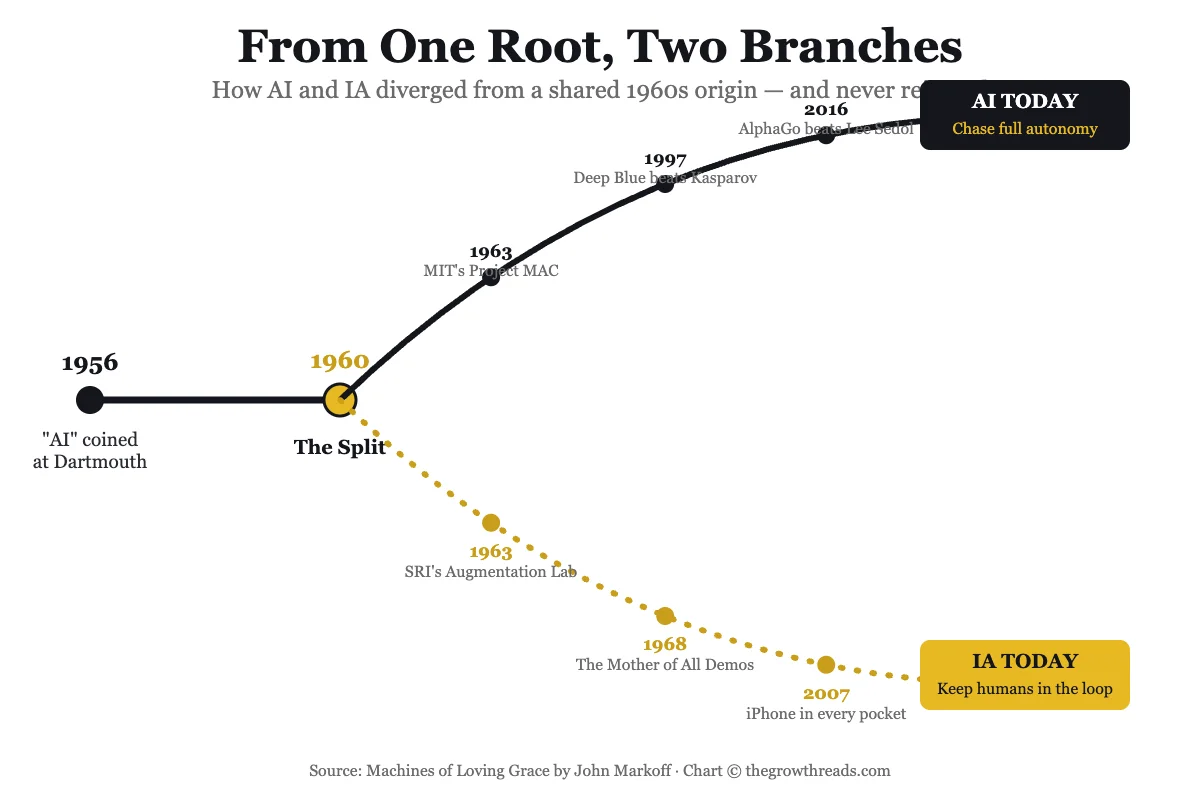
Every AI product you’ve ever used was built by someone who had already chosen a side in a fight that started in 1960 — and most of us never noticed the fight was happening. John Markoff, the veteran New York Times technology reporter who broke the story of the World Wide Web, spent years interviewing the people who built Silicon Valley’s foundational technologies to answer a single question: were they trying to replace human beings, or extend them? He found that from a handful of Bay Area research labs in the 1960s, two rival philosophies emerged — Artificial Intelligence, which chases machines that can act without us, and Intelligence Augmentation, which chases tools that make us sharper working alongside them. Markoff’s case is that this isn’t ancient history. It’s the same fork in the road that shows up every time a company decides whether a self-driving car should have a steering wheel, or whether an AI assistant should ask for your approval before it acts. Machines of Loving Grace gives you the vocabulary to see that choice — and to start asking which side the tools in your own life are actually built on.
Key takeaways
- Two births, one delivery room: AI and IA were not sequential ideas — they were argued out simultaneously, often by researchers who knew each other, in the same few Bay Area institutions.
- The 1956 Dartmouth Workshop coined “artificial intelligence,” setting a research agenda aimed squarely at building machines that could think and act autonomously.
- Douglas Engelbart’s 1962 memo “Augmenting Human Intellect” is IA’s founding document — it argued tools should make people smarter, not replace their judgment.
- The Mother of All Demos (1968) is IA’s proof of concept: Engelbart showed windows, hypertext, video conferencing, and collaborative editing decades before they became normal.
- The AI camp’s ambitions and its funding cycles collided repeatedly with reality, producing the “AI winters” — periods when replace-the-human promises outran what the technology could do.
- Robotics forced the abstract AI-vs-IA argument into physical form: does a machine act on its own in the world, or does it extend a human operator’s senses and reach?
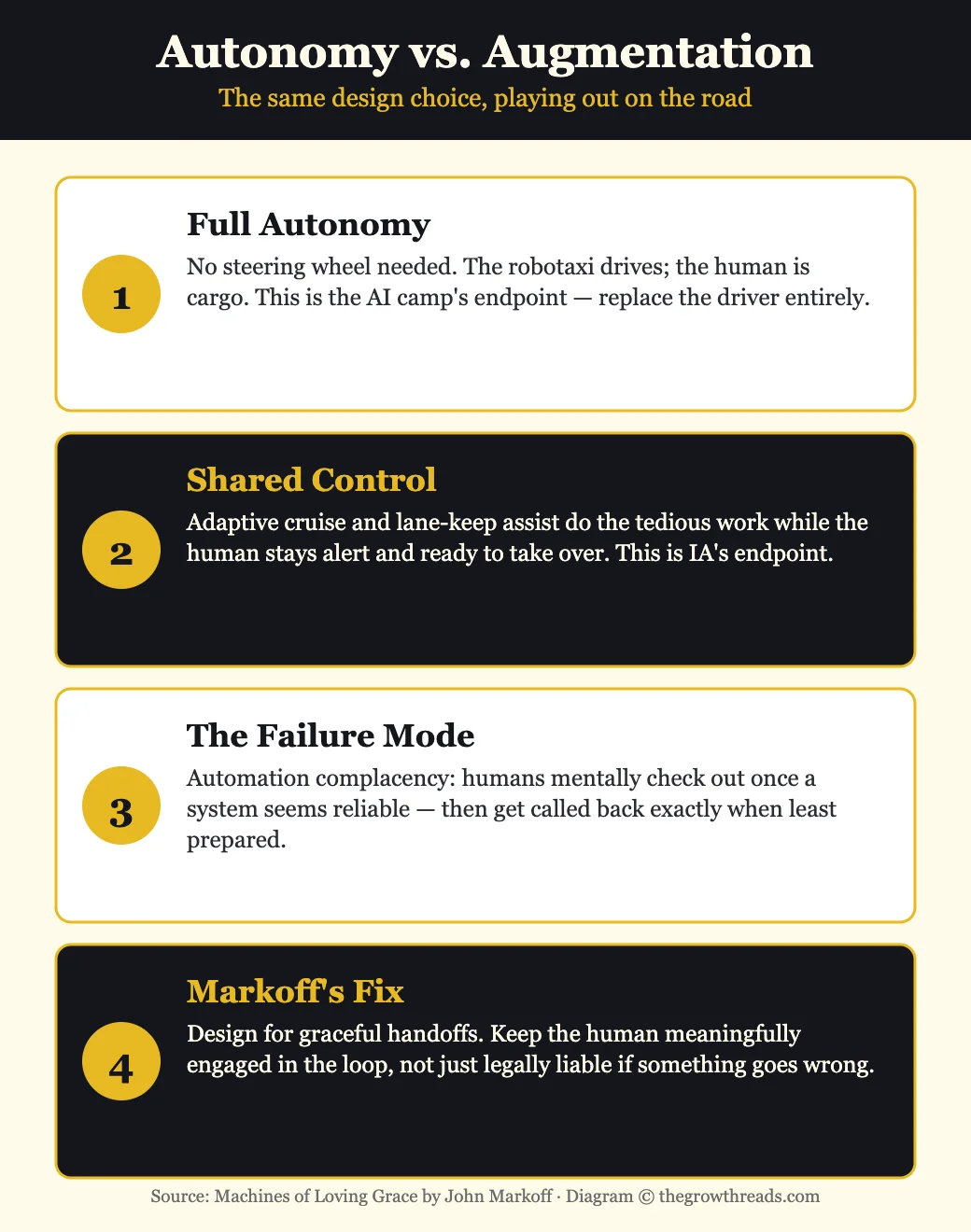
- Self-driving cars are the clearest live example of the same fork: full autonomy (no steering wheel) versus driver-assist systems that keep a human in the loop.
- “Automation complacency” is a real, documented failure mode: humans mentally disengage from systems that seem reliable, then get called back to make split-second decisions when they’re least prepared.
- Markoff interviewed pioneers from both camps directly — engineers, ethicists, and entrepreneurs who lived the split rather than just theorized about it.
- The book’s normative argument: designers should treat “keep humans meaningfully in the loop” as a deliberate choice worth defending, not a temporary stage on the way to full autonomy.
What is Machines of Loving Grace about?
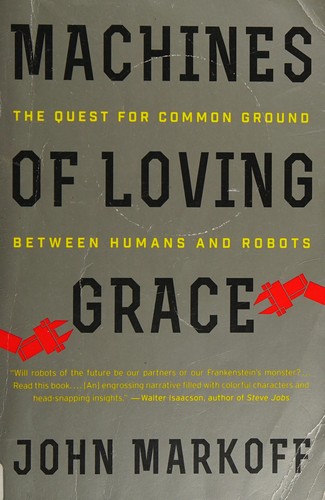
Machines of Loving Grace traces AI and robotics to their shared 1960s Bay Area origins, showing they split early into two philosophies: building machines to replace human labor, versus tools that augment human capability. Markoff argues this tension is a live design choice — visible today in robotics and self-driving cars — not a settled question from the past.
About the author
John Markoff spent 28 years covering technology and science for The New York Times, retiring in 2016 after breaking some of the era’s defining stories, including the earliest coverage of the World Wide Web. He was part of the reporting team that won the 2013 Pulitzer Prize for Explanatory Reporting. His earlier book, What the Dormouse Said: How the Sixties Counterculture Shaped the Personal Computer, traced the cultural roots of Silicon Valley; Machines of Loving Grace extends that instinct into the parallel history of AI and robotics, built on original interviews with the researchers who lived it. He lives in San Francisco. Explore all John Markoff book summaries →
Key concepts at a glance
| Concept | What it means | Use it when |
|---|---|---|
| AI (Artificial Intelligence) | The pursuit of machines that replicate and eventually replace human cognitive and physical labor | Evaluating any “fully autonomous” product claim |
| IA (Intelligence Augmentation) | The pursuit of tools that extend and amplify human capability through close collaboration | Designing or choosing tools meant to be used with a person, not instead of one |
| The 1960s split | AI and IA emerged from the same Bay Area research culture but diverged into rival research agendas almost immediately | Explaining why Silicon Valley keeps re-litigating “will this replace me?” |
| Automation complacency | The tendency for humans to disengage from monitoring a system once it seems reliable | Assessing why partial automation can be more dangerous than full automation or full manual control |
| Graceful handoff | Design pattern where control passes between human and machine smoothly, with warning and context, not abruptly | Reviewing safety-critical AI or robotics design (cars, aviation, medicine) |
| Human-in-the-loop | A design commitment to keep a person meaningfully involved in decisions, not just legally accountable for them | Deciding how much autonomy to grant an AI system in your own work or product |
Part 1: The Shared Origin — AI and IA Are Born in the Same Labs
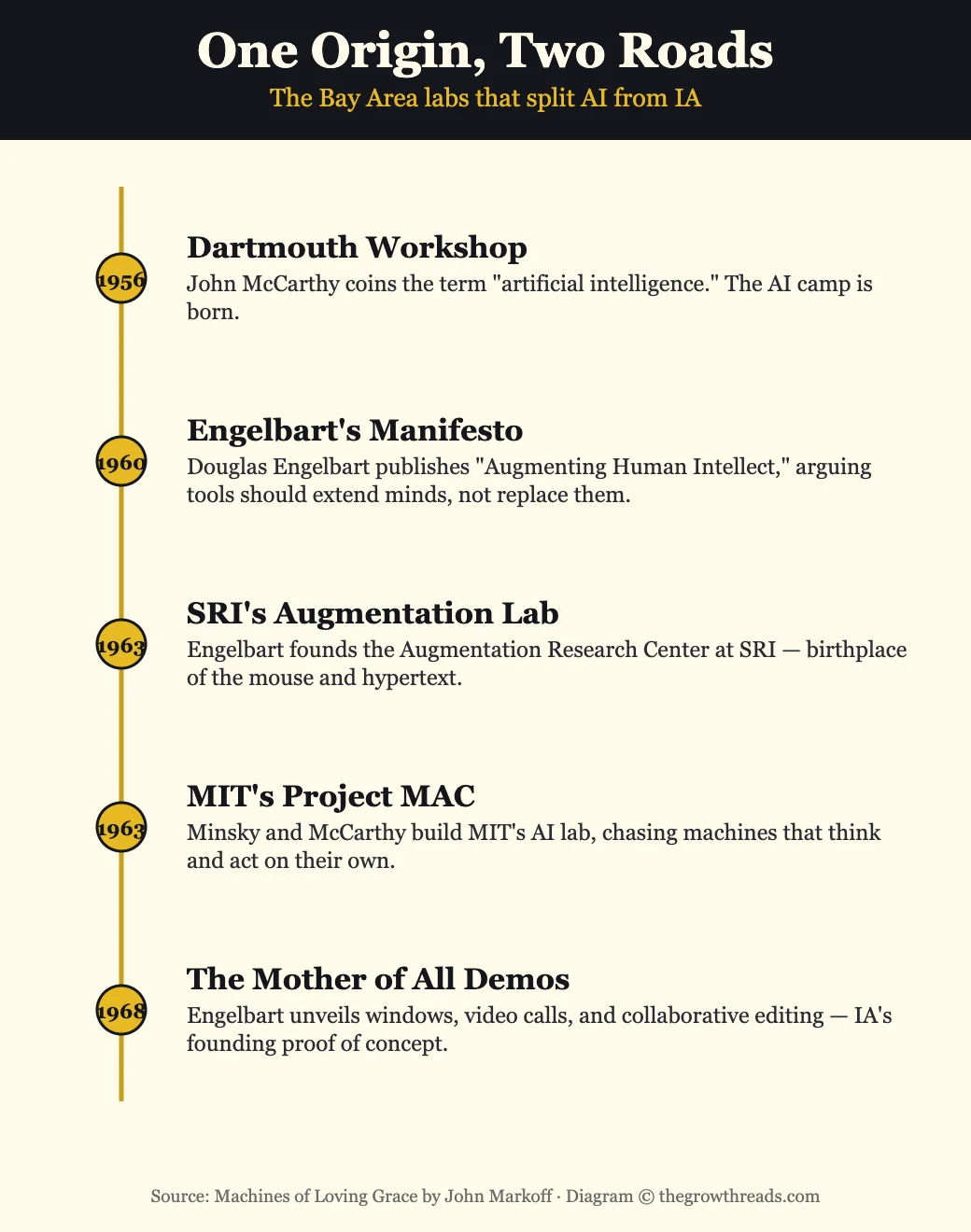
Markoff opens by dismantling a myth: that “AI” and “human-centered computing” evolved on separate tracks, meeting only recently once AI got powerful enough to raise ethical questions. Both fields actually trace to the same handful of Bay Area institutions in the same handful of years. In 1956, John McCarthy convened the Dartmouth Summer Research Project and coined the term “artificial intelligence,” setting an agenda focused on machines that could reason and act without human direction. Marvin Minsky, first at Dartmouth and then MIT, became one of AI’s most confident boosters, predicting general intelligence within a generation.
At almost exactly the same moment, and often just a short drive away, Douglas Engelbart was pursuing something philosophically opposite. In 1962, at Stanford Research Institute (SRI), he wrote “Augmenting Human Intellect: A Conceptual Framework” — arguing that computers’ highest purpose wasn’t to think for people but to make people think better. Engelbart founded SRI’s Augmentation Research Center the following year, chasing one question: how do you build tools that amplify a skilled human’s judgment rather than substitute for it? The lab’s output — the mouse, hypertext, windowed interfaces, collaborative editing — reads today like a checklist of modern computing’s building blocks, all invented in service of augmentation, not autonomy.
Markoff’s reporting shows these camps weren’t operating in ignorance of each other. Researchers crossed paths at conferences and sometimes worked in adjoining buildings. The split wasn’t a lack of communication — it was a genuine philosophical disagreement about what computers were for, argued by people who understood the other side and rejected it anyway. That’s what makes the argument land: this isn’t one idea slowly discovering its conscience. It’s two ideas competing from day one.
Part 2: Two Philosophies, One Question — Replace or Augment?
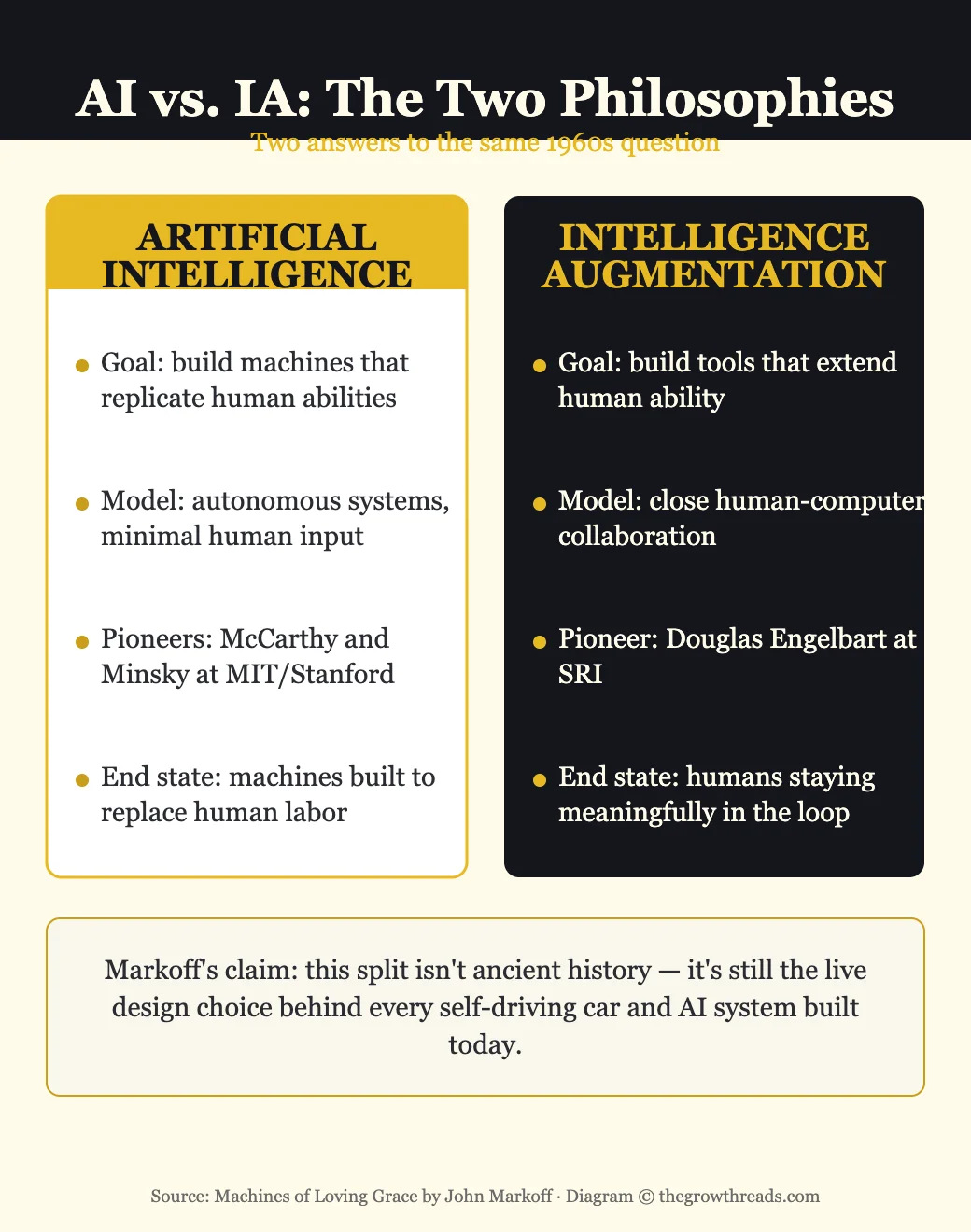
Once Markoff establishes the historical split, he uses it as an organizing lens for nearly everything that follows in Silicon Valley’s development. The AI-versus-IA framework, he argues, explains patterns that otherwise look like unrelated controversies: the periodic “AI winters” when overhyped autonomy promises collapsed under their own weight; the rise of “human-centered design” as a reaction against systems that ignored their users; and the modern anxiety around generative AI, which reopens exactly the question Engelbart and McCarthy argued in 1962 — should this tool decide, or help a person decide?
The chapter draws a distinction easy to blur in casual conversation: augmentation isn’t simply “AI with a human veto button” bolted on afterward. It’s a design philosophy starting from a different premise — that the goal is to make the human better at their job, with success measured by the human’s improved output, not by how much of their role gets absorbed. Markoff traces this thread through decades of interface design, showing how augmentation-first design tends to produce tools people trust and keep using, while replace-first design tends to produce a boom-bust cycle of hype followed by disappointment.
He’s careful not to caricature the AI camp as reckless or the IA camp as timid. Some of AI’s most consequential breakthroughs — in perception, language, and pattern recognition — came directly from researchers pursuing full autonomy as a genuine scientific goal, not a marketing angle. His point isn’t that one camp is right and the other wrong; it’s that conflating them, or assuming “AI” describes one coherent philosophy, obscures a decision being made anew with every new product.
Part 3: The Robots Among Us — Autonomy vs. Augmentation in Practice
The second half of the book moves from history and philosophy into Markoff’s real specialty: reporting on where these ideas get built into hardware. Robotics is where the abstract AI-versus-IA argument stops being abstract, because a robot must make a concrete choice about how much control it takes from the humans around it. Self-driving cars become his central case study — not because they’re the most dramatic robots, but because they’re the ones ordinary people are asked to trust with their lives on a daily commute.
He lays out the two philosophies side by side. Full autonomy removes the human from the control loop entirely: no steering wheel, no expectation a passenger is paying attention, because the vehicle isn’t built to hand control back. Driver assistance keeps a human in the loop deliberately: the car handles lane-keeping and adaptive cruise control, but assumes a person stays alert and ready to intervene. Markoff’s reporting surfaces a genuine, well-documented problem with the second approach: automation complacency. When a system performs reliably for long stretches, human attention drifts — and the moments a system actually needs a human tend to be the moments that person is least prepared.
This is where the argument sharpens into something practical. Markoff doesn’t conclude full autonomy is obviously better because it sidesteps complacency, nor that shared control is automatically safer because a human is nominally present. Instead, drawing on interviews with engineers building these systems, he argues for a third path: designing the handoff between human and machine as its own deliberate engineering problem, with warning, context, and graceful transitions — rather than assuming either “human in control” or “machine in control” is a stable answer on its own.
Part 4: Designing the Future — Why Markoff Argues for Keeping Humans in the Loop
The book’s closing argument is normative, not just descriptive: Markoff makes the case that “keep humans meaningfully in the loop” should be a deliberate design value, defended on its own merits, rather than a temporary compromise on the way to eventual full autonomy. This is a genuinely contestable claim — plenty of serious researchers believe full autonomy is both achievable and preferable once the engineering matures. His response isn’t to dismiss that view, but to argue the choice shouldn’t be made by default, driven by whichever approach is easiest to fund or market in a given decade.
He grounds this in interviews with engineers and ethicists on both sides of the AI-IA divide, several of whom describe watching their field’s incentives quietly push them toward full autonomy even when their original research questions were about augmentation. Startup funding, Markoff observes, tends to reward products that promise to eliminate labor costs more readily than products that promise to make existing workers better — a pressure unrelated to which philosophy actually produces safer technology, but which shapes what gets built regardless.
Markoff’s closing chapters land on a call to action aimed less at engineers and more at the rest of us: understand which philosophy is baked into the tools you use and build, and treat “does this replace me or augment me” as a question worth asking explicitly, not one the market quietly answers for you. It’s a modest conclusion for a book with such sweeping scope, but that’s the point — Markoff isn’t trying to settle the debate. He’s trying to make sure more people know it’s still being fought.
Who is Machines of Loving Grace best for — and who should read something else first?
This book rewards readers who want the origin story behind today’s AI debates, not just a snapshot of where things stand now. If you work in product, design, or policy and keep hitting the “will this replace people” question without a good historical frame, Markoff gives you one. It’s also a strong fit if you enjoyed Nexus and want a narrower companion focused specifically on the AI/robotics side of the story.
Looking for a hands-on guide to working with today’s generative AI rather than its historical roots? Start with Co-Intelligence instead — it applies the same augmentation philosophy to concrete, present-day practice. And if your interest is human-robot relationships specifically, The New Breed is the more direct read.
Questions to reflect on
- Think of an AI or automated tool you use regularly. Was it designed to replace part of your job, or to make you better at it?
- Have you ever experienced “automation complacency” — trusting a system enough that your attention drifted, only to be caught off guard when it needed you?
- Where in your own work do you have a choice about which philosophy to design toward — replace or augment?
- Markoff argues incentives quietly push builders toward full autonomy. Where have you seen that pressure show up, even when augmentation seemed like the better answer?
- If you could redesign one tool you use today to keep you more meaningfully “in the loop,” what would you change?
🔥 Ready to see the AI story you’ve never been told?
Get Machines of Loving Grace and trace the fork in the road back to where it started.
How to apply Machines of Loving Grace (7-day plan)
- Day 1: Read the introduction and Part 1. Note every tool you use that you’d now classify as “replace” versus “augment.”
- Day 2: Read the Engelbart chapters. Watch a clip of the 1968 “Mother of All Demos” online and notice how much of it you still use daily.
- Day 3: Read the AI-camp chapters covering McCarthy and Minsky. List one AI promise from that era that came true and one that still hasn’t.
- Day 4: Read the robotics and self-driving car chapters. Next time you use adaptive cruise control or a similar feature, consciously notice your own attention drifting.
- Day 5: Read the closing argument. Pick one tool at work you could redesign to keep people more meaningfully in the loop.
- Day 6: Write a one-paragraph “design philosophy” for a tool or process you’re responsible for — replace, augment, or a deliberate hybrid, and why.
- Day 7: Share that paragraph with a colleague and ask which philosophy they think your team’s tools actually reflect, versus which one you intended.
Frequently asked questions
Is Machines of Loving Grace mainly about robots, or about AI more broadly?
Both, deliberately. Markoff treats robotics and AI as two expressions of the same question — how much autonomy a machine should have — using robots as the visible case study for an argument that applies just as much to software-only systems like today’s language models.
Do I need a technical background to follow this book?
No. Markoff writes for a general audience, translating decades of computer science history into narrative reporting built around specific people and labs rather than technical detail. Some familiarity with AI terms helps but isn’t required.
How is this different from other AI history books?
Most AI histories tell a single-track story of the field maturing over time. Markoff’s contribution is treating AI and Intelligence Augmentation as two rival philosophies that coexisted from the start, reframing familiar history — AI winters, the rise of human-centered design — as consequences of that split rather than isolated events.
Is the book critical of AI or pro-AI?
Neither, exactly. Markoff isn’t arguing against building capable AI; he’s arguing “replace” and “augment” are both legitimate goals that get conflated under one label, and builders should be honest about which one they’re actually pursuing.
Does the book cover today’s generative AI tools like ChatGPT?
The book predates the generative AI boom, so it doesn’t name specific tools. Its framework maps directly onto today’s debates about whether AI assistants should act autonomously or defer to human judgment, which is why it still reads as current.
What’s the single most useful idea to take from this book?
That “replace versus augment” is a design choice, not a fixed destiny — and asking which one a tool is built toward is a concrete question you can apply to anything you use or build.
Who should read this before tackling Machines of Loving Grace?
No prerequisite reading is required. If you want broader context on AI’s societal stakes first, Nexus is a good on-ramp; if you’d rather start with practical AI collaboration before the history, try Co-Intelligence instead.
Related summaries
- The New Breed by Kate Darling — a complementary take on human-robot relationships
- Co-Intelligence by Ethan Mollick — the augmentation philosophy applied to today’s generative AI
- Nexus by Yuval Noah Harari — a wider lens on information networks and human judgment
- The Age of Surveillance Capitalism by Shoshana Zuboff — how business incentives shape which philosophy wins
See the full list on our Best AI & Technology Books pillar page.
Related Technology Summaries
Irresistible Summary & Review: The Six-Ingredient Hook Behind Your Habits
Machine, Platform, Crowd Summary & Review: Three Shifts Reshaping Every Industry
The Age of AI Summary & Review: A New Philosophical Rupture
The Coming Wave Summary & Review: How to Contain AI Before It Contains Us
The Fourth Industrial Revolution Summary & Review: How Every Industry Is Converging