

★★★★★ (4.6/5) — Yuval Noah Harari’s sequel to Sapiens argues that having largely tamed famine, plague, and war, humanity’s next agenda turns toward immortality, bliss, and god-like power — even as algorithms increasingly understand us better than we understand ourselves.
Best for: Readers of Sapiens or Nexus who want to think seriously about where AI, biotech, and data are taking human society and belief itself.
Reading time: ~34 min summary (book: ~11 hrs)
Difficulty to apply: Moderate — the ideas are philosophical more than tactical, but the reflection questions and 7-day plan translate them into concrete thinking habits.
Homo Deus in one minute
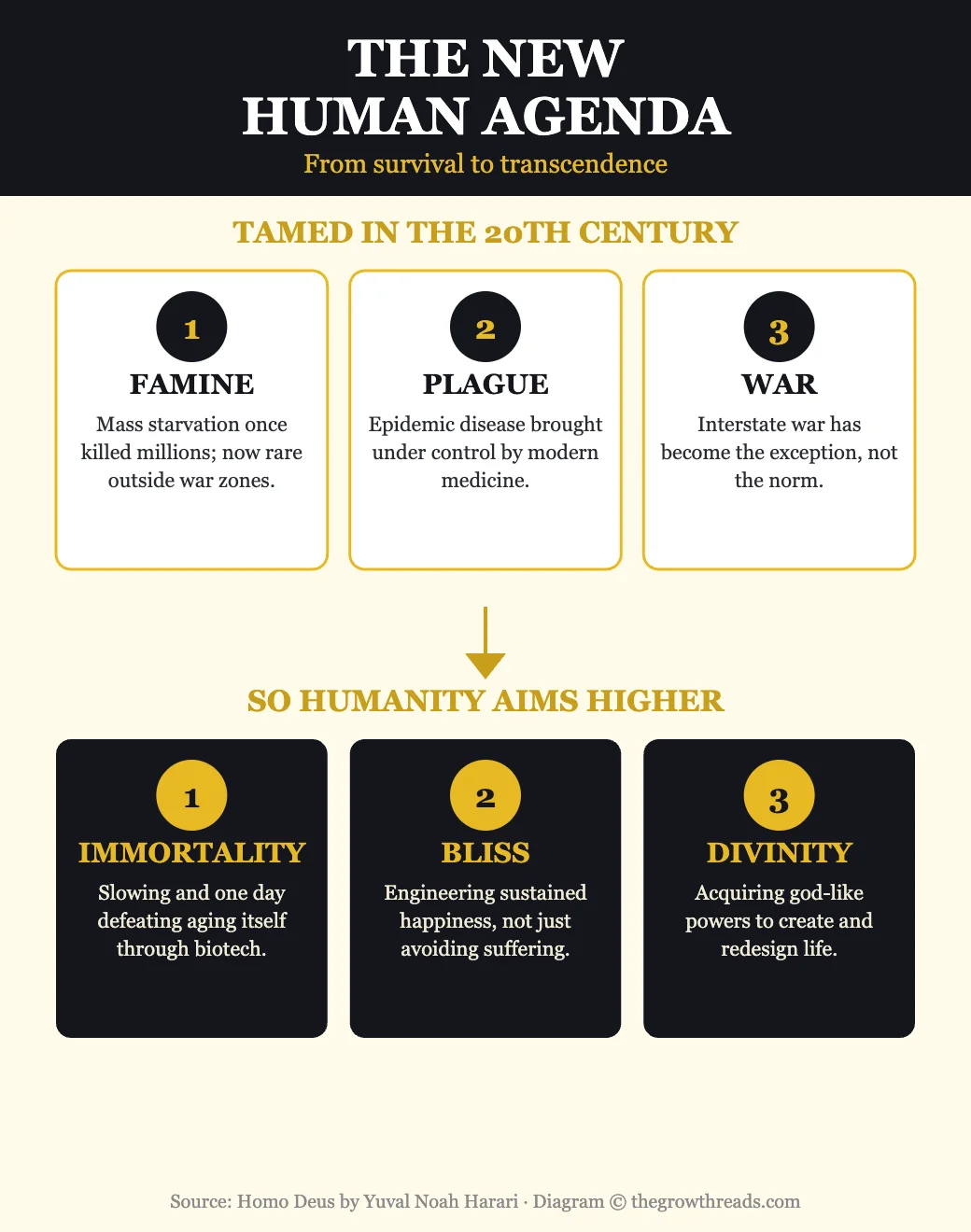
For most of history, humanity’s to-do list had three items: stop the famines, stop the plagues, stop the wars. Harari opens Homo Deus with a startling claim: by the early twenty-first century, humans have gotten remarkably good at all three. Fewer people now die from overeating than from starvation. Epidemic disease kills a smaller share of humanity than at any point in recorded history. War between states has become the exception rather than the rule. That doesn’t mean these threats are gone forever, but for the first time, they’re manageable problems rather than acts of unpredictable fate.
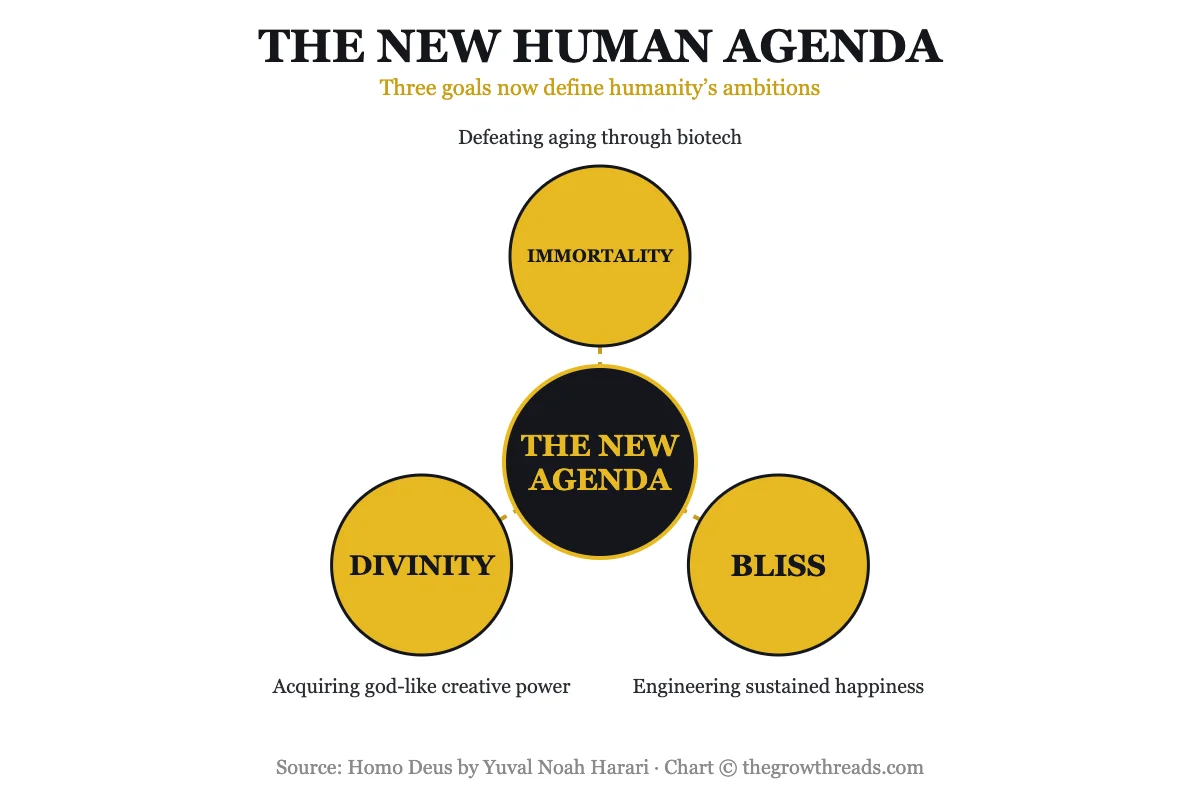
So what comes next? Harari’s answer is that humanity, having largely solved its ancient survival problems, is turning its ambitions upward: toward immortality (defeating aging), bliss (engineering sustained happiness rather than just avoiding suffering), and divinity (acquiring god-like power to create and redesign life through biotech and AI). The back half turns philosophical, arguing that liberal humanism — the idea that individual feelings are the ultimate source of meaning and authority — is being quietly undermined by algorithms that can predict our choices better than we can ourselves. Harari calls the emerging successor worldview “Dataism”: the idea that everything is best understood as a data-processing system, and the flow of information, not human experience, is what ultimately matters.
Key takeaways
- Famine, plague, and war are now manageable, not inevitable: more people die today from obesity than hunger, and epidemic and war deaths have fallen sharply versus earlier centuries.
- The new agenda is immortality, bliss, and divinity: human ambition shifts toward defeating aging, engineering happiness, and acquiring creative powers once attributed only to gods.
- Humans are algorithms, in Harari’s framing: brains and bodies can be described as biochemical algorithms that process information and produce decisions.
- Free will is a useful story, not a scientific fact: what feels like a free choice is the output of prior causes, not an uncaused first decision.
- Liberal humanism made “the individual” sacred: modern politics and ethics assume each person’s feelings are the ultimate authority — a historically recent idea.
- Algorithms increasingly out-predict human choice: from recommendations to diagnoses to voting, machine-learning systems can forecast preferences with unsettling accuracy.
- A “useless class” is a real economic risk: AI may outperform humans at both physical and cognitive tasks at once, leaving a growing group with little economic value.
- Dataism proposes a new source of authority: instead of individual feelings, a data-processing worldview trusts information flow itself — a possible successor to humanism.
- Biotech and AI converge on the same questions: both blur the line between fixing illness and upgrading healthy capability.
- The open question is where authority should sit: as power shifts toward algorithms, Harari leaves readers with who — or what — should hold authority over meaning.
What is Homo Deus about?
Homo Deus argues that having largely tamed famine, plague, and war, humanity’s next agenda shifts to immortality, bliss, and god-like power through biotechnology and AI — and that this shift is quietly undermining liberal humanism’s core belief that individual feelings are the ultimate source of meaning, replacing it with a data-driven worldview Harari calls Dataism.
About the author
Yuval Noah Harari is a historian whose book Sapiens: A Brief History of Humankind traces human history from the emergence of Homo sapiens through the cognitive, agricultural, and scientific revolutions that reshaped how humans live and understand themselves. Homo Deus, published in 2016, extends that lens forward: having spent Sapiens explaining how humanity conquered the world, Harari asks what humanity might do with that dominance now that its oldest survival threats are largely under control. A professor at the Hebrew University of Jerusalem, Harari writes for a general audience while drawing on history, biology, and philosophy; Homo Deus became a global bestseller and a direct thematic bridge to his later work on information networks, Nexus. Explore all Yuval Noah Harari book summaries →
Key concepts at a glance
| Concept | What it means | Use it when |
| The old agenda | Famine, plague, and war — now largely manageable rather than existential threats | Explaining why today’s problems feel different from previous centuries |
| The new agenda | Immortality, bliss, and divinity — the goals filling the vacuum left by tamed survival threats | Framing debates about biotech and AI ambition |
| Humans as algorithms | The view that organisms, including minds, are biochemical information-processing systems | Understanding why Harari treats free will skeptically |
| Liberal humanism | The belief that individual feelings and choices are the ultimate source of meaning and authority | Explaining the philosophical stakes of algorithmic prediction |
| The useless class | A hypothetical group whose labor and military value is superseded by AI and automation | Discussing the economic risks of automation |
| Dataism | A worldview treating data-processing — not individual experience — as the ultimate source of value | Analyzing how algorithms reshape decision-making |
| Authority shift | Decision-making power moving from individual humans to algorithms and data systems | Evaluating trust in recommendation and prediction systems |
Part 1: The Old Agenda, Conquered — Famine, Plague, and War
Harari opens by reconstructing just how dominant famine, plague, and war were for nearly all of recorded history. As recently as the early twentieth century, famine was a routine feature of life across large parts of the world, and epidemic disease could kill a meaningful share of a region’s population in a single outbreak. War between organized states was common enough that entire economies were built around expecting it. Harari’s point isn’t that these problems are solved forever — famine still exists in isolated conflict zones, and pandemics remain possible — but that for the first time in history, more people die from eating too much than too little, more die by their own hand than by another person’s violence, and interstate war has become rare enough that its absence is treated as the default.
This shift matters because it changes what a society organizes itself around. When survival is the main threat, institutions orient around managing it: storing grain, containing outbreaks, building armies. Once those threats recede, Harari argues, the freed-up ambition gets redirected. The rest of the book is an extended argument about where that ambition is heading, and what it costs.
Part 2: The New Human Agenda — Immortality, Bliss, and Divinity
With famine, plague, and war pushed toward the margins, Harari argues three new goals are filling the vacuum. The first is immortality, or more precisely “a-mortality” — not literal indestructibility, but the indefinite extension of healthy life by treating aging itself as an engineering problem, rather than an inevitable fact of biology. Anti-aging research and biotechnology investment increasingly treat death from old age as a technical failure rather than a natural endpoint.
The second goal is bliss: not merely reducing suffering, medicine’s traditional job, but actively engineering sustained happiness. Harari points to psychiatric medication, and speculatively future neurological interventions, as early steps toward treating happiness as something manufactured rather than pursued through life circumstances.
The third and most provocative goal is divinity: acquiring the kinds of creative and destructive powers mythology once reserved for gods — designing new life forms, redesigning existing ones (including ourselves), and exercising god-like control over biological systems. Harari doesn’t mean this literally; he means it as a description of where biotechnology and genetic engineering are functionally heading. Upgrading humans, he argues, is the logical continuation of curing them.
Part 3: The Useless Class — When Algorithms Out-Predict Us
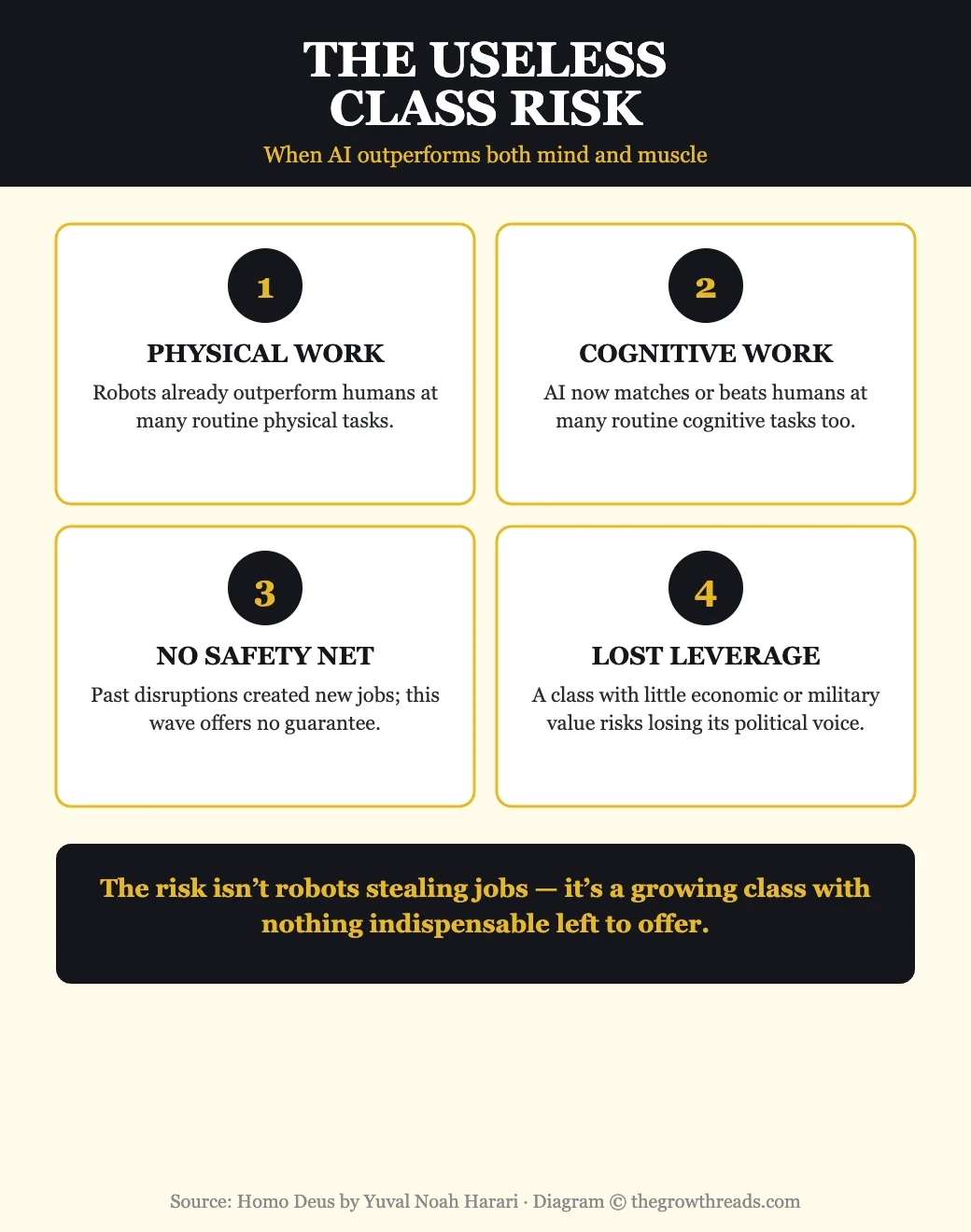
Harari’s most unsettling economic argument concerns what he calls a possible “useless class.” Historically, waves of automation displaced workers from one kind of job but created demand for new jobs elsewhere — farm labor gave way to factory work, factory work gave way to service and knowledge work. Harari’s concern is that the current wave differs in kind, not just degree: because AI increasingly can match or exceed human performance at routine physical and cognitive tasks simultaneously, there’s no guarantee enough new roles will open to absorb displaced workers the way they always have before.
This economic risk is compounded by a political one. Harari observes that historically, even the poorest humans had leverage that elites had to respect: their labor was needed to farm the fields, their bodies needed to fill the ranks of armies. A population needed for neither economic production nor military manpower risks losing that leverage entirely — not through malice, but simple economic irrelevance. This is the “useless class” risk: not that people become worthless as human beings, but that a growing group may become economically and politically dispensable in ways past generations of displaced workers never fully were.
Underlying this is Harari’s broader claim about free will. If human decisions really are the output of biochemical algorithms responding to inputs, external algorithms could plausibly model and predict those decisions with increasing accuracy. Recommendation engines that anticipate what you’ll want to watch or buy are, in Harari’s telling, crude early examples of a larger trend: systems that know your preferences better than you consciously do.
Part 4: Dataism — A New Story for Humanity
The book’s final, most philosophical turn concerns what might replace liberal humanism as humanity’s guiding worldview. Harari traces how humanism — the modern belief that individual feelings and free choices are the ultimate source of meaning and political authority — displaced older religious systems that located authority in gods or scripture. Humanism is why modern societies trust voters over kings and patients’ own reported feelings over external authorities.
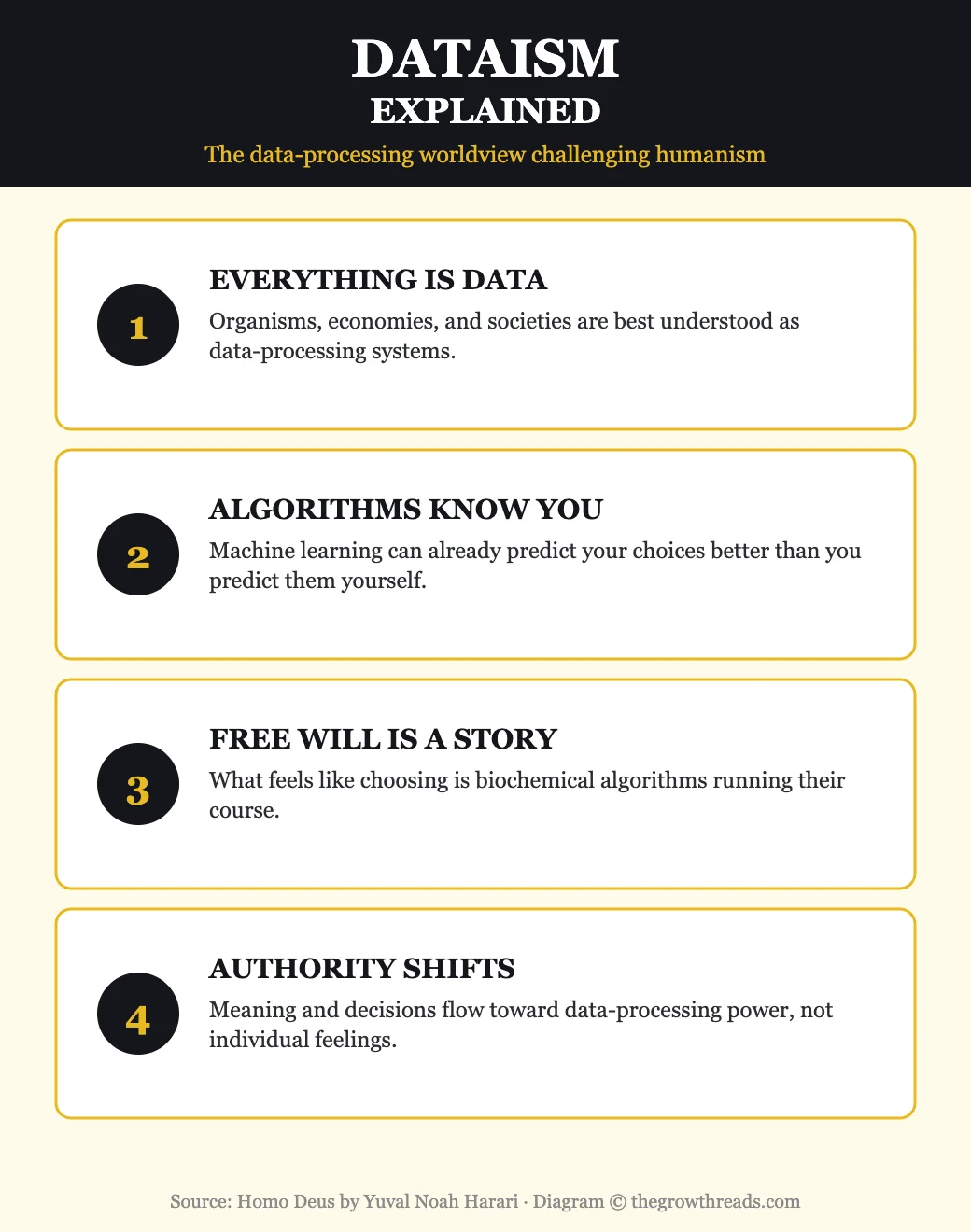
Harari’s claim is that this humanist assumption is now being quietly challenged by what he calls “Dataism”: a worldview in which organisms, economies, and societies are best understood as data-processing systems, and the free flow of information — not individual feeling — is the ultimate source of value. Under Dataism, a decision isn’t good because a person felt it was right; it’s good because it processed more relevant data than the alternative, whether in a human brain or an algorithm.
This matters practically because if algorithms genuinely can process more relevant data than an individual consciousness, trusting the algorithm’s recommendation over your own feelings starts to look rational rather than a betrayal of selfhood — the quiet erosion of humanist authority Harari worries about. He’s careful not to claim this transition is complete; the book ends with open questions rather than firm predictions. But he argues the direction of travel is already visible in medicine, dating, and recommendation systems millions defer to daily.
Who is Homo Deus best for — and who should read something else first?
Homo Deus rewards readers who enjoyed Sapiens or Nexus and want Harari’s historical lens turned toward the near future rather than the past — especially anyone curious about the philosophical stakes of AI and biotech, not just their technical mechanics.
If you haven’t read Sapiens yet, consider starting there — Homo Deus assumes some familiarity with Harari’s account of how shared fictions enabled human cooperation. Readers who want a more technical treatment of AI risk may prefer our Superintelligence summary, while readers most interested in automation’s economic effects should start with Rise of the Robots.
Questions to reflect on
- Which parts of your life already run on algorithmic recommendation — and how much do you trust those systems versus your own stated preferences?
- If you could add ten healthy years to your life through biotechnology, would you take it? What would you want to know about the tradeoffs first?
- Where do you draw the line between “curing” an illness and “upgrading” a healthy capability — and why there?
- Which daily decisions do you make most consciously, and which are closer to habit or reflex, in Harari’s terms?
- If a growing share of the population becomes economically “unneeded,” what responsibilities does that create for policy, business, or individuals?
🔥 Ready to rethink humanity’s next chapter?
Get the full picture of Harari’s argument about immortality, bliss, divinity, and the rise of Dataism.
How to apply Homo Deus (7-day plan)
- Day 1: List the “old agenda” threats (famine, plague, war) as they’ve shown up in your own family history within living memory, to feel how recent the shift really is.
- Day 2: Audit one algorithmic system you use daily and write down what it seems to know about your preferences that you haven’t explicitly told it.
- Day 3: Write one paragraph on what “immortality” and “bliss” would mean to you personally if biotechnology made both plausible — not abstractly, but for your own life.
- Day 4: Identify one task in your work that AI already does as well as a human, and one it clearly can’t yet — notice the actual boundary, not the headline version.
- Day 5: Have a conversation with someone about where decision-making authority should sit — individual feelings, data and algorithms, or somewhere in between.
- Day 6: Read (or reread) one chapter of Sapiens or Nexus alongside your Homo Deus notes to trace Harari’s throughline across the trilogy.
- Day 7: Write a short personal statement on what the “new agenda” should be for your own life, industry, or community — your own answer to the question Harari leaves open.
Frequently asked questions
What is the main argument of Homo Deus?
Homo Deus argues that having largely tamed famine, plague, and war, humanity’s next agenda shifts toward immortality, bliss, and acquiring god-like creative power through biotechnology and AI. The second half argues that this shift comes with a deeper philosophical change: liberal humanism’s assumption that individual feelings are the ultimate source of meaning is being challenged by “Dataism,” a worldview that treats data-processing itself as the ultimate source of value and authority.
Do I need to read Sapiens before Homo Deus?
It isn’t strictly required, but it helps. Sapiens establishes Harari’s core idea that shared fictions — money, nations, religions — enable large-scale human cooperation, and Homo Deus builds on that foundation when discussing humanism as a kind of shared fiction. Readers who start with Homo Deus alone can still follow the argument, but the historical grounding makes the philosophical claims land harder.
What is Dataism, according to Harari?
Dataism is Harari’s term for an emerging worldview that treats organisms, economies, and societies as data-processing systems, where the free flow of information — not individual feeling — is the ultimate source of value. A decision is judged by whether it processed more relevant data effectively, whether that happens in a human brain or an algorithm, which Harari argues is quietly displacing humanism’s trust in individual feelings as final authority.
What does Harari mean by the “useless class”?
The “useless class” is Harari’s term for a hypothetical growing group whose labor isn’t needed by the economy and whose bodies aren’t needed by the military — unlike past automation, which displaced workers into new roles, Harari worries AI could outperform humans at physical and cognitive tasks at once, removing the leverage even the poorest people historically held through necessary labor.
Is Homo Deus a prediction of the future?
No — Harari is explicit that the book explores possibilities and tendencies, not certainties. He frames immortality, bliss, divinity, and Dataism as directions humanity’s ambitions are pointed toward, not guaranteed outcomes. It’s better read as a framework for asking better questions about where biotech and AI are taking society than as a forecast.
How does Homo Deus relate to Harari’s later book, Nexus?
Nexus (2024) zooms out from Homo Deus’s questions about algorithms and authority to the longer history of information networks — how societies from ancient religions to modern AI have organized around processing information. Homo Deus asks what happens once algorithms out-predict individual humans; Nexus asks how information networks have shaped cooperation and control throughout history.
Are Harari’s claims in Homo Deus scientifically settled?
Some framing, particularly around free will and consciousness, draws on contested areas of neuroscience and philosophy; not all researchers accept his strong version of the “no free will” argument. His observations about automation trends and biotechnology investment are less controversial, even where readers may disagree with his broader conclusions.
Related summaries
- Nexus by Yuval Noah Harari — the sequel-in-spirit, tracing information networks across human history
- Superintelligence by Nick Bostrom — a more technical treatment of AI risk and control
- Rise of the Robots by Martin Ford — a deeper economic look at the useless-class risk
- The Age of Surveillance Capitalism by Shoshana Zuboff — how Dataism’s commercial infrastructure was built
- Best AI & Technology Books — the full Technology silo reading list
How we analyze books: our team reads the full text, cross-references key claims against the author’s public interviews and other reputable sources, and structures each summary around the book’s actual argument — not just its marketing description. We add original synthesis, application plans, and reflection questions that go beyond the book itself. Read our full methodology.
Related Technology Summaries
Machine, Platform, Crowd Summary & Review: Three Shifts Reshaping Every Industry
Rise of the Robots Summary & Review: Why Automation Now Threatens Cognitive Jobs Too
The AI-First Company Summary & Review (2026)
The New Breed Summary & Review: What Animals Teach Us About Living with Robots
The Second Machine Age Summary & Review: The Bounty and the Spread of Digital Technology