

Best for: Product managers, designers, marketers, and founders building anything people use repeatedly.
Reading time: About 4 hours for the full book · 11 minutes for this guide.
Difficulty to apply: Moderate — the model is simple, using it responsibly takes judgment.
Hooked in one minute
Some products you open once and forget. Others you reach for without thinking, dozens of times a day. Nir Eyal’s Hooked explains the difference with a single repeatable cycle: a trigger prompts an action, the action delivers an unpredictable reward, and the reward earns an investment from the user that makes the next trigger even more effective. Run that loop enough times and a conscious choice turns into an unconscious habit. Eyal, a product and behavioral-design consultant, wrote Hooked as a practical manual for the Trigger–Action–Reward–Investment cycle — and, importantly, as a way to check whether the habit you’re designing actually helps the people forming it.
Key takeaways
- Habits form through a repeatable loop: Trigger, Action, Variable Reward, Investment — run enough times, it becomes automatic.
- External triggers start the habit; internal triggers sustain it: the goal is for an emotion, not a notification, to eventually cue the behavior.
- Action needs to be the simplest possible behavior: reduce time, effort, and thinking required, or motivation alone won’t be enough.
- Rewards work because they’re variable, not because they’re big: unpredictability, not size, is what keeps people checking.
- There are three flavors of variable reward: the tribe (social), the hunt (resources/information), and the self (mastery, completion).
- Investment is what loads the next trigger: time, data, effort, or followers raise the odds — and the stakes — of returning.
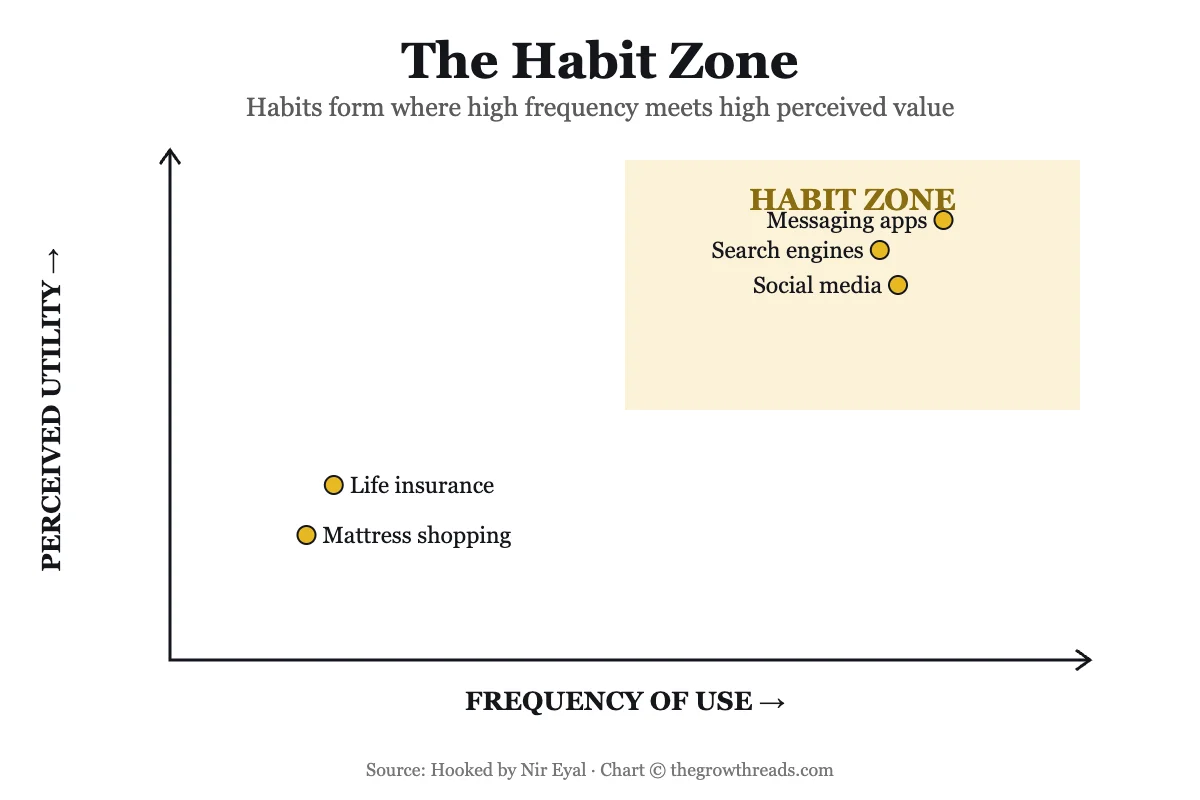
- Not every product belongs in “the habit zone”: high frequency and high perceived utility both matter; forcing a habit onto a low-utility product backfires.
- Habit-forming design is a responsibility, not just a growth tactic: Eyal’s Manipulation Matrix is a built-in check against building something exploitative.
What is Hooked about?
Hooked (2014) is Nir Eyal’s guide to designing habit-forming products using a four-step cycle: Trigger, Action, Variable Reward, and Investment. Drawing on behavioral psychology and case studies from Instagram, Pinterest, and Twitter, Eyal explains how repeated use turns into an automatic habit — and offers a framework for checking whether that habit genuinely benefits the user.
About the author
Nir Eyal is a behavioral design expert and former startup founder who has taught at Stanford’s Graduate School of Business and Design School. Hooked grew out of years spent studying why some products become daily habits and others get abandoned after a single use, drawing on research in behavioral psychology alongside his own experience building consumer products. Explore all Nir Eyal book summaries →
Eyal is also known for Indistractable, a later book that turns the same lens around to help readers manage their own attention rather than capture someone else’s. Read together, the two books make Eyal one of the few writers to seriously examine habit formation from both the maker’s side and the user’s side.
Key concepts at a glance
| Concept | What it means | Use it when |
|---|---|---|
| The Hook Model | The four-step cycle: Trigger, Action, Variable Reward, Investment | You’re designing a product you want people to return to on their own |
| External trigger | A cue in the world telling the user what to do next: a notification, an email, an ad | You’re guiding a brand-new user toward their first action |
| Internal trigger | An emotion or situation that prompts a habitual reach for a product | You want a product people reach for without being told to |
| Variable reward | A payoff whose exact form or size isn’t fully predictable | You want checking your product to feel worth it every time |
| Investment | Something the user puts in that improves the product’s value with use | You want switching costs and stored value to grow over time |
| The Habit Zone | The sweet spot of high frequency and high perceived utility | You’re deciding whether a habit is even the right goal for this product |
| Manipulation Matrix | A 2×2 check on whether a hook helps users or exploits them | You want to know if you’re building a facilitator or a dealer |
| Fogg Behavior Model | Behavior happens when motivation, ability, and a trigger converge at once | A feature isn’t getting used and you need to diagnose why |
Part 1: The Hook Model — The Engine of Habit-Forming Products
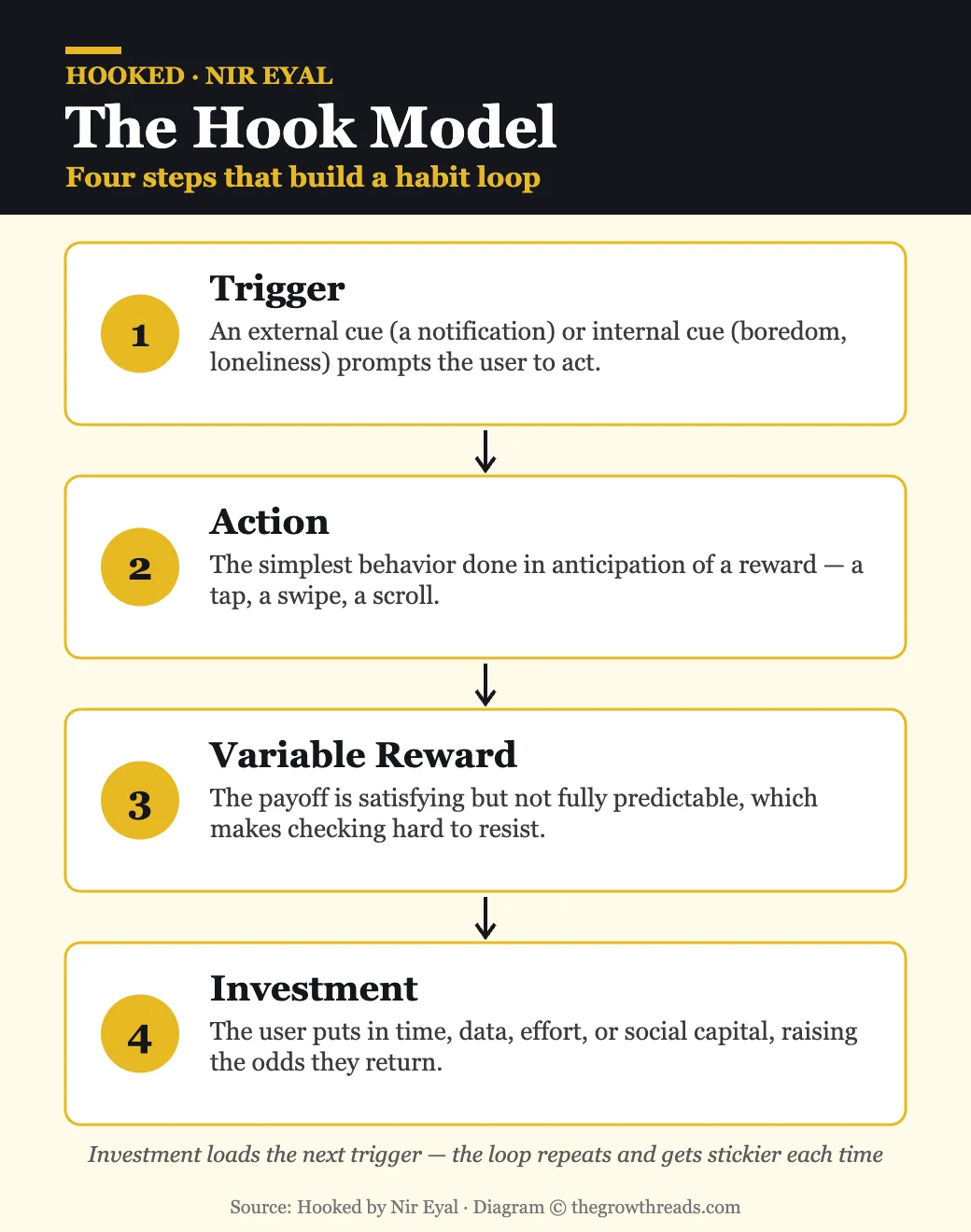
Every habit-forming product, Eyal argues, runs on the same four-step loop. A trigger prompts the user to act — either an external cue like a push notification, or an internal cue like boredom or loneliness that the user has learned to soothe with the product. The action is the simplest behavior taken in anticipation of a reward: a tap, a swipe, a scroll. The reward is variable enough to feel worth checking for. And the investment is something the user puts in — time, data, followers, effort — that makes the next trigger more effective and raises the odds they’ll cycle through the loop again.
The real engine of the model is the shift from external to internal triggers. Early on, a new product needs to nudge users with notifications and emails. But a habit, in Eyal’s definition, is a behavior done with little or no conscious thought — which means the goal is for an emotion to eventually do the triggering instead of a push alert. Once boredom alone makes someone open an app, the external trigger has done its job and can step back.
This is also why habits are hard to build and easy to underestimate: the loop has to run enough times, with a strong enough reward and investment at each pass, for behavior to become automatic. A single well-designed session doesn’t create a habit; a well-designed loop repeated dozens of times does.
Part 2: Action — Why Simplicity Beats Features
Eyal leans on BJ Fogg’s Behavior Model to explain why some triggers fire a habit and others fall flat: behavior happens when motivation, ability, and a trigger converge at the same moment. Raise motivation, or lower the effort required, and the same trigger becomes more likely to work. Most teams instinctively reach for motivation — better copy, bigger incentives — when the cheaper and more reliable lever is usually ability: removing friction until the desired action is almost trivial to complete.
Eyal breaks “ability” down into concrete constraints: time, money, physical effort, brain cycles (how much thinking is required), social deviance (does it feel normal to do this?), and non-routineness (does it fit an existing habit, or does it ask for a new one?). A product that’s hard to use along any of these dimensions is fighting itself before the reward ever has a chance to land.
Motivation itself, in Eyal’s telling, boils down to three core drives: the pursuit of pleasure and avoidance of pain, the pursuit of hope and avoidance of fear, and the pursuit of social acceptance and avoidance of rejection. Nearly every effective trigger taps into one of these three, which is why “just add a notification” so often fails — a trigger with no real motivational hook behind it has nothing to activate.
Part 3: Variable Reward — Why Unpredictability Is Addictive
Slot machines aren’t compelling because the payout is large — most pulls lose. They’re compelling because the payout is unpredictable, and that uncertainty triggers a stronger dopamine response than a reliable reward ever could. Eyal argues the same mechanic runs through most habit-forming software: an inbox, a news feed, a “pull to refresh” gesture are all, structurally, slot machines dressed up as productivity or connection.
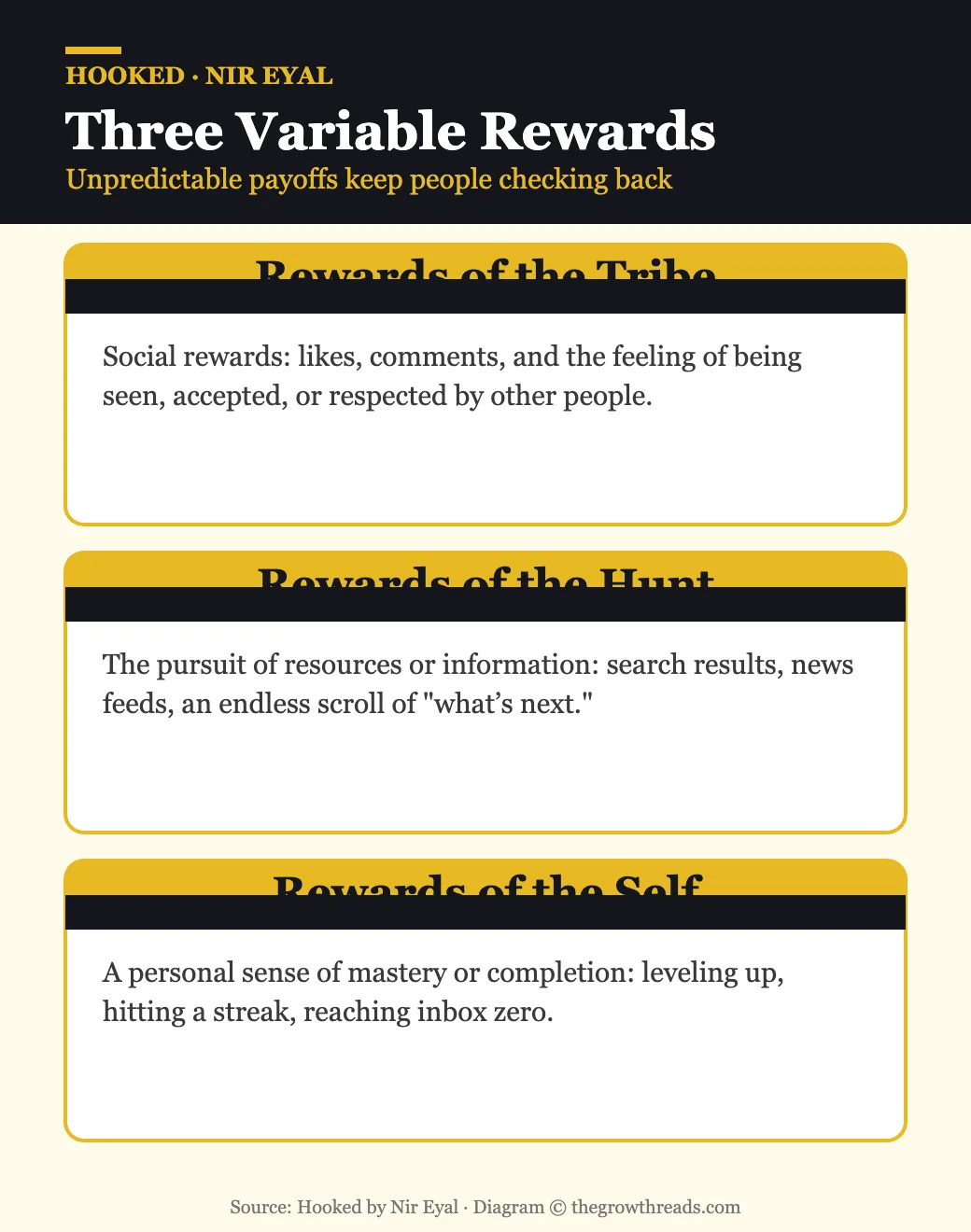
He groups variable rewards into three types. Rewards of the tribe are social — likes, comments, the sense of being seen or accepted by other people. Rewards of the hunt are about pursuing resources or information — a search result, a scrolling feed, the next interesting thing. Rewards of the self are about personal accomplishment — leveling up, hitting a streak, reaching inbox zero. Most successful products lean on more than one type at once, which is part of why they’re so effective at holding attention.
The uncomfortable implication is that “engagement” and “manipulation” often share the same underlying mechanism. Eyal doesn’t shy away from this — which is exactly why the ethics chapter that follows matters as much as the mechanics.
Part 4: Investment — Loading the Next Trigger, and the Ethics of Hooks
The investment phase is where a product stops being a habit and starts becoming a relationship. Every time a user follows an account, builds a playlist, fills out a profile, or writes a review, they’re storing value inside the product and, often unknowingly, loading the trigger for their next visit — a notification about a new follower only means something because they invested in building a following in the first place. Investment is also what raises switching costs: the more a user has put in, the more they stand to lose by leaving.
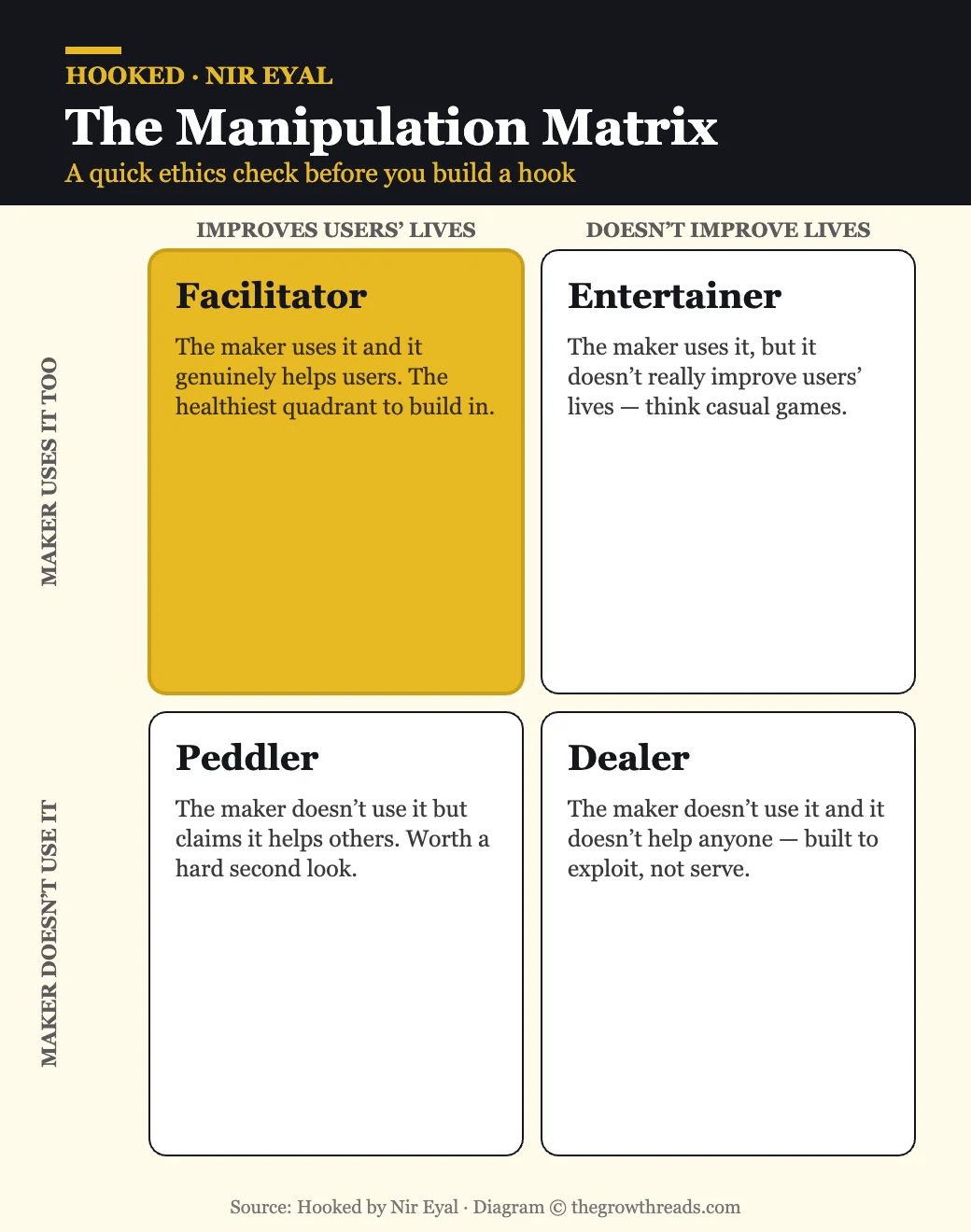
Because this loop is powerful enough to shape behavior below the level of conscious choice, Eyal spends the book’s final chapter on when that power is being used well and when it’s being abused. His Manipulation Matrix asks two questions: does the product materially improve the user’s life, and would the maker use it themselves? Products that pass both tests — facilitators — are the ones worth building. Products that fail both, built by people who wouldn’t use their own product and don’t believe it helps anyone, are what he calls dealers: technically effective, ethically indefensible.
Eyal’s own test for founders is blunt: if you wouldn’t want your own kids using what you’re building the way you intend it to be used, that’s a signal worth taking seriously before you ship the next hook.
Who is Hooked best for — and who should read something else first?
Hooked is best for product managers, designers, marketers, and founders building anything people are meant to use repeatedly — apps, tools, content platforms, even physical products with a digital layer. It rewards readers with a specific feature or product already in mind more than complete beginners looking for a general growth playbook.
If you want to understand habit formation from the user’s side before you design for it from the maker’s side, start with our summary of Irresistible. If your interest is more about reclaiming your own attention than building products that capture it, our summary of Indistractable, Eyal’s own follow-up, is the better next stop.
Questions to reflect on
- What’s the internal trigger — the emotion — that makes people reach for your product, and do you actually know it, or are you guessing?
- Where in your product is the “action” step more effortful than it needs to be?
- Which of the three variable rewards (tribe, hunt, self) does your product lean on — and is that the right one for what you’re building?
- What is the user investing when they use your product, and does that investment genuinely improve their experience, or just lock them in?
- Running the Manipulation Matrix honestly: would you want the people you care about most using what you’re building, the way you intend it to be used?
🔥 Ready to design your own habit-forming product, responsibly?
Grab a copy of Hooked and run your own product through the Hook Model and the Manipulation Matrix.
How to apply Hooked (7-day plan)
- Day 1: Map the Hook Model onto your own product: name the trigger, the action, the reward, and the investment step by step.
- Day 2: Identify whether your first-time users are relying on an external trigger — and sketch what internal trigger you actually want to earn over time.
- Day 3: Run your core action through the ability checklist — time, money, effort, brain cycles, social deviance, routine — and cut friction wherever you can.
- Day 4: Audit your reward: is it the same every time, or genuinely variable? If it’s static, sketch one way to introduce healthy unpredictability.
- Day 5: Classify your reward as tribe, hunt, or self — and check whether that matches what your users say they actually want from you.
- Day 6: List what your product asks users to invest, and confirm each investment genuinely improves their next visit rather than just raising switching costs.
- Day 7: Run your product through the Manipulation Matrix, honestly, and write down which quadrant it’s actually in today.
Frequently asked questions
What is the main idea of Hooked?
The book’s central claim is that habit-forming products are built, not accidental, and that they share a common four-step cycle: a trigger prompts an action, the action delivers a variable reward, and the reward earns an investment from the user that makes the next trigger even more effective. Run enough times, this loop turns a conscious choice into an automatic habit. Eyal pairs the mechanics with an ethical framework, the Manipulation Matrix, for checking whether a given habit actually benefits the people forming it or simply exploits them.
Is Hooked still relevant given how much has changed in tech since 2014?
Yes — the psychological mechanics Eyal describes (variable reward, investment, internal triggers) haven’t changed, even though the specific apps he cites have evolved or been replaced. If anything, the book has become more relevant as a diagnostic tool, since most major consumer apps released since 2014 visibly use the exact patterns it describes. Readers should treat the case studies as illustrations of timeless mechanics rather than a current app landscape.
What is the Hook Model?
The Hook Model is Eyal’s four-step framework for habit formation: Trigger (an external or internal cue), Action (the simplest behavior done in anticipation of a reward), Variable Reward (a payoff that isn’t fully predictable), and Investment (something the user puts in that raises the odds of returning). The cycle is meant to repeat, with each pass making the habit slightly more automatic and each investment loading a stronger version of the next trigger.
What’s the difference between an external and an internal trigger?
An external trigger is a cue in the environment that tells a user what to do next, like a push notification, an email, or an app icon. An internal trigger is an emotion or situational cue, like boredom, loneliness, or uncertainty, that a user has learned to soothe by using a product, without needing to be told. Eyal argues the real goal of habit design is to graduate users from needing external triggers to acting on internal ones alone.
What is the Manipulation Matrix?
The Manipulation Matrix is Eyal’s ethical framework for evaluating a habit-forming product, built on two questions: does the product materially improve the user’s life, and would the maker use it themselves? The four resulting quadrants are Facilitator (yes to both, the healthiest category), Entertainer (the maker uses it but it doesn’t really help users), Peddler (claims to help but the maker wouldn’t use it), and Dealer (helps no one and the maker knows it). It’s meant as a gut check before shipping a hook, not just a growth framework.
Is Hooked only useful for app and software designers?
No — the framework generalizes to any product or experience meant to be used repeatedly, including physical products, content platforms, educational tools, and even internal workplace systems. Readers outside software tend to focus on the trigger and reward chapters, adapting “variable reward” and “investment” to whatever repeat behavior they’re trying to encourage, rather than the technical app-store growth tactics in the book’s appendix.
Does Hooked address the ethics of habit-forming design?
Yes, explicitly, in its final chapter and in a later afterword Eyal added partly in response to criticism that habit-forming design can shade into manipulation or addiction. The Manipulation Matrix is his direct answer: a framework for distinguishing products that genuinely serve users from those that exploit psychological vulnerabilities for engagement metrics. Critics have noted the matrix relies on self-assessment, which is a real limitation — but it’s a more serious attempt at self-regulation than most growth-hacking literature offers.
Related summaries
- Irresistible Summary & Review
- Indistractable Summary & Review
- The Attention Merchants Summary & Review
- Best AI & Technology Books
Related Technology Summaries
Homo Deus: A Brief History of Tomorrow Summary & Review (2026)
Human-Centered AI Summary & Review: Turn Up Automation AND Human Control
Machine, Platform, Crowd Summary & Review: Three Shifts Reshaping Every Industry
Superagency Summary & Review: What Could Possibly Go Right with AI
The Shallows Summary & Review: How the Internet Is Rewiring Your Brain