

★★★★☆ — 4.3/5 — A genuinely different way into the AI-future genre: half short story, half fact-check, built to test imagination against evidence.
Best for: Readers who want to feel their way through how robots and AI might show up in daily life, not just read another workplace-automation forecast.
Reading time: ~7 hrs to read the book · 11 min to read this summary
Difficulty to apply: Easy — the payoff here is sharper questions and a calibrated sense of timelines, not a checklist.
Talking to Robots in one minute
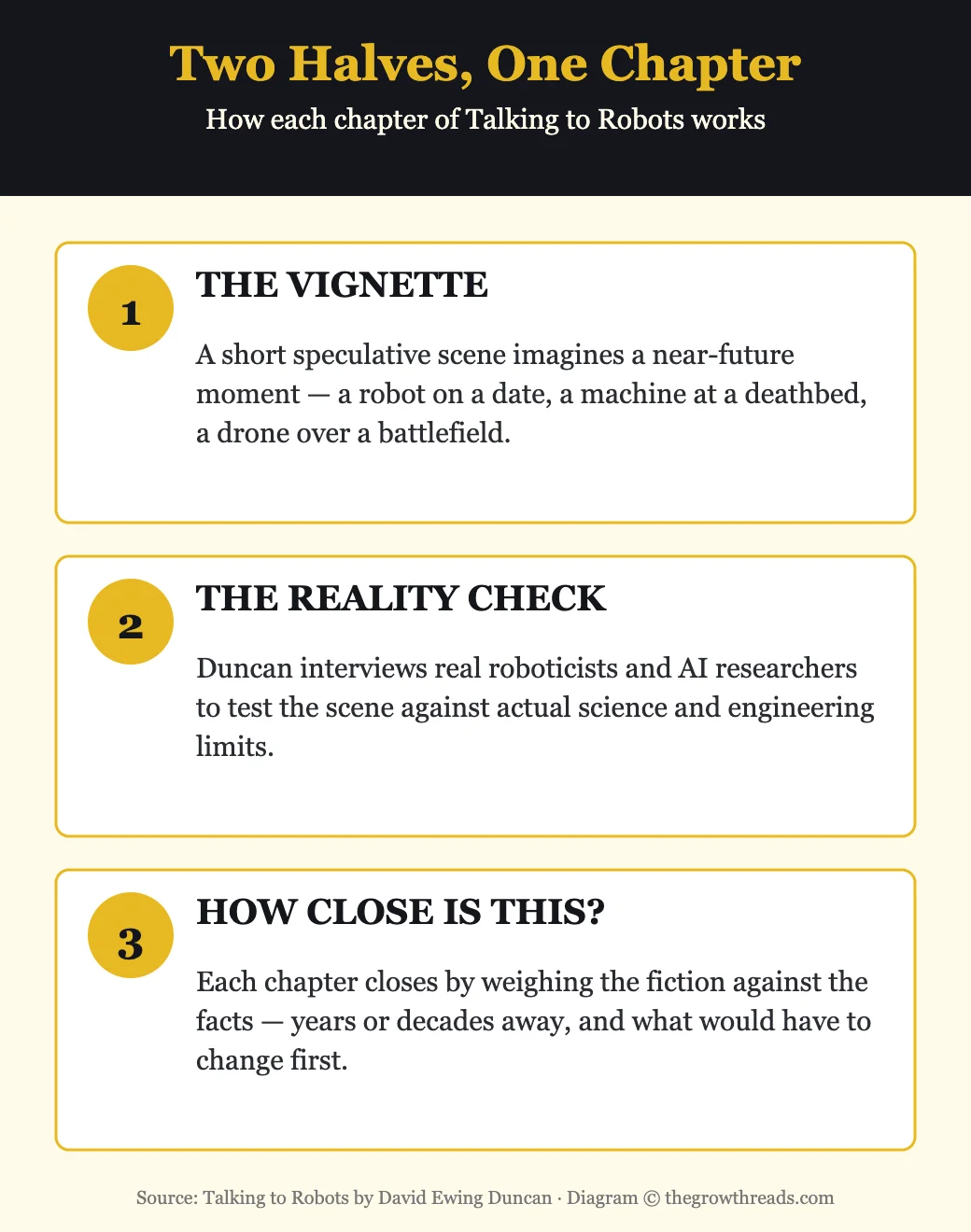
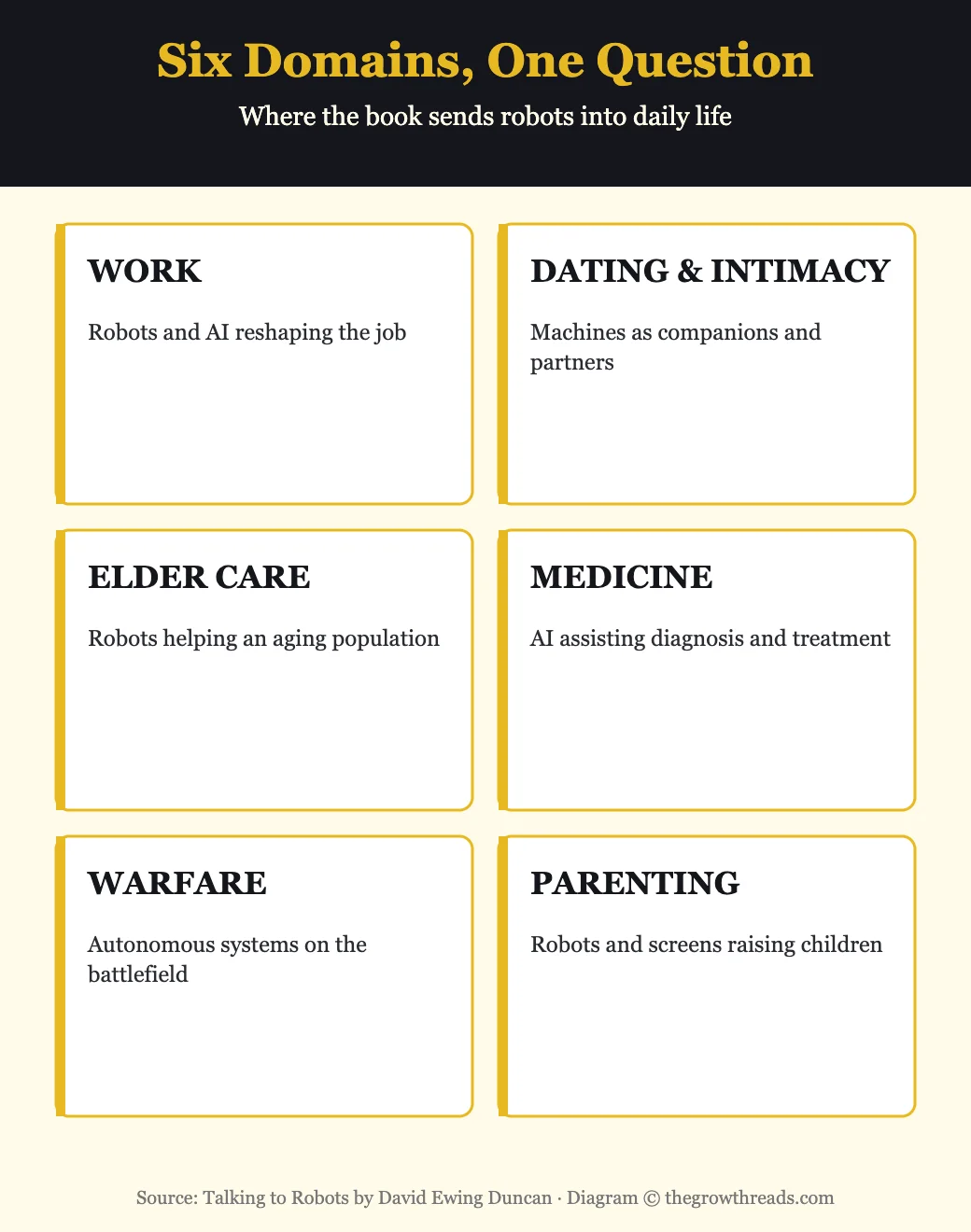
David Ewing Duncan’s Talking to Robots: Tales from Our Human-Robot Futures takes an unusual double-barreled approach to imagining the AI future. Each chapter opens with a short piece of speculative fiction — a vignette imagining a specific domain of life a decade or more from now, once robots and AI have become part of the routine. Duncan then steps out of the story and into journalism, interviewing scientists, engineers, and ethicists to pressure-test how plausible that scene really is, and how far current technology sits from making it real. The domains he covers run from the workplace to the bedroom to the hospital room: work and hiring, dating and relationships, elder care, medicine, parenting, and warfare. The result reads less like a forecast and more like a structured thought experiment — imagine boldly, then check your work against the people actually building the technology.
Key takeaways
- Pairing fiction with reporting turns “could this happen” into “how close is this, really” — a more useful question for readers than pure speculation.
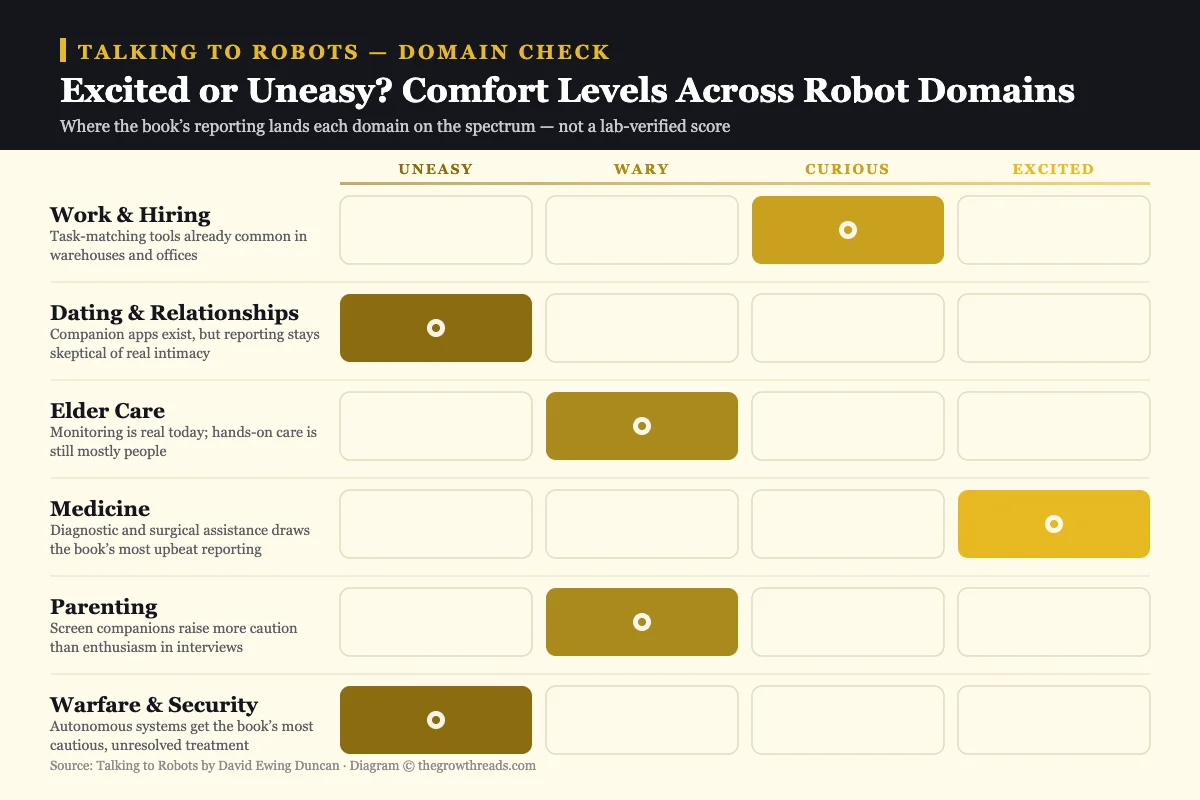
- Comfort with robots is not one dial — it varies sharply by domain, and the book treats that variation as the real story, not a footnote.
- Work and hiring is where automation already feels familiar, which makes it the easiest domain for readers to calibrate the rest against.
- Robots entering dating and relationships draw the most skepticism from the researchers Duncan interviews, even when the underlying technology exists.
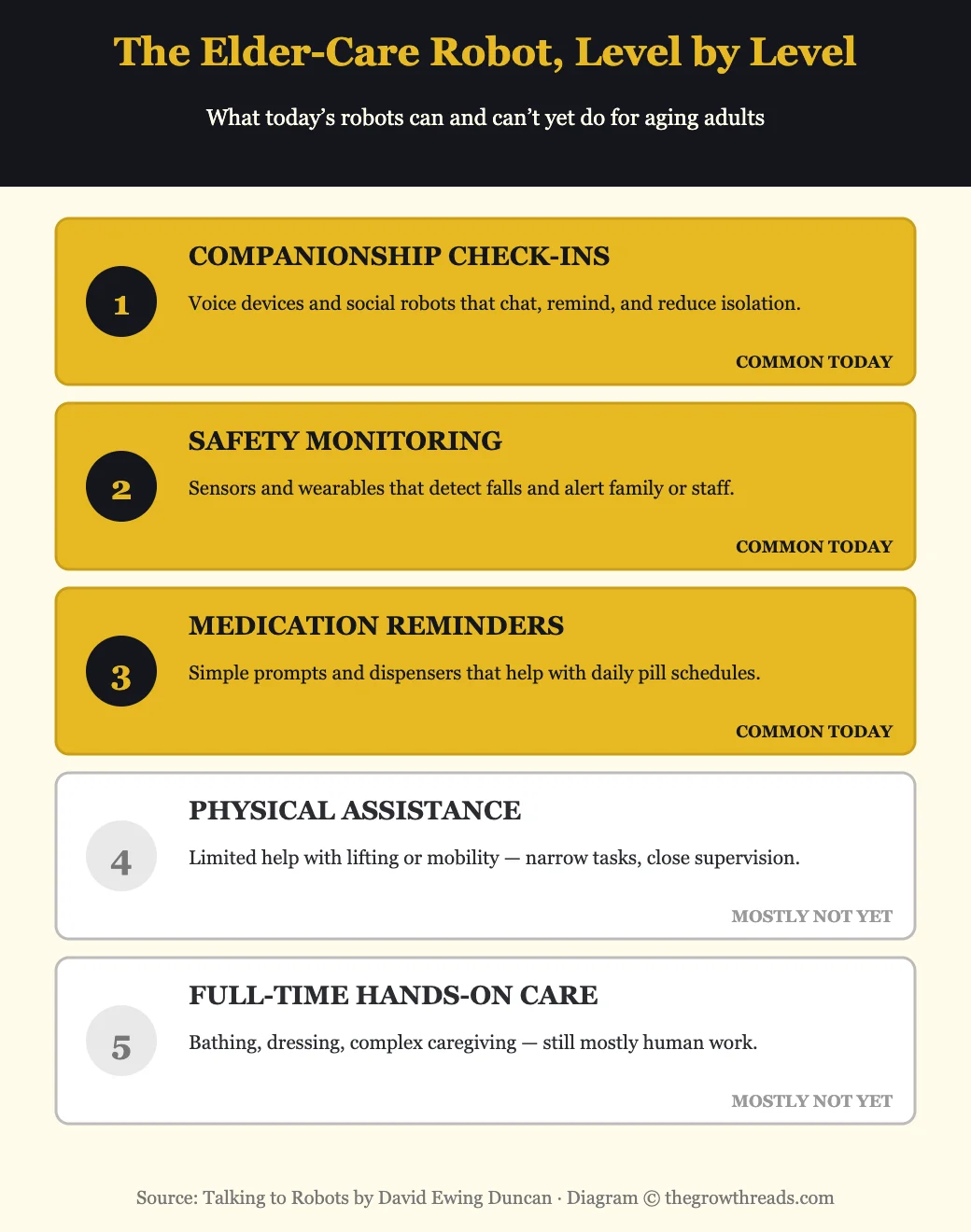
- Elder care shows the widest gap between what is common today (monitoring, reminders, check-ins) and what is still mostly people (hands-on physical care).
- Medicine is treated as one of the more genuinely promising domains, with diagnostic and assistive tools already earning cautious optimism.
- Parenting and childhood are handled with unusual restraint — Duncan is more interested in what a screen-companion changes about a childhood than in the technology itself.
- Warfare gets the book’s most unresolved chapter, because the pace of military AI development often outruns the ethical debate about it.
- Across every domain, the recurring finding is that the lab-to-living-room gap is wider than headlines suggest.
What is Talking to Robots about?
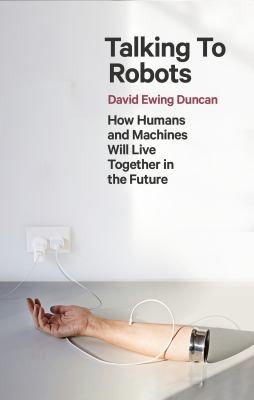
Published in 2019, Talking to Robots grew out of Duncan’s years covering biotechnology and artificial intelligence as a science journalist. Rather than write a straight survey of robotics research, he builds each chapter around a paired structure: a short speculative-fiction scene set roughly a decade or more into the future, followed by reporting that interrogates the scene. A vignette might follow a manager reviewing an AI-assisted hiring shortlist, a lonely commuter testing a companion app, or an adult child weighing whether a home-care robot is right for an aging parent. Once the fiction ends, Duncan turns interviewer, tracking down the researchers, roboticists, and ethicists closest to that specific slice of the technology and asking a version of the same question every time: how far is this from real, and what would have to change to get there. The book does not organize itself around a single argument about AI’s trajectory. Instead it works domain by domain — treating work, relationships, caregiving, medicine, childhood, and warfare as separate territories, each with its own pace of change, its own comfort level, and its own open ethical questions. That structure is also the book’s clearest signature: it refuses to let a single sweeping claim about “the AI future” stand in for what is really a patchwork of very different futures, arriving at very different speeds.
About the author
David Ewing Duncan is an American science journalist and author who has spent decades reporting on the frontiers of biotechnology, genetics, and artificial intelligence for outlets including The Atlantic, Wired, The New York Times, and NPR. He founded the Center for Life Science Policy at UC Berkeley and has written several books examining how emerging technology reshapes everyday life. Talking to Robots: Tales from Our Human-Robot Futures, published in 2019, is his contribution to the growing shelf of books trying to make sense of what AI and robotics mean beyond the lab — distinguished by its willingness to imagine first and fact-check second, rather than the other way around. Explore all David Ewing Duncan book summaries →
Key concepts at a glance
| Concept | What it means in the book |
|---|---|
| Vignette-and-reality-check structure | Each chapter opens with speculative fiction, then reports on how close current technology actually is to that scene. |
| Domain-by-domain approach | Work, dating, elder care, medicine, parenting, and warfare are treated as separate stories with separate timelines, not one AI narrative. |
| The plausibility gap | The recurring distance between what a demo or prototype can do and what actually reaches ordinary households. |
| Comfort versus capability | How willing people are to accept a robot in a domain often has little to do with whether the technology can already do the job. |
| Expert grounding | Every speculative scene is checked against interviews with the scientists and engineers working closest to that technology. |
Part 1: A Book Built to Test Itself
The most distinctive thing about Talking to Robots is not any single prediction — it is the method. Most books about the AI future pick a lane: either speculative and imaginative, or reported and cautious. Duncan refuses to choose. Each chapter opens with a short scene, written with genuine narrative craft, that drops the reader into a plausible-sounding future moment. Then, without ceremony, the book pivots into journalism. Duncan tracks down the people actually building the underlying technology and asks them to grade the scene: what part is close, what part is decades away, and what part may never happen at all.
That pairing does real work. Speculative fiction alone lets a writer’s imagination run past what evidence supports, and straight tech journalism alone can feel dry and disconnected from lived experience. By forcing the two into the same chapter, Duncan builds in a kind of self-correction — the reader gets to feel the pull of the future the fiction imagines, and then immediately gets a measuring stick for how real that pull actually is. It also means the book reads less like a set of predictions and more like a running audit of how the AI-future genre usually oversells itself.
The “how close is this, really” question turns out to be more useful than “is this possible in theory.” Almost anything is possible in theory. What Duncan is actually chasing, chapter after chapter, is timeline and friction — the gap between a working prototype in a lab and a device or service an ordinary family would actually use.
TGR Note: John Markoff’s Machines of Loving Grace asks a related question about keeping AI development human-centered, but from inside the history of computer science rather than through fiction — pairing the two gives a fuller picture of how researchers actually think about these tradeoffs.
Part 2: Robots at Work and in Relationships
The book opens its domain tour with the territory readers are already primed to think about: work. Duncan’s vignette imagines a manager leaning on an AI system to screen and rank candidates, and the reporting that follows lands somewhere between the two extremes readers usually hear. Task-matching and decision-support tools are already common in warehouses, call centers, and back offices — that part of the fiction is barely speculative at all. What is further out is full judgment-level delegation: letting a system make the final call rather than narrow the options for a person to choose from. The chapter’s throughline is that automation at work is less a single leap than a slow redrawing of where the human decision sits in the process.
Dating and relationships get a very different treatment. Here the vignette imagines a companion app sophisticated enough to feel like a genuine relationship, and the reporting turns notably more skeptical. Companion technology already exists and people already use it, but the researchers Duncan talks to are far more cautious about equating that usage with anything resembling real intimacy or attachment. This is the domain where the book’s comfort-versus-capability distinction shows up most clearly: the technical pieces are closer to real than most readers assume, but the social and psychological readiness for it lags well behind.
Placed side by side, work and relationships make the book’s central claim visible without Duncan having to state it outright: two domains can have similar levels of technical maturity and still sit at completely different points on the public’s comfort spectrum. Familiarity, not capability, is doing most of the work in how ready people feel.
That domain-by-domain variation is the organizing idea of the whole book, and it is worth seeing laid out side by side before going deeper into any one chapter.
TGR Note: Martin Ford’s Rise of the Robots goes much deeper on the work-and-automation domain specifically, while Kate Darling’s The New Breed offers a more sustained argument for treating robots as a genuinely new category rather than either tools or almost-people — a useful companion to how Duncan handles the relationships chapter.
Part 3: Elder Care and Parenting — Where the Book Gets Personal
Elder care is where Talking to Robots is most distinctive relative to the rest of the AI-and-robotics shelf. Where other books tend to fold caregiving into a broader “robots and the future of labor” argument, Duncan gives it room as its own domain, and the fiction-then-fact-check structure earns its keep here. The vignette imagines a robot woven into an aging parent’s daily routine, and the reporting that follows draws a sharp line most readers will not expect: companionship check-ins, safety monitoring, and medication reminders are already real and already deployed in various forms. Full physical assistance — lifting, bathing, the hands-on work of caregiving — remains mostly the province of people, and the researchers Duncan interviews are not shy about how far off genuinely capable physical-care robots still are. It is the domain in the book where the gap between “common today” and “mostly not yet” is drawn most clearly.
Parenting gets a quieter, more reflective chapter. Rather than dwelling on the technical feasibility of a robot nanny or a screen-based companion for a child, Duncan spends more of his reporting on what such a device would change about childhood itself — attention, imagination, the texture of a kid’s day — treating the technology question as secondary to the human one. It is the chapter where the book leans furthest from “can we build this” toward “should we, and what would it cost.”
TGR Note: If the caregiving chapter is the one that stays with you, Kate Darling’s The New Breed is the natural next read — it spends much more time on how people actually bond with robots in the home, which is exactly the question Duncan’s elder-care vignette raises but does not fully resolve.
Part 4: Medicine and Warfare — The High-Stakes Domains
Medicine is the domain where Duncan lets himself sound the most optimistic, and the reporting largely supports it. The vignette imagines AI assisting in diagnosis and surgical decision-making, and the experts he interviews are notably less guarded here than in almost any other chapter — diagnostic support tools and assistive surgical systems are already earning real, if cautious, trust from clinicians. The catch Duncan keeps circling back to is not whether the technology works, but how it integrates: into liability, into doctor-patient trust, into a healthcare system that adopts new tools unevenly and slowly regardless of how good they are.
Warfare closes the book on its most unresolved note. The vignette is deliberately unsettling, and Duncan does not try to soften what the reporting turns up: autonomous and AI-assisted military systems are advancing at a pace that regularly outruns the ethical and legal debate meant to govern them. Where other chapters end with a reasonably clear sense of how far off a technology is, this one ends with open questions Duncan is honest about not being able to answer — which domains should ever be allowed to remove a human from the decision loop, and who gets to decide.
Read together, medicine and warfare bookend the range of the whole project: one domain where the fiction turns out to be a fairly conservative guess at what is coming, and one where the fiction may be the least of the problem compared to the ethics still unresolved.
TGR Note: Eric Topol’s Deep Medicine goes far deeper into the medical-AI domain specifically, written by a physician rather than a journalist — read alongside Duncan’s chapter, it makes a strong case that healthcare may end up the domain where AI’s benefits arrive fastest and most concretely.
Who is Talking to Robots best for — and who should read something else first?
This book rewards readers who want a felt, domain-by-domain sense of the AI future rather than a single unified argument about where technology is headed. It works especially well for people who find pure speculation ungrounded and pure tech reporting dry — the pairing structure gives both the imaginative pull and the reality check in the same sitting. Readers most drawn to caregiving, relationships, or parenting will likely find this the most personal book on the shelf about AI’s near-term future, since Duncan spends real time on what change would feel like, not just what it would enable.
Readers looking for a rigorous economic argument about jobs and automation will get more from Rise of the Robots, which stays focused on labor and policy rather than ranging across six different domains. Readers specifically interested in how humans bond with robots as a category — not just whether they should — will get more depth from The New Breed. And readers who want the medical-AI chapter expanded into a full book should go straight to Deep Medicine.
Questions to reflect on
- Which domain in your own life would you be most comfortable handing to a robot or AI system first — and which would you resist longest?
- Where in your own thinking about AI have you been reacting to a vivid scenario rather than to evidence about how close that scenario actually is?
- If elder care robots remain limited to monitoring and reminders for years to come, what would that mean for how your family plans for aging relatives?
- Which is more unsettling to you: a technology domain moving faster than expected, or an ethical debate moving slower than the technology?
- What would have to be true for you to trust an AI system’s judgment in a domain that currently feels deeply personal?
🔥 Ready to test your own AI predictions against the reporting?
This summary covers the domain-by-domain structure — the specific vignettes and interviews are worth reading in full.
How to apply Talking to Robots (7-day plan)
- Day 1: Pick the domain from the book that feels most relevant to your life right now — work, caregiving, or something else — and read that chapter first.
- Day 2: Write down your own gut prediction for that domain before reading the reporting half of the chapter, so you can compare it against what the experts say.
- Day 3: Read the reporting section and note where your prediction was too fast, too slow, or roughly on target.
- Day 4: Apply the same test to a claim about AI you have seen in the news this month — ask “how close is this, really” before reacting to it.
- Day 5: Talk with someone in your life about which domain they would trust an AI system with first, and why — comfort levels vary person to person, not just domain to domain.
- Day 6: Read one more domain chapter, ideally one you expected to disagree with, and see whether the reporting shifts your view.
- Day 7: Write a short list of the two or three domains where you would want more evidence before trusting an AI system’s judgment — and revisit it in six months.
Frequently asked questions
Is Talking to Robots more fiction or more nonfiction?
It is structured as both in equal measure. Each chapter opens with a short speculative-fiction scene and then shifts into reported nonfiction that fact-checks that scene against current research — neither half stands alone.
Do I need to read every domain chapter, or can I pick and choose?
The chapters are largely self-contained by domain, so you can read the ones most relevant to you first. The throughline about comfort varying by domain is clearest if you read at least three or four chapters, though.
Is the book optimistic or pessimistic about AI?
Neither, consistently. Duncan’s tone shifts by domain — more optimistic on medicine, more cautious on relationships, and most unresolved on warfare — rather than applying one verdict across the whole book.
How is this different from other “future of AI” books?
Most books in the category pick either speculative storytelling or straight reporting. Duncan’s pairing of the two in every chapter, plus his domain-by-domain structure rather than one unified thesis, is what sets it apart.
Which domain does the book treat as closest to reality today?
Work and hiring, along with parts of elder-care monitoring, come across as the domains where the technology described is already close to or in limited use, according to the experts Duncan interviews.
Which domain does the book treat as furthest from resolved?
Warfare. The chapter is candid that the pace of military AI development is outrunning the ethical and legal frameworks meant to govern it, and it does not offer a tidy resolution.
Is Talking to Robots still relevant years after publication?
Yes, largely because its value is the method — pairing imagination with grounded reporting — rather than specific dated statistics. Applying that same “how close is this, really” question to current AI claims still works even as the underlying technology has moved on.
Related summaries
- Rise of the Robots — Martin Ford’s deeper, more economically focused look at automation and work.
- The New Breed — Kate Darling’s case for a new category between tool and almost-person, useful alongside the relationships and elder-care chapters.
- Machines of Loving Grace — John Markoff’s history-grounded argument for keeping AI development human-centered.
- Deep Medicine — Eric Topol’s physician’s-eye expansion of the medical-AI chapter’s optimism.
- See more in our Best AI & Technology Books guide.
How we analyze books: we read the source material closely, cross-check specific claims against reporting and expert commentary where available, and keep our own opinions of the book’s ideas separate from the summary itself. Read our full methodology.
Related Technology Summaries
Nexus Summary & Review: Why More Information Doesn’t Mean More Truth
Prediction Machines Summary & Review: The Simple Economics of Artificial Intelligence
Superminds Summary & Review: How People and AI Think Smarter Together
The AI-First Company Summary & Review (2026)
The Attention Merchants Summary & Review: Reclaiming Your Focus