

★★★★½ — 4.5/5 — The essential sequel: it explains why most companies’ AI initiatives plateau, and what it actually takes to break through.
Best for: Executives, product and strategy leaders, and operators past the “let’s add an AI feature” stage of adoption.
Reading time: ~7 hrs to read the book · ~25 min to read this summary.
Difficulty to apply: Moderate to high — the ideas are simple, the organizational lift is not.
Power and Prediction in one minute
Cheaper predictions don’t create an advantage by themselves — the payoff comes from rebuilding the decision around them. Power and Prediction is Ajay Agrawal, Joshua Gans, and Avi Goldfarb’s follow-up to their landmark Prediction Machines. Where that first book argued AI is best understood as a drop in the cost of prediction, this one asks the harder question: now that predictions are cheap, why haven’t most organizations captured the gains they expected? The authors’ answer is that a cheap prediction bolted onto an unchanged workflow — a “point solution” — only ever delivers modest, easily copied improvements. Real advantage comes from a “system solution”: redesigning the entire decision around the new prediction, touching judgment, action, and feedback, not just the forecast. That kind of redesign is slower, more expensive, and far more threatening to existing power structures — which is exactly why so few organizations attempt it, and why the ones that do pull decisively ahead.
Key takeaways
- Point solution: AI is bolted onto one step of an existing process while everything else stays the same.
- System solution: the whole workflow is redesigned so every step assumes AI-generated predictions are available.
- Every decision has four linked parts — prediction, judgment, action, and outcome — and redesign has to touch all four, not just the forecast.
- Judgment — what the organization values, and how much — has to be made explicit before a prediction can be acted on at scale.
- System solutions are slower and more contested than point solutions — and that difficulty is exactly what makes them hard to copy.
- Autonomous vehicles show the contrast starkly: a better driving-prediction model is a point solution; redesigning transportation around continuous prediction is a system solution.
- Lending and credit decisions illustrate the same logic — system-level AI redesign changes who gets approved and why, not just how fast an answer arrives.
- Resistance to system change is rarely about the technology — it’s about who currently holds the decision rights being redesigned.
- The more resistance a proposal meets, the more likely it’s a real system solution rather than a cosmetic one.
- Leaders who win the AI era treat redesign as the strategy, not as an implementation detail bolted onto a strategy set before AI arrived.
What is Power and Prediction about?
Power and Prediction: The Disruptive Economics of Artificial Intelligence (2022) is Ajay Agrawal, Joshua Gans, and Avi Goldfarb’s sequel to Prediction Machines. It argues AI’s real payoff comes not from cheaper predictions alone, but from redesigning the decision systems around them — and explains why that redesign meets fierce organizational resistance.
About the author
Ajay Agrawal, Joshua Gans, and Avi Goldfarb are the same trio of economists behind Prediction Machines, all based at the University of Toronto’s Rotman School of Management. Agrawal is a professor of strategic management and founder of the Creative Destruction Lab, a program that has helped launch hundreds of science-based startups. Gans is a professor of strategic management and one of the most prolific voices in the economics of innovation, writing widely on platforms, competition, and technological disruption. Goldfarb studies how digital technologies reshape marketing and competitive strategy. Together they’ve built their reputation on applying rigorous economic reasoning — treating prediction as a specific, tradeable economic good — to a technology usually discussed only in technical terms, first to prediction itself, and now to the decision systems predictions sit inside. Explore all Ajay Agrawal book summaries →
Key concepts at a glance
| Concept | What it means | Use it when |
|---|---|---|
| Point solution | AI added to one step of an existing process | You need a fast, low-risk win and the process itself isn’t the bottleneck |
| System solution | The whole workflow rebuilt around AI-generated predictions | The existing process is the bottleneck and incremental gains have plateaued |
| Decision system | The linked loop of prediction, judgment, action, and outcome | Diagnosing why a point solution isn’t delivering expected gains |
| Judgment | The explicit statement of what outcomes matter, and how much | Before scaling any prediction-driven decision beyond a pilot |
| System effects | How redesigning one workflow forces changes in the workflows around it | Planning realistic timelines and budgets for an AI-first initiative |
| Decision rights | Who currently has authority over the decision being automated | Before proposing a redesign that will meet resistance |
| AI-first organization | Roles and workflows structured around continuous prediction, not retrofitted onto the old org chart | Scaling past a successful pilot |
| Complementary investments | The non-AI changes — data, incentives, retraining — a system solution requires | Budgeting the true cost of a system-level redesign |
Part 1: From Cheaper Predictions to Bigger Decisions
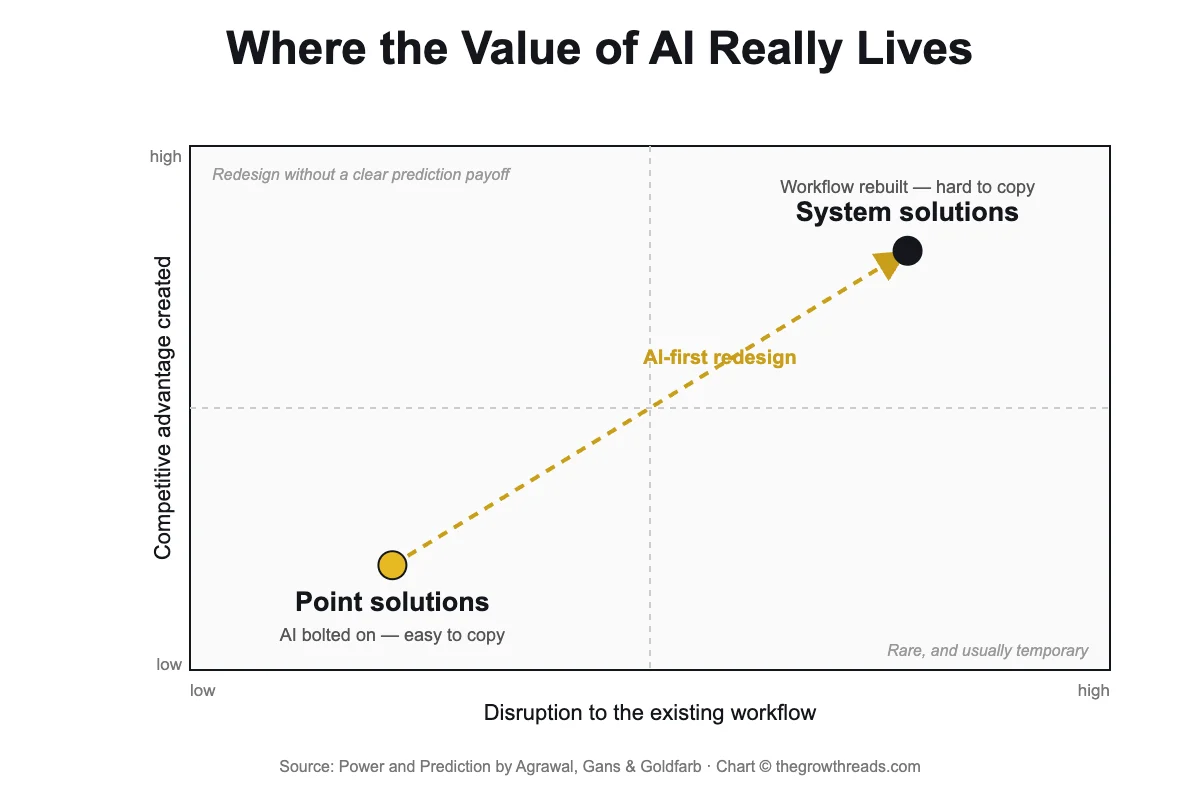
Prediction Machines made a simple but powerful claim: AI is best understood not as “intelligence” but as a drop in the cost of prediction, the same way spreadsheets dropped the cost of arithmetic. When something gets cheap, we use a lot more of it, and we use it in places we never bothered before. Power and Prediction opens by taking that idea for granted and asking what actually happened once organizations acted on it. The honest answer, the authors argue, is: not much that mattered. Most companies found a workflow, dropped a prediction model into one step of it, and called the project done. Fraud gets flagged a little faster. A recommendation gets a little more relevant. A forecast gets a little more accurate. These are real gains — but they are small, easily copied by a competitor who buys the same off-the-shelf model, and capped by every other step in the process that hasn’t changed at all.
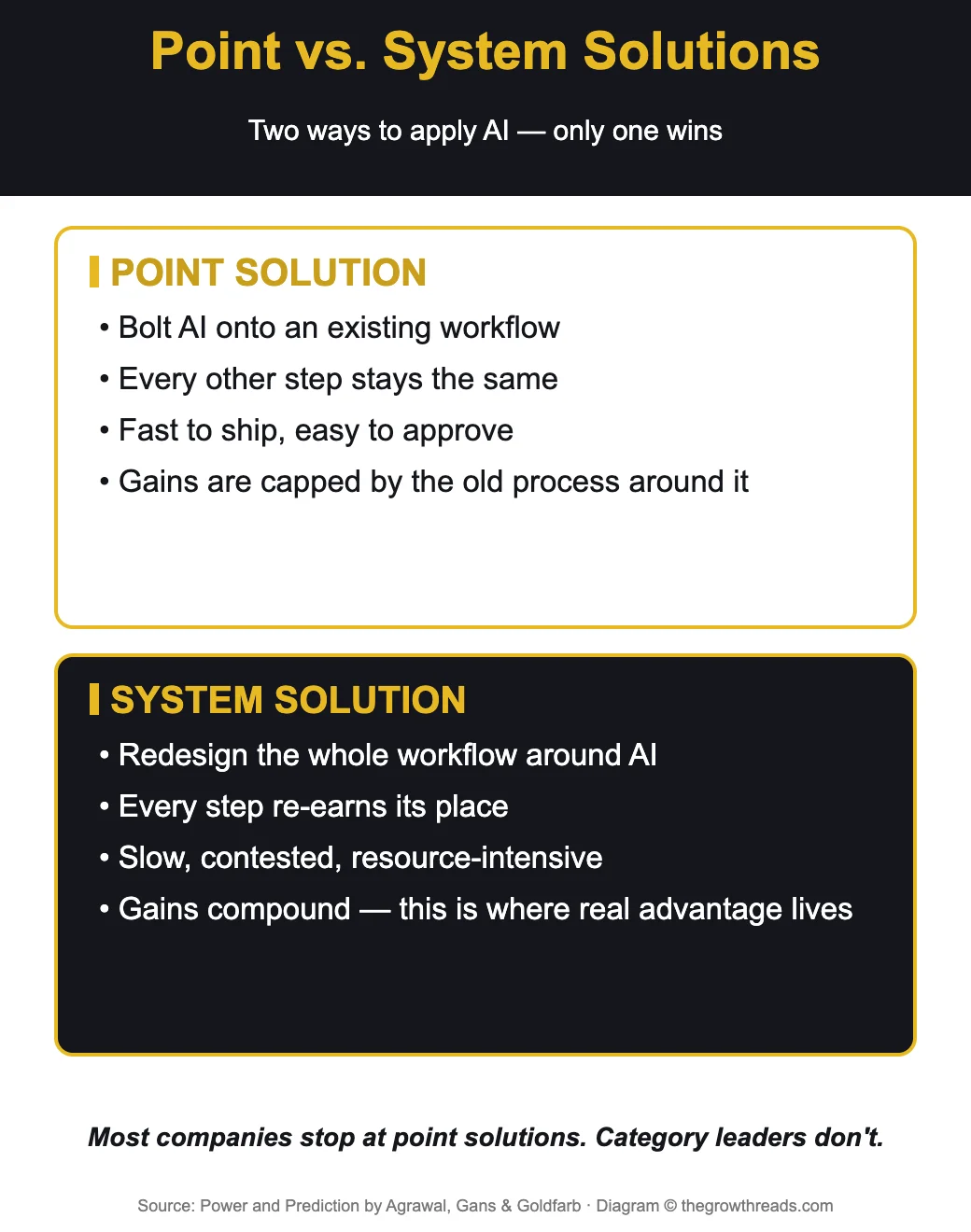
The authors call this a point solution: AI added to one step while the rest of the workflow, the org chart, and the decision rights around it stay exactly as they were. Point solutions are attractive precisely because they’re safe. They don’t require anyone to give up authority, retrain a team, or rebuild an approval chain. They ship fast and they’re easy to defend in a budget meeting. The problem is that safety is also their ceiling — a point solution can only ever be as good as the process it’s dropped into, and that process was designed for a world without cheap prediction.
TGR Note: If you haven’t read the authors’ first book yet, our Prediction Machines summary covers the “AI as cheap prediction” framing this entire book builds on — it’s the natural starting point before this one.
Part 2: Point Solutions vs. System Solutions
The book’s central move is naming the alternative to a point solution: a system solution, where the entire workflow is redesigned around the assumption that a cheap, reliable prediction is now available. The authors’ clearest illustration is autonomous vehicles. A point-solution version of self-driving technology is a better driver-assist feature bolted onto a normal car — useful, incremental, and still built around a human who is ultimately in charge. A system solution is a vehicle, and an entire transportation network, redesigned from the ground up around the assumption that the vehicle itself does the predicting: no steering wheel to fall back on, parking and routing rethought, insurance and liability rebuilt around a different set of decision-makers. The first approach ships in a product cycle. The second rebuilds an industry — and meets resistance at every layer that assumed a human driver.
The same logic shows up far from the road. A bank can bolt a credit-risk model onto its existing loan process to flag applications faster — a point solution. Or it can rebuild lending around continuous prediction: different data collected earlier, different judgment about what “creditworthy” means, approval decisions triggered automatically instead of routed through a committee built for a world of thin, expensive information. The technology in both cases might be nearly identical. What differs is how much of the surrounding system was willing to change.
TGR Note: This point-vs-system framing pairs well with Brynjolfsson and McAfee’s Machine, Platform, Crowd summary, which makes a related argument about why minds, products, and organizations all need to be rebuilt around new general-purpose technology, not just supplemented by it.
Part 3: Rebuilding the Decision System
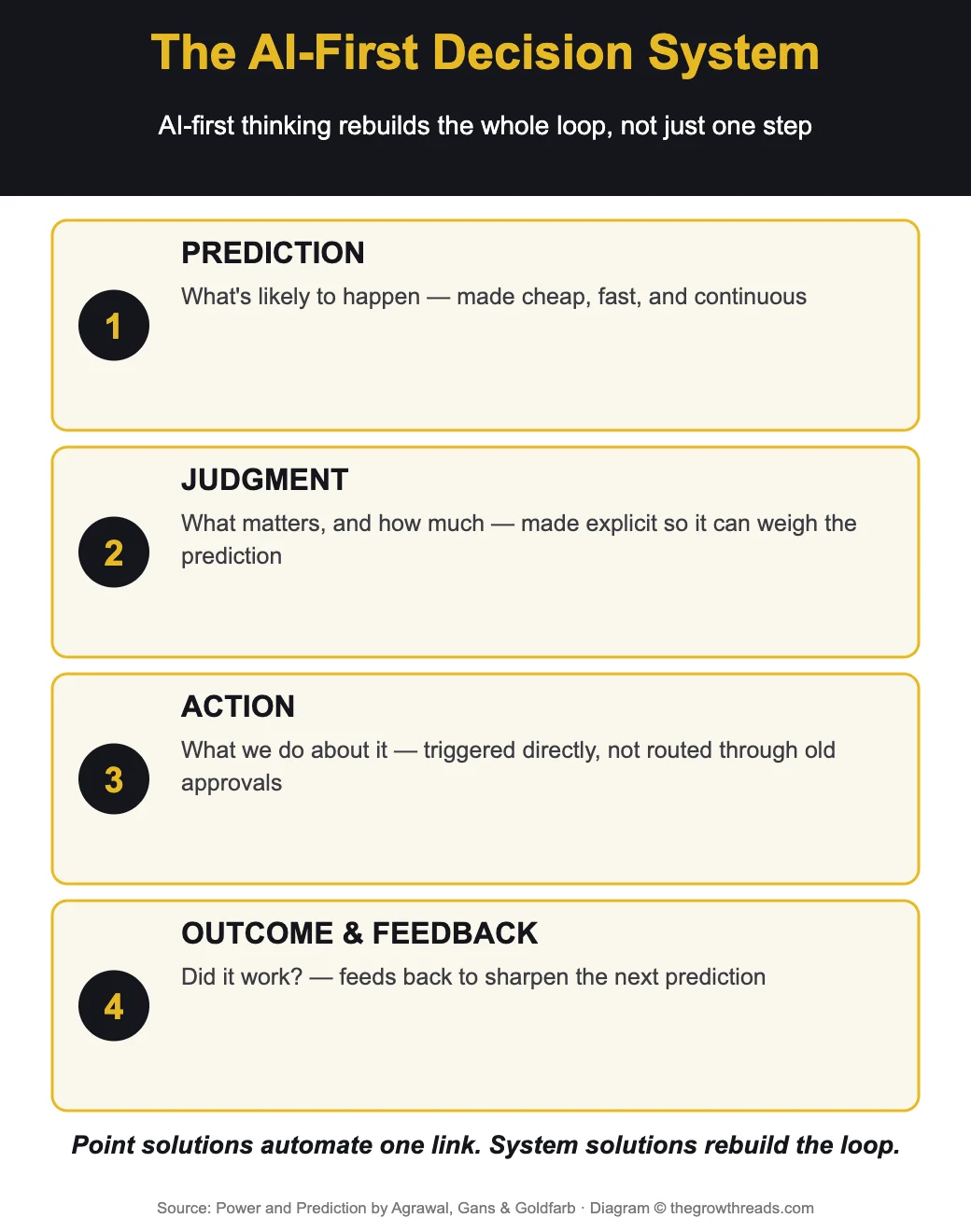
To make “redesign the system” concrete, the authors break any AI-driven decision into four linked parts: prediction (what’s likely to happen), judgment (what outcomes matter, and how much), action (what we actually do in response), and outcome (what happened, fed back to sharpen the next prediction). A point solution touches only the first link — it makes the prediction cheaper or more accurate and leaves judgment, action, and feedback exactly as they were, usually still routed through a human decision-maker who was never told to change how they weigh the new information.
A system solution touches all four. Judgment has to be made explicit — an organization has to actually decide, in writing, what it’s optimizing for and how to trade off competing outcomes, something most workflows have historically left to individual human discretion. Action has to be redesigned to trigger directly from the prediction instead of being routed through approval steps that exist only because predictions used to be scarce and unreliable. And the feedback loop — did the action work? — has to be captured systematically so the next prediction improves, rather than being lost in whatever informal channel the organization used before. Skip any one of these links and the “AI transformation” is still, underneath, a point solution wearing a system-solution’s marketing.
TGR Note: Ethan Mollick’s Co-Intelligence summary covers the same territory at the individual and team level — a useful companion once you’ve mapped a decision system and want to redesign how people actually work inside it.
Part 4: Power — Why Redesign Meets Resistance
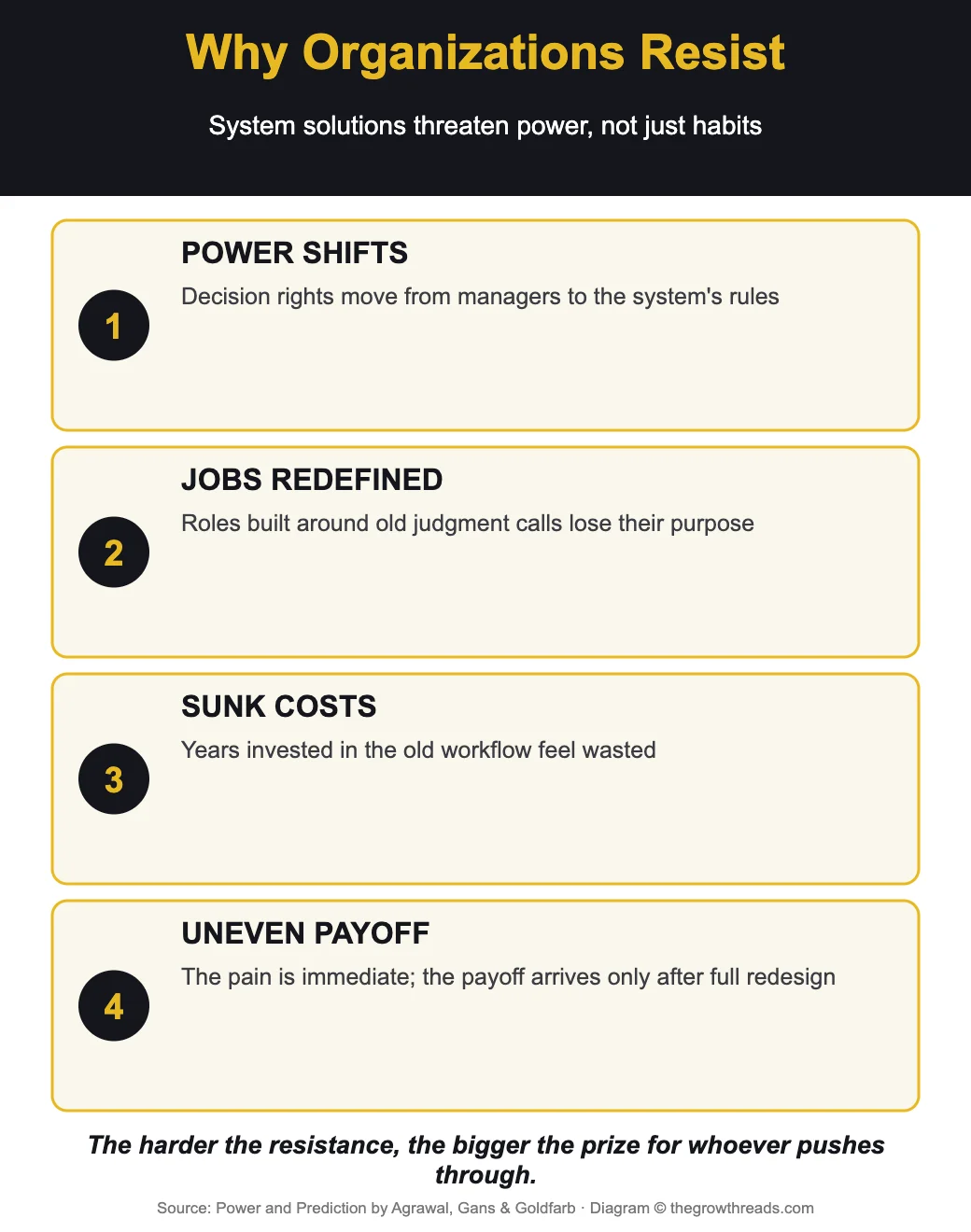
The book’s title puts “power” first for a reason: the authors argue that resistance to system solutions is rarely about whether the technology works. It’s about who currently holds the decision rights a redesign would take away. A manager whose judgment currently decides which loan applications get a second look loses that discretion when judgment gets made explicit and automated. A department built around routing decisions through careful human review loses its reason to exist when action triggers directly from prediction. Years of investment in the old workflow — training, tooling, institutional knowledge — start to look like sunk costs the moment someone proposes rebuilding it. And the pain of redesign lands immediately, while the payoff only shows up after the whole system is rebuilt, which makes it easy to kill a system solution halfway through and call the attempt a failure.
None of this is an argument against system solutions — it’s an explanation for why they’re so rare and, for the organizations willing to push through the resistance, so defensible once built. A competitor can copy a point solution by buying the same model. Copying a system solution means also rebuilding the workflows, retraining the workforce, and — hardest of all — taking on the same internal power struggle the first mover already fought and won. The authors’ practical advice for leaders is to treat that resistance as a signal, not a stop sign: the harder a redesign is fought internally, the more likely it’s touching a real system, not a cosmetic feature.
TGR Note: For more on how power and incentives shape who controls AI-driven decisions at an industry level, see our The Big Nine summary — a useful zoom-out from organizational resistance to competitive and societal stakes.
Who is Power and Prediction best for — and who should read something else first?
Best for: leaders past the pilot stage who need language to explain why an “AI initiative” stalled, plus product and strategy people redesigning a workflow rather than just shipping a model into one.
Read something else first if you haven’t yet read Prediction Machines — its “AI as cheap prediction” framing is the foundation this book builds on. If you want a broader, less economics-driven look at AI’s societal footprint, The Big Nine and Atlas of AI are better starting points.
Questions to reflect on
- Which of your organization’s “AI initiatives” are actually point solutions dressed up as strategy?
- If you made your process’s judgment criteria fully explicit and public, would today’s decision-makers agree with them?
- Who currently holds the decision rights a system redesign would take away — and how would you bring them along instead of around?
- What’s the smallest system-level pilot — one that touches prediction, judgment, action, and outcome — you could run next quarter?
- Where is your organization mistaking “we added a predictive model” for “we redesigned the decision”?
🔥 Ready to rebuild your decisions around AI, not just bolt it on?
Get the full playbook behind point vs. system solutions, straight from the economists who defined the terms.
How to apply Power and Prediction (7-day plan)
- Day 1: Map one of your own workflows end-to-end and mark where a prediction already happens — even informally, in someone’s head.
- Day 2: List every “AI initiative” you know of in your org and sort each one into point solution or system solution.
- Day 3: For one process, write out its judgment explicitly: what outcome are you optimizing for, and how would you know if the prediction was wrong?
- Day 4: Sketch what a full system redesign of that process would look like if you removed every legacy step that only exists to route around missing predictions.
- Day 5: Identify who currently holds decision rights in that process, and how a system solution would shift those rights.
- Day 6: Draft a one-page case for the redesign that names the resistance you expect and a concrete plan to address it.
- Day 7: Choose the smallest possible pilot that tests the whole loop — prediction, judgment, action, and outcome — not just the forecast.
Frequently asked questions
What’s the difference between Power and Prediction and Prediction Machines?
Prediction Machines argues that AI is best understood as a drop in the cost of prediction and explores what becomes possible once prediction is cheap. Power and Prediction picks up where that leaves off: it asks why so many organizations that adopted cheap prediction still haven’t captured much value from it, and argues the answer is that they stopped at “point solutions” instead of redesigning the full decision system — prediction, judgment, action, and outcome — around the new capability.
Do I need to read Prediction Machines first?
It isn’t strictly required — Power and Prediction restates the core “AI as cheap prediction” idea early on — but reading Prediction Machines first gives you the fuller economic argument this book assumes you already accept. If you only have time for one, read Prediction Machines for the foundational framing and this book for the practical, organizational follow-through.
What exactly is a “system solution,” in plain terms?
A system solution is what you get when you redesign an entire workflow around the assumption that a cheap, reliable AI prediction is available — changing not just the forecast but also what the organization values (judgment), what happens automatically in response (action), and how results get captured to improve the next round (outcome). It’s the opposite of a “point solution,” where AI is added to one step and everything else stays the same.
Why do organizations resist AI-driven redesign, even when it clearly works better?
The authors argue resistance is usually about power, not technology. A system solution typically reassigns decision rights away from whoever currently exercises judgment on a given process, makes years of investment in the old workflow feel wasted, and requires paying an upfront cost while the payoff only arrives once the full redesign is complete — a combination that makes it easy for internal critics to call the effort a failure partway through.
Do I need a technical or data science background to follow this book?
No. Like Prediction Machines, this book is written for a general business audience and deliberately avoids technical detail about how AI models work. The authors’ training is in economics, not computer science, and the book’s arguments are built on economic reasoning about decisions, incentives, and organizational behavior rather than on algorithms.
What real-world examples does the book use?
The authors lean heavily on autonomous vehicles as a running example of the point-versus-system distinction, alongside examples drawn from lending and credit decisions, and other industries where prediction touches a high-stakes decision. They use these cases to illustrate how the same underlying technology can be deployed as either a narrow point solution or a full system redesign, and why the two produce very different competitive outcomes.
Is the book’s argument still relevant given how much AI has changed since 2022?
Yes — the argument is about organizational and economic structure, not about any specific model or product generation, so it has aged well even as the underlying AI technology has moved quickly. If anything, the rapid arrival of more powerful models since publication has made the point-versus-system distinction more urgent: cheaper, better predictions raise the ceiling on what a system redesign can achieve, but they don’t remove the organizational resistance to attempting one.
Related summaries
- Prediction Machines by Ajay Agrawal, Joshua Gans & Avi Goldfarb
- Machine, Platform, Crowd by Andrew McAfee & Erik Brynjolfsson
- Co-Intelligence by Ethan Mollick
- The Big Nine by Amy Webb
See all our picks on the 20 Best AI Books of All Time pillar page.
How we analyze books: every TGR summary is built from a full read of the source material, cross-checked against the author’s published interviews and essays, and structured around practical application rather than just recap. We never source books from piracy sites, and we disclose our review process in full. Read our full methodology.
Related Technology Summaries
Human + Machine Summary & Review: Redesigning Work for the AI Era
The Coming Wave Summary & Review: How to Contain AI Before It Contains Us
The Creativity Code Summary & Review: Can AI Really Create?
The Fourth Industrial Revolution Summary & Review: How Every Industry Is Converging
Uncanny Valley Summary & Review: Silicon Valley’s Utopia, From the Inside