

★★★★ 4.3/5 — The clearest rule in open collaboration: treat users as co-developers and release before the cathedral is finished.
Best for: Tech leads, maintainers, and anyone sitting on a private draft that users could already debug
Reading time: ~7 hrs for the full book · ~14 min for this guide
Difficulty to apply: Linus’s Law is easy to quote; using it means shipping a smaller increment in public this week
The Cathedral and the Bazaar in one minute
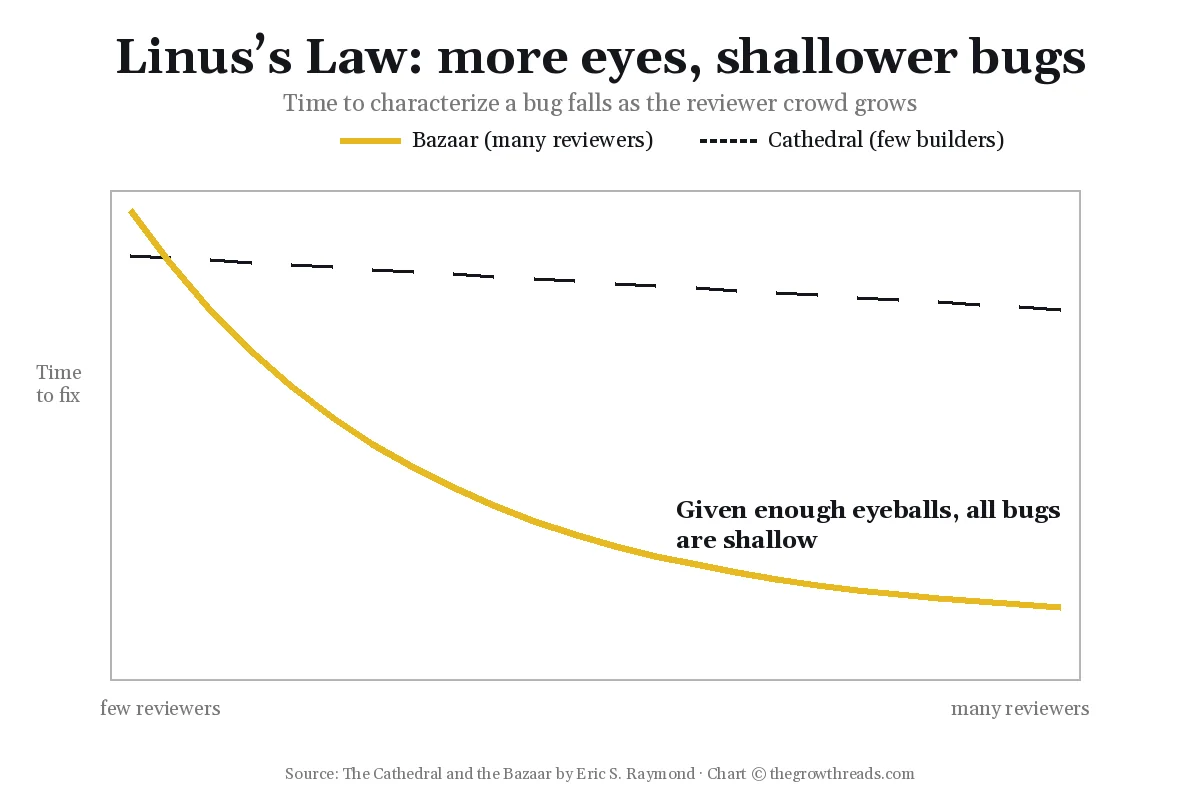
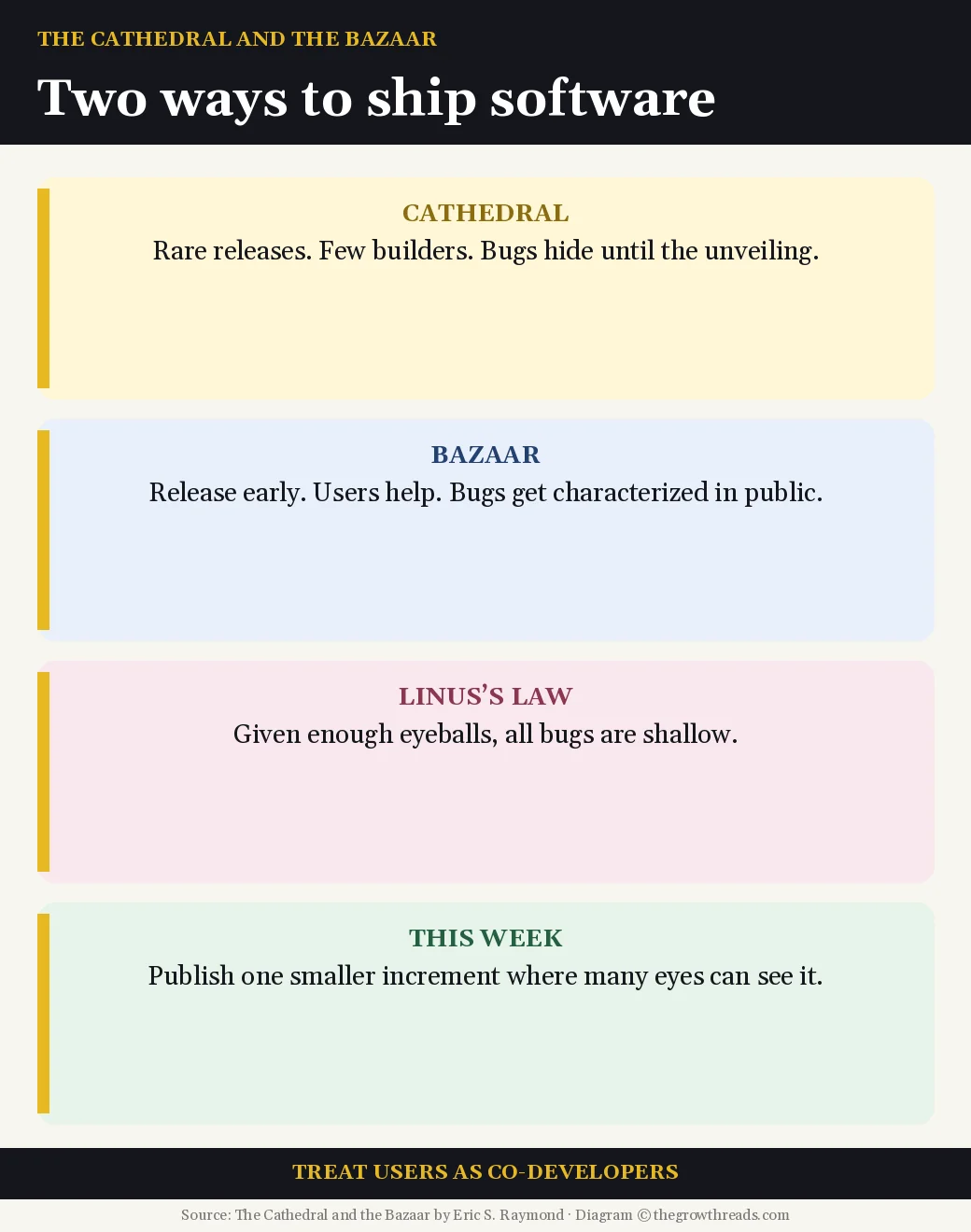
A bug that is deep to you is often shallow to someone else. Eric S. Raymond watched Linus Torvalds run Linux as a noisy market of testers, then tried the same pattern on fetchmail. Cathedrals unveil rarely. Bazaars release early, treat users as co-developers, and let many eyeballs characterize the defect. Steal this week’s habit: publish one smaller increment where the people who hit the bug can see it.
Key takeaways
- Two modes, not two moral camps: Cathedrals protect design with rare releases. Bazaars find bugs fast with many reviewers.
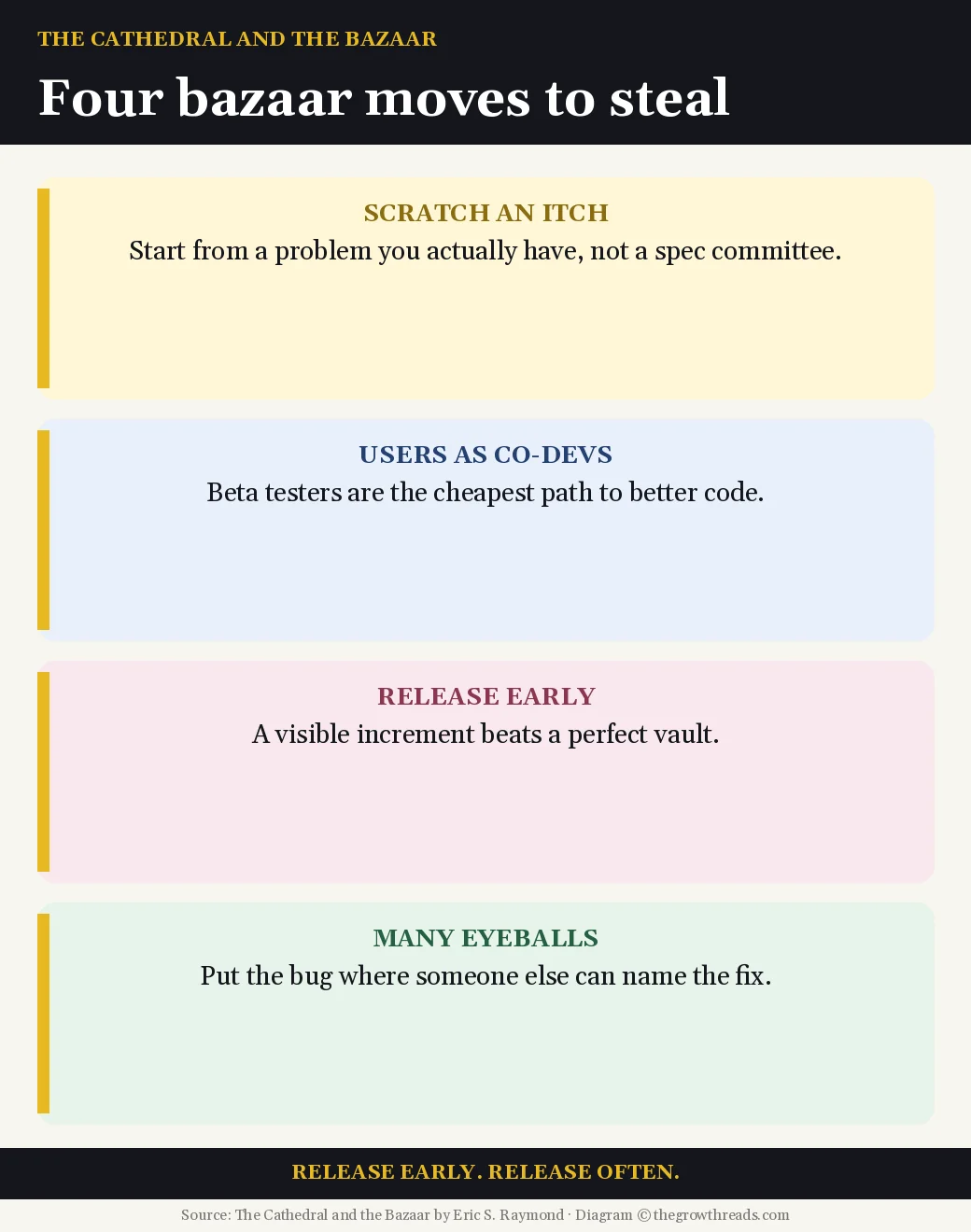
- Scratch an itch: Start from a problem you actually have, not a committee’s hypothetical user.
- Users are co-developers: Testers are colleagues, not a late-stage audience.
- Release early, release often: A visible increment beats a perfect vault.
- Linus’s Law: Given enough eyeballs, all bugs are shallow — if the failure is actually visible.
- Recognize a better idea: Spot a user’s idea and adopt it without theatre.
- Homesteading: Reputation holds a patch of idea-space. Forking is legal; losing the crowd is the cost.
- Use value vs sale value: Fund in the open the tools you must run even if you cannot sell the bits.
- A bazaar needs a maintainer: Many heads beat one only when someone can accept a patch without disappearing.
What is The Cathedral and the Bazaar about?
The Cathedral and the Bazaar is Eric S. Raymond’s field report on Linux-style development: why treating users as co-developers and releasing early lets many reviewers make bugs shallow, and why firms still pay for software they then give away.
About the author
Eric Steven Raymond (born 1957) is an American programmer who became one of the explainers of open source. In the 1990s he updated the Jargon File (The New Hacker’s Dictionary) and ran fetchmail in public after taking over popclient. In May 1997 he presented “The Cathedral and the Bazaar” at Linux Kongress, arguing that Linux’s many-eyed process was a method other teams could steal. Netscape’s 1998 Mozilla announcement followed; the 1999 O’Reilly book — revised in 2001 — collects that essay with Homesteading the Noosphere, The Magic Cauldron, and Revenge of the Hackers. He is writing so a maintainer can change how a draft meets its users this week. Explore all Eric S. Raymond book summaries →
Key concepts at a glance
| Concept | What it means | Use it when |
|---|---|---|
| Cathedral | Rare releases from a small builder group; users see a finished unveiling | A module needs one coherent design more than it needs a crowd |
| Bazaar | Early, frequent releases; users invited as co-developers | Bugs are hiding because too few people can see the running increment |
| Linus’s Law | Given enough eyeballs, all bugs are shallow | A defect is “mysterious” only to the people who wrote it |
| Release early, release often | Frequency is how the crowd gets a turn | A vault of almost-ready work has had no outside testers |
| Users as co-developers | Testers are colleagues, not a late audience | Feedback arrives only after a ceremonial launch |
| Scratch an itch | Start from a problem you actually have | The spec describes a hypothetical user nobody on the team is |
| Homesteading the noosphere | Reputation, not a retail lock, is how maintainers hold a patch of idea-space | A quiet fork is being treated as ownership |
| Use value vs sale value | What you gain by running the tool vs what you gain by locking the bits | You are about to private-label infrastructure you must use anyway |
Part 1: Cathedral vs bazaar — fetchmail, Linux, and Linus’s Law
Raymond opens with a contrast, not a sermon. Some programs are built like cathedrals: a small set of builders, a long closed period, a rare unveiling. GNU-style planned releases were the cathedral he knew. Other programs are built like bazaars: people poking at a stall that is already open. Linux in the mid-1990s was the bazaar that surprised him. Linus Torvalds did not wait for a finished nave. He shipped, listened, and let a crowd characterize defects that would have stayed “deep” inside one head.
The essay is also a lab notebook. Raymond needed mail to move. He took over popclient, renamed it fetchmail, and ran it in public on purpose — to test whether Linux’s method was Linus, or a method. Linus’s Law is the famous sentence: given enough eyeballs, all bugs are shallow. A bug is “shallow” when someone can characterize it quickly. That someone is often a user with a different machine and permission to look. Supporting rules stay blunt: scratch an itch you have, treat users as co-developers, release early and often, and take a better idea when a user has one. None of that is a license to ship garbage. It is a license to stop hiding a working increment until a ceremonial date.
The steal is a visibility test. If the people who hit the bug cannot see the increment, you do not have a bazaar. You have a cathedral with extra chat channels. Name one module that is still a vault. Cut the next release until it can go to the people who already suffer the itch — this week, not after the polish pass that never quite ends.
TGR Note: Frederick P. Brooks Jr.’s The Mythical Man-Month is the other half of the same week. Brooks: adding people to a late project makes it later. Raymond: hiding the work from people who could characterize the bugs keeps the bugs deep. If the delay is talk tax, use Brooks. If it is a private vault, open a smaller stall. Algorithms to Live By is the personal version of knowing when you have seen enough.
Part 2: Homesteading the noosphere — reputation, forks, and gift culture
Once you invite a crowd, the next question is why anyone bothers. Homesteading the Noosphere is Raymond’s answer. You cannot own a Linux kernel the way you own a toaster, and licenses that guarantee the right to fork make ordinary retail lock hard. What maintainers actually hold is a homestead: they are the people others expect to answer, to integrate, to be the sensible place to send a patch. Reputation is the title deed. It is earned by shipping and by not vanishing. Gift culture sounds soft until you watch a list: status goes to people who give working code away. Forking stays legal and still expensive, because a fork that cannot recruit the crowd is just a private cathedral with extra bitterness.
There is a warning inside the romance. A bazaar with no answering maintainer is not a market. It is a pile of files. Many heads are better than one only when someone can lead without coercion and the medium is at least as good as the internet — Raymond’s own precondition. If your “open” repo has no one home, you have not homesteaded anything. You have abandoned a stall and called it community. The steal is a reputation checklist: are you findable, do you answer, and have you accepted one idea that was not yours this month? Write the name of the person who may merge, and keep that person in the channel where users already are.
TGR Note: Douglas Hofstadter’s Gödel, Escher, Bach is about a system that can model itself. A bazaar is a milder loop: outsiders can see the bugs. If the “crowd” is only tabs and no characterization, Nicholas Carr’s The Shallows is the corrective. Do not confuse a noisy feed with many eyeballs on the defect.
Part 3: The Magic Cauldron — why firms pay for software they give away
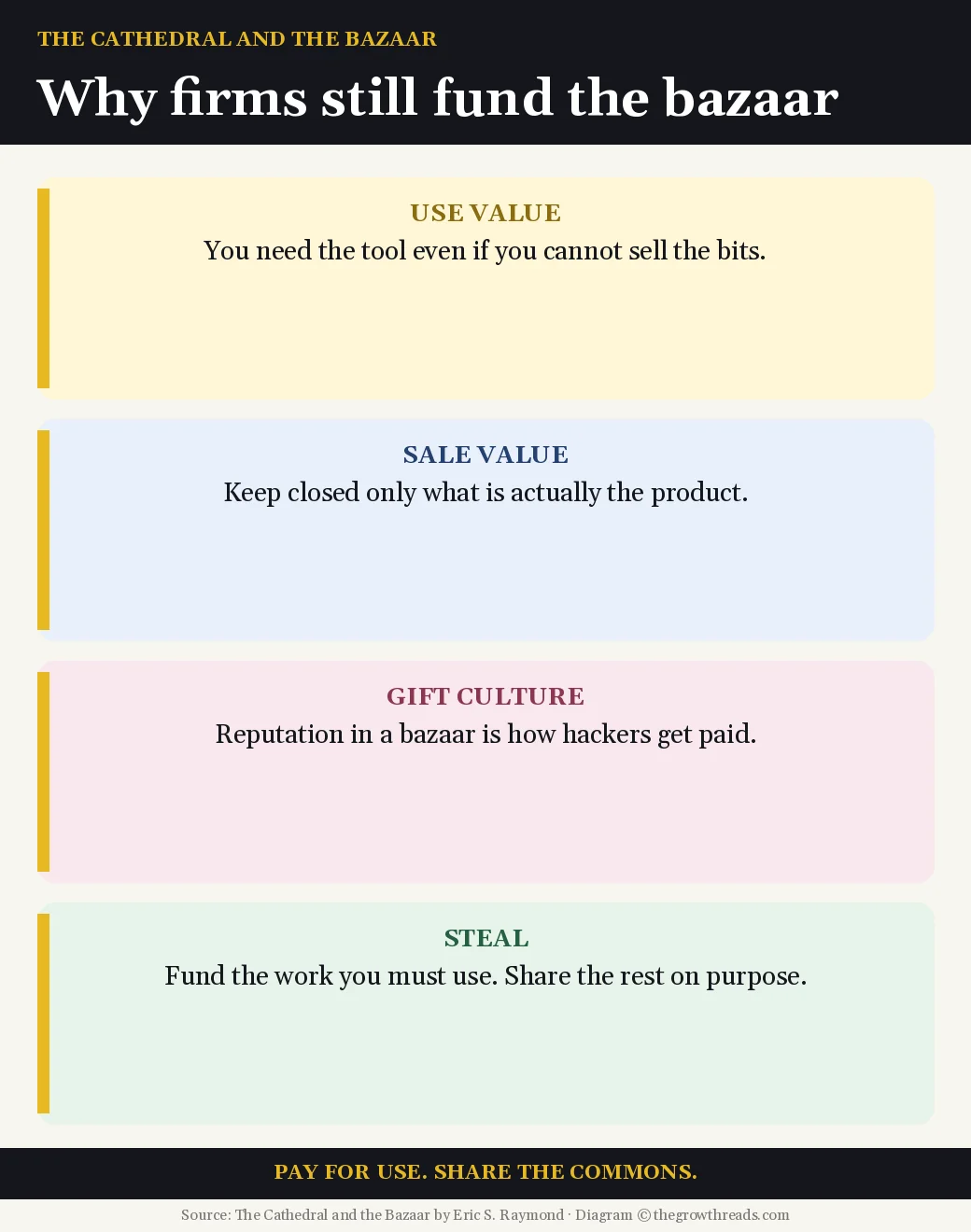
The Magic Cauldron answers a manager’s objection: if the bits are free, why write them on company time? Raymond splits value in two. Use value is what you get from running the program. Sale value is what you get from being the only one allowed to run it. A lot of infrastructure has high use value and weak sale value — you need it; customers will not pay extra for your private fork. Paying engineers to improve a commons can be cheaper than staffing a cathedral you must then carry forever. When the bits are the product, a lock can still be rational. The error is locking the scaffolding: build tools, protocols, boring libraries every competitor also needs.
The cauldron image is abundance: the more the commons is used, the more it cooks. Ports, debugging, and adjacent tools return because other people needed the same use value. That only happens if you actually share the work and accept inbound patches. A “we might open source later” slide is still a cathedral. The steal is a two-column list. Column A: we must run this even if no customer will buy it as a SKU. Column B: this is the product. Fund A in the open on purpose. Keep B’s lock if it is truly the product — and stop pretending a log-shipping library is B.
Part 4: Revenge of the Hackers — Netscape, “open source,” and a 2026 steal
Revenge of the Hackers is the history chapter. Linux made the bazaar visible to people who did not live on Usenet. The essay’s fame, then Netscape’s 1998 Mozilla release, gave executives a story they could take to a board: maybe the crowd is an asset. “Open source” as a label was a translation layer for firms that heard “free software” as a threat to a price tag. Netscape is the parable, not the fairy tale. Opening a browser did not magically finish the product. A bazaar still needs a coordinator, a usable license, and a problem users actually have. Dumping a tar file and walking away is a cathedral exploding in public, not Linus’s Law.
Read from 2026 and the accidental layer has new names: pull requests, hosted git, model-written patches. The essential split has not moved. Either the people who hit the bug can see the increment, or they cannot. Generated code can draft syntax faster. It cannot be “enough eyeballs” by itself. If you staff a late system with more generators and no users in the loop, you have a faster cathedral. The week’s steal: pick one internal tool with high use value, publish a changelog to the people who already run it, and accept one characterization you did not already have.
TGR Note: Yudkowsky and Soares’s If Anyone Builds It, Everyone Dies is a different scale of “do not open a stall on an unbounded goal.” Raymond is collaboration design for tools you can still take back. For a calmer map of keeping machine goals on our side, keep Stuart Russell’s Human Compatible nearby. A bazaar is a gift when the itch is fetchmail. It is not a default for every system.
Who is The Cathedral and the Bazaar best for — and who should read something else first?
Read it if you maintain software, run an internal platform, or ship anything where the people who hit the bugs currently cannot see the increment. You do not need to love Linux history. You need a live draft and a user who already has the itch.
Read something else first if the live problem is staffing a late project — start with The Mythical Man-Month. For personal decision algorithms, use Algorithms to Live By. If the question is whether to open a superintelligent system, use If Anyone Builds It, Everyone Dies, not a fetchmail case study. This book is a superb first read if you were about to polish a vault for another quarter.
Questions to reflect on
- Which current project is a cathedral by accident — rare unveiling, no users in the loop — and which is a bazaar on purpose?
- Who already has the itch you are scratching, and can they see this week’s increment?
- When did you last accept a user’s idea as better than yours, without a performance of having planned it?
- Which internal tool has high use value and almost no sale value — and is still locked because of habit?
- If you opened one repo tomorrow, who is the maintainer who will actually answer?
🔥 Ready to let many eyeballs find the bugs?
Get The Cathedral and the Bazaar and start reading.
How to apply The Cathedral and the Bazaar (7-day plan)
- Day 1: Name one live project a cathedral (rare unveiling) and one that could be a bazaar. Write both names on the team doc.
- Day 2: Write the itch in one sentence — the problem you actually have, not the hypothetical user in the spec.
- Day 3: Send the current draft or running increment to three people who already hit that itch. Ask for a characterization, not a compliment.
- Day 4: Ship a smaller visible increment today. Cut scope until it can leave the vault before Friday.
- Day 5: Put one open bug or question where more than your standup can see it. Count the new eyeballs, not the new meetings.
- Day 6: Adopt one user idea that is better than yours. Credit it. Do not rewrite history so it looks like you planned it.
- Day 7: Split the quarter’s work into use value vs sale value. Circle one high-use, low-sale tool and write why you would fund it in the open.
Frequently asked questions
What is The Cathedral and the Bazaar about?
The Cathedral and the Bazaar is Eric S. Raymond’s 1999 book — revised in 2001 — built around his 1997 Linux Kongress essay. A cathedral ships rare, planned releases from a small group of builders. A bazaar ships early and often, treats users as co-developers, and lets many reviewers characterize bugs in public. Raymond tested the model on fetchmail after watching Linus Torvalds run Linux in the open. Later essays ask why gift culture, reputation, and firm-funded commons make that bazaar rational. Steal one move: put a smaller increment where more eyes can see it this week.
What is Linus’s Law / “given enough eyeballs”?
Linus’s Law, as Raymond names it, says that given enough eyeballs, all bugs are shallow. A defect that is mysterious to the person who wrote the code is often obvious to someone who uses a different mental model. The law is not magic. It needs a visible increment, a channel at least as good as the internet, and a maintainer who can take a patch without a committee. Cathedral projects hide the same bugs until a rare unveiling. Put the failure where testers already are — a changelog, a beta list, a public tracker — before you add another private review meeting.
What is the difference between cathedral and bazaar development?
Cathedral development treats the program like a building: a few architects decide, releases are rare, and users see a finished nave. GNU-style planned releases were Raymond’s cathedral example. Bazaar development treats the program like a market: many people poke at a running stall, releases are frequent, and users are invited to debug. Linux in the mid-1990s was his bazaar example. Neither word is an insult. Cathedrals produce coherent design. Bazaars produce fast characterization of bugs. The steal is to know which mode a given module needs, then stop mixing them by accident on the same week’s work.
Is The Cathedral and the Bazaar still relevant in 2026?
Yes, because the delay Raymond named was never about 1990s mailing lists. It was about whether the people who hit the bug can see the code and send a characterization the same week. Cloud, chat, and generated patches changed the accidental layer. They did not make a private vault cheaper to debug, and they did not make a closed beta of three teammates equal to a crowd. Read fetchmail as a case study, not as a museum of POP clients. The 2001 chapters on Netscape and the open-source rebrand are the bridge into the vendor announcements you still hear.
What is Homesteading the Noosphere?
Homesteading the Noosphere is Raymond’s essay on how open-source “property” actually works. Nobody owns the bits in the usual retail sense. Maintainers homestead a patch of the idea-space — the noosphere — by shipping, answering, and being the person others trust with a fork. Reputation is the currency. Forking is legal and expensive because you lose the crowd. The practical steal is smaller: if you want help, be findable, accept a better idea from a user, and do not treat a quiet repo as a homestead. A bazaar with no answering maintainer is just a dump of files.
What is the Magic Cauldron in The Cathedral and the Bazaar?
The Magic Cauldron is Raymond’s economic case for why firms pay people to write software they then give away. Use value is what you get from running the tool. Sale value is what you get from locking the bits. A lot of infrastructure has high use value and low sale value — you need it, customers will not pay extra for your private fork of it. Paying engineers to improve the commons can be cheaper than building a cathedral you must then staff forever. The steal: list which of this week’s projects you must use even if you cannot sell them, and fund those in the open on purpose.
How long is The Cathedral and the Bazaar and who should read it?
The O’Reilly revised paperback is about 256 pages of essays, not a novel. Most working maintainers can finish it in a couple of evenings and steal one rule per essay. It is best for tech leads, open-source maintainers, and anyone sitting on a private draft that users could already debug. Skip it as a first book if your live problem is staffing a late project — use The Mythical Man-Month first — or if you need personal decision algorithms rather than collaboration design. Pair it with one public increment of your own the same week you finish.
Related summaries
- The Mythical Man-Month — when the delay is staffing and talk tax, not a private vault.
- Algorithms to Live By — computer-science moves for ordinary decisions.
- Gödel, Escher, Bach — how meaning and minds climb out of looping rules.
- Human Compatible — keeping goals aligned when many hands touch the machine.
Browse every title in our Best AI Books pillar page.
How we analyze books: summaries come from a full read of the source text, cross-referenced against the author’s published interviews where relevant, and structured around practical application rather than critique. We disclose our editorial process in full. Read our full methodology.