

The bottom line: Every “free” screen in your life is funded by selling your attention to someone else, and Tim Wu’s history of the attention merchants shows this trade is neither new nor accidental — it is a business model with a 150-year track record, a recurring backlash pattern, and a very different shape once algorithms took over from editors.
The Attention Merchants in one minute
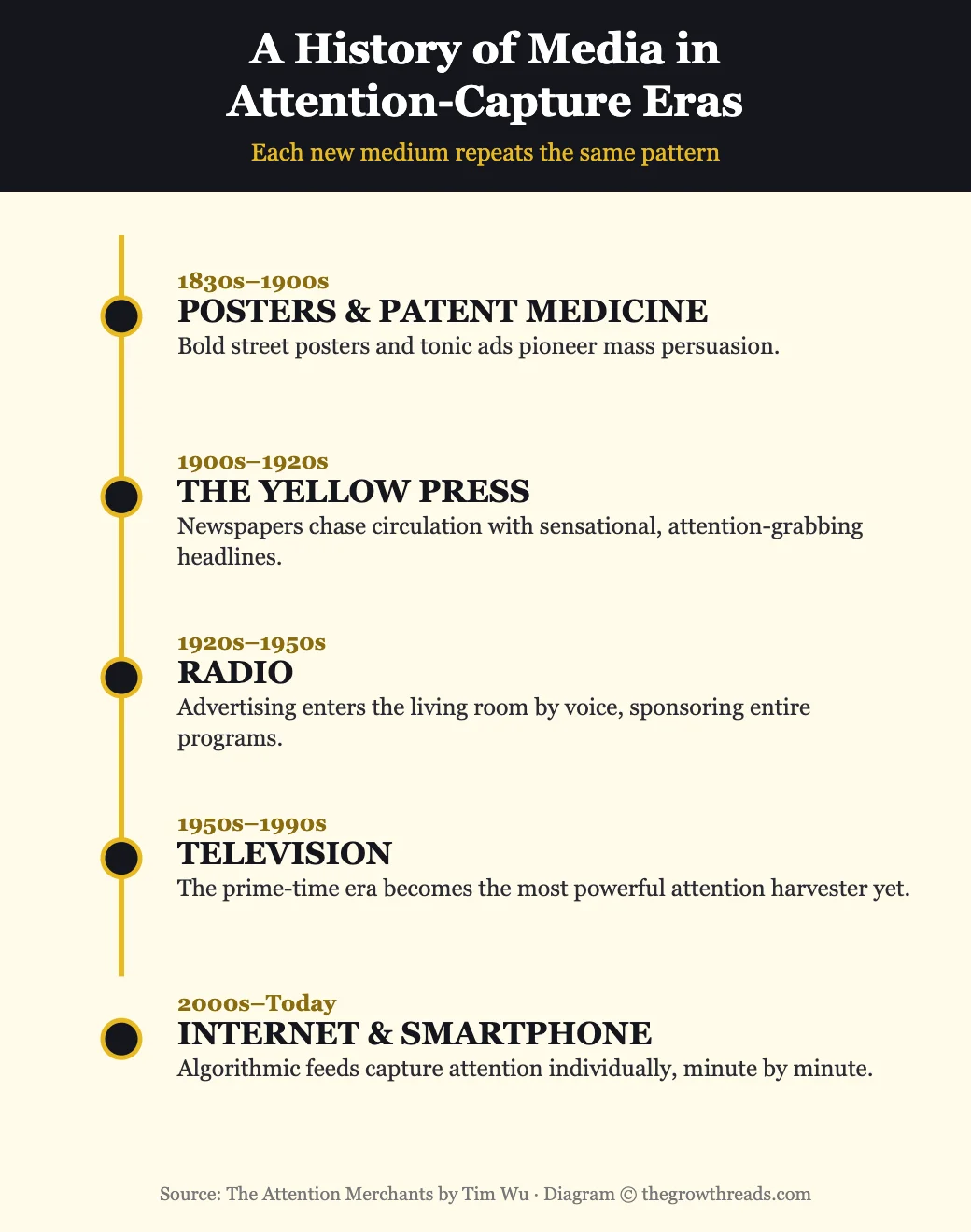
Tim Wu, the Columbia law professor who coined the term “net neutrality,” traces a single business model across a century and a half of media: capture people’s attention cheaply, then resell it to advertisers. He calls the practitioners of this trade “attention merchants,” and The Attention Merchants follows them from the patent-medicine hucksters and poster wars of the 1830s through penny newspapers, radio serials, television’s golden age, and finally the algorithmic feeds of the smartphone era. The throughline is a repeated three-step cycle: a new medium finds a way to harvest attention at scale, audiences eventually feel exploited and revolt, and the industry either reforms cosmetically or migrates to a new medium and starts again. Wu’s central warning is that each cycle has gotten more sophisticated at capturing attention and more invasive in doing so, culminating in a digital attention economy engineered by companies with more behavioral data than any advertiser in history ever had. The book is less a technology critique than a business history — and understanding that history, Wu argues, is the first step toward reclaiming any part of your day that isn’t already sold.
Key takeaways
- Attention is a commodity, and it has been bought and sold since the 1830s. The penny press pioneered the trade: sell the newspaper below cost, then sell readers’ attention to advertisers at a markup.
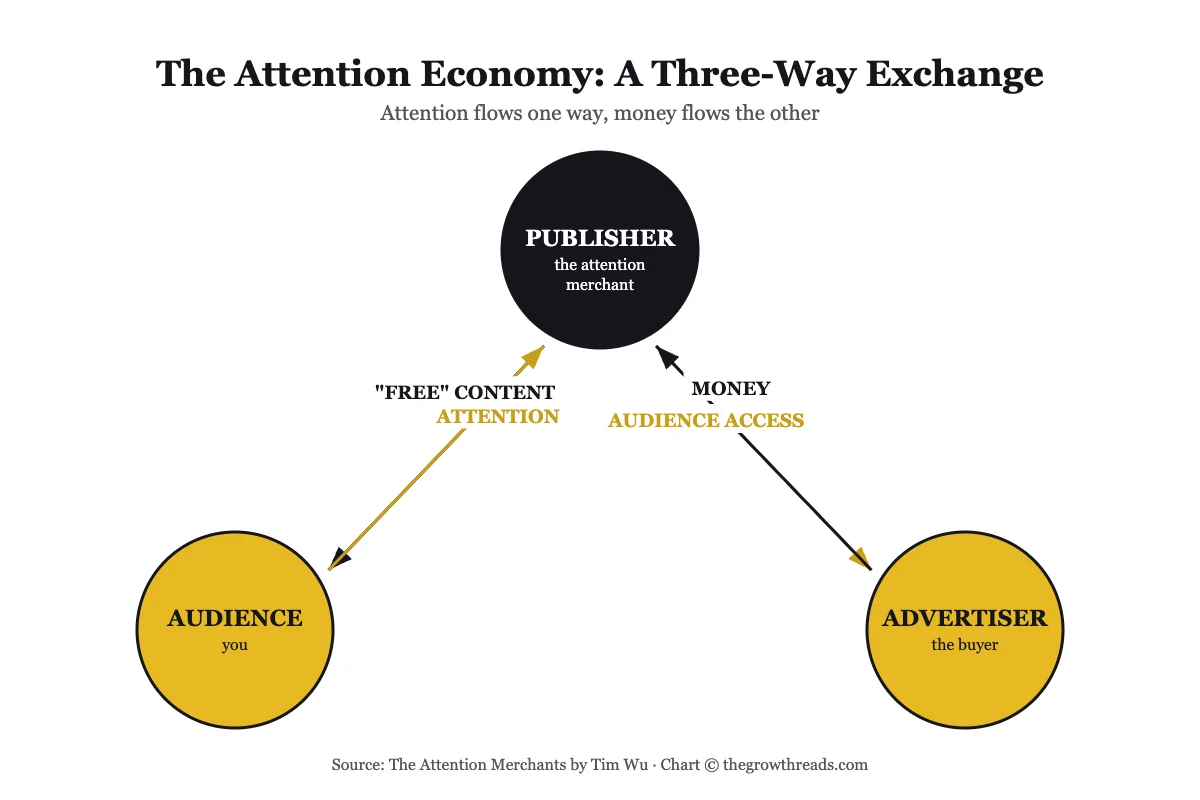
- The “attention merchant” is a specific business role — not the audience, not the advertiser, but the publisher or platform standing between them, profiting from the exchange.
- Every major medium has followed the same arc: land grab, saturation, audience backlash, and either reform or migration to the next medium.
- “Attentional revolts” are a recurring historical pattern, not a uniquely modern phenomenon — from 19th-century reactions against patent-medicine posters to 1950s complaints about television advertising.
- Radio and television professionalized attention harvesting, turning audience measurement into an industry and content into a delivery vehicle for commercial breaks.
- The internet did not escape the attention economy — it perfected it, replacing broadcast guesswork with individually targeted, algorithmically optimized capture.
- Notification design and infinite feeds are engineering, not accident, built by teams whose success metric is time-on-screen.
- Total attention capture is nearly impossible to sustain — audiences eventually resent being harvested too aggressively, which is why every era eventually produces a backlash or a regulatory response.
- Wu calls the alternative a “human reclamation project” — a deliberate, ongoing effort to carve out time and mental space that is not for sale.
What is The Attention Merchants about?
The Attention Merchants is a business history of everyone who has ever profited from capturing your attention and reselling it — from 19th-century poster wars to today’s algorithmic feeds — and a case for reclaiming your own.
About the author
Tim Wu is a law professor at Columbia University and a former White House technology and competition-policy adviser. He is best known for coining the term “net neutrality” in a 2003 paper and for a career spent studying how information industries acquire and use power. Before The Attention Merchants (2016), he wrote The Master Switch, a history of how information empires from telephone to television have risen, consolidated, and eventually faced regulatory or competitive reckonings. Explore all Tim Wu book summaries →
Wu brings a lawyer’s eye for pattern and precedent to a subject usually treated as a purely technological or psychological problem. Rather than blaming any single company or platform, he places the current attention economy inside a much longer lineage of hucksters, admen, and broadcasters — arguing that today’s feed-and-notification design is the latest, most refined version of a very old trade.
Key concepts at a glance
| Concept | What it means |
|---|---|
| Attention merchant | Any business that harvests audience attention cheaply and resells it to advertisers — the structural role played by newspapers, radio, TV networks, and today’s platforms alike. |
| Attentional revolt | A recurring pattern where audiences, having felt over-harvested, push back against a medium’s commercial excess — through boycotts, regulation, or simply tuning out. |
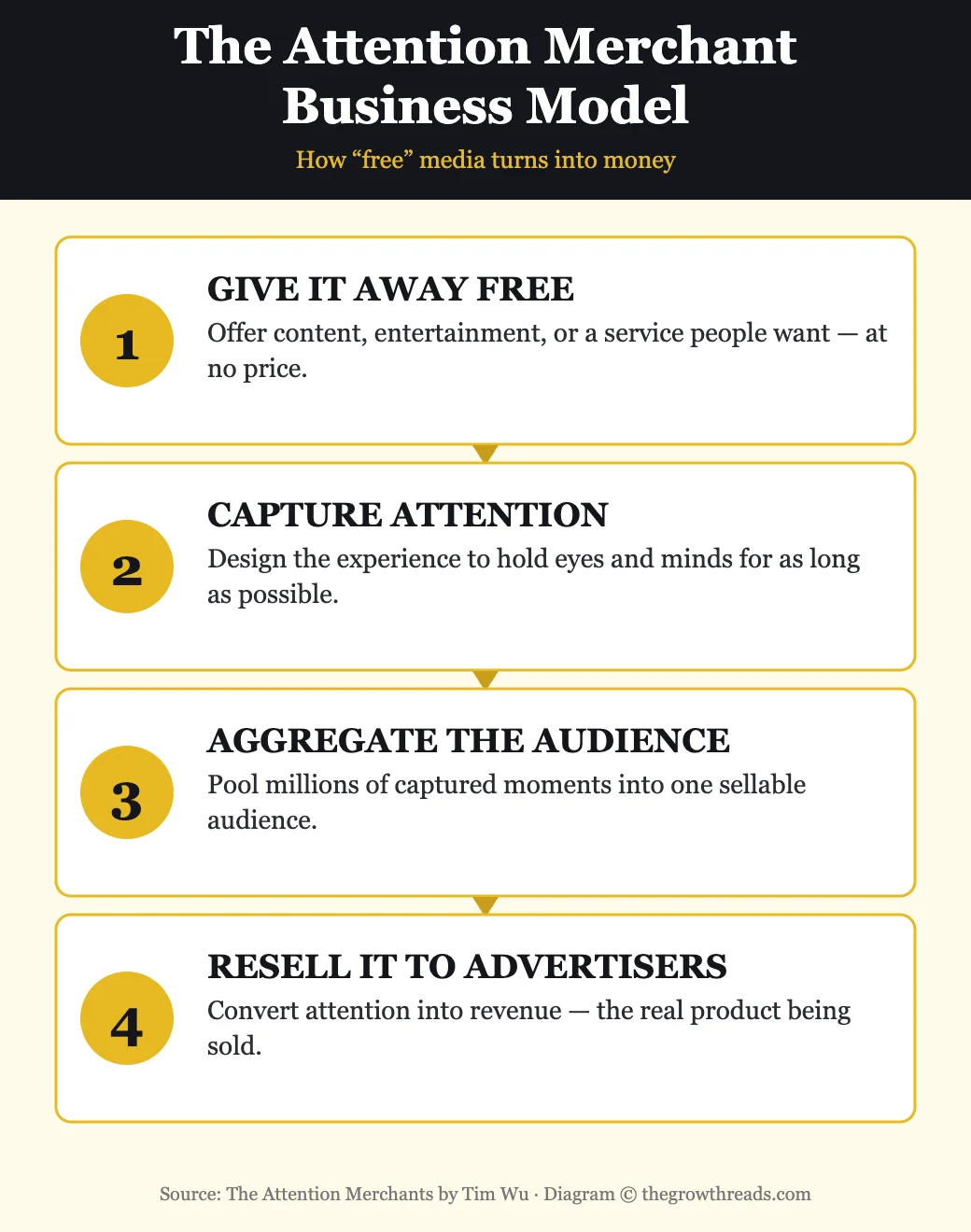
| Harvest and resell | The two-sided business model at the center of the book: give audiences something free or cheap to capture attention, then sell that attention to a third party. |
| Human reclamation project | Wu’s term for the deliberate, ongoing effort to protect personal time and attention from commercial capture. |
Part 1: The birth of the attention merchant
Wu opens with the 19th-century poster wars and patent-medicine hucksters who first realized that public attention itself was worth manufacturing demand for. Benjamin Day’s New York Sun pioneered the model that still defines the internet’s free tier: give away the core product below cost, then sell the resulting audience to advertisers. This “penny press” logic proved so effective that within a generation, most metropolitan newspapers ran on advertising revenue rather than subscription price — making the reader, in effect, the product being sold.
Wu is careful to distinguish this era’s hucksters from mere con artists. Patent-medicine sellers and poster campaigners were, in his account, early practitioners of a genuinely new commercial discipline: manufacturing demand for attention itself, independent of whether the underlying product delivered any real value. The techniques they pioneered — bold typography, emotional appeals, repetition, novelty — became the template that every subsequent attention merchant would refine rather than reinvent. This is why Wu opens his history here rather than with radio or television: the core mechanics of the trade were essentially complete by the end of the 19th century, waiting only for new distribution technology to scale them.
The chapter’s throughline is that none of this happened by accident. Ambitious publishers and admen deliberately engineered content to be attention-grabbing — sensational headlines, serialized stories, contests — because attention, once captured, could be monetized indefinitely. This is the seed of every “engagement” metric that follows in the book.
Part 2: Radio, television, and the professionalization of attention
The second act of Wu’s history covers how radio and then television turned attention-harvesting from an opportunistic trade into a measured, professionalized industry. Ratings systems (like Nielsen) gave advertisers hard numbers on exactly how many eyeballs and ears a program commanded, which in turn gave broadcasters a direct financial incentive to maximize audience size and attention span, not necessarily program quality. Television’s “golden age” of the 1950s-60s coincided with an unprecedented concentration of national attention around a handful of networks — a level of mass-audience capture that, Wu notes, has never been matched since, even by today’s largest platforms.
Wu also traces how the advertising industry itself professionalized during this period, moving from opportunistic hucksterism toward a self-conscious discipline with its own theories of persuasion, its own celebrity practitioners, and its own feedback loops between content creators and the advertisers who funded them. Radio serials were shaped, episode by episode, around what kept listeners tuned in through the commercial breaks; television programming followed the same logic at even greater scale. The audience was no longer an incidental byproduct of good content — it was the entire point, with content increasingly built backward from what would hold attention longest.
TGR Note: Wu’s account of how measurement systems reshape the content they measure echoes a theme running through Nicholas Carr’s The Shallows, which argues that any medium’s technical structure — not just its content — reshapes how we think and pay attention.
Part 3: Attentional revolts through history
A central and often overlooked argument in the book is that audiences have never passively accepted being harvested indefinitely. Wu documents a recurring cycle of backlash: 19th-century reformers campaigned against patent-medicine posters and misleading advertising; radio audiences and regulators pushed back against excessive commercial interruption in the 1930s-40s; television faced its own reckonings over advertising to children and manipulative tactics; and the rise of ad-blocking, “digital detox” culture, and privacy regulation in the smartphone era is simply the latest iteration of a very old pattern. Each revolt forced some combination of self-regulation, government rule-making, and business-model adaptation — though rarely a full retreat from the underlying attention-harvesting model.
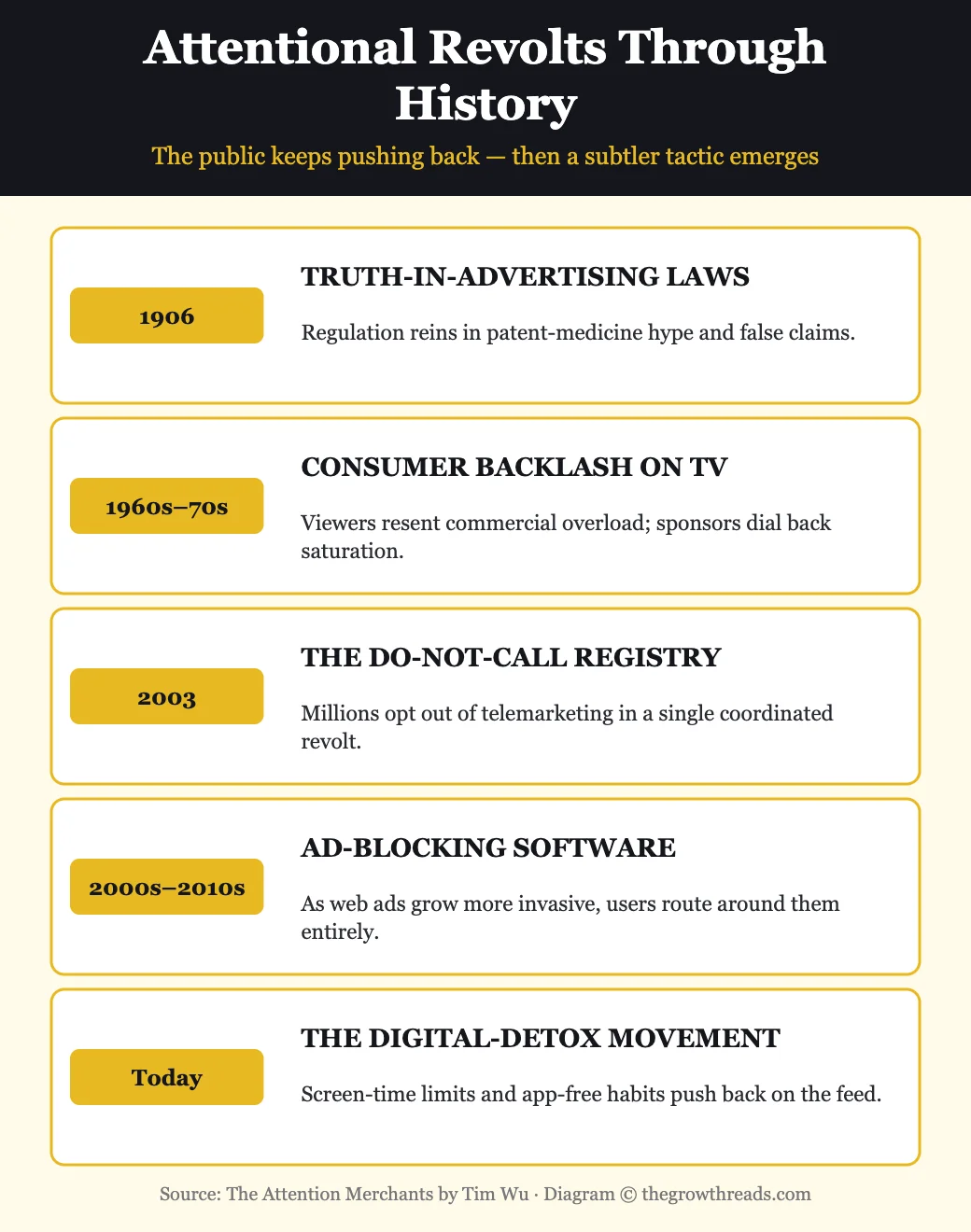
What makes this chapter especially useful is how it reframes seemingly novel modern complaints — about doomscrolling, notification fatigue, or “brain rot” — as the latest entries in a very long ledger. The specific mechanisms of harvesting change (posters give way to broadcast, broadcast gives way to algorithmic feeds), but the emotional experience of feeling over-marketed-to, and the political and cultural response it provokes, follows recognizable contours each time. Wu uses this history to puncture any assumption that today’s attention economy is uniquely dystopian; instead, he argues it is uniquely effective, precisely because it has inherited a century and a half of refinement in exactly the techniques that previous revolts were fighting.
Wu’s point in cataloguing these revolts is not reassurance — it’s a caution. Every previous revolt eventually gave way to a new, more sophisticated round of attention harvesting once the outrage faded and a new medium emerged. There is no evidence, he argues, that the digital-era backlash will end any differently unless people and policymakers actively intervene rather than simply waiting for fatigue to set in.
Part 4: The digital attention economy
The book’s final movement turns to the internet, and specifically to how digital platforms took the broadcast-era playbook and supercharged it with individual-level targeting and algorithmic optimization. Where a 1960s television network could only guess at what would hold a mass audience’s attention, a modern feed can test thousands of micro-variations in real time and learn, for each individual user, exactly which notification, headline, or autoplay trigger is most likely to keep them scrolling. Wu treats this not as a new phenomenon but as the attention merchant’s oldest trick — harvest cheaply, sell dearly — executed with a precision no poster campaign or radio jingle ever had.
Wu is also attentive to how the currency of the attention economy has shifted alongside its mechanisms. In the broadcast era, fame itself became a commodity that could be manufactured and monetized at scale — the celebrity system Wu traces through figures from Ed Sullivan to the reality-television and influencer economies is, in his telling, simply another output of the same underlying business model: harvest attention around a personality, then resell access to that attention. The rise of “micro-fame” and individual influencers on digital platforms is not a break from this pattern but its logical extension, now available to far more people at far smaller scale, but governed by the identical economics.
TGR Note: Wu’s account of algorithmically optimized attention capture pairs directly with Shoshana Zuboff’s The Age of Surveillance Capitalism, which goes further into how behavioral data extraction became the underlying business model of the modern internet — read together, the two books trace the same shift from broadcast guesswork to individualized prediction.
Wu closes with a call for what he terms a “human reclamation project” — not a rejection of technology, but a deliberate, ongoing effort by individuals, designers, and regulators alike to protect pockets of time and attention that are never for sale. He is careful not to offer a single fix; instead, the book’s final chapters treat attention reclamation as an active practice, closer to a discipline than a policy, one that has to be renewed continually as new attention merchants inevitably emerge.
Who is The Attention Merchants best for, and who should skip it?
This book is best for readers who want the historical and business-model context behind today’s attention economy — marketers, media professionals, policymakers, or anyone who has wondered whether “doomscrolling” is really a personal failing or the predictable output of a well-engineered system. It’s especially useful alongside more technical or psychological treatments of digital attention, since Wu supplies the business history those books often assume as background.
Readers looking for a hands-on productivity or habit-change guide should look elsewhere — this is a history and analysis book, not a workbook. Readers who want deep technical detail on how modern recommendation algorithms work will also want a more technical companion, since Wu’s digital-era chapters stay at the level of business strategy rather than engineering.
The book also rewards readers with a general interest in media history, even without a specific professional stake in the attention economy. Wu is a fluent, often wry narrator, and individual chapters — on figures like adman Claude Hopkins, or the rise and regulation of children’s advertising — work as standalone stories as much as building blocks in a larger argument. Readers who enjoy narrative nonfiction that moves briskly through a century and a half of commercial history will find plenty to like here, independent of whether they walk away persuaded by Wu’s closing call to action.
Questions to reflect on
- Which parts of your daily routine are currently “sold” to an attention merchant, and which are genuinely your own?
- Where in your own media habits can you see the harvest-and-resell pattern Wu describes operating today?
- Which historical “attentional revolt” feels most similar to current pushback against social media and notifications?
- What would a personal “human reclamation project” look like for you, concretely, this week?
- Which apps or platforms in your life are optimized primarily for your benefit, versus primarily for time-on-screen?
Get The Attention Merchants
Tim Wu · Knopf · 2016
How to apply The Attention Merchants (7-day plan)
- Day 1 – Audit your attention. Track, roughly, where your attention goes for one full day — which apps, feeds, and notifications actually captured it, and for how long.
- Day 2 – Identify your attention merchants. List the specific products and platforms in your life whose business model depends on holding your attention, and note which ones you’d keep even if they charged you directly.
- Day 3 – Turn off one harvest mechanism. Disable non-essential notifications on your phone for a single app that you suspect is over-harvesting your attention.
- Day 4 – Schedule a digital Sabbath block. Pick a 2-3 hour window and treat it as genuinely unsellable time — no feeds, no notifications, no “quick checks.”
- Day 5 – Reclaim one default. Change one default setting (autoplay, infinite scroll, personalized recommendations) that was designed to extend your time-on-screen rather than serve you.
- Day 6 – Compare before and after. Revisit your Day 1 attention audit and note what changed after four days of small interventions.
- Day 7 – Commit to your own human reclamation project. Decide which one or two changes from this week you’ll keep permanently, and write down why they’re worth defending.
Frequently asked questions
What is the main argument of The Attention Merchants?
Tim Wu argues that capturing and reselling human attention has been a consistent, deliberate business model for over 150 years, running from 19th-century advertising through radio, television, and today’s algorithmic platforms — and that recognizing this pattern is the first step toward reclaiming any of it.
Is The Attention Merchants about social media specifically?
No. Social media and digital platforms are covered mainly in the book’s final chapters. Most of the book is a business history of advertising, radio, and television, which Wu uses to establish the pattern that digital platforms later intensified.
What does “attention merchant” mean?
An attention merchant is any business that harvests audience attention cheaply — typically by offering free or low-cost content or diversion — and then resells that captured attention to advertisers.
What is an “attentional revolt”?
An attentional revolt is Wu’s term for the recurring historical pattern in which audiences push back against excessive attention-harvesting, through regulation, boycotts, new technology (like ad blockers), or simply disengagement.
Is The Attention Merchants a self-help book?
No. It is primarily a history and business-strategy book. It does close with a call to action — the “human reclamation project” — but it does not offer a structured habit-change program.
How does The Attention Merchants compare to The Shallows or The Age of Surveillance Capitalism?
The Shallows focuses on how the internet’s structure changes cognition, and Surveillance Capitalism focuses on the data-extraction business model behind digital platforms. The Attention Merchants supplies the longer historical business context behind both, tracing the attention-harvesting model back to the 19th century.
Who should read The Attention Merchants?
Anyone who wants historical context for today’s attention economy: marketers, media professionals, policymakers, and general readers curious whether “doomscrolling” is a personal failing or the predictable result of a deliberately engineered system.
Related summaries
- The Shallows by Nicholas Carr
- The Age of Surveillance Capitalism by Shoshana Zuboff
- Weapons of Math Destruction by Cathy O’Neil
- Atlas of AI by Kate Crawford
See more in our Best AI & Technology Books guide.
Our methodology: This summary and review is based on a close reading of the book, cross-checked against publisher materials and independent reviews. It reflects TGR’s editorial analysis and is written to help readers decide whether the book is worth their time, not as a substitute for reading it.
Related Technology Summaries
Hooked Summary & Review: The Habit Model Behind Every App You Can’t Put Down
Irresistible Summary & Review: The Six-Ingredient Hook Behind Your Habits
Superagency Summary & Review: What Could Possibly Go Right with AI
Team Human
The Algorithmic Leader Summary & Review