

★★★★★ 4.6/5 — the definitive account of how a fingernail-sized chip became the resource nations now compete over.
Best for: readers curious about tech geopolitics, supply chains, and why Taiwan matters so much
Reading time: ~14 min guide · ~9 hrs full book
Difficulty to apply: Moderate — a lens for understanding the world more than a personal system
Chip War in one minute
Every phone, car, and missile guidance system runs on a sliver of silicon smaller than a fingernail — and almost all of the most advanced ones are made in one building, on one island, by one company. In Chip War, Tufts historian Chris Miller traces how the semiconductor went from a Cold War curiosity to the single technology nations are now willing to restrict trade, subsidize industry, and reshape alliances over. The book moves from the Fairchild Semiconductor garage in 1957 to the Netherlands, where one company builds the only machines on Earth capable of printing the smallest transistors, to Taiwan, where a single foundry manufactures over 90% of the world’s most advanced logic chips. Along the way it explains why Japan’s 1980s chip dominance collapsed, how Morris Chang’s “foundry” idea at TSMC rewired the entire industry, and why the 2022 US export controls on China represent the most aggressive act of tech containment since the Cold War. Chip War isn’t a self-help book — it’s a geopolitics book that happens to be one of the clearest technology explainers written this decade, and it reframes nearly everything else you read about AI, trade policy, and national security.
Key takeaways
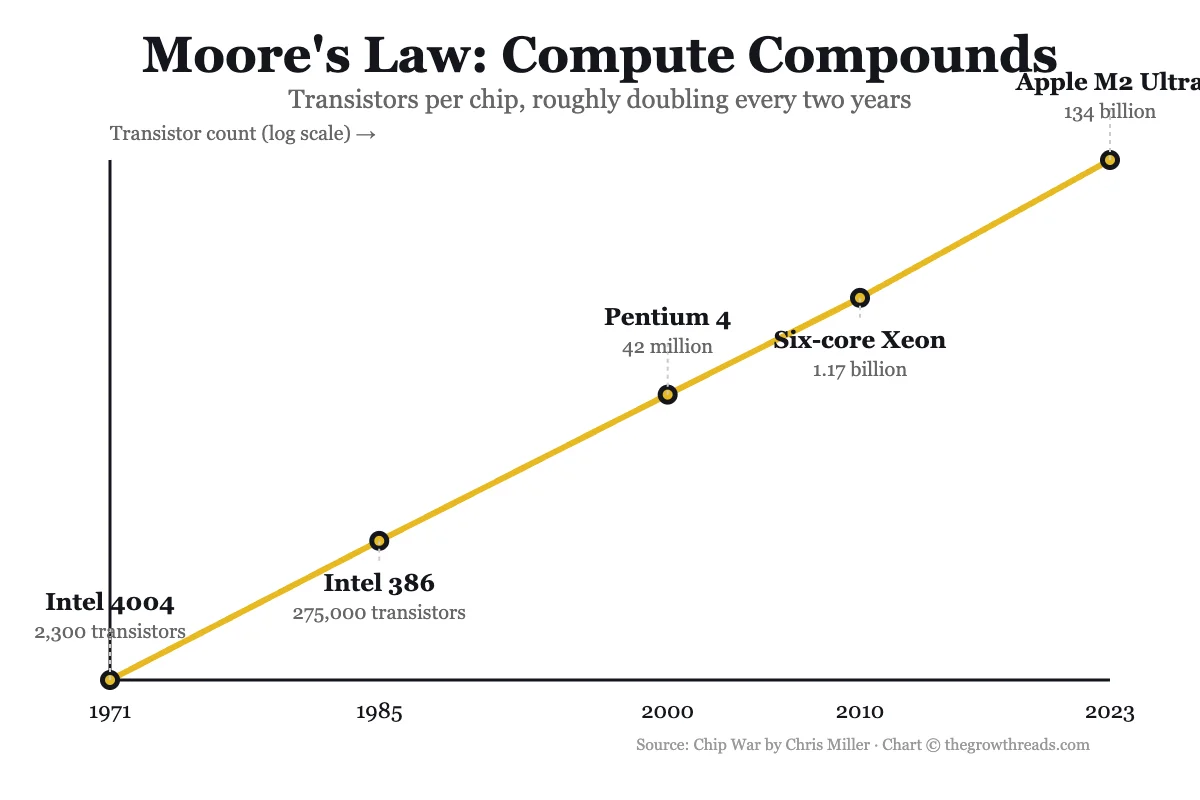
- Moore’s Law compounds: transistor density has roughly doubled every two years since 1965, turning a 2,300-transistor 1971 chip into a 134-billion-transistor one by 2023.
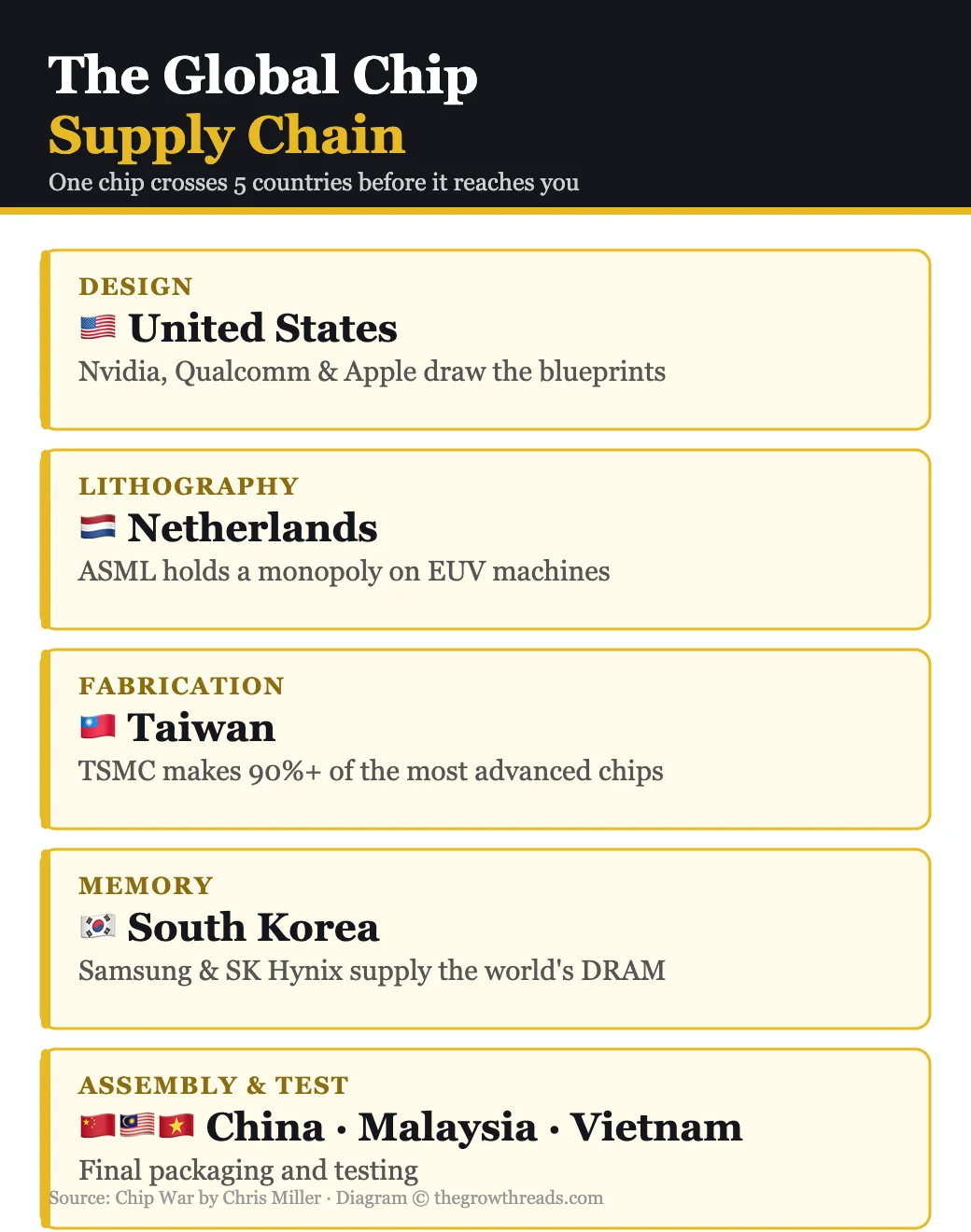
- The industry concentrated dangerously: one company, TSMC, now manufactures more than 90% of the world’s most advanced logic chips.
- One machine-maker controls a chokepoint: ASML in the Netherlands is the only company on Earth that builds extreme ultraviolet (EUV) lithography machines needed for cutting-edge chips.
- Taiwan’s dominance is deliberate strategy: its chip industry functions as a “silicon shield” — the world’s economic dependence on Taiwan raises the cost of any move against it.
- Japan’s rise and fall is a cautionary tale: Japan dominated memory chips in the 1980s, then lost ground to Korea and the shifting economics of manufacturing.
- The industry was born from war, not consumer demand: Cold War missile guidance and the Apollo program created the first mass market for integrated circuits.
- Export controls became the sharpest policy tool: since 2022, the US has restricted China’s access to advanced chip equipment, software, and talent.
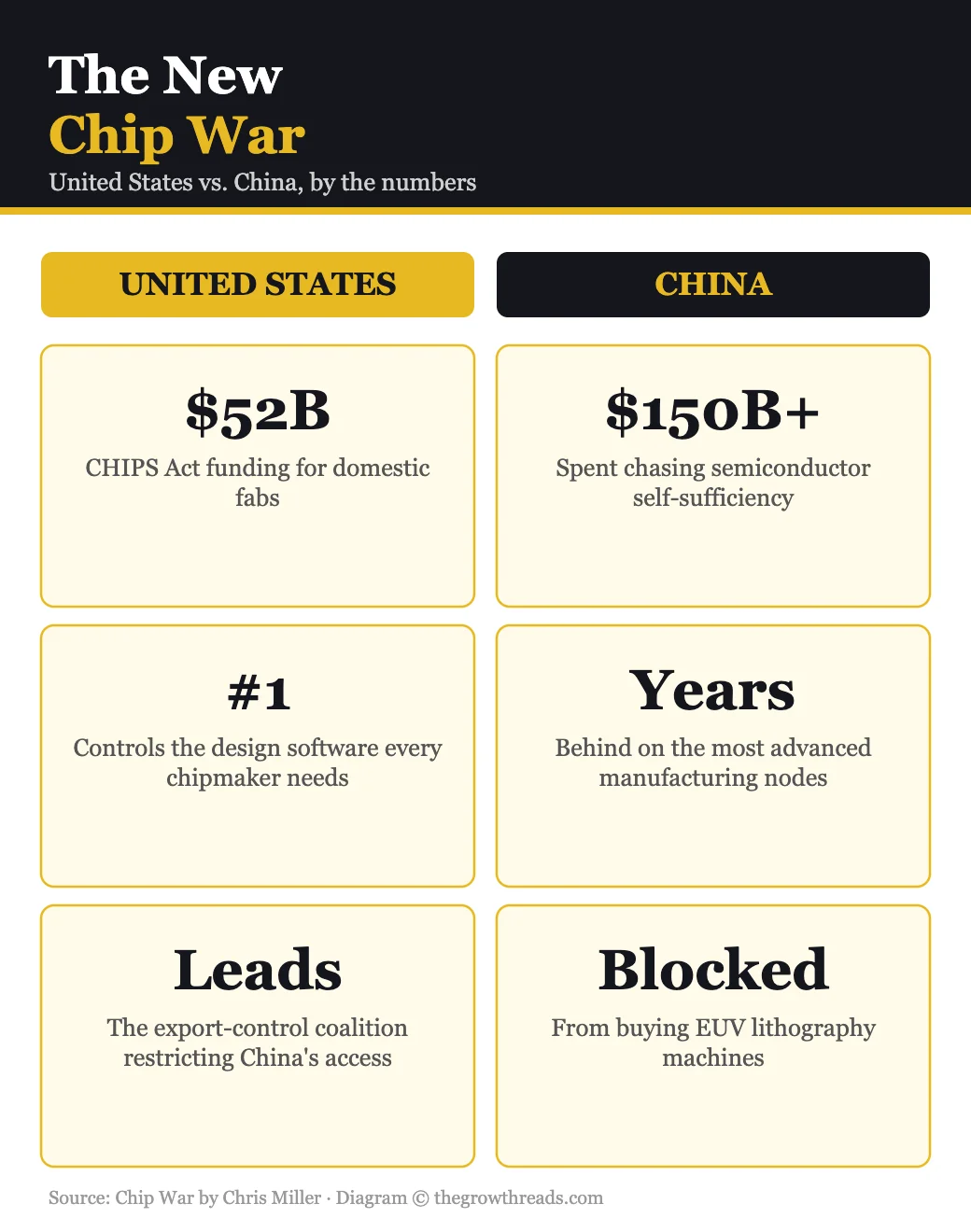
- The CHIPS Act is a $52 billion bet: the US is subsidizing domestic fabs to reduce reliance on a single vulnerable island.
- China’s self-sufficiency push is real but lagging: despite over $150 billion in state investment, Chinese fabs remain years behind the industry frontier.
- Whoever controls the chip supply chain shapes this century’s balance of power — the pace of AI, military technology, and economic growth all run through the same handful of factories.
What is Chip War about?
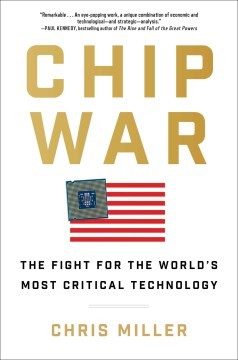
Chip War is a nonfiction history by Chris Miller tracing how semiconductors became the resource nations now compete over. It explains how a small number of firms — TSMC, ASML, Samsung — came to concentrate global chip production, and why the US-China rivalry over chip technology now shapes economic and military power worldwide.
About the author
Chris Miller is a professor of international history at The Fletcher School at Tufts University and a leading voice on the economics of technology and great-power competition. Before turning his research toward semiconductors, he wrote extensively on Russian and Soviet economic history, including Putinomics and The Struggle to Save the Soviet Economy. Chip War, published in 2022, won the Financial Times Business Book of the Year and became one of the most widely cited books in policy circles for explaining why a small Taiwanese company sits at the center of global strategy. Miller regularly briefs government and industry audiences on semiconductor supply chains and continues to publish research connecting chip technology to geopolitics. Explore all Chris Miller book summaries →
Key concepts at a glance
| Concept | What it means | Use it when |
|---|---|---|
| Moore’s Law | Transistor density roughly doubles every two years, compounding compute power | Understanding why chips keep getting cheaper and faster |
| Silicon Shield | Taiwan’s chip dominance functions as deterrence against invasion | Evaluating geopolitical risk tied to Taiwan |
| EUV Lithography | Extreme ultraviolet machines etch the smallest transistor patterns; only ASML makes them | Spotting the tightest chokepoint in the supply chain |
| Fabless Model | Companies design chips but outsource manufacturing to foundries like TSMC | Understanding why Nvidia owns no factories |
| Export Controls | US restrictions blocking China’s access to advanced chip tools and talent | Following US-China technology policy |
| CHIPS Act | A $52 billion US law funding domestic semiconductor manufacturing | Tracking reshoring and subsidy efforts |
| Chokepoint | A single company or country the entire industry structurally depends on | Assessing supply chain vulnerability in any sector |
Part 1: The Accidental Empire — Silicon Valley’s Cold War Origins
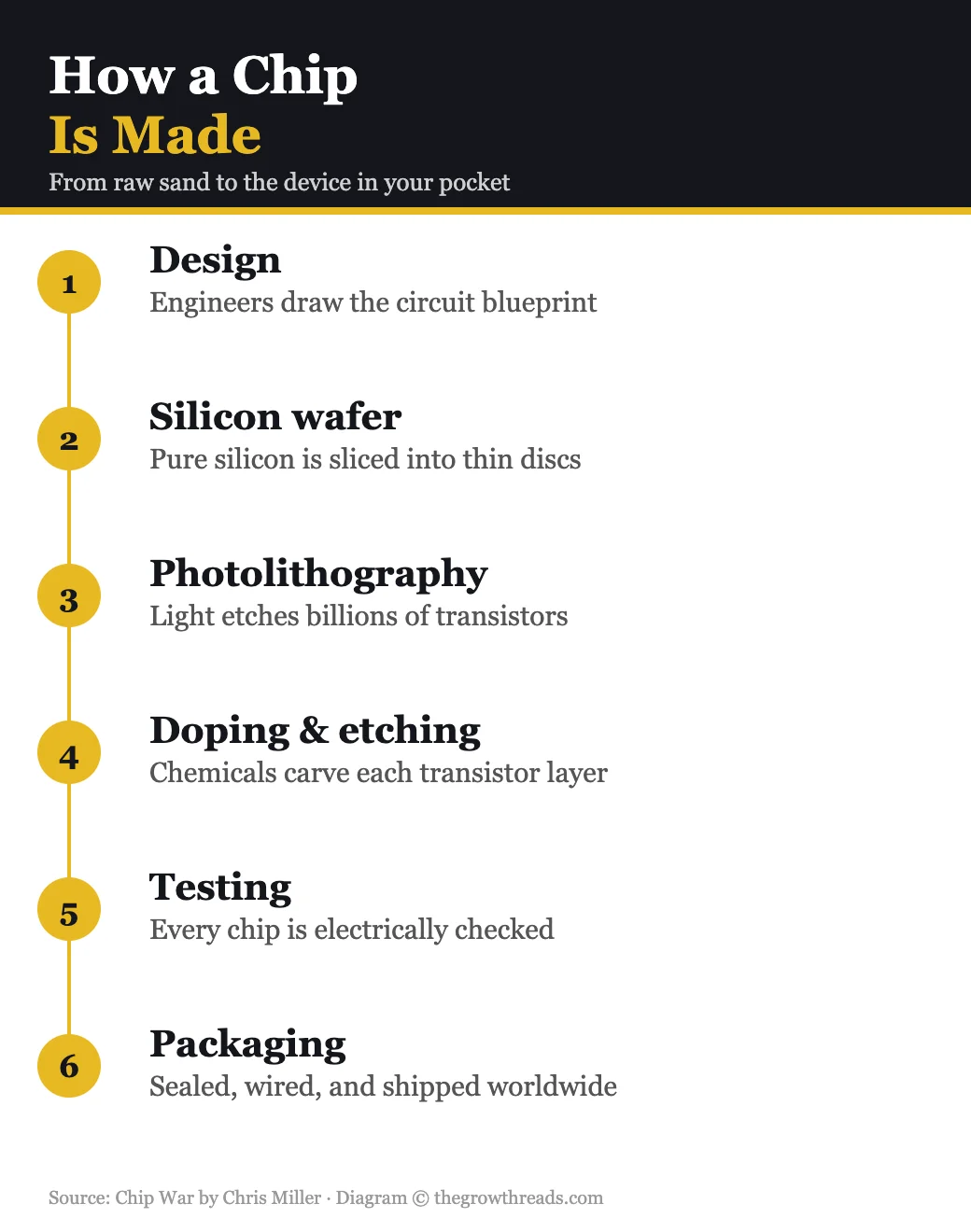
The semiconductor didn’t start as a consumer product — it started as a military problem. In the late 1950s, the US Air Force and NASA needed onboard computers small and light enough to fit inside missile nose cones and spacecraft, and the vacuum tubes powering existing computers were too bulky and fragile for the job. Miller traces how a handful of engineers who left Shockley Semiconductor to found Fairchild Semiconductor in 1957 — the so-called “traitorous eight” — built the first practical integrated circuits, largely because the Apollo program and Minuteman missile guidance systems were willing to pay almost any price for reliability at a tiny scale.
That military demand is what made Gordon Moore’s 1965 observation matter. Moore, a Fairchild co-founder, noticed that the number of components that could be packed onto a chip was doubling roughly every year (later revised to about every two years), and predicted the trend would continue. What began as an internal engineering forecast became the organizing principle of an entire industry: Moore’s Law turned semiconductors from a niche military technology into the engine of the entire computing revolution, because every doubling made chips cheaper, faster, and more useful for civilian markets that the defense budget alone could never have created.
TGR Note: This origin story pairs well with Rise of the Robots for how defense-funded research keeps seeding entire commercial industries decades later — the internet, GPS, and now advanced chips all trace back to Cold War-era military budgets rather than pure market demand.
Part 2: The Japan Challenge and the Rise of Asian Manufacturing
By the 1980s, the chip industry’s center of gravity had already shifted once. Japanese firms like NEC, Toshiba, and Hitachi out-executed American manufacturers on memory chips (DRAM), combining higher quality control with patient state-backed capital, and briefly captured the majority of the global memory market. American executives and policymakers panicked, framing Japan’s rise as an existential threat to US technological leadership — a fear that, in hindsight, proved overstated but reshaped US trade policy for a generation.
The more consequential shift, Miller argues, came from Taiwan. In 1987, Morris Chang founded Taiwan Semiconductor Manufacturing Company (TSMC) around a radical idea: a company that only manufactures chips designed by other firms, rather than designing and building its own. This “foundry” model let American companies like Nvidia and Qualcomm focus entirely on chip design while outsourcing the enormously expensive business of building and running fabrication plants. It also meant that manufacturing expertise — and the trillions of dollars of capital investment needed to stay at the cutting edge — concentrated in one place: Taiwan. South Korea’s Samsung and SK Hynix followed a similar capital-intensive playbook in memory chips, but it was TSMC’s foundry model that ultimately made Taiwan indispensable to nearly every major chip designer on Earth.
TGR Note: The foundry model is a useful case study in specialization beyond chips — it’s the same logic explored in The Second Machine Age, where the authors argue that dividing complex value chains into specialized links, rather than vertically integrating everything, tends to accelerate an industry’s overall pace of innovation.
Part 3: The Chokepoints — Why a Handful of Companies Control Everything
Modern chipmaking depends on machines so precise they sound implausible. To etch circuits smaller than a virus onto silicon, the industry relies on extreme ultraviolet (EUV) lithography — light with a wavelength of just 13.5 nanometers, generated by vaporizing droplets of molten tin with a laser 50,000 times per second. Exactly one company in the world, ASML in the Netherlands, can build these machines, and each one costs well over $150 million and takes months to ship and assemble. Miller frames ASML as the ultimate chokepoint: even TSMC, the most advanced chip manufacturer on Earth, cannot produce cutting-edge chips without ASML’s machines, and neither can anyone else.
This chokepoint logic repeats throughout the supply chain. A small number of American and European firms — Cadence, Synopsys, Siemens EDA — control the electronic design automation (EDA) software that every chip designer, anywhere in the world, needs to lay out a modern chip. Japan supplies critical silicon wafers and specialty chemicals. And at the far end of the chain, Taiwan’s TSMC alone fabricates the overwhelming majority of the world’s most advanced logic chips. Miller’s central argument is that this concentration isn’t an accident of the free market so much as the predictable result of an industry where staying at the frontier requires such enormous, compounding capital investment that only a handful of players can survive at each stage — which is exactly what makes Taiwan’s position, and its “silicon shield,” so strategically loaded.
TGR Note: If chokepoint economics interests you, The Age of Surveillance Capitalism makes a parallel argument about data — that whoever controls the underlying infrastructure of a technology, rather than just its visible products, ends up with outsized and durable power.
Part 4: The New Chip War — Export Controls, the CHIPS Act, and What Comes Next
In October 2022, the Biden administration imposed the most sweeping technology export controls in decades, barring US companies — and, through a novel “foreign direct product rule,” any company using US technology anywhere in the world — from selling advanced chips, chipmaking equipment, and even the services of American chip engineers to China. Miller frames this as a direct attempt to slow China’s military and AI development by cutting it off from the chokepoints described in Part 3, since China’s domestic chip champion, SMIC, still lags several process generations behind TSMC despite years of state investment reportedly exceeding $150 billion.
On the other side of the Pacific, the US passed its own $52 billion CHIPS and Science Act in 2022, aiming to rebuild domestic manufacturing capacity that had been offshored over decades of cost-driven consolidation. Miller is candid that reshoring is slow and expensive — building a single leading-edge fab can cost $20 billion and take years — and that Taiwan’s dominance won’t meaningfully shrink for a long time. The book ends less with a prediction than a warning: as long as the world’s most advanced chips flow through one island facing a genuine military threat, global technology, AI progress, and economic stability all carry a single point of failure that most people never think about until a headline forces them to.
TGR Note: For the AI angle on this rivalry, pair this part with AI Superpowers, which argues that access to compute — the very chips this book is about — may end up mattering more for the AI race than any algorithmic breakthrough.
Who is Chip War best for — and who should read something else first?
Chip War is best for readers who want to understand the technology and trade headlines shaping AI, national security, and the global economy — investors following semiconductor stocks, policy-curious readers, and anyone who’s wondered why Taiwan keeps coming up in conversations about war. It assumes no engineering background. If you specifically want the AI-development angle rather than the hardware-and-geopolitics angle, start with AI Superpowers instead. If you want a broader history of computing before narrowing into chips, The Second Machine Age is a gentler entry point.
Questions to reflect on
- How many devices within arm’s reach right now depend on a chip made in Taiwan?
- If TSMC’s most advanced fab went offline for a year, which industries would feel it first — and how would that ripple to you?
- Where else in your work or life does a single “chokepoint” supplier quietly hold outsized power?
- Do export controls slow a rival down permanently, or just push them to build alternatives faster?
- What would it take for a country to build a truly self-sufficient chip supply chain — and is that even the right goal?
🔥 Ready to understand the chip behind everything?
Get Chip War and see why one company most people had never heard of now sits at the center of global strategy.
How to apply Chip War (7-day plan)
- Day 1: Read the origin story (Part 1) and note how Cold War defense spending, not consumer demand, created the chip industry.
- Day 2: Look up TSMC’s foundry model and name three companies that design chips but don’t manufacture them.
- Day 3: Walk through your home and list five devices whose chips likely passed through Taiwan.
- Day 4: Research ASML and write one sentence explaining why its EUV monopoly matters more than any single chip designer.
- Day 5: Sketch a simple timeline of US-China chip export controls since 2022.
- Day 6: Discuss with a colleague or friend: “why does Taiwan matter so much?” — explain it in under two minutes.
- Day 7: Write a one-page note on where a similar chokepoint exists in your own industry, and what it would mean if it broke.
Frequently asked questions
What is Chip War about?
Chip War is a nonfiction history by Chris Miller that traces how semiconductors became one of the most contested resources on Earth. It follows the industry from its Cold War origins through Japan’s 1980s rise, Taiwan’s emergence as the center of advanced manufacturing, and the current US-China rivalry over chip technology, export controls, and supply chain security.
Who should read Chip War?
Anyone curious about the technology and trade stories behind today’s headlines — investors following semiconductor and AI stocks, policy-curious general readers, students of geopolitics, and people who want to understand why Taiwan is discussed as a potential flashpoint. No engineering or finance background is required; Miller writes for a general audience throughout.
Is Chip War still relevant given how fast the chip industry moves?
Yes. While specific export-control details and company market shares shift year to year, the book’s core argument — that a small number of chokepoints (ASML’s lithography monopoly, TSMC’s manufacturing dominance, US design-software control) shape the whole industry — has held up well and remains the standard framework analysts use to discuss chip geopolitics.
What is Taiwan’s “silicon shield”?
The “silicon shield” is the idea that Taiwan’s dominance in advanced chip manufacturing, especially through TSMC, makes the island so economically indispensable to the rest of the world that other nations have a strong incentive to defend it or discourage any move against it. It’s a form of deterrence built on economic interdependence rather than military alliance alone.
Why does TSMC matter so much?
TSMC manufactures the overwhelming majority of the world’s most advanced logic chips — the kind used in the newest smartphones, AI accelerators, and high-performance computing. Because it pioneered the “foundry” model that lets other companies design chips without owning factories, most major chip designers, including Nvidia and Apple, depend on TSMC for production they cannot easily replicate elsewhere.
Did Chip War win any awards?
Yes. Chip War won the Financial Times and McKinsey Business Book of the Year Award in 2022, and it was widely named a book of the year by multiple major publications. It has since become one of the most cited general-audience books in policy discussions about semiconductor supply chains and US-China technology competition.
Is Chip War difficult to read for non-technical readers?
No — it’s written as narrative history rather than a technical manual. Miller explains lithography, transistor design, and manufacturing economics in plain language through stories about the engineers, executives, and policymakers involved, making it accessible to readers with no background in electronics or semiconductor engineering.
Related summaries
- AI Superpowers Summary & Review
- The Age of Surveillance Capitalism Summary & Review
- The Second Machine Age Summary & Review
- Rise of the Robots Summary & Review
- See all Best AI & Technology Books
How we analyze books: our team reads the full text, cross-references key facts and figures against primary sources and expert commentary, and structures each summary around practical application rather than just retelling the plot. Read our full methodology.
Related Technology Summaries
Superagency Summary & Review: What Could Possibly Go Right with AI
The Coming Wave Summary & Review: How to Contain AI Before It Contains Us
The Creativity Code Summary & Review: Can AI Really Create?
Working with AI Summary & Review: What 29 Real Deployments Actually Prove
You Look Like a Thing and I Love You Summary & Review: What AI’s Funniest Failures Teach Us