

★★★★½ 4.5/5 — A prescient, still-urgent warning about the algorithms quietly deciding what you see.
Best for: Media-literate readers, marketers, and anyone who wants to understand why their feed feels like an echo chamber
Reading time: ~5 hrs for the full book · 12 min for this guide
Difficulty to apply: Easy — small daily habits
The Filter Bubble in one minute
Every time you click, the internet gets a little better at showing you more of what you already believe — and a little worse at showing you anything else. In The Filter Bubble, internet activist Eli Pariser argues that the personalized algorithms behind search engines and social feeds have quietly replaced human editors as the gatekeepers of information — and unlike editors, they optimize for what keeps you clicking, not what you need to know as a citizen. The result is a unique, invisible information universe built just for you, one that narrows a little more with every scroll. Pariser doesn’t argue for unplugging. He argues for noticing, and for a handful of deliberate habits that keep your feed — and your thinking — from quietly closing in.
Key takeaways
- Personalization is invisible: Algorithms filter what you see based on hundreds of quiet signals — clicks, searches, time spent — and you rarely see the criteria or the content that got filtered out.
- You’re alone in your bubble: Unlike a shared newspaper or broadcast, your feed is a unique universe built just for you, invisible to everyone else, including your closest friends.
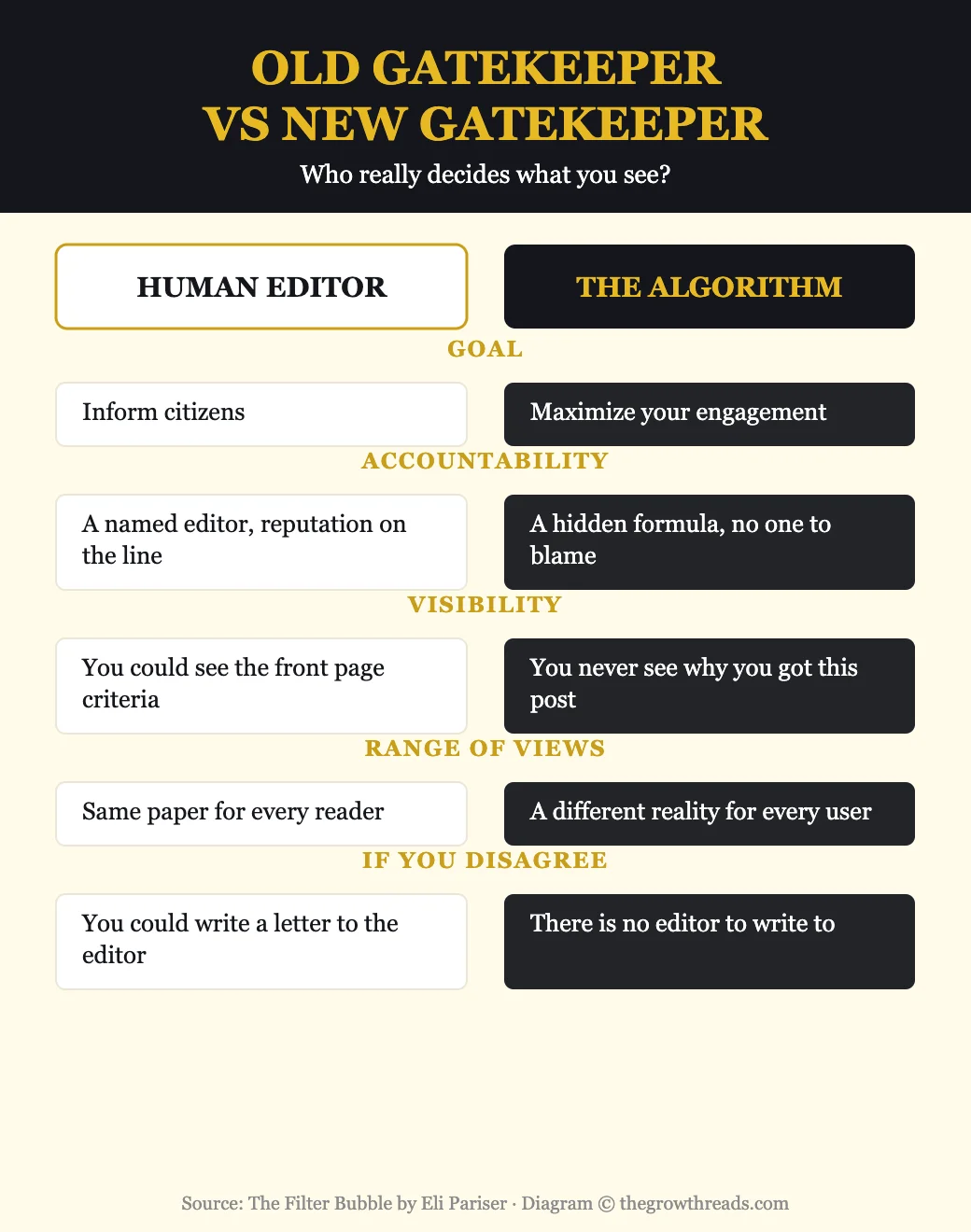
- Editors had accountability; algorithms don’t: A named editor could be criticized and held to standards. A ranking algorithm has no face, no accountability, and no civic mandate.
- Relevance crowds out importance: Feeds optimize for what’s engaging to you personally, not for what matters for you to know as a citizen — and the two increasingly diverge.
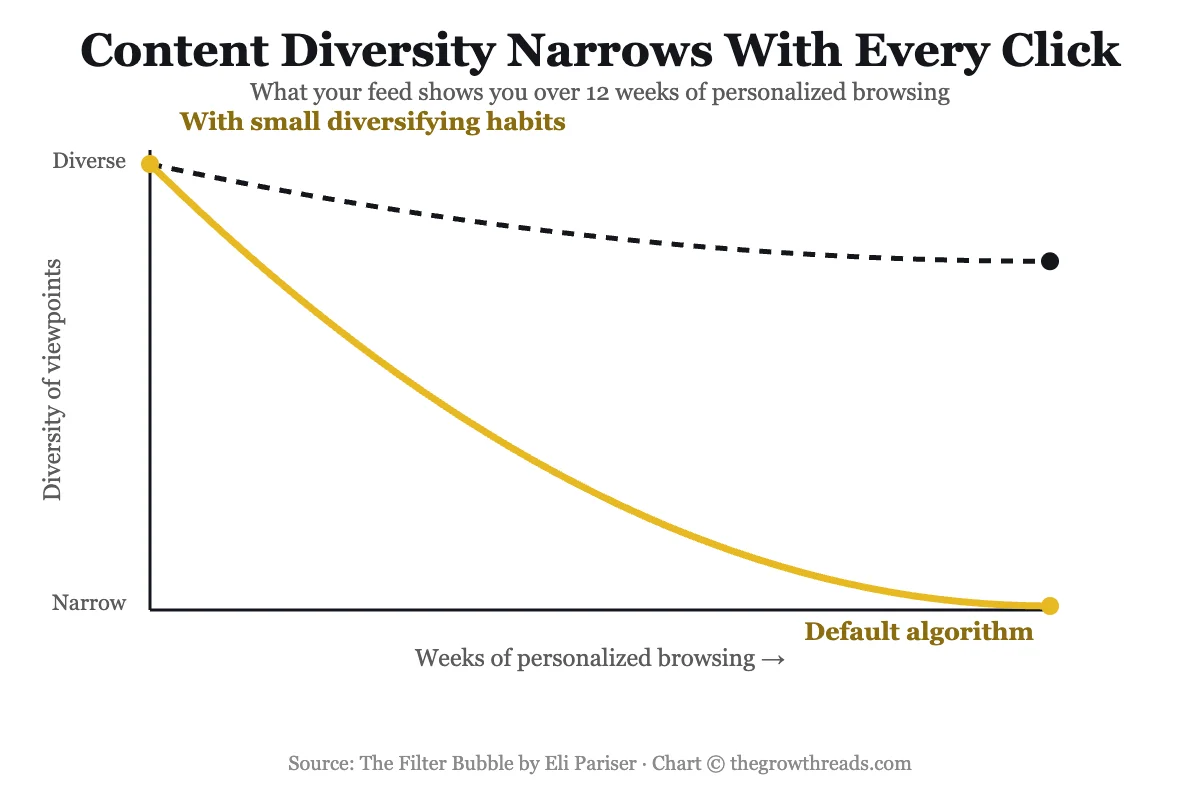
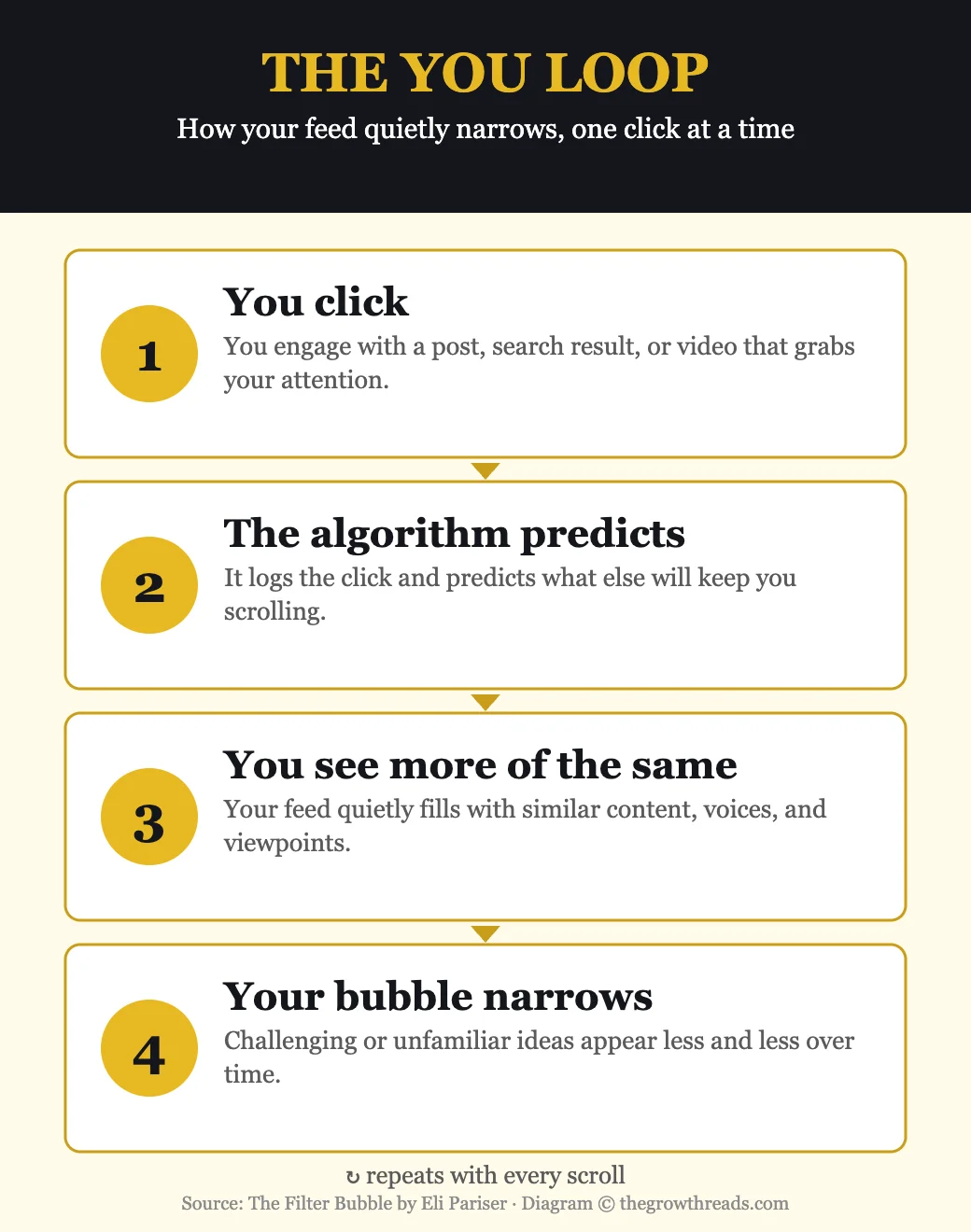
- The You Loop narrows you over time: Your clicks train the algorithm, which narrows your feed, which shapes your future clicks — a feedback loop that can narrow who you become, not just what you read.
- Filter bubbles quietly limit creativity: New ideas often come from unlikely juxtapositions; a feed engineered purely for relevance optimizes away the surprising exposure that sparks them.
- Filter bubbles fragment shared reality: Democracy depends on citizens arguing from a common set of facts — personalized feeds erode that common ground without anyone choosing to opt out of it.
- Platforms could fix this by design: Pariser proposes transparency, real user controls, and deliberate “serendipity by design” as achievable fixes — personalization doesn’t have to mean a closed loop.
- You have more control than it feels like: A handful of small, repeatable habits — searching logged out, following a contrarian voice, a weekly algorithm-free day — meaningfully loosen the bubble’s grip.
What is The Filter Bubble about?
The Filter Bubble (2011) by internet activist Eli Pariser argues that personalized algorithms on Google, Facebook, and beyond quietly filter what each of us sees online, trapping us in an invisible bubble of familiar opinions. Pariser explains how this happens, what it costs us as thinkers and citizens, and how to reclaim a more open information diet.
About the author
Eli Pariser is an internet activist, entrepreneur, and author best known for popularizing the term “filter bubble.” He rose to prominence as executive director of MoveOn.org, where he helped build one of the largest online organizing networks in American politics. In 2012, he co-founded Upworthy, a media company built around the question of how to make important stories spread. His 2011 TED Talk, “Beware Online Filter Bubbles,” has been viewed by millions and remains one of the most-watched talks on the ethics of algorithmic media. Pariser now leads Good Information Inc. and co-directs New_ Public, an initiative researching what healthier, more civically minded digital public spaces could look like. Explore all Eli Pariser book summaries →
Key concepts at a glance
| Concept | What it means | Use it when |
|---|---|---|
| Filter bubble | The unique, invisible universe of information created by personalized algorithms | Your feed feels “too agreeable” |
| Personalization algorithm | Software that ranks or selects content based on your predicted preferences | Anytime you search, scroll, or get a recommendation |
| The You Loop | The feedback cycle where your clicks train the algorithm, which narrows your future feed | You want to understand why your feed keeps narrowing |
| Relevance vs. importance | Relevance means “engaging to you”; importance means “matters for you as a citizen” | Deciding whether to trust a feed for civic information |
| Editorial gatekeeping | The human judgment that once decided what made the front page, largely displaced today | Comparing today’s feeds to pre-algorithm media |
| Echo chamber | A space where mostly agreeing voices get amplified | Auditing who you actually hear from online |
| Serendipity by design | Deliberately injecting unfamiliar or challenging content into a feed | Evaluating whether a platform is bubble-aware |
Part 1: How Personalization Quietly Took Over the Web
Before 2009, a Google search for the same term returned roughly the same results for everyone. That year, Google quietly rolled out personalized search for all users, whether they were logged in or not — a change so subtle that most people never noticed it happened. Around the same time, Facebook’s News Feed began using an algorithm to decide which of your friends’ posts you’d actually see, rather than showing every update in chronological order.
Pariser traces how these changes weren’t driven by a grand plan to shape public opinion. They were driven by something more mundane: engagement. A platform that shows you content you’re likely to click, like, or linger on keeps you on the site longer, which means more ad impressions and more revenue. Personalization, in other words, isn’t a conspiracy — it’s a business model.
To make personalization work, platforms need to build a model of you: your clicks, searches, purchases, location, device, and time spent on each post, folded into what Pariser calls a “user model.” That model gets more accurate the more you use the platform, which means the platform gets better and better at showing you things it predicts you’ll engage with.
This is a profound shift from how information gatekeeping used to work. For most of the twentieth century, a relatively small number of newspaper and television editors decided what counted as news. That system had real flaws — editors had blind spots, biases, and commercial pressures of their own. But it also had a kind of accountability: an editor’s name was attached to the front page, readers could write letters, and everyone in a given city was arguing over the same set of facts, even if they disagreed about what those facts meant.
Algorithmic curation removes that shared reference point. There’s no named editor to hold accountable, no front page everyone sees, and — critically — no visibility into why you’re seeing what you’re seeing. Two people who search the exact same term can end up with meaningfully different pictures of the world, and neither will necessarily know it.
TGR Note: Weapons of Math Destruction digs deeper into how these hidden models encode real-world bias at scale — read it alongside this chapter for the data-science version of the same warning. Hooked explains the engagement mechanics that make personalization so effective at holding your attention in the first place.
Part 2: The Three Dynamics of the Filter Bubble
Pariser distills the danger of personalization into three dynamics that combine to make filter bubbles especially hard to notice or escape.
First, you’re alone in it. A filter bubble isn’t a shared space — it’s a unique, individually tailored universe of information built just for you. Unlike a newspaper or broadcast, which at least exposes an entire audience to the same content, your bubble is invisible to everyone else, including the people you’re closest to. Two friends scrolling the same platform at the same moment may as well be looking at two different internets.
Second, the bubble is invisible. You didn’t design your filter bubble, and you can’t easily audit it. There’s no dashboard showing what got filtered out, or why. The very thing that makes personalization convenient — you don’t have to sift through irrelevant content — is what makes it dangerous, because you lose the ability to compare what you’re seeing to what you’re missing.
Third, you don’t choose to enter it. Nobody opts into a filter bubble the way they might subscribe to a newsletter with a particular slant. It forms gradually, as a side effect of ordinary use, with no single moment where you consented to a narrower information diet.
Together, these three dynamics create what this guide calls the You Loop: a self-reinforcing cycle where your past behavior shapes your future feed, which shapes your future behavior, and so on. Each click doesn’t just get you the next piece of content — it trains the model a little further in the same direction.
Pariser’s sharpest argument is that this loop doesn’t just narrow what you see; over time, it can narrow who you are. If a platform keeps showing you the version of yourself that clicks the most, it has an incentive to keep you being that version — the outraged version, the anxious version, the tribal version — rather than the more curious, more open version you might otherwise grow into.
TGR Note: If the You Loop sounds familiar, it should — Uncanny Valley explores the same feedback dynamic from the inside, as a former insider’s memoir of watching it get built.
Part 3: What We Lose: Creativity, Serendipity, and Democracy
The book’s most original argument isn’t that filter bubbles make us biased — plenty of critics had already made that point. It’s that filter bubbles quietly undermine two things we don’t usually associate with our news feed: creativity and democracy.
Creativity, Pariser argues, is often combinatorial — new ideas come from colliding two things that don’t usually appear together. A biologist reads a paper on ant colonies and stumbles on an idea for traffic engineering. A novelist reads about deep-sea fish and finds a metaphor for loneliness. This kind of unlikely juxtaposition depends on encountering material you weren’t looking for. A feed engineered purely for relevance optimizes away exactly the kind of surprising, tangential exposure that sparks those connections.
Democracy depends on something similar: a shared set of facts that citizens can argue about together. You can have a healthy disagreement about what a piece of news means. It’s much harder to have a healthy disagreement when you and your neighbor are operating from two entirely different sets of facts, because your feeds have quietly diverged. Pariser argues that this fragmentation doesn’t just create disagreement — it creates a kind of civic disorientation, where people lose a common reference point for reality itself.
This is where the book pushes back gently on a popular narrative of the internet as an automatic engine of openness and connection. Pariser, notably, was an early and enthusiastic internet organizer himself — his credibility comes partly from having built one of the most successful digital advocacy operations in the world, then watching the same tools that made that possible start working against open discourse.
The chapter is careful not to overstate the case: personalization isn’t the only cause of polarization, and people have always gravitated toward agreeable information, with or without algorithms (a tendency psychologists call selective exposure). But Pariser’s point is that algorithms don’t just reflect this tendency — they can automate and amplify it at a scale and speed no individual habit ever could.
TGR Note: For a deeper look at how attention-driven media reshaped culture even before social algorithms existed, read our summary of Attention Merchants. Human-Centered AI takes the democracy argument further, making the case for building technology around human judgment rather than engagement metrics alone.
Part 4: Reclaiming Control: Design Fixes and Personal Habits
The final section of the book resists easy pessimism. Pariser is a technologist and organizer at heart, and the book ends with concrete proposals — both for the companies building these systems and for the people using them.
On the platform side, Pariser proposes three design principles. Transparency: users should be able to see, at least in general terms, what criteria are shaping their feed. Control: platforms should offer real dials, not just an all-or-nothing opt-out, so people can adjust how much personalization they want in different contexts. And serendipity by design: algorithms could be deliberately tuned to occasionally surface unfamiliar or challenging material, the way a good editor might run a story readers didn’t ask for but needed to see.
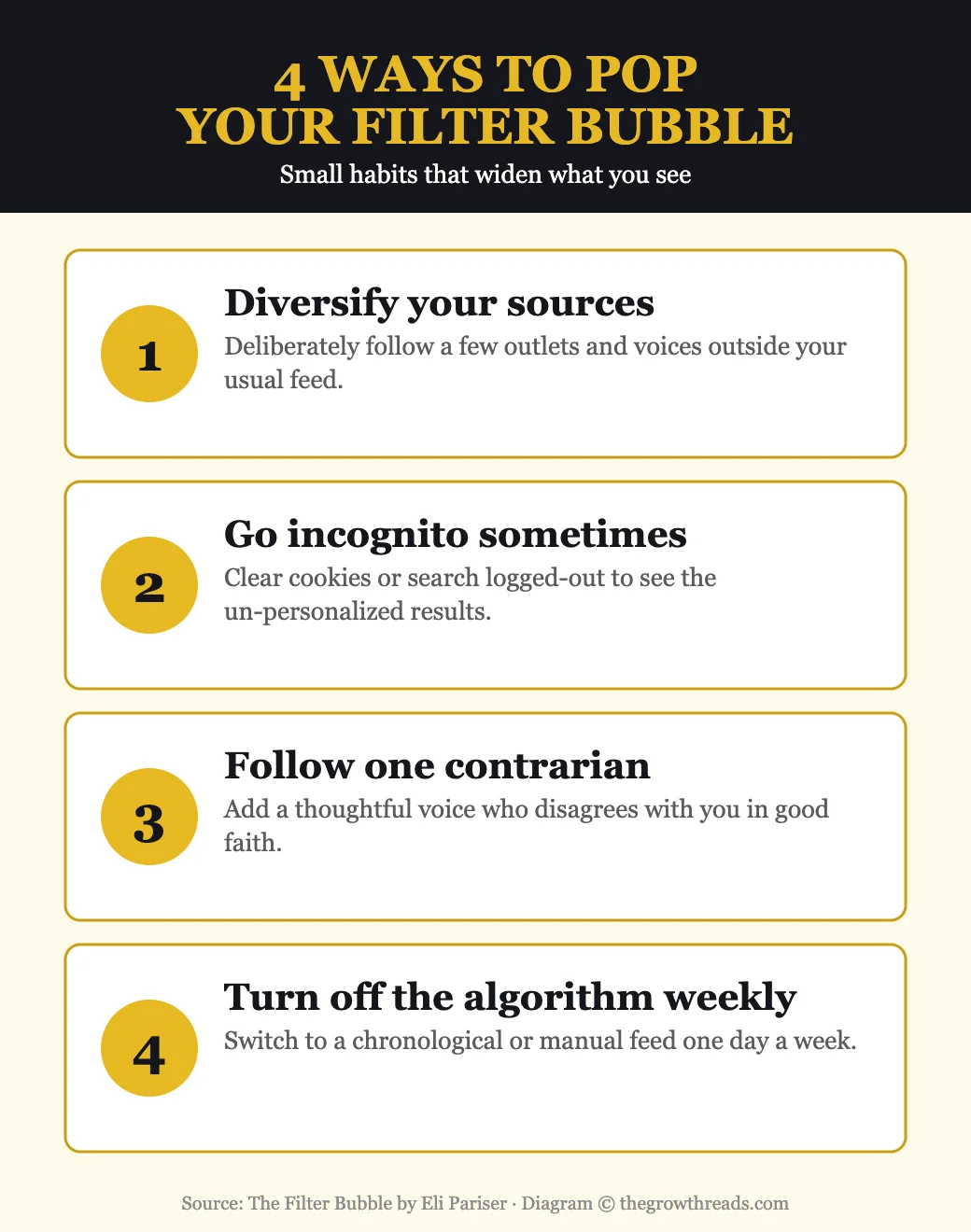
On the personal side, the book points to smaller, more achievable habits. You don’t need to quit the internet to loosen your filter bubble’s grip — you need a handful of deliberate counter-habits that reintroduce a bit of friction and diversity into an otherwise frictionless feed. That’s the spirit behind the four habits below: small, repeatable actions that put a little of the “un-personalizing” work back in your own hands, rather than waiting for platforms to redesign themselves.
TGR Note: Human-Centered AI picks up exactly where this chapter leaves off, offering a fuller framework for building technology that keeps people — not engagement metrics — in the driver’s seat.
Who is The Filter Bubble best for — and who should read something else first?
This book is best for media-literate readers who want language and evidence for something they’ve already sensed: that their feed feels a little too agreeable. It’s especially useful for marketers, content creators, and anyone who builds recommendation systems, since it lays out the ethical stakes of the tools they work with every day. Journalists, educators, and parents of young social-media users will also find it a clear, non-technical primer on how algorithmic curation actually works.
If you want the deeper data-science and legal case for algorithmic bias, start with Weapons of Math Destruction instead. If you want a first-person insider’s account of how these systems get built inside Silicon Valley, Uncanny Valley is the better entry point. And for the psychology of why these feeds are so hard to put down in the first place, pair this book with Hooked.
Questions to reflect on
- When was the last time your feed showed you something that genuinely changed your mind — and how did that happen?
- Which platforms do you use where you have no idea why you’re seeing what you’re seeing?
- Who is one thoughtful person you disagree with that you could follow or read this week?
- If you audited your last 20 searches or scrolls, how much genuine variety would you find?
- What would “serendipity by design” look like if you built it into your own daily reading habits?
🔥 Ready to pop your own filter bubble?
Get The Filter Bubble and see exactly how your feed is shaping you.
How to apply The Filter Bubble (7-day plan)
- Day 1 — Audit your feed. Scroll through your main social app or news source and write down the outlets, authors, or voices you saw most.
- Day 2 — Search logged out. Clear cookies or open a private window and repeat a recent search — compare the results side by side.
- Day 3 — Add one outside voice. Follow or subscribe to a thoughtful source you don’t usually agree with.
- Day 4 — Try a non-personalized tool. Spend a day using a privacy-first search engine or a chronological feed setting instead of the algorithmic default.
- Day 5 — Read one long-form piece from “the other side.” Read it fully before reacting, and jot down one point you find genuinely persuasive.
- Day 6 — Take an algorithm-free day. Turn off recommended feeds for 24 hours and choose what you read manually.
- Day 7 — Build a standing habit. Pick one practice from this week and put it on a recurring reminder, so it outlasts the experiment.
Frequently asked questions
What is the filter bubble, exactly?
The filter bubble is Eli Pariser’s term for the unique, personalized universe of information that algorithms quietly build around each internet user. Search engines, social platforms, and recommendation systems track your clicks, searches, and behavior, then use that data to predict and serve more of what you’re likely to engage with. The result is a feed that increasingly reflects — and reinforces — your existing interests and views, often without your awareness or explicit consent, gradually narrowing the range of ideas and information you encounter.
Who coined the term “filter bubble”?
Internet activist and entrepreneur Eli Pariser coined the term in his 2011 book of the same name, building on ideas he’d raised in his widely watched 2011 TED Talk, “Beware Online Filter Bubbles.” Pariser was previously best known as executive director of MoveOn.org and later co-founded Upworthy, giving him an unusually close view of how content actually spreads and gets amplified online.
Is the filter bubble still relevant now that feeds are increasingly shaped by AI?
Yes — arguably more so. The book predates today’s large-scale recommendation and generative AI systems, but its core mechanism (predicting engagement from behavioral data, then optimizing for it) is the same principle powering modern AI-driven feeds and assistants, just with far more data and computing power behind it. If anything, the personalization Pariser described in 2011 has become more precise, more automated, and harder to opt out of.
Does the filter bubble affect search engines, or just social media?
Both. Pariser’s original reporting focused heavily on Google’s 2009 rollout of personalized search results for all users, not just social feeds. Any system that ranks or filters content based on your predicted preferences — search results, news aggregators, video recommendations, even shopping platforms — can create a filter-bubble effect, though social feeds tend to make it most visible because of how directly they shape what you read.
Can you actually escape the filter bubble?
You can meaningfully loosen it, even if you can’t fully escape personalization in a modern digital life. Practical steps include searching logged out or in private mode, deliberately following sources and people you disagree with, occasionally using non-personalized or privacy-first tools, and periodically auditing your feed to see what patterns show up. None of these require quitting the internet — they’re closer to habits than a one-time fix.
Has research since 2011 supported Pariser’s filter bubble thesis?
The picture is more nuanced than the original book suggested. Some later studies found that algorithmic filtering plays a smaller role in political polarization than individual choice and pre-existing selective exposure — people have always gravitated toward agreeable information, with or without algorithms. Other research has found real, measurable narrowing effects from recommendation systems on some platforms. Most researchers today treat filter bubbles as one contributing factor among several, rather than the single explanation for polarization — but the book’s core warning, that non-transparent algorithmic curation deserves scrutiny, remains widely accepted.
How is a filter bubble different from an echo chamber?
The terms are related but distinct. An echo chamber typically describes a social environment you actively choose — a community, forum, or group of friends where mostly agreeing voices get amplified. A filter bubble is built for you, largely without your active choice, by algorithms optimizing for engagement. In practice, the two reinforce each other: your echo chamber choices feed the algorithm data, and the algorithm’s filter bubble narrows your echo chamber further.
Related summaries
- Weapons of Math Destruction Summary & Review
- Hooked Summary & Review
- Uncanny Valley Summary & Review
- Human-Centered AI Summary & Review
- Browse all Best AI Books
How we analyze books: every TGR summary is built from the author’s original text, published interviews, and follow-up research, structured around practical application rather than critique. Read our full methodology.