

★★★★☆ 4.4/5 — A practical, VC’s-eye playbook for turning data into a compounding competitive advantage, not a hype-driven AI primer.
Best for: Founders, product leaders, and operators who need a concrete framework for where to start with AI at work.
Reading time: ~6.5 hrs to read the book · 12 min to read this guide.
Difficulty to apply: Moderate — the ideas are simple, but redesigning a workflow around a feedback loop takes real organizational follow-through.
The AI-First Company in one minute
The companies that will dominate the next fifty years are the ones that learn fastest, not the ones that automate the most. Ash Fontana, a venture capitalist who has spent his career backing AI-first startups, argues that the real prize in artificial intelligence isn’t a smarter algorithm — it’s a compounding data advantage that gets harder to catch every single day it runs. He calls this the data network effect: collect data, use it to predict something valuable, act on the prediction, and the action itself creates more data. Do this well and the gap between you and everyone else who didn’t start early keeps widening on its own. Do it badly — bolt a model onto an existing human-first process and call it done — and you get a slightly-faster version of the same old workflow, with none of the compounding. This guide translates Fontana’s venture-capital playbook into a set of concrete moves any individual or team can make this week: what data is actually worth collecting, how to redesign a process around a feedback loop instead of a one-time automation, who needs to be on the team, and how to know the advantage is real rather than a demo that never shipped.
Key takeaways
- Data only becomes a moat when it’s proprietary. If a competitor can buy or scrape the same dataset, it isn’t an advantage — it’s a commodity.
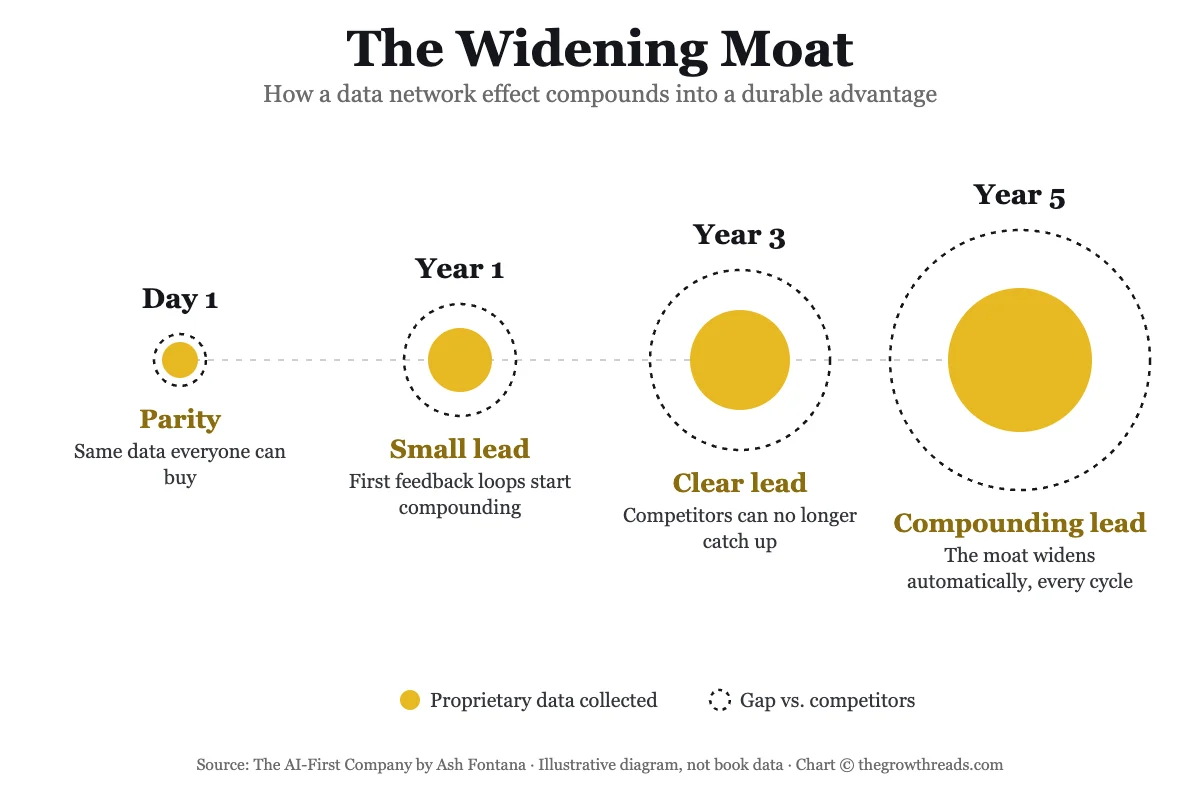
- The data network effect is the core mechanism. Collect data → train a model → serve a prediction → the outcome generates new data → repeat, faster than anyone who started later.
- AI-first means redesigning the workflow, not decorating it. Adding a chatbot to an unchanged process rarely compounds; changing how the process itself collects feedback does.
- Start with the smallest dataset that answers one real question. One dataset, one predictive feature, running on a laptop, beats a sprawling multi-source pipeline that never ships.
- Labeling quality is a genuine operational advantage. A cheap, accurate, repeatable way to label data compounds just as much as the data itself.
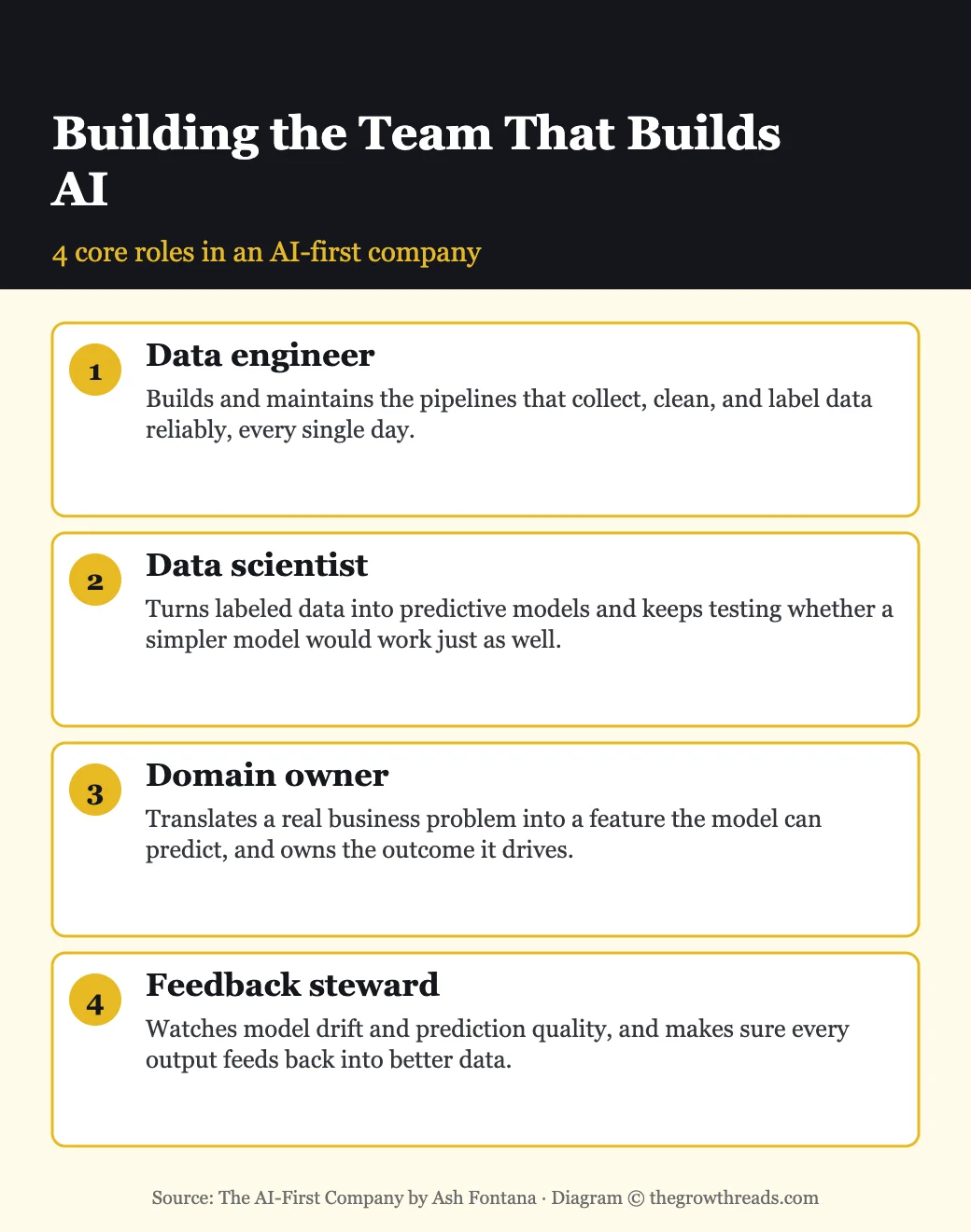
- Every AI-first team needs four functions covered: data engineering, modeling, a domain owner who defines the target outcome, and a steward who watches for drift.
- Reinvest the profits from automation, don’t just bank them. The fastest-compounding companies plow saved time and money back into collecting more and better data.
- Prediction-driven decisions still need a human in the loop. The goal is better-informed judgment, not removing judgment from the process entirely.
- A data moat is defensive as well as offensive. It’s what stops a well-funded competitor from simply copying your product and out-marketing you.
- Momentum compounds — so does neglect. A team that stops collecting and reviewing feedback loses its lead just as mechanically as one that builds it.
What is The AI-First Company about?
Venture capitalist Ash Fontana argues that lasting competitive advantage in the AI era comes from a compounding “data network effect” — proprietary data that improves predictions, which improves outcomes, which generates more proprietary data. The book is a practical playbook for redesigning workflows, teams, and incentives around that loop instead of bolting AI onto business as usual.
About the author
Ash Fontana is a venture capitalist and the founder of Zetta Venture Partners, a firm dedicated entirely to backing AI-first startups — companies built from day one around a data advantage rather than companies that added AI later. Before venture investing, he worked in product and business roles at companies including AngelList, where he helped build syndicates and data products, giving him a hands-on view of how data infrastructure decisions compound over time. Across a decade of AI-focused investing, Fontana has reviewed the founding strategy of hundreds of data-driven startups, watching which data moats held up under competition and which turned out to be commodities in disguise. The AI-First Company, published in 2021, distills that pattern-matching into a single operating framework: what to build, who to hire, and how to know a data advantage is real. He writes from the investor’s vantage point — less concerned with the elegance of any one model, more concerned with which structural choices actually compound. Explore all Ash Fontana book summaries →
Key concepts at a glance
| Concept | What it means | Use it when |
|---|---|---|
| Data network effect | Collecting data → predicting an outcome → acting on it → generating more data, in a loop that compounds faster than competitors who start later. | Deciding which product or process to invest in first. |
| AI-first vs. human-first | An AI-first process is designed around a feedback loop from the start; a human-first process just has AI added to an unchanged workflow. | Auditing whether a “digital transformation” project will actually compound. |
| Proprietary data | Data no competitor can easily buy, scrape, or replicate — the only kind that creates a real moat. | Evaluating whether a dataset is a defensible asset or a commodity. |
| Minimum viable dataset | The smallest, cheapest dataset that can answer one real predictive question — a starting point, not a warehouse. | Kicking off a new AI initiative without a multi-quarter data pipeline project. |
| Labeling advantage | A cheap, accurate, repeatable process for labeling data, which compounds in value just like the raw data itself. | Deciding where to invest early operational effort. |
| Four AI-first roles | Data engineer, modeler, domain owner (defines the target outcome), and steward (watches for drift) — all four need an owner. | Staffing or auditing an AI team. |
| Reinvestment loop | Plowing time and money saved by automation back into collecting more and better data, rather than just banking the savings. | Deciding what to do with efficiency gains from a first AI win. |
| Prediction-driven decisions | Using a model’s output to inform human judgment, not replace it — the human stays accountable for the final call. | Designing how a team actually acts on a model’s predictions. |
Part 1: The Data Network Effect — Why Data Compounds Into a Moat
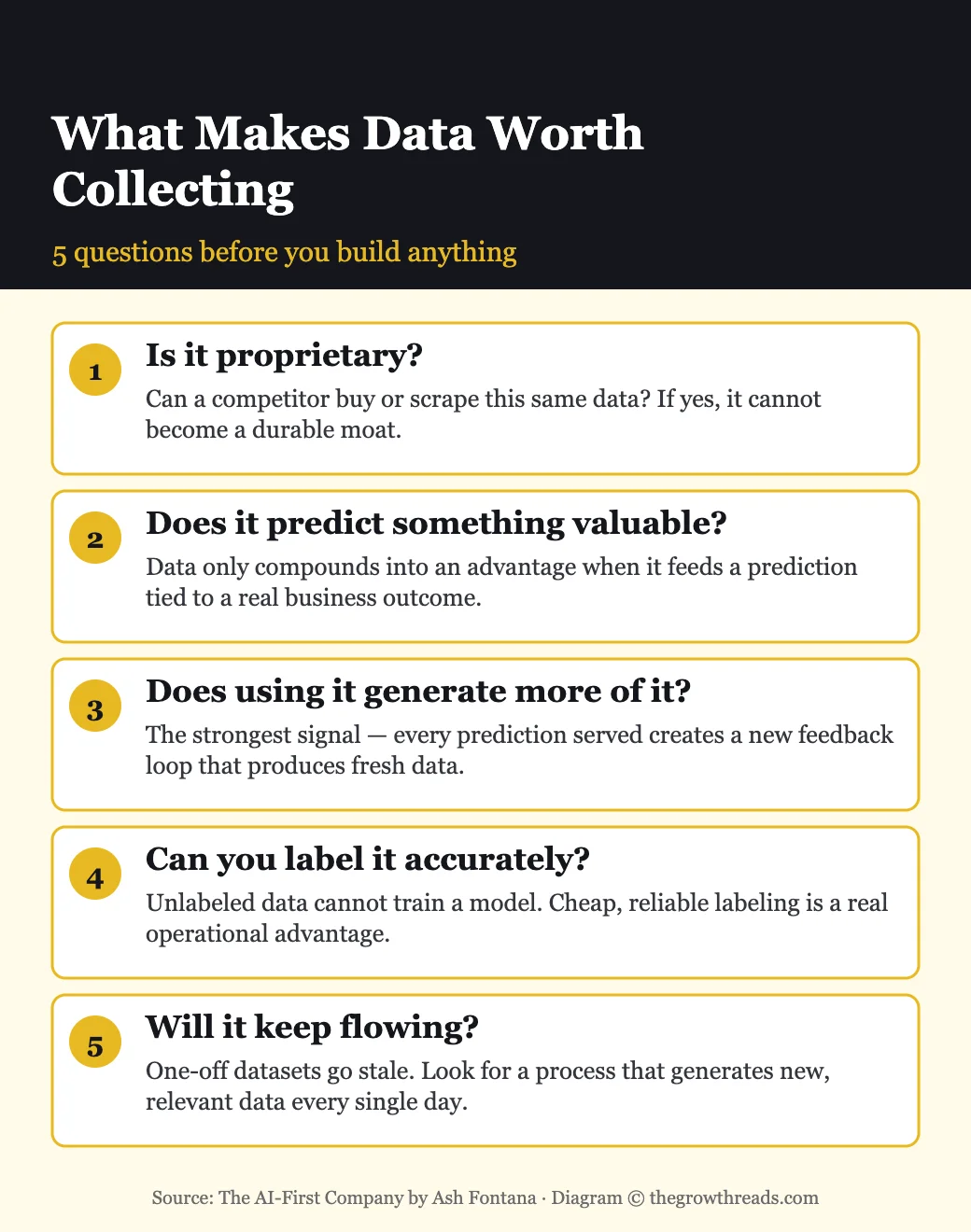
Fontana opens with a hard distinction most “AI strategy” conversations skip: having data is not the same as having a moat. If a competitor can license, buy, or scrape the same dataset you’re using, that data is a commodity — it might make your product marginally better today, but it won’t protect you tomorrow. A real advantage requires proprietary data: information generated by your own users, your own sensors, or your own processes, in a form no one else has access to.
The mechanism that turns proprietary data into a widening lead is what he calls the data network effect. It runs in four steps, on repeat: collect a piece of data, use it (with others like it) to make a prediction, act on that prediction in a way the user or the business notices, and let that action generate a new piece of data that feeds back into step one. Each cycle is small. The compounding is not. A company that starts this loop a year before a competitor doesn’t just have a one-year head start — it has a model trained on a year of outcomes the competitor doesn’t have, informing decisions the competitor can’t yet make as well, generating another year of advantage before the competitor’s loop even gets running.
This is why Fontana is skeptical of AI initiatives that begin with the model. Picking an algorithm before you know what data you can uniquely collect is backwards — you end up with a generic model trained on generic data, indistinguishable from what any well-funded competitor could stand up in a quarter. The starting question isn’t “what can we build?” It’s “what will only we ever be able to observe?”
TGR Note: This reframes a common productivity trap. Teams often chase the newest model release as if capability alone were the advantage — but if the underlying data is available to everyone, the newest model just resets everyone to the same starting line. The actual lasting move is asking what data your daily work already generates that no one else can see, and building the smallest possible loop around it.
Part 2: From Human-First to AI-First — Redesigning the Operating Model
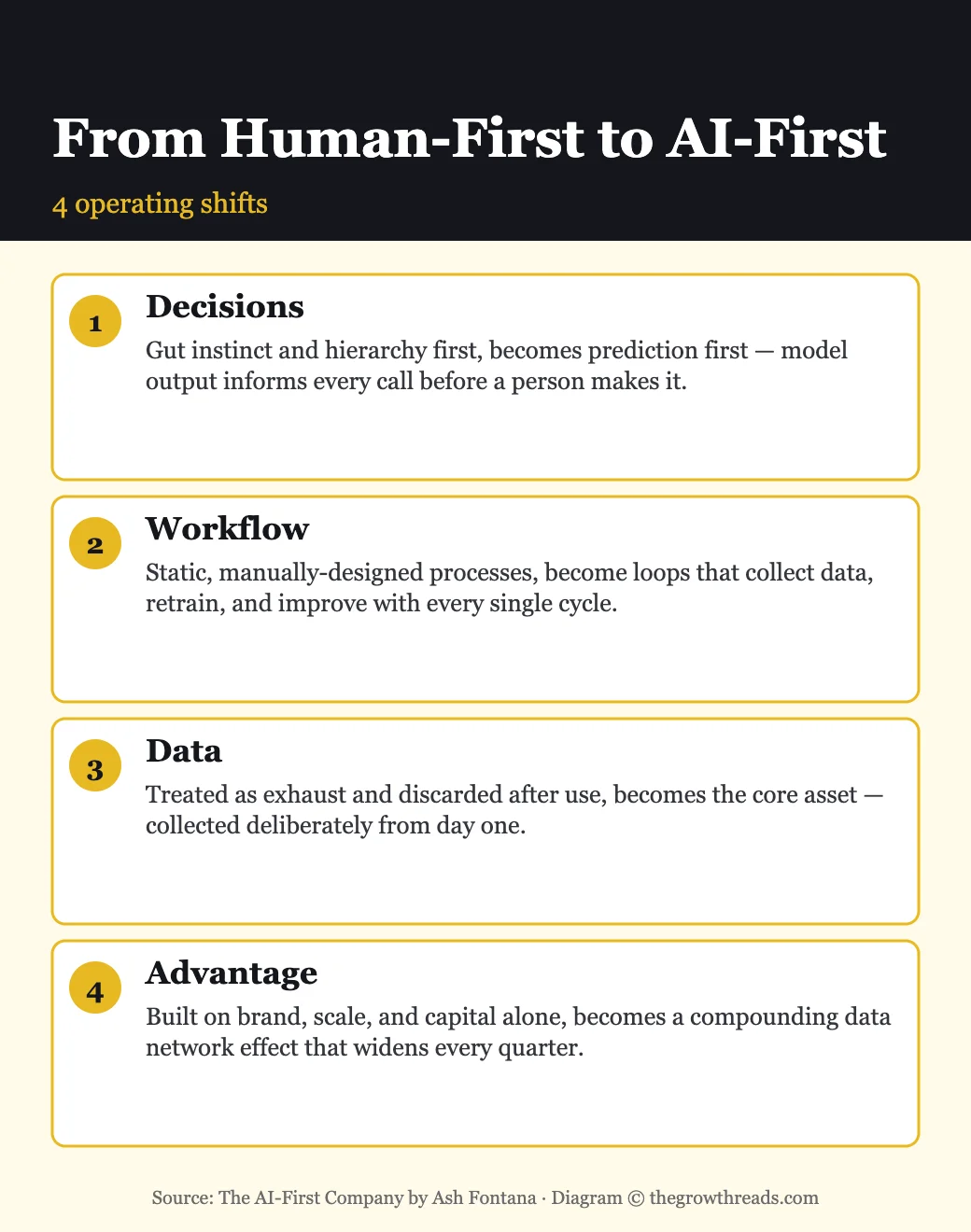
The book’s sharpest distinction is between a “human-first” company that adds AI on top of an existing process, and an “AI-first” company that designs the process around a feedback loop from the outset. A human-first company might add a chatbot to its support workflow — it looks modern, it might even save a little time, but the underlying process (a person answers a question, the answer is forgotten) hasn’t changed. An AI-first company redesigns the workflow so that every support interaction becomes labeled training data: what the customer asked, what worked, what didn’t, feeding directly back into a system that gets better at answering the next one.
Fontana walks through what this shift actually requires at the level of daily operations: what data is captured at each step of a process (and what silently isn’t), where a prediction could replace a guess, and — critically — where the outcome of that prediction gets recorded so the loop can close. Most organizations, he notes, do the first two steps and skip the third. They add prediction without instrumenting the outcome, so the system never learns from what actually happened. It’s the equivalent of running an experiment and never checking the result.
TGR Note: For an individual contributor, this maps onto something smaller than “redesign the company”: pick one recurring task you already do, and ask what would need to be recorded — not just done — for next month’s version of that task to be measurably better than this month’s. That’s the AI-first mindset at the scale of a single workflow.
Part 3: Building the Team and the Loops That Learn
Fontana breaks the AI-first team into four functions that every initiative needs covered, even if one person wears two hats early on. A data engineer makes sure the pipeline capturing raw information is reliable and doesn’t silently drop or corrupt records. A modeler turns that data into predictions. A domain owner — often the most overlooked role — defines what outcome actually matters and translates it into something measurable; without this role, teams optimize a proxy metric that drifts from the real goal. And a steward watches the system in production, catching the moment when the world changes and the model’s assumptions quietly stop holding.
He’s equally specific about how to start collecting data cheaply and well. Rather than commissioning a sprawling data warehouse project, he recommends finding the smallest dataset that can answer one real predictive question — something closer to a spreadsheet than an infrastructure investment — and proving the loop closes before scaling it up. Labeling that data accurately and cheaply is its own compounding advantage: a company with a fast, reliable way to label new examples can retrain and improve continuously, while a competitor stuck manually re-labeling data every quarter falls further behind with every cycle.
TGR Note: The “domain owner” role translates surprisingly well outside of formal AI teams. Any team running a recurring process benefits from someone whose explicit job is to keep asking “is this metric still measuring the thing we actually care about?” — because metrics quietly stop meaning what they used to mean far more often than most teams notice.
Part 4: Measuring, Reinvesting, and Defending the Advantage
A data advantage that isn’t reinvested stalls. Fontana’s argument here is almost counterintuitive for anyone used to thinking of automation as a cost-saving exercise: the money and time an AI initiative frees up shouldn’t just be banked as margin. The fastest-compounding companies plow those savings back into collecting more data, labeling it better, and expanding the loop into adjacent processes — treating the first win as fuel for the second, not a finish line.
He’s also careful to draw a boundary that keeps this from becoming a case for full automation. Prediction-driven decisions still need a human in the loop for anything with real stakes — the point of the system is better-informed judgment, not judgment removed from the process. A model can surface a prediction with a confidence level; a person still decides what to do when that confidence is borderline, or when the situation looks like nothing the model has seen before.
Finally, the moat is defensive as much as offensive. A well-funded competitor can usually out-market or out-spend a smaller company on almost every dimension except one: they can’t buy years of proprietary outcome data that hasn’t been generated yet. That’s precisely why the compounding needs to start now rather than “when we have more resources” — every quarter of delay is a quarter of data the moat never accumulates, and Fontana is blunt that neglect compounds just as mechanically as diligence does. A team that stops reviewing and acting on its own feedback loop loses its lead on the same curve it built it.
TGR Note: The reinvestment instinct is worth stealing even outside AI initiatives. When a process improvement frees up an hour a week, the default move is to just enjoy the hour back — Fontana’s framing suggests asking first whether that hour could go toward improving the same process again, so the gain compounds instead of being a one-time step change.
Who is The AI-First Company best for — and who should read something else first?
The AI-First Company is written for founders, product leaders, and operators who need a concrete framework for deciding where to invest first — it assumes you’re ready to make organizational and staffing decisions, not just get inspired. If that’s not quite your situation, a few alternatives on the shelf might fit better:
- If you want a broader, more personal introduction to working alongside AI day-to-day, start with Co-Intelligence.
- If you’re specifically interested in how humans and machines split up tasks inside a single workflow, Human + Machine covers that ground in more operational detail.
- If you’re a manager looking for leadership habits rather than a data strategy, The Algorithmic Leader is the better fit.
- If you want the case for why groups of people and computers together outperform either alone, try Superminds.
- If your interest is causal reasoning rather than data strategy — understanding why a prediction is right, not just that it is — The Book of Why is a deeper, more technical companion.
Questions to reflect on
- What data does your team already generate every day that no competitor or outside vendor has access to?
- Where in your current workflow does a prediction get made but the outcome never gets recorded anywhere?
- If you automated one recurring task tomorrow, would the time saved get reinvested into improving that task further, or just absorbed elsewhere?
- Who on your team is explicitly responsible for noticing when a metric has quietly stopped measuring what it used to?
- Is there a process you’ve labeled “AI-powered” that’s really just a human-first process with a model bolted onto the front end?
How to apply The AI-First Company (7-day plan)
- Day 1 — Map one workflow. Pick a single recurring process and write down every step where data is generated, whether it’s captured, and whether it’s currently thrown away.
- Day 2 — Find the proprietary signal. Identify which piece of data from that process no competitor or outside vendor could ever access. If nothing qualifies, look at an adjacent process.
- Day 3 — Define the smallest useful prediction. Write one sentence describing a prediction that data could plausibly support — not a model architecture, just the question it would answer.
- Day 4 — Assign the four roles. Even informally, name who owns data quality, who owns the model or method, who owns the target outcome, and who will watch for drift.
- Day 5 — Instrument the outcome. Add one concrete step to the workflow that records what actually happened after a prediction or decision was made, closing the loop.
- Day 6 — Decide the reinvestment rule. Before you launch anything, agree in writing what happens to any time or cost savings the change produces — reinvest into the loop, don’t just bank it.
- Day 7 — Review and widen. Look back at the week’s loop, note what broke, and pick the next adjacent process to bring into the same feedback loop.
Frequently asked questions
What is the main idea of The AI-First Company?
The book’s central claim is that lasting competitive advantage in AI comes from a “data network effect”: collecting proprietary data, using it to make a prediction, acting on that prediction, and letting the outcome generate new data that improves the next prediction. Companies that design their processes around this loop from the start pull ahead of competitors who simply add AI features to an unchanged workflow, and the gap widens automatically the longer the loop runs.
What does “AI-first” mean, according to Ash Fontana?
An AI-first company is one where the operating model is designed around a continuous feedback loop of data collection, prediction, and action, rather than a company that has simply layered an AI feature onto an existing human-first process. The distinction matters because a bolted-on feature rarely captures the outcome of its own predictions, so it never actually learns — while an AI-first workflow is built so that every action produces the next round of training data.
Do I need a data science team to apply the ideas in this book?
No. Fontana explicitly recommends starting with the smallest dataset that can answer one real question, run on ordinary tools, rather than commissioning a large data science build-out. The four roles he describes — data engineer, modeler, domain owner, and steward — can be covered informally by a small team or even one or two people wearing multiple hats while the loop is still small.
Is this book only relevant to venture-backed startups?
The examples lean toward startups because that’s Fontana’s vantage point as a VC, but the underlying framework — proprietary data, feedback loops, reinvestment, team roles — applies to any team inside a larger company that owns a recurring process. The scale changes; the mechanism for building a real advantage doesn’t.
How is this different from a general book about machine learning?
This isn’t a technical book about how models work — it’s a strategy book about which data-collection decisions create a defensible competitive advantage and which don’t. Readers looking for algorithm details or hands-on modeling technique should look elsewhere; readers deciding where an organization should invest its first AI effort are the intended audience.
What is a “data network effect” in simple terms?
It’s a loop where collecting data leads to a better prediction, the prediction leads to a better action, and the action generates more data than a competitor without the same loop could ever produce — so the advantage compounds on its own, cycle after cycle, without additional strategic effort.
Does the book address the risk of relying too heavily on automated predictions?
Yes. Fontana is explicit that prediction-driven decisions still need a human in the loop for anything with real stakes — the goal is better-informed judgment, not removing judgment from the process. He also emphasizes the “steward” role specifically to catch the moment a model’s assumptions stop matching reality.
Related summaries
- Human + Machine — how people and AI split tasks inside real workflows.
- The Algorithmic Leader — leadership habits for managing in an AI-driven organization.
- Superminds — why groups of people and computers together outperform either alone.
- The Book of Why — the causal reasoning behind trustworthy predictions.
For the full list of AI books we recommend, see our best AI books guide.
Methodology: This summary and review is based on a close reading of the full published book, cross-checked against the author’s public talks and interviews about his venture-investing framework. Ratings reflect the editorial judgment of The Growth Reads team on clarity, practical applicability, and durability of the ideas — not sponsored or influenced by the publisher. Affiliate links may earn this site a commission at no extra cost to you.
Related Technology Summaries
Power and Prediction Summary & Review: Redesigning Decisions, Not Just Predictions
Superminds Summary & Review: How People and AI Think Smarter Together
Team Human
The Age of Surveillance Capitalism Summary & Review: How Big Tech Turned Your Life Into a Product
The Inevitable Summary & Review: 12 Forces Reshaping Our Future