

★★★★★ 4.5/5 — A mathematician’s clear-eyed, story-driven verdict on whether machines can truly create.
Best for: readers who want a rigorous but readable answer to whether AI can be creative — artists, musicians, mathematicians, and anyone AI-curious.
Reading time: ~7 hrs to read the book · guide: 24 min
Difficulty to apply: Easy — this book mostly changes how you think about creativity, not a skill you practice.
The Creativity Code in one minute
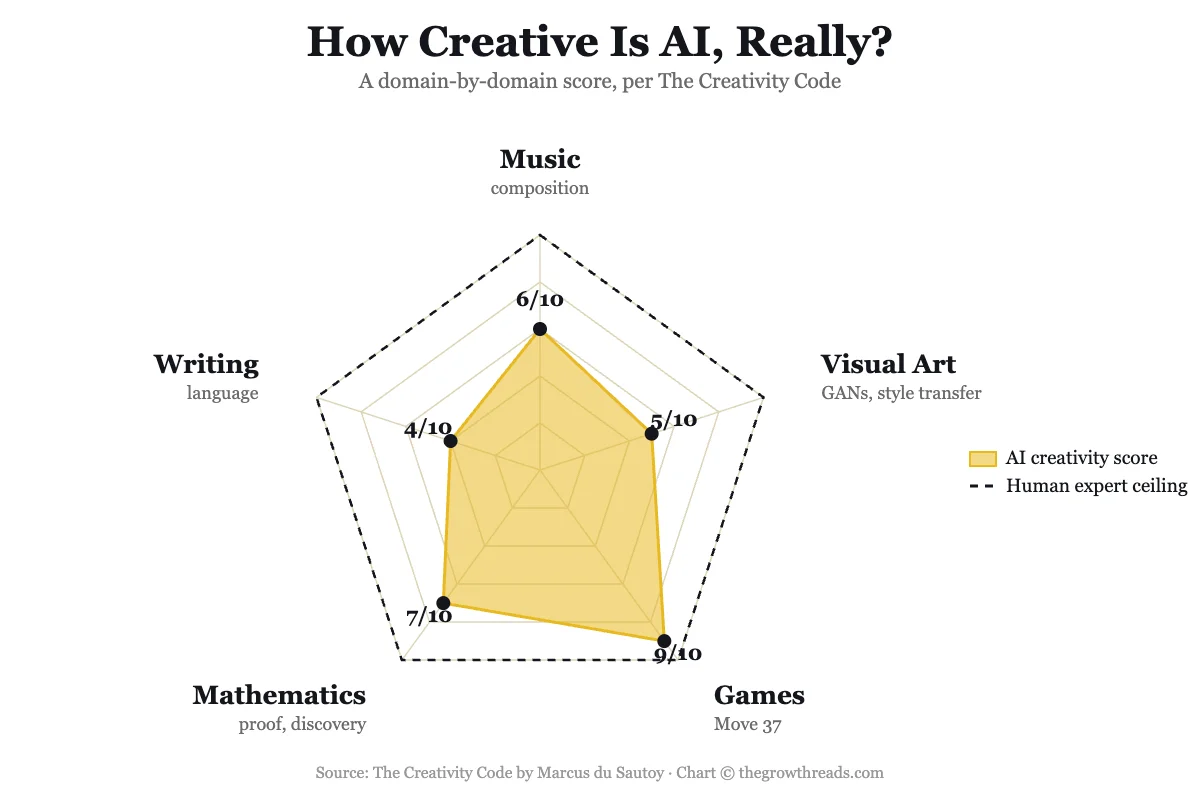
An AI beat the world’s best Go player with a move no human would ever play — and that single moment forces the question this book is really about: is that creativity, or just very good pattern-matching? Oxford mathematician Marcus du Sautoy tours five domains where machines are pushing into territory once considered exclusively human — games, visual art, music, language, and his own field, mathematics — testing each one against a real philosophical bar for creativity, not a marketing one. He borrows cognitive scientist Margaret Boden’s three-part framework (exploratory, combinational, and transformational creativity) to judge whether AlphaGo’s “Move 37,” an AI-painted portrait that sold at Christie’s, or an algorithmically composed symphony actually clears the bar for genuine originality, or merely simulates it convincingly. Du Sautoy’s own answer is careful rather than sensational: current AI is a formidable exploratory and combinational creator, but transformational creativity — rewriting the rules of the game itself — remains rare, precious, and (for now) still mostly human.
Key takeaways
- Creativity has three flavors: Boden’s framework — exploratory, combinational, and transformational — gives du Sautoy a rigorous yardstick instead of a vague “wow” reaction.
- Move 37 wasn’t a fluke: AlphaGo’s “impossible” move against Lee Sedol emerged from self-play, not imitation — the book’s clearest case of transformational machine creativity.
- Algorithmic music predates deep learning: David Cope’s EMI generated convincing Bach-style chorales in the 1980s using hand-built rules, decades before neural networks.
- GANs create through competition: a generator and a discriminator trained against each other produce increasingly convincing AI art — not a single clever algorithm.
- An AI portrait sold for $432,500 at Christie’s — but the credit went to the human collective that built and trained it, not the algorithm.
- Mathematics is a creative art, not a mechanical one: proving a genuinely new theorem takes the same imaginative leap as composing a symphony, du Sautoy argues.
- Surprise isn’t enough: an AI output can surprise its own creators, as Move 37 did, without that surprise alone qualifying as full creativity.
- The “Lovelace question” is still open: almost 200 years after Ada Lovelace first asked it, whether a machine can truly originate anything remains unresolved.
- The strongest results are collaborative: the most interesting art, music, and mathematics in the book comes from humans and algorithms working together.
- Writing an algorithm is itself creative: du Sautoy’s closing argument is that code is a new creative medium, whatever the program later produces.
What is The Creativity Code about?
The Creativity Code asks whether artificial intelligence can be genuinely creative, touring AI’s advances in games, painting, music, and language, and using mathematics — du Sautoy’s own field — as the toughest test case for where machine originality currently ends and human creativity still leads.
About the author
Marcus du Sautoy is a British mathematician and the Simonyi Professor for the Public Understanding of Science at the University of Oxford, a chair previously held by Richard Dawkins. A number theorist by training, he has spent his career translating abstract mathematics for general audiences through books, television, and public lectures, including the BBC series “The Story of Maths.” Explore all Marcus du Sautoy book summaries →
In The Creativity Code, du Sautoy turns his mathematician’s eye on artificial intelligence, asking whether machines that compose music, paint pictures, and play world-class Go are actually being creative — or merely executing very sophisticated pattern-matching. His own discipline becomes the book’s sharpest test case: if an algorithm can prove a genuinely new theorem, he argues, that would be the clearest evidence yet that machines can cross from generation into invention.
Key concepts at a glance
| Concept | What it means | Use it when |
|---|---|---|
| Exploratory creativity | Generating new variations within a known set of rules | Judging AI that remixes an existing style convincingly |
| Combinational creativity | Blending unrelated ideas into something new | Assessing GAN-generated art or style-transfer results |
| Transformational creativity | Breaking or rewriting the rules of the game itself | Judging AlphaGo’s Move 37 or a true mathematical breakthrough |
| The Lovelace question | Can a machine originate something its programmer never anticipated? | Deciding whether an AI’s output really counts as “creative” |
| Self-play | An AI improves by playing against itself, not by imitating humans | Explaining why AlphaGo surprised even its own creators |
| GAN (Generative Adversarial Network) | Two networks compete — one generates, one critiques | Understanding how AI art keeps getting more convincing |
| Algorithmic composition | Music generated from mathematical rules or learned patterns | Evaluating whether “computer music” can genuinely move a listener |
| Automated theorem proving | Software that searches for valid, rigorous mathematical proofs | Weighing whether mathematics itself can ever be automated |
Part 1: Can Machines Play? Games as the Sharpest Early Test
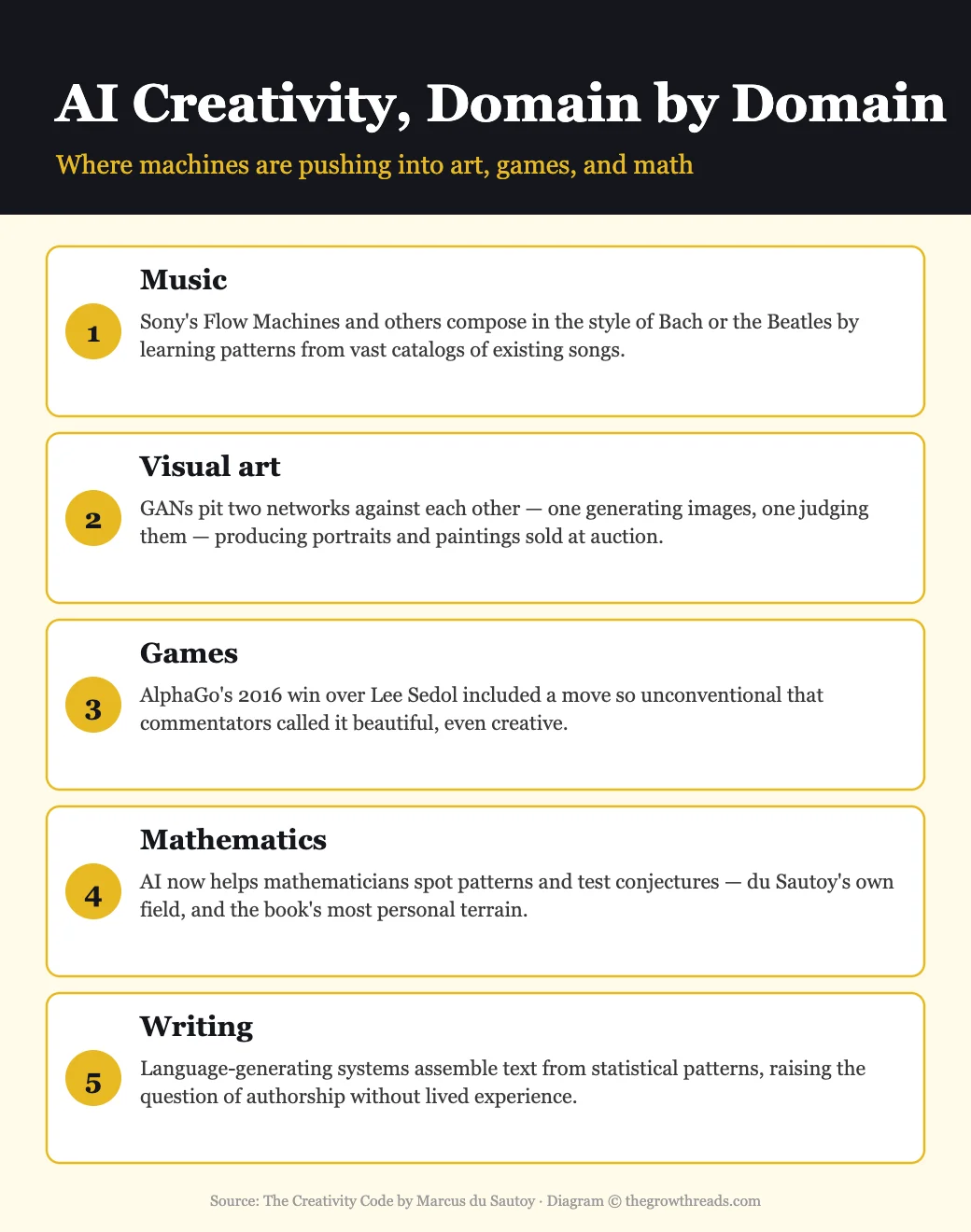
Du Sautoy opens with games because they offer a clean scoreboard. Chess gave the first clear verdict: IBM’s Deep Blue beat world champion Garry Kasparov in 1997 through brute-force search, evaluating hundreds of millions of positions per second rather than understanding the game. Du Sautoy treats this as an important negative case — raw computation alone isn’t creativity by any of Boden’s three definitions.
Go is different, and it’s where he spends the most time. The game has more possible positions than atoms in the observable universe, so brute force is hopeless — a Go program needs something closer to intuition. DeepMind’s AlphaGo trained on human games, then played millions of games against itself, refining its strategy without human guidance. Against champion Lee Sedol in 2016, it played a move — Move 37, in game two — that no professional would have considered. Commentators assumed it was a mistake. It won the game and reshaped how professionals think about the opening.
Du Sautoy’s case for Move 37 as transformational creativity rests on a simple distinction: AlphaGo wasn’t imitating a human strategy or stumbling into a good position by chance — self-play let it discover a genuinely new idea about how the game could be played. That’s the book’s clearest example of a machine doing something that looks like invention rather than recombination.
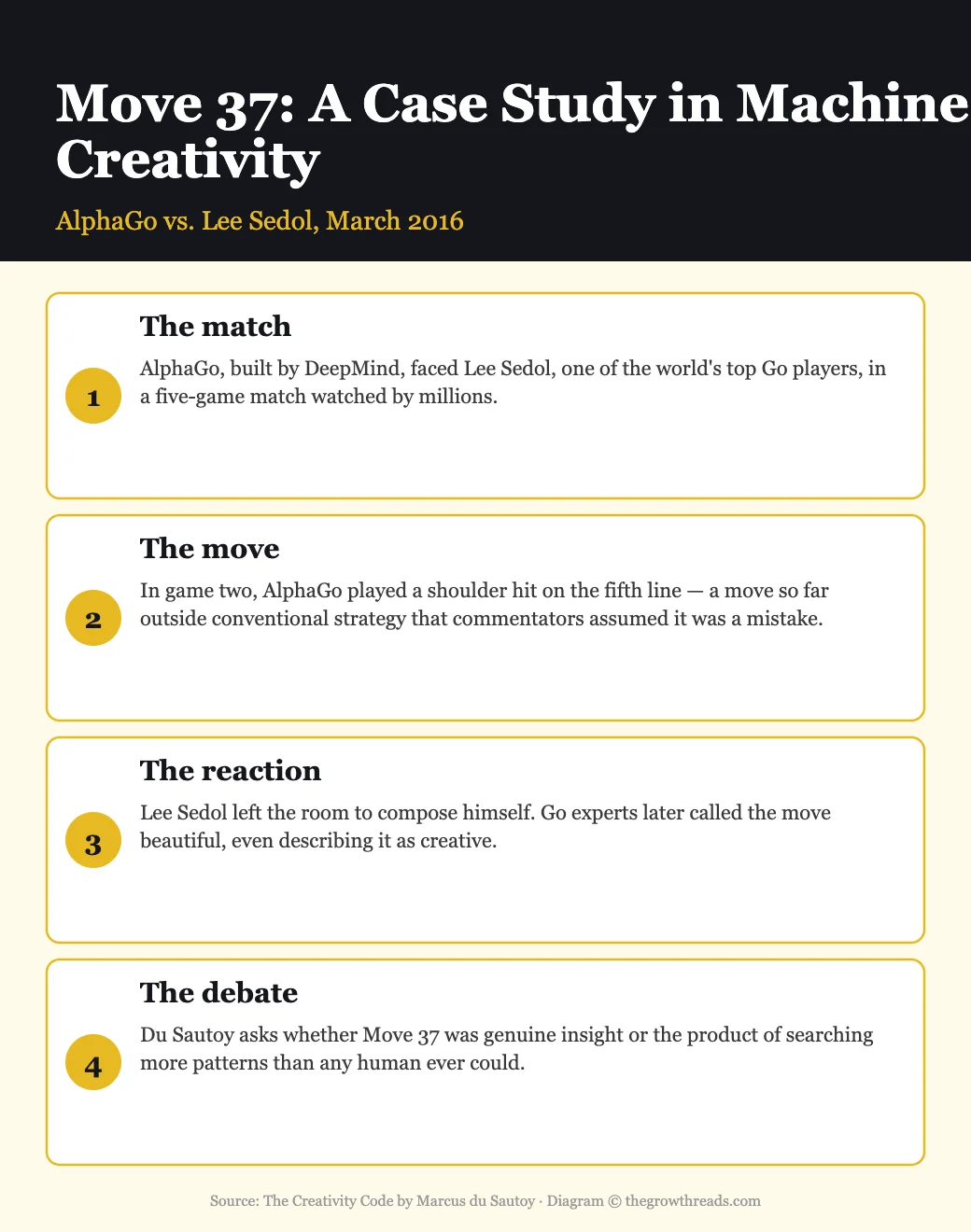
But he’s careful not to overclaim. AlphaGo’s creativity exists entirely within Go’s fixed, closed rules — it can’t decide to invent a new game or apply that instinct elsewhere. That narrowness, du Sautoy argues, is exactly why we should be cautious about extrapolating from game-playing triumphs to broader claims about machine creativity.
TGR Note: For the mechanics behind how systems like AlphaGo generalize a single trick (self-play) across problems, Pedro Domingos’s The Master Algorithm maps the five competing “tribes” of machine learning behind this kind of narrow-but-startling intelligence. For the infrastructure and human labor cost of training a system at AlphaGo’s scale, see Kate Crawford’s Atlas of AI.
Part 2: Can Machines Paint? From AARON to the Christie’s Auction Block
Visual art is where AI’s creativity is most publicly contested. Du Sautoy traces the lineage back to artist Harold Cohen’s AARON, begun in the 1970s: hand-coded rules generating original drawings and paintings decades before machine learning existed. Cohen refined AARON’s rule set his entire life — raising an early version of a question the book keeps returning to: when a human spends fifty years tuning a program’s aesthetic judgment, whose creativity is on display?
The more recent wave runs through Generative Adversarial Networks (GANs) — two neural networks in competition, a generator producing images and a discriminator judging real from fake. Neither network is creative alone, but the tension between them pushes the generator toward increasingly convincing, sometimes genuinely novel output. The Next Rembrandt project used a similar data-driven approach to synthesize a “new” Rembrandt-style portrait from the painter’s existing works — a useful test of how much “style” can be captured statistically.
The moment du Sautoy returns to most is Christie’s 2018 sale of Edmond de Belamy, a GAN-generated portrait, for $432,500. He makes a sharper point than the headlines did: the auction house credited “Obvious,” the human collective that built and trained the algorithm — not the algorithm itself. That credit line, he argues, is the art world’s most honest verdict so far: exploratory and combinational creativity, clearly present; authorship, still resolutely human.
Part 3: Can Machines Compose? Algorithmic Music from Bach to AIVA
Music has the longest history of algorithmic creation of any art form, because music is already, at some level, mathematics. Du Sautoy gives real weight to David Cope’s EMI (Experiments in Musical Intelligence), which by the 1980s and ’90s produced chorales convincingly “in the style of” Bach — complete enough that listeners in blind tests sometimes preferred them to genuine Bach. Cope built EMI from explicit rules about harmony and voice-leading rather than machine learning, an important historical point: algorithmic creativity long predates deep learning.
Newer systems like AIVA use neural networks trained on large catalogs of existing scores to generate original compositions, some used in film and advertising. Applying Boden’s three-part test, du Sautoy finds these systems strong exploratory and combinational composers, fluent within a learned style, but little evidence yet of a musical “Move 37” — a piece that redefines a genre rather than extending it well.
One detail he lingers on: composer Iannis Xenakis built entire orchestral scores, including his landmark Metastaseis, from mathematical formulas and stochastic processes decades before computers could do it for him — a reminder that the line between “human creativity” and “algorithmic process” was never as clean as AI headlines suggest.
TGR Note: If Parts 2 and 3 leave you wanting a broader map of what today’s AI can and can’t do outside games and art, Melanie Mitchell’s Artificial Intelligence: A Guide for Thinking Humans is the clearest plain-language companion — it explains why systems that ace a narrow creative task can still lack anything resembling general understanding.
Part 4: Can Machines Prove? Why Du Sautoy Puts Mathematics to the Test
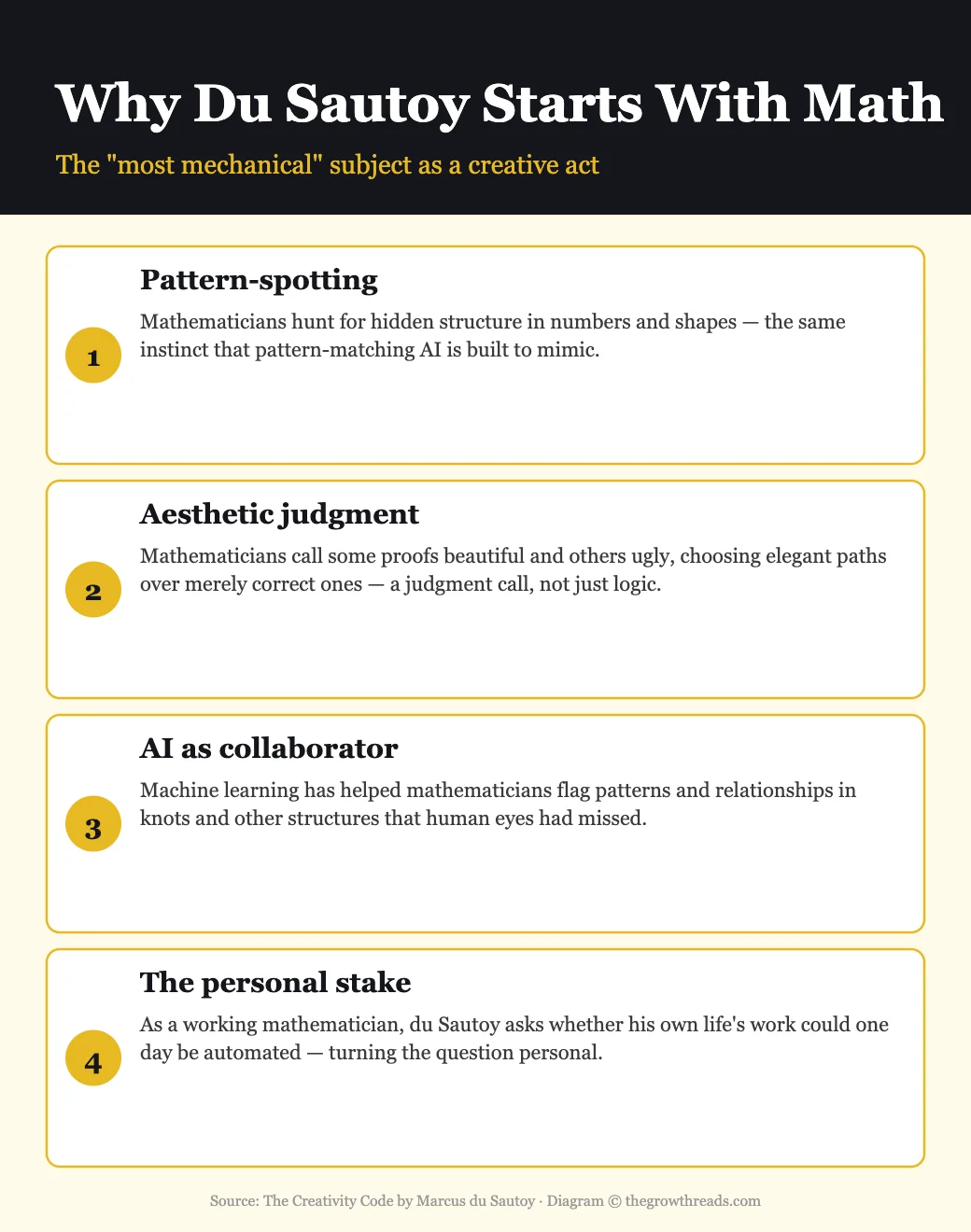
The book’s final and most personal test is mathematics — du Sautoy’s own field, and the one he argues is the purest measure of creativity, because a proof either works or it doesn’t; there’s no critic’s taste or auction price to muddy the verdict. He walks through automated theorem provers, software that searches valid logical steps to check a mathematical claim, and the controversial 1976 computer-assisted proof of the four-color theorem, which no human could verify case by case.
What makes mathematics such a sharp test, he argues, is that a genuinely new proof isn’t just correct — it has to be surprising and elegant, often connecting two areas of math that looked unrelated. That’s transformational creativity by definition. He’s honest that automated systems excel at exploratory work — checking cases, verifying steps, searching a defined space — but finds little evidence of a machine independently producing the conceptual leap mathematicians like Srinivasa Ramanujan were famous for: seeing a truth before anyone could explain why it was true.
He closes with a brief look at machine-generated language — the GPT-family models were just emerging as he finished the book — arguing that fluent, even witty text generation is a strong exploratory and combinational skill, but coherent, book-length original argument was, at the time of writing, still out of reach. He frames this as the current edge of a fast-moving line rather than a permanent limit.
Du Sautoy’s verdict, across all five domains, is neither “AI is now creative” nor “it’s just statistics.” Machines have become formidable exploratory and combinational creators, remixing and searching within a space of possibilities faster than any human could. Transformational creativity, which redefines the space itself, remains rare even in the most impressive systems — and where it has appeared, above all in Move 37, it emerged from self-play against clearly defined rules, not an open-ended creative drive. The most valuable outcomes in the book aren’t humans-versus-machines contests at all, but collaborations: artists training GANs on their own work, mathematicians using theorem-provers to check ideas too large to verify by hand.
TGR Note: Du Sautoy’s math-as-creativity argument pairs well with Judea Pearl’s case, in The Book of Why, that AI is strong at correlation but still weak at the causal reasoning underlying real scientific insight — a different angle on the same question of what machines are still missing.
Who is The Creativity Code best for — and who should read something else first?
This book rewards readers who want a rigorous, well-argued answer to “can AI really create?” rather than a hot take — artists, musicians, and writers curious (or anxious) about AI tools in their own field; math and science enthusiasts who’ll enjoy du Sautoy’s own field getting the same scrutiny he applies to everyone else’s; and general AI-curious readers who want real case studies over abstract philosophy.
If you want a broader survey of AI’s societal impact rather than a focused look at creativity, start with Melanie Mitchell’s Artificial Intelligence: A Guide for Thinking Humans. If you’re more interested in the machine-learning mechanics behind systems like AlphaGo, Pedro Domingos’s The Master Algorithm is the better starting point.
Questions to reflect on
- Think of something you’ve made recently — a piece of writing, a recipe, a plan. Was it exploratory, combinational, or transformational by Boden’s definitions?
- If a machine surprises its own programmers, as AlphaGo did with Move 37, does that surprise alone qualify as creativity — or is something else required?
- Does it matter, ethically or artistically, whether the “artist” behind a work is human, if you can’t tell the difference from the output alone?
- Where in your own work could an AI tool act as a creative collaborator rather than a replacement — searching a space of possibilities faster than you could alone?
- Du Sautoy treats mathematics as the sharpest test case in his own field. What’s the equivalent “hardest test” in your own profession or hobby?
🔥 Ready to see whether AI can really create?
Get The Creativity Code and decide for yourself where the line between imitation and invention really sits.
How to apply The Creativity Code (7-day plan)
- Day 1: Watch a short clip of AlphaGo’s Move 37 (game 2 vs. Lee Sedol) and read a summary of why commentators initially thought it was a mistake. Notice your own instinct: does it feel “creative” to you?
- Day 2: Look up Edmond de Belamy, the GAN-generated portrait sold at Christie’s for $432,500. Read who received the artist credit, and decide for yourself whether you agree with that call.
- Day 3: Listen to a short piece attributed to David Cope’s EMI program alongside a genuine Bach chorale. Try to guess which is which before checking — then reflect on what that tells you.
- Day 4: Apply Boden’s three-part test (exploratory, combinational, transformational) to one piece of AI-generated content you encounter today — an image, a playlist recommendation, a chatbot reply.
- Day 5: Pick one task in your own work and ask: could an AI tool act as a creative collaborator here — generating options for you to judge and refine — rather than doing the whole task alone?
- Day 6: Read one paragraph about the four-color theorem’s 1976 computer-assisted proof and why it was controversial. Consider what “proof” means when no human can check every step by hand.
- Day 7: Write down your own one-paragraph answer to the book’s central question — can machines be creative? — using Boden’s framework, before comparing it to du Sautoy’s own careful, non-sensational conclusion.
Frequently asked questions
Is The Creativity Code by Marcus du Sautoy worth reading if I’m not a mathematician?
Yes. Du Sautoy writes for a general audience and spends most of the book on games, art, and music before turning to mathematics in the final section, using accessible stories (Ramanujan, the four-color theorem controversy) rather than technical proofs. The framework for judging creativity — Boden’s exploratory, combinational, and transformational categories — is explained in plain language and applied consistently across every domain.
What is AlphaGo’s “Move 37” and why does the book focus on it?
Move 37 was a move AlphaGo played against champion Lee Sedol in game two of their 2016 match — a move no professional would have considered, initially assumed to be a mistake. It won the game and changed how professionals think about the opening. Du Sautoy uses it as the book’s clearest case of transformational machine creativity, since it emerged from self-play rather than imitation of human strategy.
Does The Creativity Code argue that AI is or isn’t truly creative?
Neither, flatly. Using Boden’s three-part framework, du Sautoy finds AI systems are already strong exploratory and combinational creators, remixing and extending within a defined space of possibilities, but that transformational creativity, which redefines the space itself, remains rare — and where it has appeared, as with Move 37, it occurred within a single game’s closed rules rather than open-endedly.
What is the Christie’s auction story about, and what does it prove?
In 2018, Christie’s auctioned Edmond de Belamy, a GAN-generated portrait, for $432,500. Du Sautoy highlights that the auction house credited “Obvious,” the human collective that built and trained the algorithm, rather than the algorithm itself. He treats that credit line as the art world’s own honest verdict: real exploratory and combinational creativity, but authorship still human.
How does mathematics fit into a book mostly about AI and art?
Du Sautoy, an Oxford mathematician, treats mathematics as the book’s toughest test case, because a proof either holds up rigorously or it doesn’t — no room for taste or auction prices to blur the verdict. A genuinely new, elegant proof is transformational creativity by definition, and he finds current theorem-proving software strong at exploratory verification but still short of that conceptual leap.
Is The Creativity Code still relevant given how fast AI has changed since 2019?
Yes, because its core contribution isn’t a snapshot of any single AI system — it’s Boden’s exploratory/combinational/transformational framework, which still applies cleanly to newer tools. Du Sautoy’s specific examples (Move 37, EMI, GANs) are now historical case studies, but the questions he raises about authorship and originality remain exactly as relevant to today’s generative AI.
What’s the single most important idea to take from The Creativity Code?
That “creative” is not one thing but three — exploratory, combinational, and transformational — and most headline-grabbing AI achievements clear only the first two bars. Learning to ask which kind of creativity you’re looking at, rather than reacting to a single “wow” moment, is the practical skill the book leaves you with.
Related summaries
- The Master Algorithm by Pedro Domingos — the machine-learning mechanics behind systems like AlphaGo.
- Atlas of AI by Kate Crawford — the human and infrastructure cost behind training AI at scale.
- Artificial Intelligence: A Guide for Thinking Humans by Melanie Mitchell — a broader map of what today’s AI can and can’t do.
- The Book of Why by Judea Pearl — why AI is strong at correlation but weak at causal reasoning.
- See all Best AI Books →
How we analyze books: our team reads each title in full, cross-checks factual claims against the author’s own cited sources and public interviews, and builds every summary around practical application rather than critique. Read our full methodology.
Related Technology Summaries
Human + Machine Summary & Review: Redesigning Work for the AI Era
Our Final Invention Summary & Review: Is Superintelligent AI a Genuine Threat?
Prediction Machines Summary & Review: The Simple Economics of Artificial Intelligence
The New Breed Summary & Review: What Animals Teach Us About Living with Robots
You Look Like a Thing and I Love You Summary & Review: What AI’s Funniest Failures Teach Us