

★★★★★ 4.7/5 — A moving, clear-eyed memoir that doubles as the best insider account of how the deep-learning boom actually happened.
Best for: Readers curious about the human story behind AI, aspiring scientists and immigrants, anyone who wants a hopeful, values-driven view of technology.
Reading time: ~5.5 hrs to read the book · ~9 min to read this guide
Difficulty to apply: Moderate — mindset shifts more than checklists
The Worlds I See in one minute
Fei-Fei Li didn’t set out to build the technology that would define the 2010s — she set out to understand how sight works. The Worlds I See braids two stories together: a teenage immigrant who arrived in New Jersey speaking almost no English and worked the counter of her family’s dry cleaners, and the Stanford scientist who, a decade later, made a bet nobody else wanted to make. That bet was ImageNet — a dataset of more than 14 million labeled images that gave neural networks enough real-world examples to finally learn to see. When a network called AlexNet crushed the competition on that dataset in 2012, it didn’t just win a contest. It kicked off the deep-learning era that produced everything from image search to today’s large language models. Li’s memoir is the origin story of that moment, told by the person who built its foundation — and it ends with an urgent argument: AI has to be kept centered on human beings, or it will drift toward whatever is easiest to automate rather than what actually helps.
Key takeaways
- Curiosity, not certainty, was the trait that mattered most: it carried Li from a dry-cleaning counter to a physics degree to a career nobody in her family could have mapped out in advance.
- ImageNet bet on scale when everyone else bet on cleverness: instead of tuning algorithms on a few thousand images, Li’s team built a dataset of millions, betting that data — not just code — was the missing ingredient.
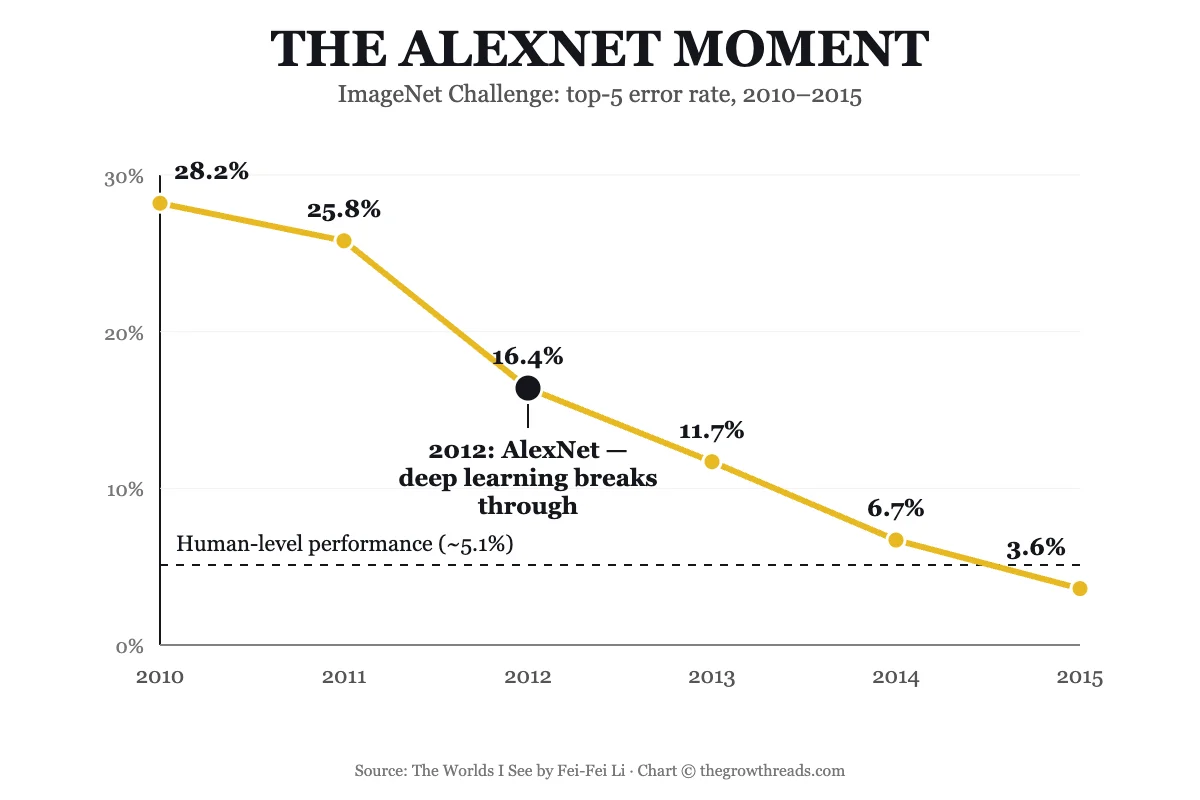
- 2012 is the hinge point of modern AI history: AlexNet’s win at the ImageNet Challenge is the moment researchers now point to as the start of the deep-learning boom.
- Building ImageNet was unglamorous, years-long labor: tens of thousands of crowdworkers, hired through Amazon Mechanical Turk, hand-labeled millions of images so the dataset would be reliable enough to train on.
- Her immigrant years shaped her science: translating for her parents and ringing up customers while acing physics left Li with a lasting instinct that technology has to work for ordinary people, not just impress experts.
- Motherhood collided with a field that never stops moving: Li writes candidly about the tradeoffs of building a research career and a family at the same time, in a field with no slow season.
- Industry taught her where academic ideals meet commercial pressure: her stint as Chief Scientist of AI/ML at Google Cloud exposed the gap between what responsible AI should look like and what a business needs on a quarterly timeline.
- Stanford HAI was built on a simple premise: AI research needs ethicists, social scientists, and policymakers in the room from the start, not consulted after a product ships.
- “Human-centered AI” has a specific meaning in the book: systems that augment human ability, reflect a genuinely diverse set of human values, and spread their benefits broadly rather than narrowly.
- Optimism about AI is a discipline, not a default: Li argues hopeful outcomes don’t happen automatically — they have to be engineered into the technology as deliberately as any algorithm.
What is The Worlds I See about?
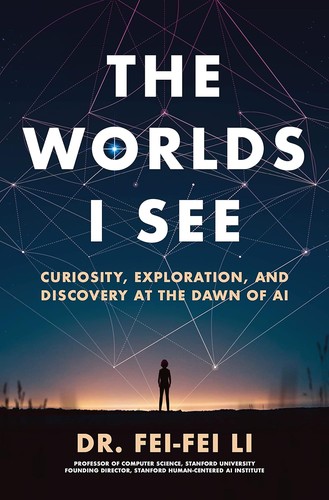
The Worlds I See is Fei-Fei Li’s memoir tracing her path from a teenage immigrant working in her family’s dry cleaners to the Stanford scientist who built ImageNet, the dataset behind the deep-learning revolution — and her case for building AI that augments human potential instead of replacing it.
About the author
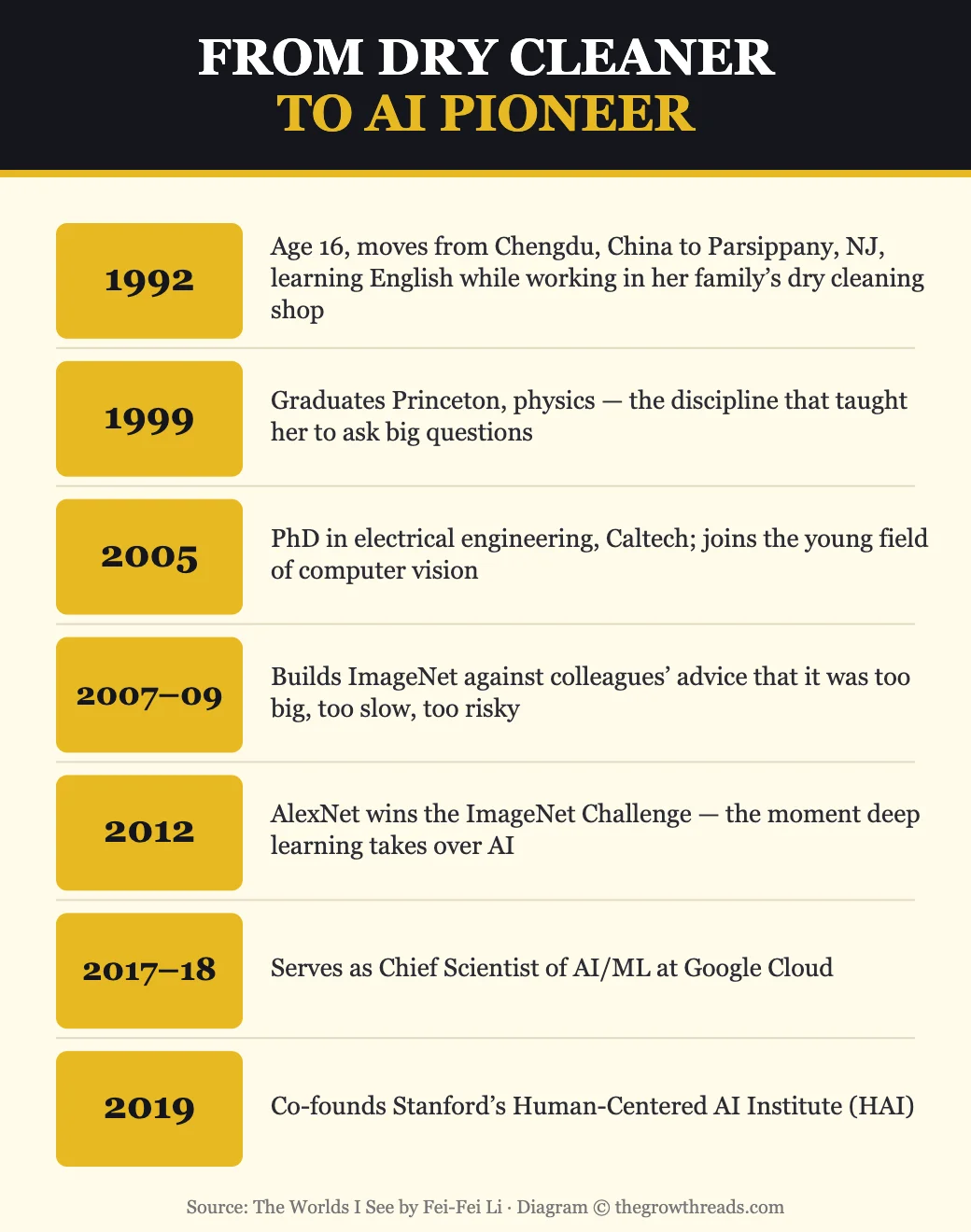
Fei-Fei Li is a Professor of Computer Science at Stanford University and Co-Director of the Stanford Institute for Human-Centered Artificial Intelligence (HAI). Born in Beijing and raised partly in Chengdu, she moved to Parsippany, New Jersey at 16, learning English while working in her family’s dry cleaning business. She earned a physics degree from Princeton and a PhD in electrical engineering from Caltech before specializing in computer vision. In 2009 she launched ImageNet, and in 2012 the dataset became the proving ground for the deep-learning breakthrough that reshaped the field. She later served as Chief Scientist of AI/ML at Google Cloud, co-founded Stanford HAI in 2019, and has continued building and advocating for AI grounded in human values. Explore all Fei-Fei Li book summaries →
Key concepts at a glance
| Concept | What it means | Use it when |
|---|---|---|
| ImageNet | A dataset of 14M+ labeled images across 21,800+ categories that gave neural networks enough examples to learn general vision | Explaining why data scale mattered as much as algorithms |
| AlexNet moment | The 2012 ImageNet Challenge win that proved deep neural networks could beat older computer-vision methods | Dating the start of the modern AI boom |
| Human-Centered AI (HAI) | A design philosophy: build systems that augment human ability and reflect human values | Judging whether a new AI tool helps people or quietly replaces them |
| Computer vision | The field of teaching machines to interpret images and video | Understanding the technical foundation the book is built on |
| Scientific citizenship | Li’s term for a researcher’s duty to engage with the public and policy, not just publish papers | Thinking about a scientist’s responsibility beyond the lab |
| North Star | Li’s metaphor for holding onto a long-term, human-centered goal under short-term pressure | Making decisions when incentives pull toward speed over care |
| Crowdsourced labeling | Using a distributed online workforce (Amazon Mechanical Turk) to label millions of images affordably | Understanding how ImageNet was actually built at scale |
Part 1: The Girl Who Asked Too Many Questions
Li opens not in a lab but in a strip mall in Parsippany, New Jersey, where her family’s dry cleaning shop became the place she learned English, learned to read a customer’s frustration, and learned — almost by accident — that she was good at asking questions nobody else in the room was asking. She had arrived from Chengdu at 16 with her parents, neither of whom spoke much English, which meant Li herself became the family’s translator for everything from medical appointments to loan paperwork. It’s a familiar immigrant story in outline, but Li uses it to make an unfamiliar point: the same curiosity that helped her figure out an unfamiliar country was the exact trait that, a decade later, let her see an opportunity in computer vision that established researchers had missed.
She traces her path through Princeton physics — a discipline she credits with teaching her to hold two things in her head at once: rigorous math and big, almost naive questions about how the universe works — and then to a Caltech PhD in electrical engineering, where she drifted toward computer vision — then a young, unglamorous field. Li became convinced it was stuck not because researchers lacked good ideas, but because nobody had enough real-world examples to test those ideas against.
TGR Note: Li’s account of translating for her parents while excelling academically echoes a theme in our AI Superpowers summary, where Kai-Fu Lee argues that immigrant and cross-cultural experience is quietly common among the researchers who shaped the current AI landscape — a pattern that rarely makes it into the technical histories.
Part 2: The Bet Nobody Wanted to Make
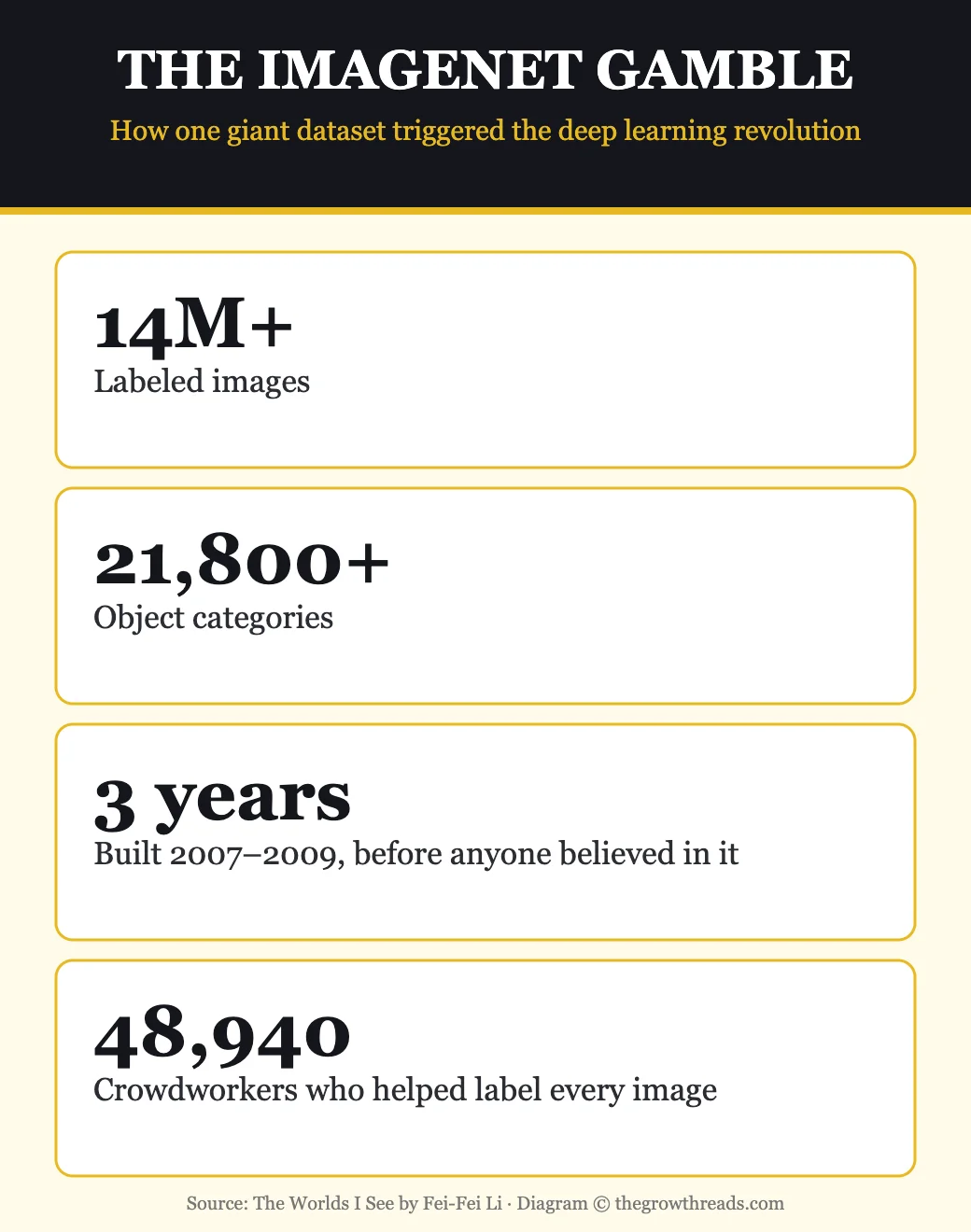
By the mid-2000s, Li had a hunch that was unfashionable in her field: that computer vision wasn’t stuck because the algorithms were bad, but because researchers had almost nothing real to train them on. Existing datasets had a few thousand images in a handful of categories — nowhere close to the messy diversity of the real visual world. Li’s answer was ImageNet: an attempt to label millions of images across tens of thousands of categories, organized around the structure of WordNet, a linguistic database of how concepts relate to each other.
The scale nearly broke the project before it started — hand-labeling millions of images was originally going to take her lab decades. The fix wasn’t technical but logistical: Li’s team used Amazon Mechanical Turk to distribute the labeling to tens of thousands of workers worldwide. Even so, building ImageNet took years, drew skepticism from funding committees, and offered no guarantee it would matter. Li describes colleagues building careers on faster, safer projects while she poured years into a dataset few outside her lab seemed to want.
The payoff arrived in 2012. A deep neural network called AlexNet, trained on ImageNet, entered that year’s ImageNet Large Scale Visual Recognition Challenge and beat every other approach by a startling margin — a result so far ahead of the field that it is now treated as the starting gun for the modern deep-learning era. Every major advance since, from image recognition to the large language models behind today’s chatbots, traces its lineage back to that demonstration that scale plus the right architecture could unlock capabilities nobody had predicted.
TGR Note: For a broader cast of the researchers who built the deep-learning era alongside Li, our Genius Makers summary tells the wider story of the field’s key breakthroughs — useful context for seeing where ImageNet fits into the bigger timeline.
Part 3: From the Lab to the Real World
ImageNet made Li’s reputation, but the book’s second half is about what happened once that technology left the university for industry and daily life. She writes candidly about becoming a mother during her most demanding research years, and the unglamorous math of running a lab, publishing, and raising a family in a field that moves in months, not semesters. There’s no tidy resolution — Li didn’t “balance” these things so much as constantly renegotiate what she’d sacrifice in any given month.
Her time as Chief Scientist of AI/ML at Google Cloud gave her a close-up view of a different kind of pressure: the gap between what careful, responsible AI development looks like in principle and what a business under quarterly pressure is willing to fund. She doesn’t frame this as a villain story — the engineers and leaders she worked with were, in her account, genuinely trying to build good products. But she came away convinced that good intentions inside a company aren’t enough on their own; the incentives of the surrounding system matter just as much as the values of the people in the room.
TGR Note: Li’s account of incentives quietly overriding good intentions inside a company pairs well with our Human Compatible summary, where Stuart Russell makes a more technical case for why AI systems need to be built to defer to human judgment by design, not by good faith alone.
Part 4: Building AI That Sees People, Too
The book’s final act is Li’s answer to the tension she spent the previous three parts laying out: Stanford HAI, the Human-Centered AI Institute she co-founded in 2019. Her argument is that AI research has, for most of its history, been the exclusive domain of computer scientists and engineers — and that this narrowness is a design flaw, not a neutral fact. Decisions about what an AI system optimizes for, whose data it’s trained on, and who benefits from it are inescapably human and ethical decisions, whether or not the people making them think of themselves that way.
Li’s fix is to put ethicists, social scientists, policymakers, and affected communities in the room from the start, not after a system has already shipped and caused harm. She calls this “human-centered AI” and distills it into three commitments: augment human ability instead of automating people out of the loop, reflect a genuinely diverse set of values rather than the defaults of whoever built the system, and measure success by how broadly benefits reach — not just how impressive a demo looks.
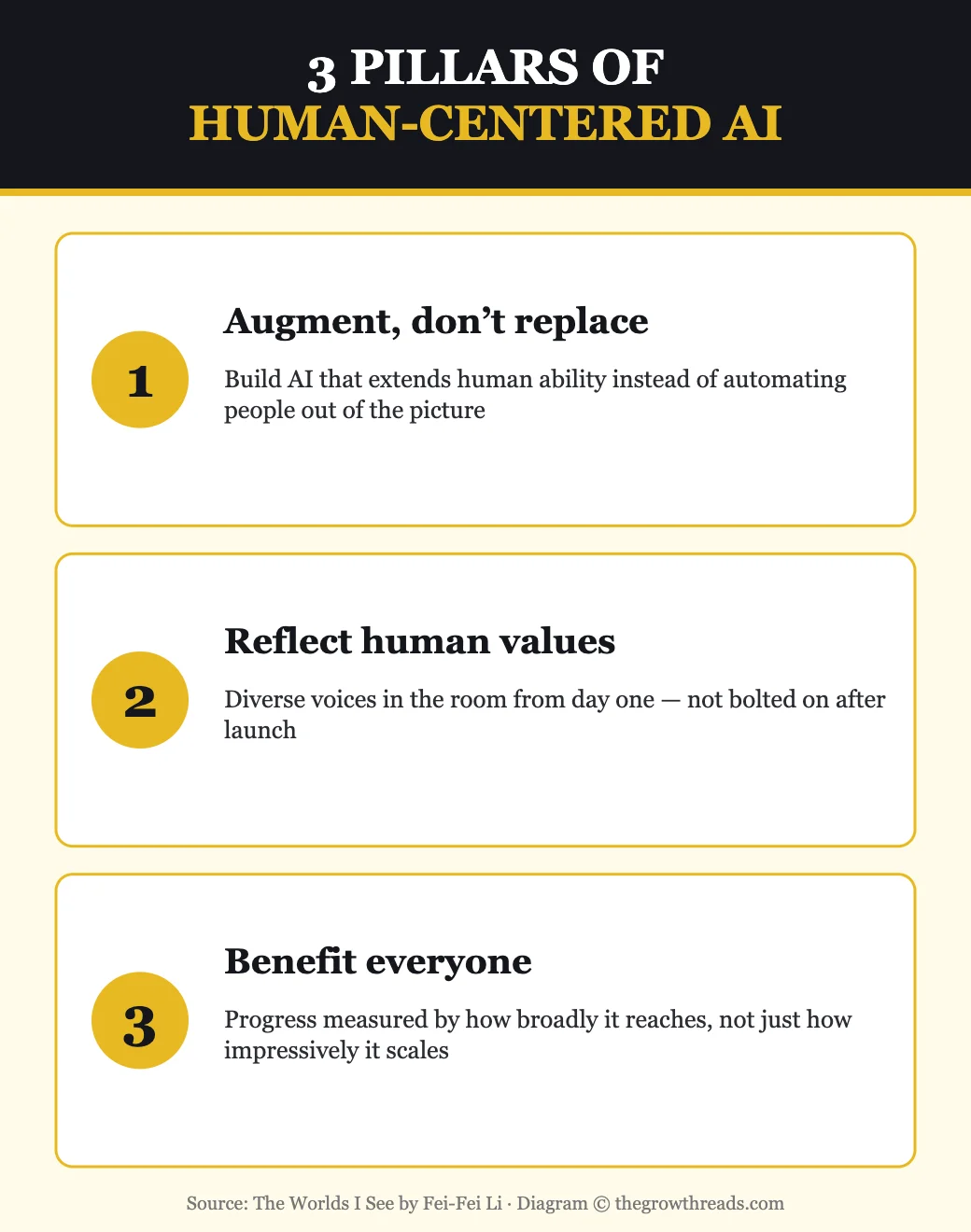
TGR Note: If Li’s three pillars resonate, our Co-Intelligence summary picks up almost exactly where this book leaves off — Ethan Mollick’s practical playbook for how individuals and teams can actually work alongside AI in a way that augments rather than replaces their judgment.
Who is The Worlds I See best for — and who should read something else first?
This book is best for readers who want the human story behind the AI boom — the motivations, setbacks, and values of the people who built it — not a technical manual. It’s an especially good fit for anyone with an immigrant background, aspiring scientists weighing an unglamorous, multi-year project, and managers or policymakers who need an accessible entry point into why “human-centered AI” isn’t just a slogan.
If you want the technical mechanics of how modern AI systems actually function, you’ll get more from our Life 3.0 summary or Human Compatible summary. If you’re looking for a hands-on guide to using AI tools well today rather than a history of how they came to exist, start with our Co-Intelligence summary instead.
Questions to reflect on
- What’s a project you’ve avoided starting because it seemed too big, too slow, or too uncertain to pay off?
- Where in your work or life has curiosity mattered more than having the “right” credentials or background?
- Think of an AI tool you rely on: does it genuinely augment your judgment, or has it quietly started making decisions for you?
- Who is missing from the room when decisions get made about a technology, policy, or product you’re close to?
- What would a “North Star” sentence look like for a project you’re responsible for right now?
🔥 Ready to read The Worlds I See?
Get the memoir behind ImageNet and the case for human-centered AI, in whichever format you prefer.
How to apply The Worlds I See (7-day plan)
- Day 1: Read this summary in full and look closely at the ImageNet and timeline infographics — get the shape of the whole story before diving into the book.
- Day 2: Write down one moment when you followed your curiosity despite it looking impractical at the time — and one you talked yourself out of.
- Day 3: Pick one AI tool you use regularly and honestly assess: does it augment your judgment, or has it started quietly replacing it?
- Day 4: Read Part 2 of the book and note one project you’ve delayed or avoided because it seemed “too big” to start.
- Day 5: Have a conversation with someone outside your field about how a technology or system you help build actually affects their day-to-day life.
- Day 6: Draft a one-sentence “North Star” for a project you’re currently responsible for — the long-term goal you don’t want short-term pressure to erode.
- Day 7: Share one of the three Human-Centered AI pillars with a colleague or manager and discuss where it does — or doesn’t — apply to your current work.
Frequently asked questions
Is The Worlds I See a technical book about AI?
No. It’s a memoir written for a general audience, with minimal jargon. Fei-Fei Li explains the technical ideas behind ImageNet and deep learning in plain language, using her own story as the throughline rather than equations or code. Technical readers still get real value: an insider’s account of how the research unfolded, including the setbacks and doubts that don’t usually make it into papers or conference talks.
What is ImageNet and why does it matter so much?
ImageNet is a dataset of more than 14 million images, hand-labeled across more than 21,000 categories, that Fei-Fei Li’s lab built between 2007 and 2009. It mattered because it gave researchers, for the first time, enough real-world labeled examples to train large neural networks effectively. When a network called AlexNet was trained on ImageNet and won the 2012 ImageNet Challenge by a wide margin, it proved that scale plus the right architecture could unlock capabilities nobody had predicted — a result now treated as the starting point of the modern deep-learning era.
Is Fei-Fei Li still active in AI research today?
Yes. She remains a professor at Stanford and continues to co-direct Stanford HAI, where she works on research and policy aimed at keeping AI development grounded in human values. She has also continued to pursue new ventures at the frontier of AI beyond the university, consistent with the book’s argument that scientists have a responsibility to stay engaged with how their research is applied in the real world, not just in the lab.
What does “human-centered AI” mean in practice?
In the book, it means three things: building systems that augment human ability rather than automate people out of the loop, making sure the values embedded in a system reflect a genuinely diverse set of people rather than the default assumptions of whoever built it, and measuring success by how broadly a technology’s benefits reach rather than how impressive it looks in a demo. It’s presented as a discipline to practice deliberately, not a property that AI systems have by default.
Do I need a computer science background to understand this book?
No. The book is written as a memoir first, and Li translates every technical concept — from neural networks to how ImageNet was built — into accessible language grounded in her own story. Readers who work in policy, business, education, or any field touched by AI will be able to follow the full arc without prior technical training, while still coming away with a genuine understanding of why ImageNet and the 2012 AlexNet result mattered.
How does this compare to other AI books like Life 3.0 or Superintelligence?
Life 3.0 and Superintelligence are more speculative, focused on where AI could go and how to think about long-term risk. The Worlds I See is grounded in the past and present: a firsthand account of how the deep-learning era started, told by someone who built a foundational piece of it. Read it for the human, historical story; read the speculative books for frameworks on what’s next.
What’s the single biggest takeaway from The Worlds I See?
That the technology we now call AI wasn’t inevitable — it was built by specific people making specific choices, often against skepticism and without any guarantee of success. Fei-Fei Li’s central argument is that because AI is built by people, it can and should be built deliberately around human values, augmenting human ability rather than replacing it. That’s a choice available at every stage of development, not a property the technology will arrive at on its own.
Related summaries
- Genius Makers Summary & Review — the wider cast of researchers who built the deep-learning era
- Human Compatible Summary & Review — a technical case for AI that defers to human judgment by design
- Co-Intelligence Summary & Review — a practical playbook for working alongside AI today
- AI Superpowers Summary & Review — how the US–China AI race is reshaping the field
- Best AI Books — our full pillar guide to the best books on artificial intelligence
How we analyze books: we read the full text, cross-reference key facts and figures, and summarize the arguments in our own words rather than reproducing the author’s writing. Read our full methodology.