

★★★★½ 4.5/5 — a clear, refreshingly non-hysterical case for treating robots less like almost-humans and more like the animals we’ve worked beside for millennia.
Best for: product builders, technologists, policymakers, and anyone unsettled or excited by robots showing up in daily life
Reading time: ~5 hrs (physical book) · Guide: ~18 min
Difficulty to apply: Easy — the reframe is simple, even if the implications are big
The New Breed in one minute
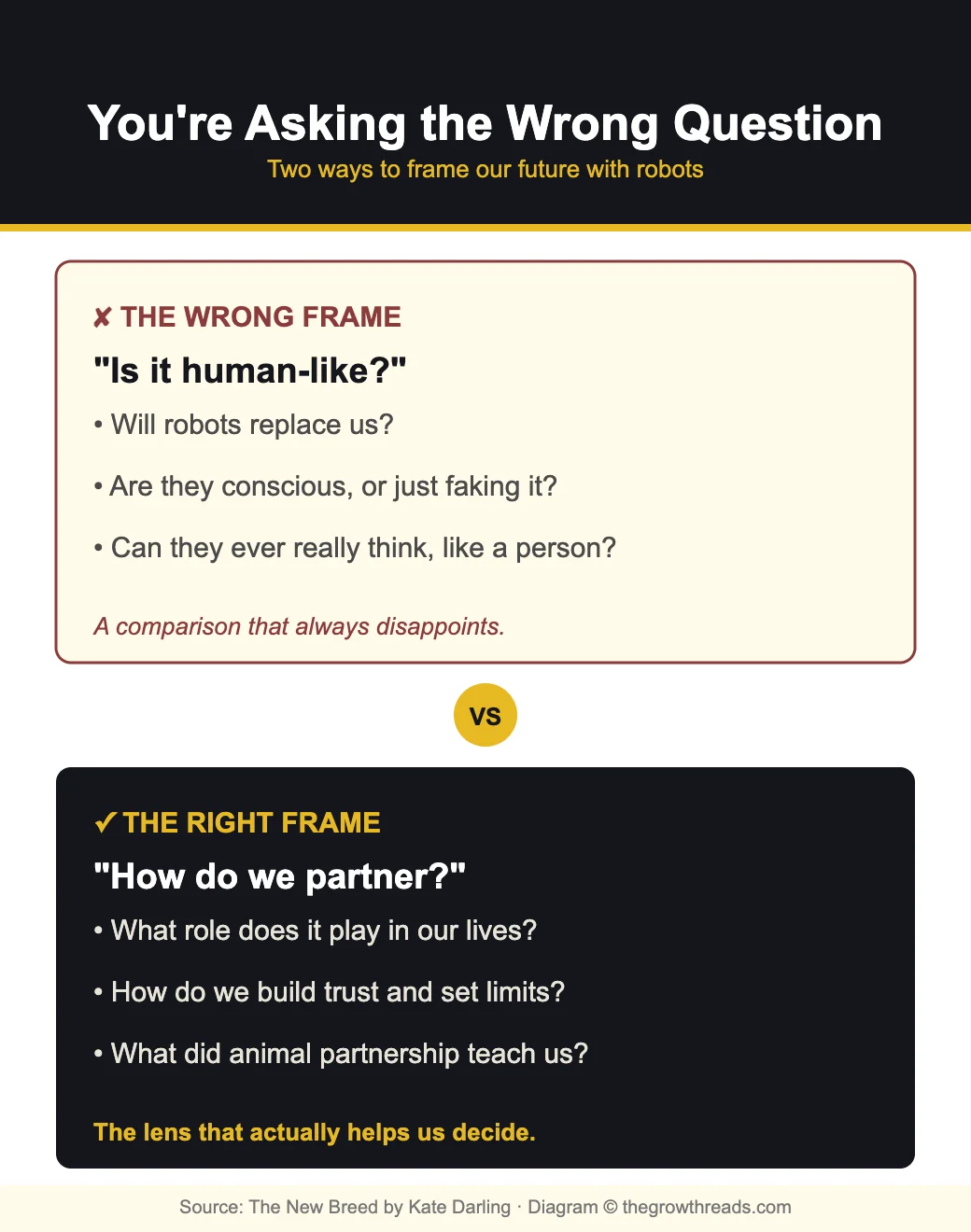
We’ve been asking the wrong question about robots for decades. Instead of debating whether machines will replace us or whether they’re secretly conscious, MIT researcher Kate Darling argues we should look at the one relationship humans have sustained with a non-human intelligence for thousands of years: our relationship with animals. Oxen plowed our fields, dogs guided the blind, and horses carried us into war — none of them needed to be human-like for the partnership to work. The New Breed makes the case that this animal lens, not science fiction, is the most useful tool we have for building a healthy, sustainable relationship with the robots already entering our homes, hospitals, and battlefields.
Key takeaways
- Wrong question: “Will robots replace us?” and “Are they conscious?” are dead-end questions borrowed from science fiction.
- Better question: “What role does this robot play, and how do we build a healthy partnership with it?”
- Animals were our first automation: for over 10,000 years, humans outsourced labor, transport, and protection to animals without needing them to think or feel like us.
- Anthropomorphism is normal, not naive: naming your Roomba or feeling bad for a struggling robot isn’t a bug — it’s how we’ve always related to non-human agents that move with apparent purpose.
- Robots trigger real empathy: Darling’s own workshops with a robotic dinosaur, Pleo, showed people hesitate to “hurt” robots that display lifelike movement, even knowing they feel nothing.
- Moral status has always been negotiated: animal-welfare law evolved gradually and unevenly — a template for how robot rights and protections might evolve too.
- Displacement isn’t disappearance: working animals weren’t deleted from the economy by engines — their roles shifted. Human work with robots may follow a similar shift, not a clean replacement.
- Robots excel at complementary capability: like search-and-rescue dogs, the most successful robots do the dangerous or repetitive jobs — not the “be human” job.
- Design for the relationship, not the resemblance: companies get more value, and fewer ethical headaches, building robots for a working partnership than chasing a humanlike appearance.
What is The New Breed about?
The New Breed argues that the most useful way to think about robots isn’t through science-fiction comparisons to humans, but through humanity’s long, practical history of working alongside animals — using that partnership model to guide how we design, regulate, and relate to robots today.
About the author
Kate Darling is a researcher at the MIT Media Lab, where she studies human-robot interaction, robot ethics, and the way people relate to social robots. Trained in law and economics, she brings a policy-minded, empirically grounded lens to questions usually left to science fiction. Her early experiments with Pleo, a robotic baby dinosaur, revealed how quickly people form emotional attachments to machines that move with apparent purpose — research that became a foundation for her work on robot ethics and law. Darling advises policymakers and companies on robot regulation and is a frequent voice in mainstream AI coverage. The New Breed, published in 2021, distills over a decade of her research into one accessible argument. Explore all Kate Darling book summaries →
Key concepts at a glance
| Concept | What it means | Use it when |
|---|---|---|
| Animal-partnership framing | Comparing robots to how we’ve related to animals, not humans | Deciding how to introduce a new robot into a home, hospital, or workplace |
| The wrong-question trap | Asking “is it conscious / human-like?” instead of “what’s its role?” | Evaluating any new robot, chatbot, or AI product |
| Anthropomorphism | The instinct to project intent, emotion, or personality onto non-human agents | Understanding why people name, thank, or apologize to machines |
| Complementary capability | Robots, like animals, do jobs we can’t or won’t — not a like-for-like replacement | Designing what a robot’s job actually should be |
| Moral status by function | Rights and protections track a being’s role and relationships, not just its “insides” | Thinking through robot ethics or robot “rights” debates |
| Social robots | Machines purpose-built to trigger emotional and relational responses | Evaluating companionship, therapy, or care robots |
| The trust apprenticeship | Working partnerships with animals, and robots, are earned gradually, not instant | Planning how a team or family adopts new automation |
| Displacement, not disappearance | Working animals’ roles evolved rather than vanished as engines arrived | Thinking about how AI and robots will really affect jobs |
Part 1: You’re Asking the Wrong Question
For most of the last century, science fiction has supplied our vocabulary for thinking about robots. HAL 9000, the Terminator, and Data from Star Trek trained us to ask the same two questions whenever a new robot appears: will it replace me, and is it secretly a person? Darling opens The New Breed by arguing both questions are traps — framed around the wrong comparison, the human being, which sets up an evaluation the machine can only fail, or unsettle us by half-succeeding.
The comparison feels natural because robotics researchers long chased human-likeness as a design goal. But the most successful robots in the world look nothing like us: Roombas are pucks, warehouse robots are shelves on wheels, surgical robots are multi-armed machines bolted to a table. None needed to resemble a person to become useful — and the uncanny-valley effect, where near-human robots become creepy rather than comforting, actively punishes designers who chase resemblance too far.
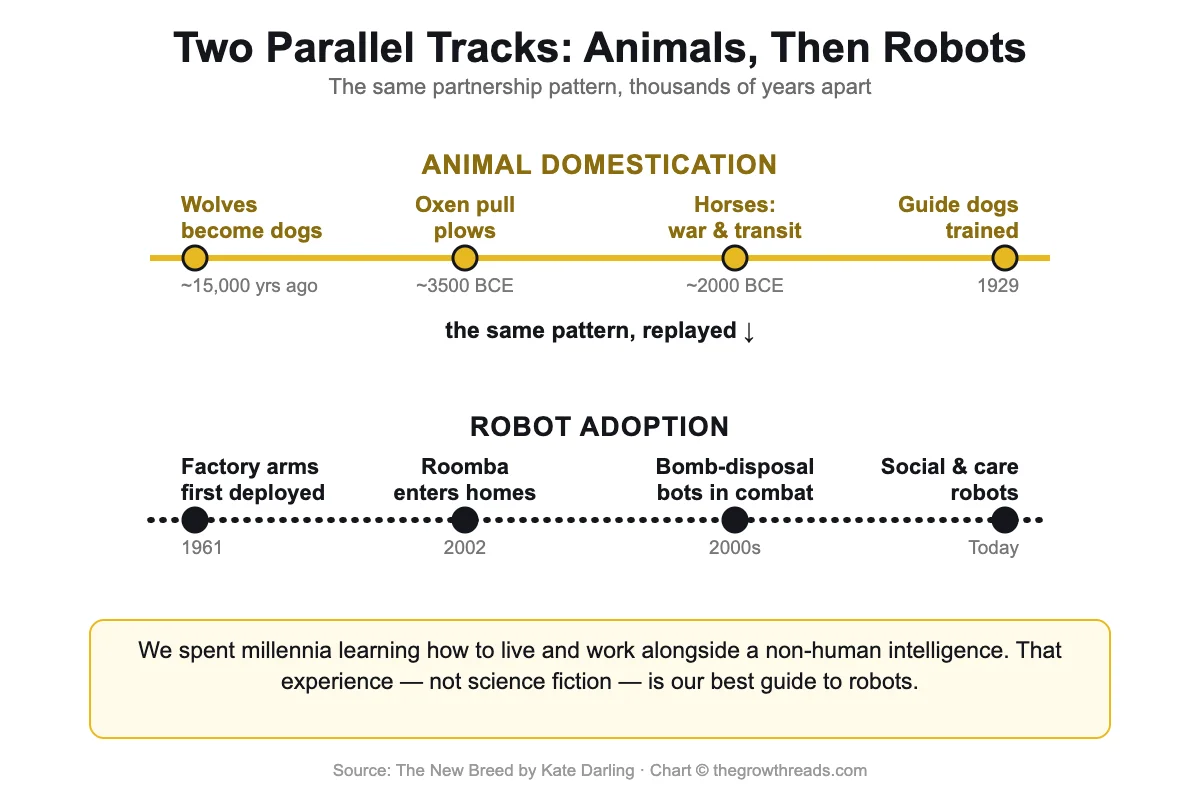
So if not humans, what’s the right comparison? Darling’s answer, and the book’s central argument, is animals. For over ten thousand years, humans have built working, trusting relationships with beings that are unambiguously not human — dogs, horses, oxen, falcons — without needing them to think, speak, or reason like we do. We built roles, routines, and legal categories around what animals could do for and with us, adjusting those roles as our needs and their capabilities changed.
This reframing changes the questions worth asking about a robot: not “is it conscious,” but “what job does it do, and does it do that job well”; not “will it replace me,” but “what does a healthy division of labor look like.” We’ve been answering versions of these questions about animals for millennia. Darling isn’t claiming robots and animals are the same kind of thing — she’s arguing our animal history is the richest, most tested playbook we have for living alongside non-human agents that act with apparent purpose.
TGR Note: Kate Crawford’s Atlas of AI makes a complementary point from the opposite direction — AI depends on hidden labor and infrastructure, so “partnership” only holds up if we’re honest about who’s actually doing the work behind the robot.
Part 2: A Deep History of Working Animals
Chapter by chapter, Darling walks through just how deep and varied the animal-labor relationship really is — most of us know the highlight reel (plows, cavalry) but not the texture of how those partnerships actually worked.
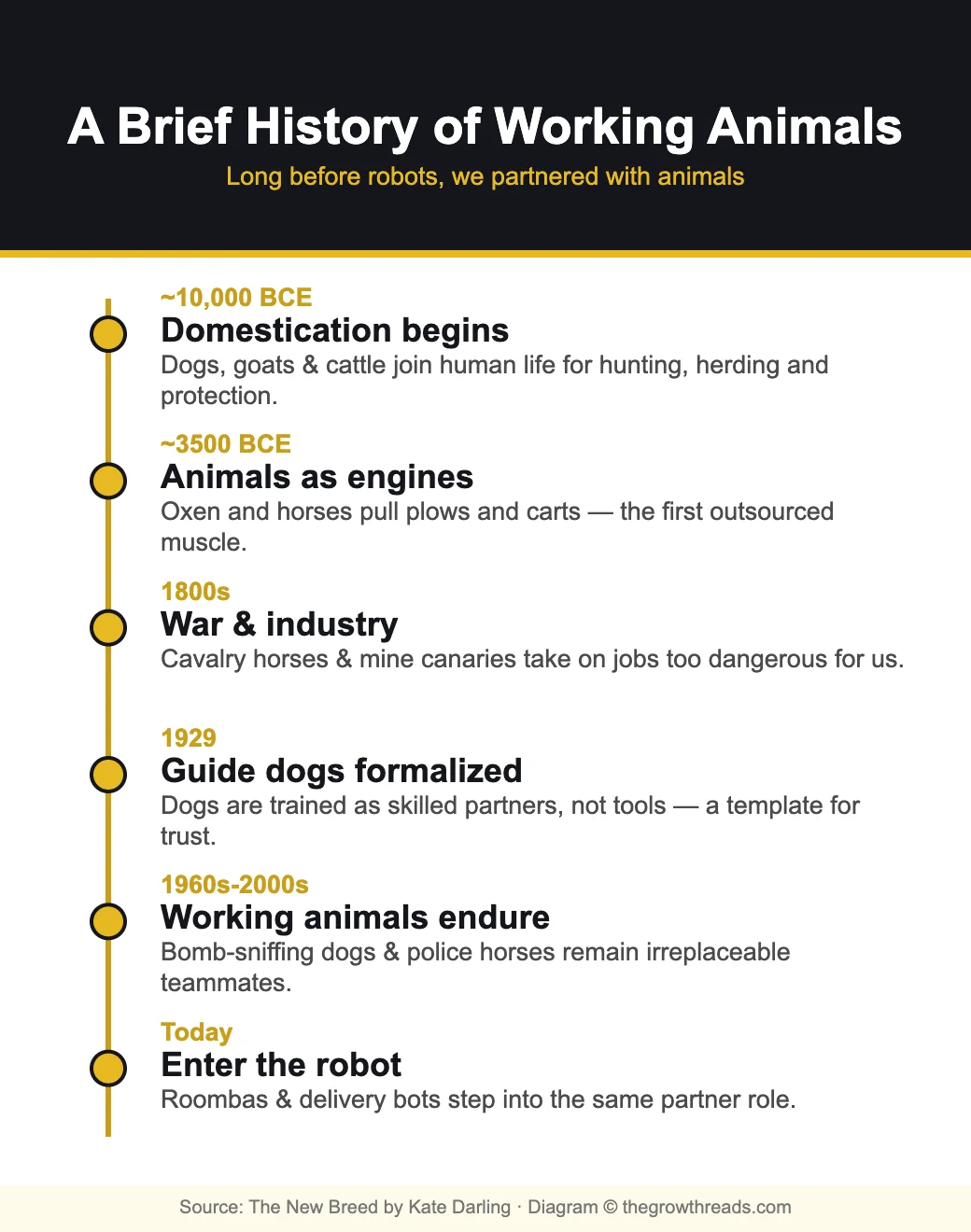
Domestication wasn’t a single clean event but a slow co-evolution stretching back roughly 15,000 years, starting with wolves that scavenged near human camps and gradually became dogs suited to hunting, herding, and companionship. Cattle, goats, and horses followed, each domestication changing both the animal, through selective breeding, and human society, through new forms of labor and mobility. By roughly 3500 BCE, oxen were pulling plows across Mesopotamia — arguably the first large-scale “outsourcing” of human physical labor.
What’s striking, Darling argues, is how quickly humans built legal, economic, and moral systems around these partnerships without ever resolving the philosophical question of what animals “really” experience. Property law figured out how to treat a horse as both valuable equipment and a being capable of suffering. Military traditions built elaborate rituals of honor around cavalry horses and messenger pigeons that performed extraordinarily dangerous work. And in 1929, the founding of The Seeing Eye formalized something subtler: guide dogs weren’t trained as tools to be operated, but as skilled partners whose judgment a blind handler had to learn to trust — a genuinely reciprocal relationship, not a one-way command structure.
None of this required settling whether a dog is conscious in the way a human is. It required building institutions — training programs, welfare laws, professional norms — that matched the animal’s real capabilities and the human’s real needs, revised as understanding improved. That, Darling argues, is exactly the kind of institution-building robots need now, and we’re behind because we keep getting distracted by the wrong debate (is it alive) instead of the productive one (what’s it good at, and how do we build trust around that).
TGR Note: Kevin Kelly’s The Inevitable describes technology adoption as a gradual “becoming” rather than a single event — echoing Darling’s point that domestication, and now robot adoption, unfolds over decades, not overnight.
Part 3: Why We Anthropomorphize Robots (and Why That’s Okay)
If Part 2 makes the historical case, Part 3 makes the psychological one — and it’s where Darling’s own research takes center stage. Years before writing the book, she ran workshops using Pleo, a toy robotic dinosaur capable of simple, lifelike movements: it would flinch, whimper, and “cry” when handled roughly. She asked participants to play with the robots, then asked them to hit or “torture” one.
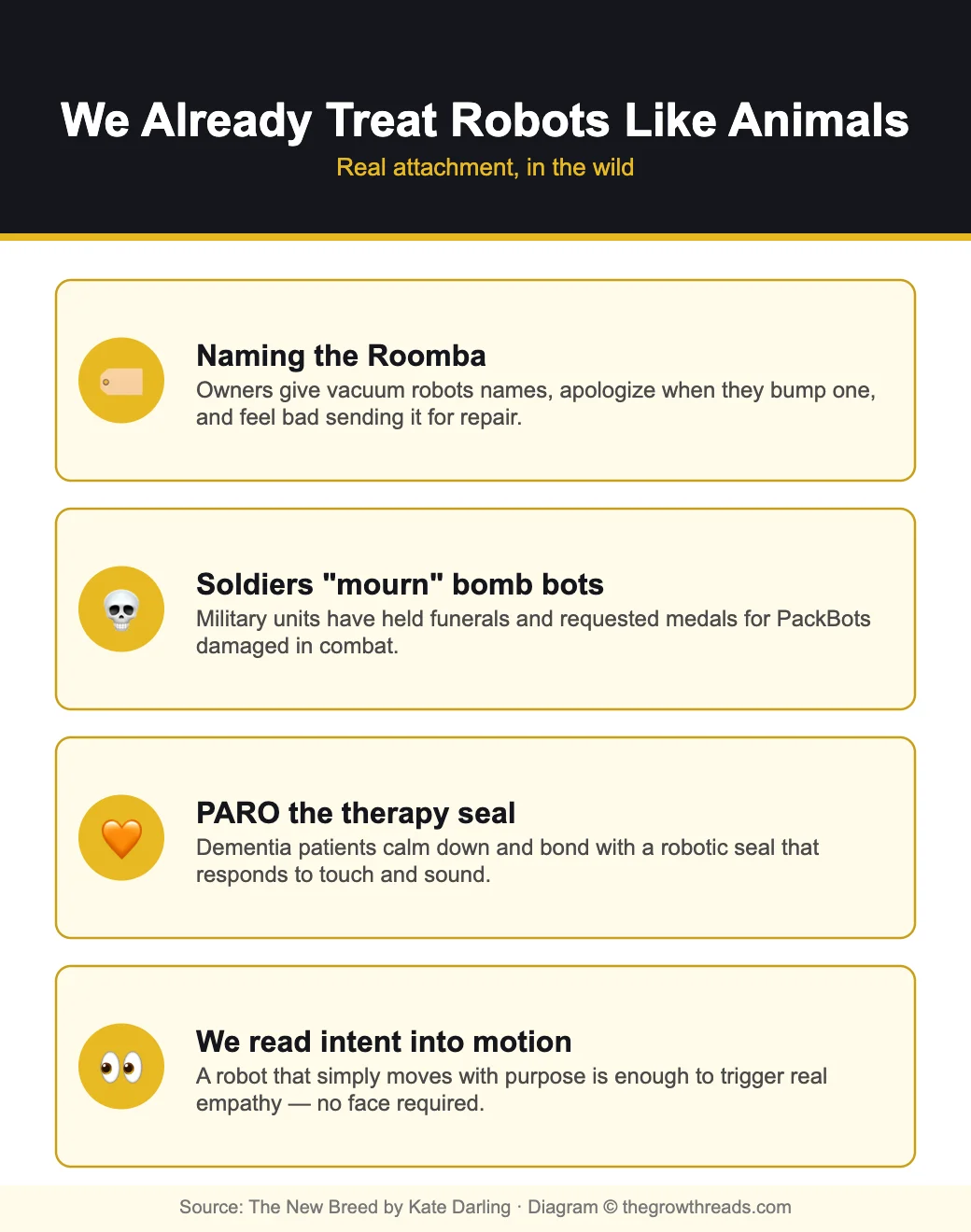
Most people refused, or hesitated so long the exercise had to be cut short. Some protected their Pleo from other participants; a few named theirs — even though everyone knew, rationally, the robot felt nothing at all. What Darling found is that lifelike movement alone is enough to trigger real, measurable empathic responses. We don’t anthropomorphize robots because we’re confused about what they are; movement that looks purposeful is one of the oldest triggers for social cognition in the human brain, the same instinct that makes us read intention into a dog’s tilted head.
This instinct shows up everywhere once you look for it. Roomba owners name their vacuums, apologize when one gets stuck, and report reluctance to send a “dead” unit back for a cold replacement rather than a repair. Bomb-disposal units have held informal funerals for robots destroyed in the field, treating a machine’s service history as if it mattered — because to the humans who worked alongside it, it did. In elder care, the robotic therapy seal PARO measurably reduces agitation and loneliness in dementia patients, who stroke and talk to it much as they would a real animal.
Darling’s argument isn’t that this anthropomorphism is silly and should be corrected. It’s a real, predictable, largely positive part of how humans form relationships with non-human agents, and fighting it is futile. The more productive move is designing with it — building robots whose apparent personalities are honest about their real capabilities.
TGR Note: Stuart Russell’s Human Compatible argues AI systems should be built to stay uncertain about our true preferences and defer to us — a design philosophy that pairs well with Darling’s trust-first, partnership-first approach to robots.
Part 4: Rights, Labor, and the Robots to Come
The final section turns from psychology to policy — robot rights, robot labor, and what a future genuinely modeled on animal partnership might look like.
On rights, Darling doesn’t argue robots deserve legal protections today; she argues the debate is worth taking seriously, and that animal-welfare history offers a working template rather than a dead end. Animal-cruelty laws didn’t wait for a settled answer on animal consciousness — they emerged gradually, often for practical or public-relations reasons. Robot protections, if they arrive, will likely follow a similarly messy, function-first path: protecting robots not because we’re sure they suffer, but because how we treat them says something about us.
On labor, she pushes back on the simple “robots will take our jobs” narrative by pointing to working animals once engines arrived. Horses didn’t vanish overnight — their role shifted over decades, toward recreation, sport, and specialized work like mounted policing. It was a real, sometimes painful transition, not a clean replacement. Darling’s point isn’t that automation is painless — it’s that “replacement” is usually the wrong mental model for how a labor role changes.
The book closes by returning to design. Companies chasing human-likeness in robots are often solving the wrong problem, optimizing for a comparison that breeds unease rather than the actual working relationship a robot needs with the people around it. The more promising path looks like what worked with animals: give the robot a clear, honest role; make its capabilities legible; and build in the slow, structured trust-building that turned wary strangers into working partners over thousands of years. We don’t need robots to be almost-human to get enormous value from them — we need to get better at doing with robots what we’ve already proven we’re good at doing with animals.
TGR Note: Ethan Mollick’s Co-Intelligence makes the human-AI teammate case for software; Darling makes the same case for hardware — both land on treating the machine as a complementary partner, not a replacement.
Who is The New Breed best for — and who should read something else first?
Best for: product and policy people thinking about human-robot interaction, and general readers wanting a calm alternative to sci-fi robot panic.
Read something else first if: you want AI safety and control (Human Compatible), broad economic impact (The Inevitable), or a sharper critique of AI’s labor costs (Atlas of AI).
Questions to reflect on
- Do you evaluate a robot or AI tool by “is it smart” or by “does it do its job well”?
- Have you ever named, thanked, or apologized to a machine? What does that tell you?
- What task in your life would benefit from a clear division of labor with a machine, rather than full automation?
- What would it take for you to trust a robot’s judgment the way a guide-dog handler trusts their dog?
- Where do you draw the line between “just a tool” and “deserves some consideration”?
🔥 Ready to rethink robots?
Get The New Breed and see robots — and animals — differently for good.
How to apply The New Breed (7-day plan)
- Day 1 — Notice the instinct. Spend a day noticing every time you, or someone near you, talks to, names, or apologizes to a device. Don’t judge it — just log it.
- Day 2 — Reframe one robot in your life. Pick one automated tool and write its “job description” the way you’d describe a working animal’s role, not a person’s.
- Day 3 — Ask the better question. Next time you evaluate a new AI tool, catch yourself asking “is it smart enough” and rewrite it as “what’s the healthy division of labor here.”
- Day 4 — Research one working-animal partnership. Read a short history of guide dogs, search-and-rescue dogs, or cavalry horses, and notice how trust and roles were built gradually.
- Day 5 — Set one explicit boundary. Choose one AI tool or robot you use and write one clear rule for what you will and won’t let it decide on its own.
- Day 6 — Talk it through. Discuss the “wrong question” reframe with a skeptic and an enthusiast in your life, and notice which parts of the argument change each person’s mind.
- Day 7 — Write your own partnership policy. In one paragraph, describe how you want to work with the robots and AI tools already in your life a year from now — as partners with a role, not people you’re replacing or fearing.
Frequently asked questions
What is the main argument of The New Breed?
Kate Darling argues that comparing robots to humans — asking if they’ll replace us or whether they’re conscious — is the wrong frame. A more useful comparison is humanity’s long history of working with animals, where we built trust and roles around non-human partners without needing them to think like people. That animal-partnership model is the best available guide for designing and regulating robots today.
Is Kate Darling saying robots are basically the same as animals?
No. Darling is explicit that robots and animals are different kinds of things — robots don’t have biological welfare the way animals do, at least not currently. Her claim is narrower: building a working partnership with a non-human agent — trust, roles, boundaries — is a problem humans have already solved versions of with animals for thousands of years.
Does the book focus on physical robots or AI in general?
The book leans toward physical, embodied robots — vacuums, military robots, therapy robots, guide-dog-style assistive machines — since Darling’s research is in human-robot interaction. That said, the core reframing, partnership over replacement, applies just as well to software AI and chatbots, and Darling draws that connection in several chapters.
Is The New Breed a technical or an accessible book?
It’s written for general readers, not engineers. Darling explains research clearly, leans on stories and historical examples rather than equations or code, and keeps each chapter focused on one clear idea — accessible with no robotics background, and still fresh for readers already deep in AI ethics.
What does Darling say about robot rights?
She doesn’t argue robots deserve legal rights today. Instead, she points to the messy, gradual, function-first history of animal-welfare law as the likely template — protections that emerge for practical and social reasons well before any settled answer about whether the being truly suffers.
Will robots take our jobs, according to this book?
Darling complicates the “robots will take our jobs” story by pointing to working animals: their roles shifted over decades, toward recreation, sport, and specialized work, rather than disappearing overnight. She suggests robots are more likely to reshape and specialize human work than replace it wholesale — though the transition won’t be painless.
How is The New Breed different from other AI and robot books?
Most AI books focus on capability or risk. The New Breed instead focuses on relationship — how humans form bonds with non-human agents, and what history teaches us about doing that well. Its animal-history angle, backed by Darling’s own robot-empathy research, is genuinely distinct in the AI-books landscape.
Related summaries
- Atlas of AI by Kate Crawford — the hidden labor and resource costs behind every AI system.
- The Inevitable by Kevin Kelly — the slow, unstoppable forces reshaping technology adoption.
- Human Compatible by Stuart Russell — building AI that stays deferential to human intent.
- Co-Intelligence by Ethan Mollick — treating AI as a teammate, not a replacement.
- See all Best AI Books →
How we analyze books: our team reads each title in full, cross-checks key claims against the author’s sources, and builds every summary around practical application, not just condensed notes. Read our full methodology.
Related Technology Summaries
Hello World Summary & Review: When to Trust an Algorithm (and When Not To)
Machines of Loving Grace Summary & Review: The Hidden Fork Behind Every AI Debate
Nexus Summary & Review: Why More Information Doesn’t Mean More Truth
Prediction Machines Summary & Review: The Simple Economics of Artificial Intelligence
Weapons of Math Destruction Summary & Review: How Algorithms Quietly Encode Bias