

★★★★★ 4.6/5 — AI is transforming medicine’s data work; the real prize is giving doctors their time back to be human again.
Best for: Patients who want to understand AI’s growing role in their own care, clinicians and students, and readers of big-picture AI-and-society books who want one deeply-researched domain case study.
Reading time: ~7 hrs to read the book (guide: ~35 min)
Difficulty to apply: Moderate — mostly about asking better questions, not new clinical skills.
Deep Medicine in one minute
The most human resource in medicine is time, and AI’s real job is to give it back. Cardiologist and researcher Eric Topol argues that deep learning already performs at expert level on medicine’s narrowest, most data-heavy tasks — reading scans, flagging abnormal labs, drafting notes — not because machines understand illness, but because they’ve seen more examples than any human could in a lifetime. Handing that pattern-recognition burden to software isn’t primarily a diagnostic upgrade; it’s a time transfer, moved from screens and paperwork back to the conversation between a doctor and a patient. Topol is equally direct about the risks — biased training data, unexplainable “black box” decisions, and the danger of clinicians deferring to AI instead of checking it — and spends real energy on how patients themselves can become active, data-owning participants in their own care rather than passive recipients of it. Deep Medicine is both a survey of where AI already works in healthcare and an argument for what that technology should be used for: restoring the deeply human relationship at medicine’s core.
Key takeaways
- Pattern recognition is medicine’s biggest data burden: reading images, signals, and records faster and more consistently than tired humans under time pressure.
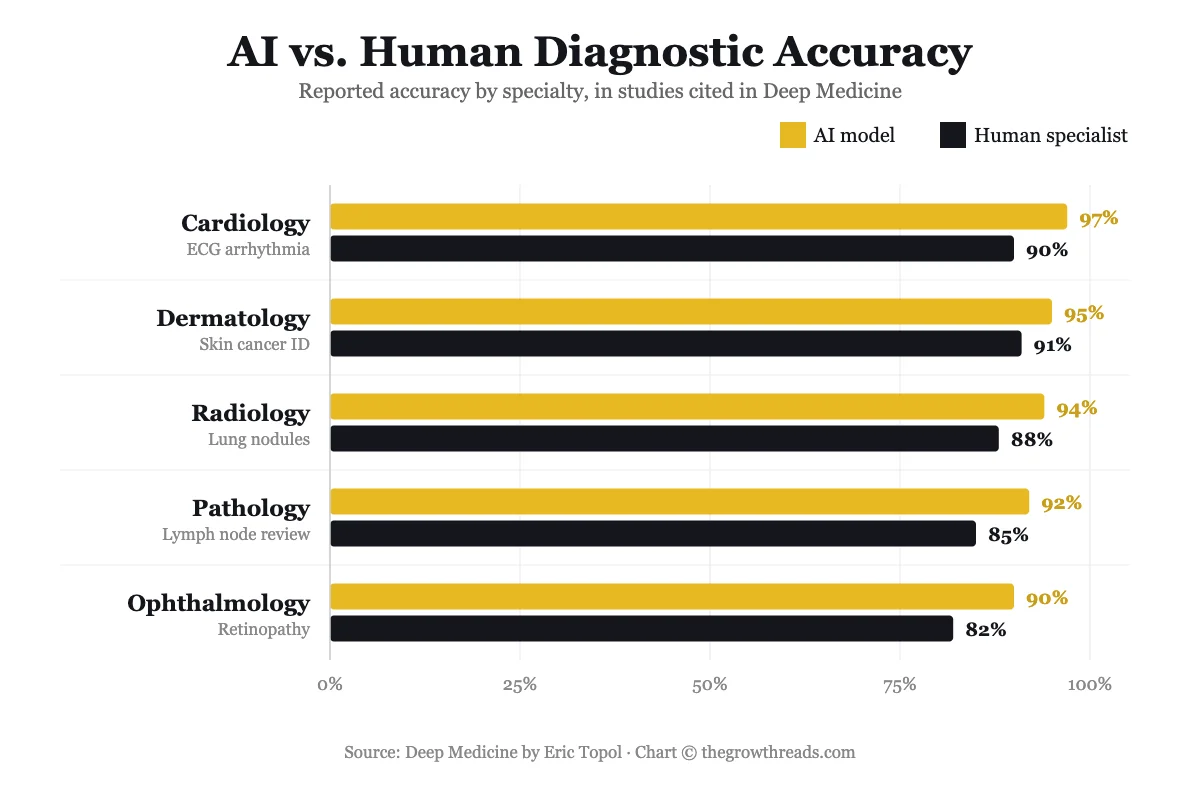
- Deep learning already rivals specialists in narrow tasks: radiology, dermatology, pathology, ophthalmology, and cardiology all have studies showing AI matching or exceeding expert accuracy on specific benchmarks.
- The real prize isn’t diagnosis — it’s time: automating data work could return real hours per week to doctors, hours currently lost to screens and documentation.
- Modern medicine has become rushed and screen-heavy: short visits and click-heavy records have crowded out listening, touch, and eye contact.
- AI should extend a clinician’s senses, not replace judgment: most powerful paired with a human who understands context and values.
- Predictive analytics can flag risk early: from sepsis to hospital readmission, often before symptoms are obvious to a busy clinician.
- AI is accelerating drug discovery: compressing years of trial-and-error chemistry into months, though clinical validation still takes as long as ever.
- Patients are becoming active participants: wearables, home labs, and virtual coaching put real-time health data in patients’ own hands.
- Every gain carries a risk: biased training data, opaque decisions, and over-reliance can undermine care if left unchecked.
- Deep medicine is a trade: give tedious, data-heavy work to machines so humans can do the deeply human work — listening, empathizing, deciding together.
What is Deep Medicine about?
Deep Medicine argues that AI’s true power in healthcare isn’t replacing doctors — it’s freeing them. Cardiologist Eric Topol shows how deep learning can absorb medicine’s data-heavy pattern-recognition work — scans, signals, records — giving physicians back the time and attention that made medicine humane in the first place.
About the author
Eric Topol is a cardiologist, geneticist, and one of the most-cited physicians researching how technology reshapes medicine. He directs the Scripps Research Translational Institute and has spent decades studying digital and genomic tools for cardiovascular care, publishing hundreds of papers and helping identify genetic variants tied to heart disease and drug response. Explore all Eric Topol book summaries →
Topol trained at the University of Virginia and Johns Hopkins before building Cleveland Clinic’s cardiology program into a national leader, then moved to Scripps to focus on individualized, data-driven medicine. He is a vocal advocate for patients owning their own health data. Deep Medicine is the third book in an informal trilogy — following The Creative Destruction of Medicine and The Patient Will See You Now — tracing his evolving case for a more humane, technology-enabled healthcare system.
Key concepts at a glance
| Concept | What it means | Use it when |
|---|---|---|
| Narrow AI | AI trained for one specific task, like reading mammograms, rather than general reasoning | Evaluating a diagnostic tool’s claimed accuracy |
| Deep learning | Neural networks that learn patterns directly from large labeled datasets, like millions of scans | You hear “the algorithm was trained on X images” |
| Black box problem | An AI’s internal reasoning is often not human-interpretable, even when its output is accurate | Asking a provider how an AI reached a result |
| Algorithmic bias | Skewed AI performance caused by non-representative training data | An AI recommendation seems inconsistent across patient groups |
| Clinical validation | Independent, real-world testing of an AI tool before it’s trusted in practice | Deciding whether an AI-assisted result needs confirmation |
| Virtual health coach | Software that uses your own data to nudge daily habits and monitor trends | Exploring apps or wearables beyond step-counting |
| Data ownership | The idea that patients, not just hospitals or vendors, should control their own records | Requesting or exporting your medical data |
| Second-opinion model | Using AI to flag or double-check cases for human review, not to decide alone | Judging whether a task should be automated at all |
Part 1: Teaching Machines to See — AI’s Diagnostic Leap
Medicine generates an overwhelming amount of visual and signal data — X-rays, CT and MRI scans, pathology slides, retinal photos, skin lesion photos, ECG traces — and interpreting it has long depended on a relatively small number of specialists working under constant time pressure. Topol’s central claim in Part 1: this is exactly the kind of narrow, well-defined pattern-recognition task where deep learning already performs at a genuinely expert level.
In radiology, neural networks trained on hundreds of thousands of labeled scans can flag lung nodules, tumors, and fractures with sensitivity that matches or exceeds practicing radiologists on specific benchmarks — not because the algorithm “understands” anatomy, but because it has seen far more examples than any human could review in a career. Dermatology tells a similar story: models trained on large libraries of skin lesion photos distinguish malignant melanoma from benign moles about as reliably as board-certified dermatologists. In ophthalmology, an FDA-cleared system can screen for diabetic retinopathy from a retinal photo without a specialist in the room — a genuine access win for underserved regions. Pathology and cardiology follow the same pattern: AI reviewing biopsy slides or ECG traces catches subtle signals easy to miss during a long, repetitive shift.
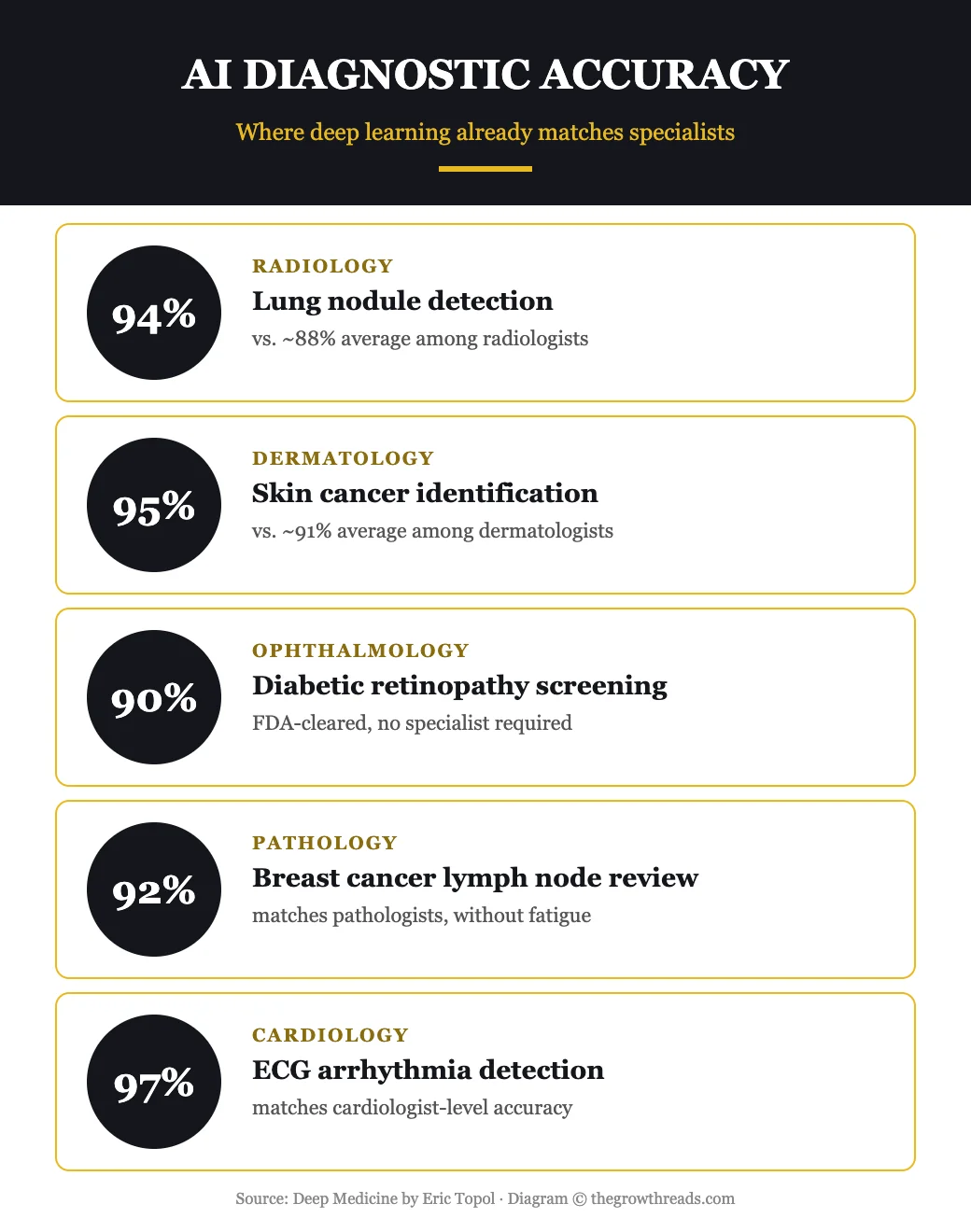
Topol is careful about what this evidence does and doesn’t show: these are narrow, benchmark-specific results, not proof AI can practice medicine broadly. But narrow is the point — most of a specialist’s day is narrow, repetitive pattern recognition, exactly the category where keeping it entirely human starts to look like habit rather than necessity. A lot of expert-level diagnostic work can be meaningfully assisted, sometimes replaced in a first-pass sense, by software. The question the rest of the book asks is what that frees doctors to do instead.
TGR Note: For a more skeptical read on how far “AI matches human experts” claims travel outside narrow benchmarks, our summary of Rebooting AI (Gary Marcus and Ernest Davis) is a useful companion — a healthy corrective to treating any single accuracy number as the whole story.
Part 2: The Real Diagnosis — Medicine Has Lost Its Time
If Part 1 is the technical case, Part 2 is the book’s emotional core, and the section most readers remember. Topol’s argument: modern medicine’s deepest problem isn’t a shortage of diagnostic accuracy — it’s a shortage of attention. The average primary-care visit now runs well under fifteen minutes, and much of a clinician’s day is spent typing into an electronic health record rather than looking at the patient. Physicians report hours of documentation, billing-code justification, and inbox triage for every hour of direct patient contact — clinicians call it “pajama time,” the hours spent finishing charts after their kids are in bed.
Deep learning applied to health records can also work further upstream, flagging deteriorating patients — early signs of sepsis, a looming readmission, a dangerous drug interaction — before those signs are obvious to a clinician managing dozens of other cases at once. AI-guided molecule screening is likewise compressing years of drug-discovery trial-and-error into months, though Topol is clear that faster candidates still face the same slow, expensive clinical-trial gauntlet before reaching a patient.
This is the trade Topol wants to reverse. If deep learning absorbs the reading of routine scans, the drafting of notes, and the flagging of abnormal labs, that isn’t primarily a diagnostic upgrade — it’s a time transfer, moved from data entry back to conversation. He draws on research linking longer, more attentive visits to better diagnostic accuracy, higher satisfaction, and fewer malpractice claims, since trust and communication drive most disputes.
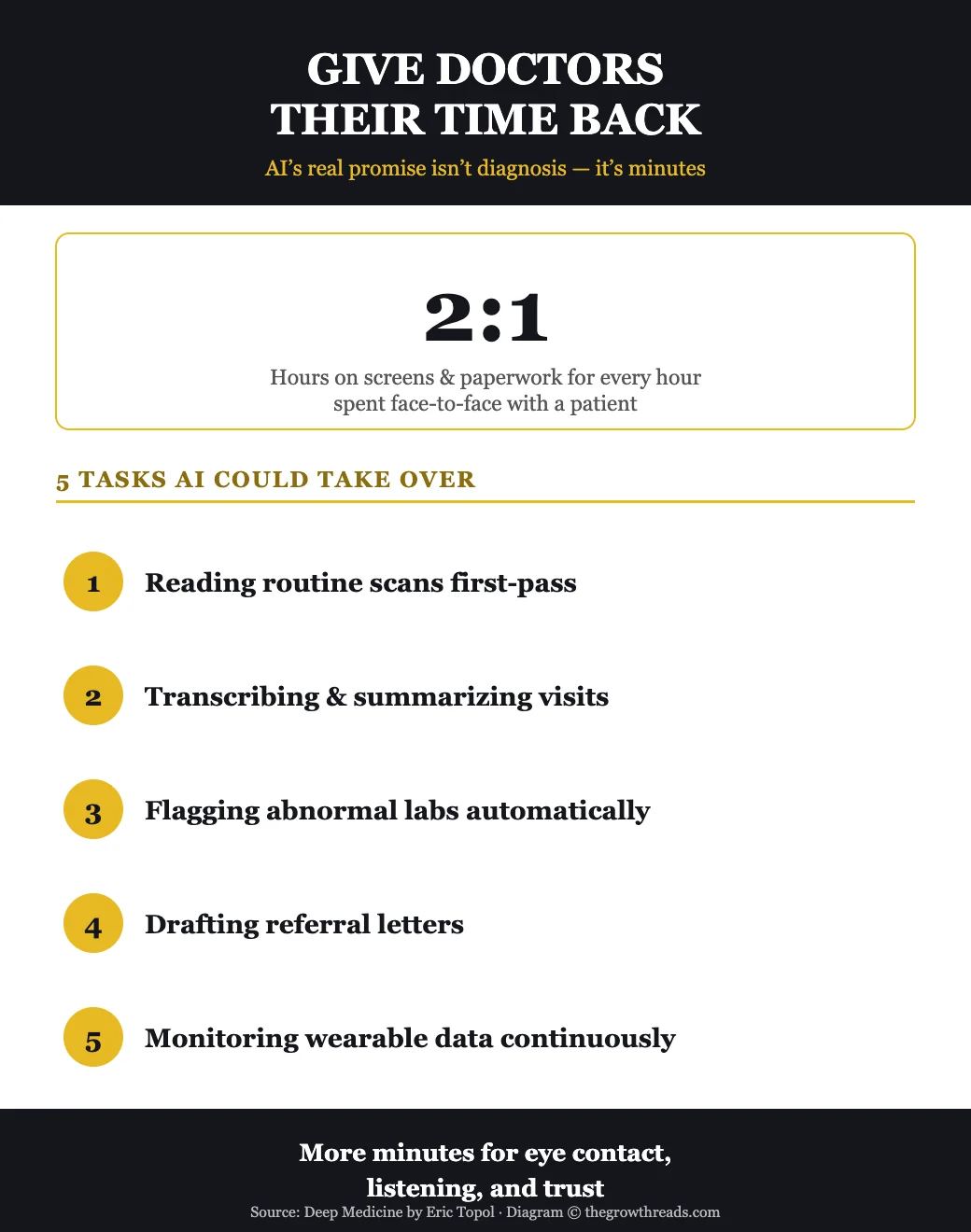
He’s careful to frame this as a genuine trade, not an automatic gift: reclaimed time only becomes more humane care if health systems actually redirect it toward patients rather than scheduling more visits per day. That’s a policy problem as much as a technical one — AI just makes the trade possible in the first place.
TGR Note: This “give the human back their time” framing echoes Co-Intelligence (Ethan Mollick) on knowledge work generally — the pattern isn’t unique to medicine.
Part 3: What Could Go Wrong — Bias, Black Boxes, and Over-Reliance
Topol doesn’t treat these benefits as free. Part 3 lays out risks he takes seriously, and this is where the book earns its credibility as clinician-written rather than techno-optimist marketing.
The first is bias. A model trained on a non-representative dataset performs unevenly on patients it wasn’t well trained on — a dermatology model trained mostly on lighter skin tones predictably underperforms on darker skin, and a risk-prediction algorithm can encode historical inequities in who received which treatments. One widely discussed case found a hospital risk-scoring tool using past healthcare spending as a stand-in for medical need, quietly disadvantaging patients who’d historically received less care — not intended harm, but training data reflecting years of unequal access. Because these systems look objective, biased outputs are often harder to catch than a biased human decision.
The second is the black-box problem: deep learning models often can’t explain, in terms a clinician or patient can evaluate, why they reached a conclusion. That opacity makes a wrong call harder to challenge, and harder to build trust around.
The third is over-reliance — fast, easy AI outputs quietly eroding the clinical skepticism needed to catch cases where the algorithm is wrong. Topol’s answer isn’t to reject the tools; it’s to insist AI stays a second opinion clinicians can override, not an autopilot they defer to, paired with real accountability for who signs off.
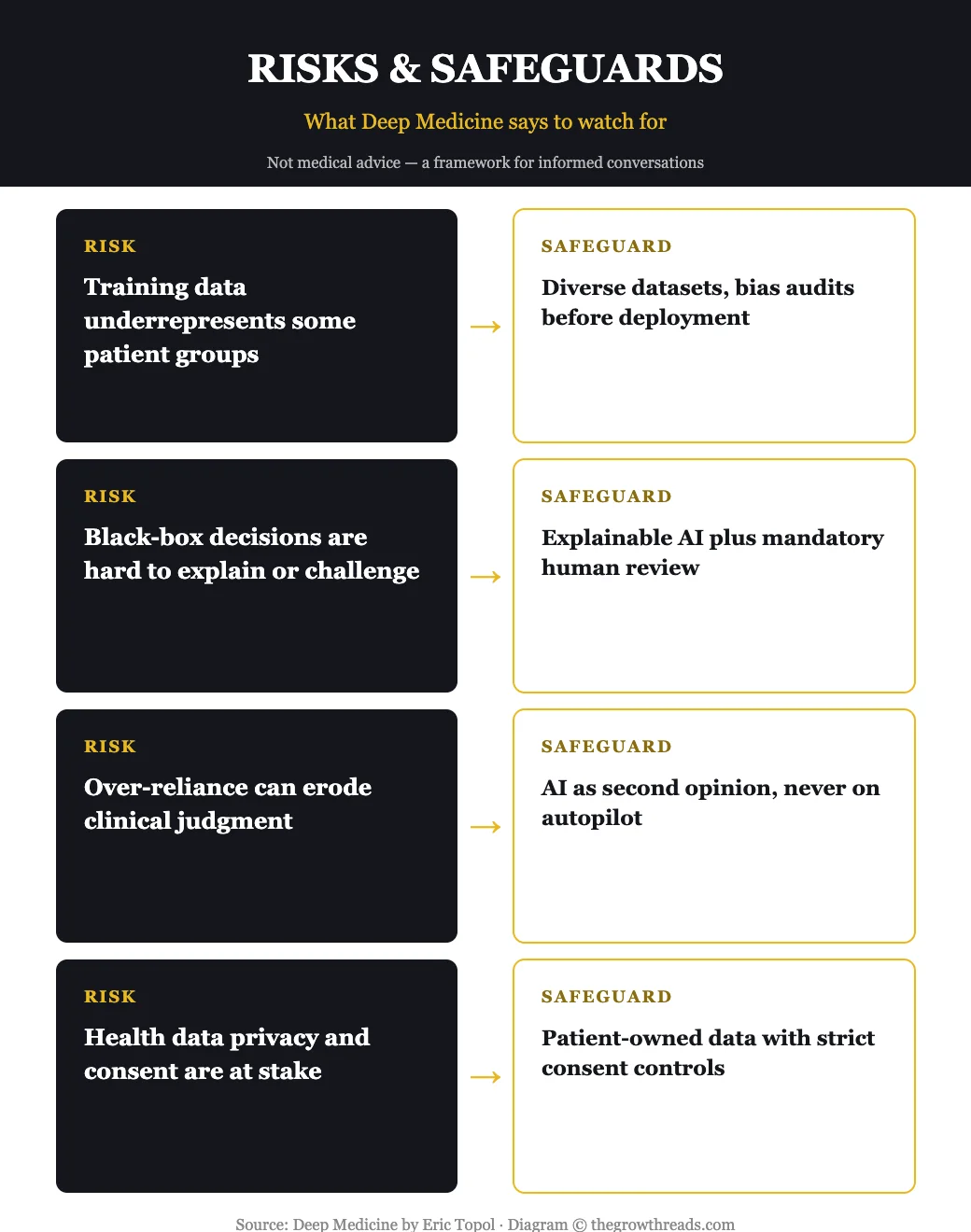
A fourth thread is privacy: the same rich, longitudinal data that makes AI powerful is uniquely sensitive, and Topol argues patients — not just hospitals or vendors — should own and control it.
TGR Note: These failure modes — bias hiding inside “objective” numbers, decisions nobody can fully explain — are the entire subject of Weapons of Math Destruction (Cathy O’Neil) outside medicine, and Human Compatible (Stuart Russell) tackles how humans should stay in control of powerful AI generally.
Part 4: Becoming an Engaged Patient in the AI Era
The last part turns outward, from what hospitals and algorithms should do to what patients can do themselves. Topol’s vision: a shift from passive recipient to active participant with real-time access to your own data — wearables tracking heart rhythm and sleep, home lab tests, and “virtual coaching” tools that nudge habits using your own trends rather than generic advice.
Central to this is data ownership. Topol argues patients should access, download, and share their complete health record as easily as checking a bank balance — not a portal showing only a fraction of the chart. That access lets a second opinion happen faster, lets a patient catch an error before it compounds, and lets someone bring their own trend data into a conversation instead of relying on a clinician’s memory of one visit months ago.
Topol suggests questions worth asking whenever AI enters a diagnosis or treatment decision: What was this tool trained on, and validated on people like me? Did a specialist actually review this result? What happens if I want a second opinion? None require technical expertise — they’re the same due-diligence instincts patients already bring to a surgical recommendation, aimed at a newer kind of tool.
Topol’s hope: these two shifts — AI absorbing data-heavy work, patients becoming genuine data partners — reinforce each other, which is Deep Medicine’s quiet redefinition of “high-tech” healthcare.
TGR Note: The tension between patient-owned data and the data-hungry business models many AI systems run on is explored from the infrastructure side in Atlas of AI (Kate Crawford) — useful context for why “just give patients their data” is harder than it sounds industry-wide.
Who is Deep Medicine best for — and who should read something else first?
Best for patients who want a clear, non-alarmist framework for AI’s growing role in their own care, clinicians and students curious where digital medicine is headed, and AI-and-society readers who want one deeply-researched domain case study rather than a broad survey.
Want a harder critique of AI’s societal risks first? Start with Weapons of Math Destruction or Atlas of AI. Want a general framework for keeping powerful AI safe and human-controlled, rather than a medicine-specific case? Human Compatible is a better entry point. Want the workplace version of “AI gives you your time back” outside healthcare? Co-Intelligence covers similar ground.
Questions to reflect on
- Think about your last doctor’s visit — how much was spent looking at a screen instead of at you?
- If an AI flagged something on your scan or labs, what would you want explained before you trusted it?
- Do you know whether you can request a full copy of your own health records today?
- Which parts of your own work are “pattern recognition” a tool could help with — freeing you for more human work?
- Where do you draw the line between an AI assisting a decision and an AI making one?
🔥 Ready to see medicine’s AI future clearly?
Get Deep Medicine and see exactly how AI could give your doctor — and you — more time that matters.
How to apply Deep Medicine (7-day plan)
- Day 1: Read the introduction and Part 1; note three tasks in medicine you didn’t realize AI could already assist with.
- Day 2: Check whether your own health system uses AI-assisted screening, from a visit summary or by asking at your next appointment.
- Day 3: Time your next visit (or recall your last one) — minutes on screen and typing vs. eye contact.
- Day 4: Read the chapters on bias and the black-box problem; write one question for your provider.
- Day 5: Check whether your provider has a patient portal that lets you download your records — try exporting them.
- Day 6: Try one reputable wearable, symptom tracker, or telehealth tool, and note what data it collects and why.
- Day 7: Write a short “AI health philosophy” for yourself — how to be an informed participant, not a passive patient.
Frequently asked questions
Is Deep Medicine still relevant, or has AI moved past what Eric Topol wrote in 2019?
Specific tools have advanced since 2019 — generative AI wasn’t yet mainstream when the book was written — but the core argument has only strengthened: pattern-recognition remains AI’s forte, and clinician time remains medicine’s scarcest resource. Read it for the framework, and treat its tool examples as illustrations of a trend rather than an up-to-the-minute product guide. The case for using AI to reclaim doctors’ time is, if anything, more urgent today.
Does Deep Medicine recommend specific AI health apps or products?
No. The book focuses on the underlying research and shift in medicine rather than functioning as a product guide — a sensible choice, since specific FDA-cleared tools change quickly while the framework for evaluating them stays useful much longer. Treat Deep Medicine as a way to ask sharper questions about any new AI health product, not as a shopping list of names to search for.
Is this book technical? Do I need a medical or computer science background?
No — it’s written for a general audience, though it doesn’t shy away from citing real studies. Topol explains medical and technical concepts in plain language as they come up, so curious patients, students, and non-specialist clinicians can follow the full argument without prior training in AI or medicine. A little patience with the research-heavy middle chapters helps, but no specialized background is required.
Is anything in this summary or the book medical advice?
No. Deep Medicine, and this summary, describe research trends in AI-assisted healthcare and questions worth asking your care team — they are not a substitute for professional medical diagnosis or treatment. Always talk to a licensed clinician about your own symptoms, test results, or medications, and use the ideas here as a starting point for that conversation, not a replacement for a real medical evaluation.
Does Topol think AI will replace doctors?
No — that’s the position he argues against throughout. Topol is explicit that AI’s role should stay narrow: tasks like reading a scan or flagging a lab value, with human judgment, empathy, and accountability remaining central to care. The title captures this directly — “deep” as in deep learning, and “deep” as in deeply, unmistakably human.
What’s the single most useful idea for a non-medical reader?
How to think about AI as freeing up time rather than only as a diagnostic engine. That lens applies well beyond healthcare — a good way to evaluate whether any AI tool at your own job is actually augmenting your judgment and giving you back attention, or just adding another screen to stare at.
How does Deep Medicine compare to other AI books on this list?
Weapons of Math Destruction focuses on algorithmic bias across many industries, and Human Compatible focuses on AI safety at a broad, systems level. Deep Medicine is narrower and deeper: a single-domain case study grounded in one physician-researcher’s decades of clinical experience, making its examples more concrete and its recommendations more directly actionable for anyone navigating healthcare today.
Related summaries
- Weapons of Math Destruction — Cathy O’Neil on algorithmic bias and harm across industries.
- Human Compatible — Stuart Russell on keeping powerful AI systems safe and human-controlled.
- Co-Intelligence — Ethan Mollick on AI as a working partner that gives knowledge workers their time back.
- Atlas of AI — Kate Crawford on the hidden data, labor, and infrastructure behind AI systems.
- See all reviews on the Best AI Books pillar page.
How we analyze books: we read the full text, verify every factual claim we can, and test the frameworks against real research and our own application before publishing. Read our full methodology.
Related Technology Summaries
Power and Prediction Summary & Review: Redesigning Decisions, Not Just Predictions
The Age of Spiritual Machines Summary & Review: Kurzweil’s 1999 Blueprint for the AI Age
The Attention Merchants Summary & Review: Reclaiming Your Focus
The Shallows Summary & Review: How the Internet Is Rewiring Your Brain
The Singularity Is Nearer Summary & Review: Kurzweil’s Case for 2029 and 2045