

Best for: Builders, founders, and policy-curious readers weighing AI’s upside against its risks.
Reading time: ~6 hrs to read the book (this summary: about 13 minutes)
Difficulty to apply: Moderate — the ideas translate most directly if you’re building or deploying something.
Superagency in one minute
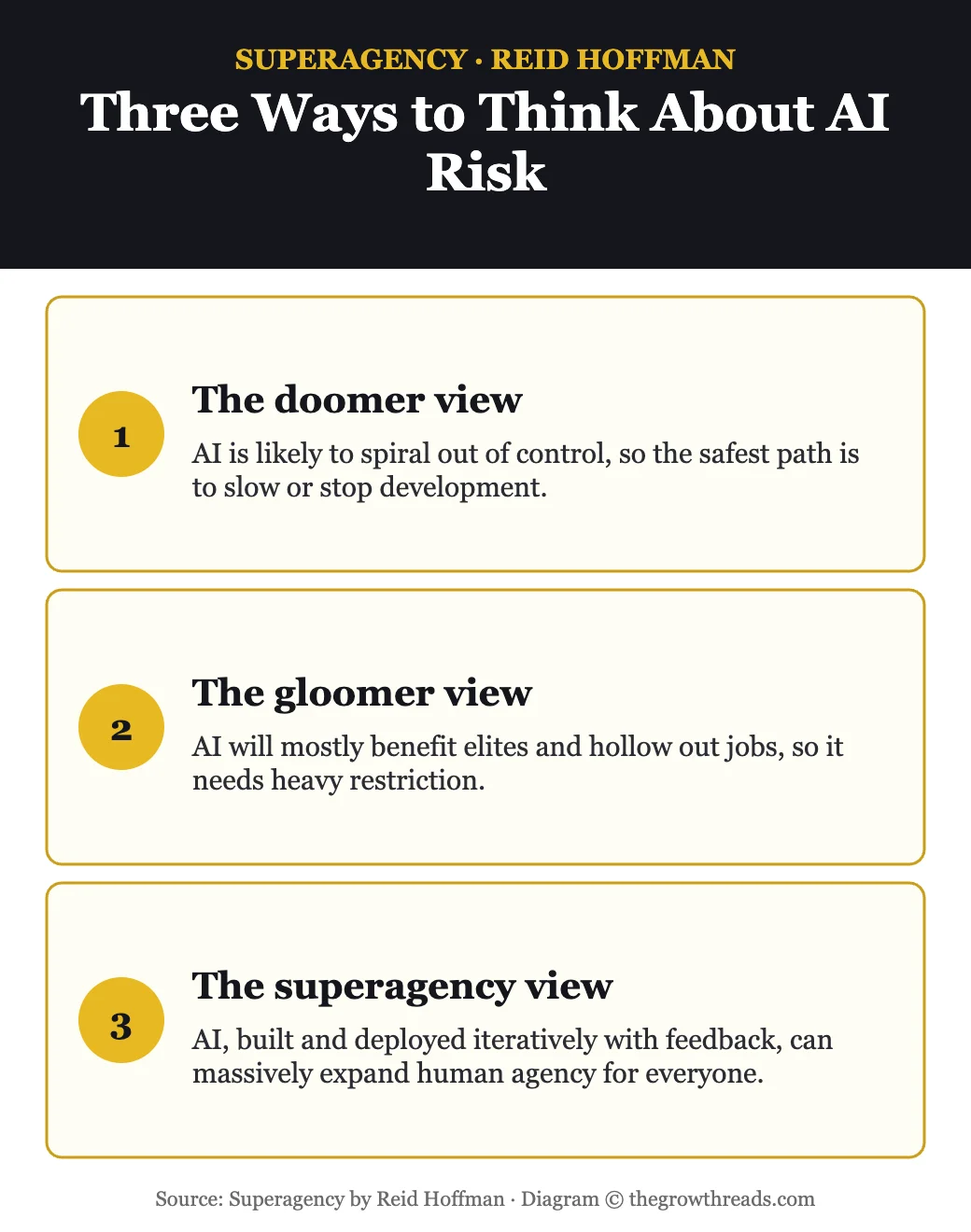
The biggest risk from AI may not be that it moves too fast, but that fear stops us from building the tools that could expand human potential at scale. In Superagency, LinkedIn co-founder and venture investor Reid Hoffman (with Greg Beato) argues against both techno-utopianism and doom-driven caution, proposing a third path: iterative deployment — shipping real AI tools to real people, learning from what goes wrong, and fixing it in the open rather than trying to perfect everything behind closed doors first. His case rests on a simple historical observation: nearly every transformative technology, from the printing press to the internet, provoked the same fears now aimed at AI, and the societies that engaged with the technology openly generally did better than those that tried to suppress it.
Key takeaways
- “Superagency” means AI-expanded human agency, not machine autonomy: Hoffman’s core claim is that AI can give ordinary people capabilities once reserved for the wealthy or highly credentialed.
- Iterative deployment beats theoretical perfection: shipping tools to real users and learning from real feedback catches problems faster than trying to solve everything in the lab first.
- History rhymes more than it repeats — but it does rhyme: the printing press, electricity, and the internet all faced doom predictions that didn’t fully materialize once society adapted.
- Concentrated control is a bigger risk than distributed access: Hoffman argues that limiting AI to a few large labs is riskier than getting it into many hands, with guardrails.
- Guardrails work best when they’re built alongside the technology, not instead of it: pairing deployment with active feedback loops beats either pure caution or pure speed.
- AI’s biggest upside may be in ordinary, unglamorous domains: healthcare access, education, and small business are where Hoffman sees the most human agency unlocked.
- Job disruption is real, but historically survivable: Hoffman doesn’t dismiss labor concerns, but argues previous technological shifts show adaptation is possible with the right policy support.
- Democratic, distributed AI is a policy choice, not an inevitability: who controls and benefits from AI depends on decisions being made right now, not just on the technology itself.
- Optimism is not the same as naivety: Hoffman repeatedly acknowledges real risks while arguing that disengagement is itself a risky choice.

What is Superagency about?
Superagency is Reid Hoffman’s argument that AI, deployed openly and iteratively, can massively expand ordinary people’s agency rather than concentrate power in a few hands. Co-written with Greg Beato, the book rejects both blind techno-optimism and doom-driven caution in favor of engaged, careful, real-world building.
About the author
Reid Hoffman is co-founder of LinkedIn, a longtime partner at Greylock Partners, and one of Silicon Valley’s most prominent voices on AI policy. He was an early investor in and board member of OpenAI, and has spent years engaging directly with the debate over how AI should be built and governed. Hoffman co-hosts a podcast exploring AI’s societal impact and has written previous bestsellers on career strategy and company-building, including The Start-up of You and Blitzscaling. Superagency draws on his front-row seat to the current AI boom — both as an investor shaping it and as a public voice arguing for how it should unfold. Explore all Reid Hoffman book summaries →
Key concepts at a glance
| Concept | What it means | Use it when |
|---|---|---|
| Superagency | AI-expanded human capability and agency, as opposed to AI autonomy or control | Framing the upside case for adopting a new AI tool |
| Iterative deployment | Releasing real tools to real users early, then learning and patching quickly | Deciding how cautiously to roll out an AI feature |
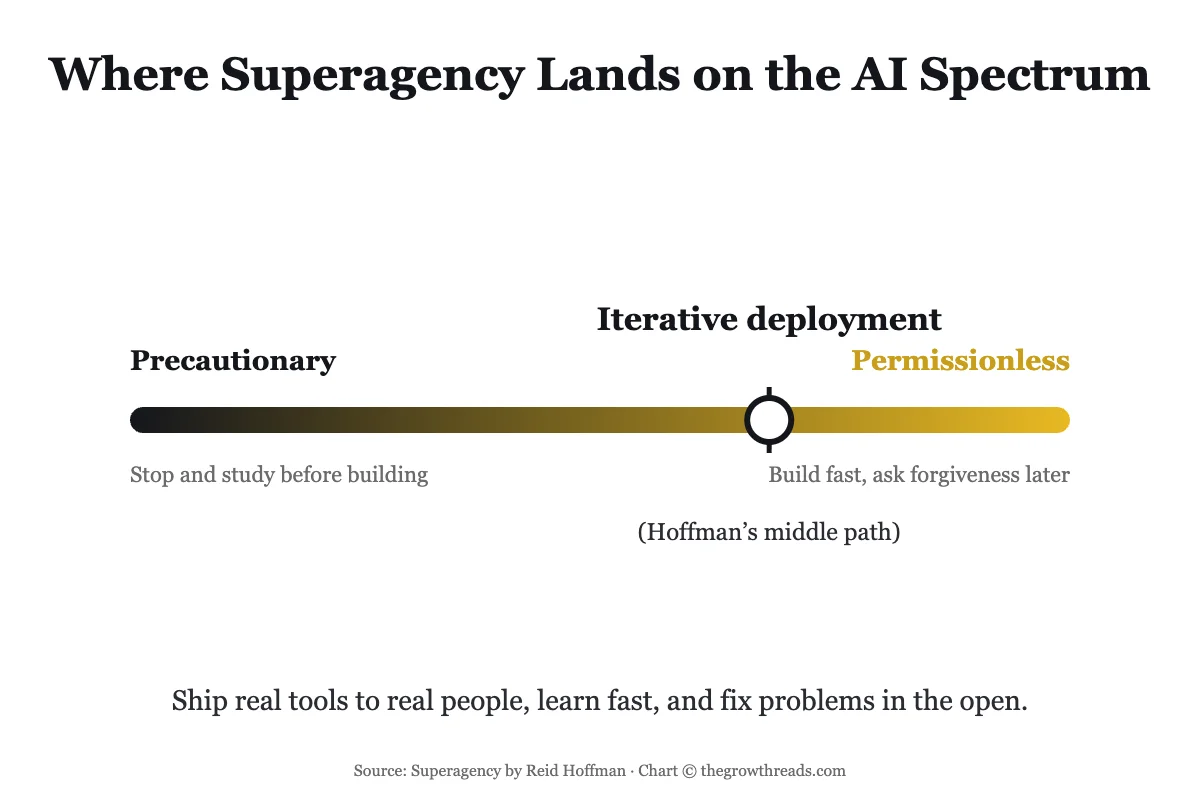
| The precautionary principle | The view that new technology should be restricted until proven safe | Evaluating calls to pause or heavily regulate AI development |
| Permissionless innovation | The view that builders shouldn’t need approval before releasing new technology | Understanding the opposite end of the deployment spectrum from precaution |
| Techno-humanism | Hoffman’s stance that technology should be shaped explicitly to serve human flourishing | Evaluating whether an AI product is designed around user benefit |
| Distributed access | Getting AI capability into many hands rather than concentrating it in a few labs | Assessing the competitive and societal risk of an AI monopoly |
| Adaptive regulation | Policy that evolves alongside the technology instead of freezing rules in advance | Discussing what “responsible AI policy” should actually look like |
Part 1: Why fear is the default response to new technology
Hoffman opens with a tour through history’s technology panics: the printing press was blamed for spreading heresy and social chaos; electricity was feared as dangerous and destabilizing; the automobile, radio, and television all provoked predictions of social collapse that never fully arrived. His point isn’t that new technologies are always harmless — some genuinely have caused serious harm — but that the instinctive response to sweeping change is almost always fear, and that fear alone is a poor guide to policy. Societies that engaged with disruptive technology directly, building institutions and norms around it as it developed, tended to capture more of its benefits than those that tried to hold it back.
This historical framing sets up his central argument: AI is disruptive in exactly this pattern, and the question isn’t whether to feel uneasy about it — everyone does — but what to actually do about that unease.
Part 2: Iterative deployment as a middle path
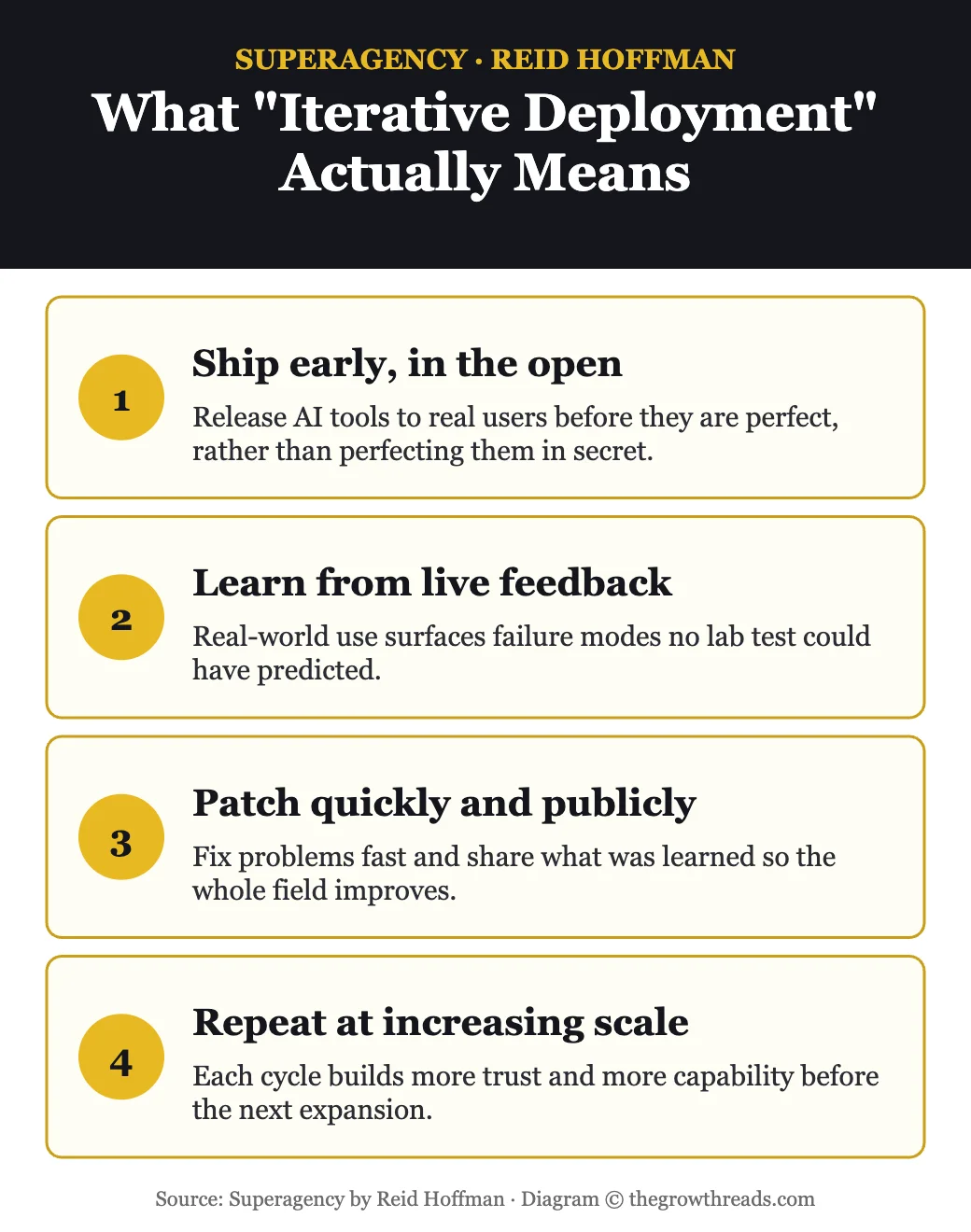
The heart of the book is Hoffman’s case for iterative deployment: rather than trying to fully solve AI safety in a lab before release (the precautionary approach) or releasing tools with no guardrails at all (pure permissionless innovation), companies should ship real, useful tools to real users early, watch closely for problems, and fix them quickly and transparently. He argues this approach — which he has practiced directly as an early OpenAI investor and board member — surfaces failure modes that no amount of internal testing would catch, because real-world use is far messier and more varied than any lab scenario.
Critically, Hoffman insists this isn’t the same as recklessness. Iterative deployment still requires guardrails, monitoring, and a genuine willingness to pull back or patch when something goes wrong — the difference is that the learning happens in contact with reality rather than in isolation from it.
Part 3: Who should control AI, and for whom
Hoffman is candid that the answer to “who controls AI” isn’t settled by the technology itself — it’s settled by policy choices, corporate decisions, and public pressure happening right now. He walks through scenarios where a handful of labs end up as gatekeepers for an entire economy’s worth of AI capability, contrasting that with a world where smaller companies, researchers, and even individuals have meaningful access to build on top of frontier models. His preference for the latter isn’t just philosophical; he argues it produces better safety outcomes too, because more independent eyes on a system catch more failure modes than a single company’s internal review ever could.
Hoffman spends significant time on the concentration-of-power question: if AI capability ends up locked inside a handful of companies or governments, he argues, that’s a far bigger risk to society than distributing it more broadly with appropriate guardrails. Distributed access creates competitive pressure, diverse oversight, and more chances to catch problems early — concentrated access creates a single point of failure and a small group deciding outcomes for everyone else.
He also tackles labor disruption directly, acknowledging that AI will genuinely displace some jobs while arguing — drawing on past technological transitions — that societies have navigated similar shifts before, provided policy actively supports retraining and transition rather than assuming markets will handle it automatically.
Part 4: Where the upside actually shows up
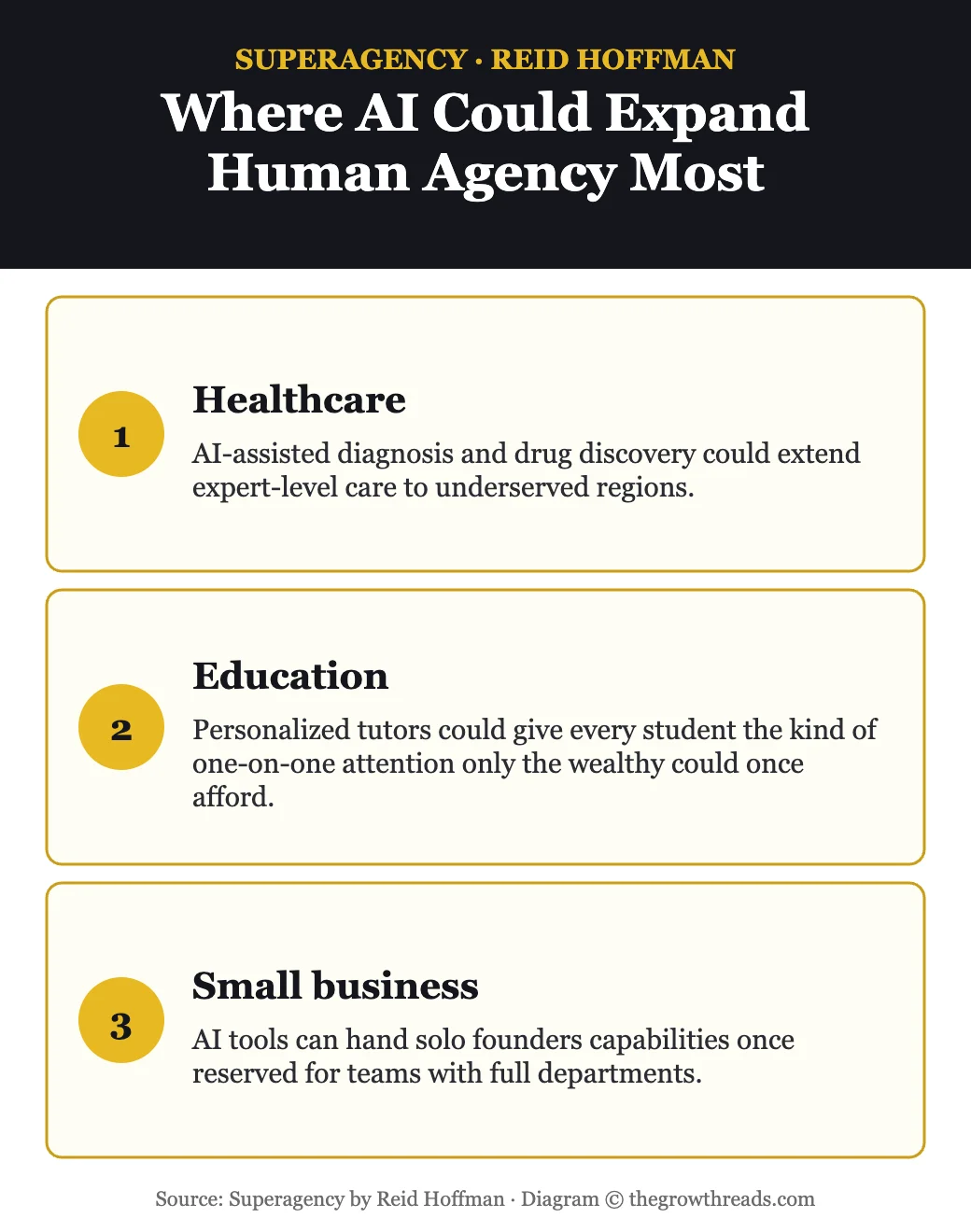
The book closes with concrete domains where Hoffman sees the most potential for AI-expanded human agency: healthcare, where AI-assisted diagnosis and drug discovery could extend expert-level care far beyond where it currently reaches; education, where personalized AI tutoring could give every student something close to the one-on-one attention historically reserved for the privileged few; and entrepreneurship, where AI tools let small teams and solo founders do work that once required entire departments. Hoffman frames these not as speculative futures but as capabilities already emerging, provided the underlying tools keep getting built, tested, and improved in the open.
A closing case for engagement over withdrawal
Underneath the specific arguments about deployment strategy and power concentration, Superagency is ultimately making a values claim: that disengaging from a transformative technology out of fear tends to cede more control to whoever doesn’t disengage, not less. Hoffman isn’t asking readers to abandon skepticism — he explicitly welcomes scrutiny of AI companies, including his own investments — but he is asking readers to direct that skepticism toward better building and better policy rather than toward simply opting out. Whether or not you share his optimism, the book is a useful stress test for your own assumptions about what “responsible AI” should actually look like in practice.
Who is Superagency best for — and who should read something else first?
Superagency is best for builders, founders, and anyone professionally optimistic about AI who wants a rigorous, historically grounded case for why careful, open deployment beats both blind speed and blanket caution. Because Hoffman writes as an investor deeply embedded in the AI industry, readers wanting a more skeptical or critical counterweight should pair this with Kate Crawford’s Atlas of AI. Readers wanting the underlying technical grounding first should start with Melanie Mitchell’s Artificial Intelligence: A Guide for Thinking Humans.
Questions to reflect on
- Where in your own life or work have you avoided trying an AI tool out of caution rather than testing it and learning from the result?
- Do you find Hoffman’s historical parallels (printing press, electricity, internet) convincing for AI specifically? Why or why not?
- What guardrails would you want in place before you’d trust an “iteratively deployed” AI tool with something important?
- Which of the three domains — healthcare, education, small business — feels most personally relevant to you right now?
- What’s one AI-related fear you hold that you’d want to test against real evidence rather than assume?
🔥 Ready to build a more optimistic case for AI?
Get Superagency and see the strongest argument for engaging with AI instead of fearing it.
How to apply Superagency (7-day plan)
- Day 1: Identify one AI tool you’ve avoided out of caution and try it on a low-stakes task.
- Day 2: Write down the specific failure mode you’re most worried about for that tool.
- Day 3: Test whether that failure mode actually occurs, and note what you learn.
- Day 4: Identify one guardrail (review step, human check, rollback plan) you’d want before scaling up use of that tool.
- Day 5: Look into how AI is being used in one domain — healthcare, education, or small business — near you.
- Day 6: Share what you learned this week with someone more skeptical of AI than you are.
- Day 7: Write one sentence describing where you personally land between “precautionary” and “permissionless.”
Frequently asked questions
What does “superagency” mean?
Superagency refers to AI’s potential to dramatically expand ordinary people’s ability to act, create, and solve problems — not autonomy or control by machines. Hoffman uses the term to argue that AI’s biggest impact could be handing capabilities once reserved for the wealthy or highly credentialed to far more people.
Is Reid Hoffman biased given his investments in AI companies?
Hoffman is transparent about his role as an investor and former OpenAI board member, and readers should factor that into how they weigh his optimism. His financial and professional stake in AI’s success is a legitimate reason to seek out more critical perspectives, like Kate Crawford’s Atlas of AI, alongside this book.
What is “iterative deployment”?
Iterative deployment is the practice of releasing AI tools to real users relatively early, monitoring closely for problems, and fixing issues quickly and transparently, rather than trying to perfect a system entirely in a lab before release. Hoffman argues this surfaces real-world failure modes faster than isolated testing can.
Does the book address job losses from AI?
Yes. Hoffman acknowledges that AI will displace some jobs and doesn’t dismiss the concern, but argues — using past technological transitions as evidence — that societies can adapt, provided policy actively supports retraining and transition rather than leaving it entirely to market forces.
How does this book compare to more critical AI books?
Superagency is deliberately optimistic and written from inside the AI industry, which makes it a useful counterweight to more critical books like Atlas of AI, but not a substitute for them. Readers get the most complete picture by reading both perspectives rather than relying on either alone.
Who is Greg Beato, the co-author?
Greg Beato is a writer and journalist who has co-authored several books with Reid Hoffman, including this one. He brings a journalistic, narrative-driven writing style that helps make the book’s arguments accessible to a general audience.
Is this book more about policy or personal AI use?
Both, though it leans toward policy and industry-level arguments about how AI should be built and governed. Readers looking for tactical advice on using AI tools personally may find the practical takeaways thinner than the philosophical and policy arguments.
Related summaries
- Atlas of AI by Kate Crawford
- Artificial Intelligence: A Guide for Thinking Humans by Melanie Mitchell
- The Master Algorithm by Pedro Domingos
- Human Compatible by Stuart Russell
- Best AI Books — The Full List
Related Technology Summaries
Chip War Summary & Review: Why Silicon Chips Now Decide Global Power
Our Final Invention Summary & Review: Is Superintelligent AI a Genuine Threat?
Superminds Summary & Review: How People and AI Think Smarter Together
The Ethical Algorithm Summary & Review: Building Fairness and Privacy Into Code, Not Policy
The Shallows Summary & Review: How the Internet Is Rewiring Your Brain