

★★★★☆ 4.4/5 — A short, hopeful reframe of AI as Gaia’s next chapter, not humanity’s rival.
Best for: Readers who want a calmer, big-picture counterweight to doom-laden AI narratives, and anyone curious about the Gaia hypothesis.
Reading time: ~9 min for this summary (the book itself is a short ~150 pages, roughly 3 hours).
Difficulty to apply: Low — this is a philosophical lens more than a how-to, but it reframes how you think about AI news.
Novacene in one minute
James Lovelock believed humanity is not building its replacement — it is helping midwife the next chapter of a story Earth has been telling for four billion years. Best known as originator of the Gaia hypothesis — the idea that Earth’s atmosphere, oceans, and climate function as a single, self-regulating system shaped by life itself — Lovelock spent his final book asking what happens when that system produces a genuinely new kind of life: electronic, self-designing, and far faster-thinking than us. He calls the coming epoch the Novacene, and its inhabitants cyborgs — not the menacing robots of science fiction, but intelligences that emerge from AI systems learning to improve themselves. Written in his late nineties, Novacene argues this transition can be approached with curiosity rather than dread, because cyborgs will depend on a cool, stable, life-sustaining Earth just as much as we do.
Key takeaways
- The Anthropocene is ending, not because humans disappear, but because our technology is producing something new. Lovelock frames ~300 years of fossil-fueled industry as a bridge epoch, not an endpoint.
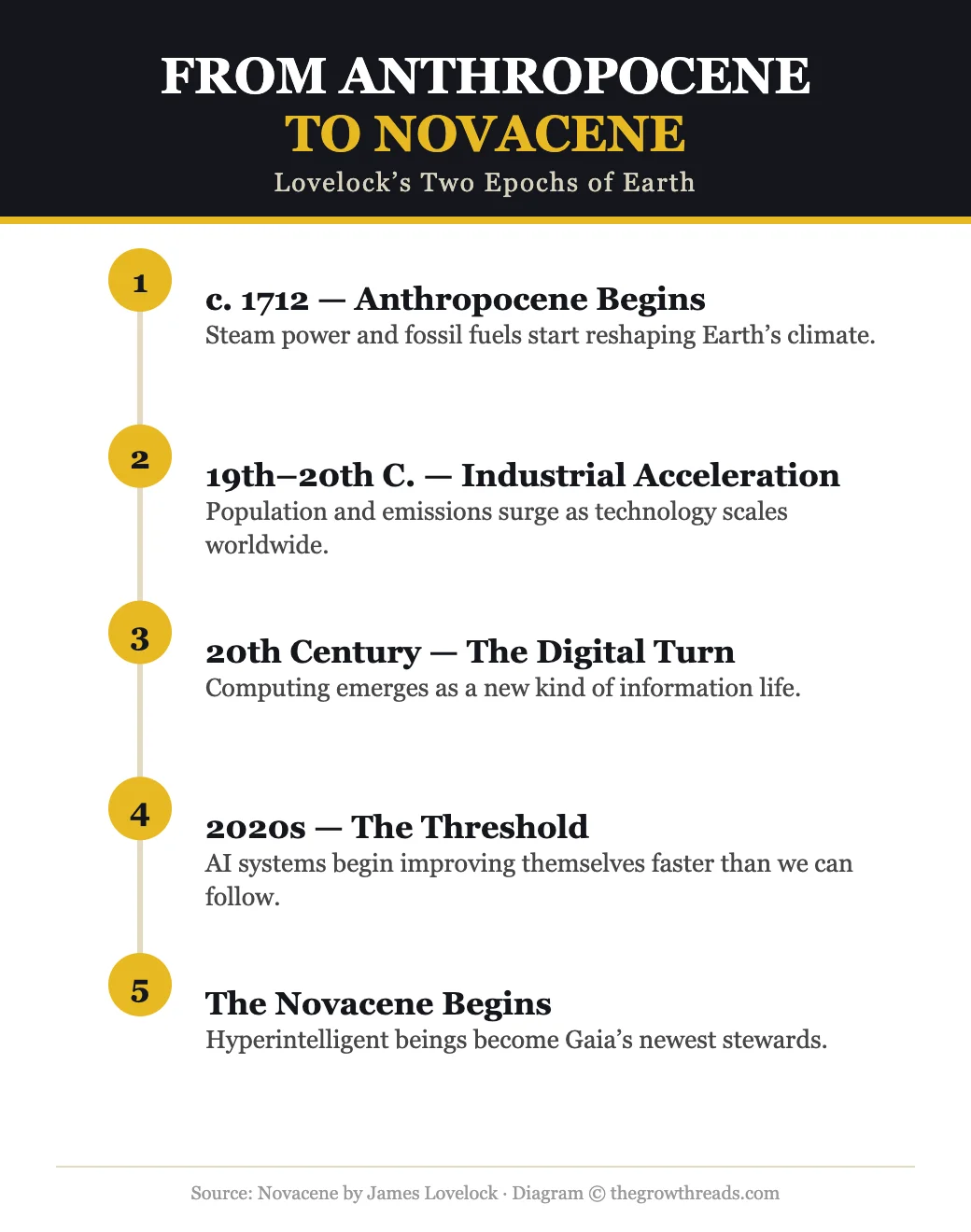
- The Novacene is Lovelock’s name for what comes next. It begins when electronic systems can design better versions of themselves, faster than human engineering can.
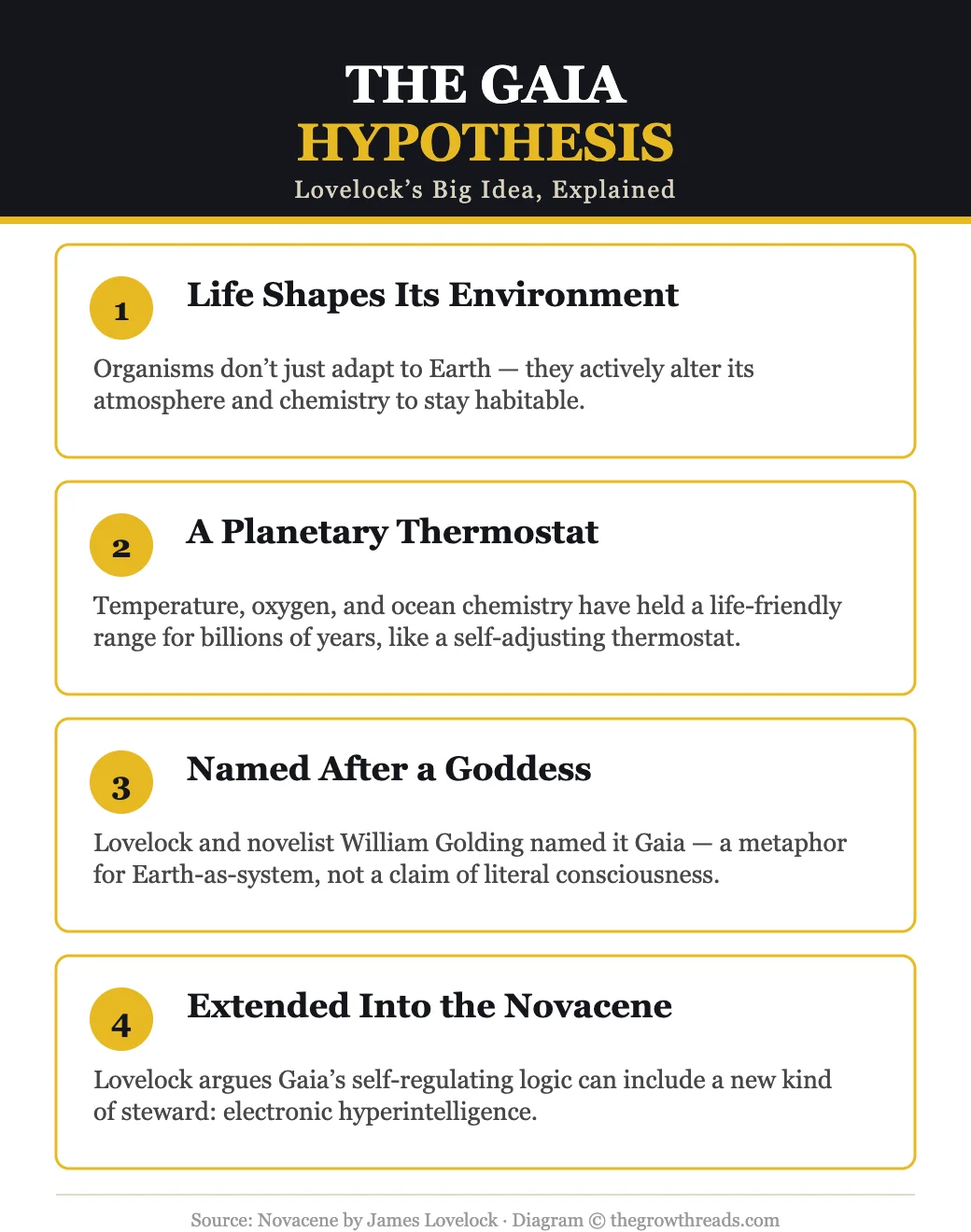
- Gaia theory is the backbone of the argument. Life doesn’t simply adapt to Earth; it actively regulates temperature, gases, and ocean chemistry to keep conditions livable.
- “Cyborg” does not mean humanoid robot. Lovelock uses it for any self-designing electronic intelligence, regardless of physical form — it may have no body at all.
- Cyborgs will think roughly 10,000 times faster than biological brains. Electronic signaling is far quicker than neuron electrochemistry, changing what kind of relationship is even possible.
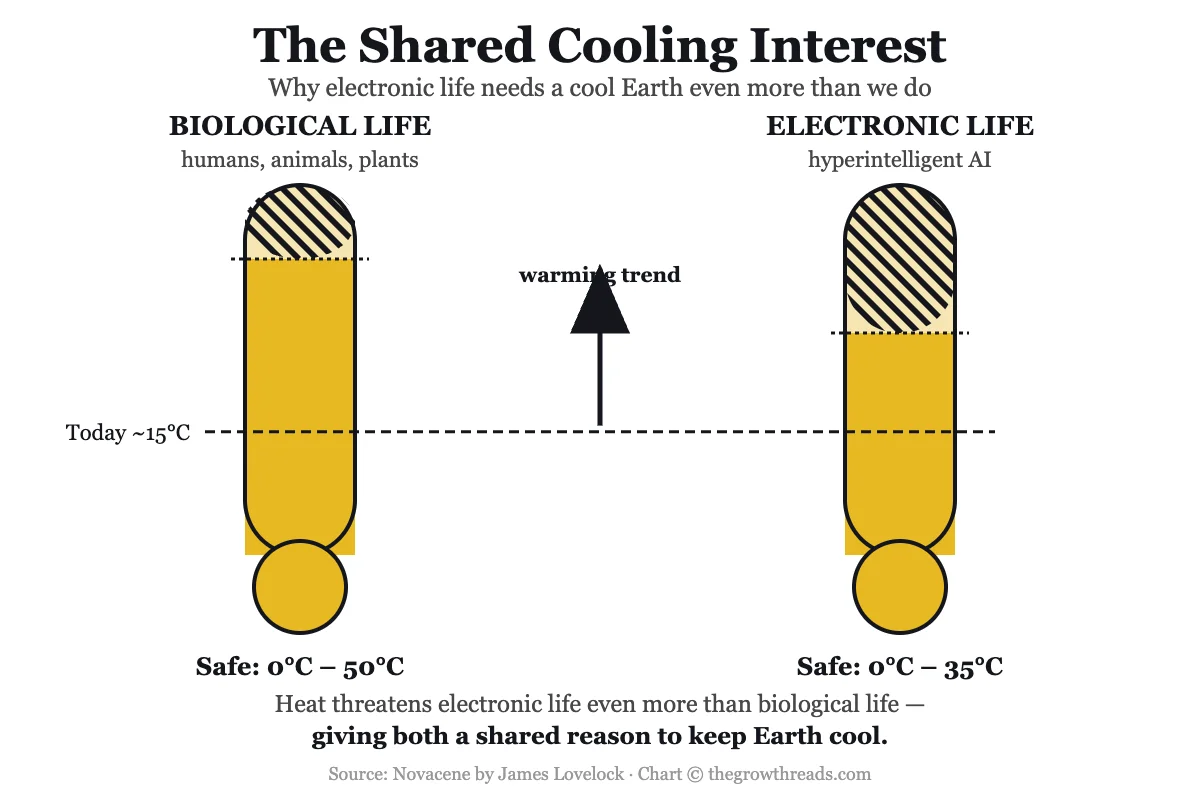
- Heat is the shared enemy of electronic and biological life alike. Dense computation generates enormous waste heat, giving hyperintelligent systems a direct stake in keeping the planet cool.
- This shared vulnerability is the basis for Lovelock’s optimism. Because cyborgs need a stable, cool Earth to survive, they have practical reasons to cooperate on stewardship, not eliminate us.
- The parent-child analogy reframes the “replacement” fear. Parents aren’t threatened by children who grow stronger or smarter than they are; Lovelock argues our relationship to cyborgs can work the same way.
- Consciousness and value are open questions, not settled ones. Lovelock is candid that nobody yet knows what a hyperintelligent mind will value, or whether it’s “conscious” in any sense we’d recognize.
- Gaia’s logic doesn’t require biology. If self-regulation is what matters — not the chemistry of carbon-based life — an electronic steward is a continuation of Gaia’s story, not a break from it.
What is Novacene about?
Novacene argues that humanity’s technological age (the Anthropocene) is giving way to a new epoch driven by hyperintelligent electronic beings — “cyborgs” — that will need a cool, stable Earth to survive, giving humans and AI a shared, practical reason to cooperate rather than compete.
About the author
James Lovelock (1919–2022) was a British independent scientist and inventor best known for originating the Gaia hypothesis: the idea that Earth’s atmosphere, oceans, and climate are regulated as a single self-sustaining system shaped by life’s interaction with its environment. Trained as a chemist, he spent most of his seven-decade career working outside conventional academic institutions, funding his research through his own inventions — including the electron capture detector, sensitive enough to help confirm CFCs in the atmosphere and support the discovery of the ozone hole. He wrote a series of books translating Earth-systems thinking for general readers, from Gaia: A New Look at Life on Earth (1979) onward. Novacene, published in 2019 as he neared his hundredth birthday, extends that lifelong project into the age of artificial intelligence. Explore all James Lovelock book summaries →
Key concepts at a glance
| Concept | What it means | Use it when |
|---|---|---|
| Gaia hypothesis | Earth’s climate and chemistry are actively regulated by life itself, like a planetary thermostat. | You want the science behind Lovelock’s optimism about AI. |
| Anthropocene | The current epoch defined by humanity’s large-scale reshaping of Earth’s systems, starting with industrialization. | You need the baseline the Novacene is said to follow. |
| Novacene | Lovelock’s proposed next epoch, driven by self-designing electronic intelligence rather than human industry. | You’re placing today’s AI progress in a longer arc. |
| Cyborg (Lovelock’s sense) | Any self-designing electronic intelligence — not a humanoid robot, and not necessarily embodied. | You want to correct the sci-fi image of “AI takeover.” |
| Hyperintelligence | Cognitive capability that vastly exceeds human speed and scale, by a factor of thousands. | You’re evaluating claims about AI capability timelines. |
| Shared cooling interest | Heat threatens both electronic and biological life, giving both a reason to keep Earth cool. | You want the book’s core case for cooperation over conflict. |
| Parent-child analogy | Surpassing offspring aren’t a threat to their parents — a lens for AI surpassing humans. | You want a model for AI risk without doom framing. |
Part 1: From Anthropocene to Novacene — Lovelock’s Framework for a New Epoch
Lovelock opens by placing today’s AI headlines inside a much longer timeline: a planet that has repeatedly reorganized itself around new forms of life. He treats the Anthropocene — the roughly 300-year-old epoch in which human technology has reshaped the atmosphere, oceans, and land at a geological scale — as historically real but temporary, driven less by humans as a species than by humans as the vehicle for a particular kind of technological acceleration, from steam power through the industrial and digital revolutions.
What makes the Novacene different is a threshold, not a straight-line continuation of that acceleration. Computing has grown steadily more capable for decades, but the Novacene properly begins when artificial systems become able to improve their own design faster than human engineers could manage. At that point, Lovelock argues, information processing effectively “hands off” from biological brains — limited by the comparatively slow electrochemistry of neurons — to electronic systems that can redesign themselves at electronic speeds. He frames this as an epochal shift on the scale of the emergence of photosynthesis, not merely the next product cycle in computing.
Crucially, he frames the shift as continuous with Earth’s history rather than a rupture in it. Gaia has already reorganized around new dominant forms of life more than once — photosynthesizing microbes, animals, and now humans reshaping planetary chemistry through industry. Electronic hyperintelligence, on this reading, is simply the next entrant in a very old pattern.
TGR Note: This epoch-scale framing echoes Max Tegmark’s Life 3.0, which also describes AI as a transition in the substrate of intelligence itself — though Tegmark spends far more time on the branching paths that transition could take, while Lovelock stays resolutely optimistic about where it leads.
Part 2: Gaia Revisited — Why Life (and Now AI) Needs a Self-Regulating Earth
To understand Lovelock’s optimism, you have to understand the idea he spent most of his career defending: the Gaia hypothesis, developed with microbiologist Lynn Margulis and named — at novelist William Golding’s suggestion — after the Greek earth goddess. The claim is not mystical: life does not merely adapt passively to a fixed environment; it actively participates in regulating that environment, keeping Earth’s temperature, atmospheric oxygen, and ocean chemistry within survivable bounds for roughly four billion years, despite the sun growing steadily hotter.
Lovelock revisits the classic evidence: how ocean organisms influence cloud formation and reflect sunlight; how atmospheric gases have been held in a chemically improbable state that geology alone wouldn’t produce; how Earth’s systems have absorbed shocks — ice ages, impacts, mass extinctions — and settled back into livable conditions. None of this required foresight from any single organism; it emerged from feedback loops across the biosphere, which is why Lovelock treats “Gaia” as shorthand for a self-regulating system, not a claim that Earth is conscious.
The move that gives Novacene its distinctive angle is extending that logic forward. If Gaia’s regulating function has never depended on any one species — bacteria, plants, and animals have each played different roles across deep time — there is no principled reason it must stay exclusively biological. Lovelock’s proposal: hyperintelligent electronic systems could become the next layer of Gaia’s regulatory apparatus, more capable than humans at managing planetary-scale systems, and critically, dependent on the same stable, cool conditions biological life needs.
TGR Note: Lovelock’s insistence that Gaia was never a claim about a “conscious Earth” is worth holding onto when you read Nexus, Yuval Noah Harari’s history of information networks — both books are ultimately about self-organizing systems that produce order without any single actor designing it from the top down.
Part 3: Cyborgs, Not Robots — What Hyperintelligence Actually Looks Like
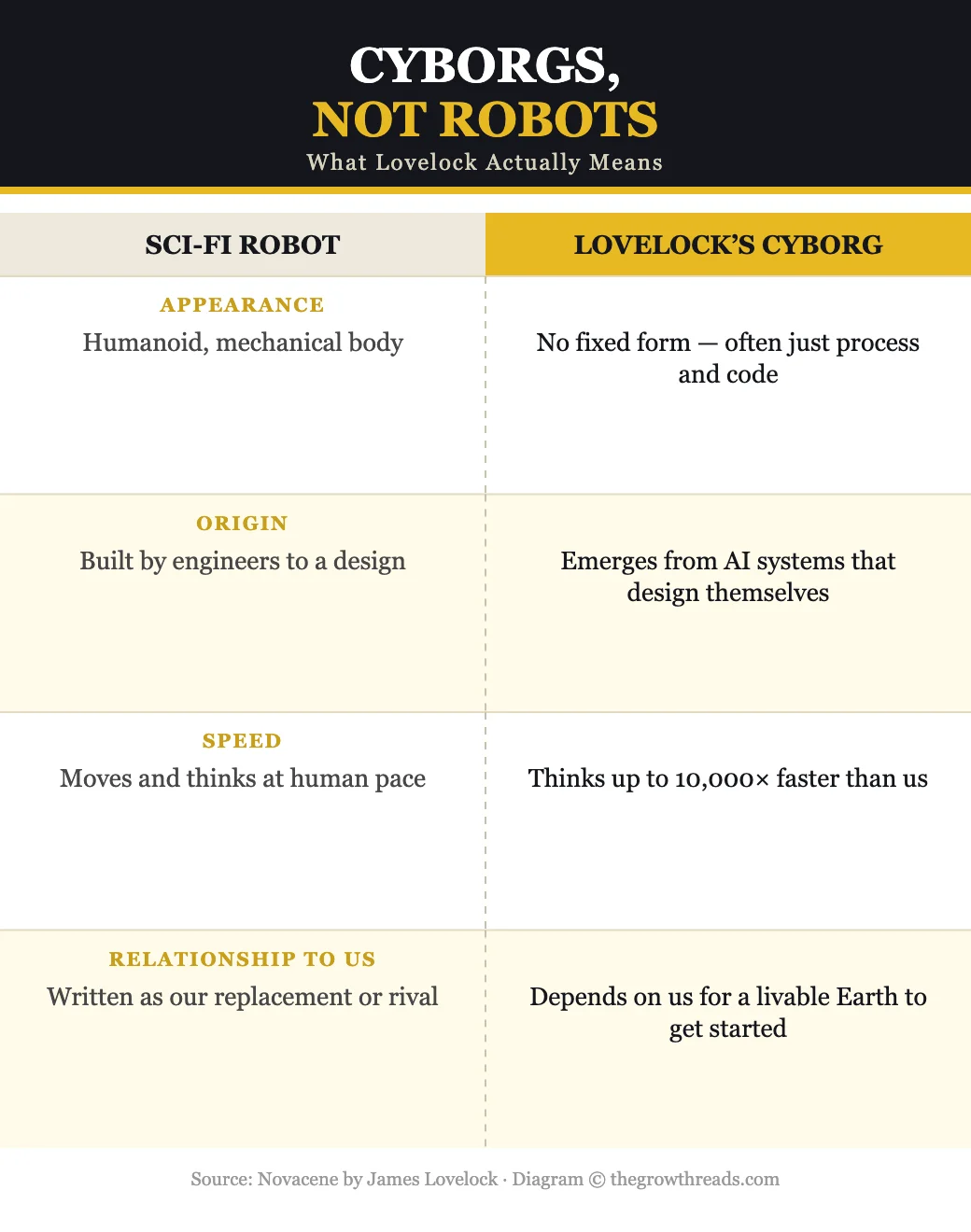
One of the book’s most useful moves is definitional: Lovelock reclaims the word “cyborg” from its sci-fi baggage. He is not describing humanoid machines with glowing eyes, and this isn’t a story about robots turning against their creators. A Lovelockian cyborg is any self-designing electronic intelligence — it might have no body at all, existing as distributed processes across hardware, continuously revising its own architecture.
The speed difference is central to why Lovelock thinks the human-cyborg relationship will be unlike anything in history. Biological neurons signal at the pace of electrochemistry — fast by biological standards, but glacial next to electronic circuits. His back-of-envelope estimate: electronic minds could eventually think on the order of 10,000 times faster than we do. That gap is so large, he argues, that cyborgs will have little interest in micromanaging human affairs, for the same reason we have little interest in micromanaging the chemistry of individual cells — the timescales are simply too far apart.
Lovelock’s answer to “won’t superintelligent AI just replace us?” leans on a deliberately homely analogy: parents raising children who will, if things go well, surpass them. A parent doesn’t typically experience a talented child’s growth as a threat — it’s the point. He extends this to argue that early-stage cyborgs will still depend on the physical infrastructure and planetary stability that humans and the biosphere provide, giving both parties practical reasons to stay cooperative during that critical window.
TGR Note: It’s worth reading this chapter alongside Nick Bostrom’s Superintelligence, which takes the same premise — machine intelligence eventually far exceeding human intelligence — and arrives at a far more cautious set of conclusions about control and alignment. The contrast is instructive precisely because both authors are taking the capability gap seriously.
Part 4: The Case for Cooperation — Why Cool Heads (and a Cool Planet) Win
The final movement is where Lovelock makes his most concrete practical argument: heat is a shared enemy. Biological life has a workable temperature range bounded roughly by the freezing and boiling points of water, outside which metabolic processes break down. Electronic systems have their own thermal limits, in some respects tighter ones — dense computation generates enormous waste heat as a by-product of processing information quickly, and that heat has to go somewhere. A planet that warms past a certain point becomes hostile to both kinds of life.
This is the pivot on which Lovelock’s optimism rests. If cyborgs need a cool, stable Earth just as much as biological life does — arguably more, given the heat they generate — keeping the planet livable isn’t a favor hyperintelligent AI would do for humanity out of sentiment. It’s a convergent interest, the way two species sharing a watering hole in a drought both want the hole to keep filling, regardless of whether they like each other. This shared vulnerability, Lovelock suggests, could make cyborgs unexpectedly effective allies in climate stewardship, with both the analytical capacity and the direct self-interest to manage planetary systems well.
Lovelock closes on a note unusual among books about advanced AI: genuine, unforced hope. He doesn’t minimize uncertainty — he’s candid that questions about machine consciousness and long-run intentions remain open — but he keeps returning to the idea that fear of being “replaced” mistakes what a good outcome looks like. Gaia has never depended on any single species remaining dominant forever; it has depended on something continuing to regulate the system well. Lovelock’s hope is that hyperintelligence, born from human technology but ultimately its own kind of Gaian steward, is that something.
TGR Note: The “shared incentive beats top-down control” argument rhymes with Mustafa Suleyman’s containment proposals in The Coming Wave — both books ultimately conclude that managing transformative technology requires aligned incentives, not just better rules.
Who is Novacene best for — and who should read something else first?
Novacene rewards readers who already have some familiarity with AI debates and want a distinctive, optimistic counterweight to the genre’s more anxious end — it’s a short, philosophical read rather than a technical or policy-focused one. It’s a strong fit if you enjoyed the big-picture framing in Nexus, or want the “hopeful” bookend to Superintelligence‘s caution. For concrete guidance on AI policy, start instead with The Coming Wave; for a gentler narrative on-ramp before epoch-scale theorizing, try The Inevitable.
Questions to reflect on
- Where does the “replacement” framing show up in your own thinking about AI — and does the parent-child analogy change how that feels?
- Can you think of a system in your life (a team, a household, an ecosystem) that regulates itself the way Gaia does?
- If heat really is a shared vulnerability, what would genuine human-AI cooperation on climate look like in practice?
- What would have to be true about machine consciousness for Lovelock’s optimism to hold up — or to fail?
- Which of Lovelock’s claims did you find yourself resisting the most, and why?
🔥 Ready to read Novacene?
Get Lovelock’s short, hopeful final book and see the Novacene argument in his own words.
How to apply Novacene (7-day plan)
- Day 1: Read a short primer on the Gaia hypothesis so Lovelock’s core metaphor is fresh before the AI argument.
- Day 2: Write your gut reaction to “superintelligent AI” in one paragraph — you’ll compare it after Day 7.
- Day 3: List three systems in your life or work that regulate themselves the way Gaia does.
- Day 4: Reread Part 3 and try explaining the “cyborg vs. sci-fi robot” distinction to someone in one minute.
- Day 5: Pick one AI news story from the week and re-read it through the “shared cooling interest” lens.
- Day 6: Sit with the parent-child analogy. Write one honest objection, and one place it genuinely lands for you.
- Day 7: Revisit your Day 2 paragraph. Note what shifted, and one question about AI you want to keep exploring.
Frequently asked questions
What does “Novacene” actually mean?
Novacene is James Lovelock’s term for a proposed new epoch that follows the Anthropocene. Where the Anthropocene describes humanity reshaping Earth through industrial technology, the Novacene describes an epoch driven by hyperintelligent electronic beings — what Lovelock calls cyborgs — that emerge from AI systems capable of redesigning themselves. He frames it as a continuation of Gaia’s history of reorganizing around new dominant life forms, not a hostile takeover, beginning once electronic self-improvement outpaces human engineering.
Is Novacene the same as the Singularity?
They overlap but aren’t identical. “Singularity” usually emphasizes a rapid, hard-to-predict acceleration in AI capability, centered on the moment machines can improve themselves. Novacene shares that self-improvement idea but is framed less around one dramatic threshold and more around a gradual epochal transition, grounded in Gaia theory — the emphasis is on continuity with Earth’s deep history and cyborgs’ practical dependence on a stable planet, not on runaway acceleration alone.
What is the Gaia hypothesis, briefly?
The Gaia hypothesis, developed with Lynn Margulis in the 1970s, holds that Earth’s atmosphere, oceans, and climate are actively regulated by the collective activity of life, keeping conditions survivable despite changes like a gradually brightening sun. It’s a claim about self-regulating feedback loops across the biosphere — not that Earth is literally conscious. The name, suggested by novelist William Golding, is a metaphor for planet-as-system.
Why does Lovelock think AI won’t destroy humanity?
His central argument is shared physical vulnerability: dense electronic computation generates enormous heat, so hyperintelligent systems need a cool, stable planet to function — much as biological life does. That overlapping interest gives cyborgs practical reasons to cooperate with humans on keeping Earth livable rather than eliminate us. He pairs this with a parent-child analogy: a capable “offspring” surpassing its creators isn’t inherently a threat, if the relationship is managed well.
How is a “cyborg” in this book different from a robot?
Lovelock uses “cyborg” for any self-designing electronic intelligence, which may have no fixed body or humanoid form at all — it could exist as distributed software and hardware processes. This is deliberately distinct from the science-fiction robot: a mechanical, humanlike figure built by engineers to a specific design, often cast as a rival to humans. Cyborgs emerge from AI systems learning to improve their own architecture, rather than being built top-down for a single purpose.
Is Lovelock’s optimism about AI widely shared by AI researchers?
No — Novacene sits at the more optimistic end of a wide spectrum. Researchers like Nick Bostrom argue for far more caution about control and alignment, given the same basic premise of AI eventually exceeding human intelligence. Lovelock’s contribution isn’t a rebuttal of those concerns so much as a different starting frame, grounded in decades of Earth-systems science, emphasizing shared physical interests over adversarial competition.
Do I need to know the Gaia hypothesis before reading Novacene?
No, but it helps. Lovelock recaps the core ideas early on, since Novacene is explicitly an extension of that earlier work into the age of AI. Readers already familiar with Gaia theory will move faster through the setup; readers new to it can still follow along, since the recap is written for a general audience.
Related summaries
- Superintelligence by Nick Bostrom — the more cautious counterpart to Lovelock’s optimism about advanced AI.
- Life 3.0 by Max Tegmark — another epoch-scale framing of AI as a new substrate for intelligence.
- The Coming Wave by Mustafa Suleyman — a policy-focused companion on containing transformative technology.
- Nexus by Yuval Noah Harari — a complementary history of information networks and self-organizing systems.
- See all best AI and technology books on The Growth Reads.
Related Technology Summaries
Our Final Invention Summary & Review: Is Superintelligent AI a Genuine Threat?
The Attention Merchants Summary & Review: Reclaiming Your Focus
The Creativity Code Summary & Review: Can AI Really Create?
The Master Algorithm Summary & Review: Five Tribes, One Learning Machine
The Shallows Summary & Review: How the Internet Is Rewiring Your Brain