

★★★★★ (4.6/5) — Kevin Kelly distills three decades of watching Silicon Valley into twelve directional forces that make sense of where technology is headed, even when specific products and companies come and go.
Best for: Readers who want a durable framework for thinking about tech trends, not a forecast of specific winners.
Reading time: ~35 min summary (book: ~9 hrs)
Difficulty to apply: Easy — the ideas reshape how you read the news and evaluate new tools; no direct action required.
The Inevitable in one minute
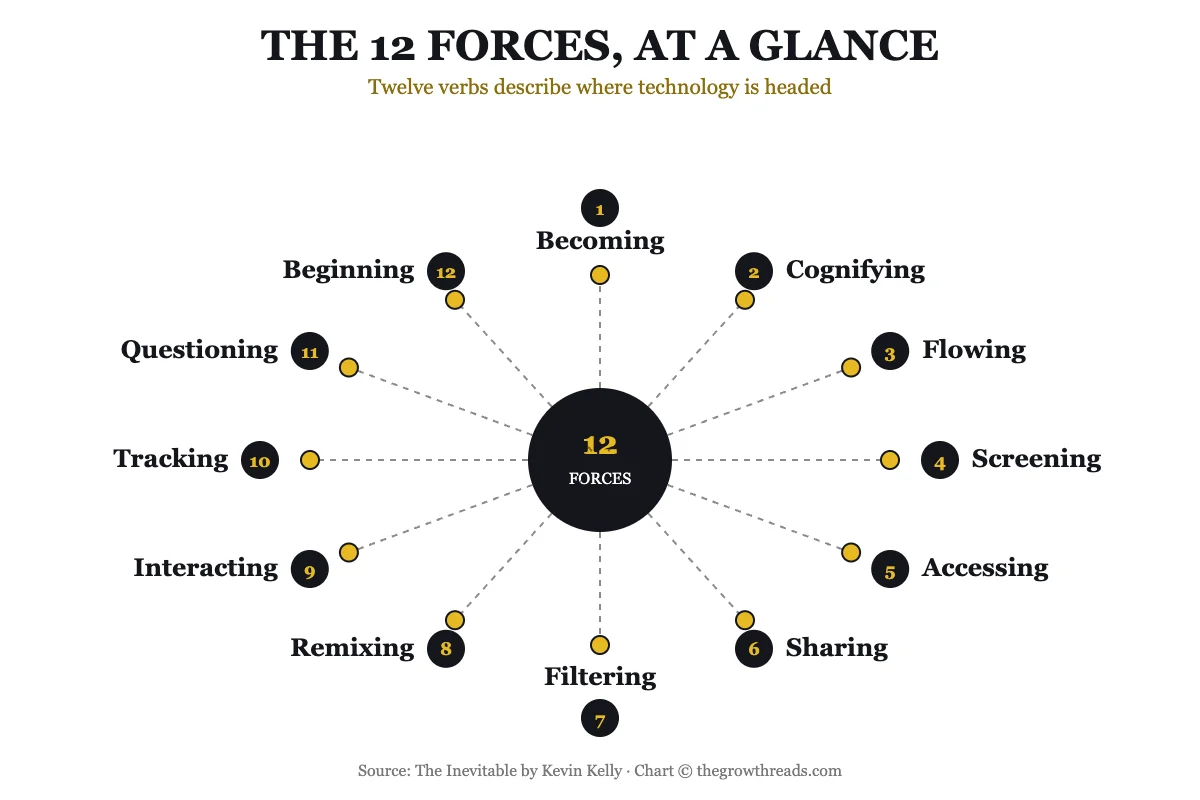
Nobody can predict which specific product or company will win — but the direction technology is moving is remarkably predictable. Kevin Kelly, co-founder of Wired magazine, spent decades watching the tech industry up close and noticed the same twelve forces resurfacing again and again beneath the surface churn: Becoming, Cognifying, Flowing, Screening, Accessing, Sharing, Filtering, Remixing, Interacting, Tracking, Questioning, and Beginning. Each is a verb, not a noun, because Kelly’s core claim is that these are ongoing processes, not final states. Once you can name the force behind a confusing new product or headline, the noise starts to resolve into a pattern — and you can bet on the direction of change even when you can’t predict the destination.
Key takeaways
- Direction, not destination: Individual products and companies fail constantly, but the underlying forces — more access, more sharing, more intelligence layered in — keep moving the same way regardless of who wins any given year.
- Everything is becoming, never finished: Software, devices, and digital services are permanently “in beta,” continuously upgraded rather than ever fully completed.
- Intelligence gets added, not built from scratch: The cheapest way to improve almost any ordinary product or process is to layer a bit of machine intelligence into it.
- Data wants to flow: Value increasingly comes from real-time streams of information rather than static files you download once and keep.
- Fixed media becomes interactive: Text, video, and even physical objects are turning into screens that respond to us instead of sitting still.
- Access is overtaking ownership: Subscriptions, streaming, and on-demand services increasingly beat owning things outright, trading permanence for convenience and constant upgrades.
- Sharing scales further than expected: From open-source software to crowdfunded products, mass collaboration keeps outperforming solo effort at a scale few predicted.
- Filters are mandatory, not optional: In a world of near-infinite content, curation — human or algorithmic — is what makes anything findable at all.
- Almost nothing is created from nothing: The overwhelming majority of new media is a remix — existing pieces recombined into something that reads as new.
- Good questions outlast good answers: With answers a search or a prompt away, framing the right question becomes the scarcer, more valuable skill.
What is The Inevitable about?
The Inevitable is Kevin Kelly’s field guide to twelve technological forces — verbs like Becoming, Cognifying, and Sharing — that he argues will keep shaping computing, media, and daily life for decades, regardless of which specific companies or products come and go along the way.
About the author
Kevin Kelly co-founded Wired magazine in 1993 and served as its executive editor through its formative first years, giving him a front-row seat to nearly every major technology wave since the dawn of the commercial internet. Before Wired, he edited the Whole Earth Review and helped organize the early Hackers Conferences, putting him in the room with many of the people who went on to build the modern tech industry. He is also the author of Out of Control and What Technology Wants, both examining how large technological systems evolve in ways that echo biological ones. In The Inevitable, Kelly blends decades of reporting with a naturalist’s patience for spotting long-running patterns. Explore all Kevin Kelly book summaries →
Key concepts at a glance
| Concept | What it means | Use it when |
|---|---|---|
| Becoming | Everything stays permanently “in beta,” always upgrading | You’re frustrated a product keeps changing on you |
| Cognifying | Adding a layer of machine intelligence to something that lacked it | You’re deciding where AI actually adds value in your work |
| Accessing | Renting or streaming increasingly beats owning outright | You’re weighing a subscription against a one-time purchase |
| Sharing | Mass collaboration routinely outperforms solo effort at scale | You’re building or evaluating a community-driven project |
| Filtering | Curation becomes mandatory once content turns effectively infinite | You’re overwhelmed by choice and need a way to narrow it |
| Remixing | Nearly all new media recombines existing pieces into new forms | You’re stuck for an original idea and need a starting point |
| Questioning | A good question keeps its value longer than any single answer | You’re using search or AI tools and want sharper results |
Part 1: The Shape of Inevitable Change — Becoming, Cognifying, Flowing
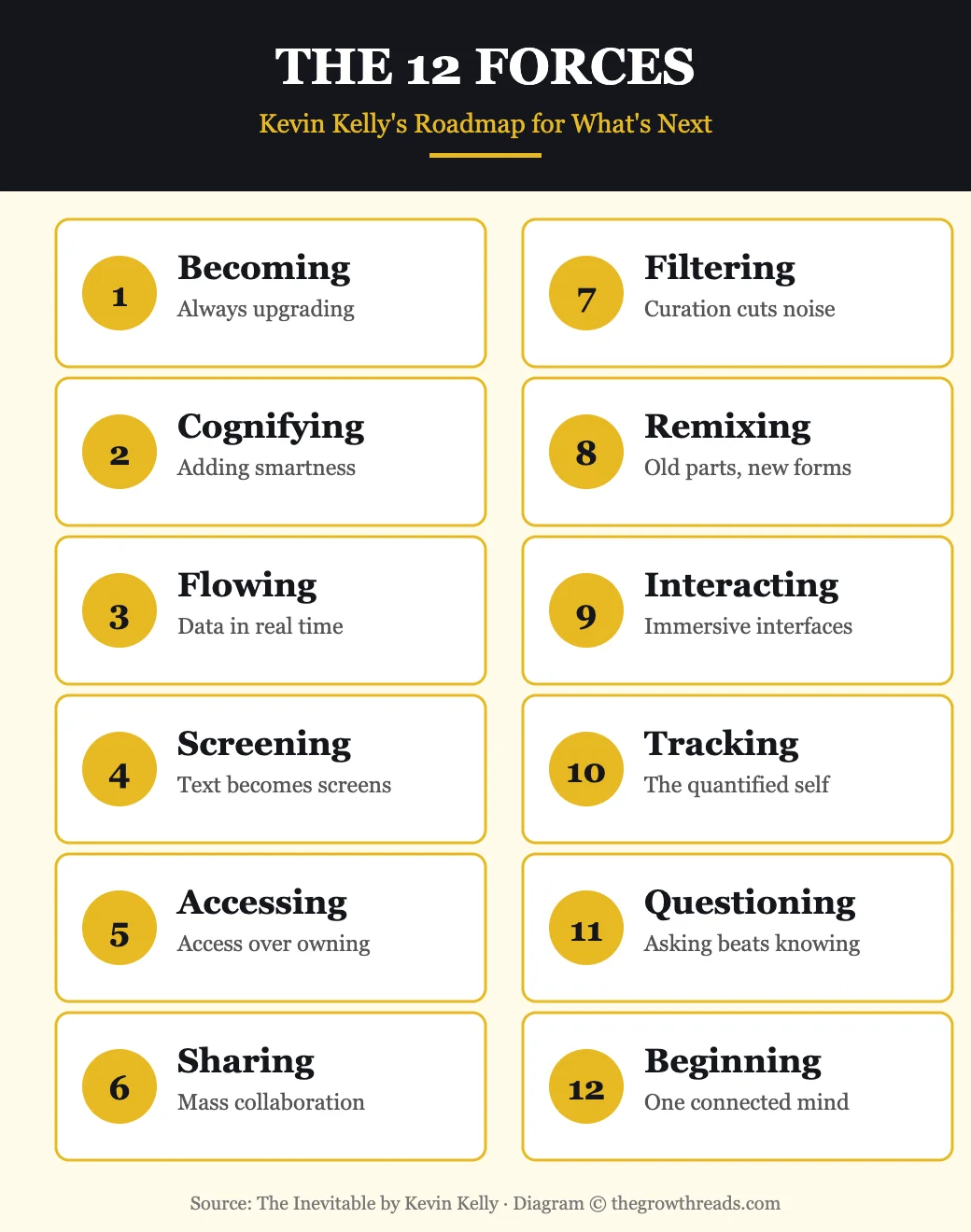
Kelly opens by rejecting the idea that we can forecast winners. Instead, he asks readers to notice the verbs that describe motion rather than the nouns that describe products. The first of these is Becoming: nothing ships finished anymore. Operating systems, apps, and even hardware firmware are perpetually mid-upgrade, patched and re-patched in a state Kelly calls “protopia” — not a fixed utopia, but a condition of continuous, incremental improvement that never quite arrives. This reframes a common frustration: when a familiar app’s interface changes again, it isn’t a design team failing to settle on an answer — it’s the entire industry behaving exactly as this force predicts it will.
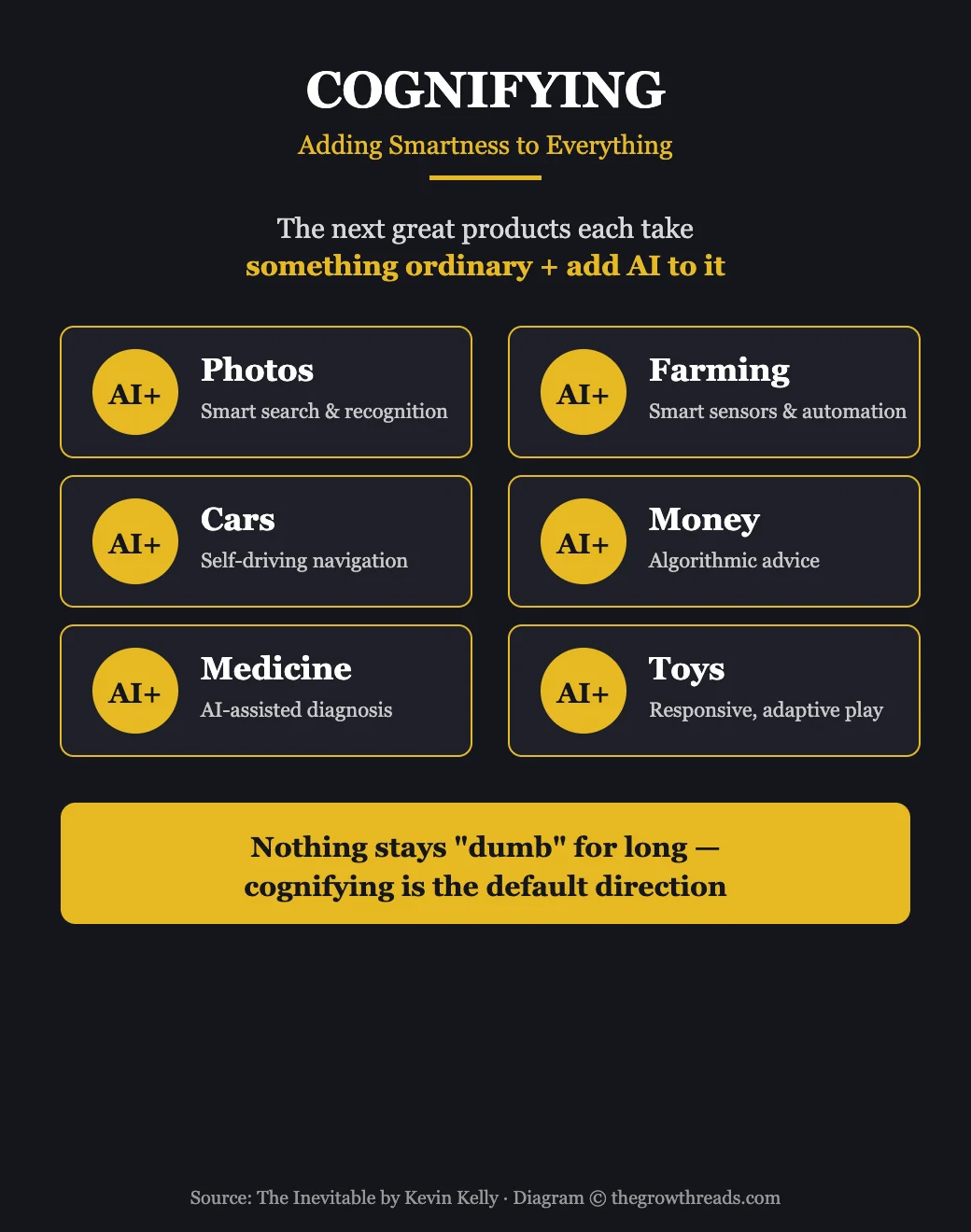
Cognifying is the force Kelly treats as the most consequential of the twelve. His argument is not that superintelligent machines are about to replace human judgment wholesale, but that cheap, general-purpose intelligence is becoming a utility — something you plug into a product the way earlier generations plugged in electricity. The pattern he traces is simple: take anything that currently isn’t smart — a thermostat, a camera roll, a tractor — and the economically obvious move is to add a layer of machine intelligence to it. He suggests that the next wave of major companies will largely be built this way: not by inventing new categories from scratch, but by taking something ordinary and cognifying it.
Flowing closes out this first cluster of forces. Kelly traces a progression in how information has been packaged: fixed physical formats gave way to portable copies, which gave way to real-time streams. A song is no longer something you own as a physical object or even a file — it is a stream you tap into. The same logic extends to news, video, and eventually most other media and services. The implication for anyone building or evaluating a product is to ask whether it’s still built around discrete, ownable units when the market has already moved toward continuous flow.
TGR Note: Kelly’s Cognifying force pairs well with Kai-Fu Lee’s more country-specific account of the AI buildout in AI Superpowers — where Kelly describes the general pattern of “add intelligence to anything,” Lee documents exactly how that pattern played out as a race between the US and China. Reading both gives you the abstract force and the concrete competitive dynamics it produced.
Part 2: From Owning to Sharing — Screening, Accessing, Sharing
The second cluster tracks what happens once nearly everything becomes a screen. Screening describes the migration of text, and eventually most media, onto interactive surfaces. A printed book is a fixed, one-way object; a book on a screen can be searched, linked, annotated, and connected to everything else you’ve ever read. Kelly’s point isn’t that paper disappears — it’s that the default expectation shifts: readers increasingly expect content to talk back, to be linked, to be part of a living network rather than a sealed artifact.
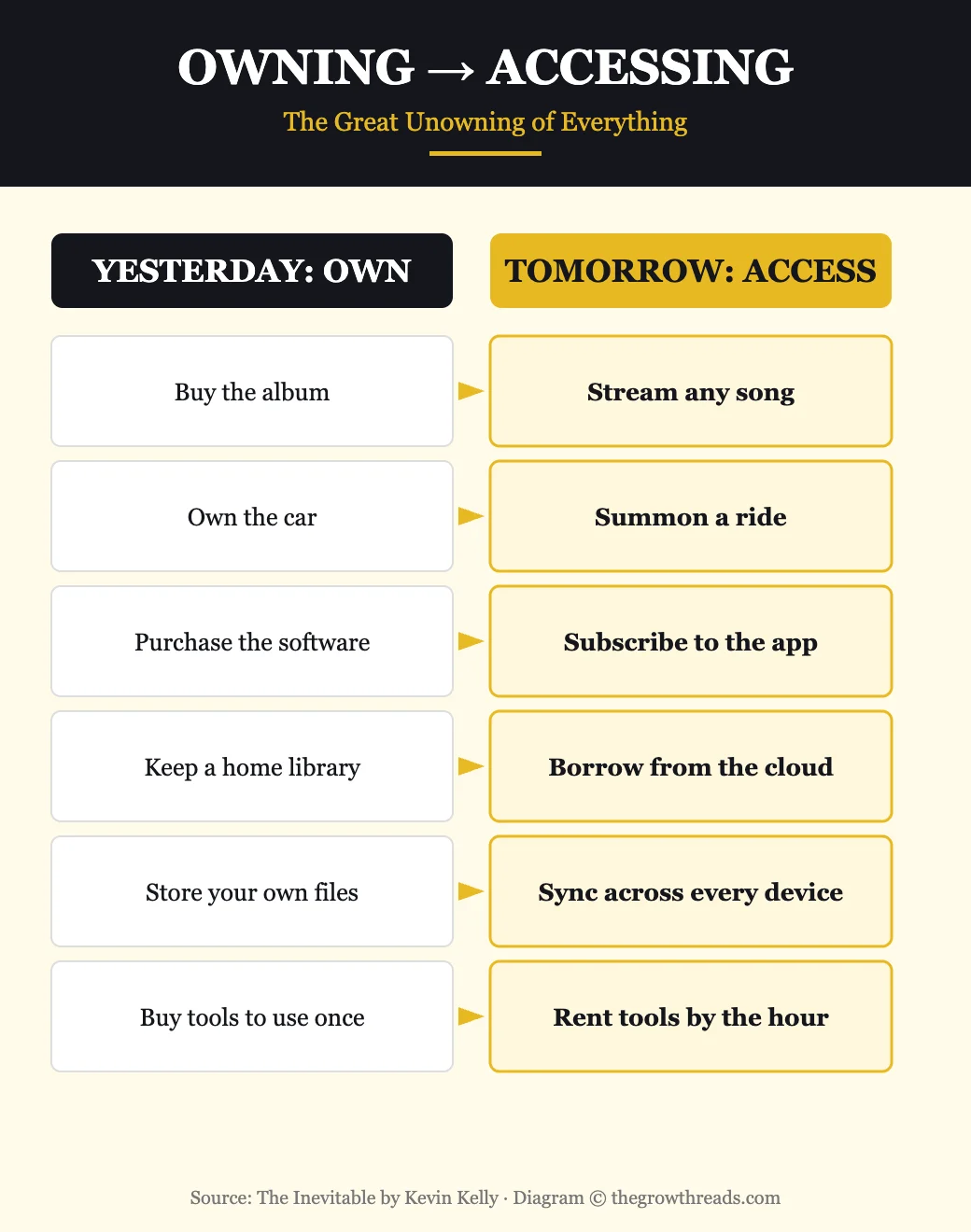
Accessing is where Kelly makes his most quietly radical claim: ownership itself is becoming less important than guaranteed access. He notes that owning something comes with real costs — storage, maintenance, obsolescence — that access-based models simply route around. Why own a car that sits idle 95% of the time when a ride is a tap away? Why own software that becomes outdated the moment you buy it when a subscription keeps it current automatically? This isn’t a moral argument about materialism; it’s a practical observation about where convenience keeps pulling entire categories of goods and services.
Sharing takes the access argument a step further into collaboration itself. Kelly walks through the rise of open-source software, user-generated content, and crowdfunded products as evidence that mass collaboration routinely outperforms what any single closed team could produce alone — not despite being open to strangers, but because of it. His interest is in the mechanics of how large, loosely coordinated groups of contributors reliably produce results that rival centralized production, and why that keeps happening at greater scale.
TGR Note: The Sharing force is essentially a preview of the argument in Machine, Platform, Crowd, which digs much deeper into exactly how and when crowds outperform traditional hierarchies — and, just as usefully, when they don’t. Pair the two if you want Kelly’s big-picture pattern followed by a more operational playbook.
Part 3: Making Sense of Abundance — Filtering, Remixing, Interacting
Once access and sharing make nearly everything available, the bottleneck shifts from scarcity to attention. Filtering is Kelly’s answer to the resulting overload: when there is too much of everything, curation stops being a nice-to-have and becomes the actual product. He traces filtering through several layers — editors, algorithms, social recommendations, and eventually AI-driven personalization — and argues that whoever controls the filter increasingly controls what gets seen at all, which is why fights over recommendation systems and search rankings carry so much weight.
Remixing follows naturally: once abundant, filtered content exists, the most common way to make something new is to recombine pieces of what already exists. Kelly points to sampling in music, mashups in video, and fan fiction in writing as early, obvious examples of a much broader pattern — nearly all cultural production, he argues, has always worked this way, and digital tools simply make the recombination faster, cheaper, and more visible. The skill this rewards isn’t inventing from nothing; it’s having a large enough library of existing pieces and a good enough eye for which combinations will resonate.
Interacting extends this into how we physically engage with technology. Kelly describes a long arc moving from keyboards and mice toward gesture, voice, and eventually full-body, immersive interfaces — virtual and augmented reality among them. The through-line is that computers are steadily disappearing into the environment around us rather than staying confined to a single screen. The interface, in his framing, is trending toward becoming everything we can see and touch, not just the specific device in our hand.
TGR Note: If Filtering and Remixing feel abstract, The Coming Wave makes a related argument with a sharper edge — it treats the same “technology diffuses and recombines faster than institutions can respond” dynamic as a genuine governance problem, not just a cultural one. Read Kelly first for the pattern, then The Coming Wave for the stakes.
Part 4: Living Inside the System — Tracking, Questioning, Beginning
Tracking covers the rise of the quantified self and the broader surveillance infrastructure that shadows nearly every digital interaction. Kelly is candid that this force cuts both ways: the same sensors and logs that let you monitor your own sleep, steps, and habits also make it possible for companies and governments to monitor everyone else. He doesn’t resolve this tension so much as insist readers stop pretending it isn’t happening — tracking is accelerating regardless of how any individual feels about it, so the more useful question is how to shape its guardrails rather than whether it can be stopped.
Questioning is Kelly’s case for why curiosity becomes more valuable, not less, in a world where machines can answer almost anything. If answers are abundant and nearly free, the scarce and valuable skill is knowing what to ask — framing a question precisely enough to get a useful answer, or, better, a question nobody has thought to ask yet. He treats every new tool, from search engines to AI assistants, primarily as a question-answering machine, which makes the person asking the questions the actual bottleneck on how useful the tool turns out to be.
The book closes with Beginning, Kelly’s most speculative force: the idea that billions of connected minds, devices, and sensors are gradually knitting themselves into something like a single planetary system — what he calls the “holos.” He frames this as an early-stage, ongoing process, not a finished singularity — the point is that connection itself keeps compounding, and we are still near the beginning of however far it goes.
TGR Note: The Tracking and Beginning forces echo the themes in Nexus, which zooms out even further to ask how information networks — not just AI specifically — have shaped human societies for millennia. If Kelly’s “one connected mind” idea intrigues you, Nexus is the natural next stop for the longer historical view.
Who is The Inevitable best for — and who should read something else first?
The Inevitable rewards readers who want a durable mental model for interpreting tech news — founders, product people, investors, and generally curious readers who keep noticing the same kinds of headlines and want a framework that makes them less surprising. It’s less useful as a hands-on implementation guide. If you want concrete, step-by-step advice on building or adopting AI tools today, Co-Intelligence is more directly practical. If you’re after a rigorous look at AI’s technical and safety trade-offs rather than a broad diffusion pattern, Human Compatible is the better starting point.
Questions to reflect on
- Which of the twelve forces is already reshaping your industry the fastest — and are you positioned to benefit from it or exposed to it?
- Where in your own life or work are you still paying the costs of ownership for something you could access instead?
- What’s one process or product around you that hasn’t been “cognified” yet — and what would adding a layer of intelligence to it actually look like?
- Are you better at finding answers or framing questions? Which skill is actually scarcer in your field right now?
- What would it mean to treat your own skills, habits, or career as permanently “in beta” rather than a finished, fixed thing?
🔥 Ready to see where technology is really headed?
Get The Inevitable and start reading the forces behind the headlines.
How to apply The Inevitable (7-day plan)
- Day 1: List three products or habits in your life that are still “finished” rather than “becoming” — note where an upgrade or subscription model might already be replacing them.
- Day 2: Pick one manual, “dumb” process in your work and sketch what a lightly cognified version of it — even a simple rule-based automation — would look like.
- Day 3: Audit one thing you own outright and ask whether an access-based alternative (rental, subscription, sharing) would actually serve you better.
- Day 4: Find one open, collaborative project (open-source, wiki, community forum) relevant to your field and spend 20 minutes seeing how it coordinates contributors.
- Day 5: Audit your own filters — which feeds, algorithms, or people curate what you see — and deliberately swap one for a source you don’t already trust.
- Day 6: Practice remixing: take two ideas, articles, or tools you already know well and force yourself to combine them into one new concept.
- Day 7: Write down the single best question in your field right now — not the answer, the question — and spend the week trying to sharpen it further.
Frequently asked questions
What are the 12 forces in The Inevitable?
Kevin Kelly’s twelve forces are Becoming, Cognifying, Flowing, Screening, Accessing, Sharing, Filtering, Remixing, Interacting, Tracking, Questioning, and Beginning. Each describes an ongoing direction of technological change — not a fixed prediction — that Kelly argues has been building for decades and will keep building for decades more, regardless of which specific companies or products end up winning along the way.
Is The Inevitable still relevant, given it was published in 2016?
Yes — the book deliberately avoids naming specific products likely to age poorly, focusing instead on directional forces. Cognifying (adding AI to everything) and Accessing (subscriptions over ownership) in particular describe trends that have only accelerated since publication, which is part of why the book has held up better than most tech titles from the same period.
Does Kevin Kelly predict specific future technologies?
Not really, and that’s deliberate. Kelly explicitly avoids naming winners because he believes specific products are far harder to predict than the underlying forces pushing an entire industry in a given direction. The book is closer to a set of durable questions to ask about any new technology than a list of forecasts to check off.
How is The Inevitable different from Kelly’s other books, like What Technology Wants?
What Technology Wants builds the underlying theory that technology behaves like an evolving system with its own momentum. The Inevitable applies that theory practically, breaking it into twelve specific, recognizable forces you can spot in everyday products and headlines, making it the more accessible and applied of the two.
Is The Inevitable optimistic or pessimistic about technology?
Broadly optimistic, though not uncritically so. Kelly acknowledges real trade-offs — particularly around Tracking and surveillance — but his overall stance is that these forces are going to keep unfolding regardless of how anyone feels about them, so the more productive response is understanding and shaping them rather than resisting them outright.
What’s the best way to read The Inevitable — cover to cover or by chapter?
Each of the twelve forces is its own self-contained chapter, so the book works well either way. Reading cover to cover gives you the fullest sense of how the forces build on each other, but you can also jump straight to whichever force feels most relevant to a decision you’re facing right now.
Who should read The Inevitable first — beginners or people already in tech?
Both audiences get value, but for different reasons. Newcomers get an accessible framework for a confusing industry; people already working in tech tend to find it useful as a way of naming patterns they’ve sensed intuitively but never had clean language for, which makes it easier to communicate to others.
Related summaries
- AI Superpowers by Kai-Fu Lee — a country-level view of the AI race Kelly’s Cognifying force describes in the abstract.
- Machine, Platform, Crowd — a deeper operational playbook for the Sharing force.
- The Coming Wave — the governance stakes behind Filtering and Remixing at speed.
- Nexus by Yuval Noah Harari — the longer historical arc behind Tracking and Beginning.
- Best AI Books — our full ranked guide to the AI and technology reading list.
How we analyze books: our team reads each title in full, cross-checks key claims where possible, and builds original frameworks — verdicts, application plans, and reflection questions — rather than reproducing the book’s own text. Read our full methodology.
Related Technology Summaries
The Attention Merchants Summary & Review: Reclaiming Your Focus
The Fourth Industrial Revolution Summary & Review: How Every Industry Is Converging
The New Breed Summary & Review: What Animals Teach Us About Living with Robots
The Singularity Is Near Summary & Review: Why Kurzweil Thinks 2045 Changes Everything
Working with AI Summary & Review: What 29 Real Deployments Actually Prove