

★★★★☆ 4.3/5 — Ten grounded visions of a world twenty years from now, told through fiction and fact-checked in real time.
Best for: Curious generalists, tech leaders, educators, and policy-minded readers who want AI speculation with real evidence attached.
Reading time: ~8.5 hrs full book · ~22 min this guide
Difficulty to apply: Easy — this is a thinking tool more than a how-to manual.
AI 2041 in one minute
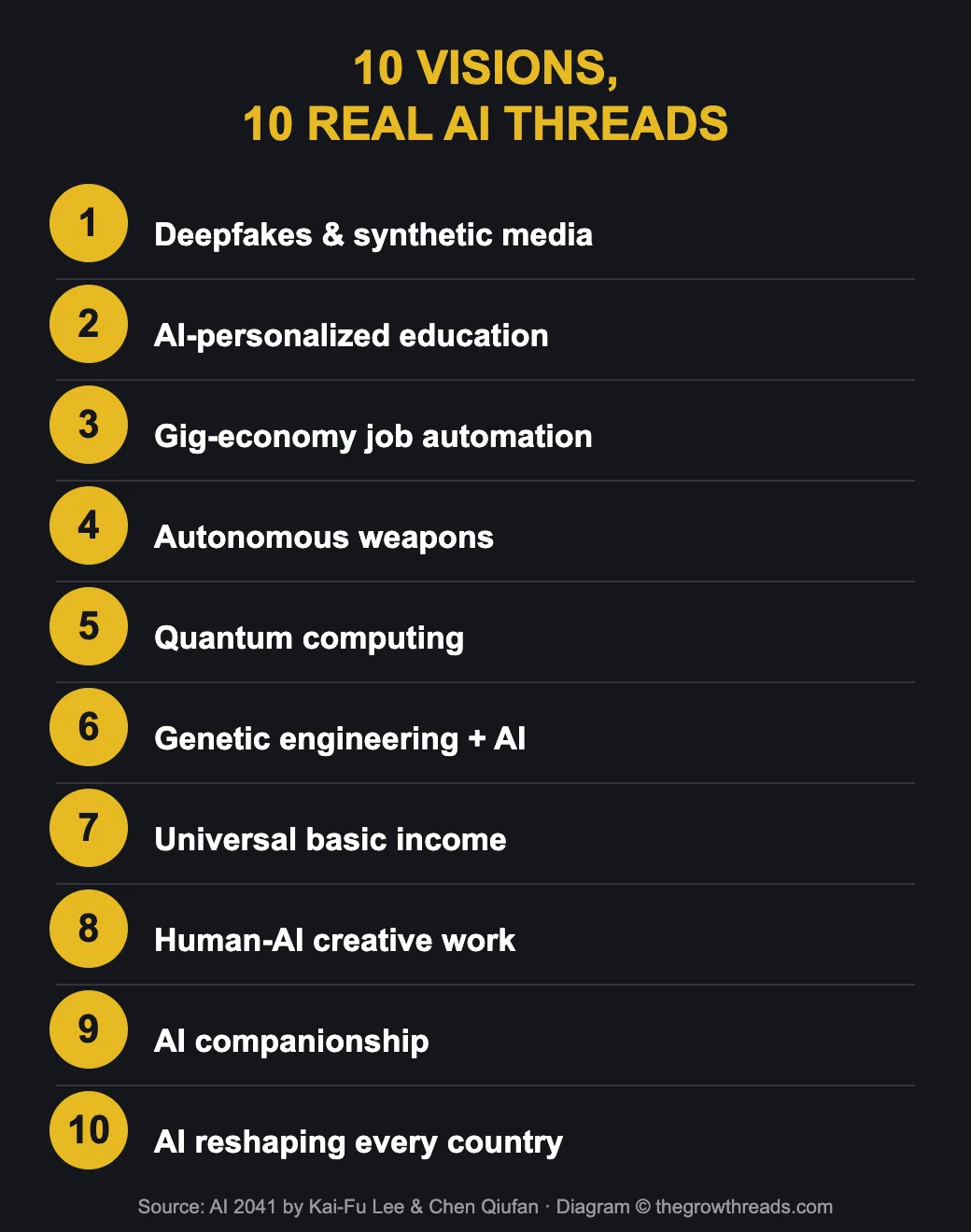
AI 2041 imagines the next twenty years of artificial intelligence twice — once as a story, once as an explanation. Novelist Chen Qiufan writes ten speculative-fiction chapters set in the year 2041, each following ordinary people in a different country as they collide with a specific AI-driven technology: synthetic media, personalized education, automated gig work, autonomous weapons, quantum computing, genetic engineering, universal basic income, and creative machines among them. After every story, AI researcher and investor Kai-Fu Lee steps in with a short analytical essay that separates what is already real from what is still speculative, and offers his own best estimate of when — or whether — each technology actually arrives. The result reads less like a forecast and more like a structured argument: humanity’s AI future is not fixed, and the choices made in the next two decades will decide whether these stories land closer to utopia or caution.
Key takeaways
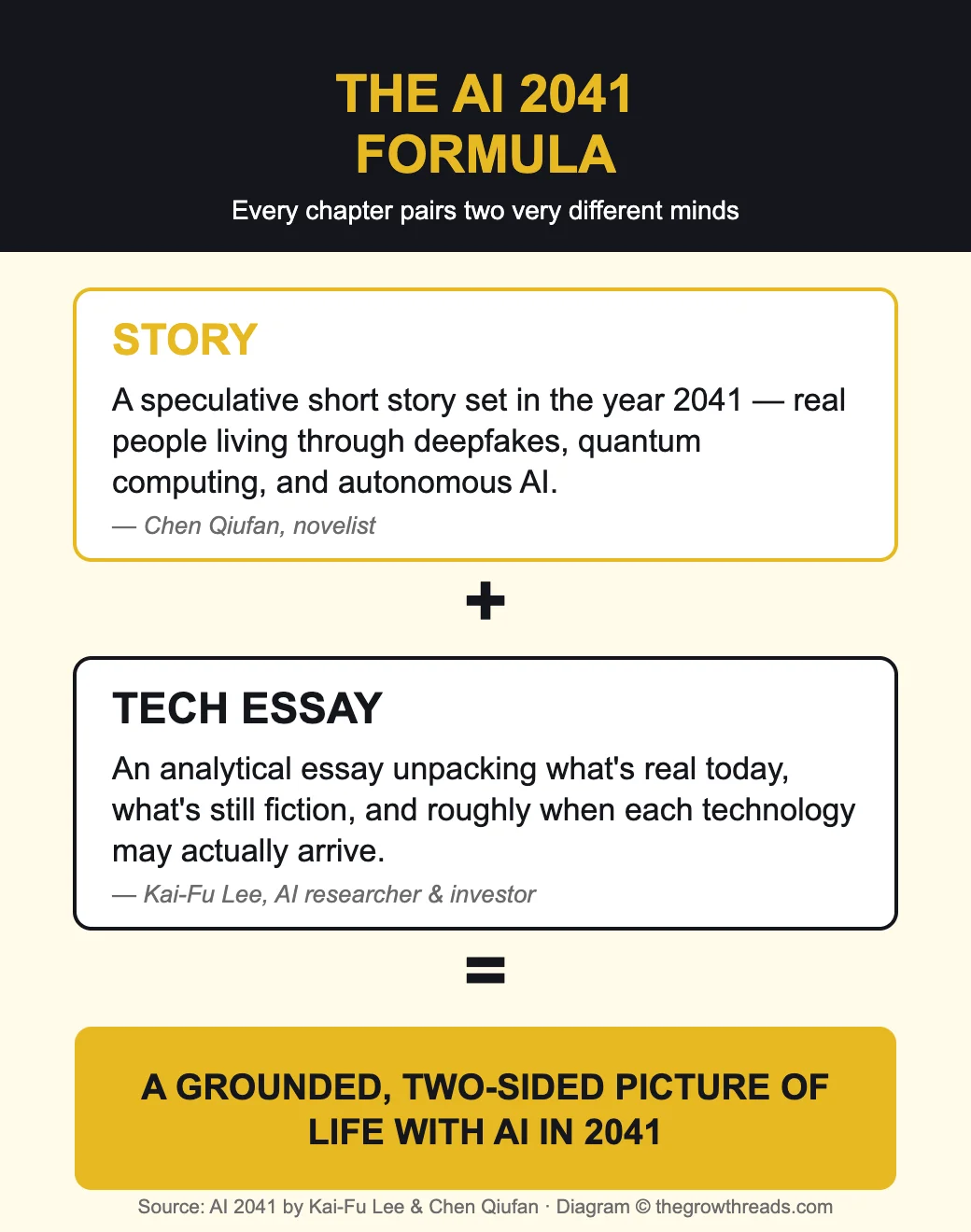
- Two authors, two formats: each of the book’s ten chapters pairs a Chen Qiufan short story with a Kai-Fu Lee technical essay — fiction for feeling, analysis for grounding.
- Genuinely global: the stories are set across multiple countries and cultures, not just the US-China axis Lee wrote about in his earlier work.
- Synthetic media arrives first: deepfakes and AI-generated content are treated as an imminent, already-unfolding problem rather than a distant risk.
- Education gets personalized: AI tutors and adaptive learning systems reshape how the book imagines childhood and skill-building by 2041.
- Work becomes more automated and more gig-based: several stories follow characters navigating algorithm-managed labor, strengthening the case for stronger safety nets.
- Autonomous weapons and quantum computing are taken seriously: Lee doesn’t wave these away as science fiction — he lays out realistic-sounding paths and real risks.
- Genetic engineering meets AI: machine learning accelerates biology in ways that raise new questions about health, enhancement, and inequality.
- Creativity becomes collaborative: human-AI co-creation in art, writing, and design is presented as a genuine addition to human capability, not a replacement for it.
- Every story gets a reality check: Lee’s essays consistently ask “how close are we, really?” — the book’s most original contribution.
- The throughline is optimistic but conditional: the future these stories describe is achievable, but only if humans stay deliberately involved in steering it.
What is AI 2041 about?
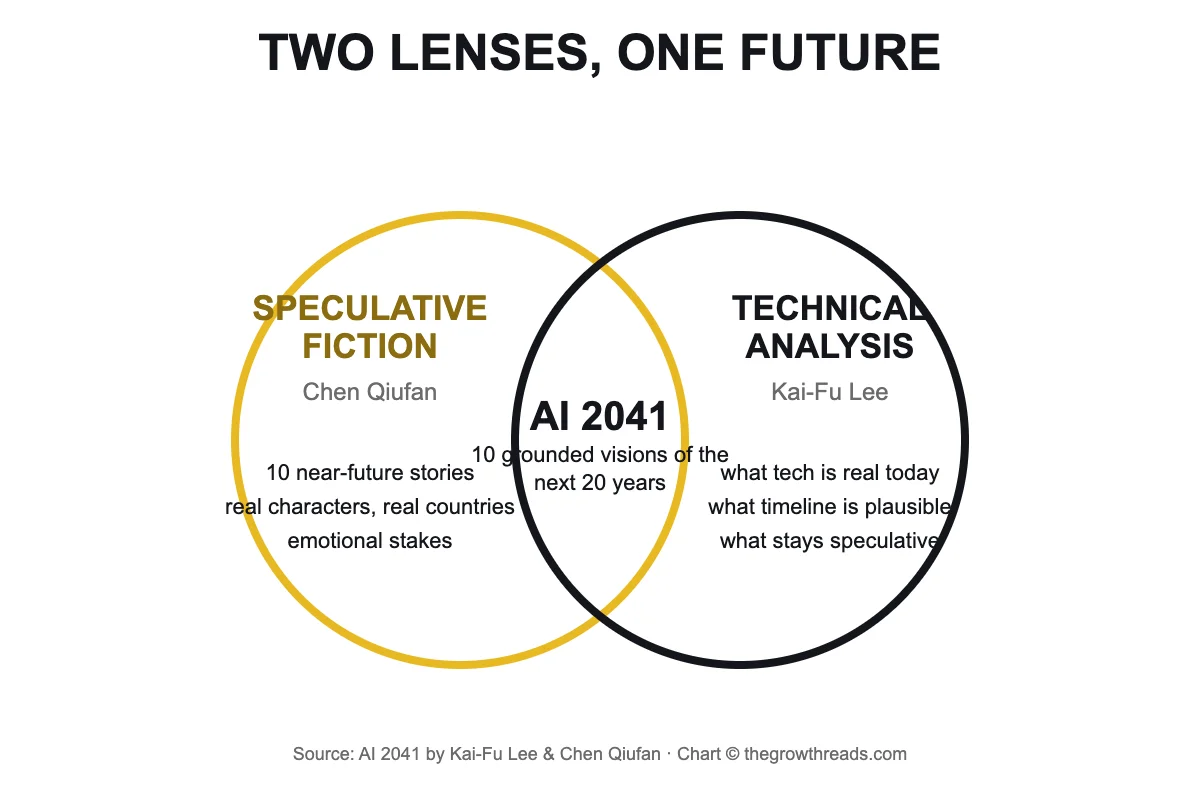
AI 2041 pairs ten near-future short stories by novelist Chen Qiufan with ten analytical essays by AI researcher Kai-Fu Lee, using fiction set in the year 2041 to dramatize real AI trends — from deepfakes to quantum computing — while Lee’s essays explain what’s already true, what’s plausible, and what’s still imagined.
About the author
Kai-Fu Lee is a computer scientist, AI researcher, and venture capitalist who led AI labs at Apple, Microsoft, and Google before founding Sinovation Ventures. He holds a PhD in computer science from Carnegie Mellon and previously wrote the bestselling AI Superpowers, which examined the US-China AI competition. In AI 2041, Lee widens that lens from geopolitics to a genuinely global twenty-year forecast, grounding each of the book’s speculative stories in his own read on real technical trajectories. Explore all Chen Qiufan book summaries →
Chen Qiufan is an award-winning Chinese science-fiction author, best known internationally for his novel Waste Tide. His fiction blends technological speculation with social commentary, often focusing on how new technology reshapes ordinary lives in unequal ways. In AI 2041, Qiufan supplies the human, narrative half of every chapter — characters and settings vivid enough to make Lee’s technical forecasts feel lived-in rather than abstract.
Key concepts at a glance
| Concept | What it means | Use it when |
|---|---|---|
| Story + essay pairing | Each chapter is fiction first, technical analysis second | You want both an emotional and factual take on one technology |
| Deepfakes / synthetic media | AI-generated video, audio, and text realistic enough to deceive | Evaluating trust, misinformation, or content authenticity |
| AI-personalized education | Adaptive tutoring systems that tailor pace and content per student | Thinking about the future of schools or corporate training |
| Gig-economy automation | Algorithms increasingly manage, price, and allocate human labor | Assessing job security or the case for stronger safety nets |
| Autonomous weapons | AI systems that can select or engage targets with reduced human control | Discussing AI governance, ethics, or military policy |
| Quantum computing | A fundamentally different computing paradigm that could accelerate AI itself | Looking past today’s deep learning toward the next technical leap |
| Genetic engineering + AI | Machine learning applied to biology, drug design, and human enhancement | Thinking about health, longevity, or bioethics debates |
| Universal basic income | A guaranteed income floor proposed as a response to AI-driven job loss | Weighing policy responses to automation |
| Human-AI co-creation | AI as a creative collaborator in art, writing, music, and design | Exploring how AI changes creative and knowledge work |
Part 1: The hybrid format — why two authors, not one
AI 2041’s structure is its core argument. Lee has said plainly that non-fiction alone struggles to make a twenty-year AI forecast feel real — readers nod along to statistics but rarely feel them. Fiction alone has the opposite problem: it can feel real without being true. So the book alternates: Qiufan opens each chapter with a story that puts a recognizable, specific human being inside a specific AI-shaped future, then Lee closes the loop with an essay that names the actual technology behind the story, states plainly what already exists, what’s a reasonable extrapolation, and what’s still speculative dramatization.
This isn’t a gimmick. It solves a real problem with most AI forecasting: predictions are usually either too dry to internalize or too speculative to trust. By fact-checking his own co-author’s fiction, Lee builds a rare kind of credibility — the book effectively grades its own imagination, chapter by chapter.
TGR Note: If Lee’s earlier book AI Superpowers convinced you AI progress was mostly a US-China race, AI 2041 is worth reading as his own course-correction — the frame widens from geopolitics to twenty near-future scenarios spread across the whole world.
Part 2: The near-term visions — media, education, and work
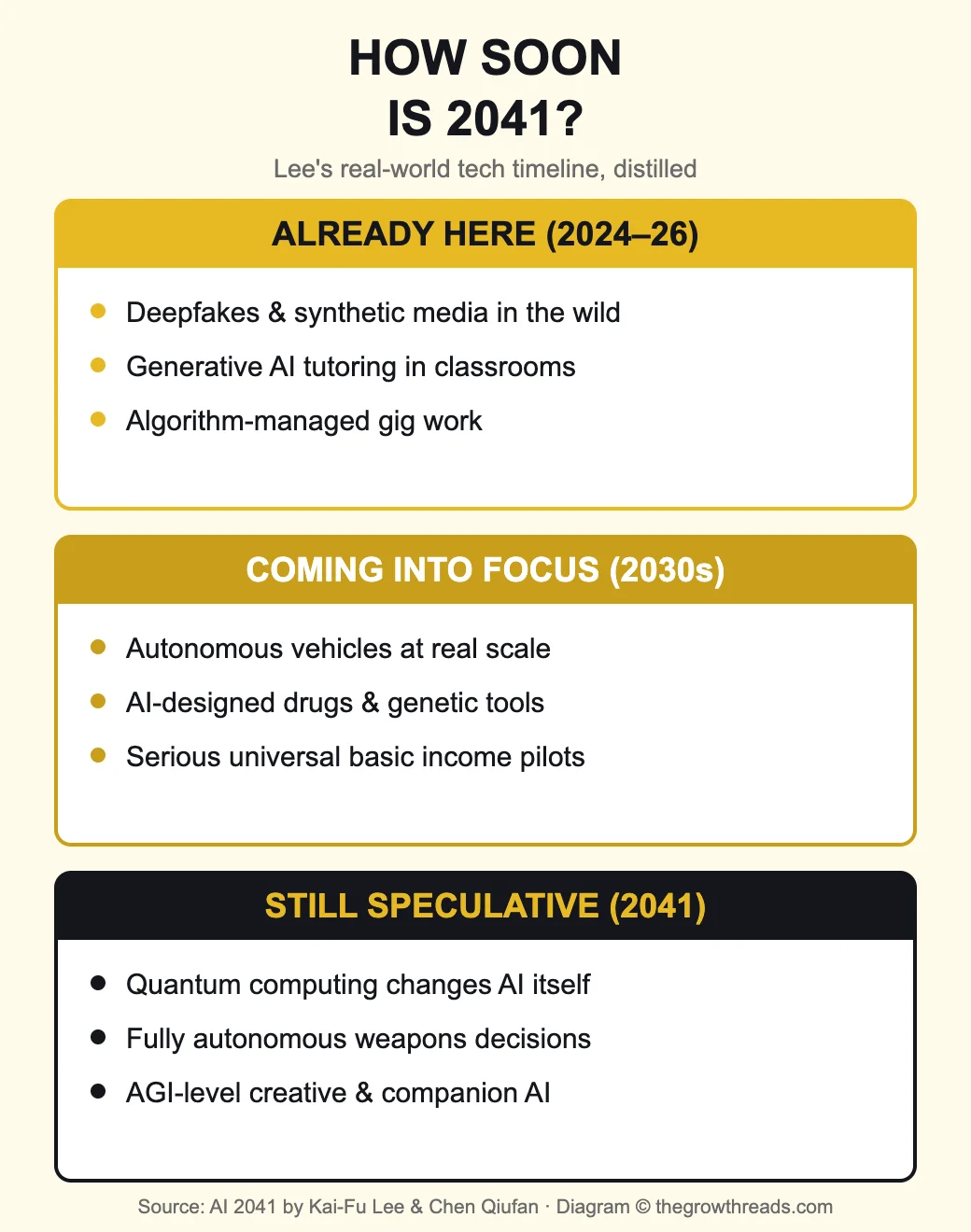
The book’s earliest-arriving predictions cluster around information, learning, and labor — three areas where the underlying AI (large-scale pattern recognition and generative models) was already mature well before 2041. The synthetic-media chapter is the book’s most unsettling because it requires the least imagination: AI-generated video, audio, and text realistic enough to fool ordinary scrutiny are framed not as a future risk but as a present one, with Lee’s essay walking through detection arms races and the incentives that make deepfakes hard to fully contain.
The education chapter takes a more hopeful turn, imagining AI tutors that adapt pace, content, and even teaching style to an individual learner — personalization at a scale no human teacher could match alone. Lee is careful to separate what adaptive-learning software already does today from the more ambitious, still-unproven claim that AI tutoring can replace the social and motivational role of human teachers.
Work is the third near-term thread. Multiple stories follow characters whose income depends on algorithm-managed gig platforms — a plausible extrapolation of already-existing systems, extended twenty years forward. Lee’s essays here are the book’s most policy-flavored, laying out why he sees stronger safety nets, and eventually something like universal basic income, as a near-inevitable companion to widespread automation rather than a fringe idea.
TGR Note: The synthetic-media and autonomous-systems chapters pair well with Human Compatible, which goes deeper on why controllable, human-aligned AI is harder to build than it looks — AI 2041 shows the stakes in story form; Human Compatible shows the technical fix Stuart Russell proposes.
Part 3: The harder cases — autonomous weapons, quantum computing, and genetics
The book’s middle stretch is its most sobering. One story follows the logic of autonomous weapons systems to an uncomfortable conclusion, and Lee’s essay doesn’t soften it — he treats reduced human control over lethal decisions as a real governance failure mode worth taking seriously now, not a distant hypothetical. It’s the clearest example in the book of fiction and analysis agreeing that a technology’s trajectory is genuinely worrying rather than merely dramatic.
Quantum computing gets a different treatment: less moral urgency, more raw technical uncertainty. The relevant story imagines a world where quantum breakthroughs supercharge AI itself, and Lee’s essay is refreshingly honest about how far current quantum computing is from that scenario — useful, since quantum computing is one of the most hyped and least understood technologies in the book’s ten visions.
The genetic-engineering chapter connects AI to biology: machine learning accelerating drug discovery, diagnostics, and — more uncomfortably — human enhancement. Lee’s essay draws a clear line between AI-assisted medicine (already delivering real results) and AI-assisted genetic enhancement (still mostly speculative, and freighted with inequality concerns the book doesn’t shy away from).
TGR Note: For readers who want the long-horizon, worst-case version of the autonomous-systems and control questions AI 2041 only dramatizes in one chapter, Superintelligence is the natural next read — Nick Bostrom’s book is far less optimistic, and reading both back-to-back is a useful calibration exercise.
Part 4: The long view — a world remade, on purpose
The book’s final stretch zooms out from individual technologies to the cumulative picture: a 2041 where creative work is routinely human-AI collaborative, where some form of guaranteed income has become politically normal in at least parts of the world, and where the countries and communities that adapted deliberately — investing in education, safety nets, and governance alongside the technology itself — end up meaningfully better off than those that didn’t.
What keeps this from reading as naive is Lee’s own twenty-year framework, built from decades inside AI research and venture investing: deep learning’s core capabilities were already largely proven by the early 2020s, meaning most of what AI 2041 imagines isn’t a bet on new breakthroughs so much as a bet on deployment, scale, and integration — new capabilities from research labs increasingly common in daily life, one implementation cycle at a time. The genuinely uncertain variables aren’t primarily technical; they’re the human choices around policy, education, and governance that determine whether that deployment goes well.
The book’s closing argument is deliberately un-cynical: none of its ten futures are locked in. Every story could tip toward its more cautionary version or its more hopeful one, and the difference is mostly made by decisions still being made today — which is the entire reason Lee and Qiufan chose fiction paired with fact instead of a straight forecast.
TGR Note: AI 2041’s closing case — that outcomes depend on deliberate human choices, not fixed technological momentum — is worth reading alongside our full best AI books guide, where several other authors converge on the same conclusion from very different angles.
Who is AI 2041 best for — and who should read something else first?
AI 2041 is best for readers who want AI’s next twenty years made vivid and specific rather than abstract — tech-curious generalists, educators, policy-minded readers, and science-fiction fans who like their speculation fact-checked. Its hybrid format also makes it an unusually good entry point for readers newer to AI, since every story translates into plain-English analysis a few pages later.
If you want pure, rigorous non-fiction without the story wrapper, start with Human Compatible instead. If you want the darker, longer-horizon version of the control questions AI 2041 only touches on, Superintelligence is the better next step. And if you’re specifically interested in Lee’s original US-China AI competition argument, his earlier AI Superpowers is the direct predecessor to this book.
Questions to reflect on
- Which of the book’s ten near-future scenarios feels closest to already happening in your own life or work?
- Where do you personally draw the line between AI you’d welcome and AI you’d resist — and why?
- If synthetic media becomes as common as the book predicts, what would actually restore your trust in what you see and hear online?
- Which of Lee’s “still speculative” technologies do you think will arrive sooner than he expects — and which later?
- What’s one deliberate choice — personal, organizational, or civic — you could make now that would nudge your own 2041 toward the book’s more hopeful outcomes?
🔥 Ready to see your own next twenty years more clearly?
Grab AI 2041 and get both the story and the science, chapter by chapter.
How to apply AI 2041 (7-day plan)
- Day 1: Read the first story-essay pair (synthetic media) and write down one way you already can’t fully trust digital content.
- Day 2: Audit one app or platform you use daily for how much of its output is already AI-personalized.
- Day 3: Read the education-focused chapter and consider how you’d redesign one course or training program around an AI tutor.
- Day 4: Read the autonomous-weapons or quantum-computing essay and note one governance question you think deserves more public attention.
- Day 5: List three tasks in your own work where human-AI collaboration could genuinely improve the outcome, not just the speed.
- Day 6: Discuss one of the book’s ten scenarios with a colleague or friend and compare which parts you each find more utopian versus cautionary.
- Day 7: Write your own one-paragraph ‘2041 essay’ — the realistic, fact-checked version of your own field twenty years from now.
Frequently asked questions
Do I need to have read AI Superpowers first?
No. AI 2041 stands on its own and doesn’t assume you’ve read Kai-Fu Lee’s earlier book. AI Superpowers focused specifically on the US-China AI competition; AI 2041 is a broader, more global twenty-year forecast told partly through fiction. Readers who enjoyed AI Superpowers will recognize Lee’s analytical voice in the essay halves of each chapter, but no prior context is required to follow the arguments here.
Is this science fiction or a business book?
Both, deliberately. Each chapter opens with a short story by novelist Chen Qiufan, then closes with a non-fiction analytical essay by Kai-Fu Lee that explains the real technology behind the story. Readers who want pure fiction can read just the stories; readers who want pure analysis can read just the essays — but the book’s real value comes from reading both halves of each chapter together.
How accurate are the book’s predictions likely to be?
No twenty-year technology forecast can be fully accurate, and the authors don’t claim otherwise — Lee’s essays explicitly flag which predictions are near-certain extrapolations of existing technology versus more speculative leaps. The book’s honesty about its own uncertainty is part of its credibility; some individual timelines will likely prove too optimistic or too cautious, but the underlying technical trends it identifies are well-supported by AI research as of this writing.
Is AI 2041 too technical for a general reader?
No — it’s written to be accessible. The fiction chapters require no technical background at all, and Lee’s essays are written in plain, non-jargon-heavy language aimed at general readers, not AI specialists. If anything, the story-first structure makes the technical concepts easier to absorb than a standard non-fiction AI book would.
Which chapter is the best starting point if I only read one?
The synthetic-media chapter (on deepfakes) is the most immediately relevant, since it covers a technology already affecting daily life rather than a more distant possibility. It’s also a good showcase of the book’s format at its best — the fiction is unsettling in exactly the way the accompanying essay explains and justifies.
Does the book take a side on whether AI’s impact will be good or bad?
It deliberately avoids a single verdict. Some stories lean utopian, others cautionary, and Lee’s essays generally present AI’s impact as genuinely contingent on human choices around policy, education, and governance rather than predetermined in either direction. The book’s stance is closer to “the outcome is still ours to shape” than either techno-optimism or doom.
How is this different from other “AI in the future” books?
Most AI forecasting books are either straight non-fiction or straight speculative fiction. AI 2041’s hybrid format — a story followed immediately by a fact-check of that same story — is genuinely unusual, and it’s what lets the book cover ten very different technologies (from deepfakes to quantum computing) without feeling like a dry survey or an ungrounded thought experiment.
Related summaries
- AI Superpowers by Kai-Fu Lee — the direct predecessor, focused on the US-China AI race.
- Human Compatible by Stuart Russell — the technical case for AI that stays under human control.
- Superintelligence by Nick Bostrom — a darker, longer-horizon look at the same control questions.
- Best AI Books guide — our full ranked list of the best AI books to read next.
How we analyze books: we read the full text, cross-check factual and technical claims against primary sources and expert commentary, and focus our reviews on practical, real-world application rather than summary alone. Read our full methodology.
Related Technology Summaries
Deep Medicine Summary & Review: How AI Could Give Doctors Back Their Time
Human Compatible Summary & Review: Building AI That Stays on Our Side
Novacene Summary & Review: Why AI Might Save Earth, Not Destroy It
The Age of AI Summary & Review: A New Philosophical Rupture
The Age of Spiritual Machines Summary & Review: Kurzweil’s 1999 Blueprint for the AI Age