

★★★★★½ 4.6/5 — A rigorous, refreshingly calm economist’s answer to a debate usually run on anecdotes.
Best for: Readers who want the underlying economics of the automation-and-jobs debate, not just examples of robots taking jobs.
Reading time: ~7 hrs to read the book · ~12 min for this guide.
Difficulty to apply: Moderate — this is a framework for thinking, not a checklist, though the 7-day plan below turns it into concrete steps.
A World Without Work in one minute
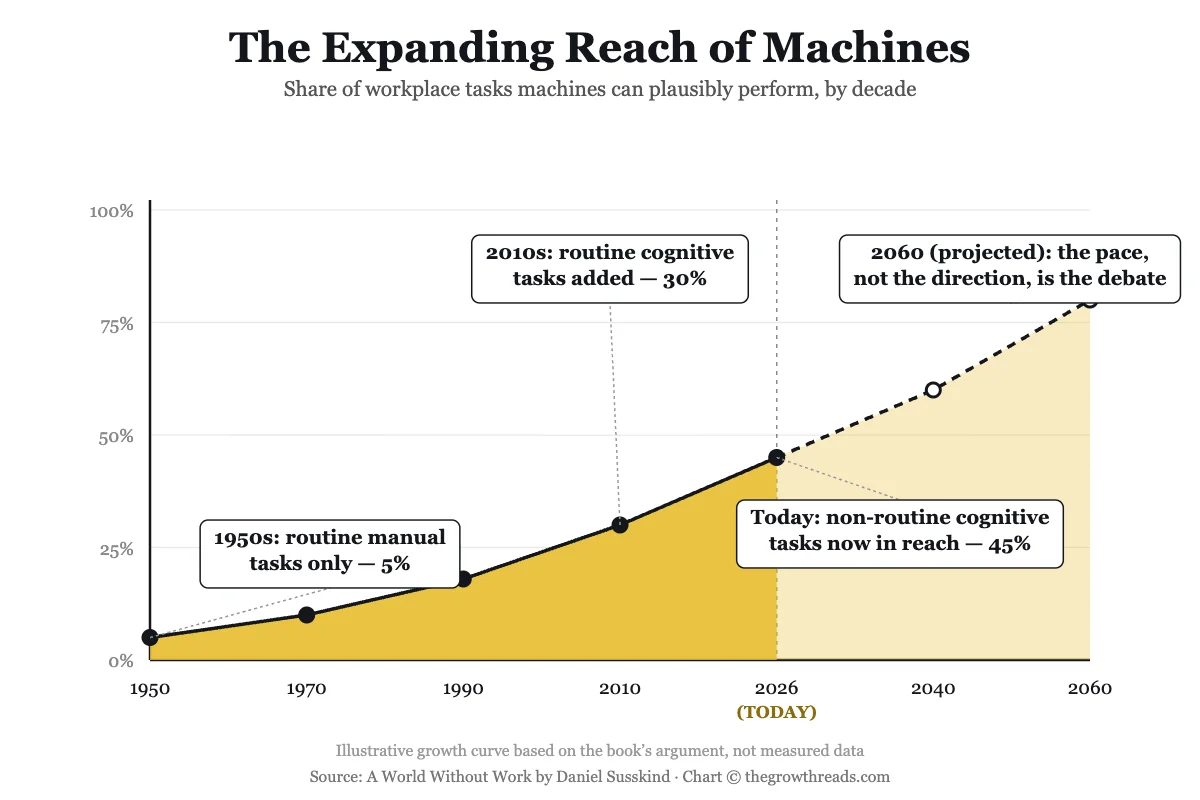
Machines do not need to think like us to take our jobs — they just need to find a different way to finish the task. That is the reframe at the heart of Daniel Susskind’s A World Without Work. For two centuries, economists have reassured worried workers with a simple pattern: automation destroys some jobs but creates new, better ones, so employment always recovers. Susskind, an Oxford economist, does not dismiss that pattern — he shows why it held for so long, and then makes a careful, non-alarmist case that it may not hold indefinitely as artificial intelligence starts encroaching on non-routine, cognitive tasks that used to be uniquely human territory. His conclusion is not doom. It is a call for a more active, deliberate policy response — before the shift, not after it.
Key takeaways
- Task encroachment, not job destruction, is the real mechanism: machines do not take whole jobs at once — they take individual tasks inside a job, one at a time, until little is left for the human.
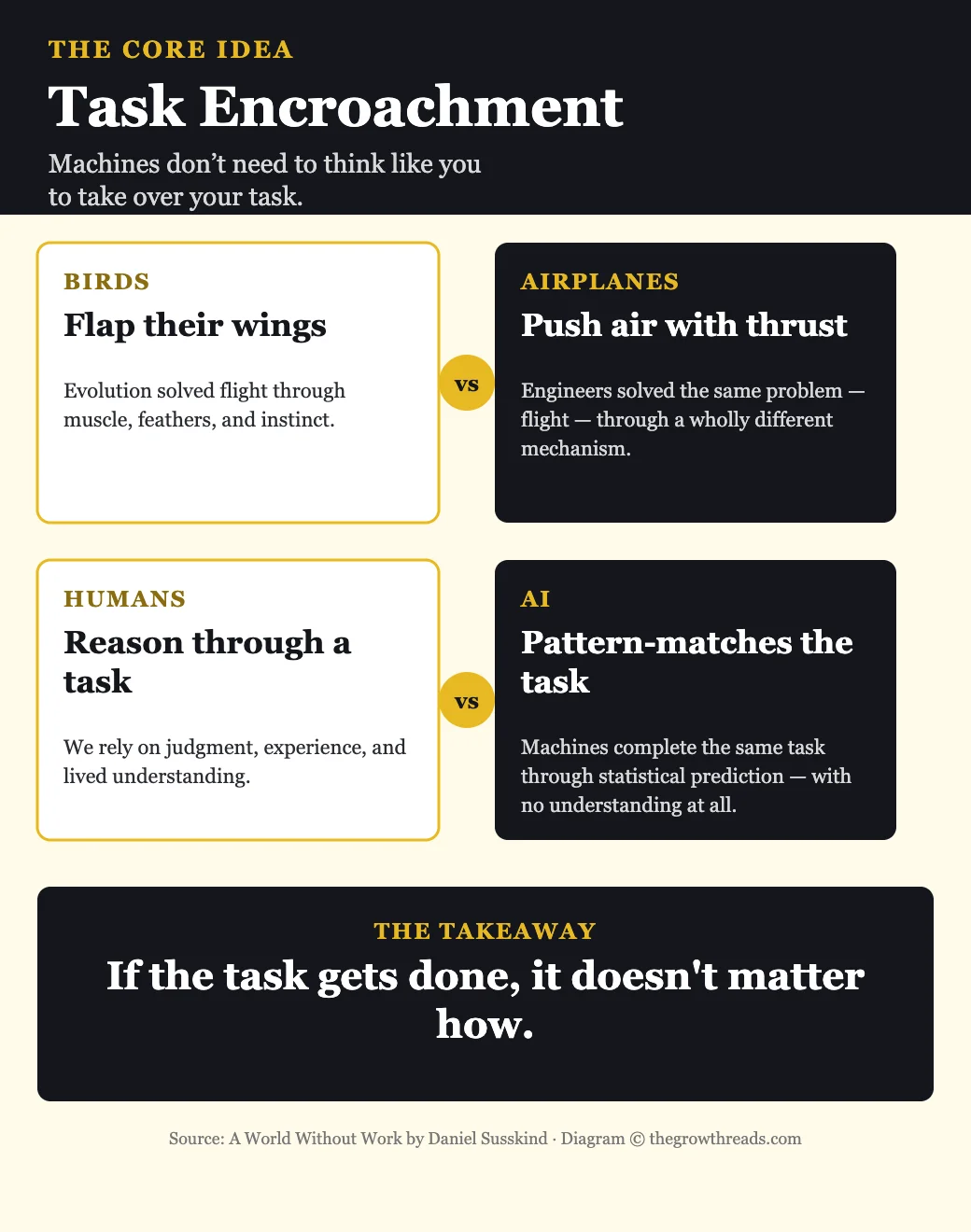
- The ant-and-airplane principle: airplanes do not fly by flapping wings like birds; they solve the same problem — flight — through a completely different mechanism. AI does the same with cognitive tasks.
- The old reassurance is a 200-year pattern, not a law of economics: it has held so far, but Susskind argues we should not simply assume it extrapolates forward forever.
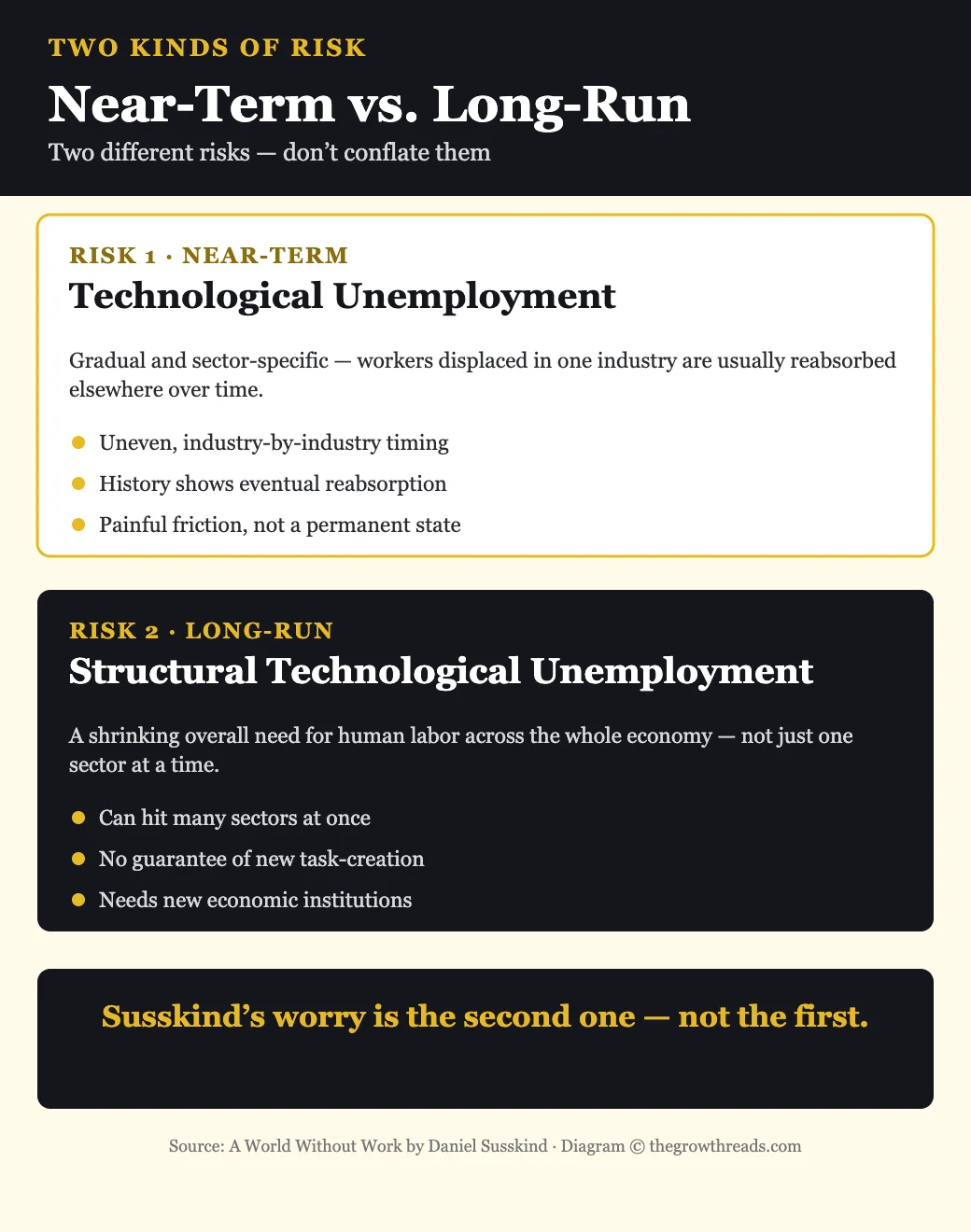
- Two separate risks exist, and conflating them causes bad predictions: near-term technological unemployment (gradual, sector-specific) and long-run structural technological unemployment (a shrinking overall need for human labor).
- AI is increasingly capable in the “safe zone”: non-routine cognitive work — judgment, pattern recognition, even some creative tasks — is no longer automatically off-limits to machines.
- Capital may capture more of the economic pie: if machines do more of the work, more income can flow to whoever owns the machines rather than to wage-earners — an inequality risk as much as an unemployment risk.
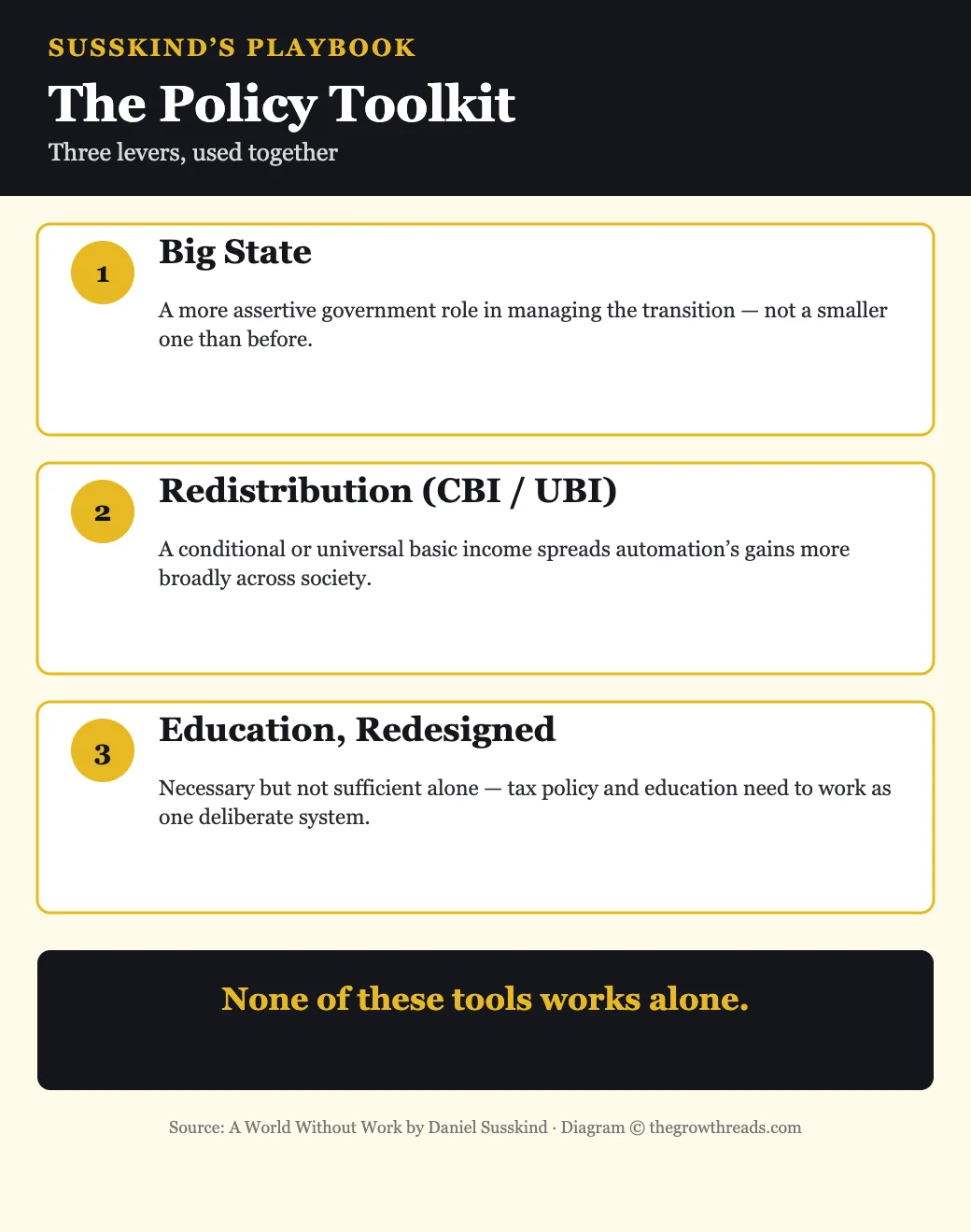
- Education alone cannot solve this: retraining is necessary, but Susskind calls the idea that education alone will keep pace with encroaching machines a comforting oversimplification.
- A more assertive “Big State” is likely needed: not a smaller government managing a shrinking role, but a more active one managing a genuine economic transition.
- Basic income is one tool among several: conditional or universal basic income can redistribute automation’s gains, but Susskind treats it as part of a toolkit, not a silver bullet.
- Meaning may need to be decoupled from paid employment: if traditional full-time work organizes less of life for fewer people, society needs new sources of purpose and structure too.
What is A World Without Work about?
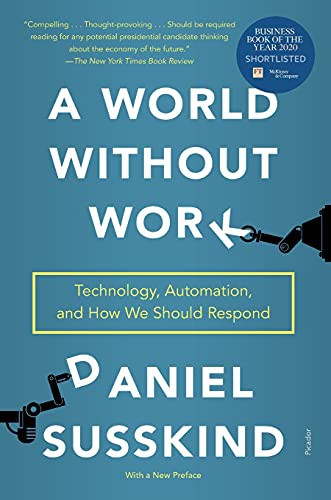
A World Without Work argues that AI threatens jobs not by matching human intelligence, but by completing our tasks through different means entirely. Oxford economist Daniel Susskind traces automation’s history, distinguishes near-term disruption from long-run structural risk, and proposes a bigger state role, redistribution, and rethought education to manage a future with far less paid work.
About the author
Daniel Susskind is an economist and Fellow at King’s College London, and was previously a Fellow of Balliol College, Oxford, where he taught economics for a decade. He has also worked inside the UK government, including in the Prime Minister’s Strategy Unit, giving his writing on policy an unusually practical edge for an academic economist. Explore all Daniel Susskind book summaries →
Before this book, Susskind co-authored The Future of the Professions with his father, legal scholar Richard Susskind, examining how technology is reshaping expert work in law, medicine, and education. A World Without Work extends that inquiry to the economy as a whole, and was shortlisted for the *Financial Times* & McKinsey Business Book of the Year Award. Susskind writes as an economist first — building his argument on labor-market history and formal reasoning about tasks, not just case studies.
Key concepts at a glance
| Concept | What it means | Use it when |
|---|---|---|
| Task encroachment | Machines take over individual tasks inside a job, not the whole job at once | Assessing how exposed a specific role really is |
| The ant-and-airplane principle | A machine can finish a task through a completely different mechanism than a human would use | Explaining why “AI isn’t really intelligent” misses the point |
| Lump of labor fallacy | The mistaken idea that there is a fixed amount of work, so automation must permanently reduce total jobs | Evaluating knee-jerk claims that automation always destroys net jobs |
| Technological unemployment (near-term) | Gradual, sector-by-sector job displacement with eventual reabsorption elsewhere | Thinking about disruption over the next 5–10 years |
| Structural technological unemployment (long-run) | A shrinking overall need for human labor across the whole economy | Thinking about multi-decade, economy-wide shifts |
| Big State | A more assertive government role actively managing the transition, not just insuring against its effects | Evaluating what policy response the book actually calls for |
| Conditional/Universal Basic Income | Regular payments to redistribute the gains from automation more broadly | Comparing redistribution proposals against each other |
| The purpose problem | Work provides identity and structure beyond income; losing it needs a separate solution | Thinking beyond the economics to meaning and daily life |
Part 1: Why the Old Reassurance May Not Hold Forever
For decades, the standard answer to automation anxiety has been that machines can only follow rules, while humans bring judgment, creativity, and common sense — so new tasks will always open up for people even as old ones disappear. Susskind’s central challenge is that this reassurance quietly assumes machines must replicate human reasoning to replicate human output. They don’t. An airplane doesn’t fly by flapping wings like a bird, yet it outflies every bird alive — a different route to the same result. Machine learning systems are increasingly the airplane of cognition: they don’t need to understand a task the way a person does, only to match or beat human performance on it through pattern recognition at a scale no person can match. As that “ant and the airplane” gap widens, it doesn’t matter how the machine gets there — only that it does.
TGR Note: Rise of the Robots by Martin Ford supplies the sector-by-sector evidence for this same task-encroachment pattern — trucking, retail, and manufacturing all show machines quietly absorbing tasks long before whole jobs vanish.
Part 2: Two Risks, Not One
Susskind separates automation anxiety into two distinct risks that are often blurred together. The near-term risk is structural: even where total employment holds up, individual tasks get peeled away, narrowing roles, eroding bargaining power, and pushing wages down for the humans left doing what remains. The long-run risk is more fundamental: if machines keep encroaching on task after task, there may eventually be too little economically valuable work left for everyone who wants it — not because of a single dramatic breakthrough, but because the frontier of what machines can do keeps quietly advancing. Treating these as one problem leads to the wrong policy response; treating them separately lets you match the fix to the actual risk.
TGR Note: Architects of Intelligence by Martin Ford takes you inside the labs pushing that frontier forward, in the AI researchers’ own words — useful grounding for judging how fast Susskind’s long-run risk might actually arrive.
Part 3: Capital, Inequality, and the Case for a Bigger State
If machines keep taking on more of the tasks that used to require paid workers, the economic value those tasks create doesn’t vanish — it flows increasingly to whoever owns the machines and the capital behind them, rather than to labor. Susskind argues this makes rising inequality a structural feature of continued automation, not a temporary side effect, and that today’s welfare systems — built for an era of near-full employment — are not equipped to handle it. His answer is a bigger, more active state: stronger redistribution, more generous income support, and in his more radical moments, direct efforts to spread the ownership of capital itself more broadly, not just tax and redistribute the income it generates.
TGR Note: Automating Inequality by Virginia Eubanks shows what happens when the state automates its own systems without first building this bigger, better-funded safety net — a cautionary companion to Susskind’s policy prescription.
Part 4: Where Humans Find Meaning If Work Isn’t the Answer
Susskind closes on a question policy alone can’t answer: if a paid job stops being the default source of income, structure, and identity for most people, where does meaning come from instead? He resists both easy despair and easy utopianism, pointing instead to the deliberate cultivation of purpose through community, care, learning, and creative or civic pursuits that were always valuable independent of a paycheck. The practical takeaway is that this shift shouldn’t be left to chance — individuals and societies that start building non-work sources of meaning and status now will handle a smaller-work future far better than those who wait for it to arrive.
TGR Note: Homo Deus by Yuval Noah Harari raises a similar “useless class” worry from a civilizational, historical angle rather than an economic one — read them together for the full range, from Susskind’s policy-grounded caution to Harari’s longer sweep of history.
Who is A World Without Work best for — and who should read something else first?
This book is best for readers who want the economics of automation explained clearly by someone who has spent two decades studying it professionally — policymakers, managers, students, and anyone who wants a level-headed framework for a debate that’s usually either breathless hype or dismissive denial. Susskind writes for a general audience; no economics background is required.
If you want the on-the-ground, sector-by-sector case for why robots and software are already displacing workers today, start with Rise of the Robots by Martin Ford instead — it’s more concrete and less theoretical. If you want the AI-industry insider’s view of what’s coming from the labs themselves, Architects of Intelligence by Martin Ford is the better entry point. If you’re more interested in how automation has already reshaped the welfare state and who it hurts first, Automating Inequality by Virginia Eubanks is a sharper, more human-centered companion. Readers who want the philosophical long view — what happens to human meaning and status once economic usefulness stops being the organizing principle of society — should pair this with Homo Deus by Yuval Noah Harari.
Questions to reflect on
- Which tasks in your own job are closest to being fully learnable by a machine, and which depend on judgment, context, or relationships that are hard to encode?
- Do you think the risk to your income is more about your job disappearing entirely, or about your bargaining power eroding as tasks are peeled away one by one?
- How would you personally answer the question “who am I, if not my job?” — and how much of your sense of purpose currently comes from paid work versus other sources?
- What’s one skill you could start building now that leans on judgment, care, or creativity rather than a well-defined, rule-based task?
- If a Big State response to automation (stronger safety net, more redistribution, public options) meant higher taxes, where would you personally draw the line?
How to apply A World Without Work (7-day plan)
- Day 1 — Audit your own tasks. List the 8-10 core tasks that make up your job. For each one, rate it on two axes: how well-defined the task is, and how much it depends on judgment, empathy, or context. Tasks that are well-defined and judgment-light are the ones exposed first.
- Day 2 — Separate the two risks. Ask honestly: is your near-term risk that a specific task gets automated and your role narrows and pays less, or is it a long-run risk that most of what you do eventually becomes learnable by a machine? Write down which one worries you more and why.
- Day 3 — Find your “ant and airplane” tasks. Identify one task in your work that you currently do the “human way” but that could plausibly be done a completely different, non-human way by a machine. Note what would have to change for that to happen at your organization.
- Day 4 — Build one judgment-heavy skill. Pick a skill that leans on relationship-building, ambiguous problem-solving, or taste rather than a defined procedure, and commit to one deliberate hour of practice this week.
- Day 5 — Check your safety net. Review your own financial buffer, insurance, and any retraining benefits available through your employer or government programs. Susskind’s “Big State” argument starts at the household level too — know what your actual cushion looks like today.
- Day 6 — Have the meaning conversation. Talk with a partner, friend, or mentor about where you’d find purpose and structure if paid work played a smaller role in your life. This is uncomfortable but clarifying — most people have never actually answered it.
- Day 7 — Take a stance on policy. Read one credible explainer each on universal basic income and on public-option job guarantees, then write two sentences on which toolkit you’d want your own country to prioritize first, and why.
Frequently asked questions
Is A World Without Work saying robots will take all our jobs?
No — Susskind is careful to distinguish between task automation and total job elimination. His argument is that machines don’t need to replace an entire job to disrupt it; they only need to take over enough individual tasks to shrink the role, reduce bargaining power, or eliminate the need for as many people doing it. Some jobs will disappear entirely over time, but the more immediate and widespread effect is narrower, lower-paid versions of jobs that still technically exist.
What is the “ant and the airplane” analogy about?
It’s Susskind’s response to the common reassurance that “machines can’t really think like us, so our jobs are safe.” His point is that this reassurance rests on a false assumption — that machines need to replicate human reasoning to replicate human output. An airplane doesn’t fly the way a bird does, flapping wings, yet it still flies, often better. Likewise, a machine doesn’t need to reason, understand, or have common sense the way a person does to still successfully complete the task a person’s job depends on.
Does the book recommend universal basic income?
Susskind treats UBI as one serious tool among several, not a silver bullet. He’s sympathetic to it as part of a “Big State” response but spends equal attention on alternatives and complements — stronger education and retraining systems, a “conditional basic income” tied to participation, and even a more radical idea of a state that redistributes capital ownership itself, not just income. The book’s real argument is that the scale of the response needs to be bigger than most current welfare systems, not that any single policy is the answer.
How is this book different from Rise of the Robots by Martin Ford?
Rise of the Robots is built from the ground up — sector-by-sector reporting on where automation is already displacing workers today, written by a technologist. A World Without Work is built top-down — a trained economist’s structural argument about why the traditional reassurances about automation don’t hold up, and what policy should do about it if they don’t. They make excellent companion reads: Ford shows the evidence on the ground, Susskind supplies the economic and policy framework to reason about it.
Is Daniel Susskind a credible source on this topic?
Yes. Susskind is an economist who has taught at Oxford and King’s College London, previously worked in the UK Prime Minister’s Strategy Unit, and co-authored The Future of the Professions with his father, Richard Susskind, before writing this book. He approaches automation as a career-long academic and policy specialty, not a topic he parachuted into.
Does the book address AI specifically, or just automation and robots in general?
Both — the book treats AI as the latest and most capable wave of a much longer automation story rather than a completely separate phenomenon. Because it was written before the recent generative-AI boom, it doesn’t discuss today’s large language models by name, but its core framework — task-level encroachment, the near-term versus long-run risk distinction, and the policy toolkit — applies directly to them and holds up well.
Is the book more optimistic or pessimistic about the future of work?
Neither, deliberately. Susskind avoids both utopian techno-optimism and doom-laden pessimism. His stance is that a world with much less traditional work is a plausible, even likely, outcome — and that this doesn’t have to be a catastrophe if society builds the economic and political structures (income distribution, meaning, and purpose beyond a job) to handle it well in advance rather than reactively.
Related summaries
- Rise of the Robots by Martin Ford — the on-the-ground case for automation’s threat to jobs today.
- Architects of Intelligence by Martin Ford — interviews with the AI researchers building the technology driving this shift.
- Automating Inequality by Virginia Eubanks — how automated systems already affect low-income Americans.
- Homo Deus by Yuval Noah Harari — the longer civilizational and philosophical view of a post-work world.
For more, see our full best AI and technology books guide.
About this summary: This review is an independent, original summary and analysis written by The Growth Reads. It is not affiliated with or endorsed by Daniel Susskind or his publishers. Quotes are limited and attributed; all other content is our own paraphrase and commentary, informed by the published book and the author’s public interviews and essays on this subject.
Related Technology Summaries
Power and Prediction Summary & Review: Redesigning Decisions, Not Just Predictions
The Attention Merchants Summary & Review: Reclaiming Your Focus
The Coming Wave Summary & Review: How to Contain AI Before It Contains Us
The Singularity Is Near Summary & Review: Why Kurzweil Thinks 2045 Changes Everything
Weapons of Math Destruction Summary & Review: How Algorithms Quietly Punish the Poor