

★★★★☆ 4.4/5 — the book that names the “digital poorhouse” hiding inside modern welfare systems.
Best for: caseworkers, policy advocates, technologists building public-sector tools, and anyone who wants to understand how automated decisions actually land on poor and working-class families.
Reading time: ~7 hrs for the full book · ~18 min for this summary.
Difficulty to apply: Moderate — the ideas are easy to grasp, but acting on them means engaging with local policy and institutions.
Automating Inequality in one minute
The tools that decide who gets welfare, whose children get investigated, and who gets housing aren’t neutral — they’re the newest chapter in a two-hundred-year American habit of treating poverty as a personal failing to be policed, rather than a condition to be addressed.
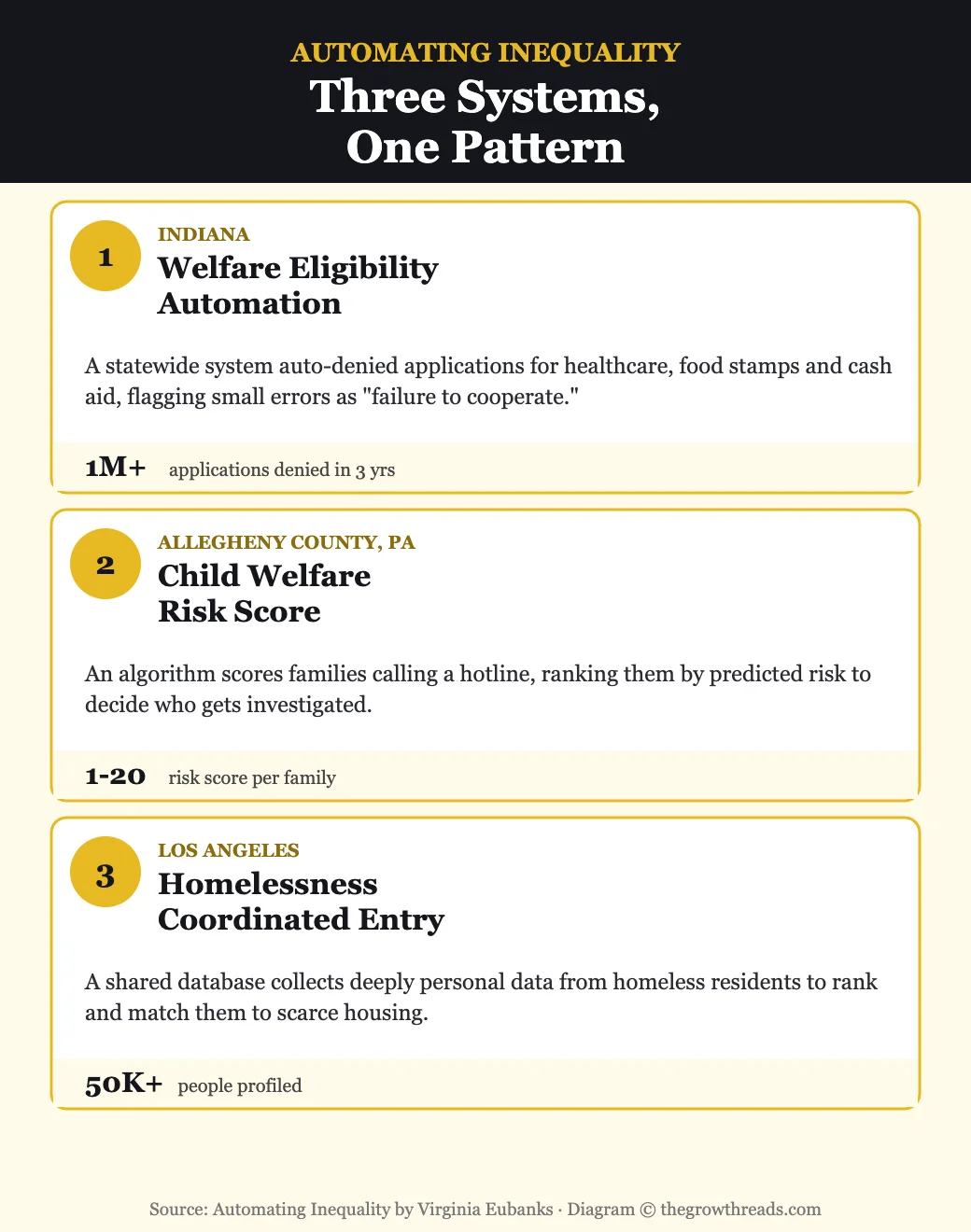
Political scientist Virginia Eubanks spent years embedded with caseworkers, applicants, and advocates in three places where algorithms now shape life-altering decisions for poor families: a statewide welfare-automation system in Indiana, a child-welfare risk-scoring tool in Allegheny County, Pennsylvania, and a homelessness-services database in Los Angeles. In each case, a system sold as an efficiency upgrade instead built what she calls a “digital poorhouse” — a tool that surveils, sorts, and often punishes the very people it claims to serve, while looking too objective to challenge.
Key takeaways
- Automation doesn’t remove bias — it launders it. A biased decision that comes out of software looks neutral, even when the data and design choices behind it are anything but.
- The poor are the testing ground. New surveillance and scoring technologies are piloted on populations with the least power to refuse them, then quietly expand outward.
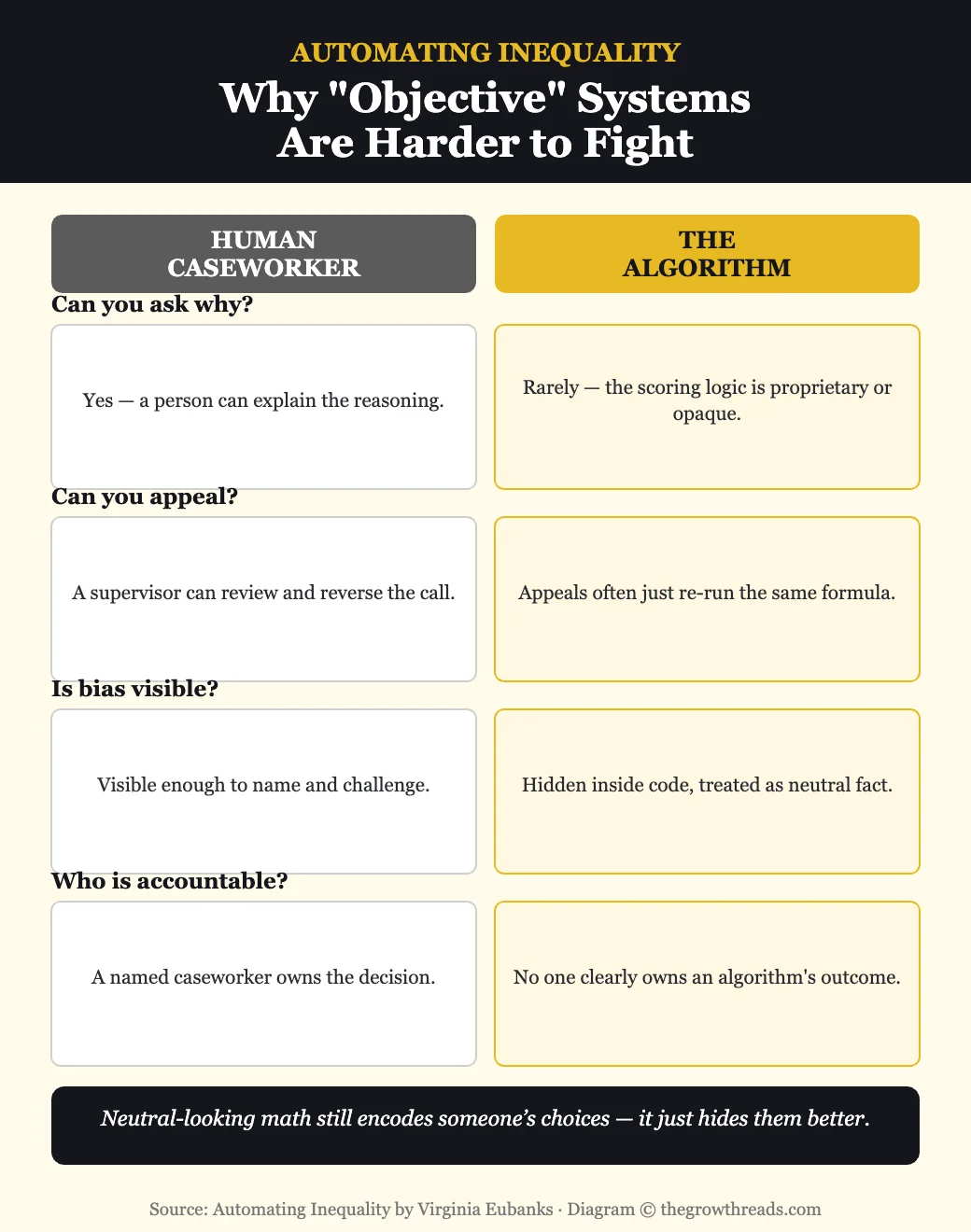
- “Objective” systems are harder to challenge than a person. You can ask a caseworker why; you usually can’t ask a scoring formula the same question.
- Small errors get treated as intentional fraud. Indiana’s system read a missed fax or an unanswered call as “failure to cooperate,” and canceled benefits outright.
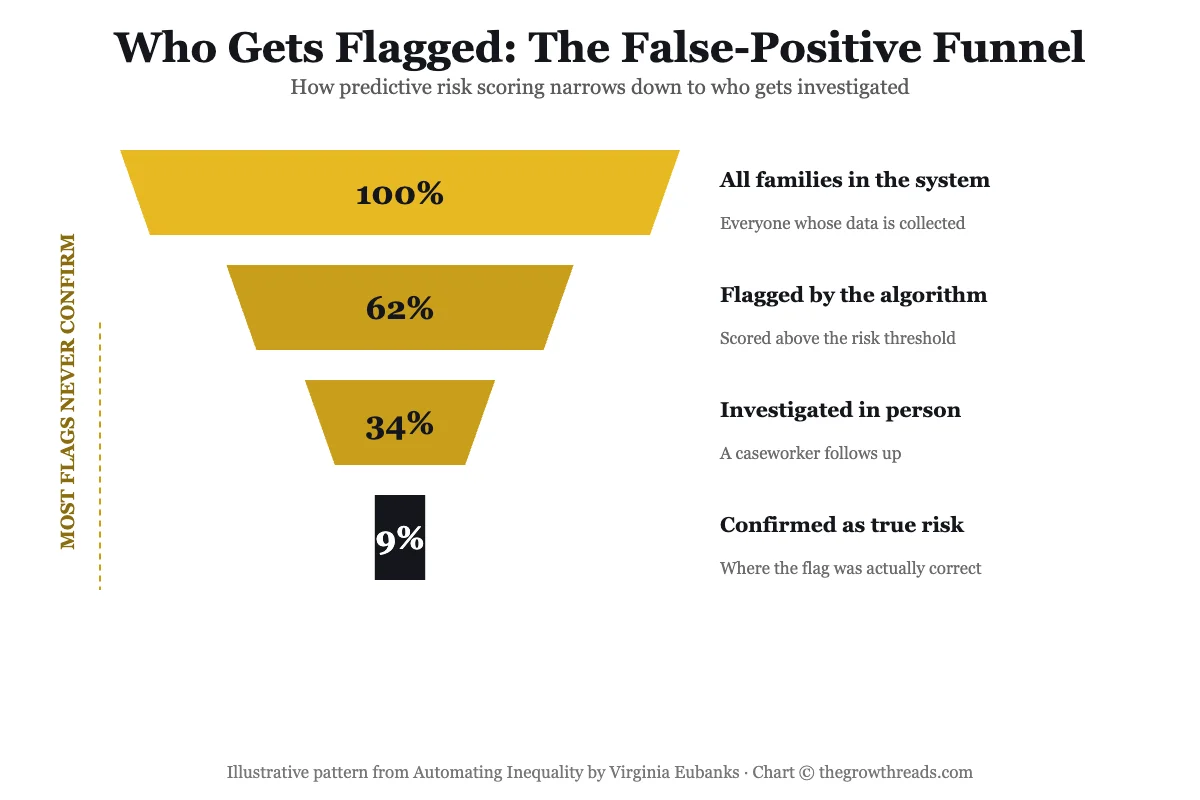
- Risk scores shift blame from institutions to individuals. Allegheny County’s tool scores families, not the under-resourced systems and stressors surrounding them.
- Data collection can become a precondition for aid. Los Angeles’s coordinated-entry system extracts more personal history from homeless applicants than most housed people would ever share for a bank loan.
- History rhymes. The 19th-century poorhouse, mid-century caseworker surveillance, and today’s algorithms all share one underlying assumption: poverty reflects individual character.
- Efficiency for institutions isn’t the same as dignity for people. A system can process cases faster and still make life measurably worse for the people inside it.
- Contesting an algorithm is procedurally different from contesting a person. Appeals often just re-run the same formula rather than genuinely reconsidering a case.
- Better tools start with the people they affect. Eubanks calls for participatory design and a “Hippocratic oath” for the people who build public-sector systems.
What is Automating Inequality about?
Automating Inequality investigates how automated eligibility systems, predictive risk-scoring tools, and shared case-management databases used in American welfare, child protection, and homelessness services disproportionately surveil and penalize poor people — continuing, in high-tech form, a centuries-old pattern of treating poverty as an individual failing rather than a structural condition.
About the author
Virginia Eubanks is a political scientist, investigative journalist, and Associate Professor of Political Science at the University at Albany, SUNY, where she researches technology and social policy. Before turning to writing and research full-time, she spent years in grassroots organizing alongside poor and working-class communities, work that shapes the on-the-ground, story-driven reporting style of Automating Inequality. Her investigative writing and essays have appeared in The New York Times Magazine, Harper’s Magazine, The Guardian, WIRED, and Scientific American. She is also the author of Digital Dead End and co-editor of Ain’t Gonna Let Nobody Turn Me Around, and her reporting has earned her recognition as one of the field’s most cited voices on algorithmic accountability in public services. Explore all Virginia Eubanks book summaries →
Key concepts at a glance
| Concept | What it means | Use it when |
|---|---|---|
| Digital poorhouse | The idea that automated systems recreate the surveillance and moral judgment of 19th-century poorhouses in digital form | You want shorthand for how tech can hide punitive policy behind a “helpful” interface |
| Automated eligibility system | Software that decides who qualifies for a benefit with minimal human review | Evaluating whether a public program’s technology helps or blocks access |
| Predictive risk model | A statistical tool that scores the likelihood of a future harmful event, such as child abuse | Assessing tools used to flag people for extra scrutiny |
| Coordinated entry | A shared database that ranks and matches vulnerable people, like homeless residents, to scarce services | Examining how much personal data a “helpful” system requires in exchange for aid |
| Technological objectivity | The false idea that a data-driven decision is automatically fairer than a human one | A system’s design is described as “neutral” or “unbiased” |
| Failure to cooperate | A catch-all administrative label used to deny benefits over minor procedural errors | Auditing how “noncompliance” gets defined inside a benefits system |
| Participatory design | Building systems with input from the people they’ll affect, not just the institutions deploying them | Proposing reforms to any public-sector algorithm |
Part 1: Indiana’s Automated Denial Machine
In 2006, Indiana signed a billion-dollar contract to automate its welfare eligibility system, shifting decisions about healthcare, food assistance, and cash aid from local caseworkers to a privately-run computer system and call centers. The stated goal was cutting fraud and speeding up processing. What happened instead, Eubanks documents, was a wave of wrongful denials at a scale rarely seen in American social policy.
The new system replaced caseworkers who knew their communities with a centralized, largely automated process. Applicants who once handed a missing document to someone local instead navigated call centers and mailed forms. A missed call, a late fax, or a paperwork mismatch — even one caused by the agency’s own error — could be logged as “failure to cooperate,” triggering automatic denial regardless of fault.
Eubanks follows several Indiana residents through the system, including a woman undergoing cancer treatment whose benefits were cut off after she was recorded as missing an appointment she had, in fact, attended. Appeals offered little relief: because denials were procedural rather than substantive, families often couldn’t get a plain-language explanation of what they’d allegedly done wrong.
Over roughly three years, the state denied more than a million applications for food stamps, Medicaid, and cash assistance. Investigations and lawsuits eventually forced Indiana to cancel the contract — but not before tens of thousands went without healthcare, food, or income in the gap.
Part 2: Scoring Families in Allegheny County
In Pittsburgh’s Allegheny County, Eubanks turns to a different tool: the Allegheny Family Screening Tool, a predictive model that helps decide which calls to the county’s child-abuse hotline warrant an in-person investigation. Every report pulls from a vast trove of county records — jail bookings, behavioral-health visits, welfare history — to generate a numerical risk score for the family.
The county’s stated purpose was reducing two kinds of error: missing a genuinely at-risk child, and investigating a family that poses no real danger. Eubanks doesn’t dispute the good intentions. Her concern is what the score quietly does: it launders subjective judgment about which risk factors matter into one seemingly objective number, drawn almost entirely from families who already use public services.
Families who can afford private therapy or private treatment stay largely invisible to the model, since that data was never captured by a public agency. The result, Eubanks argues, is a tool that looks neutral while systematically training its attention on poor families — mistaking “more visible to government data” for “more likely to harm a child.”
Caseworkers describe a complicated relationship with the score: some lean on it as cover for a hard call, others quietly override it. But few families ever learn a number was calculated about them, and fewer still have any real way to contest it.
Part 3: Los Angeles and the Price of “Coordinated” Help
The book’s third case study moves to Los Angeles County, where a coordinated-entry system addresses a real problem: far more people experiencing homelessness than available housing. Designers reasoned that if every agency shared one intake database, the region could rank people by vulnerability and match the most at-risk to scarce resources first.
In practice, that meant asking the county’s most vulnerable people deeply personal, sometimes traumatic questions — sexual history, mental-health crises, past arrests, survival strategies — for a spot on a waiting list that, for many, led nowhere for months or years. People experiencing homelessness disclosed more to get a shelter bed than most housed people disclose for a bank loan.
Because the database is shared across law enforcement, outreach workers, and service agencies, information given in a moment of crisis can follow someone indefinitely. Eubanks interviews unhoused Angelenos who describe an intake process that treats them as a risk to assess first, a person to help second.
The deepest irony is that coordinated entry was designed by people who genuinely wanted to help — yet it still reproduces a familiar pattern: extracting maximum information from people with minimum power to refuse, for aid that may never arrive.
Part 4: The Digital Poorhouse — A 200-Year Pattern
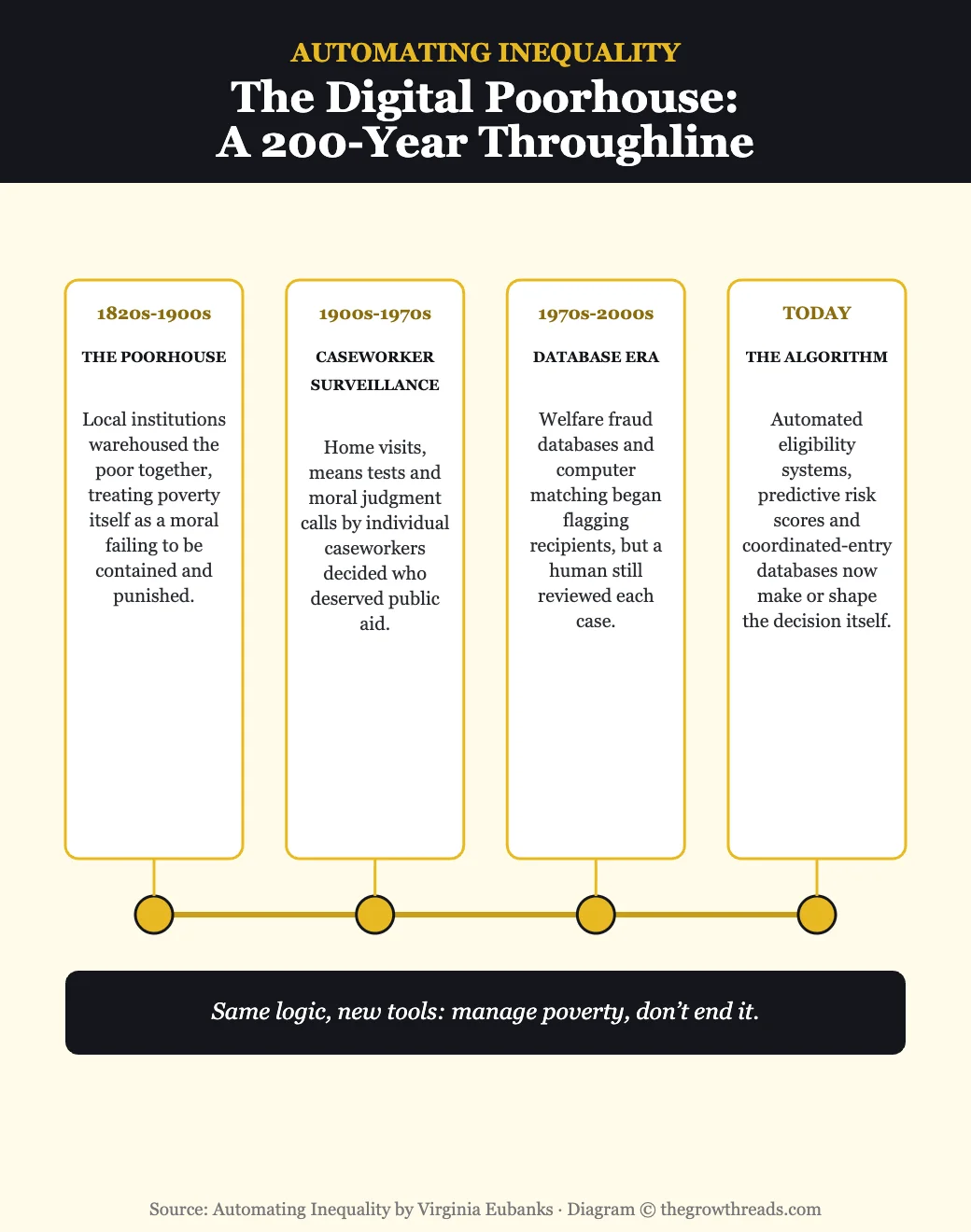
Eubanks steps back from the three case studies to trace a longer American history. Nineteenth-century poorhouses physically confined poor people, using the threat of institutionalization to discourage anyone from asking for help and treating poverty as evidence of moral failure. In the twentieth century that logic moved into home visits, means tests, and caseworker discretion over who counted as “deserving.”
What changes with automation, Eubanks argues, isn’t the belief — it’s the disguise. A caseworker’s suspicion is visible and can be named as bias. A denial generated by an algorithm looks like math, and math is hard to argue with. The tools she studied all wear the appearance of neutral efficiency while making the same judgment poorhouses made two centuries earlier: poverty as an individual problem to manage, not a structural condition to address.
This is the throughline that gives the book its title. Automating a punitive system doesn’t reform it; it hides it more effectively, behind a layer of software most people never get to inspect.
Eubanks closes without cynicism. She proposes concrete alternatives: a “Hippocratic oath” for data scientists building public-sector tools, participatory design that puts affected people in the room, and a standard that any tool aimed at poor people be tested on everyone else first.
Who is Automating Inequality best for — and who should read something else first?
This book rewards social workers, policy students, public-sector technologists, journalists, and anyone who wants a ground-level view of how automated decision-making plays out in people’s lives. Its case-study structure also suits organizers who need concrete, documented examples for a policy fight.
If you want the broader mathematical mechanics of biased algorithms across many industries, start with Weapons of Math Destruction instead. If you want a wider critique of blind faith in computational “objectivity” generally, Artificial Unintelligence is the better entry point. And if your interest is specifically the AI industry’s global labor and resource extraction, Empire of AI covers that ground in more depth.
Questions to reflect on
- Which public services in your area already use automated or algorithmic decision tools — and do you know which ones?
- If a system denied you something important, would you know how to find out why, and how to appeal?
- Where in your own work or community do “efficiency” gains for an institution come at a cost to the people it serves?
- What would it look like to design a public-sector tool with the people it affects in the room from day one?
- Who currently has the power to say no to a data request — and who doesn’t?
🔥 Ready to see the digital poorhouse for yourself?
Eubanks’s case studies will change how you read every headline about a new government “efficiency” tool.
How to apply Automating Inequality (7-day plan)
- Day 1 — Map your local systems. Look up which local agencies (welfare, child services, housing) in your area use automated or algorithmic tools, and note what you find.
- Day 2 — Learn your rights. Research whether your state or country requires notice when an automated tool contributes to a decision affecting you, and what the appeal process looks like.
- Day 3 — Practice the ownership question. Pick three apps or services you use and ask: who built this, who does it actually serve, and who reviews it when it’s wrong?
- Day 4 — Check your own workplace. If you work in tech or policy, find out whether your organization has any participatory-design or public-comment process for tools that affect vulnerable populations.
- Day 5 — Find a watchdog. Identify one local advocacy or legal-aid organization focused on algorithmic accountability or public-benefits rights, and follow their work.
- Day 6 — Prepare, don’t wait. If you or someone you know interacts with a public-benefits system, learn the appeals process in advance, before a denial ever happens.
- Day 7 — Share what you learned. Pass one concrete idea from this week to someone in a position to change a system — a caseworker, an elected official, or a product manager.
Frequently asked questions
Is Automating Inequality a technical book about how algorithms work?
No. Eubanks writes as an investigative journalist and political scientist, not a computer scientist, and the book spends little time on code or math. It’s built around embedded reporting — months spent with applicants, caseworkers, and advocates in Indiana, Allegheny County, and Los Angeles — tracing how automated tools change people’s encounters with public services. Readers wanting a technical machine-learning explainer should look elsewhere; readers who want the human consequences of automated decision-making in social policy are the audience Eubanks is writing for.
What’s the difference between this book and Weapons of Math Destruction?
Weapons of Math Destruction, by data scientist Cathy O’Neil, surveys algorithmic harm broadly — credit, hiring, policing, insurance — through the lens of statistical modeling. Automating Inequality narrows in on U.S. public-benefits systems specifically, through on-the-ground reporting in three communities rather than a mathematician’s overview. O’Neil explains why the models misbehave; Eubanks shows what it feels like to be denied care by one. They pair well together and are cross-referenced elsewhere on this site.
Are the Indiana, Allegheny, and Los Angeles systems Eubanks describes still in place today?
Partially. Indiana rolled back the specific automated-denial contract Eubanks documents after public backlash, though eligibility systems remain heavily software-driven nationwide. Allegheny County’s Family Screening Tool is still in active use, revised after criticism. Los Angeles continues to use a coordinated-entry model for homelessness services, updated since the book’s 2018 publication. The book’s specific numbers are dated; its underlying pattern — automation reshaping who gets help — is not.
Does Eubanks think all technology in social services is bad?
No — her argument is more specific than “technology is bad.” She’s critical of tools deployed without the input of the people they affect, tools that hide human policy choices behind a claim of neutrality, and tools rolled out on vulnerable populations first because they have the least power to object. Her proposed alternative isn’t abandoning technology; it’s participatory design, transparency, and accountability standards that treat affected people as stakeholders rather than data points.
Is the book specific to the United States, or does it apply elsewhere?
All three case studies are American, and the book is deeply grounded in U.S. welfare policy, child-protection law, and homelessness-services structure. That said, the underlying pattern — automated tools deployed first on populations with the least power to contest them — has been documented in other countries too, so the framework travels even where the specific programs don’t.
What is the “digital poorhouse” Eubanks keeps referring to?
It’s her central metaphor: the idea that modern automated systems recreate the function of the 19th-century poorhouse — surveilling, sorting, and discouraging poor people from seeking help — just distributed across databases and call centers instead of a single physical building. The poorhouse confined people; the digital poorhouse tracks and scores them, but Eubanks argues the underlying logic and the practical effect on people’s lives are strikingly similar.
How long does it take to read Automating Inequality, and is this summary a substitute?
The full book runs about 288 pages and takes most readers around seven hours. This summary, at roughly eighteen minutes, covers the three core case studies, the historical argument, and Eubanks’s proposed reforms — enough for a working understanding and to decide whether the full book merits a place on your shelf. It isn’t a replacement for the book’s detailed reporting, extended interviews, and full policy analysis.
Related summaries
- Weapons of Math Destruction by Cathy O’Neil — the mathematical mechanics of biased algorithms, across many industries.
- Artificial Unintelligence by Meredith Broussard — a broader critique of blind faith in computational “objectivity.”
- Empire of AI by Karen Hao — the global labor and resource extraction behind the AI industry.
- Best AI & Technology Books — our full ranked guide to the AI and technology reading list.
Related Technology Summaries
Rise of the Robots Summary & Review: Why Automation Now Threatens Cognitive Jobs Too
Superintelligence Summary & Review: Paths, Dangers, and the Control Problem
The AI-First Company Summary & Review (2026)
The Second Machine Age Summary & Review: The Bounty and the Spread of Digital Technology
The Shallows Summary & Review: How the Internet Is Rewiring Your Brain