

★★★★½ 4.6/5 — A meticulously reported reckoning with what today’s AI actually costs, and who pays for it.
Best for: Anyone who uses AI tools regularly and wants to understand the systems behind them.
Reading time: ~14 min summary (book: ~11 hrs)
Difficulty: Moderate — the payoff is sharper judgment, not a drilled skill.
Empire of AI in one minute
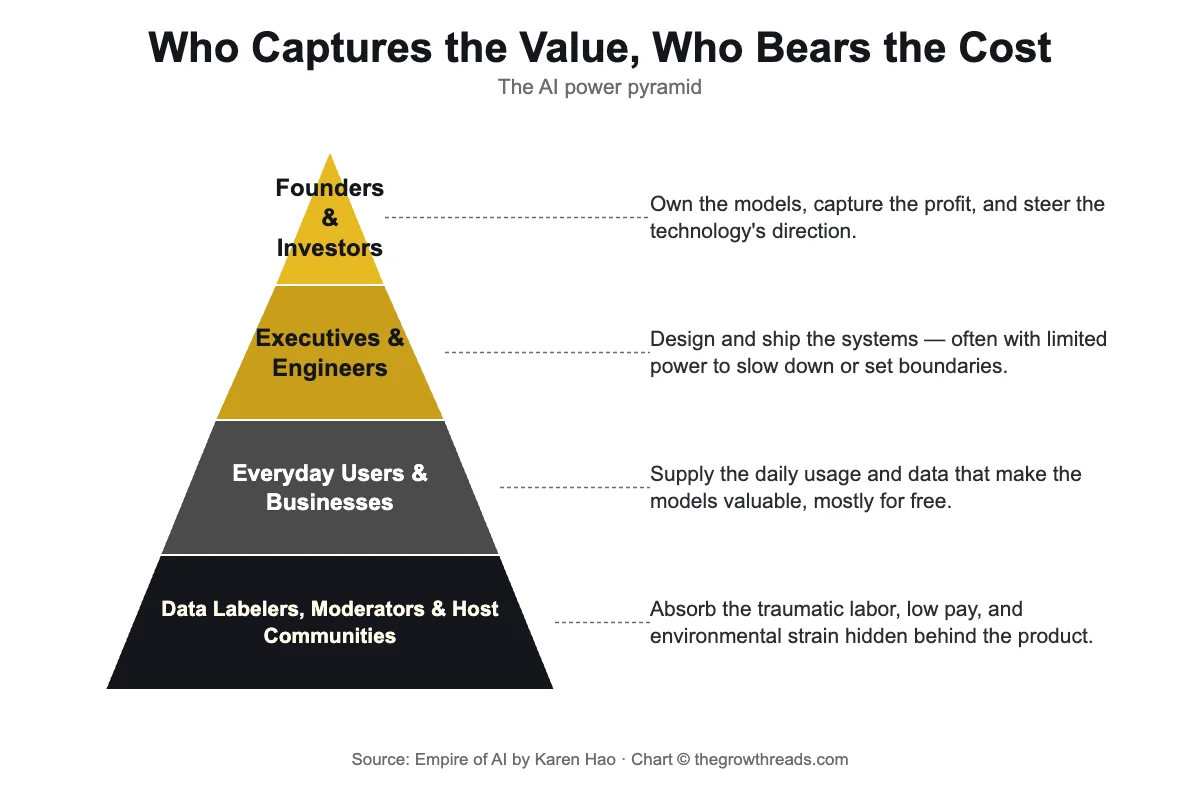
Karen Hao’s central claim is blunt: the companies building today’s most powerful AI, led by OpenAI, behave like empires. They pull in labor, data, energy, and capital from around the world, concentrate the resulting wealth and influence inside a tiny circle of leaders and investors, and frame the arrangement as an act of generosity toward humanity. Drawing on years of reporting inside and around OpenAI, Hao traces the company’s drift from an idealistic, safety-first nonprofit to a fiercely competitive commercial power, using the chaotic five-day board crisis of November 2023 as her central case study in how easily good intentions buckle under commercial pressure. Her point isn’t that AI is inherently harmful — it’s that its real costs stay hidden from the people who use it every day, and deciding how AI gets built and governed shouldn’t be left to a handful of companies alone.
Key takeaways
- AI companies function like empires: they extract labor, data, energy, and capital from around the globe while concentrating the resulting power and profit in a small circle of leaders.
- OpenAI’s founding mission was genuinely idealistic: in 2015 it launched as a nonprofit pledging to research AGI openly and ensure it benefited “all of humanity,” not one company or investor group.
- The capped-profit pivot changed the incentives: in 2019, OpenAI created a for-profit subsidiary to raise the enormous capital frontier AI models require, opening the door to outside investors and competitive pressure.
- ChatGPT’s 2022 launch reset the industry’s clock: a runaway public hit turned a research lab into a consumer product company overnight and ignited a global commercial race.
- The November 2023 board crisis exposed thin governance: Sam Altman’s board briefly removed him over trust concerns, only to reinstate him days later after an employee revolt and investor pressure.
- Human labor is AI’s hidden factory floor: low-paid data labelers and content moderators, many in Kenya and other Global South hubs, review traumatic material to make AI outputs usable and “safe.”
- Training data is extracted, not licensed: today’s models are built on billions of pages of human writing, art, and code, scraped largely without consent or compensation.
- Energy and water are the physical cost of “the cloud”: large-scale data centers strain local power grids and watersheds in the communities that host them.
- AI-safety culture carries its own contradictions: the same effective-altruism and safety-minded ideas that shaped OpenAI’s founding also justified racing ahead competitively.
- Accountable AI governance can’t be left to insiders alone: Hao closes by arguing for broader, more democratic input into how AI is built, deployed, and regulated.
What is Empire of AI about?
Empire of AI is Karen Hao’s investigative account of how OpenAI, and the AI industry it leads, extracts labor, data, energy, and capital from around the world while concentrating power in a small circle of leaders — tracing the company’s path from idealistic nonprofit to commercial giant, and asking what genuinely accountable AI governance would require.
About the author
Karen Hao is an investigative journalist who has covered artificial intelligence for nearly a decade, including senior reporting roles at MIT Technology Review and The Atlantic, where her coverage of OpenAI’s internal culture and the global AI supply chain became some of the most widely cited independent reporting on the company. She has reported from AI data-labeling hubs in Kenya, interviewed current and former OpenAI staff and leadership, and tracked the environmental footprint of large-scale AI infrastructure across multiple countries. Empire of AI, her first book, draws on hundreds of interviews to reconstruct the company’s internal history in detail rarely available to outsiders, and is frequently cited as a foundational account of how modern AI power actually operates. Explore all Karen Hao book summaries →
Key concepts at a glance
| Concept | What it means | Use it when |
|---|---|---|
| AI Empire | The book’s central frame: AI companies extract resources and concentrate power the way historical empires did. | Evaluating any AI company’s real footprint, not just its stated mission. |
| Capped-Profit Structure | OpenAI’s hybrid nonprofit/for-profit model, designed to attract investor capital while capping returns. | Understanding why a “mission-driven” lab still chases huge valuations. |
| Ghost Labor | The low-paid, often traumatic human work — data labeling, content moderation — that makes AI outputs usable. | Asking who actually built the safety features a product advertises. |
| Data Extraction | Training data pulled from the open internet at massive scale, largely without consent or payment. | Thinking about where a model’s “knowledge” actually came from. |
| Compute & Energy Costs | The physical infrastructure — chips, power, water — that AI’s outputs quietly depend on. | Considering the environmental footprint of the tools you use. |
| Governance Crisis (Nov 2023) | The board’s brief removal and reinstatement of Sam Altman, used as a case study in fragile oversight. | Evaluating how much independent oversight any AI company really has. |
| Democratizing AI Governance | Hao’s call for broader public and civic input into how AI is built and regulated. | Deciding how to engage with AI policy as an informed citizen. |
Part 1: The Founding Myth
OpenAI was founded in December 2015 as a nonprofit research lab with a mission that sounded almost utopian: ensure that artificial general intelligence benefits all of humanity, not a single company or government. Its earliest backers, including Sam Altman and Elon Musk, framed the lab as a counterweight to an unaccountable, closed-off AI arms race brewing at a handful of tech giants. The founding pledge to share research openly is baked into the company’s name, and for its first several years OpenAI genuinely operated more like an academic lab than a startup.
Hao traces how quickly that idealism collided with reality. Training frontier AI models is astronomically expensive, and a nonprofit structure couldn’t raise the billions the work would eventually require — a tension between “open, safe AI for everyone” and “an organization that needs enormous capital to compete” that shapes everything that follows.
What makes this founding story more than corporate history is how directly it explains OpenAI’s public rhetoric today. Every major decision, including ones that look purely commercial, still gets narrated through the language of its founding mission — which is why understanding that mission matters for reading the rest of the story clearly.
TGR Note: For more on how today’s AI labs trace back to a handful of research breakthroughs and personalities, see our summary of Genius Makers, which covers the scientists and rivalries that built the deep-learning era OpenAI later dominated.
Part 2: The Supply Chain Behind the Model
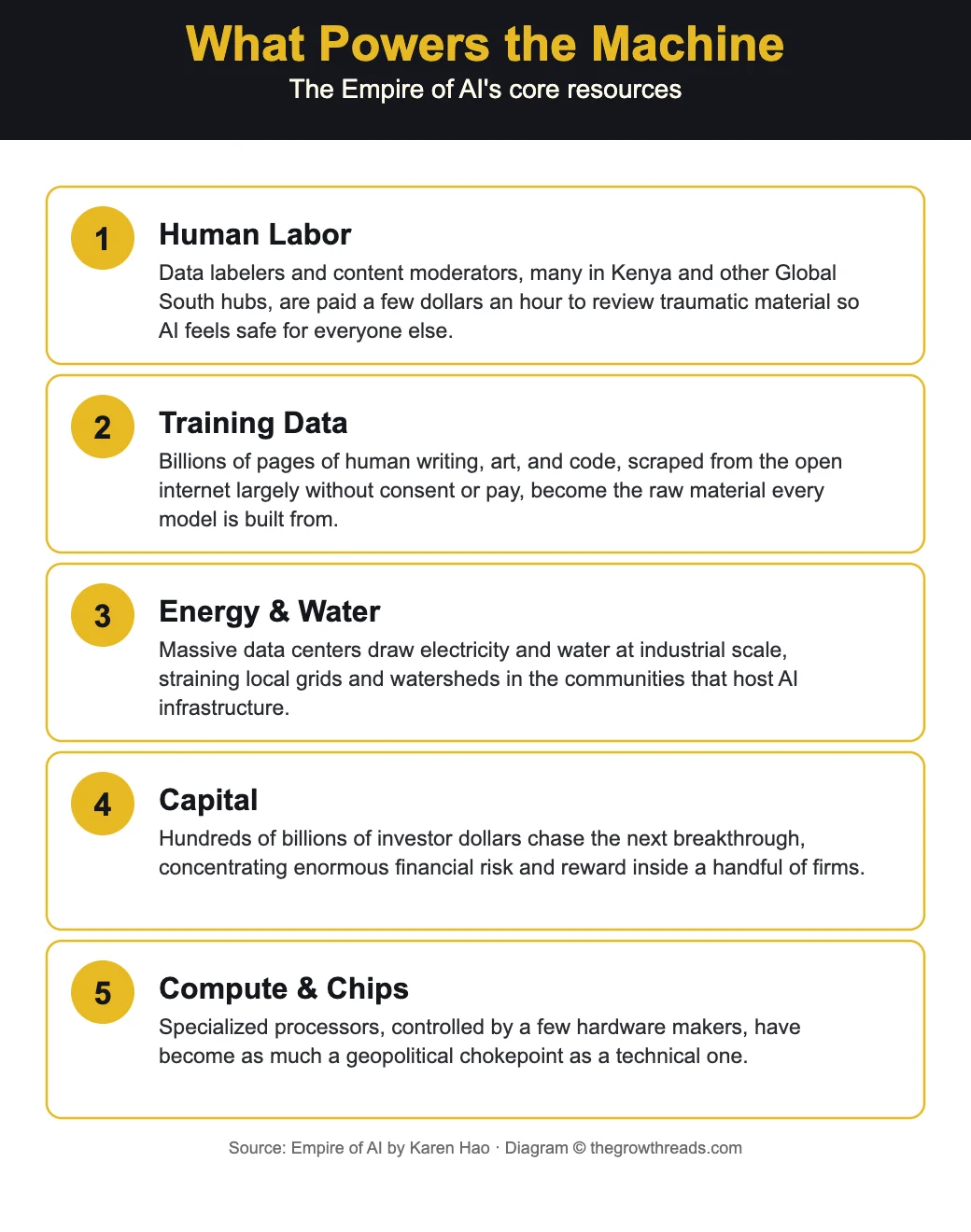
A chatbot response feels instantaneous and immaterial, but Hao’s reporting insists on making its physical and human supply chain visible. The first link is labor: to make AI outputs safe and usable, companies rely on contract workers who label training data and review flagged content, often for a few dollars an hour. Hao’s on-the-ground reporting from Kenya documents workers reading graphic, violent material for hours at a time so the product can present a clean, helpful interface to paying customers thousands of miles away.
The second link is data. Large language models train on staggering quantities of text, images, and code pulled from the open internet — books, articles, forum posts, art, code — largely without asking permission or paying the humans who created it. Hao frames this as extraction: value generated by millions of individual creators absorbed into a product controlled by a handful of firms.
The third link is physical infrastructure. Training and running large models requires enormous data centers, which consume electricity and water at industrial scale. Hao reports on communities near AI infrastructure facing strained grids and depleted water supplies — costs that never appear on a subscription bill but are very real for the people living near the hardware.
Together, these three extraction points are what Hao means by “empire”: value flowing from a dispersed, often invisible base of workers, creators, and communities upward into a concentrated core of leadership and investors.
TGR Note: This same extraction pattern — hidden labor and infrastructure behind a polished consumer product — is the central argument of Atlas of AI by Kate Crawford, which maps AI’s material and human supply chains in even more technical depth. Read them together for a fuller picture of what “the cloud” is actually made of.
Part 3: Power, Money, and the Board Crisis
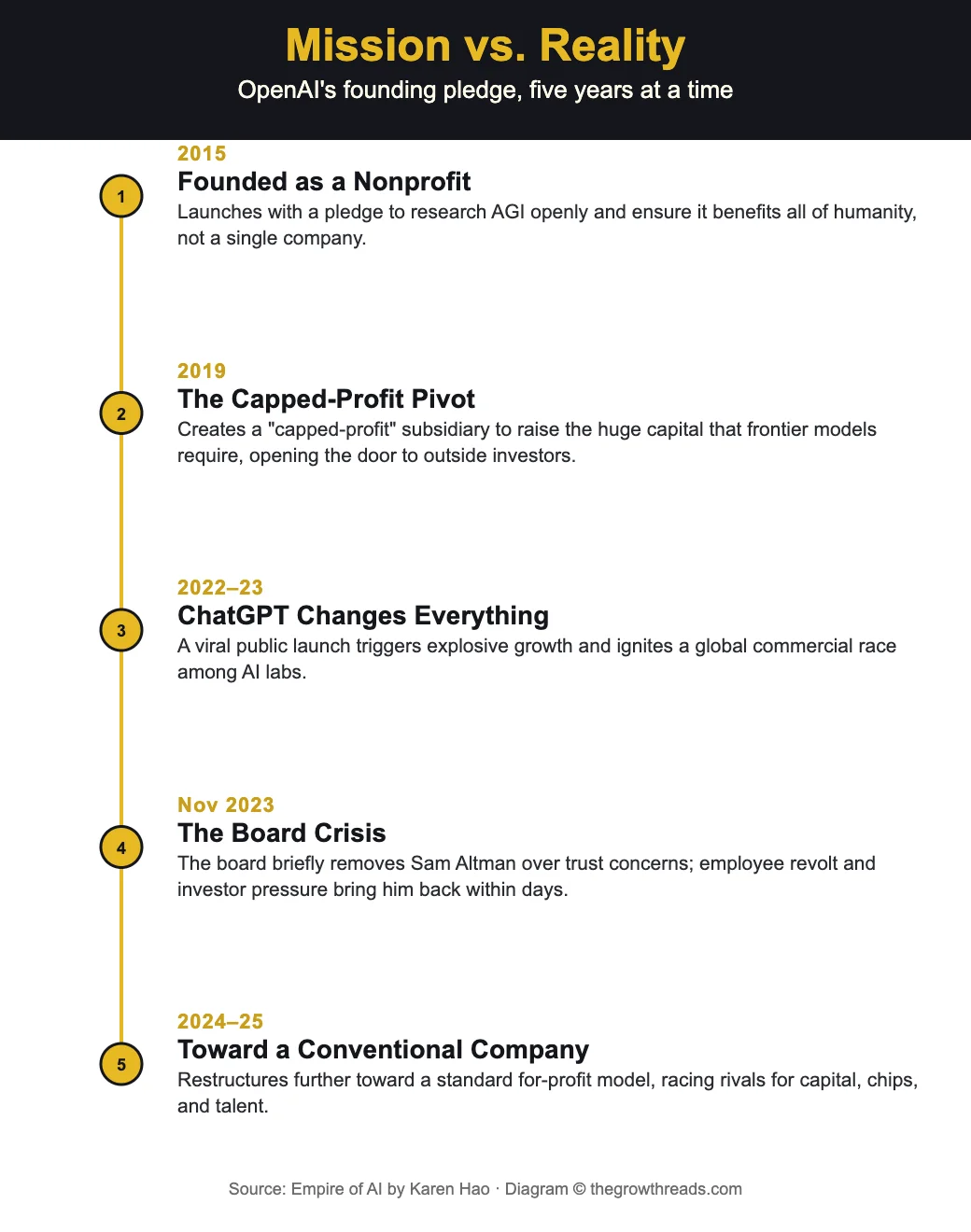
By 2019, OpenAI’s leadership had concluded that a pure nonprofit structure could never raise the capital frontier AI research demanded. The company created a “capped-profit” subsidiary: outside investors could earn a return, but a contractually limited one, with any profit beyond the cap flowing back to the nonprofit’s mission. It was a genuine attempt to reconcile idealism with AI’s brute economics — and it worked well enough to land a landmark, multi-billion-dollar investment from Microsoft.
ChatGPT’s public launch in November 2022 changed the calculus again. What had been a research-oriented lab suddenly had the fastest-growing consumer product in history, and with it, overwhelming competitive pressure. Hao argues this moment, more than any single decision, is when OpenAI’s culture shifted from cautious research lab to product company racing rivals for market share.
That pressure came to a head exactly one year later. In November 2023, OpenAI’s board abruptly removed Sam Altman as CEO, citing a breakdown in trust, stunning employees, partners, and investors alike. Over the following days, Microsoft offered to hire Altman and his closest colleagues, nearly all of OpenAI’s roughly 770 employees signed a letter threatening to resign, and the board reversed course. Altman returned as CEO under a reconstituted board less than a week after being pushed out.
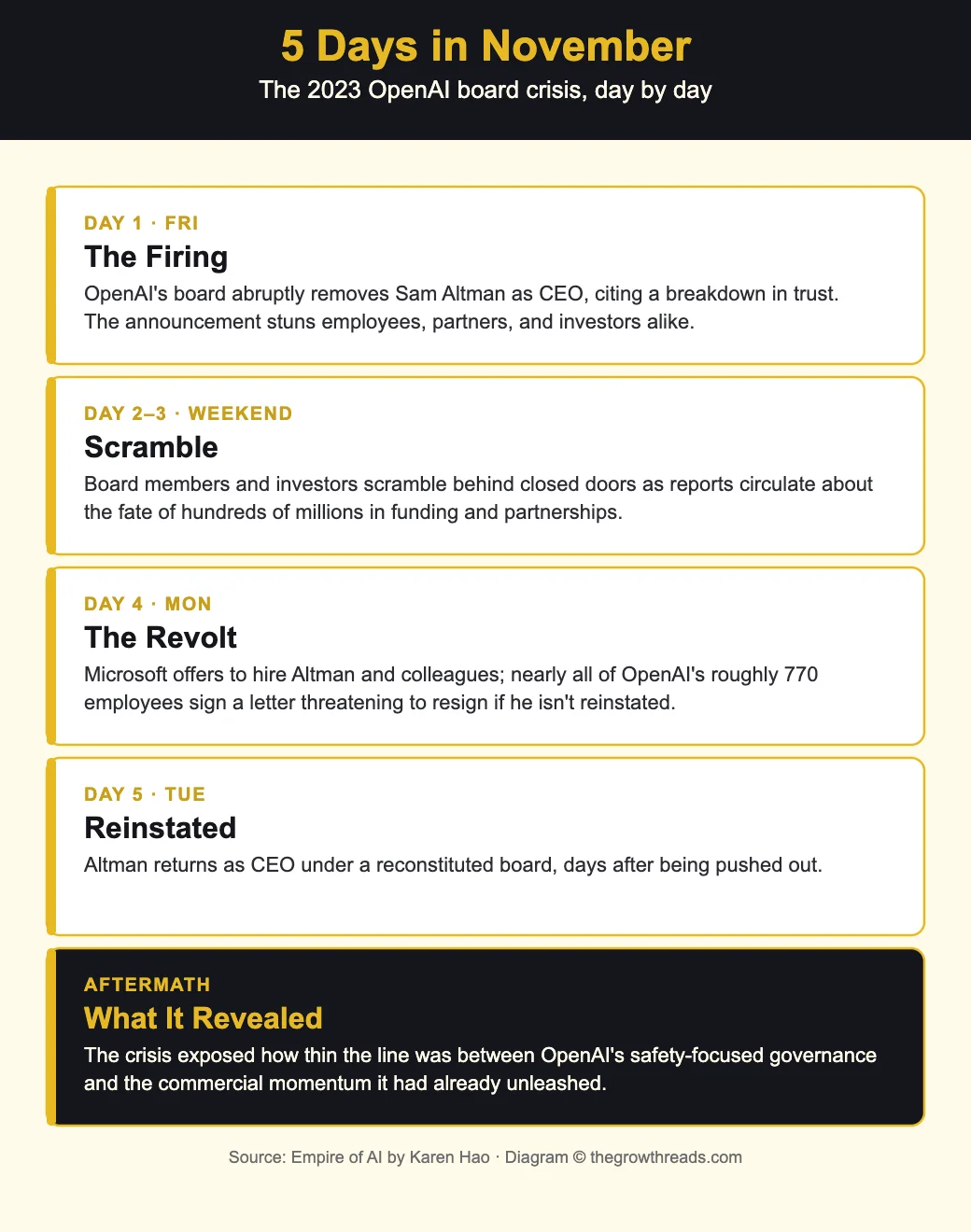
Hao treats this not as a personality drama but a case study: it revealed how little independent power OpenAI’s safety-focused governance actually had once commercial momentum, employee loyalty, and investor leverage all pointed the same direction. The board built to be the company’s ultimate safety check folded within days.
TGR Note: For a deeper look at how AI-safety researchers think about exactly this kind of institutional risk, see our summaries of Superintelligence and Human Compatible, both of which explore what it would take to keep powerful AI systems, and the organizations that build them, genuinely under control.
Part 4: Governing AI’s Future
Hao spends real time on the ideological currents running through Silicon Valley’s AI-safety and effective-altruism communities, many of which shaped OpenAI’s early culture. These communities take AI’s risks seriously and pushed the industry toward safety — but Hao also documents a recurring contradiction: the reasoning that justifies caution (“this could be dangerous, so build it carefully”) gets repurposed to justify speed (“this could be dangerous, so build it before someone less careful does”). That contradiction, she argues, has repeatedly resolved in favor of racing ahead.
The book’s closing argument is a call to widen the circle of who gets a say. Right now, decisions with global consequences — what data trains a model, what safety testing happens before release, how much energy a data center consumes, how content moderators are treated — are made almost entirely inside a small number of companies, largely outside public view. Hao doesn’t offer a single tidy fix; instead, she argues for more transparency, independent oversight, and meaningful public and worker input into decisions made behind closed doors.
For readers, the takeaway isn’t to reject AI tools outright — it’s to bring a more informed, skeptical eye to how AI companies describe themselves, and treat questions about labor, data, energy, and governance as legitimate to ask before adopting a tool, not afterthoughts.
TGR Note: If you want to go deeper on the accountability side of this argument, our summaries of Weapons of Math Destruction and Artificial Unintelligence both dig into how algorithmic systems can cause real harm even when nobody is deliberately trying to cause it.
Who is Empire of AI best for — and who should read something else first?
Empire of AI rewards readers who already use AI tools regularly and want to understand the systems behind them with more nuance than a headline provides — managers and teams evaluating AI vendors, policy-curious readers who want a grounded starting point, and anyone who found the November 2023 board drama confusing and wants the real story.
If you want a more optimistic, technology-forward take on where AI and connected systems are heading, start with The Inevitable by Kevin Kelly instead. If you’re newer to AI concepts generally and want a gentler, more explanatory entry point before diving into an accountability-focused critique, Artificial Intelligence: A Guide for Thinking Humans is a better first stop. Readers specifically interested in the geopolitics of AI development might prefer starting with AI Superpowers.
Questions to reflect on
- Which AI tools do you personally rely on, and how much do you actually know about the company behind them?
- If you knew exactly how a tool’s training data was sourced, would it change how you use it?
- What would “asking better questions” of an AI vendor actually look like at your workplace?
- Where do you draw the line between AI’s genuine benefits and its hidden costs?
- Who should have a say in how AI gets built and regulated, and how would you personally get more involved?
🔥 Ready to see the real machine behind the magic?
Get Empire of AI and read Karen Hao’s full reporting for yourself.
How to apply Empire of AI (7-day plan)
- Day 1: List every AI tool you personally use, at work and at home, then write down what you actually know about each company behind it.
- Day 2: Pick one AI tool from your list and read its public usage policy or model card in full, not just the marketing page.
- Day 3: Research where that tool’s data centers are located and what powers them — a company’s sustainability page is a reasonable starting point.
- Day 4: Look into how that company sources content moderation or data-labeling work, if the information is publicly available.
- Day 5: Write a short “AI vendor questionnaire” for yourself — three to five questions you’ll ask before adopting any new AI tool going forward.
- Day 6: Follow one AI policy or governance tracker for a week to see how these debates actually play out in practice.
- Day 7: Share what you learned with a colleague or friend, and discuss how it changes how you’ll use AI going forward.
Frequently asked questions
What is Empire of AI by Karen Hao about?
Empire of AI is an investigative account of how OpenAI, and the AI industry more broadly, extracts labor, data, energy, and capital from around the world while concentrating the resulting power in a small circle of leaders. Karen Hao traces OpenAI’s evolution from an idealistic 2015 nonprofit to a commercially driven, capped-profit giant, using the November 2023 board crisis as a central case study, and blends reporting from AI data-labeling hubs with interviews and environmental analysis into one narrative about who benefits from AI and who bears its hidden costs.
Is the book critical of OpenAI specifically, or the AI industry as a whole?
Both, though OpenAI is the primary case study because of Hao’s years of access and reporting inside the company. She uses OpenAI’s founding mission, capped-profit pivot, and 2023 board crisis as a lens for dynamics she argues apply industry-wide: concentrated power, hidden labor, extracted data, and heavy environmental costs. Readers get plenty of OpenAI-specific reporting, but the larger argument is about how AI power operates across the whole industry.
What does the “empire” metaphor in the title actually mean?
Hao uses “empire” to describe how leading AI companies extract resources, cheap labor, personal data, energy, and water, from communities around the world while concentrating the resulting wealth and decision-making power in a small circle of leaders and investors, much like historical empires concentrated power at the center. It’s a framing device, not a literal claim, meant to make an abstract industry’s power structure easier to see and evaluate critically.
Does the book explain what actually happened during the November 2023 OpenAI board crisis?
Yes, in detail. Hao reconstructs the roughly five-day sequence: the board’s sudden removal of Sam Altman as CEO, the scramble among investors that followed, Microsoft’s offer to hire Altman and his colleagues, an employee letter signed by nearly the entire company threatening to resign, and Altman’s reinstatement under a reconstituted board. She treats it less as a personality drama and more as a case study in how quickly institutional safety checks can collapse under pressure.
What are the main hidden costs of AI that the book documents?
Three recur throughout: human labor, where low-paid workers, often in the Global South, label data and moderate disturbing content to keep AI outputs usable; data extraction, where models train on scraped human-created content without consent or pay; and environmental costs, where data centers consume significant electricity and water. Hao argues these costs stay largely invisible to everyday users and rarely appear in how AI companies market their products.
Is Empire of AI a one-sided or biased account?
It’s an openly critical, investigative work, and readers should know that going in. That said, Hao’s reporting is extensively sourced, and she acknowledges OpenAI’s genuine early idealism and real technical achievements rather than dismissing the company outright. Some granular claims about internal deliberations rely on anonymous sourcing, common in investigative journalism about private companies, so weigh individual anecdotes alongside the book’s broader, well-documented patterns.
Who should read Empire of AI?
It’s a strong fit for anyone who uses AI tools regularly and wants a more grounded understanding of the industry behind them: professionals evaluating AI vendors, policy-curious readers, and anyone who wants the real story behind the board crisis headlines. Readers wanting a purely technical explanation of how models work, or a more optimistic take on AI’s trajectory, may want to pair it with a different book from our Technology shelf.
Related summaries
If this resonated, these Technology-silo summaries dig into related territory:
- Atlas of AI — Kate Crawford’s deeper technical map of AI’s material and human supply chains.
- Weapons of Math Destruction — Cathy O’Neil on how algorithms can quietly cause large-scale harm.
- Artificial Unintelligence — Meredith Broussard’s case against overtrusting what AI can actually do.
- Genius Makers — the scientists and rivalries behind the deep-learning breakthroughs that made this moment possible.
For our full ranked list of AI books, see Best AI Books.
Related Technology Summaries
Artificial Intelligence Summary & Review: A Guide for Thinking Humans
Homo Deus: A Brief History of Tomorrow Summary & Review (2026)
Hooked Summary & Review: The Habit Model Behind Every App You Can’t Put Down
Nexus Summary & Review: Why More Information Doesn’t Mean More Truth
Prediction Machines Summary & Review: The Simple Economics of Artificial Intelligence