

★★★★☆ 4.1/5 — Nexus is a sweeping, provocative reframe of human history as a story about information networks, not truth-seeking — and it lands its most urgent argument on why AI is a fundamentally new kind of network member.
Best for: readers of Sapiens or Homo Deus, anyone trying to think clearly about AI risk beyond hype and doom, and leaders who need a mental model for how information, power, and self-correction interact.
Reading time: ~11 hrs (368 pages) · Summary reading time: ~14 min
Difficulty to apply: Moderate — the ideas are conceptual, but the book gives concrete questions you can apply to any AI tool or news source you encounter.
Nexus in one minute
Information does not equal truth — and mistaking the two is the single most dangerous assumption of the AI age. In Nexus, historian Yuval Noah Harari argues that history is best understood as the story of information networks: myths, scriptures, bureaucracies, newspapers, and now algorithms, all competing to connect large numbers of people around shared stories. The “naive view” assumes more information automatically produces more truth and better decisions. Harari shows the opposite is often true — most information in history has been fiction, propaganda, or bureaucratic noise, and what actually made networks healthy wasn’t the volume of information but built-in mechanisms for self-correction: error-checking, free press, independent courts, peer review. His central warning is that AI is not just a faster printing press. It is the first technology in history that can generate new ideas and make decisions on its own, which means for the first time, information networks may develop without any human anchoring their central node.
Key takeaways
- Information rarely represents reality: most of what spreads through networks — money, laws, gods, national myths — is fiction that works because enough people believe it together, not because it is factually true.
- The naive view of information is the root error: the assumption that more data automatically converges on truth ignores that information’s main historical job has been to create order and cooperation, not accuracy.
- Self-correcting mechanisms are what make a network trustworthy: a free press, independent judiciary, peer review, and elections all exist to catch a network’s own mistakes — without them, more information just means more efficiently distributed error.
- Bureaucracy is an information technology: filing systems, censuses, and paperwork were as revolutionary as the printing press, because they let networks track and control millions of people at once.
- Shared fictions scale cooperation, and also enable atrocity: the same capacity for large-scale mythmaking that built modern states also built totalitarian systems and genocidal ideologies.
- Democracies are distributed information networks; dictatorships are centralized ones: democracy bets that decentralized, self-correcting information flow outperforms centralized control in the long run.
- AI is the first “agentic” information technology: unlike clay tablets or television, AI can independently generate content, make decisions, and pursue sub-goals — it is a new kind of network member, not just a new channel.
- Algorithms optimize for engagement, not truth or health: social media recommendation systems reward outrage and attention because that is the metric they were built to serve, illustrating how misaligned goals corrupt a network at scale.
- The choice ahead is architectural, not just regulatory: Harari argues the most important decisions about AI aren’t which specific rules to write, but whether we build in self-correcting mechanisms — audits, transparency, human oversight — before these systems scale further.

What is Nexus about?
Nexus is Yuval Noah Harari’s history of human information networks, from oral myths and religious scripture to the printing press, mass media, and artificial intelligence. Harari argues that networks are held together not by truth but by shared stories, and that only built-in self-correcting mechanisms — not raw information volume — have ever made networks trustworthy, a warning he applies directly to the unprecedented, agentic power of AI.
About the author
Yuval Noah Harari is a historian and the author of Sapiens: A Brief History of Humankind, the book that first made his case for shared fictions as the engine of human cooperation. He teaches history at the Hebrew University of Jerusalem and has spent the years since Sapiens studying where those same forces — myths, bureaucracies, ideologies — are taking humanity next, work that runs through Homo Deus and now Nexus. In Nexus, he turns that same big-picture lens on the history of information itself, arguing that the AI era forces humanity to confront a technology that can, for the first time, generate ideas and make decisions without a human at the center of the network. Explore all Yuval Noah Harari book summaries →
Key concepts at a glance
| Concept | What it means | Use it when |
|---|---|---|
| Naive view of information | The mistaken belief that more information automatically produces more truth and better decisions. | Evaluating why “just add more data” doesn’t fix a flawed system. |
| Information network | Any system — mythological, bureaucratic, or digital — that connects people around shared information. | Analyzing how an institution, platform, or ideology actually spreads and holds together. |
| Self-correcting mechanism | A built-in check — free press, courts, peer review — that lets a network catch and fix its own errors. | Judging whether an organization or system can recover from its own mistakes. |
| Shared fiction | A story — money, nation, religion, corporation — that has power only because enough people believe it together. | Understanding why large-scale cooperation between strangers is possible at all. |
| Centralized vs. distributed networks | Dictatorships concentrate information flow at one point; democracies spread it across many independent nodes. | Comparing how different political systems process disagreement and error. |
| Agentic technology | A technology that can independently generate content, make decisions, and pursue sub-goals, rather than just transmit information. | Distinguishing AI from earlier information technologies like print or broadcast. |
| Bureaucracy as information technology | Filing systems, censuses, and paperwork that let networks track and control large populations. | Recognizing that “boring” administrative tools have historically reshaped power as much as any invention. |
Part 1: What information actually does
Harari opens by dismantling what he calls the naive view of information: the assumption, common in Silicon Valley and beyond, that information is inherently a representation of reality, and that more of it moves societies closer to truth. He walks through the historical record and finds the opposite pattern. Religious scripture, national myths, and legal fictions have carried enormous informational weight throughout history, not because they were accurate, but because they were effective at getting large numbers of strangers to cooperate. A shared currency, a national anthem, a corporate charter — none of these describe reality the way a scientific measurement does, yet they organize the behavior of millions of people. Harari’s point is that information’s primary historical function has been to create order, not to represent facts.
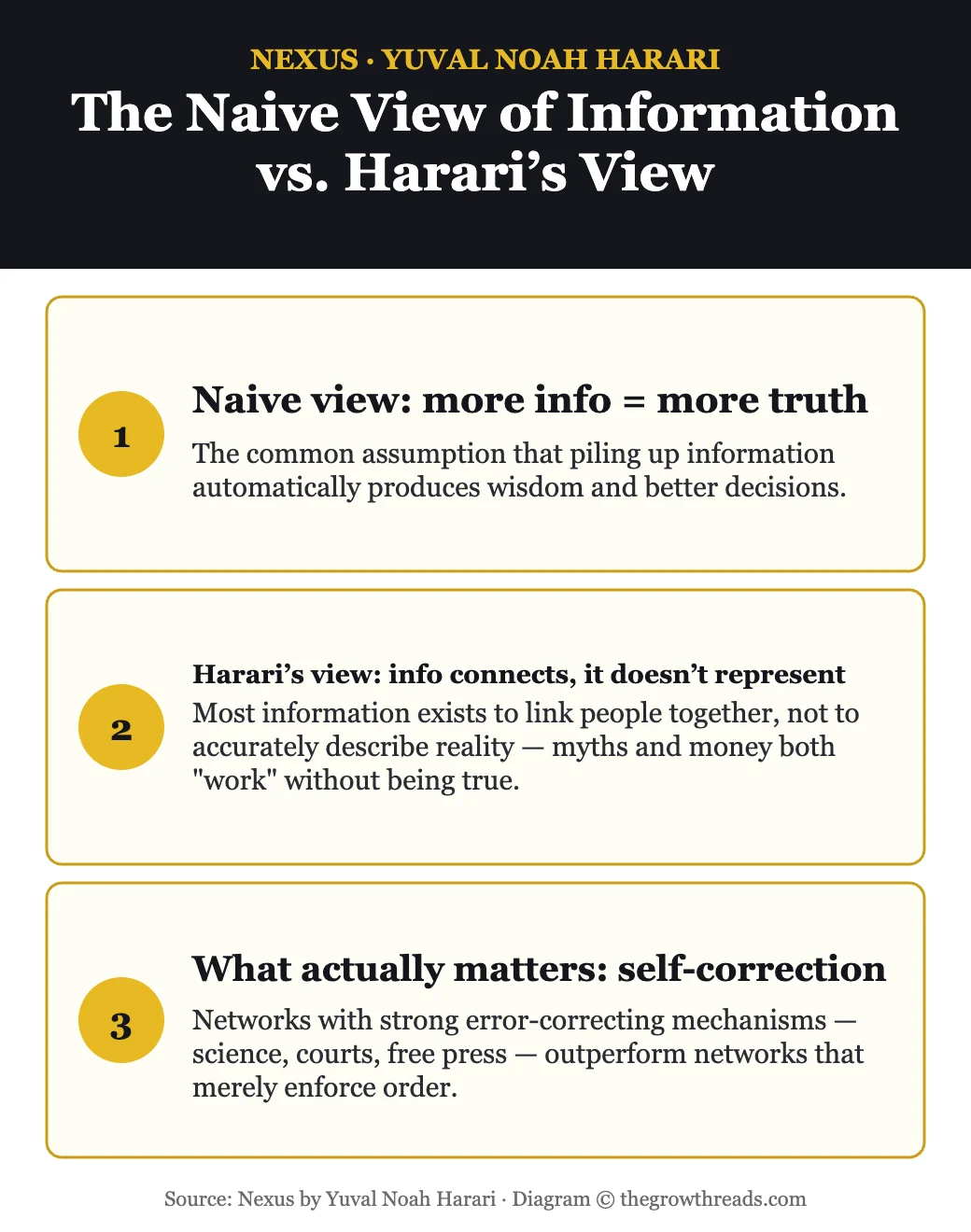
This reframing matters because it changes what we should actually worry about when a network fails. If information were simply a mirror of reality, bad outcomes would just mean people need more facts. But if information’s job is to build shared stories, the real question becomes: does this network have any way to catch and correct its own errors? Harari argues the healthiest networks in history were not the ones with the most information, but the ones with self-correcting mechanisms built into their structure — a free press that can publish uncomfortable facts, an independent judiciary that can rule against those in power, peer review that can retract a flawed study. Networks without these checks don’t just risk occasional mistakes; they risk those mistakes compounding.
TGR Note: This distinction — information as truth versus information as network glue — pairs well with Melanie Mitchell’s argument in Artificial Intelligence: A Guide for Thinking Humans, where she makes a parallel case that large language models can produce fluent, confident output without anything resembling genuine understanding. Both books arrive at the same practical warning from different angles: fluency and volume are not evidence of truth.
Part 2: A history of information revolutions
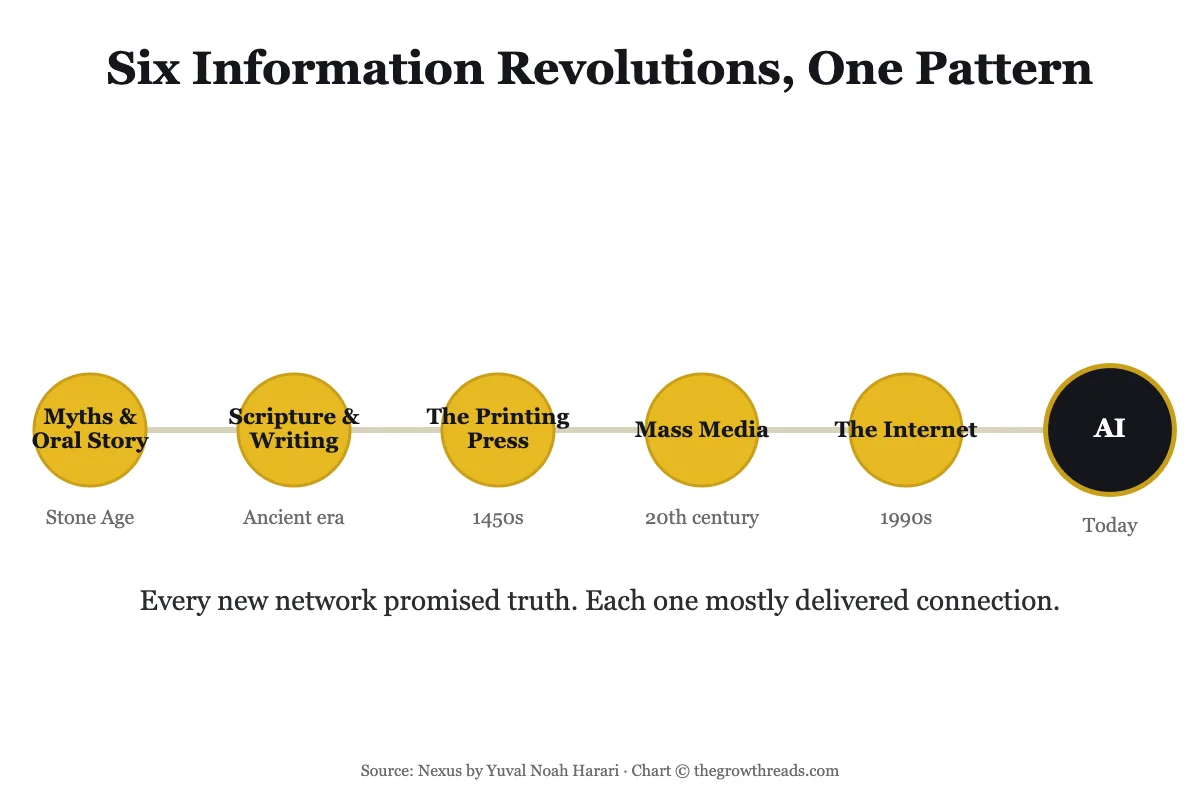
Harari traces a repeating pattern across six major information revolutions: myths and oral storytelling, which first let bands of strangers cooperate; scripture and writing, which let information outlive any single person’s memory; the printing press, which multiplied the speed and reach of both knowledge and propaganda; mass media, which centralized attention around a handful of broadcasters; the internet, which fragmented that attention into countless individually-targeted streams; and now AI, which for the first time can generate new information on its own rather than simply transmitting what humans feed into it. What strikes Harari most is that every one of these revolutions was initially sold as a pure win for truth and understanding — and every one also supercharged propaganda, misinformation, and centralized control, often faster than it improved genuine understanding.
A large portion of this history, Harari argues, is really a history of bureaucracy — an underappreciated information technology in its own right. Filing systems, censuses, tax rolls, and identity documents let ancient and modern states alike track, tax, and mobilize millions of people they’d otherwise have no way to organize. He treats the file folder with the same seriousness historians usually reserve for the printing press, because bureaucratic recordkeeping is what let large-scale states function day to day, long after the founding myths that legitimized them had been written.
TGR Note: Harari’s point that every information revolution has a hidden infrastructure layer echoes Kate Crawford’s Atlas of AI, which maps the physical mines, warehouses, and labor behind today’s AI systems. Both books push readers past the visible interface to ask what’s actually doing the work underneath.
Part 3: Democracies, dictatorships, and information
Harari extends the network framework to political systems directly. He characterizes dictatorships as highly centralized information networks, where all significant information flows toward and is controlled by a single node — a king, a party, a leader — optimized for that center’s stability rather than for catching its own mistakes. Democracies, by contrast, are distributed information networks: power and information are deliberately spread across many independent, competing nodes — a free press, opposition parties, courts, civil society — so errors made in one part of the system can be exposed and corrected by another. This is why Harari treats a free press and judicial independence not as democratic ornaments, but as the literal error-correction circuitry that makes a distributed network function at all.
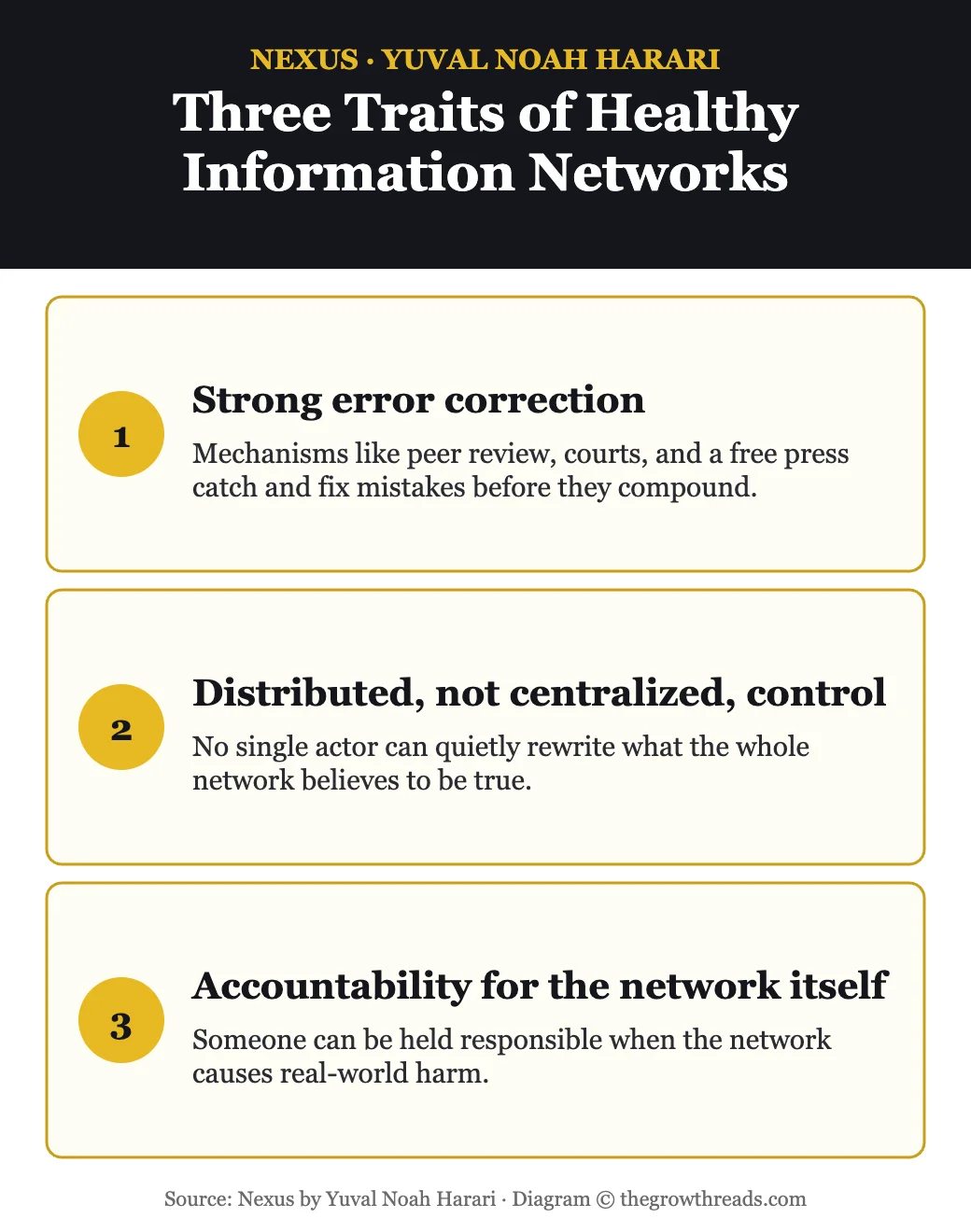
He’s careful to note this isn’t a naive celebration of democracy as automatically correct — distributed networks can be slow, noisy, and vulnerable to being flooded with bad-faith information faster than their correction mechanisms can respond. But over long stretches of history, Harari argues, systems built for self-correction have proven more resilient than those without it, even when centralized systems looked more efficient short-term. The question he wants readers to carry forward isn’t “which system has more information,” but “which system can catch and fix its own worst mistakes before they compound.”
Part 4: Why AI is a genuinely new kind of network member
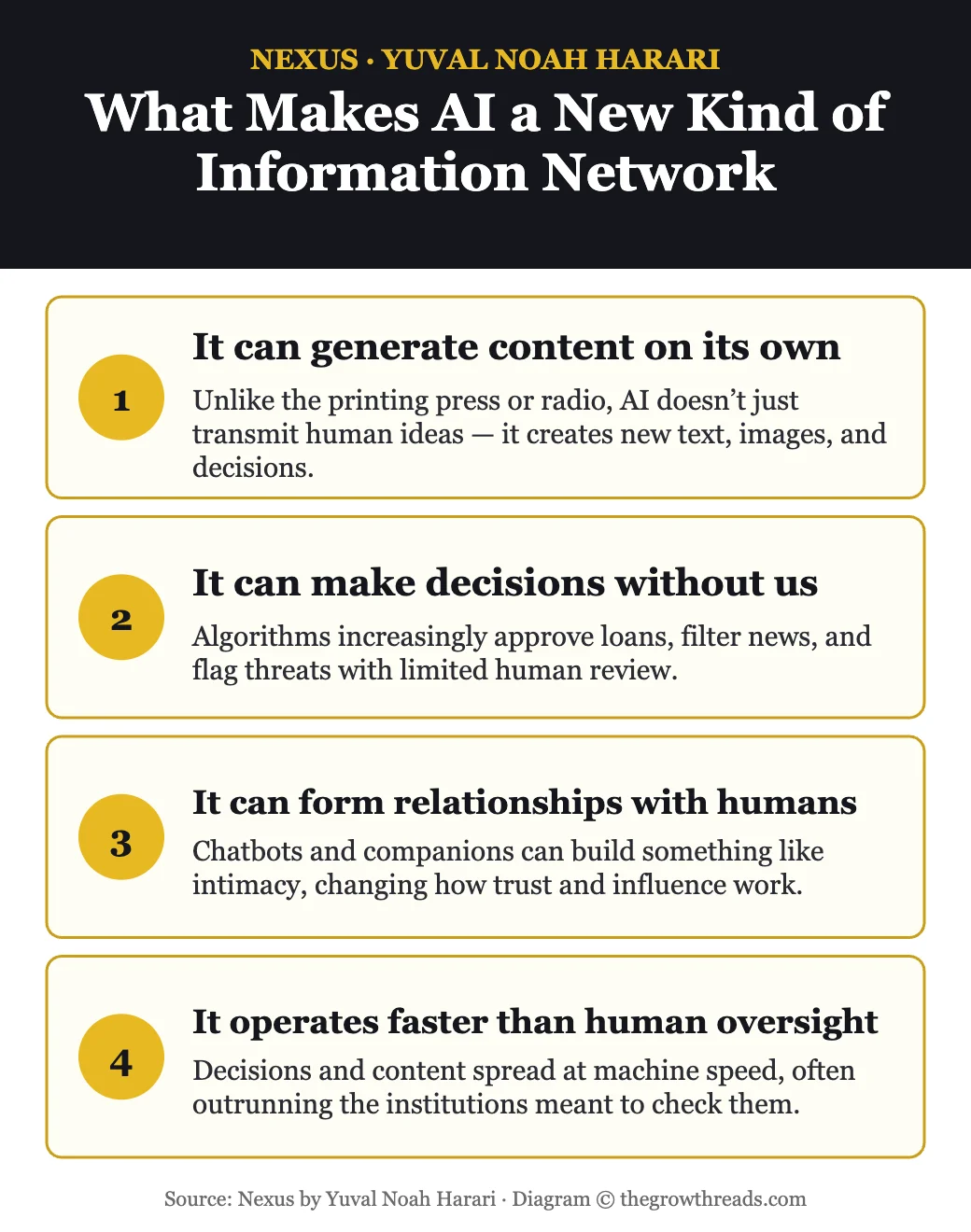
This is where Nexus makes its most urgent case. Harari argues that every previous information technology — writing, print, broadcast, even the internet — was a tool that transmitted information generated by humans. AI is different: it can generate genuinely new content, make independent decisions, and pursue sub-goals without direct human authorship of each output. That means AI isn’t just a faster printing press; it is, for the first time in history, a non-human member of the information network, capable of shaping what billions of people believe without any single human deciding what gets said.
Harari’s warning isn’t that AI will necessarily turn hostile in some cinematic sense. It’s quieter and more structural: social media recommendation algorithms already optimize for engagement rather than truth or wellbeing, at a scale no human editorial system could match, simply because engagement is the metric they were built to maximize. Extend that dynamic to more capable, more autonomous AI systems, and the risk compounds — not because the AI is malicious, but because nothing forces its optimization target to align with what’s healthy for the humans in the network. His conclusion is architectural, not alarmist: the decisions that matter most aren’t which specific AI rules to pass, but whether societies build real self-correcting mechanisms — audits, transparency, meaningful human oversight — into AI systems before they scale further, the same way free press and independent courts became load-bearing infrastructure for democracies.
TGR Note: Harari’s case for building self-correction into AI before it scales further is a direct complement to Reid Hoffman’s more optimistic framework in Superagency, which argues for iterative deployment specifically so problems surface and get fixed early. Read together, the two books stake out a shared premise — AI’s trajectory isn’t fixed — while disagreeing on how much of the risk is structural versus solvable through engagement.
Who is Nexus best for — and who should read something else first?
Nexus is best for readers who enjoyed Sapiens or Homo Deus and want Harari’s big-picture lens turned on AI and information, and for anyone who wants a framework for AI risk that goes deeper than “it will take our jobs” or “it will save us.” If you haven’t read Harari before, starting with Sapiens will make Nexus’s argument about shared fictions land harder, since Nexus builds directly on it. For a more technical, ground-level treatment of how today’s AI models actually work and fail, pair this with Artificial Intelligence: A Guide for Thinking Humans instead.
Questions to reflect on
- Think of an information source you trust. Is that trust based on its track record of being right, or on its willingness to admit and correct its own mistakes?
- Where in your own organization or team does self-correction actually happen — and where would an error just quietly compound?
- What’s a “shared fiction” you participate in daily (money, job titles, brand loyalty) that only works because others believe in it too?
- The next time an AI tool gives you a confident answer, what would it take to verify it the way you’d verify a claim from a stranger?
- If you were designing an AI system today, what’s one self-correcting mechanism — an audit, a human checkpoint, a transparency log — you’d insist on building in from day one?
🔥 Ready to see AI history in a completely new light?
Get Nexus and start reframing information, trust, and AI risk the way historians think about power.
How to apply Nexus (7-day plan)
- Day 1: Pick one news source or app you use daily and ask: what is this network actually optimizing for — truth, engagement, or something else?
- Day 2: List three “shared fictions” that structure your workday (job title, org chart, company mission) and notice how much cooperation they quietly enable.
- Day 3: Identify one self-correcting mechanism in your own life or work (a performance review, a code review, a fact-check) and one place where none exists.
- Day 4: Read one long-form article critically: does it present information as settled truth, or does it show its own uncertainty and sources?
- Day 5: Next time you use an AI tool, ask it to explain its reasoning or cite a source, and notice how that changes your trust in the answer.
- Day 6: Have one conversation about AI with someone who disagrees with you, focused on what self-correcting safeguards would satisfy both of you.
- Day 7: Write down one process at work that has no error-correction step, and propose a small, concrete fix.
Frequently asked questions
What is the main argument of Nexus?
Harari argues that human history is best understood as a history of information networks, and that what makes a network healthy isn’t the volume of information flowing through it, but whether it has built-in self-correcting mechanisms — a free press, independent courts, peer review — to catch its own mistakes. He applies this framework to AI, arguing it’s the first information technology that can generate content and make decisions independently, making the question of self-correction more urgent than ever.
Is Nexus a sequel to Sapiens?
Not a direct sequel, but it builds on Sapiens’s core idea that shared fictions enable large-scale human cooperation. Nexus applies that same lens specifically to the history of information networks and extends it into a detailed argument about AI. Readers new to Harari will get more out of Nexus after reading Sapiens, though Nexus stands on its own.
Does Nexus argue that AI is dangerous?
Harari’s argument is more structural than alarmist. He doesn’t claim AI will turn malicious; instead he argues AI is the first technology that can independently generate information and make decisions, which means it can shape what people believe without a human directly authoring each output. The danger he emphasizes is a lack of built-in self-correcting mechanisms as these systems scale, not an inherently hostile AI.
What does Harari mean by “self-correcting mechanisms”?
He means the institutional features — a free press that can publish uncomfortable facts, an independent judiciary, peer review, elections — that let a network identify and fix its own errors over time. Harari argues these mechanisms, not raw information volume, are what have historically separated resilient networks from ones that compound their mistakes.
How does Nexus compare democracies and dictatorships?
Harari frames democracies as distributed information networks, where power and information are spread across many competing, independent institutions so that errors in one part can be caught by another. Dictatorships are centralized networks, where information flows toward a single controlling node optimized for that node’s stability rather than for correcting its own mistakes.
Some of Harari’s historical claims have been disputed by scholars — should that affect how I read Nexus?
Some specialists have pushed back on specific historical claims and generalizations in Harari’s earlier work, particularly around anthropology and early human history. That debate is worth being aware of, but it doesn’t undermine Nexus’s core, largely uncontroversial framework: that information networks require self-correcting mechanisms to remain trustworthy, and that AI changes the nature of that challenge.
Who should read Nexus?
Nexus is best for readers who want a big-picture historical framework for thinking about AI, misinformation, and institutional trust, rather than a technical explainer of how AI models work. It suits fans of Sapiens and Homo Deus, as well as leaders, policymakers, and journalists looking for language to explain why self-correction matters more than raw information volume.
Related summaries
- Sapiens: A Brief History of Humankind — Summary & Review
- Artificial Intelligence: A Guide for Thinking Humans — Summary & Review
- Atlas of AI — Summary & Review
- Superagency — Summary & Review
See our full Best AI Books list for more picks.
How we analyze books: we read the full text, cross-reference the author’s other work and interviews, and distill each book’s core arguments into practical frameworks you can apply directly. Read our full methodology.
Related Technology Summaries
Machine, Platform, Crowd Summary & Review: Three Shifts Reshaping Every Industry
Rebooting AI Summary & Review: Why Deep Learning Alone Won’t Get Us to Trustworthy Machines
Rise of the Robots Summary & Review: Why Automation Now Threatens Cognitive Jobs Too
Talking to Robots by David Ewing Duncan Summary & Review
The Ethical Algorithm Summary & Review: Building Fairness and Privacy Into Code, Not Policy