

★★★★★ 4.6/5 — the clearest field guide yet to how opaque algorithms quietly decide who gets a loan, a job, a lighter sentence, or a second chance.
Best for: anyone who works with, is scored by, or builds data-driven systems — managers, developers, policy readers, and the simply algorithm-curious.
Reading time: ~14 min guide (~6 hrs for the full book)
Difficulty to apply: Easy — the payoff is a sharper set of questions to ask, not a new skill to learn.
Weapons of Math Destruction in one minute
Not every algorithm is dangerous — but the ones that are share three traits, and once you can name them, you start seeing them everywhere. Cathy O’Neil, a mathematician who left Wall Street quant work disillusioned after the 2008 crash, calls these models Weapons of Math Destruction, or WMDs: opaque, large-scale scoring systems that quietly punish the people they claim to evaluate fairly. A WMD isn’t just any formula — it’s a model that can’t be inspected, that runs on enough people to matter, and that actively damages the lives of those it scores. O’Neil walks through real examples — teacher evaluations, recidivism scores, college rankings, hiring filters, credit models, insurance pricing, political microtargeting — and shows the same pattern each time: a reasonable-sounding proxy stands in for something hard to measure, the model treats that proxy as truth, and the people already at a disadvantage take the hit. The book’s real gift isn’t outrage — it’s a short, repeatable checklist for telling a legitimate model from a WMD, and for demanding better from the ones that run your life.
Key takeaways
- A WMD needs three traits at once: opacity (you can’t see how it scored you), scale (it runs on huge populations), and damage (it works against your interests).
- Models are opinions embedded in math. Every algorithm encodes a choice about what to measure and what counts as success — those choices aren’t neutral.
- Proxies replace the thing you actually care about. Zip code stands in for creditworthiness, keyword matches stand in for teaching quality — and the substitution quietly bakes in bias.
- WMDs punish the poor and reward the rich. The wealthy get human judgment and appeals; everyone else gets an automated score with no recourse.
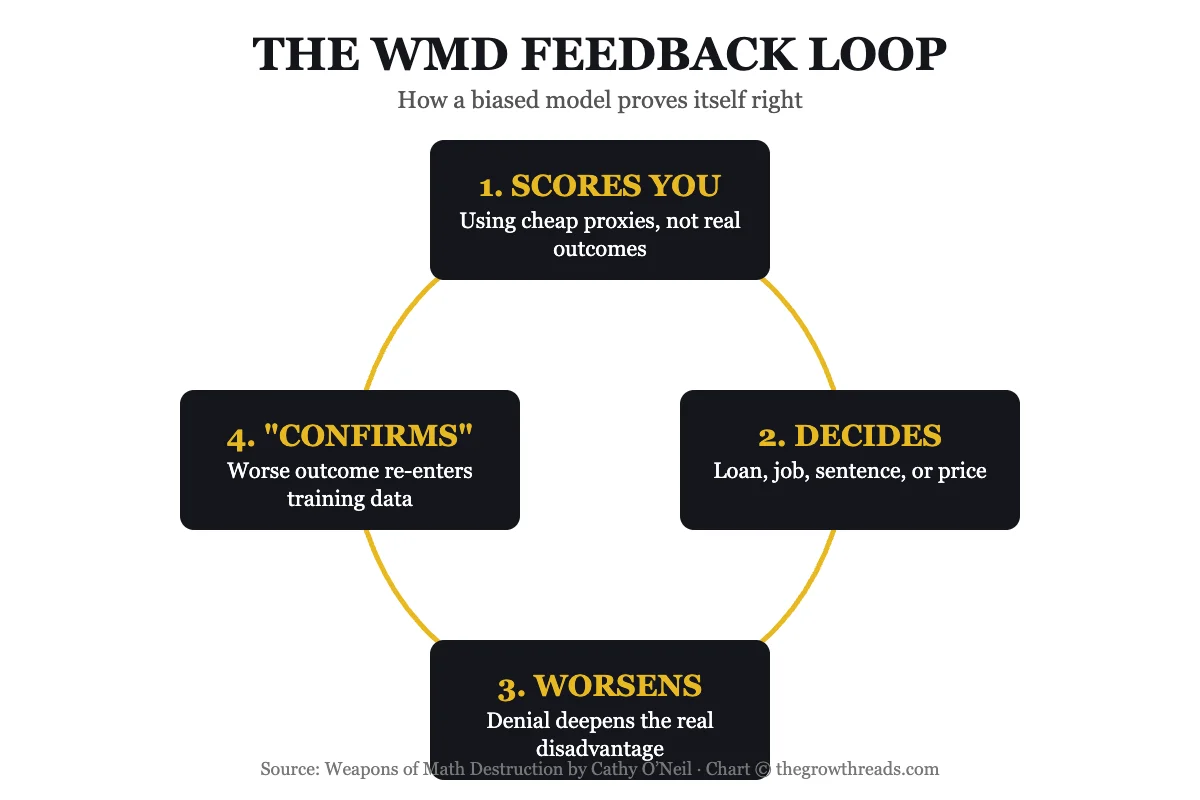
- Feedback loops make WMDs self-confirming. A biased decision worsens someone’s real situation, and that worse outcome then “proves” the model was right.
- Scale turns a local bias into a systemic one. One flawed assumption, applied to millions of people, does more damage than any single biased human ever could.
- Legitimate models are transparent and correctable. A credit score you can see and appeal is not the same species as a hiring algorithm no one can explain.
- “Efficient” is not the same as “fair.” WMDs are often adopted because they’re cheap and fast, not because anyone checked whether they’re accurate or just.
- Accountability requires auditing, not good intentions. O’Neil argues for regular, independent testing of high-stakes models for discriminatory impact — the same way we audit finances.
What is Weapons of Math Destruction about?
Weapons of Math Destruction (2016) by mathematician Cathy O’Neil argues that many of the algorithms scoring us in education, hiring, credit, and criminal justice are opaque, large-scale, and actively harmful — and shows how to tell those “WMDs” apart from models that are simply doing their job well.
About the author
Cathy O’Neil is a mathematician who earned her PhD at Harvard, taught at Barnard College, and then moved into quantitative finance, working at the hedge fund D.E. Shaw through the 2008 financial crisis. Watching mathematical models help trigger a global collapse — and seeing colleagues walk away unaccountable — pushed her out of finance and into data science, and eventually into public writing about algorithmic harm. She writes the “mathbabe” blog, helped organize Occupy Wall Street’s Alt Banking group, and later founded ORCAA, a firm that audits algorithms for bias. Weapons of Math Destruction won the Euler Book Prize and was a National Book Award longlist finalist. Explore all Cathy O'Neil book summaries →
Key concepts at a glance
| Concept | What it means | Use it when |
| WMD (Weapon of Math Destruction) | A model that is opaque, runs at scale, and damages the people it scores | Auditing any algorithm that materially affects people’s lives |
| Toxic triad | Opacity + scale + damage — the three traits that make a model dangerous | Quickly triaging whether a system deserves scrutiny |
| Proxy | A measurable stand-in for something hard to measure directly | Spotting where bias sneaks into a model’s design |
| Feedback loop | A biased decision that worsens outcomes, which then “confirms” the model | Explaining why a bad model gets more entrenched, not less, over time |
| Value-added model | Scoring teachers by predicted vs. actual student test gains | Understanding a specific, heavily criticized real-world WMD |
| Algorithmic audit | Independent testing of a model for accuracy and discriminatory impact | Proposing a fix once a WMD is identified |
| E-score | An unregulated credit-like score built from unrelated personal data | Understanding how consumer data gets repurposed to gatekeep opportunity |
Part 1: What makes a model a WMD
O’Neil opens with her own origin story: a quant on Wall Street who watched mathematical models — trusted precisely because they looked objective — help inflate and then detonate the 2008 housing bubble. That experience gives the book its central move: models are not neutral. Every model encodes a choice about what to optimize for, and those choices reflect the goals and blind spots of the people who built them. A model built to predict which loan applicants will repay, for instance, has to decide what “repay” means, over what time window, using which historical data — and each of those decisions can quietly bake in the biases of the past.
From that foundation, O’Neil defines the toxic triad that separates a WMD from an ordinary model. First, opacity: the people scored by a WMD can’t see its inner workings or challenge a bad result, the way you might dispute an incorrect line on a bill. Second, scale: a WMD doesn’t just affect one classroom or one loan applicant — it runs across a school district, a state prison system, or a national hiring pipeline, multiplying one flawed assumption millions of times over. Third, damage: a WMD actively works against the interests of the person it’s scoring, rather than helping them.
The teacher value-added model is her clearest case study. School districts adopted formulas that scored teachers by comparing predicted versus actual student test-score gains, then used those scores to fire “low-performing” teachers — including veteran teachers with strong track records and glowing peer reviews, whose scores swung wildly year to year for reasons no one could explain. The model was opaque (teachers couldn’t see the calculation), it ran district-wide (scale), and it ended careers on statistically noisy grounds (damage). The recidivism-risk scores used in sentencing tell a similar story: questionnaires that ask about a defendant’s neighborhood, family criminal history, and friendships feed into a “risk” number that judges use to set bail or sentence length — quietly re-scoring poverty and race as criminal risk, with no way for the defendant to see or contest the math.

TGR Note: The toxic-triad test pairs well with The Ethical Algorithm, which picks up where O’Neil leaves off and asks how fairness constraints can actually be built into code rather than bolted on afterward as policy.
Part 2: Where WMDs hide in everyday life
Once you have the toxic triad, O’Neil spends the book’s middle section showing how many ordinary systems qualify. College rankings are one of the sharpest examples: U.S. News built a formula rewarding metrics like spending per student, alumni giving, and acceptance-rate exclusivity — and because the ranking itself became valuable, schools began optimizing directly for the formula’s inputs rather than for education, chasing selectivity and spending rather than affordability or outcomes. A well-meaning attempt to inform consumers became a WMD that distorted the industry it measured.
Online advertising for for-profit colleges follows the same shape at a more predatory level: recruiting algorithms are tuned to find people who are anxious about their job prospects and susceptible to a hard sell, then target them with ads promising a credential that, for many, leads mostly to debt. Hiring algorithms complete the pattern in the workplace — automated resume screens and “culture fit” personality tests filter out candidates based on proxies (a gap in a resume, a specific phrasing on a questionnaire) that correlate weakly with job performance but strongly with race, class, or disability history, and applicants rarely learn why they were rejected.

TGR Note: For the criminal-justice thread specifically, Automating Inequality goes deeper into how risk-scoring tools reshape welfare, policing, and child-welfare systems for the poor.
Part 3: WMDs at work and in your wallet
The book’s third act moves into the systems that shape ordinary financial life. Workplace scheduling software optimizes shifts purely for labor-cost efficiency, generating the erratic, last-minute schedules that make it nearly impossible for hourly workers to arrange childcare, hold a second job, or attend school — the algorithm never sees the human cost, only the spreadsheet. Corporate wellness programs, similarly, quietly convert health data (weight, cholesterol, activity trackers) into insurance-premium penalties, effectively taxing employees for medical conditions under the banner of “encouraging healthy choices.”
Credit is where O’Neil’s proxy argument lands hardest. Traditional credit scores at least use financial history — late payments, credit utilization — which, while imperfect, is at least related to the thing being measured. But unregulated “e-scores” go further, inferring creditworthiness from browsing habits, social connections, and zip code, effectively re-encoding historical redlining into a shiny new algorithmic form. Auto and home insurers do something similar with pricing models that charge poorer, majority-minority zip codes higher premiums than wealthier ones with comparable accident rates, because the model has learned that poverty correlates with claims — regardless of why.
Part 4: Politics, accountability, and the way forward
The book’s final movement widens the lens to democracy itself. O’Neil examines political microtargeting — campaigns using data models to show different voters different, sometimes contradictory, messages, and to identify which citizens are worth mobilizing versus safely ignoring. The same modeling logic that decides who gets a loan can decide whose vote is worth courting, with no public visibility into how those decisions get made.
O’Neil doesn’t end on alarm, though — she ends on a concrete proposal: treat high-stakes algorithms the way we treat financial audits or clinical trials. Require testing for discriminatory impact before deployment, ongoing monitoring after, and a real channel for individuals to see and appeal their scores. She sketches an informal “Hippocratic Oath” for modelers: understand the potential harm of your model, not just its accuracy, before you ship it. None of this requires abandoning data-driven decisions — it requires treating a scoring system with the same seriousness we’d apply to any other tool capable of large-scale harm.

TGR Note: If this section resonates, The Age of Surveillance Capitalism extends the accountability argument to the data-collection side of the pipeline — how your data gets gathered in the first place, before any model even runs.
Who is Weapons of Math Destruction best for — and who should read something else first?
This book is best for managers, developers, policy readers, and anyone who has ever been scored, filtered, or ranked by a system they couldn’t see inside — which, in 2026, is nearly everyone. It requires no math background; O’Neil writes for a general audience and keeps the technical detail light. If you want the deeper causal-reasoning toolkit behind why models mislead, pair it with The Book of Why. If you’re specifically interested in criminal-justice and welfare algorithms, start with Automating Inequality instead — it goes deeper on that one domain than O’Neil’s broader survey does.
Questions to reflect on
- Which algorithms currently score you — credit, insurance, hiring, ads — and how many of them could you actually see or appeal if you disagreed?
- Think of a system you manage or build. Would it pass the toxic-triad test: is it opaque, does it run at scale, and could it damage someone unfairly?
- Where in your own decisions do you rely on a proxy (a resume gap, a credit score, a star rating) instead of the thing you actually care about?
- Have you ever seen a feedback loop up close — a bad score that made someone’s real situation worse, which then “justified” the score?
- What would it take for the systems that affect your life to publish regular, independent audits of their fairness?
🔥 Ready to see the algorithms that score you differently?
Grab Weapons of Math Destruction and start asking better questions of every system that ranks you.
How to apply Weapons of Math Destruction (7-day plan)
- Day 1: List every algorithm you know is scoring you right now — credit, insurance, ad targeting, workplace tools.
- Day 2: Pick one and run the toxic-triad test: is it opaque, at scale, and potentially damaging to you?
- Day 3: Try to find and read that system’s privacy policy or scoring explanation, if one exists.
- Day 4: Request your own data or score where possible (many credit bureaus and ad platforms allow this).
- Day 5: If you build or manage any scoring system at work, write down what proxy it uses and what it might be missing.
- Day 6: Ask one colleague or friend the five questions from this guide about a tool your team relies on.
- Day 7: Decide one system — personal or professional — where you’ll push for more transparency or a human appeal path.
Frequently asked questions
What does “WMD” stand for in this book?
It stands for “Weapon of Math Destruction” — O’Neil’s term for an algorithm that is opaque (you can’t see how it scores you), operates at scale (affecting large populations), and causes damage (works against the interests of the people it evaluates). Not every algorithm is a WMD; plenty of models are transparent and correctable, which is exactly the distinction the book asks readers to make.
Is this book against algorithms and data science in general?
No — O’Neil is a mathematician and former quant who values good models. Her argument is narrower and more practical: some models are built and deployed without checking whether they’re fair or accurate, and those specific models deserve scrutiny. She proposes auditing and transparency as fixes, not abandoning data-driven decision-making altogether.
What’s the most famous example from the book?
The teacher value-added model, which scored public school teachers by comparing predicted versus actual student test-score gains. Several capable, well-reviewed teachers were fired based on scores that swung wildly year to year for reasons the model couldn’t explain — a textbook case of opacity, scale, and damage combining into real harm.
Has anything changed since the book was published in 2016?
Some — algorithmic-accountability laws, AI audit requirements, and “right to explanation” rules have expanded in several jurisdictions, and O’Neil’s own auditing firm, ORCAA, has done paid work assessing hiring and other tools. That said, most of the systems she describes (credit scoring, hiring filters, insurance pricing) remain largely unregulated in the U.S., which is part of why the book still reads as current.
Do I need a math or statistics background to read this?
No. O’Neil deliberately writes for a general audience and explains every technical idea in plain language with concrete stories. The math stays conceptual — you’ll understand feedback loops and proxies without ever seeing an equation.
How is this different from Automating Inequality by Virginia Eubanks?
Both books cover algorithmic harm, but O’Neil surveys a wide range of domains — education, hiring, credit, insurance, politics — with a memorable diagnostic framework (the toxic triad), while Eubanks goes deep on one area: how automated tools reshape welfare, policing, and child-protective systems specifically for poor Americans. Reading them together gives both the framework and the on-the-ground detail.
What’s one thing I can do after reading this?
Start asking the five questions from this guide about any system that scores you or your work — can you see the score, can you appeal it, was it tested for unfair impact, does opacity benefit someone, and is there a human backstop. Asking is often enough to surface whether a system was built responsibly.
Related summaries
Continue exploring algorithmic accountability and the future of technology with these related summaries: Automating Inequality, The Age of Surveillance Capitalism, The Ethical Algorithm, and The Book of Why. For more AI and technology reading, see our Best AI & Technology Books pillar guide.
How we analyze books: we read the full text, cross-check key claims and examples against the author’s public interviews and cited sources, and build original diagrams and application plans rather than reproducing the book’s text. Read our full methodology.
Related Technology Summaries
Life 3.0 Summary & Review: What Happens After Superintelligence Arrives
The Algorithmic Leader Summary & Review
The Book of Why Summary & Review: How to Think in Causes, Not Just Correlations
The Singularity Is Near Summary & Review: Why Kurzweil Thinks 2045 Changes Everything
Working with AI Summary & Review: What 29 Real Deployments Actually Prove