

★★★★☆ — 4.4/5 — A clear-eyed, urgent case that this automation wave is different from every one before it.
Best for: Anyone in a “safe” white-collar career who wants to understand why credentials alone may no longer guarantee job security.
Reading time: ~7 hrs to read the book · 12 min to read this guide.
Difficulty to apply: Moderate — the ideas are simple, but acting on them means rethinking career assumptions most of us were never taught to question.
Rise of the Robots in one minute
The jobs automation threatens next aren’t just factory jobs — they’re yours, too, no matter how many degrees hang on your wall. Martin Ford’s Rise of the Robots argues that AI and machine learning are starting to automate cognitive work — the pattern-recognition, analysis, and judgment that lawyers, radiologists, journalists, and analysts get paid for — not just the routine physical labor earlier technology displaced. Past disruptions were painful but temporary: machines took over one narrow task, and the economy eventually generated new jobs to absorb displaced workers. Ford’s worry is that this disruption is broader and faster than the economy’s historical capacity to invent new work, which could produce structural unemployment and inequality that markets alone won’t fix. It’s not a call to panic — it’s a case for taking the possibility seriously, updating how we think about careers and education, and starting a real conversation about policies like universal basic income before the transition forces our hand.
Key takeaways
- This wave targets cognitive work, not just manual work: machine learning increasingly performs pattern-recognition tasks — diagnosing scans, reviewing contracts, writing routine reports — that once required a degree.
- “Routine” is the real dividing line, not “blue-collar” vs. “white-collar”: any job built from predictable, learnable patterns is exposed, regardless of the credential it requires.
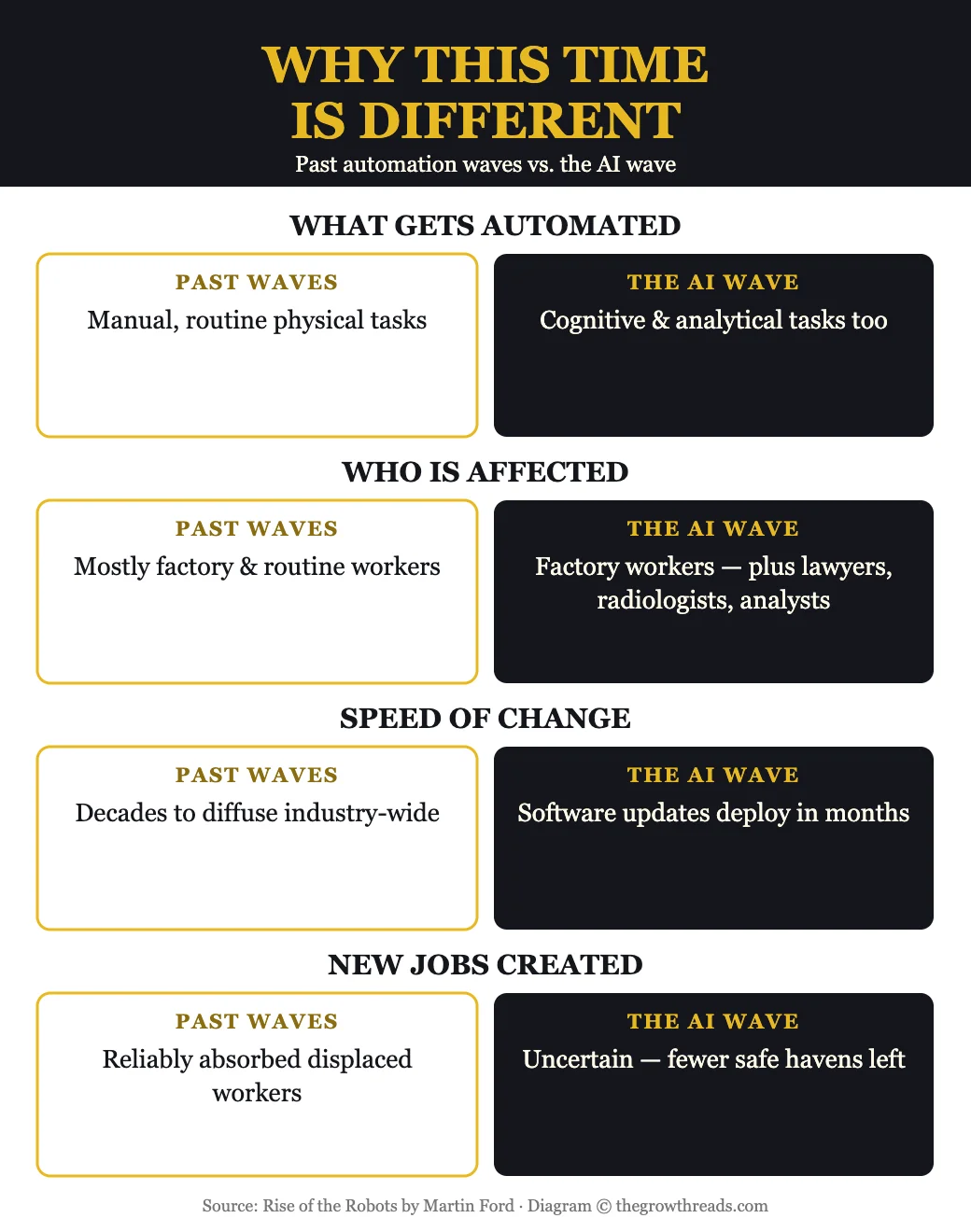
- Speed matters as much as scope: cloud deployment can roll a new capability out across an entire industry in months, not the decades earlier technologies took to diffuse.
- Education is not an automatic shield: a degree helped workers move up the skill ladder during past disruptions, but offers less protection when the automated tasks are themselves cognitive.
- Productivity and pay have been quietly decoupling: value created by automation increasingly flows to the owners of capital and algorithms rather than to the workers whose tasks were streamlined.
- Historical “creative destruction” isn’t a law of nature: new jobs appeared after past disruptions because humans still had an advantage; that advantage narrows as machines take on cognitive tasks.
- Consumer spending power is the economy’s blind spot: an economy that automates away too many paychecks risks undermining the consumer demand businesses depend on.
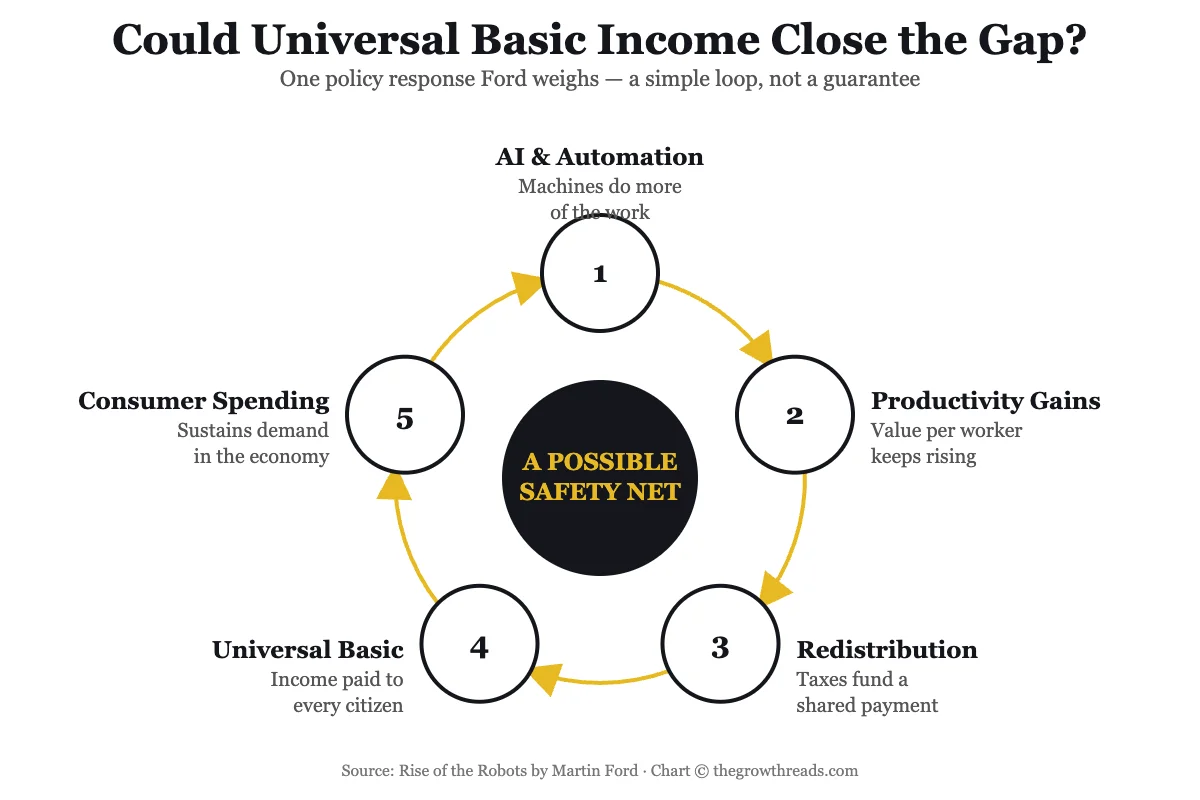
- Universal basic income moves from fringe idea to serious policy tool: Ford treats a guaranteed income not as charity but as a plausible way to keep purchasing power flowing if jobs can’t.
- Waiting for someone else to solve this is the riskiest strategy: individuals, employers, and governments all have a role in adapting early rather than reacting late.
- The book’s real value is the framework, not the specific numbers: some 2015-era statistics have aged, but the underlying logic — narrow AI eating routine cognitive tasks — has only strengthened since.
What is Rise of the Robots about?
Rise of the Robots is Martin Ford’s argument that AI and machine learning are automating cognitive, not just manual, work — spreading across manufacturing, retail, and white-collar professions faster than the economy can generate offsetting jobs, which could mean structural unemployment, deeper inequality, and a need for policies like universal basic income.
About the author
Martin Ford is a Silicon Valley entrepreneur and futurist who has spent decades building technology companies from the inside while watching automation reshape which tasks machines could plausibly take over next. Rise of the Robots, published in 2015, won the Financial Times and McKinsey Business Book of the Year award and helped move the “AI and jobs” conversation out of academic journals and into mainstream debate. Ford writes as a technologist rather than an economist by training, which gives the book a practitioner’s eye for what software can realistically do — and a willingness to say plainly when a task looks automatable well before most institutions are ready to admit it. He has continued writing and speaking on AI, automation, and the future of work in the years since. Explore all Martin Ford book summaries →
Key concepts at a glance
| Concept | What it means | Use it when |
| Routine cognitive work | Predictable, pattern-based mental tasks (reviewing, summarizing, calculating) machine learning can learn to replicate | Auditing your job for parts that follow a repeatable script |
| The “job polarization” trend | Growth concentrating at the very top and very bottom of the labor market, hollowing out the middle | Evaluating whether a mid-skill career path is getting riskier |
| Decoupling of productivity and pay | Output per worker rising while median wages stagnate, as automation’s gains accrue to capital owners | Understanding why “the economy is growing” doesn’t mean “workers are better off” |
| Structural technological unemployment | Job losses from automation the economy fails to offset with enough new work | Distinguishing a temporary downturn from a longer-term labor shift |
| Universal basic income (UBI) | A regular, unconditional cash payment to all citizens, proposed as a cushion if jobs can’t keep pace | Framing policy conversations about safety nets |
| The “job-creation lag” | The historical gap between a technology destroying old jobs and the economy generating enough new ones | Judging claims that “technology always creates more jobs than it destroys” |
| Narrow AI vs. general intelligence | Today’s AI excels at specific tasks without general reasoning — but “specific” now covers more professional tasks than before | Separating realistic automation risk from science-fiction scenarios |
Part 1: The Automation Frontier Moves Into the Office
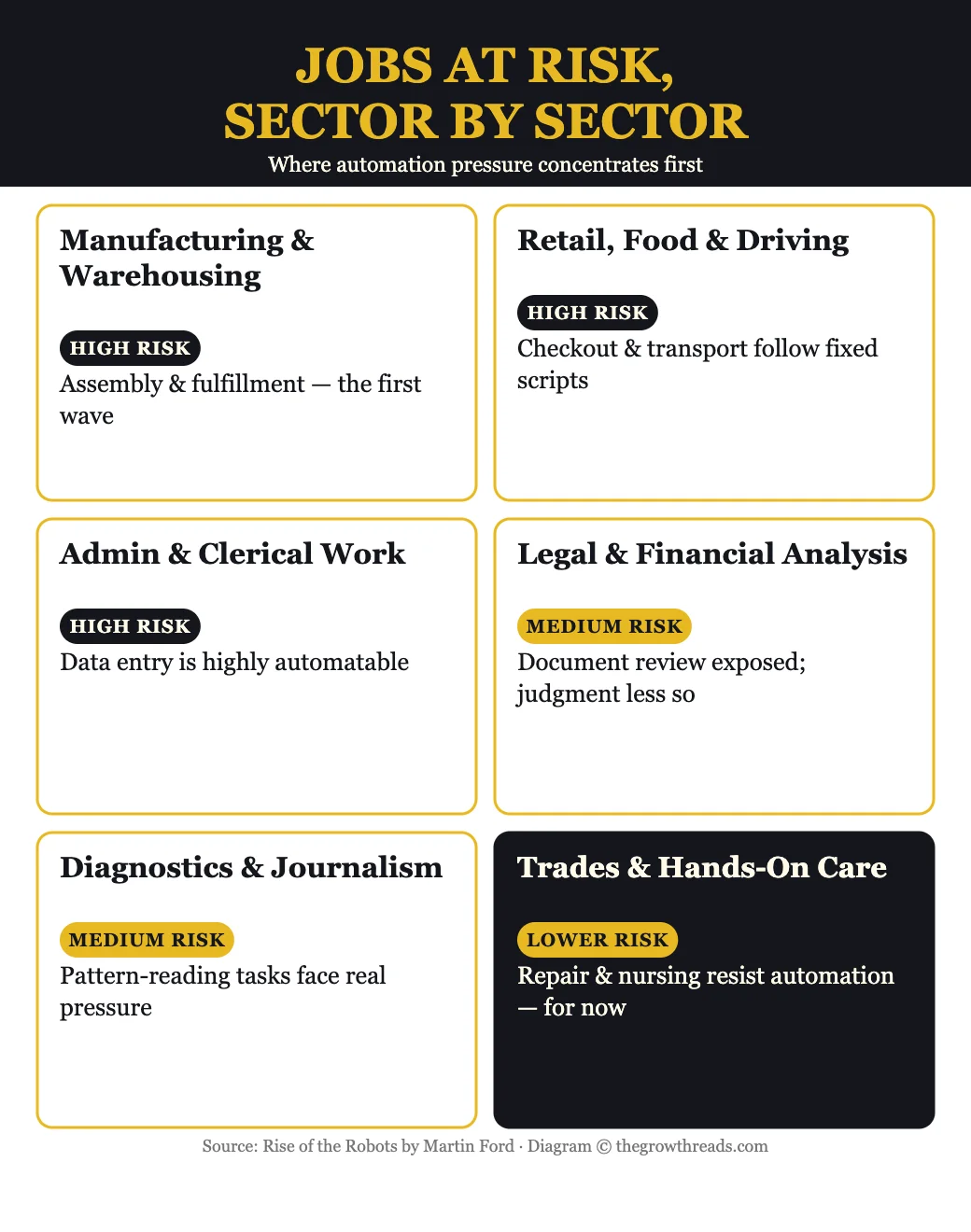
Ford opens where most automation stories start: the factory floor. Industrial robots have displaced routine manufacturing labor for decades, and warehouses have automated much of the physical work of moving goods. None of this is new — Ford treats it as scene-setting, the well-documented first act of a longer story.
The real argument begins when he moves the same logic into retail, food service, and transportation, then into spaces most readers assume are safe: paralegal document review, radiology scan interpretation, financial report generation, journalism, and aspects of software development itself. What connects a self-checkout kiosk to a model that flags anomalies on a mammogram isn’t the collar color of the worker it replaces — it’s whether the task follows a learnable pattern. A parking attendant and a first-pass loan underwriter are, in this framework, doing more similar work than either would expect.
Ford is careful to distinguish this from a doomsday claim that “all jobs disappear.” His point is narrower: within almost every profession, a meaningful share of tasks are routine enough to automate, even if the profession itself survives in a smaller, more specialized form. A radiologist doesn’t vanish, but a practice that used ten radiologists to keep up with scan volume might need three, assisted by software that pre-screens routine cases — a real shock for the other seven, even though “radiologist” technically remains a job description that still exists.
TGR Note: Erik Brynjolfsson and Andrew McAfee’s The Second Machine Age covers similar ground from a more optimistic angle — both agree automation is accelerating, but Brynjolfsson and McAfee lean harder on human-machine collaboration generating new work. Reading them back to back stress-tests Ford’s more cautious view.
Part 2: Why This Time Is Different
Every generation has its automation skeptics and panics, and Ford anticipates the obvious objection: “people said the same about the printing press, the tractor, and the ATM, and jobs turned out fine.” His response isn’t to dismiss that pattern — it’s to argue two things have changed that make it less reliable going forward.
The first is breadth. Earlier automation waves were narrow enough that displaced workers could usually retrain into an adjacent, less-automated task. When cognitive work is what’s being automated, the retraining path narrows, because the same techniques that eliminated one analytical task tend to generalize to nearby ones fairly quickly. There are fewer safe adjacent lily pads to jump to.
The second is speed. A factory retooling with industrial robots is a slow, capital-intensive process — years to plan and roll out, giving communities time to see it coming. A model that automates document review can deploy across a company, then license to an entire industry, within months. The diffusion curve is far steeper than anything before it, compressing the adjustment window for workers, employers, and policymakers alike.
Ford pairs breadth and speed with a quieter third point: this wave doesn’t require the machine to be smarter than the human it replaces, only cheaper and consistent enough at a narrower slice of the job. A loan-underwriting model doesn’t need judgment as good as a veteran’s — just good enough on the routine 80% of applications that a human is only needed for the hard 20%. That’s a far lower bar than “general intelligence,” and it’s already being cleared across a growing list of professions.
TGR Note: Klaus Schwab’s The Fourth Industrial Revolution makes a related “speed and breadth” argument at the level of whole economies rather than individual careers — useful macro context alongside Ford’s ground-level view.
Part 3: The Education Trap and the Rise of Inequality
For decades, the standard advice for workers worried about automation was simple: get more education. Ford tests this advice and finds it holds up less well than it used to. It worked when automation targeted manual and routine tasks, because more education reliably moved a worker into cognitive, non-routine work machines couldn’t yet touch. But if the new wave targets cognitive tasks specifically, “get more education” stops being a reliable escape route — it just moves you further up a ladder the machines are now climbing too.
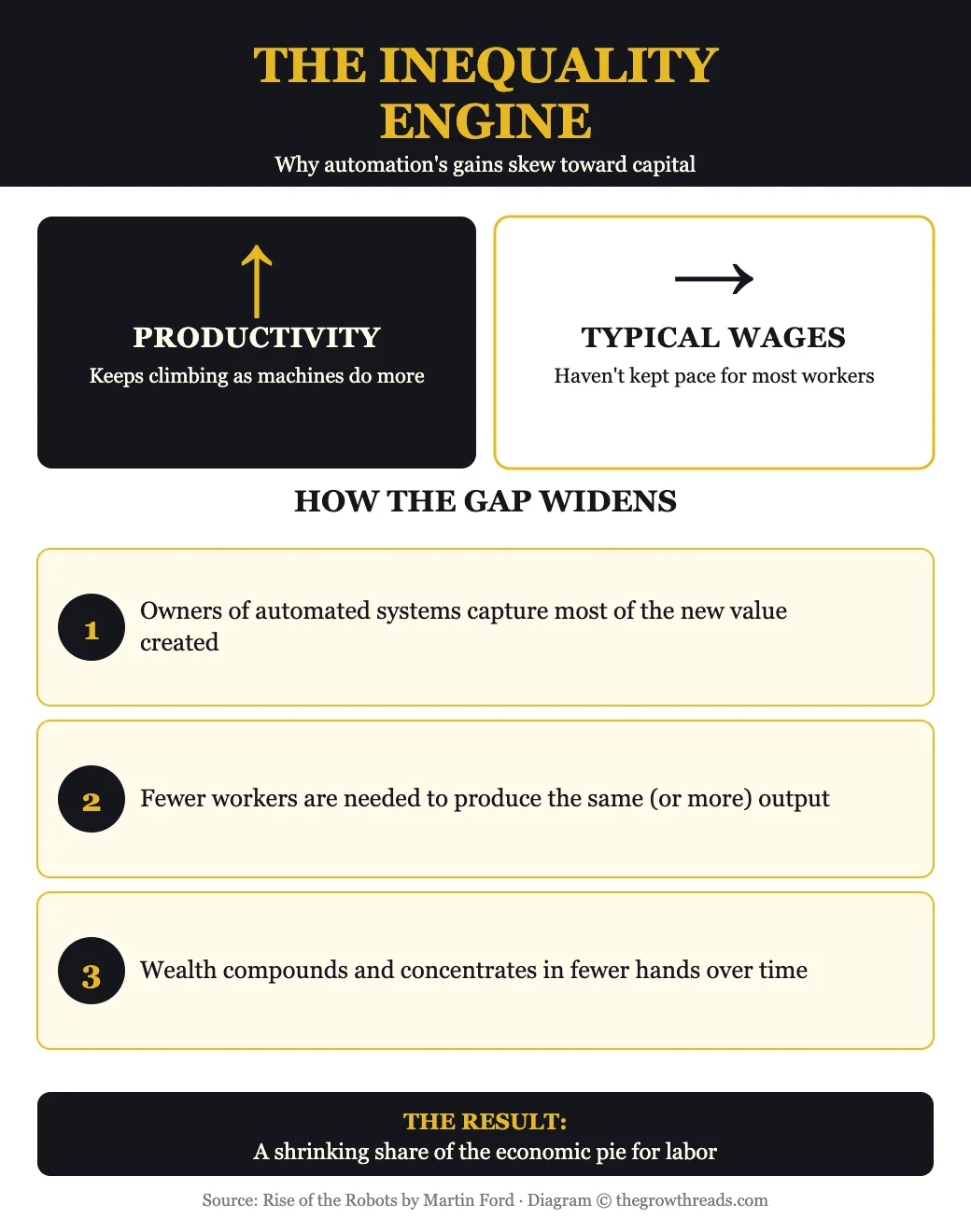
This is where the book shifts from technology to political economy. If automation increasingly performs the tasks that used to justify a worker’s wage, the economic value that task generated doesn’t disappear — it flows somewhere else. Ford argues it flows disproportionately to the people who own the automated systems: the software, the models, the capital. Workers whose tasks get automated don’t share proportionally in the productivity gains their old jobs helped create; owners of the replacing technology do. Repeated across enough industries, this shows up as a widening gap between overall growth and typical incomes — GDP climbs while paychecks stall.
Ford doesn’t frame this as a moral failing of any single business — a company automating a task it can automate is behaving rationally under competitive pressure. His argument is that millions of individually rational decisions add up to a structural one: wealth concentrates, purchasing power thins across the population, and the tax base funding social support narrows just as demand for it grows.
TGR Note: Cathy O’Neil’s Weapons of Math Destruction zooms into a related harm — how hiring, lending, and scheduling algorithms can quietly encode and amplify the inequality Ford describes at the economic level. Strong pairing for the macro argument plus the on-the-ground mechanics.
Part 4: Rethinking the Social Contract — UBI and Other Responses
If the traditional playbook — retrain, get a degree, wait for the market to create new jobs — is less reliable this time, the book’s final act asks what a better one looks like. Ford surveys the usual proposals: retraining programs, shorter work weeks, taxing automation, expanded public-sector employment — with a technologist’s skepticism about scale. Retraining gets the hardest look: it works for individuals but has a poor record of working fast enough, at large enough scale, to keep pace with a labor market shifting under people’s feet.
The idea Ford defends most is universal basic income: an unconditional cash payment to every citizen, funded through some mix of taxation and automation’s own productivity gains. His case isn’t utopian — he frames UBI as a pragmatic backstop for a structural problem, not a replacement for work or purpose. If machines keep taking over routine value-creation, something has to keep purchasing power flowing to people who no longer earn it through a paycheck, or the whole system — including businesses selling to those people — eventually suffers insufficient demand.
Ford doesn’t pretend UBI is simple. He acknowledges the funding challenge is real, the political challenge bigger, and that work’s psychological role isn’t solved by writing a check. What he’s arguing for is taking the idea seriously — not as a fringe proposal but as a mainstream policy tool worth designing carefully before the transition it’s meant to cushion arrives. A decade later, UBI pilots in multiple countries have moved that conversation into the mainstream, even where programs look different from what he proposed.
TGR Note: Shoshana Zuboff’s The Age of Surveillance Capitalism examines a related concentration of power — not just who owns the automation, but who owns the data training it. Read alongside Ford, it rounds out where economic power accumulates in an automated economy.
Who is Rise of the Robots best for — and who should read something else first?
This book is best for mid-career professionals who feel reasonably secure in a “knowledge work” job and want an honest assessment of how exposed that security really is. It’s also valuable for anyone shaping policy, hiring, or strategy around automation, since Ford’s framework for separating “routine” from “genuinely irreplaceable” tasks outlasts any specific statistic in the book. For a more optimistic counterweight, pair this with The Second Machine Age or Superagency. For a broader, industry-level view, start with The Fourth Industrial Revolution instead.
Questions to reflect on
- Which tasks in your current role are most routine — and which require judgment a machine can’t yet replicate?
- If you redesigned your career around “what stays uniquely human,” what would you spend the next year learning?
- Does your workplace treat automation as happening to employees or planned with them?
- How would your finances hold up against a sudden six-month income gap — and what would close it fastest?
- Where do you stand on universal basic income before reading this book, and has that shifted by the end?
🔥 Ready to see the full argument for yourself?
Ford’s case is more persuasive with the full evidence — grab a copy and decide where you land.
How to apply Rise of the Robots (7-day plan)
- Day 1 — Audit your own tasks. List what you do in a typical week and mark each task “routine/predictable” or “judgment-heavy.” Be honest about the split.
- Day 2 — Research your field’s automation trendline. Search for how AI tools are already piloted in your industry — not to panic, but to see the pattern early.
- Day 3 — Identify your judgment-heavy 20%. Pick the parts of your job hardest to automate — relationship-building, creative framing, complex calls — and spend more time there.
- Day 4 — Learn one AI tool relevant to your work. Rather than treating automation as something that happens to you, become the person on your team who knows how to use it.
- Day 5 — Build a financial buffer plan. Calculate how many months of expenses your savings would cover, and set one concrete target to extend that runway.
- Day 6 — Have one honest conversation. Talk to a manager, mentor, or peer about how automation is likely to change your role in the next two to three years.
- Day 7 — Form a view on policy. Read one serious piece on universal basic income and decide where you currently stand — you’ll be a more informed voice in a louder conversation.
Frequently asked questions
Is Rise of the Robots still relevant, given it was published in 2015?
Yes — while some specific statistics and case studies have aged, best read as the book’s estimates at time of writing rather than current figures, the underlying argument has only gained relevance. The generative AI wave that followed automates an even broader range of cognitive tasks than Ford described, making his core framework — routine tasks are exposed regardless of skill level — more applicable today, not less.
Does Martin Ford think all jobs will eventually be automated?
No. His argument is narrower: within most professions, a meaningful share of tasks are routine enough to automate, which can shrink headcount and restructure careers even where the profession survives. He distinguishes this from a claim that human labor disappears entirely.
What does the book say about universal basic income?
Ford treats UBI as a pragmatic policy response, not a utopian ideal — a mechanism to keep purchasing power flowing if automation outpaces job creation. He acknowledges the funding and political challenges are real and treats it as a serious proposal worth designing carefully, not a simple fix.
Is more education still good career advice, according to Ford?
Education still matters, but Ford questions whether it’s an automatic shield the way it was during past disruptions. If the automation wave targets cognitive tasks specifically, more schooling doesn’t automatically move a worker into safer territory the way it did when automation mostly hit manual labor.
How is this book different from other AI-and-jobs books?
Ford writes as a Silicon Valley technologist rather than an academic economist, giving the book a practitioner’s read on what software can plausibly do next. It’s also notably early — published in 2015, well before generative AI made this a mainstream concern — part of why it won the Financial Times/McKinsey Business Book of the Year award.
Should I be worried about my specific job after reading this?
The book prompts a clear-eyed audit, not panic. The useful exercise is separating the routine, pattern-based parts of your role from the judgment-heavy parts, then investing more of your time and skill-building in the latter — the exercise this guide’s 7-day plan walks through directly.
Is anything in this summary financial or career advice I should follow without further research?
No — this summary and the book offer a framework for thinking about automation risk, not individualized financial or career advice. Decisions about savings, career changes, or job security should rest on your own full circumstances, ideally with a qualified professional’s input where relevant.
Related summaries
- The Second Machine Age — Erik Brynjolfsson & Andrew McAfee’s more optimistic take on the same core question.
- The Fourth Industrial Revolution — Klaus Schwab’s broader, industry-and-economy-level view of the same disruption.
- Weapons of Math Destruction — Cathy O’Neil on how algorithms can encode and amplify the inequality Ford describes.
- The Age of Surveillance Capitalism — Shoshana Zuboff on who owns the data powering the automation wave.
- See more in our Best AI & Technology Books guide.
How we analyze books: we read the source material closely, cross-reference key claims against the author’s other published work and interviews, and structure each guide around practical application rather than just summary. Read our full methodology.
Related Technology Summaries
Irresistible Summary & Review: The Six-Ingredient Hook Behind Your Habits
Machine, Platform, Crowd Summary & Review: Three Shifts Reshaping Every Industry
The Age of Surveillance Capitalism Summary & Review: How Big Tech Turned Your Life Into a Product
The Master Algorithm Summary & Review: Five Tribes, One Learning Machine
The Singularity Is Nearer Summary & Review: Kurzweil’s Case for 2029 and 2045