

★★★★☆ 4.4/5 — A memoir you can use as a checklist: name the metric, name who it skips, and keep a copy of the dissent.
Best for: Policy, trust-and-safety, and comms people inside growing platforms, and readers who want the meeting-room view behind a dashboard.
Reading time: ~8 hrs, guide: 16 min
Difficulty to apply: Moderate. The moves are small. The hard part is writing them down while you still want the seat.
Careless People in one minute
A growth metric can be perfect and still be an incomplete sentence. From 2011 to 2017 Sarah Wynn-Williams was Facebook’s director of public policy, the person sent to open doors with governments. Careless People, out in 2025, is her account of what that access cost. The title is Fitzgerald’s: careless people who smash things up and leave the mess.
The useful spine is a record, not the gossip. In Myanmar, hate speech outran two Burmese-speaking moderators in Dublin while the country was called a low priority. On China, censorship tools were designed for market entry and not launched. Inside the building, boundaries were treated as optional, and she was fired in 2017. Meta says parts of the book are outdated or false. Read that beside the pages. Then steal the method: write the metric, the missing person, and the sentence that never makes the update.
Key takeaways
- Priority is a decision: Calling a place “not a priority” keeps harm off the agenda without a vote.
- Headcount is policy: Two Burmese-language moderators in Dublin were the filter for a whole country.
- Write the takedown test: A 2015 rule, as she reports it, acted when the service or the staff were at risk, not simply when the speech was wrong.
- Design counts even if you do not ship: China tools were built and not launched. The design still shows the trade the room would make.
- The seat is not the standard: A meeting with a president feels like the job. A standard you would publish is the job.
- Keep an outside copy: A verbal boundary disappears when the invitation is the reward.
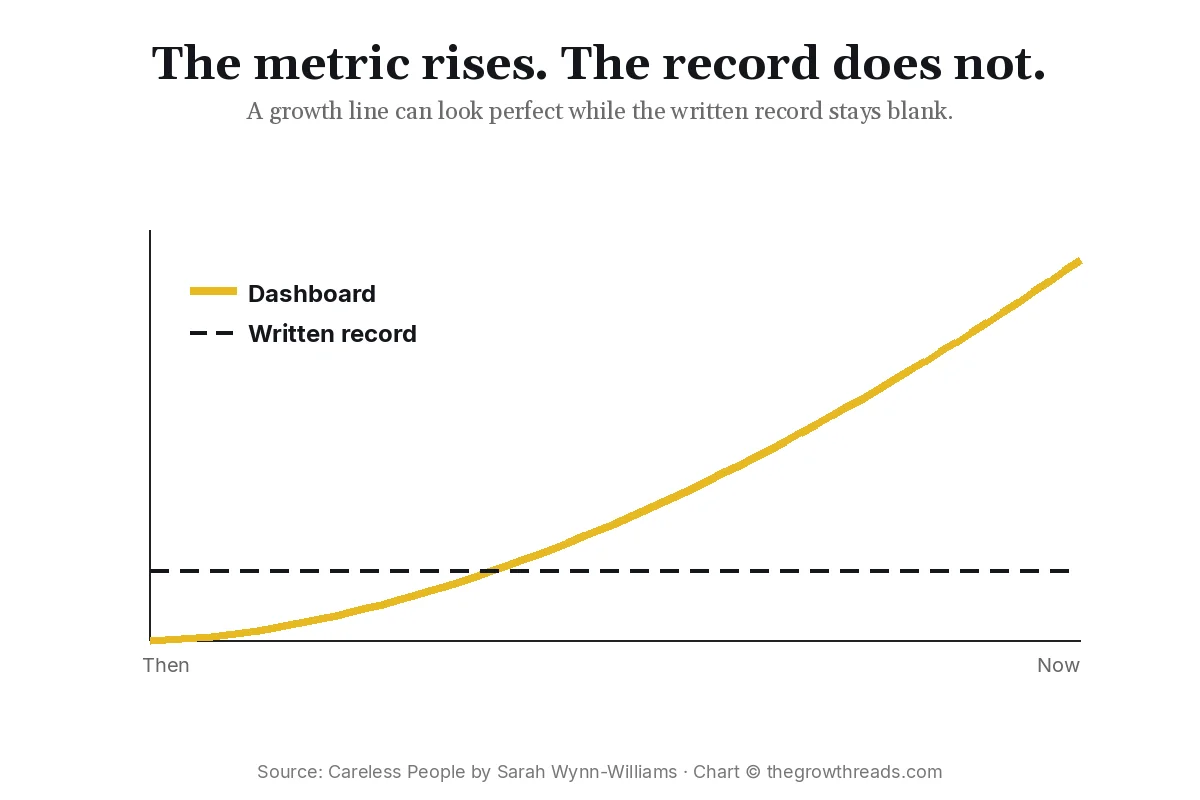
- The dashboard is not the record: The chart can rise while the missing sentence is the news.
- Put the denial next to the claim: Meta calls parts of the book false. Keep both documents, and keep your own.
- A record outlives a badge: Fired in 2017, she still had the SEC complaint, the book, and Senate testimony on April 9, 2025.
What is Careless People about?
Careless People is Sarah Wynn-Williams’s 2025 memoir of her years as Facebook’s director of public policy, from 2011 to 2017. She argues the company chased access and growth while harm in places like Myanmar, and a push into China, stayed off the official record.
About the author
Sarah Wynn-Williams is a New Zealand lawyer, diplomat, and author, born in 1979 or 1980. She joined Facebook in 2011 to build a public-policy function she believed the company lacked, and stayed until it terminated her in 2017. She later filed with the U.S. Securities and Exchange Commission and, in 2025, published this memoir while Meta tried to stop her promoting it. By late March the book was number one on the New York Times list. On April 9, 2025 she testified before the Senate Judiciary Committee. Her subject is the note you write when a powerful room would rather you did not. Explore all Sarah Wynn-Williams book summaries →
Key concepts at a glance
| Concept | What it means | Use it when |
|---|---|---|
| Careless people | People who smash things and leave the cleanup to others. | A win is cheered and the mess has no owner. |
| The seat | Access to leaders and the meeting where the decision is spoken. | Proximity starts to feel like proof of the work. |
| Not a priority | A label that drops a country or a harm off the queue. | Someone says a place can wait while speech there is already hot. |
| The two tests | A 2015 rule: act if the service may be blocked, or if staff are at risk. | Your real rule protects the company first. |
| The unshipped tool | Censorship designs for China that were built and not launched. | A roadmap item is defended with “we never shipped it.” |
| The outside copy | A concern stored where the employer cannot edit it. | You are about to raise a problem that could cost you the room. |
| The missing sentence | The line cut from the update so the metric stays clean. | The cut in a weekly note feels like relief. |
A seat at the table is not a standard
Wynn-Williams did not arrive as a cynic. She arrived as a New Zealand lawyer who thought connectivity could reach people slow institutions missed, and that Facebook was stumbling into that role with no map. The early job was to invent a public-policy team for a company governments had started to treat as infrastructure. A fast company loves that ambition. It sounds like statesmanship, and it opens doors.
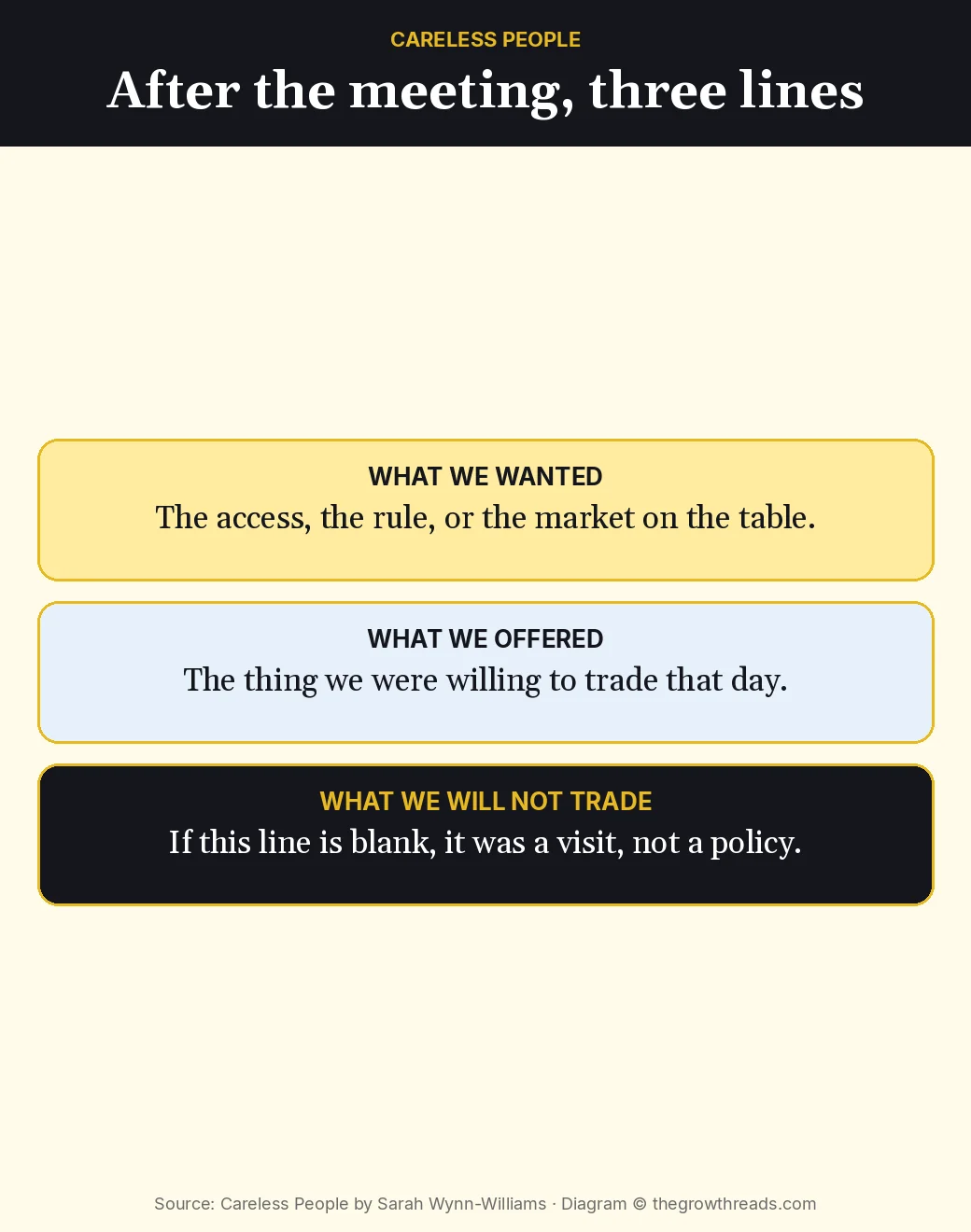
Doors are the trap. The memoir is full of flights, summits, and photographs with people who run countries. A policy lead who cannot get the meeting cannot do the work. The mistake is to let the meeting become the proof that the work was done. A seat tells you that you were invited. It does not tell you what you refused, what you translated, or who was absent when the rule was set. After the next meeting, write three lines: what we wanted, what we offered, and what we would not trade. If the third line is blank, it was a visit, not a policy.
TGR Note. Hooked is the product loop that keeps people tapping. This memoir is the calendar of the people who fly to capitals while that loop runs. The loop is the machine. The seat is how the machine gets permission. For the design test, keep The Design of Everyday Things nearby.
Myanmar was not a priority country
The Myanmar chapters are specific enough to use. Wynn-Williams describes Facebook carrying hate against the Rohingya, including the slur “kalar,” while the company could barely moderate Burmese. Her count: two Burmese-language moderators, both in Dublin, for the country. She writes that one waved hate through and removed human-rights posts, that she flagged a feared link to the junta, and that the content team dismissed her. A push to translate the Community Standards into Burmese met the line she quotes as “Myanmar isn’t a priority country.”
She also writes: “Myanmar would have been a better place if Facebook had not arrived.” You do not have to adopt that as your theory of the country. The mechanism is enough. A platform can arrive before the duty of care, which here was a headcount, a translation, and a refusal to treat a small market as if speech there could get people killed. “Not a priority” sounds like sequencing and works like a burial. When someone says a language or a queue can wait, write the label down and add the harm already happening. Priority is a dated choice.
TGR Note. The Attention Merchants is the history of harvesting attention and calling it a service. The Filter Bubble is how a ranked feed narrows what someone sees. Myanmar here is those ideas plus a staffing chart: a queue that ranked engagement above a language almost nobody in the building could read.
The takedown rule and the China project
Hold the China claim at the size the public record supports. Wynn-Williams says Facebook developed censorship tools to court Beijing: a chief editor who could remove posts, a way to shut the service during unrest, automatic detection of restricted terms, and ideas that would have weakened privacy for users in Hong Kong, including government access to their data. She also describes pressure around critic Guo Wengui’s account. The company built pieces of this and did not launch a China service. “We never shipped” is not the same sentence as “we never designed.”
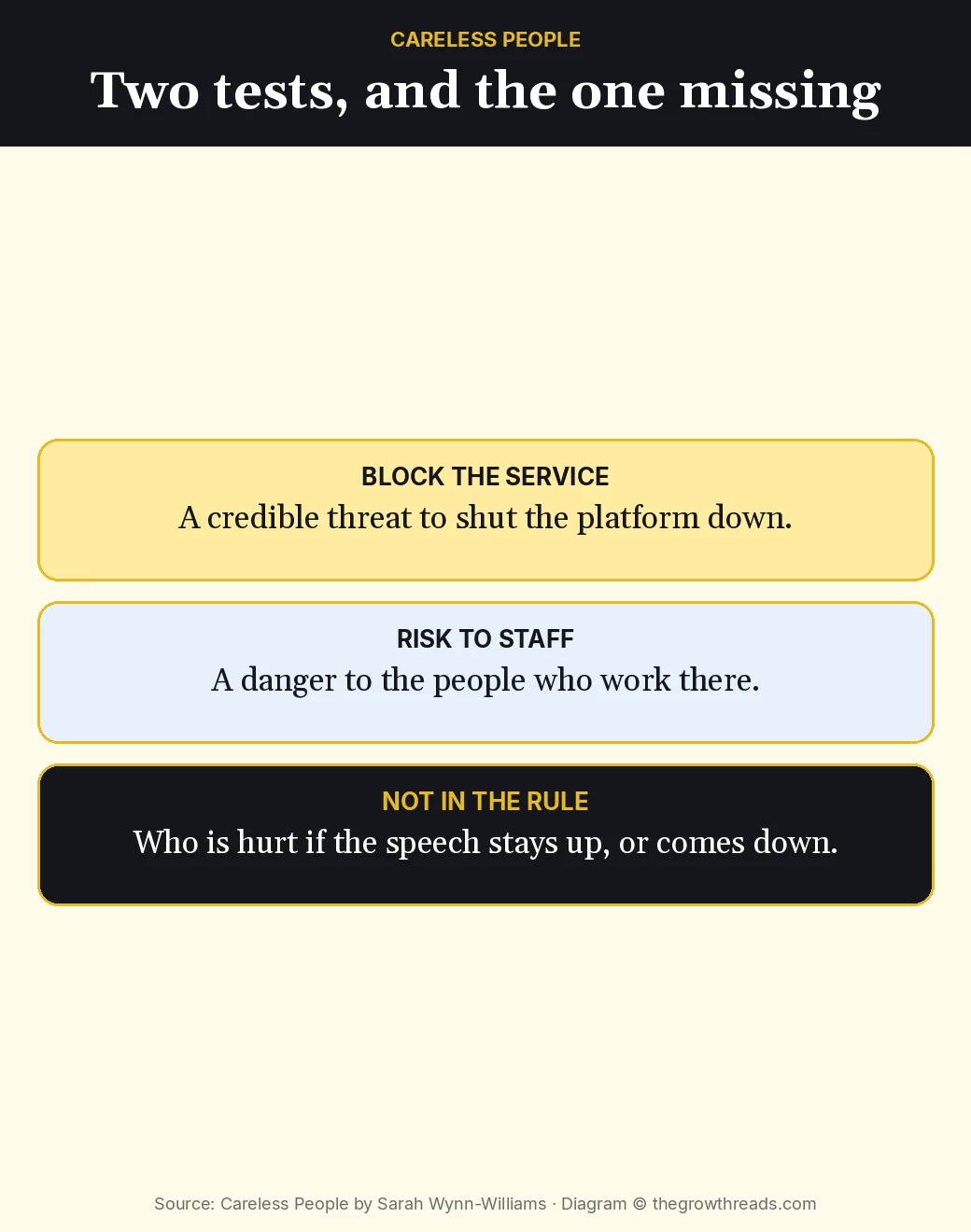
Beside that project she reports a February 2015 content rule. As she relays it, content a government wanted down would come down only if one of two tests was met: a credible threat to block Facebook, or a risk to employees. The tests protect the platform and the staff. They do not ask whether the speech is true, or who is hurt if it stays up or comes down. That is a crisp operating rule, and it does not sound like the public Community Standards.
Write the tests you actually use when a powerful outsider complains. If they are “will they hurt us” and “will our people be safe,” say so. You may keep that rule. You may not call it a speech principle. The Senate later named the China push Project Aldrin. On April 9, 2025 she told the Judiciary Committee that leadership had worked in step with Beijing. Meta says she mixes old reporting with false accusations. Leave both on the desk, then look at your own unshipped tools.
TGR Note. The Age of Surveillance Capitalism is the business model: behavior extracted, predicted, and sold. These chapters are the government deal beside that model. Empire of AI carries the cost question into the next platform wave. Same missing sentence in the update.
The record that outlived the job
The workplace chapters are easy to sensationalize, so keep the usable fact narrow. Wynn-Williams alleges sexual harassment and a culture in which senior leaders, including Sheryl Sandberg and Joel Kaplan, treated personal boundaries as optional, including during travel and around a medical emergency in childbirth. Meta says accusations about its executives are false. What a reader can take without acting as a court is the failure mode: when access is the currency, a boundary that lives only in the moment gets renegotiated by the person who controls the invitation.
Write the boundary before you need it. One sentence on a trip, on recovery time, and on who you tell if someone leans. Store a copy the company does not administer. Facebook terminated her in 2017. She later filed with the SEC and wrote the book. Arbitration tried to stop the promotion. Macmillan was not bound. By late March 2025 the book led the New York Times list, and in April she was under oath in the Senate. That does not repair Myanmar. It shows a written record outlives a badge.
TGR Note. Read Lean In beside this. Sandberg’s book is a manual for taking the seat. This memoir asks what you owe the people outside the room once you have it. Uncanny Valley is the other insider view of the gap between the pitch and the floor. None of the three replaces your own one-page record.
Who is Careless People best for — and who should read something else first?
Read this if you sit near a proud metric: policy, trust and safety, partnerships, or the person who edits the weekly note. You will recognize the seat, the priority label, and the sentence that gets cut. It is also the right next book after Surveillance Capitalism or Empire of AI if you want one person’s calendar instead of a system map.
Start elsewhere if you want product craft. Read Hooked or The Design of Everyday Things first. If you want the company’s case as the main text, read Meta’s reply, which calls the memoir a mix of old claims and false accusations. This book is one former director’s account. It is better once you know that bargain.
Questions to reflect on
- Where do you call a language, a region, or a user “not a priority” while something ugly is already happening there?
- If you wrote your real escalation rule on a whiteboard, would it protect users, or only the organization and the staff?
- Which boundary of yours is still only spoken, ready to bend the moment someone with access asks?
- Who outside the organization holds a copy of the concern you least want to raise?
- What sentence did you leave out of this week’s update, and why did the cut feel like relief?
🔥 Ready to keep the record?
Use the memoir as a checklist: the metric, the missing person, and the dissent you store outside the room.
How to apply Careless People (7-day plan)
- Day 1 — Name the metric. Write the number your team celebrates and the person it does not count. Pin both lines where you draft updates.
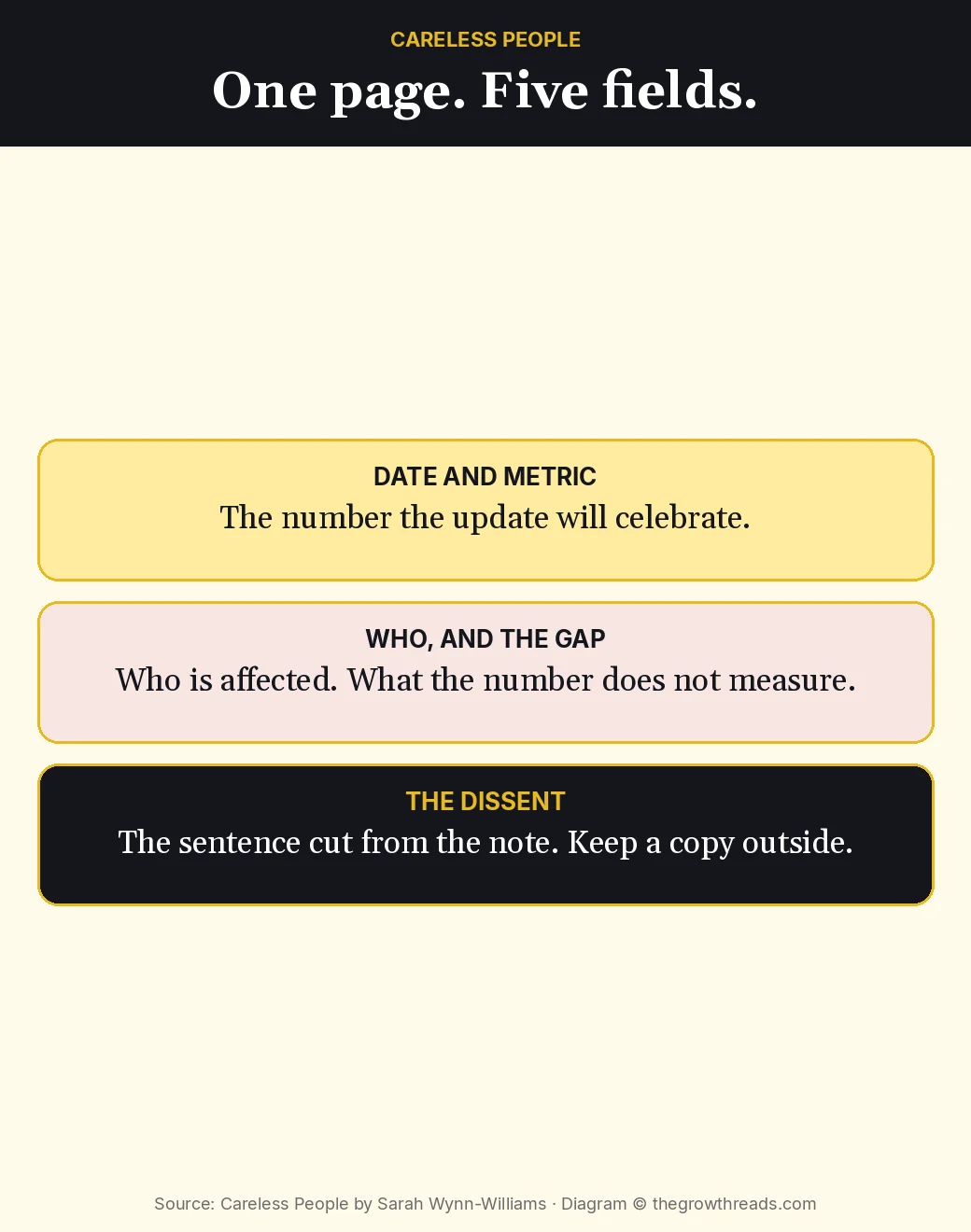
- Day 2 — Open the record. One page, five fields: date, metric, who is affected, what you did not measure, and dissent. Fill it with one decision from this week.
- Day 3 — Name the absent. List who was missing from your last review. Read one source they would have brought, or invite one of them next time.
- Day 4 — Write the boundary. One sentence you will not trade for access or a senior person’s approval. Store a copy in an account your employer does not own.
- Day 5 — Translate one rule. Rewrite a rule you enforce in the language of the people it hits. If you cannot, that gap is the finding.
- Day 6 — Ask for the missing sentence. Ask, in the room or in writing, what you would not put in the update. File the answer under dissent before the mood passes.
- Day 7 — Hand the page to an outsider. Share the record with someone who does not need you to look loyal. Ask what you softened. Decide what you will raise on Monday.
Frequently asked questions
What is Careless People about?
Careless People is Sarah Wynn-Williams’s memoir of directing public policy at Facebook from 2011 until the company terminated her in 2017. She describes the access, the governments that wanted the platform nearby, and the harms she says were ranked below growth. Myanmar, a China project shaped for market entry, and a workplace she calls careless with personal boundaries carry most of the weight. Published on March 11, 2025, the book topped the New York Times list within weeks and put her before the U.S. Senate in April. Treat it as one insider’s record plus a method you can reuse, not as a complete corporate history.
Is Careless People Facebook's official history?
No. It is a former director’s memoir, and the company rejects important parts of it. Meta has called the book a mix of out-of-date and previously reported claims, plus false accusations about its executives. Reporters who have covered the company for years split: some said the worst scenes were already public, others called it the internal account they had wanted. A policy lead from the region also argued that Wynn-Williams underplays her own role in those years. Hold those responses next to the chapters. The operating details are still worth your time. The book is not a neutral timeline, and it does not pretend to be one.
What does the memoir say happened in Myanmar?
Wynn-Williams writes that Facebook became a channel for hate against the Rohingya, including the slur kalar, and that the company was not staffed to moderate Burmese. She counts two Burmese-language moderators, both sitting in Dublin. She says one of them allowed hate and removed human-rights posts, that she flagged a feared link to the junta, and that the content team brushed her off. She says a request to translate Community Standards into Burmese was met with the line that Myanmar was not a priority country. She concludes the country would have been better off had the platform never arrived. The staffing fact is the piece you can use immediately.
What is the claim about China and Project Aldrin?
The memoir, and a later Senate inquiry, describe a mid-2010s effort to enter China that staff called Project Aldrin. Wynn-Williams says the company designed censorship tools for that market: human editors, a switch to shut the service during unrest, automated restricted terms, and proposals that would have exposed user data, including in Hong Kong. She also ties the work to pressure on a critic’s account. The service was not launched. Her point is that the design was still a choice. In April 2025 testimony she said leadership had worked in step with Beijing. Meta disputes her account. Read the denial with the chapter, not instead of it.
Did Meta try to stop the book?
Yes. After publication, Meta went to emergency arbitration to limit what Wynn-Williams could say. The arbitrator ordered her not to disparage the company or its leaders. That order did not bind the publisher, and Macmillan kept the book in print. The fight did what quieting a book often does. More people heard about it. By late March 2025 it was number one on the New York Times list, even though she had been told to stop promoting it. She had already talked to Business Insider hours before the order. A record held by a publisher is harder to pull back than a remark made in a meeting.
What exactly is "Myanmar isn't a priority country"?
It is the sentence Wynn-Williams says the team used when she pushed to translate Community Standards into Burmese. Priority sounded like ordinary sequencing, big markets first. In her telling it worked as a refusal. People were already living on the platform, hate had a local word, and two moderators sat in another country. A non-priority label let the queue follow convenience while the harm did not wait. Use it as a household test. When a team says a language, a region, or a kind of user can wait, ask what is already going wrong there, and write the answer down the same day.
How do you apply this if you do not work at a platform?
You already have a dashboard. It might be revenue, a grade, a headcount, or a case-closed number. The method does not need a billion users. Write the number you are praised for and the person it skips. Keep a five-field note: date, metric, who is affected, what you did not measure, and the dissent. Once in the week, ask what you would not put in the update, and store that line where the institution cannot edit it. If you manage people, add one boundary in writing before the next offsite. The book is about a giant company. The habit fits a team of six.
Related summaries
- The Age of Surveillance Capitalism Summary & Review — the extraction model, seen here from the policy calendar.
- Uncanny Valley Summary & Review — another insider gap between the pitch and the floor.
- Empire of AI Summary & Review — the cost of the next platform wave.
- The Attention Merchants Summary & Review — harvesting attention and calling it a service.
- Best AI and technology books — the Technology shelf this summary joins.