

⭐⭐⭐⭐ 3.7/5 — The most comprehensive personal investing guide available, packed with billionaire insights and a step-by-step system for building lifelong income.
Best for: Beginners and intermediate investors who want a complete, action-oriented system for building wealth — not abstract theory.
Reading time: ~14 hours (688 pages) | Difficulty to apply: Medium (the 7-step system is clear; the book’s length is the main barrier)
Money: Master the Game in one minute
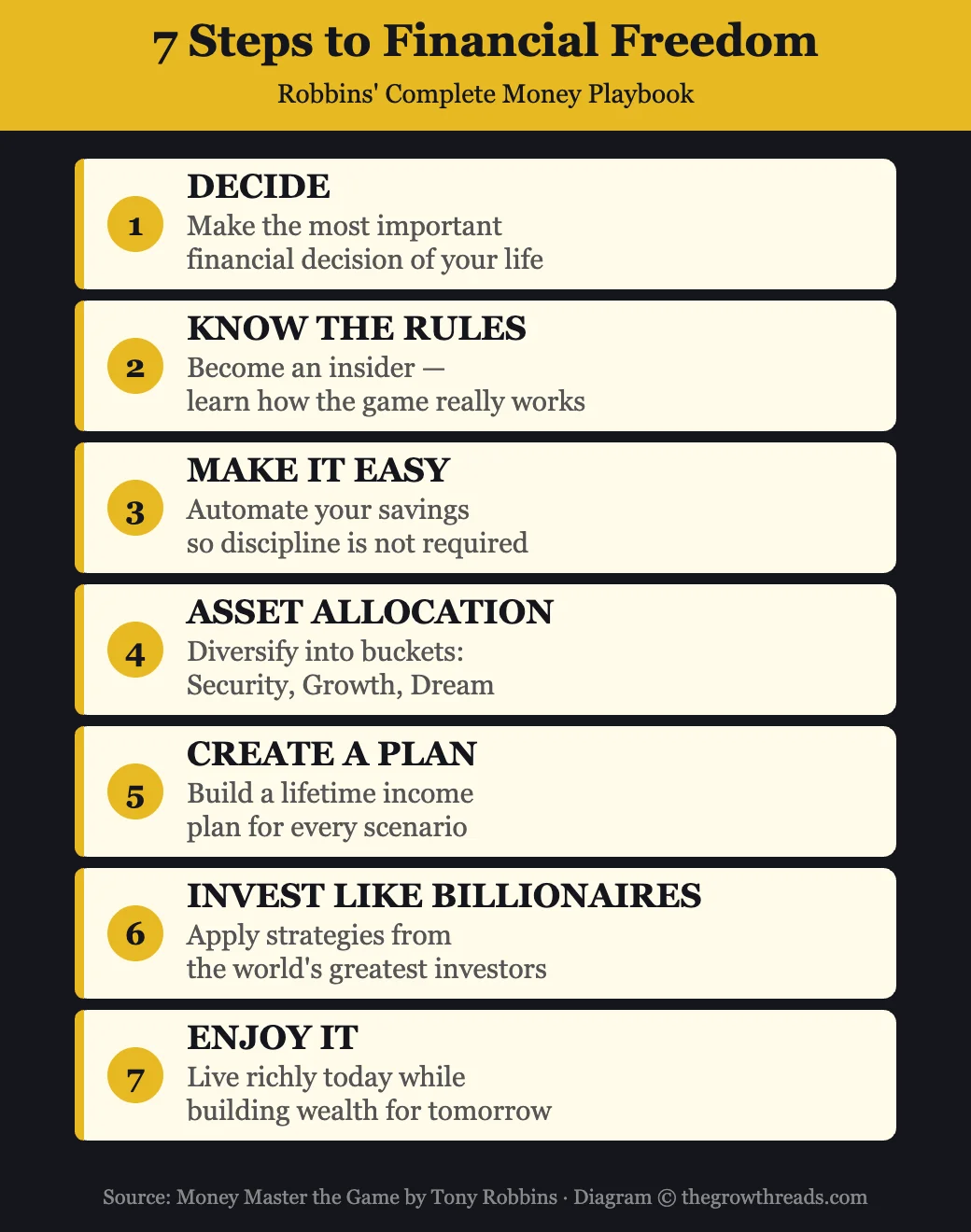
The financial industry is rigged — but you can still win if you know the rules. Tony Robbins interviewed fifty of the world’s greatest financial minds — including Ray Dalio, Warren Buffett, Carl Icahn, Jack Bogle, and David Swensen — and distilled their collective wisdom into a seven-step system any person can follow. Step one: decide to become an investor, not just a consumer. Step two: understand the fees, conflicts, and myths that drain most people’s wealth. Steps three through five: automate savings, allocate assets across three buckets (Security, Growth, Dream), and create a lifetime income plan. Steps six and seven: apply the asymmetric risk-reward strategies used by billionaires, and learn to enjoy the journey. The book is long, but the core message is simple: save more than you think you need, invest in low-cost index funds, and let compound interest do the heavy lifting.
Key takeaways
- The game is rigged — play anyway: The financial industry profits from your confusion. Understanding fees, conflicts of interest, and marketing tricks is the first step to keeping your money working for you.
- Compound interest is the eighth wonder: Even small amounts, invested consistently and early, create extraordinary wealth over decades. Time is your greatest asset — start now.
- Fees destroy wealth silently: A seemingly modest 2% annual fee can consume over 60% of your total returns over a 30-year period. Low-cost index funds are the antidote.
- Automate everything: Willpower fails. Set up automatic transfers to savings and investment accounts so building wealth requires zero daily discipline.
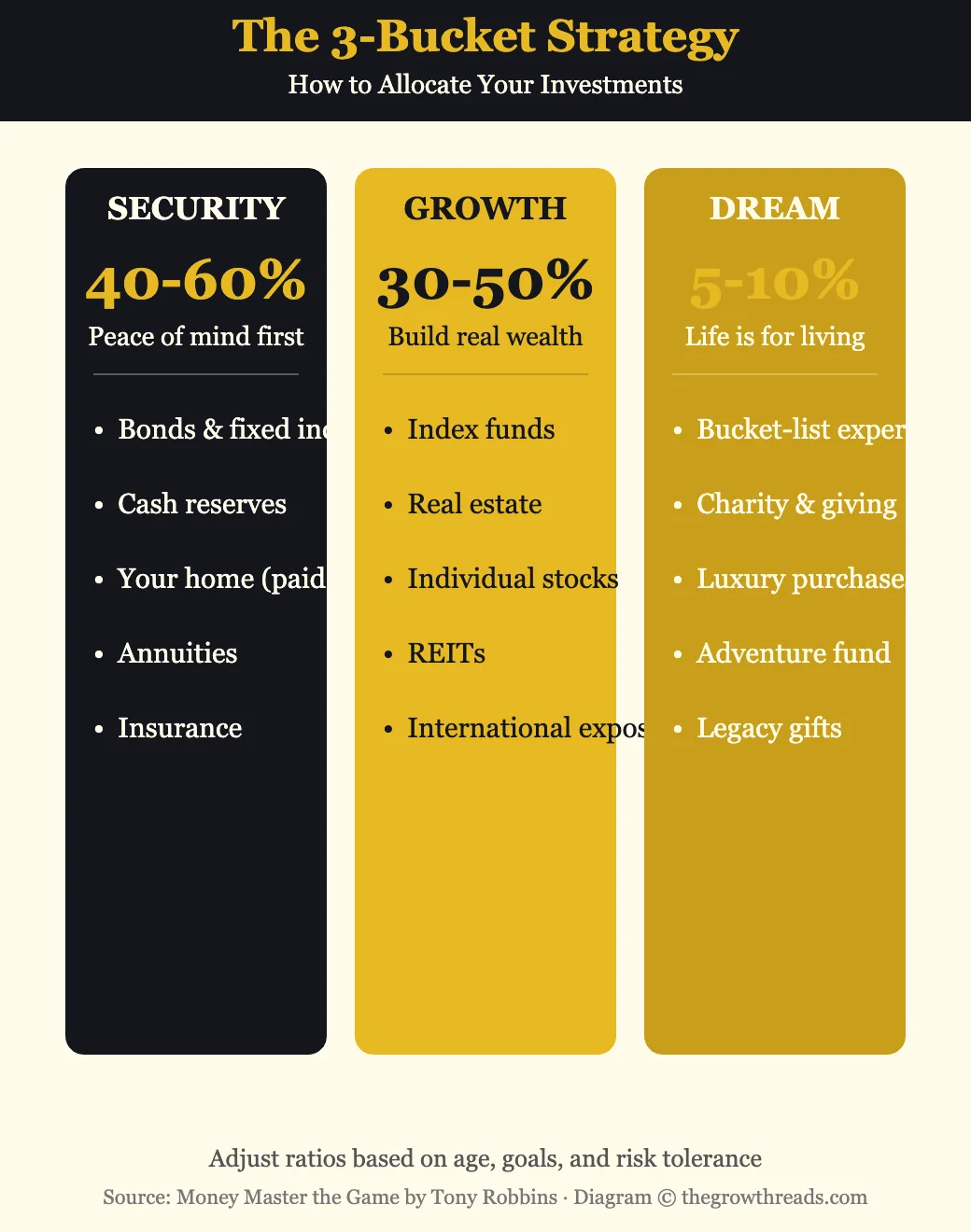
- Use the 3-Bucket system: Divide investments into Security (bonds, cash), Growth (stocks, real estate), and Dream (experiences, giving). The ratio depends on your age and goals.
- Asymmetric risk-reward is the secret: The best investors risk little to gain a lot. They structure deals where the downside is capped but the upside is unlimited.
- Most mutual funds underperform: 96% of actively managed funds fail to beat a simple index fund over 15 years. The evidence for passive investing is overwhelming.
- Create a lifetime income plan: Calculate exactly how much passive income you need to cover your expenses forever. Then work backward to determine what you need to save and invest.
- Tax efficiency matters enormously: Using the right account types (tax-deferred, tax-free) can add decades of compound growth that taxes would otherwise steal.
- Give to live: Robbins argues that financial freedom without generosity is hollow. Building giving into your financial plan from the start makes the journey meaningful.
What is Money: Master the Game about?
Money: Master the Game is a comprehensive guide to personal investing based on Tony Robbins’ interviews with fifty of the world’s most successful investors. The book lays out a seven-step system for achieving financial freedom — from understanding how the financial industry really works to building an automated investment plan using low-cost, tax-efficient strategies proven by billionaires.
About the author
Tony Robbins is one of the world’s most recognized life coaches and motivational speakers, having coached everyone from presidents to professional athletes over four decades. He runs multiple companies, manages a personal fortune, and has raised hundreds of millions for charity through his foundation. For this book, he stepped outside his usual domain of personal development and spent four years interviewing the greatest financial minds alive — Ray Dalio, Warren Buffett, Jack Bogle, Carl Icahn, David Swensen, and dozens more. All author proceeds from the book are donated to Feeding America, funding over 100 million meals. Explore all Tony Robbins book summaries →
Key concepts at a glance
| Concept | What it means | Use it when |
|---|---|---|
| The 7 Steps | A sequential system from decision to enjoyment covering the full investing lifecycle | You want a complete roadmap rather than scattered tips |
| The 3-Bucket System | Divide assets into Security, Growth, and Dream buckets for balanced allocation | You need a simple framework for where to put your money |
| Asymmetric Risk/Reward | Structure investments where you can lose little but gain a lot | You want to invest like billionaires without billionaire-level risk |
| The 9 Myths | Common financial industry lies about fees, performance, and brokers | You suspect you are paying too much or getting bad advice |
| Speed It Up | Five ways to accelerate your path: save more, earn more, reduce fees, get better returns, change lifestyle | Your timeline to freedom feels too long and you want to shorten it |
| All Seasons Portfolio | Ray Dalio’s allocation: 30% stocks, 40% long bonds, 15% intermediate bonds, 7.5% gold, 7.5% commodities | You want a set-and-forget portfolio that performs in any economic environment |
| Fiduciary Standard | Advisors legally required to act in your interest — vs. brokers who are salespeople | You want professional help but need to pick the right kind of advisor |
Part 1: Welcome to the jungle — why most people fail with money
Robbins opens with a sobering reality check: most people are not on track for financial security, let alone freedom. He cites studies showing that the average American has saved a fraction of what they need to retire, and that the gap between the wealthy and everyone else continues to widen. But his tone is empowering, not pessimistic — he argues that the problem is not income level but financial literacy.
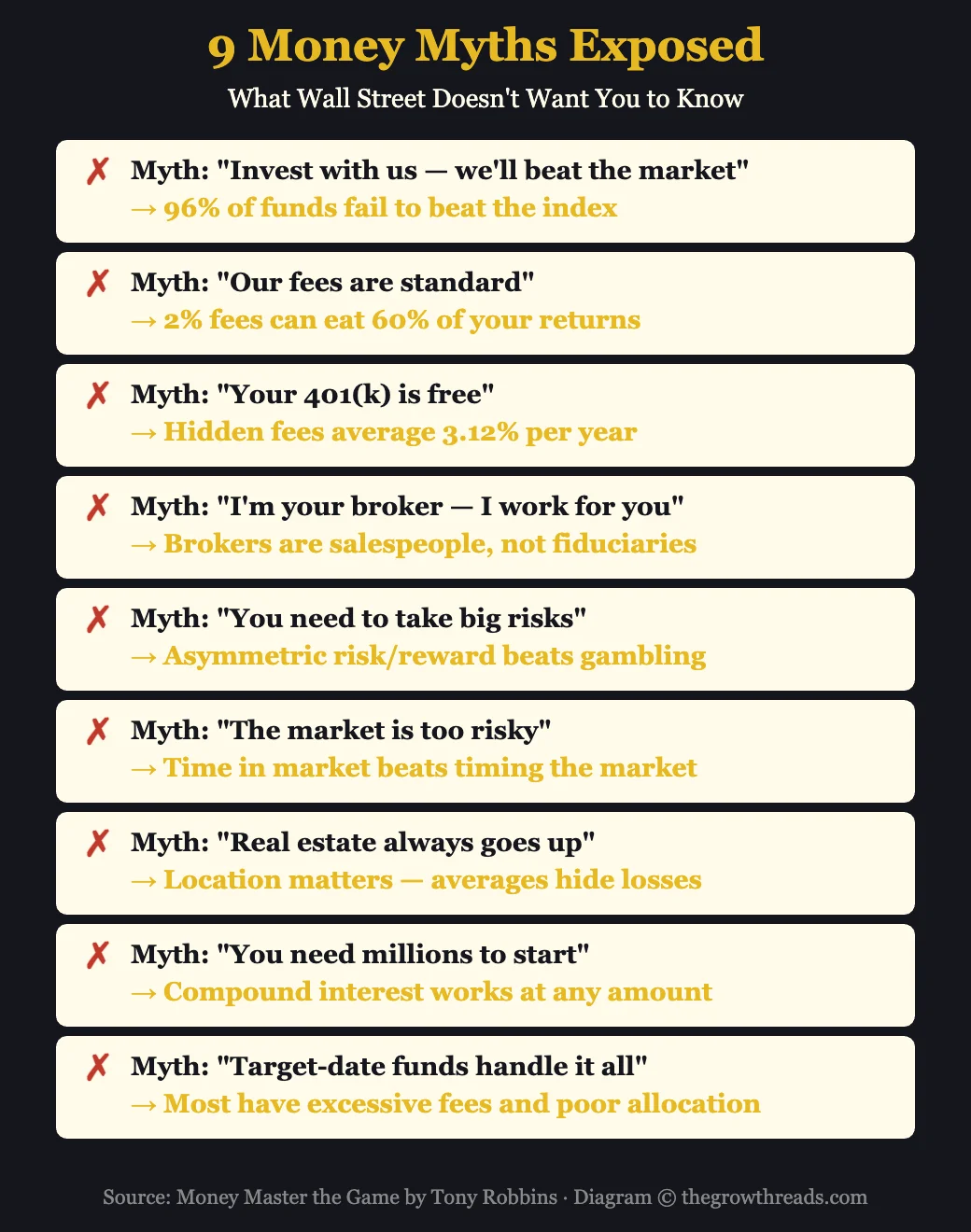
The first major section exposes what Robbins calls the nine myths of the financial industry. He shows that 96% of actively managed mutual funds underperform a simple index fund over 15 years, yet the industry continues to charge enormous fees for this underperformance. He explains how a 2% annual fee — which sounds trivial — can consume over 60% of your total investment returns over a 30-year period. He reveals that many 401(k) plans have hidden fees averaging 3.12% annually, and that most brokers are legally salespeople, not fiduciaries — meaning they have no legal obligation to put your interests first.
Robbins makes a crucial distinction: a broker operates under a “suitability standard” (they only need to recommend products that are suitable, even if a better option exists) while a fiduciary operates under a legal duty to act in your best interest. The difference can cost hundreds of thousands of dollars over a lifetime. His advice: always work with a registered investment advisor (RIA) who is a fiduciary, never a broker pretending to be an advisor.
Part 2: The money machine — automate, allocate, accelerate
With the myths cleared away, Robbins shifts to building what he calls “the money machine” — an automated system that builds wealth whether you think about it or not. The key insight is that willpower is unreliable. The people who successfully build wealth do not rely on discipline to save each month — they set up automatic transfers that move money into investment accounts before they ever see it.
Robbins then introduces his three-bucket asset allocation system. The Security Bucket holds conservative investments (bonds, fixed income, cash reserves) that protect your downside. The Growth Bucket holds assets with higher return potential (index funds, real estate, stocks) that build wealth over time. The Dream Bucket holds money for the things that make life worth living — experiences, charitable giving, luxury items you have earned. The ratio between buckets depends on your age, goals, and risk tolerance, but Robbins insists that everyone needs all three.
The acceleration section provides five levers for speeding up your timeline: save more (even 1% more makes a measurable difference over decades), earn more (invest in skills and income-generating assets), reduce fees and taxes (switch to low-cost index funds and use tax-advantaged accounts), get better returns (through smarter allocation, not higher risk), and change your lifestyle needs (reducing your required income for freedom means reaching it sooner).
Robbins emphasizes that the most important financial decision you will ever make is what percentage of your income to save and invest. He recommends starting with whatever you can — even if it is just 3% — and increasing it by 1% per year. The compound effect of this simple habit is staggering over a working career.
Part 3: Billionaire strategies — what the greatest investors actually do
The most distinctive section of the book features direct interviews with legendary investors. Robbins secured conversations that most financial journalists would never get — and he asked each person the same core questions: What is your investment strategy? What should ordinary people do? What do most people get wrong?
Ray Dalio, founder of Bridgewater Associates (the world’s largest hedge fund), shares his “All Seasons” portfolio — an asset allocation designed to perform well in any economic environment: 30% stocks, 40% long-term bonds, 15% intermediate-term bonds, 7.5% gold, and 7.5% commodities. Dalio’s insight is that most portfolios are too heavily weighted toward equities, which means they get destroyed in deflationary or recessionary periods. His balanced approach has historically delivered strong returns with dramatically lower volatility.
Jack Bogle, founder of Vanguard, reinforces his lifelong message: buy the entire market through index funds, keep costs near zero, and never try to time the market. He tells Robbins that the secret to investing is that there is no secret — just buy low-cost, hold forever, and ignore the noise.
Warren Buffett echoes Bogle: for most people, a low-cost S&P 500 index fund is the best investment they can make. He even instructed the trustees of his estate to put 90% of his wife’s inheritance into an index fund. If the greatest investor alive recommends index funds over active management, Robbins argues, the case is settled.
Robbins extracts a common principle from all the interviews: asymmetric risk-reward. The best investors structure their positions so that the downside is limited but the upside is substantial. They never bet the farm on a single idea. They diversify, hedge, and always ask: “What happens if I’m wrong?”
Part 4: Living rich — creating a life of meaning and impact
Robbins closes with a section that distinguishes this book from most financial guides: the emotional and psychological side of wealth. He argues that financial freedom without purpose is meaningless — and that the wealthiest people he interviewed were also among the most generous. He shares how building giving into your financial plan from the start (even before you reach your goals) creates a sense of abundance that actually helps you earn and save more.
He introduces the concept of “wealth psychology” — the internal game that determines whether money brings you happiness or anxiety. Many people who achieve financial success still feel poor because their expectations keep rising faster than their wealth. Robbins argues for consciously defining “enough” and building your lifestyle around meaning, contribution, and growth rather than endless accumulation.
The final chapters address creating a lifetime income plan — calculating exactly how much passive income you need to cover your expenses indefinitely, then working backward to determine what portfolio size, contribution rate, and timeline will get you there. Robbins provides worksheets and formulas (updated in subsequent editions) to make this calculation accessible to anyone.
Who is Money: Master the Game best for — and who should read something else first?
This book is ideal for investing beginners who want a comprehensive, all-in-one guide, for people who suspect they are paying too much in fees, and for anyone overwhelmed by financial options who wants a clear step-by-step system. It is also valuable as a reference — the billionaire interview sections are worth revisiting periodically.
If you find the 688-page length daunting, start with The Simple Path to Wealth for a streamlined version of the same core philosophy, or I Will Teach You to Be Rich for a more action-oriented approach. If you want the philosophical foundation of value investing, read The Intelligent Investor. Come back to Robbins when you want the encyclopedic version with billionaire interviews.
Questions to reflect on
- What percentage of your income are you currently saving and investing — and what would happen if you increased it by just 1%?
- Do you know the total fees you pay on your investments? Have you checked whether a low-cost index fund would outperform your current portfolio?
- Is your financial advisor a fiduciary? If you are not sure, the answer is probably no.
- If you calculated your “freedom number” — the amount of passive income needed to cover expenses forever — would you be closer or further than you think?
- How would your relationship with money change if you started giving a percentage away today, before reaching your financial goals?
🔥 Ready to stop guessing and start building real wealth?
Robbins distills the wisdom of fifty billionaires into seven steps anyone can follow.
How to apply Money: Master the Game (7-day plan)
- Day 1 — Calculate your freedom number: Add up your monthly expenses. Multiply by 12. That annual number divided by 0.04 gives you a rough portfolio target for financial independence.
- Day 2 — Audit your fees: Log into every investment account. Find the expense ratios on your funds. If anything exceeds 0.50%, research a low-cost index fund alternative.
- Day 3 — Set up automation: Create an automatic monthly transfer from your checking account to your investment account. Start with whatever you can — even a small amount — the habit matters more than the number.
- Day 4 — Check your advisor’s fiduciary status: Ask your financial advisor in writing: “Are you a fiduciary at all times?” If the answer is anything other than a clear yes, start interviewing fee-only RIAs.
- Day 5 — Build your bucket plan: Decide your Security/Growth/Dream allocation based on your age and goals. Write it down and set up your accounts to match.
- Day 6 — Learn one billionaire strategy: Research Ray Dalio’s All Seasons portfolio. Consider whether its balanced approach suits your risk tolerance better than your current allocation.
- Day 7 — Start giving: Choose an amount — even one percent of your income — and set up a recurring donation to a cause you care about. Begin building the giving habit before you feel “ready.”
Frequently asked questions
Is this book still relevant given that it was published in 2014?
The core principles — low-cost index investing, fee awareness, automation, asset allocation, and compound interest — are timeless. Specific product recommendations and interest rate assumptions may need updating for current market conditions, but the seven-step framework and the billionaire insights remain as applicable as ever. The fundamental math of wealth building does not change with market cycles. Always consult current financial data and a qualified advisor for specific investment decisions.
Do I need a lot of money to start applying this?
No. Robbins specifically designed the system for people at every income level. He argues that the habit of investing — regardless of amount — is more important than the dollar value. With the rise of fractional shares and zero-commission brokerages, you can now start with as little as a few dollars per month. The compound effect means even small amounts grow substantially over decades. The key is starting and automating, not waiting until you have a large sum.
What is the All Seasons portfolio and should I use it?
The All Seasons portfolio is an asset allocation shared by Ray Dalio: 30% stocks, 40% long-term US bonds, 15% intermediate-term US bonds, 7.5% gold, and 7.5% commodities. It is designed to perform adequately in all economic environments — growth, recession, inflation, and deflation. Historically, it has delivered solid returns with significantly lower volatility than a stock-heavy portfolio. Whether it suits you depends on your age, goals, and risk tolerance. Consult a fiduciary advisor to determine if this allocation fits your situation.
How does this compare to The Simple Path to Wealth?
Both books advocate low-cost index investing, but they differ in scope and style. JL Collins’ book is 286 pages of streamlined advice focused on one fund (total stock market index) and simplicity. Robbins’ book is 688 pages covering the same core philosophy plus billionaire interviews, detailed tax strategies, annuities, insurance products, and behavioral psychology. Collins is the sprint; Robbins is the marathon. If you want the fastest path to action, start with Collins. If you want the comprehensive encyclopedia, read Robbins.
Is Tony Robbins qualified to write about investing?
Robbins is not a certified financial advisor, and he is transparent about this. His qualification is access — he secured interviews with Ray Dalio, Warren Buffett, Jack Bogle, Carl Icahn, David Swensen, and dozens of other investment legends who would not typically sit down with a financial journalist. He serves as a translator, making their strategies accessible to ordinary investors. All proceeds go to charity, which removes the profit motive criticism. The strategies he presents are well-supported by financial research and endorsed by the experts he interviews.
What are the biggest criticisms of the book?
The main criticisms are length (at 688 pages, many readers find it repetitive), the inclusion of annuity recommendations that some financial advisors dispute, and Robbins’ motivational speaking style which can feel excessive in a finance book. Some critics note that the book was written during a bull market and that certain return assumptions may be optimistic. Despite these valid points, the core advice — low fees, index funds, automation, diversification — is sound and well-supported by decades of financial research.
Should I read this or Unshakeable first?
Unshakeable is Robbins’ shorter follow-up (256 pages) that focuses specifically on navigating market volatility and corrections. If you are anxious about market crashes and want reassurance, start with Unshakeable. If you want the complete system from scratch — the full framework including fees, automation, allocation, lifetime income planning, and billionaire interviews — start with Money Master the Game. Many readers find that reading Unshakeable first gives them the confidence to tackle the longer book.
Related summaries
- The Simple Path to Wealth Summary & Review — JL Collins’ streamlined version of the same index-fund philosophy in a third of the pages.
- The Psychology of Money Summary & Review — Morgan Housel on why your behavior with money matters more than your knowledge.
- Unshakeable Summary & Review — Robbins’ shorter companion book on navigating market volatility with confidence.
- Best Money & Investing Books — Our full ranked guide to books that build lasting wealth.