

★★★★★ 4.6/5 — A blunt, practical case for spending your money — and your health and time — before it’s too late to enjoy any of it.
Best for: People in their 30s–50s with steady income who were taught to save first and live later
Reading time: ~6 hrs to read the book · ~12 min to read this guide
Difficulty to apply: Moderate — it asks you to rethink default financial habits, not just budget differently
Die With Zero in one minute
Most people don’t run out of money before they die — they die with far more left over than they ever needed, having spent decades deferring the experiences that would have made their lives feel full. That’s the uncomfortable observation at the center of Die With Zero, a book by hedge fund manager and professional poker player Bill Perkins.
Perkins isn’t arguing against saving. He’s arguing against saving with no end point — the habit of accumulating money indefinitely because it feels safer than deciding how much is actually enough. His case is built on a simple idea: money is only valuable for what it can convert into — experiences, relationships, memories — and every dollar left unspent when you die represents time and health you traded away for nothing.
The book gives you a framework for figuring out when to stop optimizing for net worth and start optimizing for what he calls your peak — the point at which your money can buy the most life before declining health and shrinking time make that value harder to access. It’s part personal finance, part memoir, and part provocation aimed at anyone who has quietly assumed that more savings is always the safer choice.
Key takeaways
- Money’s only real value is what it converts into: memorable experiences, not a growing account balance.
- Enjoyment follows a curve, not a straight line: your ability to enjoy money-fueled experiences typically peaks in your 40s and 50s, then declines even as your wealth keeps rising.
- Experiences pay “memory dividends”: the joy of a trip or moment compounds for years afterward through the memories and stories it produces.
- Over-saving is a real, under-discussed risk: working years longer than you need to, for money you’ll never get the chance to spend, is a permanent loss of time you can’t buy back.
- Generic withdrawal rules can work against you: formulas like the 4% rule are built for people who never plan to spend principal — Perkins argues for a more personalized read on what you can actually afford to spend.
- Annuities can buy confidence, not just income: converting savings into guaranteed payments can make spending in your later years feel safe instead of reckless.
- Take your biggest risks earliest: while you have the least to lose and the most runway to recover, not after you’ve built a comfortable cushion.
- Give while it matters most: money for your kids or causes you care about usually has more impact decades before your death than after it.
- Match experiences to “time buckets”: physical adventures, family trips, and quieter travel each belong to a different decade of your life.
- The goal is zero on purpose: not an accident of poor planning, but a deliberate target you spent your way toward.
What is Die With Zero about?
Die With Zero is a personal finance book by hedge fund manager Bill Perkins that argues against open-ended saving, urging readers to deliberately spend money on meaningful experiences while they still have the health and time to enjoy them — so net worth reaches zero by the end of life instead of leaving an unplanned estate.
About the author
Bill Perkins is a hedge fund manager, entrepreneur, and professional poker player known to the Wall Street Journal as the “Last Cowboy” of energy trading. He studied electrical engineering at the University of Iowa before moving to Houston, Texas, where he built his fortune as one of the most successful energy traders of his generation, reportedly generating more than a billion dollars for his firm over a five-year stretch. He’s the founder of Skylar Capital Management, an energy-focused investment firm, and a co-founder of the satellite-imagery company SkyFi and the maritime intelligence firm SynMax. Away from trading, Perkins has played in high-stakes poker tournaments alongside actors and entrepreneurs, an experience that shaped his thinking about risk and the true cost of playing it safe. He published Die With Zero in July 2020 through Mariner Books; it has since become an international bestseller translated into more than 25 languages. Explore all Bill Perkins book summaries →
Key concepts at a glance
| Concept | What it means | Use it when |
|---|---|---|
| Net worth curve vs. fulfillment | Your ability to enjoy money-fueled experiences rises then falls with health, even as wealth keeps climbing | Deciding whether to delay a big trip or experience “for later” |
| Memory dividends | Experiences pay you back for years through the memories and stories they generate | Comparing a one-time purchase against an experience when budgeting for joy |
| Dying with zero | The goal isn’t an accidental estate — deliberately plan to spend down your assets by the end of your life | Setting a target spending curve instead of open-ended saving |
| Time bucketing | Divide your life into stages and match specific experiences to the stage you can best enjoy them in | Prioritizing which trips or activities to do now versus later |
| Health-wealth-time tradeoff | You have the most time and health when you have the least money, and the most money when you have the least time and health | Deciding how aggressively to save versus spend in your 20s–40s |
| Annuitizing | Converting a portion of savings into guaranteed income so you can spend confidently without fear of running out | Planning retirement income once you’ve built a nest egg |
| Giving while living | Transferring wealth to children or causes when it has the most impact, often decades before death | Estate planning and gifting decisions |
Part 1: Why Most People Die With Too Much Money
Most personal finance advice optimizes for a single outcome: a bigger number. Save more, invest more, let compound interest do the rest, and hope the balance is large enough by the time you need it. Perkins’ argument in Die With Zero starts by pointing out what that advice quietly ignores — that the money is supposed to buy you something, and most of what it can buy requires a body and a calendar that cooperate.
The book opens with a story from Perkins’ own life: a colleague at his firm who kept showing up to a job he no longer financially needed, grinding through years he could have spent with his young kids, because stopping felt riskier than continuing. Perkins isn’t dismissive of the instinct — under-saving is a real risk too — but he argues over-saving is treated as costless when it isn’t. Every year you work past the point your money can meaningfully improve your life is a year of health and attention you can’t get back and can’t buy with the extra savings.
To make that visible, this guide charts what Perkins calls his net worth curve alongside a second line for fulfillment: your wealth, your health, and the enjoyment you can actually extract from spending, all plotted against age. Wealth tends to climb steadily for most of adulthood. Health tends to decline slowly at first, then faster. Fulfillment — how much genuine enjoyment a given amount of money can produce — is a function of both, and it typically peaks well before either curve does, often somewhere in your 40s or 50s, then falls even as your bank balance keeps growing.
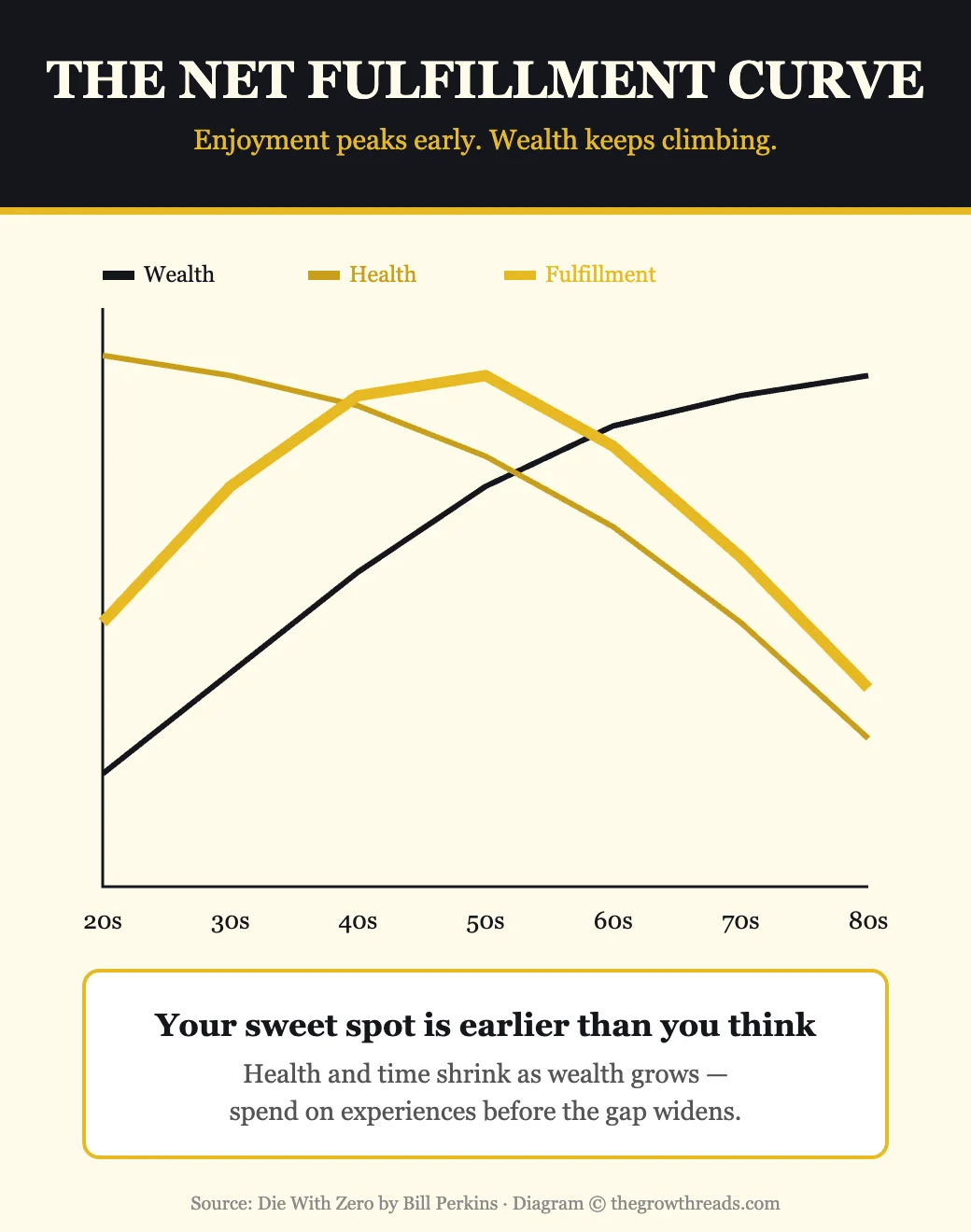
The gap between the wealth curve and the fulfillment curve is, in Perkins’ framing, wasted potential — money sitting in an account that could have paid for a physically demanding trip, a long stretch of time with your kids while they still wanted to spend it with you, or a risk you were too cautious to take when you could most afford to recover from it. His point isn’t that everyone should spend recklessly. It’s that “save more, always” isn’t actually a neutral default — it’s a bet that later will be better than now, and for a specific kind of experience, that bet is usually wrong.
TGR Note: Morgan Housel’s The Psychology of Money makes a related point from the opposite angle — that how you feel about money matters more than what a spreadsheet says is optimal. Read them together: Housel explains why people irrationally under-spend out of fear, and Perkins gives you a framework for deciding when that fear has stopped being useful.
Part 2: The Nine Rules for Optimizing Your Life
The back half of Die With Zero condenses its philosophy into nine practical rules — less a rigid checklist than a set of defaults to replace the ones most people inherit without examining.
The first two deal with timing: maximize your positive experiences, and start investing in them early, because the compounding effect of a memory works the same way compound interest does — the earlier you “deposit” an experience, the longer it has to pay dividends in recollection, storytelling, and the way it shapes who you become. A backpacking trip at 24 pays differently than the same trip at 64, not because the destination changed, but because you did.
The middle rules are about permission and tools. Aiming to die with zero doesn’t mean spending carelessly — it means treating an empty balance at the end of your life as the goal, not the failure. Perkins pushes readers to use whatever planning tools are available, from life-expectancy calculators to financial planning software, to set a rough finish line, and then to trust their own judgment over generic withdrawal formulas built for people who have no intention of ever touching their principal.
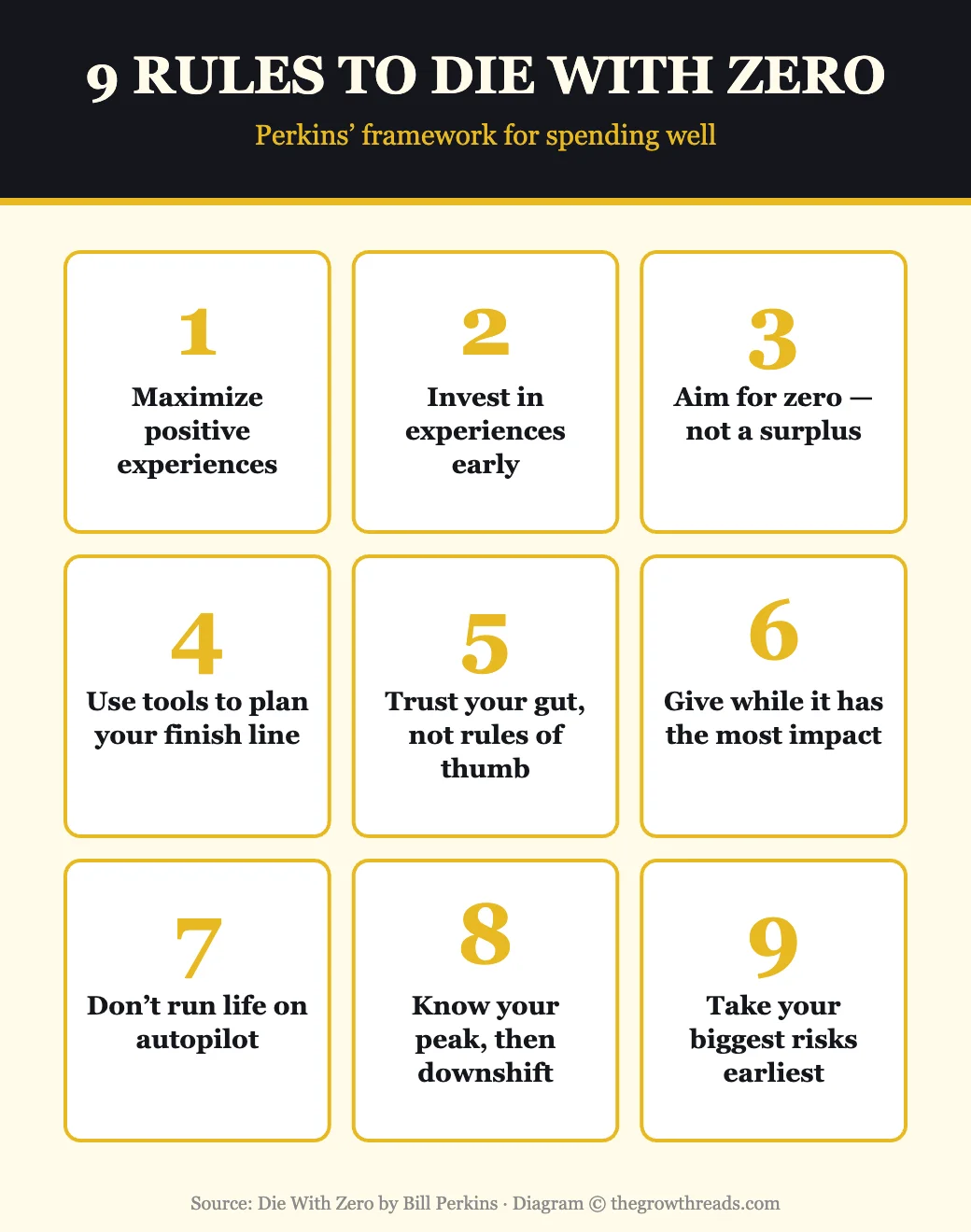
The later rules turn outward. The rule that tends to surprise readers most is the one about giving: hand money to your kids, or to causes you care about, while you’re alive to see it matter — not as an inheritance that arrives when your children are themselves nearing retirement and the money can no longer change much. The final rules are about avoiding autopilot, recognizing the point at which continuing to earn stops paying off in fulfillment, and — counterintuitively — taking your biggest risks earliest, when you have the smallest cushion to protect and the most time to recover if something doesn’t work out.
TGR Note: If Rich Dad Poor Dad taught you to build assets, Die With Zero is the deliberate rulebook for spending them back down. Read both to cover the full arc from accumulation to enjoyment.
Part 3: Memory Dividends and the Tools to Spend With Confidence
Central to Perkins’ case is a concept he calls the memory dividend: unlike money sitting in an account, a memory keeps paying you back. You spend once — on the trip, the dinner, the weekend away — and then collect returns for years afterward every time you retell the story, revisit the photos, or simply think back on it. Perkins argues this dividend is real enough to factor into financial decisions, even though it doesn’t show up on any balance sheet. A $3,000 vacation that generates twenty years of “remember when” isn’t a $3,000 expense — it’s closer to an investment with a return that compounds in a currency spreadsheets don’t track.
This is where the health-wealth-time tradeoff becomes concrete. Early in adulthood, most people have abundant health and free time but limited money — the years when you could hike for a week straight or sleep on a friend’s floor with no complaints, but can’t necessarily afford the plane ticket. In midlife, money usually becomes more available just as time gets scarcer, squeezed by work and family obligations. By the time wealth peaks — often in your 50s or 60s — health has typically declined enough that some experiences are simply off the table, no matter the budget.
Perkins’ response to this squeeze is practical, not just philosophical. He’s a strong advocate for annuitizing a portion of savings — converting a lump sum into a guaranteed income stream — specifically because it removes the fear that keeps people under-spending. Most retirees don’t run out of money; many die with substantial savings intact because they never trusted themselves to spend down principal, defaulting instead to living off interest alone out of fear of running out. An annuity, in Perkins’ framing, isn’t primarily a return-maximizing product — it’s a confidence-buying one, letting you spend a guaranteed monthly amount without the background anxiety of watching a balance shrink.
That’s also his objection to blanket withdrawal guidelines like the well-known 4% rule: it was designed to make a portfolio last indefinitely, which is a reasonable goal if you plan to leave everything to your heirs, but a mismatch if your actual goal is to spend it on yourself before you die. Perkins pushes readers to calculate a personalized number instead — one based on your own life expectancy, health, and what you actually want to do with the years you have left, rather than a formula built for outliving your money by decades you don’t need to.
TGR Note: The Millionaire Next Door celebrates the habits that built the wealth in the first place — frugality, delayed gratification, consistent saving. Die With Zero picks up exactly where that mindset can start working against you, once the goal shifts from building the pile to using it.
Part 4: Time Buckets and Giving While You’re Alive
Perkins’ practical tool for putting all of this into action is what he calls time bucketing: instead of one long, undifferentiated retirement plan, divide your remaining years into stages defined by what you’re actually capable of enjoying in each one, and plan your spending — and your major experiences — around those stages rather than around a single retirement age.
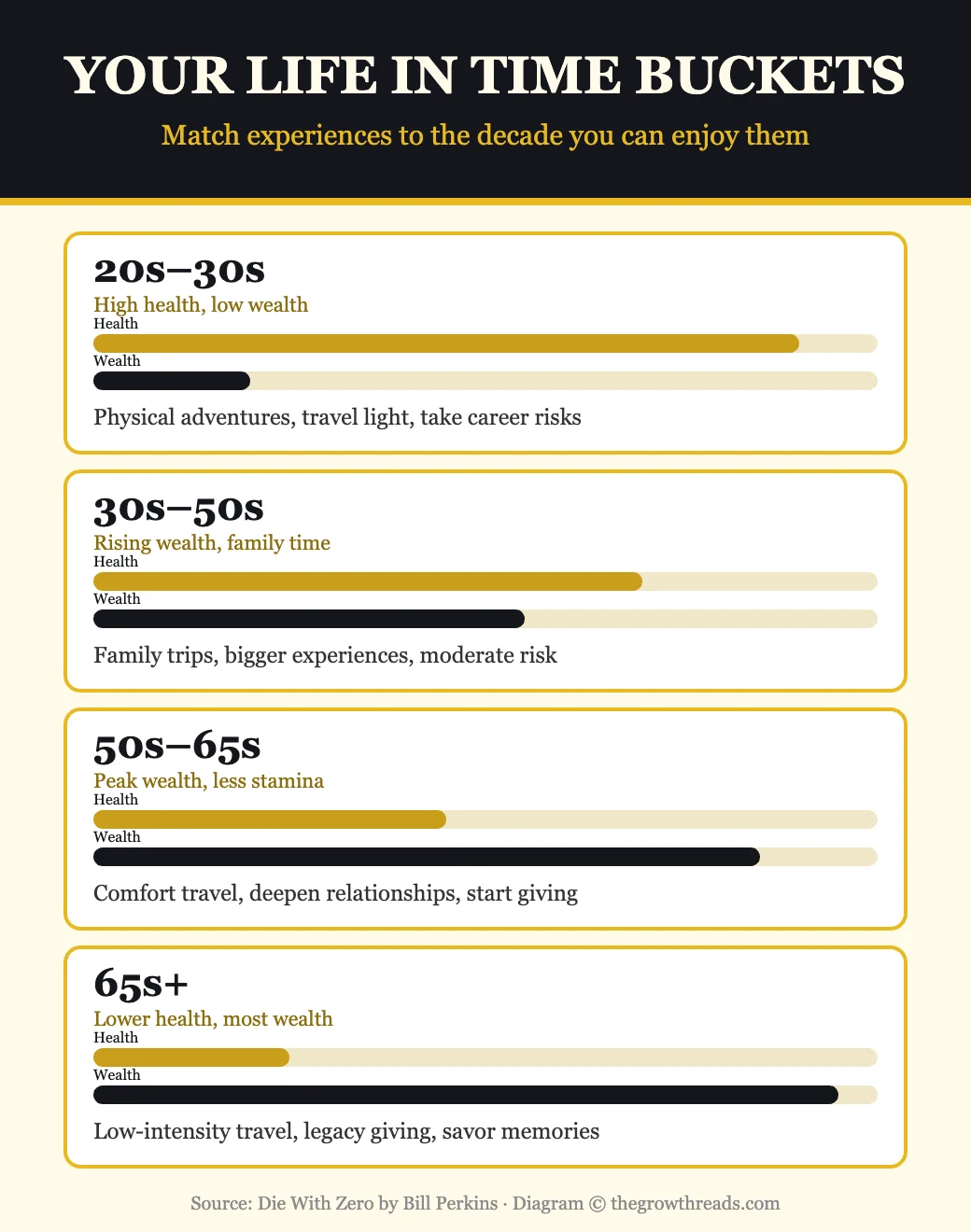
In your 20s and 30s, health and free time are usually at their highest even though income is often at its lowest — the right season for physically demanding travel, career risks, and experiences that require energy more than money. Your 30s through 50s tend to bring rising income alongside family responsibilities, which shifts the ideal experiences toward things you can share with a partner or kids rather than the solo, high-intensity trips of your 20s. Your 50s and 60s often mark peak earning power, but with early signs of physical limits creeping in — a window for the kind of travel and experiences that require money more than stamina. And in the decades beyond that, Perkins argues the priority shifts again, toward lower-intensity experiences, deepening relationships, and — critically — giving.
That last point is the most counterintuitive part of the book for many readers. Perkins makes a simple mathematical case: money given to your children when they’re in their 30s, buying a first home or covering a stretch of financial stress, does more for their lives than the same amount arriving as an inheritance in their 60s, when they’re likely to already be financially established and the gift mostly just pads a balance they didn’t urgently need. The same logic applies to charitable giving — money donated now has decades to compound its impact that money donated at death does not. Perkins isn’t arguing against leaving anything behind. He’s arguing that the timing of giving is itself a decision worth making deliberately, instead of defaulting to “whatever’s left.”
The common thread across all four time buckets is that none of them wait for permission. Perkins’ case throughout Die With Zero is that the traditional savings mindset treats “later” as an infinitely patient, infinitely capable version of you who will get around to enjoying the money eventually. Time bucketing is his way of forcing a more honest question: not whether you’ll eventually spend it, but whether you’ll still be able to enjoy it when you do.
TGR Note: If Die With Zero convinces you to spend more deliberately, I Will Teach You to Be Rich has the tactical systems — automated accounts, a conscious spending plan — to make that sustainable rather than chaotic.
Who is Die With Zero best for — and who should read something else first?
Die With Zero is best for people in their 30s through 50s who have built up meaningful savings, feel financially disciplined by default, and have never seriously questioned whether “save more” is still the right instruction at every stage. It’s especially useful if you’ve caught yourself deferring a trip, a career change, or time with family for “someday,” or if you’re the kind of saver who feels a twinge of guilt spending on experiences rather than investments.
It’s a poor fit if you’re still building an emergency fund or paying down high-interest debt — Perkins’ advice assumes a baseline of financial stability that not everyone has reached yet. If that’s you, The Total Money Makeover or I Will Teach You to Be Rich are better starting points — foundational systems before optimization. And if you want the psychology behind why people under-spend out of fear rather than a framework for correcting it, The Psychology of Money covers that ground more directly.
Questions to reflect on
- If your health and free time stayed exactly as they are today but your income doubled, what would you actually do differently in the next twelve months?
- What’s one experience you’ve been deferring “until things settle down” — and what would have to be true for you to stop waiting?
- If you pictured your net worth on the day you die, would you want that number to be large, or would you rather it be close to zero because you spent it on a life you actually lived?
- Is there a gift — money, time, an experience — you’re planning to give someone eventually that would matter more if they received it now?
- Where in your life are you following a savings rule (a percentage, a formula, a “rule of thumb”) without having checked whether it still fits your actual goals?
🔥 Ready to stop saving on autopilot?
Get your copy of Die With Zero and start planning a life you actually spend down.
How to apply Die With Zero (7-day plan)
- Day 1: Write down your current net worth and your rough life expectancy, then do the uncomfortable math on how many “healthy years” of spending are actually left.
- Day 2: List three experiences you’ve been deferring for “someday,” and note what health or circumstance you’re implicitly betting will still allow them later.
- Day 3: Sketch your own version of the net fulfillment curve — even roughly — marking when you think your ability to enjoy money will peak.
- Day 4: Look at your current withdrawal or savings rule and ask whether it was built for your goals or for maximizing a balance you don’t actually need.
- Day 5: Pick one deferred experience from Day 2 and put a real date on it within the next 12 months.
- Day 6: If you plan to give money to children or causes eventually, estimate what giving a portion of it now, instead of later, would let the recipient do with it.
- Day 7: Write one sentence describing what “enough” looks like for you — a number or a feeling — so future savings decisions have a target instead of defaulting to “more.”
Frequently asked questions
Is Die With Zero telling me to stop saving for retirement?
No. Perkins isn’t against saving — he’s against saving with no defined endpoint or purpose. The book assumes you’ll still plan for retirement and build a financial cushion; its argument is about what happens after you’ve reached a reasonable level of security, when the instinct to keep piling up savings can quietly cost you experiences you’ll never get the chance to have. If you haven’t yet built basic financial stability, Perkins’ advice isn’t meant for that stage — books focused on foundational saving and debt payoff are a better starting point first.
What is a “memory dividend”?
It’s Perkins’ term for the ongoing value an experience keeps generating after you’ve paid for it. Unlike a purchase that depreciates, a meaningful trip, event, or shared moment can be “withdrawn” repeatedly — through retelling the story, looking at photos, or simply recalling it — for years or decades afterward. Perkins argues this dividend is real enough to weigh against the money’s other uses, even though it can’t be measured the way investment returns can. Experiences purchased earlier in life have more years to pay dividends than the same experience purchased later.
Isn’t it risky to plan to spend down all your savings?
It can be, which is why Perkins spends real time on the mechanics, not just the philosophy. He recommends using life-expectancy tools to set a realistic planning horizon and favors annuitizing a portion of savings specifically to remove the risk of running out — converting savings into guaranteed income rather than spending down an unprotected balance. The goal isn’t to guess your death date and spend to zero blindly; it’s to replace vague, fear-driven under-spending with a more deliberate, tool-assisted plan.
Does Perkins say I should give my kids their inheritance early?
He argues you should give money to your children, or to causes you care about, at the point it will have the most impact on their lives, which is usually well before your death — not necessarily all of it, and not recklessly. The idea is that a gift that helps a 32-year-old buy a first home or weather a hard financial stretch typically does more good than the same amount arriving as an inheritance decades later, once that adult child is likely already financially established.
How is this different from typical FIRE (Financial Independence, Retire Early) advice?
FIRE philosophy is largely about accumulation — building enough assets to stop working as early as possible, often through aggressive saving and a fixed withdrawal rate. Die With Zero shares FIRE’s interest in financial independence but focuses on the other half of the equation: what happens after you’ve built the number, and how to make sure the money actually gets converted into a life you enjoy rather than becoming an end in itself. It’s less a competing system than a companion argument for what accumulation is supposed to be for.
Do I need to be wealthy for this book’s advice to apply?
No — the core ideas (matching experiences to your current health and time, questioning whether “save more” is still the right default, giving thoughtfully rather than by accident) apply at any income level. The specific tools, like annuitizing a large lump sum, are more relevant once you’ve built meaningful savings, but the underlying mindset shift — treating your remaining healthy years as the actual scarce resource, not just your money — is useful well before you’re wealthy.
What’s the single biggest change most readers make after this book?
Based on reader discussion and reviews, the most common shift is smaller and more immediate than a full financial overhaul: people start putting real dates on experiences they’d been vaguely deferring, rather than treating “someday” as a plan. The book’s bigger, more structural ideas — annuitizing, calculating a personalized spend-down number — tend to take longer to act on, but the habit of no longer indefinitely postponing meaningful experiences is the change readers report making almost immediately.
Related summaries
- The Psychology of Money summary
- Rich Dad Poor Dad summary
- The Millionaire Next Door summary
- I Will Teach You to Be Rich summary
- See all the best money books
How we analyze books: We read the full book, cross-reference its core claims against other research and reviewer discussion, and build original diagrams and application plans rather than reproducing the author’s text. We never reprint more than a line or two verbatim, and every framework here is our own paraphrase and synthesis. Read our full methodology.