

★★★★½ 4.6/5 — the rare money book that ignores spreadsheets and fixes the one variable that actually decides your wealth: your own behavior.
Best for: anyone who feels they “should” be better with money but keeps making the same emotional mistakes · Reading time: ~5 hours (this guide: 17 min) · Difficulty to apply: Easy — the lessons are simple, the discipline is the work
The Psychology of Money in one minute
Doing well with money has little to do with how smart you are and everything to do with how you behave. Across 19 short stories, former Wall Street Journal columnist Morgan Housel argues that finance is taught like physics — with rules and formulas — when it actually behaves like psychology, driven by ego, fear, and the unique life history each of us carries. A janitor can die with millions while a Harvard-trained executive goes bankrupt, because wealth is not built by knowledge but by a handful of behaviors: living below your means, leaving room for error, letting compounding run undisturbed, and knowing when you have enough. The book’s promise is liberating: you do not need a high IQ or a finance degree to get rich. You need patience, humility, and a savings rate you can defend when everything in you wants to spend.
Key takeaways
- No one is crazy: every financial decision that looks insane to you makes sense to the person making it, given the world they have lived through. Your money views were shaped by a lottery of birth year and circumstance.
- Luck and risk are siblings: both are the reality that outcomes are guided by forces other than individual effort. Judge decisions by process, not by the result, because the result was never fully in anyone’s control.
- The hardest financial skill is getting the goalpost to stop moving: “enough” is not too little — it is the realization that an insatiable appetite for more will push you to the point of regret.
- Compounding is counterintuitive: $81.5 billion of Warren Buffett’s $84.5 billion net worth came after his 65th birthday. His edge is time, not just returns.
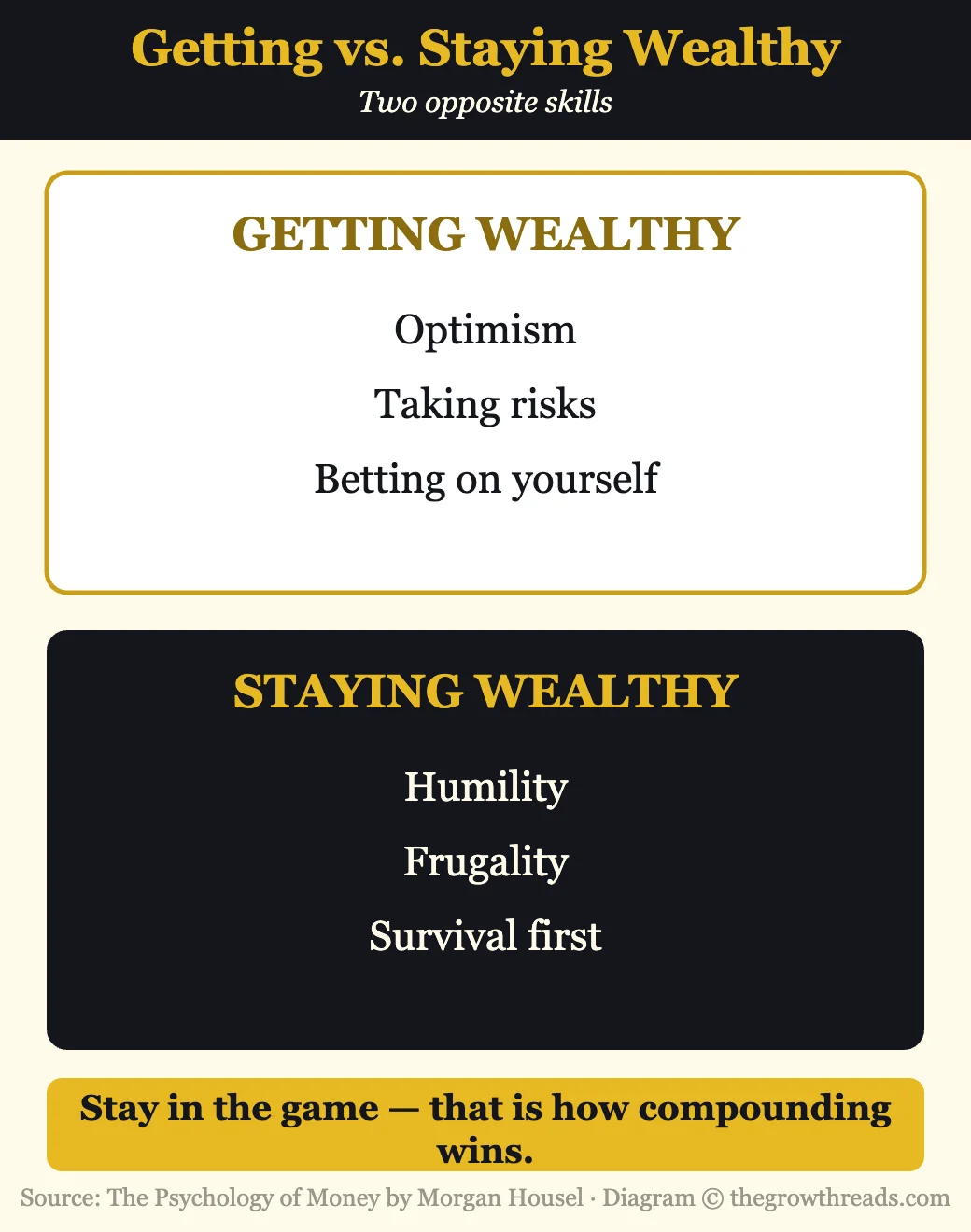
- Getting money and keeping money are opposite skills: getting rich takes optimism and risk; staying rich takes humility, frugality, and fear that some of what you made was luck.
- Tails drive everything: a small number of events account for the majority of outcomes. You can be wrong half the time and still make a fortune.
- The highest dividend money pays is control over your time: the ability to wake up and do what you want, with who you want, for as long as you want, is the greatest form of wealth.
- Wealth is what you don’t see: it is the cars not purchased and the upgrades declined. Spending money to show people how rich you are is the fastest way to have less of it.
- Wealth is just accumulated leftovers: your savings rate — the gap between your ego and your income — matters far more than your investment returns.
- Room for error is the most underrated force: plan on your plan not going according to plan. A margin of safety lets you stay in the game long enough for compounding to work.
What is The Psychology of Money about?
The Psychology of Money is a collection of 19 short stories about how people think and behave around money. Morgan Housel argues that financial success is a “soft skill” — that temperament, patience, and humility matter more than intelligence or technical knowledge — and shows how ordinary savers can outperform experts by simply behaving well over time.
About the author
Morgan Housel is a partner at the Collaborative Fund and a former columnist for The Motley Fool and The Wall Street Journal. He is a two-time winner of the Best in Business Award from the Society of American Business Editors and Writers, and a two-time finalist for the Gerald Loeb Award for Distinguished Business and Financial Journalism. Housel’s gift is not new data but new framing: he takes ideas everyone half-knows — save more, be patient, don’t get greedy — and wraps them in stories so vivid they finally stick. Published in 2020, The Psychology of Money grew from a widely read 2018 report of the same name and went on to sell millions of copies in dozens of languages, making it one of the defining personal-finance books of its decade. He writes for readers, not for finance professionals, which is exactly why the book travels so far beyond Wall Street. Explore all Morgan Housel book summaries →
Key concepts at a glance
| Concept | What it means | Use it when |
|---|---|---|
| No one’s crazy | Money decisions reflect personal history, not universal logic | You’re tempted to call someone’s choice “stupid” |
| Enough | Knowing the point beyond which more isn’t worth the risk | You feel the pull to chase one more win |
| Confounding compounding | Time, not returns, does the heavy lifting | You’re impatient with slow, steady growth |
| Tails you win | A few events produce most of the results | You’re rattled by being wrong often |
| Wealth is what you don’t see | Real wealth is unspent money and assets, not visible stuff | You measure success by lifestyle |
| Room for error | A margin of safety that keeps you in the game | You’re deciding how much risk to take |
| Freedom | Control over your time is money’s best dividend | You’re weighing a raise against your hours |
Part 1: No one’s crazy — money is behavioral, not mathematical
Housel opens with a story that frames the entire book. Ronald Read was a janitor and gas-station attendant in Vermont who, on his death in 2014, left an $8 million fortune — most of it donated to a hospital and library. He had no windfall and no finance degree; he simply saved what little he could and let blue-chip stocks compound for decades. In the same era, Richard Fuscone — a Harvard-educated Merrill Lynch executive with everything Read lacked — went bankrupt during the 2008 crisis, his massive home foreclosed. The gap between them was not intelligence or access. It was behavior.
Why do smart people make terrible money decisions? Because, Housel argues, no one is actually crazy — we just make decisions based on our own unique experiences of how the world works. A person who grew up in poverty thinks about risk and reward in ways someone raised in wealth simply cannot understand. Someone who came of age during high inflation invests differently than someone who never saw prices spike. Studies of lifetime investing behavior show people’s willingness to buy stocks is heavily predicted by what markets did during their own young adulthood — pure accident of birth. We are all making sense of a rigged, personal deck, which means the “irrational” behavior we criticize in others is usually rational from inside their story.
The second pillar of Part 1 is the pairing of luck and risk. Housel tells the story of Bill Gates, who attended one of the only high schools in the world with a computer in 1968 — a one-in-a-million stroke of luck. Gates himself said Microsoft would never have happened without it. But his friend Kent Evans, equally talented, died in a mountaineering accident before graduation: the same one-in-a-million odds, pointing the other way. Luck and risk are siblings — both are the reality that life outcomes are guided by forces beyond individual effort. The practical lesson is humility: be careful who you praise and admire, and careful who you look down upon, because you are seeing outcomes without seeing the full role chance played in them.
TGR Note: Housel’s warning to judge process over outcome is the financial cousin of the “outcome bias” and “narrative fallacy” Daniel Kahneman documents in Thinking, Fast and Slow — our tendency to build tidy stories around lucky results and mistake them for skill. Read the two together and you get both the psychology of why we misjudge, and the money-specific antidote: assume some of every good result was luck, and some of every bad one was risk.
Part 2: Getting wealthy vs. staying wealthy — and why “enough” matters
If Part 1 is about how we form beliefs, Part 2 is about the two forces that build fortunes and the trap that destroys them. Start with the trap. Housel tells the story of Rajat Gupta, who rose from orphan in Kolkata to CEO of McKinsey and a net worth over $100 million — and then committed insider trading to make even more, landing in prison. Bernie Madoff was already a wildly successful, legitimate market-maker before running history’s largest Ponzi scheme. Both men had everything and risked it for more they did not need. The hardest financial skill, Housel writes, is getting the goalpost to stop moving. Modern capitalism is superb at manufacturing two things: wealth, and envy. When your definition of success is always “a little more than I have,” no amount ever satisfies, and the pursuit of more pushes you toward the one outcome that undoes everything — ruin.
The engine that quietly builds fortunes is compounding, and Housel insists it is genuinely counterintuitive. Consider the ice ages: relatively small changes in the Earth’s tilt don’t melt snow so much as let a little of it persist through summer, which reflects more sunlight, which cools the planet, which lets more snow persist — a modest input compounding into continent-sized glaciers. Money works the same way. Warren Buffett is a phenomenal investor, but his real secret is time: he has been investing since he was ten years old.
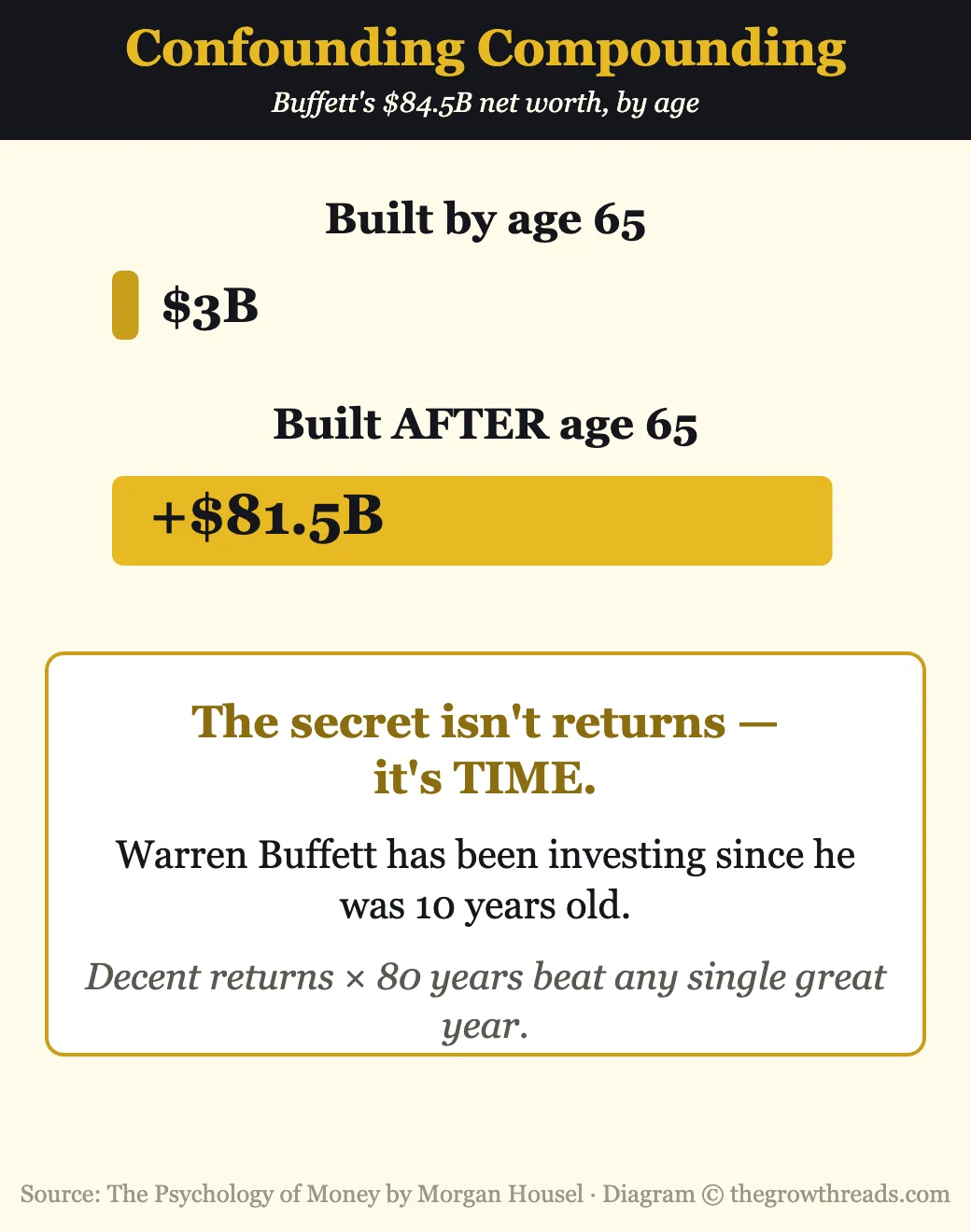
The math is staggering: of Buffett’s roughly $84.5 billion net worth, about $81.5 billion arrived after his 65th birthday. If he had started at 30 and retired at 60 like a normal person, almost no one would have heard of him. His skill is investing; his secret is that he did it for three-quarters of a century. That is why “getting wealthy” and “staying wealthy” are opposite skills. Getting money requires optimism, risk-taking, and putting yourself out there. Keeping money requires the opposite — humility, frugality, and a fear that what you have made could be taken away. Survival is everything, because only by staying in the game long enough does compounding have a chance to do its work.
The final idea of Part 2 explains why survival matters so much: tails drive everything. In venture capital, most investments fail, a handful do okay, and one or two pay for the entire fund and then some. The same lopsidedness runs through the public markets, blockbuster films, and even the great artists — a few outlier hits carry a career. Housel’s point for ordinary investors is calming: you can be wrong the majority of the time and still do spectacularly well, as long as you capture the few enormous winners. That is only possible if you never get knocked out of the game.
TGR Note: “Time in the market beats timing the market” is really the same law that governs habits. In Atomic Habits, James Clear shows how a 1% daily improvement compounds into a 37x gain over a year — identical mathematics, applied to behavior instead of dollars. Both books are ultimately arguments for patience: the results feel invisible at first because compounding is back-loaded, and most people quit in the flat part of the curve right before it bends upward.
Part 3: Freedom, and the real dividend of money
What is money actually for? Housel’s answer is the emotional heart of the book: the highest dividend money pays is control over your time. He cites research by Angus Campbell into what makes people happy, whose strongest finding was not income, geography, or health, but a pervasive sense of controlling one’s own life — being able to do what you want, when you want, with the people you want. Using money to gain that autonomy, Housel argues, is the highest-return purchase available to anyone, and it beats a bigger house or a nicer car in almost every case.
He then punctures the reason we overspend: the Man in the Car Paradox. When you see someone driving a Ferrari, you rarely think “that driver is admirable.” You imagine yourself in the car being admired. The driver is invisible; the object is everything. The paradox is that the possessions we buy to signal status to others mostly cause others to skip past us and admire the object. Nobody is as impressed by your things as you hope — a humbling but freeing realization, because it means the treadmill of buying to impress leads nowhere.
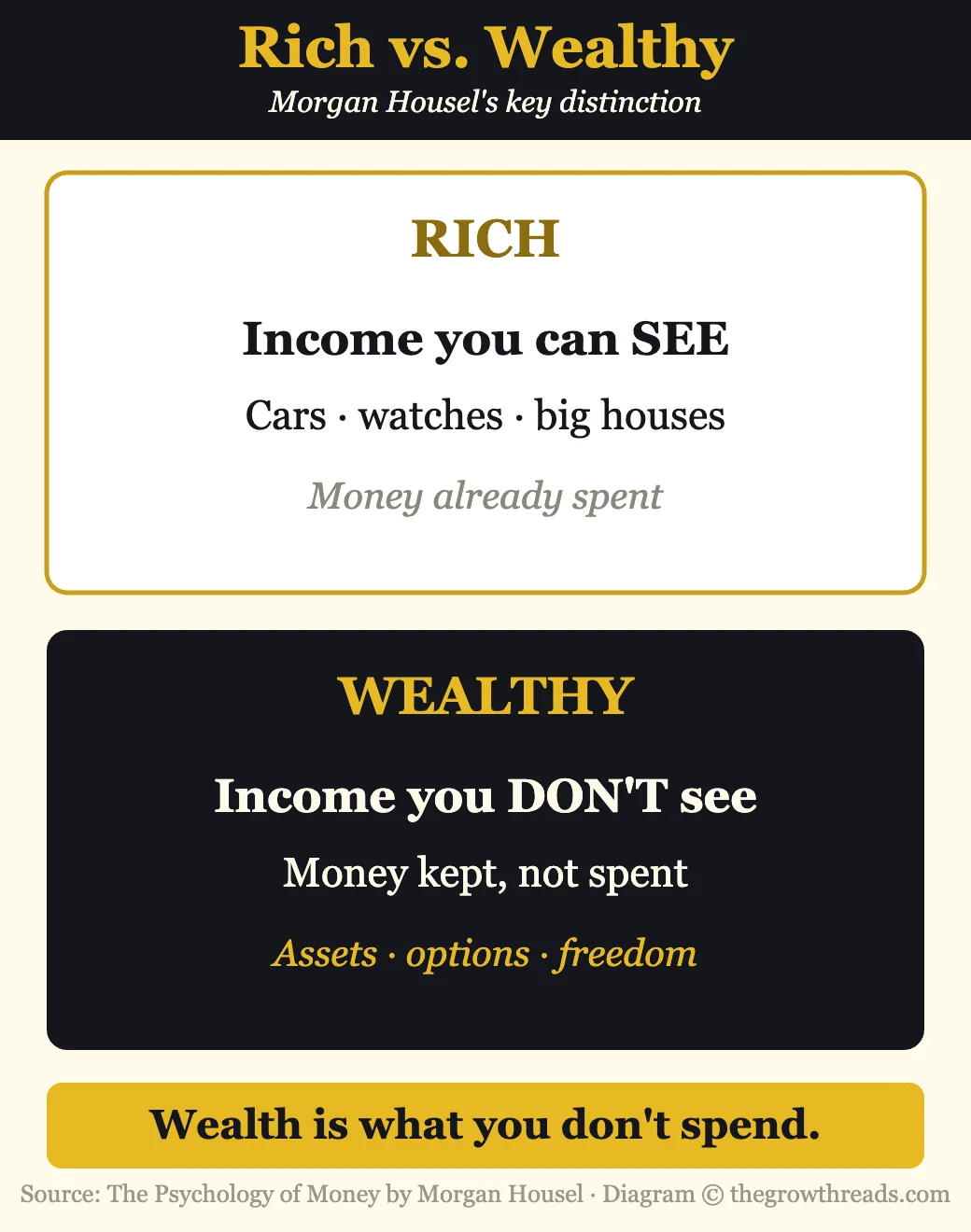
This leads to the book’s most quoted distinction: wealth is what you don’t see. When we see a person in a $100,000 car, the only data point we actually have is that they have $100,000 less than they did before — or a large loan. Real wealth is the financial assets that haven’t yet been converted into stuff: the cars not bought, the diamonds not purchased, the upgrades declined. It is invisible by definition, which is exactly why it is so easy to underestimate how attainable it is. We judge wealth by what we can see, and what we can see is spending — the opposite of wealth.
So how do you build the invisible kind? By saving, and Housel’s framing is refreshingly blunt: wealth is just the accumulated leftovers after you spend. Your savings rate — the gap between your ego and your income — is far more in your control than your investment returns and matters far more than most people think. You do not necessarily need a specific reason to save. Saving simply for optionality and flexibility is its own reward, because it buys you the ability to wait, to say no, and to seize opportunities others can’t.
TGR Note: Housel’s “wealth is what you don’t see” is the lived reality behind the data in The Millionaire Next Door, where researchers found most American millionaires drive used cars and live in modest homes, while many high earners in flashy neighborhoods are technically broke. If Housel gives you the mindset, I Will Teach You to Be Rich gives you the automation to make a high savings rate effortless — pay your future self first, before your ego gets a vote.
Part 4: Reasonable beats rational — room for error and the price of admission
The last movement of the book is about how to actually behave over a lifetime of uncertainty. Housel’s first counsel is to aim to be reasonable rather than coldly rational. On a spreadsheet, the optimal portfolio might be one you cannot emotionally tolerate through a crash. A slightly “suboptimal” strategy you can stick with for thirty years will beat a mathematically perfect one you abandon in a panic. Loving your investments enough to hold them is not a bug — it helps you stay in the game, which, as Part 2 showed, is the whole ballgame.
Next comes room for error, which Housel calls the most underrated force in finance. The single most important part of every plan is planning on your plan not going according to plan. History is mostly a chain of surprises no one saw coming, so forecasting the future by extrapolating the past is a trap. A margin of safety — call it wiggle room — raises the odds of success at a given level of risk by letting you endure the range of outcomes you cannot predict. You should also expect to change: the “End of History Illusion” is our tendency to know we have changed a lot in the past while assuming we are done changing now. Because your goals and desires will shift, avoid the extreme ends of financial planning and keep your options open.
Finally, everything has a price, but not every price is on a tag. Market volatility, fear, doubt, and regret are the fee for admission to good long-term returns — not a fine for doing something wrong. Investors who mistake the fee for a fine try to avoid it, and in doing so avoid the returns too. Housel closes by turning the lens on himself, describing his own boringly simple approach: a paid-off house (not optimal on paper, but it lets him sleep), plenty of cash, and steady low-cost index investing. The book ends where it began — with the reminder that a workable plan you can live with beats a brilliant one you can’t.
TGR Note: Housel’s “reasonable over rational” is a quiet rebuke to the get-rich-fast promises of classic wealth literature. Where Rich Dad Poor Dad lights a fire under your ambition, The Psychology of Money supplies the guardrails that keep ambition from becoming ruin — enough, room for error, and survival first. Read the motivator and the moderator together, and you get both the will to build wealth and the temperament to keep it.
Who is The Psychology of Money best for — and who should read something else first?
This book is ideal for anyone who feels smart but keeps making emotional money mistakes, for new investors who want the right mindset before they touch a brokerage account, and for high earners who are surprised they haven’t built more wealth. It is short, story-driven, and jargon-free, so it works beautifully as a first finance book for a reluctant reader. If you want step-by-step mechanics — which accounts to open, how to budget, how to automate — pair it with I Will Teach You to Be Rich for the how-to, or The Millionaire Next Door for the data behind quiet wealth. And if what you really need is the discipline to execute a savings habit, Atomic Habits is the natural companion.
Questions to reflect on
- What early experience — a parent’s job loss, a windfall, a recession you lived through — most shaped how you feel about money today?
- Where in your life is the goalpost still moving? What would “enough” actually look like if you defined it on purpose?
- How much of your recent spending was to build wealth versus to be seen as wealthy?
- If your plan didn’t go according to plan next year, how much room for error have you actually built in?
- What is one thing you could buy with money that would give you more control over your time?
🔥 Ready to change how you behave with money?
This guide is the map — the book is the territory. Housel’s stories are the part that actually changes what you do on payday.
How to apply The Psychology of Money (7-day plan)
- Day 1 — Write your money story. Spend ten minutes noting the experiences that shaped your financial beliefs. Naming them loosens their grip on your decisions.
- Day 2 — Define “enough.” Write a specific number and lifestyle that would genuinely satisfy you, so the goalpost stops moving on autopilot.
- Day 3 — Calculate your savings rate. Divide what you saved last month by what you earned. This single number matters more than any investment return — know it.
- Day 4 — Automate one transfer. Set up an automatic move to savings or investments the day after payday, before your ego can spend it.
- Day 5 — Audit one status purchase. Find one recent buy made to impress others and ask what it actually bought you. Redirect that amount next time.
- Day 6 — Build room for error. Decide on an emergency cash buffer that lets you sleep, and start a plan to reach it.
- Day 7 — Buy back some time. Identify one way to spend money that increases control over your schedule, then take the first step toward it.
Frequently asked questions
Is The Psychology of Money worth reading?
Yes — it is one of the most recommended personal-finance books of the last decade for good reason. Rather than teaching tactics that go stale, it fixes the behaviors that quietly determine wealth: patience, humility, a strong savings rate, and knowing when you have enough. It is short (around 250 pages), written in plain language, and organized as 19 standalone stories, so it is unusually easy to finish and remember. Reviewers who already know finance still praise it for reframing ideas they thought they understood. If you read only one money book, this is a defensible choice.
What is the main message of The Psychology of Money?
That doing well with money depends far more on how you behave than on what you know. Housel argues finance is taught like a hard science of formulas when it is really a soft skill of temperament. The people who build lasting wealth are usually not the smartest; they are the most patient, the most humble about luck, and the most disciplined about spending less than they earn and letting compounding run undisturbed for decades. Behavior beats brilliance.
How long does it take to read The Psychology of Money?
The book is roughly 250 pages and most readers finish it in about five hours, or two to three relaxed sittings. Because it is built from 19 short, self-contained chapters, it is easy to read in small bursts without losing the thread. Our summary above captures the core arguments in about 17 minutes if you want the essence first, but the book is worth the full read — its power comes from the stories, which make the simple lessons emotionally sticky in a way a summary cannot fully replicate.
Who should read The Psychology of Money?
Anyone who feels they should be better with money but keeps repeating emotional mistakes, new investors who want the right mindset before opening a brokerage account, and high earners puzzled that they have not built more wealth. Because it avoids jargon and step-by-step mechanics, it is an ideal first finance book — even for people who find money intimidating. Those who want concrete how-to systems may want to pair it with a more tactical guide like I Will Teach You to Be Rich.
Is The Psychology of Money good for beginners?
Very much so. It assumes no prior knowledge, uses no complex math, and never requires you to understand markets or products. Instead it teaches the mindset that makes every later financial decision easier: save a meaningful share of your income, avoid lifestyle creep, leave room for error, and be patient. Beginners often find it more useful than a technical primer because it addresses the real reason people struggle with money, which is behavioral rather than informational.
What are the key lessons from The Psychology of Money?
A few stand out: no one is crazy — money views reflect personal history; luck and risk are siblings, so judge decisions by process; the hardest skill is knowing when you have enough; compounding rewards time more than genius; getting rich and staying rich are opposite skills; wealth is what you do not see; your savings rate matters more than your returns; and always build room for error so you can survive long enough for compounding to work. Behavior ties them all together.
Does The Psychology of Money tell you how to invest?
Only lightly, and on purpose. Housel shares his own approach — a paid-off home for peace of mind, ample cash, and steady low-cost index-fund investing — but the book is about temperament, not stock picks. Its investing advice is behavioral: stay in the game, treat volatility as the fee for good returns rather than a fine, be reasonable rather than coldly rational, and let time do the heavy lifting. For account-by-account mechanics, pair it with a dedicated how-to guide.
Related summaries
- The Millionaire Next Door Summary — the data behind quiet, invisible wealth.
- I Will Teach You to Be Rich Summary — the automation that makes a high savings rate effortless.
- Rich Dad Poor Dad Summary — the mindset shift on assets versus liabilities.
- Think and Grow Rich Summary — the classic on wealth psychology and desire.
- Browse all our best money books.
How we analyze books: We work from the full book — reconstructing its core arguments in our own words, adding commentary that connects it to related research and other books in our library, and pressure-testing the advice against how it plays out in real life. We never reproduce the text; we synthesize it. Read our full methodology.
Disclosure: The Growth Reads is reader-supported. When you buy through links on our site we may earn an affiliate commission at no extra cost to you. We only recommend books we believe are worth your time, and our summaries and opinions are written independently.