

★★★★★ 4.6/5 — The clearest, most compelling case for index investing ever written.
Best for: Anyone who wants to stop overthinking their investments and start building wealth with a simple, proven strategy.
Reading time: ~4 hrs (216 pages) · This summary: ~18 min
Difficulty to apply: Very low — the entire strategy fits on an index card.
Links below may earn us a commission at no extra cost to you.
The Little Book of Common Sense Investing in one minute
The stock market is a positive-sum game for businesses and a zero-sum game for investors — and after costs, it becomes a negative-sum game. Jack Bogle, the founder of Vanguard and inventor of the index fund, lays out an argument so simple it is almost embarrassing: since all investors collectively own the entire market, they must collectively earn the market return. But after subtracting management fees, trading costs, and taxes, the average investor earns significantly less. The solution is to own the entire market through a low-cost index fund and keep as much of the return as possible. Published in 2007, the book distills Bogle’s 60+ years of market wisdom into a slim volume that has become the investing world’s single most recommended book.
Key takeaways
- All investors collectively earn the market return: This is arithmetic, not opinion. Before costs, the average dollar invested earns exactly the market return.
- After costs, most investors underperform: Fees, trading costs, and taxes drag down returns, turning the average investor into a below-average performer.
- The cost matters hypothesis trumps the efficient market hypothesis: You do not need to believe markets are perfectly efficient to prefer index funds — you only need to understand the math of costs.
- Index funds give you the entire haystack: Instead of searching for the needle (the winning stock), buy the whole haystack (the entire market).
- Past fund performance does not predict future results: Hot funds rarely stay hot. Reversion to the mean is the most powerful force in fund management.
- Star managers are a myth: For every Peter Lynch, hundreds of managers quietly underperform. Survivorship bias makes the winners look more common than they are.
- Simplicity beats complexity: The best investment portfolio is also the simplest — one or two broad index funds held for decades.
- Stay the course: The biggest enemy of long-term returns is the investor’s own behavior — buying high, selling low, and chasing trends.
- Compounding is magical but fragile: Small differences in annual returns, compounded over decades, create enormous differences in final wealth.
- Time is your greatest asset: The longer you hold a diversified index fund, the more certain your returns become and the less volatility matters.
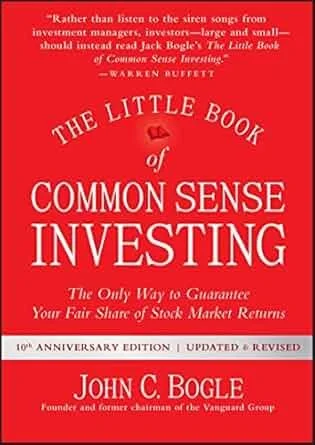
What is The Little Book of Common Sense Investing about?
The Little Book of Common Sense Investing is a concise investing guide by Vanguard founder John C. Bogle that makes the mathematical case for why low-cost index funds outperform the vast majority of actively managed funds. It shows investors how to capture the full return of the stock market by minimizing fees, taxes, and emotional mistakes.
About the author
John Clifton Bogle founded The Vanguard Group in 1974 and created the first index mutual fund available to individual investors in 1976. Wall Street laughed at the idea — critics called it “Bogle’s Folly.” By the time of his death in 2019, Vanguard managed over $5 trillion in assets and index funds had become the dominant force in investing. Fortune magazine named Bogle one of the four investment giants of the twentieth century. He wrote 12 books, testified before Congress on industry reform, and spent his career advocating for individual investors against what he called the excessive costs and conflicts of interest in the financial industry. Explore all John C. Bogle book summaries →
Key concepts at a glance
| Concept | What it means | Use it when |
|---|---|---|
| Cost Matters Hypothesis | Net return = gross return minus costs; lower costs = higher net returns | Comparing any two investment options |
| Reversion to the Mean | Funds that outperform tend to underperform later, and vice versa | Tempted to chase last year’s top fund |
| The Relentless Rules of Humble Arithmetic | All investors together earn the market return; costs make most fall behind | Someone claims they can consistently beat the market |
| The Haystack Approach | Buy the entire market instead of searching for individual winning stocks | Deciding between index funds and stock picking |
| Stay the Course | Hold through downturns; switching strategies during volatility locks in losses | Markets are crashing and you want to sell |
| The Tyranny of Compounding Costs | Small fee differences compound into enormous wealth differences over decades | Evaluating whether a 1% advisory fee is worth it |
Part 1 — The relentless rules of humble arithmetic
Bogle opens with what he calls the most important lesson in investing, and it is not a theory — it is simple arithmetic. All investors collectively own all the stocks in the market. Therefore, all investors collectively earn exactly the market return before costs. This is not an assumption or a hypothesis. It is a mathematical identity.
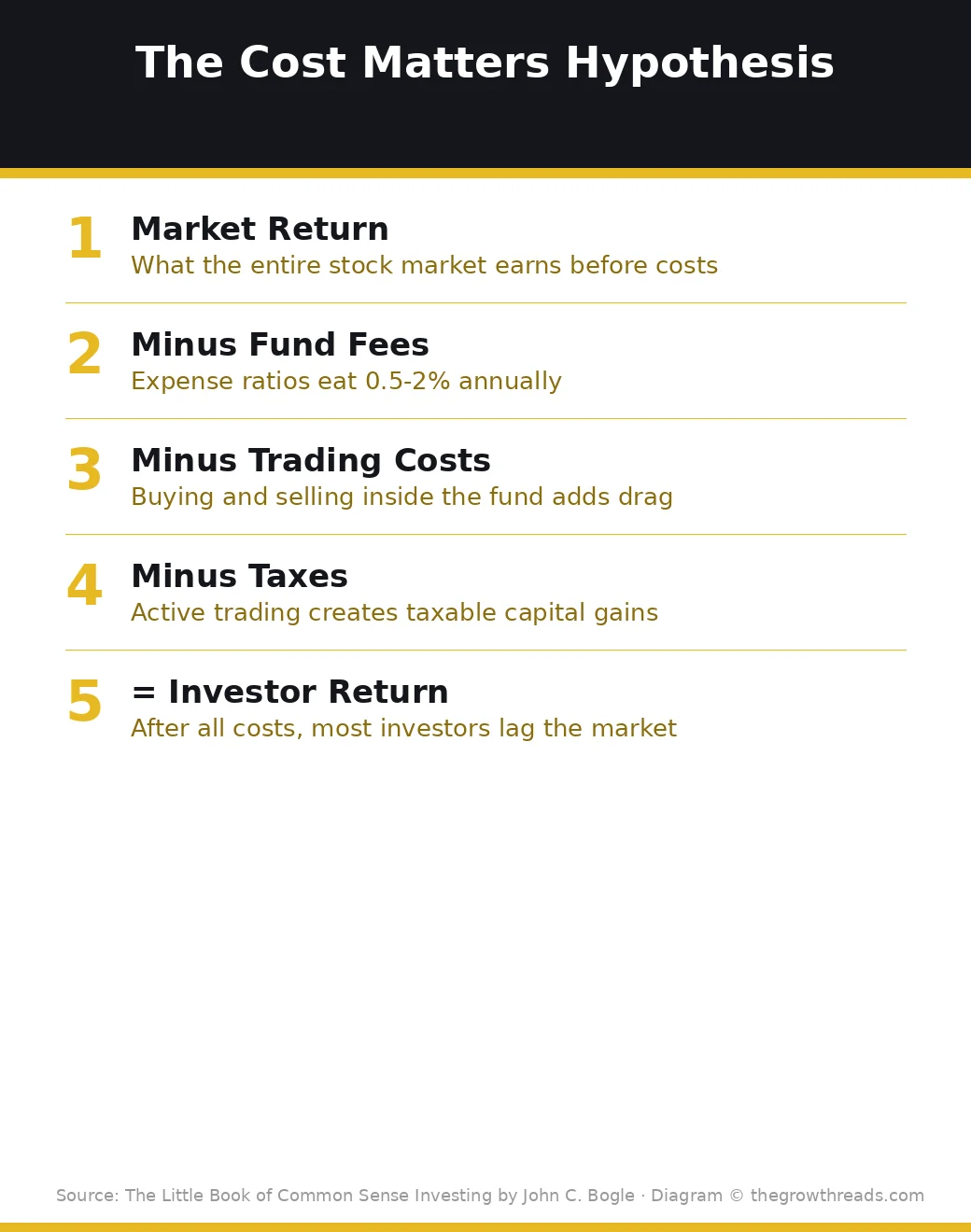
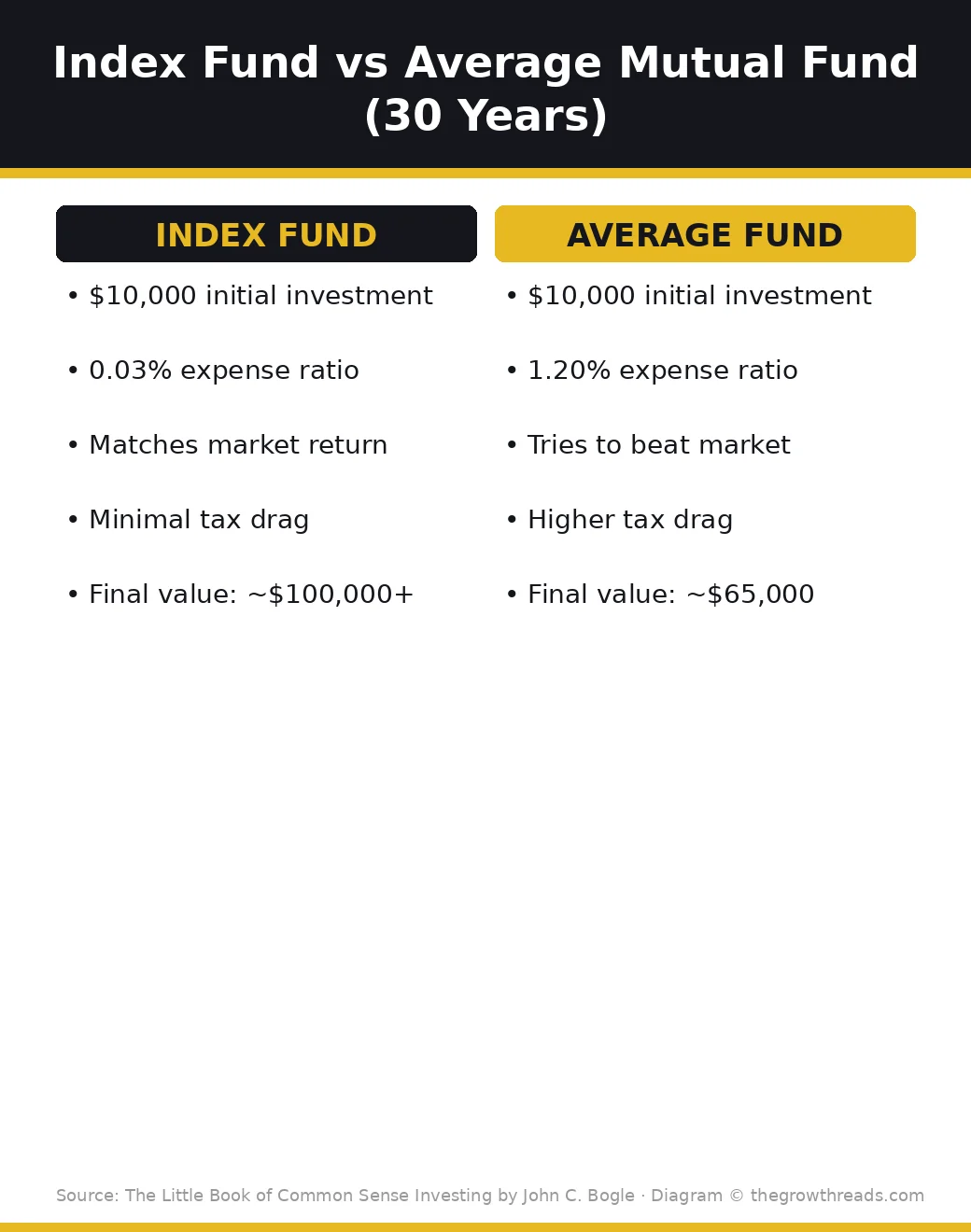
The problem is costs. Every dollar paid in management fees, trading commissions, and taxes is a dollar that does not compound for the investor. Bogle shows that the average actively managed equity fund charges roughly 1-2% per year in total costs (expense ratio plus hidden trading costs plus tax drag). Over 30 years, this means an investor in the average active fund keeps roughly 65 cents of every dollar the market generates, while an index fund investor keeping costs at 0.03% keeps over 95 cents.
This is the Cost Matters Hypothesis: you do not need to believe markets are perfectly efficient to prefer index funds. You just need to understand that costs are certain and performance advantages are not. Even if some managers can beat the market before costs, the fees they charge consume most or all of the excess return.
Part 2 — The grand illusion of active management
Bogle devotes several chapters to systematically dismantling the case for actively managed funds. He shows that over virtually every measured time period — 10 years, 20 years, 30 years — the majority of active funds underperform their benchmark index. The longer the period, the worse the numbers get. Over 30 years, roughly 95% of active funds fail to beat a simple index.
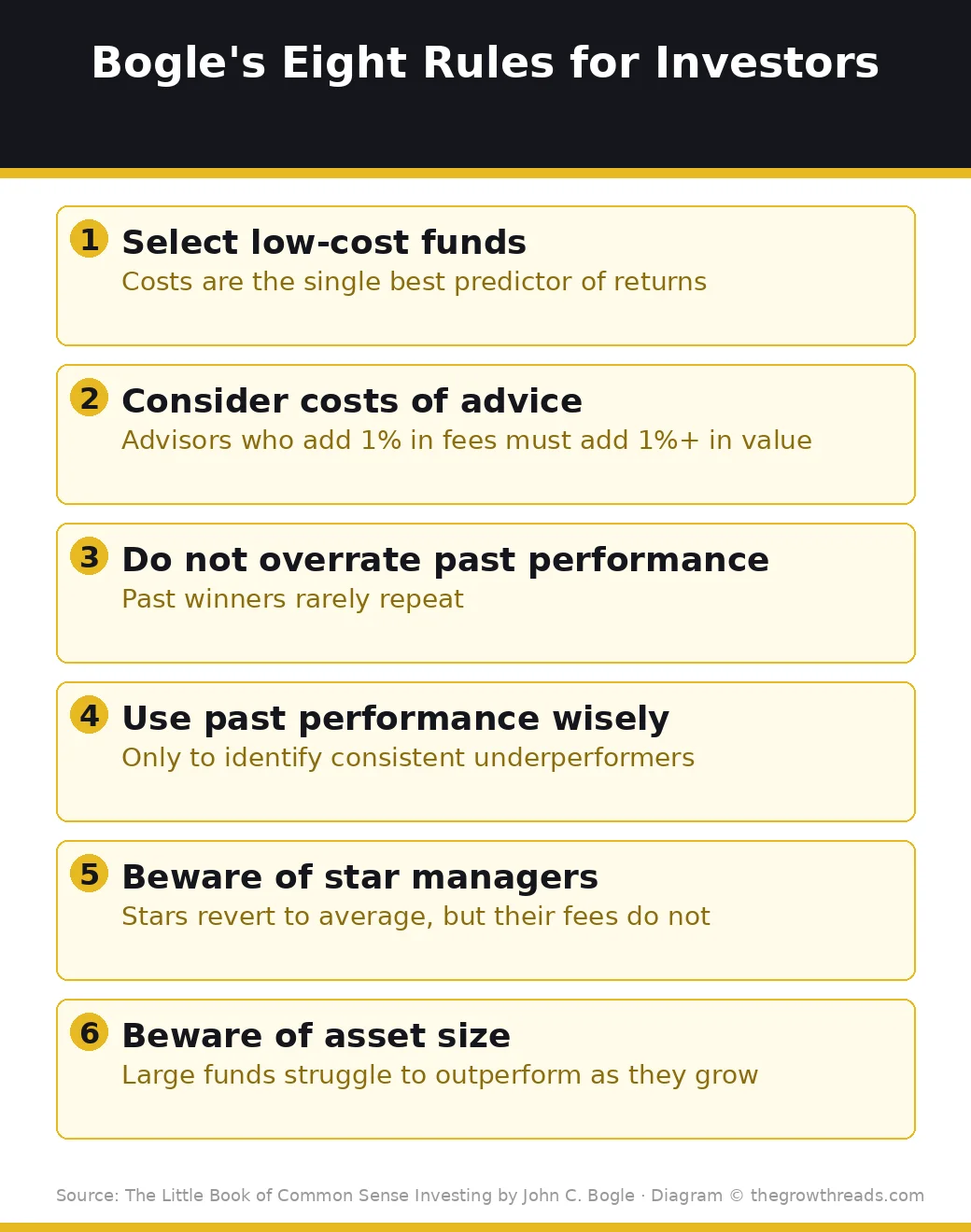
He is particularly sharp on the myth of the star manager. For every Peter Lynch or Warren Buffett, hundreds of managers quietly underperform year after year. Survivorship bias — the fact that failed funds are closed and removed from the record — makes active management look better than it actually is. When you include dead funds in the analysis, the picture becomes even more damning.
Reversion to the mean is another powerful force Bogle highlights. Funds that top the performance charts in one decade rarely repeat in the next. The correlation between past returns and future returns is essentially zero. Chasing hot funds is not just unhelpful — it actively destroys wealth because investors tend to buy after a run-up and sell after a decline.
Part 3 — The tyranny of compounding costs
In what may be the most eye-opening section of the book, Bogle walks through the long-term math of fees. Imagine two investors each put $10,000 into the stock market at age 25 and earn a gross return of 7% per year for 40 years. One uses an index fund charging 0.03% per year; the other uses an actively managed fund charging 1.2%. After 40 years, the index fund investor has roughly $148,000. The active fund investor has roughly $98,000. The fund manager’s fees consumed over $50,000 — more than a third of the total gains.
Bogle calls this the “tyranny of compounding costs.” The same force that makes compound interest so powerful for investors — small differences growing exponentially over time — works in reverse when applied to fees. A seemingly modest 1% annual fee does not take 1% of your money. Over decades, it takes 25-35% of your ending wealth because it reduces the base on which future returns compound.
Part 4 — Stay the course: building your index portfolio
Bogle’s practical advice is almost aggressively simple. Buy a total stock market index fund. If you want bonds, add a total bond market index fund. Set an allocation that reflects your age and risk tolerance — a common starting point is your age in bonds and the rest in stocks. Contribute regularly regardless of what the market is doing. Rebalance once a year. Then leave it alone.
He warns against the temptation to complicate things. You do not need sector funds, international funds (though he softened on this in later editions), or alternative investments. You do not need to time the market. You do not need to read financial news. Every additional layer of complexity adds costs and decision points where you can make mistakes.
The hardest part, Bogle emphasizes, is not picking the right fund — it is staying the course when markets crash. During the 2008 financial crisis, the S&P 500 lost over 50% of its value. Investors who panicked and sold locked in those losses permanently. Those who stayed invested saw their portfolios fully recover within a few years and go on to new highs. The index fund strategy only works if you have the discipline to do nothing during the worst moments.
Who is The Little Book of Common Sense Investing best for — and who should read something else first?
This is the single best first investing book you can read. If you have never invested before or feel overwhelmed by choices, Bogle gives you a clear, proven plan in under 200 pages. If you already invest in actively managed funds, this book will make you seriously question whether those fees are worth paying. If you want more academic depth behind the same thesis, follow up with A Random Walk Down Wall Street by Burton Malkiel. If you want the same message with more personal finance context, try The Simple Path to Wealth by JL Collins.
Questions to reflect on
- What total percentage of your investment returns are you giving up to fees each year — including expense ratios, advisory fees, and trading costs?
- If you invest in actively managed funds, have any of them consistently beaten their benchmark index after fees over the past decade?
- During the last significant market downturn, did you stay invested or did you sell? What would the outcome have been if you had done the opposite?
- Could you simplify your portfolio to just two or three index funds without giving up meaningful diversification?
- What would you do with the extra money if you switched from a 1% annual fee to a 0.03% index fund fee over the next 30 years?
Ready to invest with common sense?
Get the investing classic that launched a revolution in how ordinary people build wealth.
How to apply The Little Book of Common Sense Investing (7-day plan)
- Day 1 — List every investment you own: Write down each fund or stock, its expense ratio, and its benchmark index. Calculate your total annual cost in dollars.
- Day 2 — Compare to an index: For each actively managed fund, look up the 10-year return of its benchmark index. Calculate the gap after fees.
- Day 3 — Open an index fund account: If you do not already have one, open a brokerage account at Vanguard, Fidelity, or Schwab and select a total stock market index fund.
- Day 4 — Set your allocation: Decide your stock-to-bond ratio. A simple rule: subtract your age from 110 — that is your stock percentage. Write it down.
- Day 5 — Automate contributions: Set up automatic monthly transfers from your bank account into your index fund. Remove the decision from each paycheck.
- Day 6 — Plan your exit from high-cost funds: For each underperforming active fund, plan the transition to an equivalent index fund. Consider tax implications for taxable accounts.
- Day 7 — Write your investment policy: In one paragraph, write down what you own, why, and what you will do when markets drop 40%. Tape it to your monitor for the next crash.
Frequently asked questions
Who was John Bogle and why does he matter?
John C. Bogle founded The Vanguard Group in 1974 and created the first index mutual fund for individual investors in 1976. Before Bogle, every mutual fund was actively managed, meaning investors paid high fees for professionals to pick stocks. Bogle proved that a fund matching the market at rock-bottom cost would beat most active managers over time. By the time of his death in 2019, Vanguard managed over $5 trillion, and index funds had become the dominant investment vehicle worldwide. He is widely credited with saving ordinary investors billions of dollars in unnecessary fees.
What is the main message of The Little Book of Common Sense Investing?
The main message is that owning a low-cost index fund that tracks the entire stock market will, over time, outperform the vast majority of actively managed mutual funds. This is not because index funds are brilliant — it is because the costs of active management (fees, trading, taxes) eat into returns so significantly that most active funds cannot overcome the drag. The math is simple and the evidence is overwhelming.
What is the cost matters hypothesis?
The cost matters hypothesis is Bogle’s reframing of the efficient market debate. He argues you do not need to believe markets are perfectly efficient to prefer index funds. The arithmetic is simpler: all investors collectively earn the market return before costs. After costs, the average investor earns below the market return. Since index funds have the lowest costs, they capture the most return. This is not a theory — it is math.
Which index fund does Bogle recommend?
Bogle recommends a total stock market index fund as the core holding for most investors. His specific recommendation is the Vanguard Total Stock Market Index Fund (VTSAX for the mutual fund, VTI for the ETF), though equivalent funds from Fidelity (FSKAX) and Schwab (SWTSX) work just as well. For investors who want bonds, he suggests adding a total bond market index fund. He kept his own recommendations deliberately simple — often just one or two funds.
Is this book still relevant in 2026?
More relevant than ever. Since the book’s first edition in 2007, the evidence for index investing has only strengthened. Every additional year of data confirms that active managers continue to underperform. The rise of ultra-low-cost ETFs and zero-commission trading has made Bogle’s strategy even more accessible. What has changed is that the ideas are no longer controversial — they are mainstream. But millions of investors still pay unnecessary fees, making the book as needed as ever.
How is this different from A Random Walk Down Wall Street?
Both books arrive at the same conclusion — buy index funds — but from different angles. Burton Malkiel’s A Random Walk Down Wall Street builds the academic case through efficient market theory, behavioral finance, and historical analysis. Bogle’s book builds the practitioner’s case through industry data and simple arithmetic. Malkiel is a professor explaining why; Bogle is the man who built the solution explaining how. Reading both gives you the complete picture.
What about international stocks — does Bogle recommend them?
Bogle was famously skeptical of international diversification for most of his career, arguing that large U.S. companies already derive significant revenue from overseas. In later editions and interviews, he softened slightly, suggesting that a small international allocation (up to 20%) was reasonable. Most financial advisors today recommend more international exposure than Bogle preferred, but his core point — that simplicity matters more than optimization — remains valid.
Related summaries
- A Random Walk Down Wall Street Summary — Burton Malkiel on the academic case for index investing
- The Simple Path to Wealth Summary — JL Collins on the simplest investing strategy
- The Psychology of Money Summary — Morgan Housel on behavior and wealth
- Best Money Books — Our complete ranked guide