

★★★★★ 4.8 / 5 — The foundational text on value investing, as relevant today as when Graham first published it in 1949. Warren Buffett calls it “the best book on investing ever written.”
Best for: Anyone who invests money — from complete beginners building their first portfolio to experienced investors who want to strengthen their intellectual framework.
Reading time: ~12 hours (640 pages) · This summary: 18 min
Difficulty to apply: Medium — the defensive investor strategy is simple to implement; the enterprising investor approach requires significant analysis skills.
The Intelligent Investor in one minute
Successful investing is not about being smart — it is about being disciplined, patient, and rational when everyone else is emotional. Benjamin Graham, the father of value investing and mentor to Warren Buffett, wrote this book to teach ordinary investors how to build wealth without speculation. His core framework rests on three pillars: treat stocks as ownership stakes in real businesses, always demand a “margin of safety” between price and value, and understand that the market is your servant (not your master) through the metaphor of Mr. Market. First published in 1949 and revised through 1973, the book’s principles have survived every market crash, bubble, and financial crisis since — because human psychology does not change.
Key takeaways
- Investment vs speculation: An investment operation promises safety of principal and an adequate return based on thorough analysis. Everything else is speculation — even if it looks sophisticated.
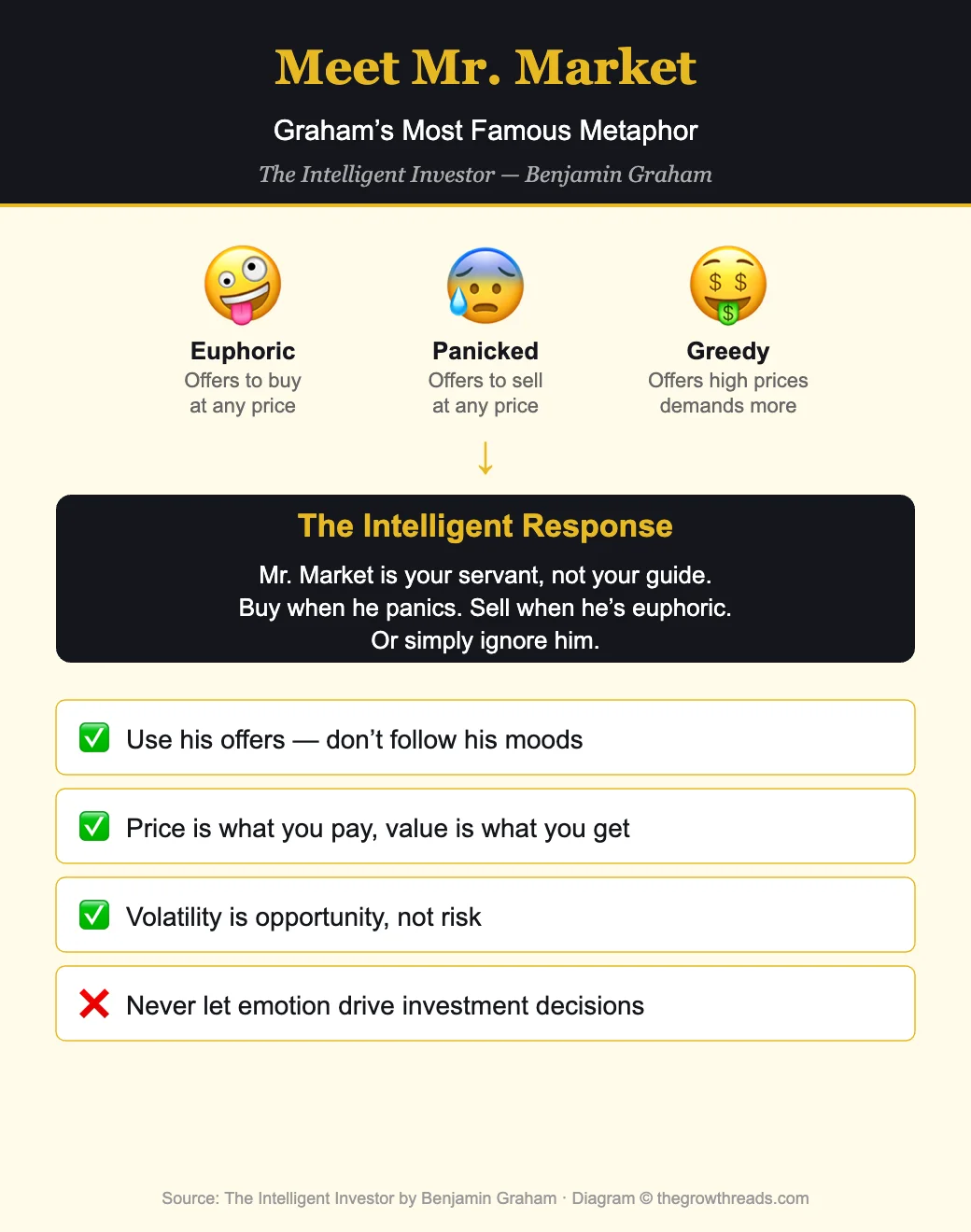
- Mr. Market is your servant: Imagine the market as a business partner who offers to buy or sell shares every day at wildly varying prices based on his mood. You are free to accept or ignore his offers.
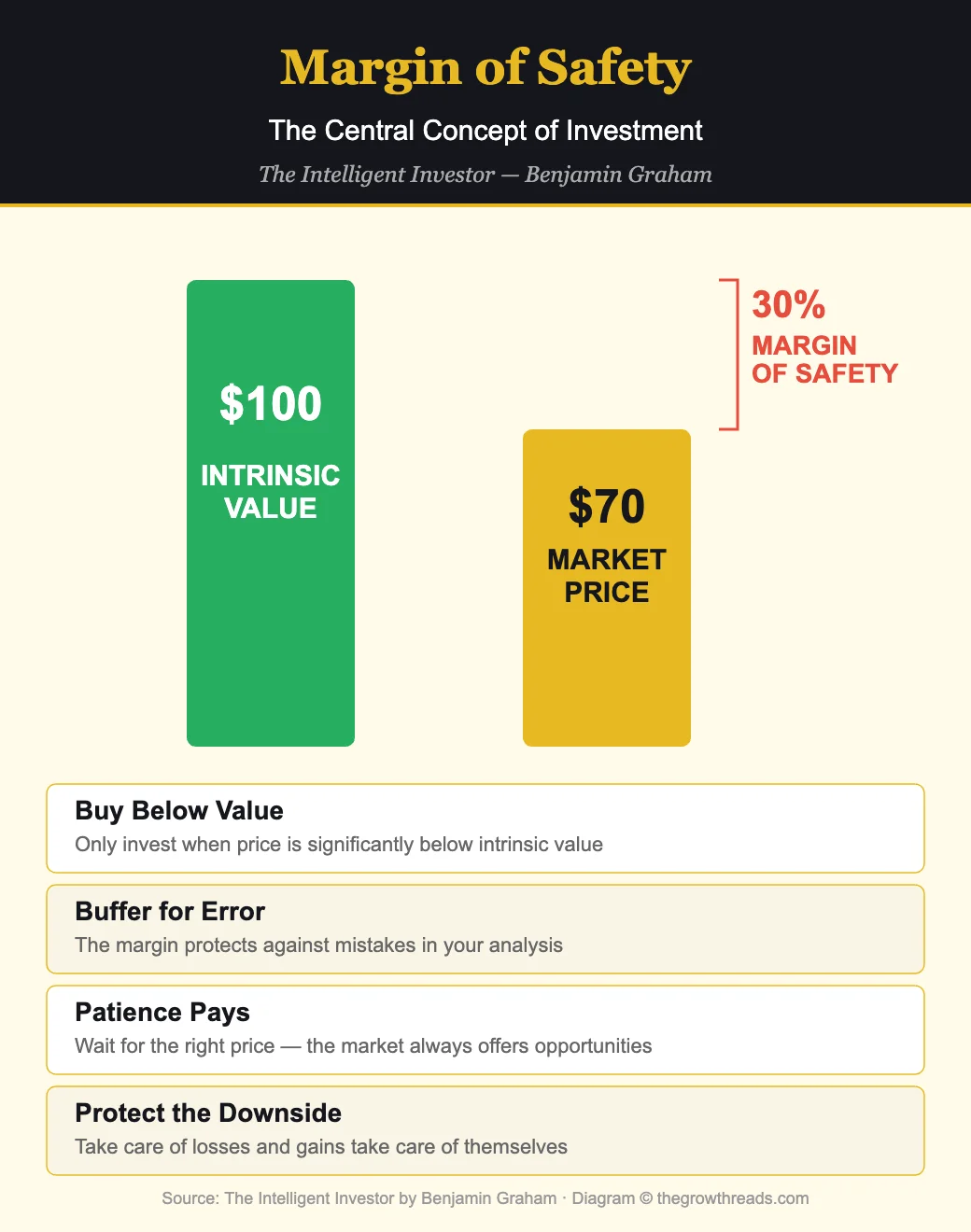
- Margin of safety is everything: Only buy when the price is significantly below your conservative estimate of intrinsic value. This buffer protects you against errors in analysis and unpredictable events.
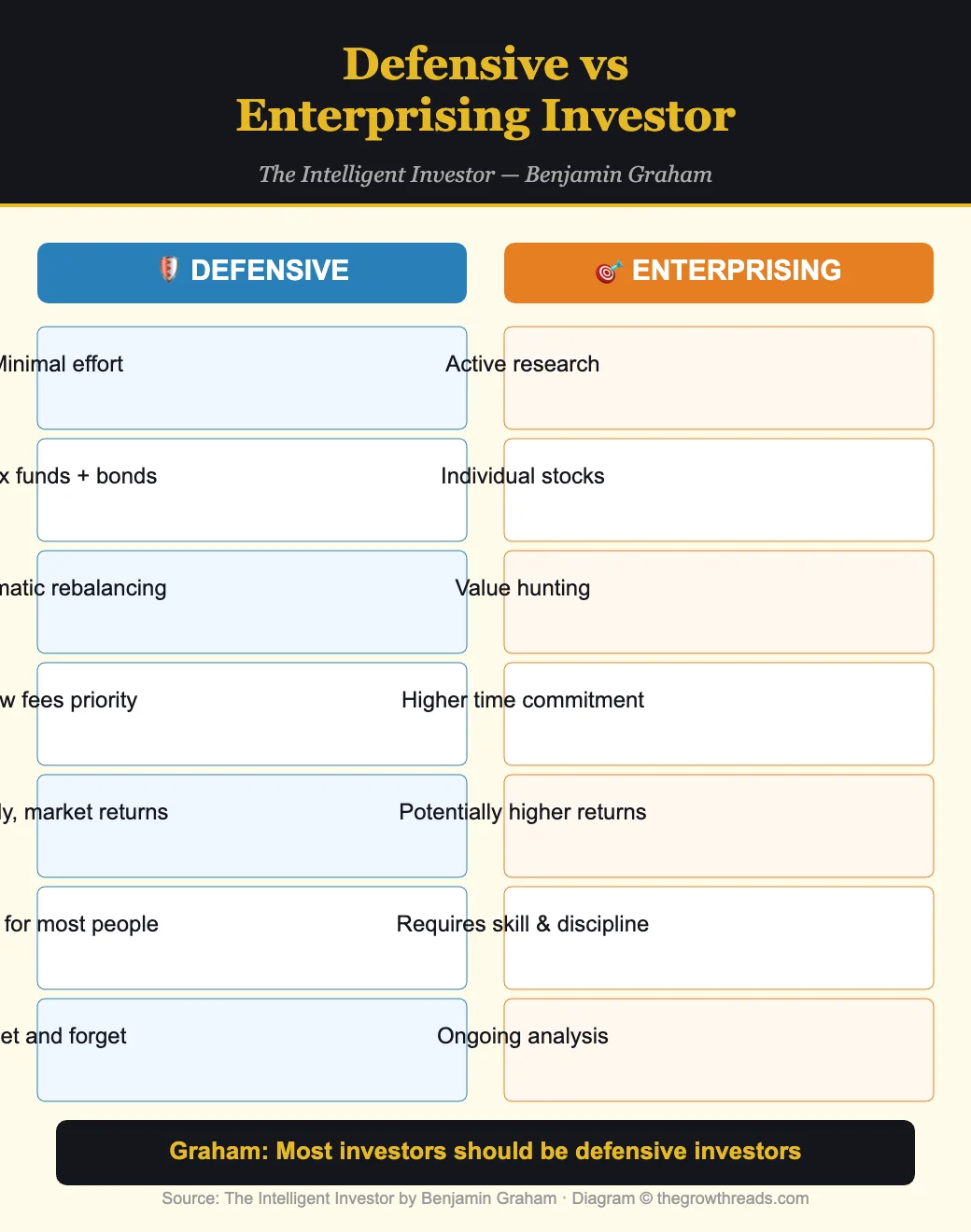
- Be a defensive or enterprising investor: Most people should be defensive investors who hold diversified index-like portfolios with minimal effort. Only those willing to invest serious time should attempt active value investing.
- Diversification is non-negotiable: Never concentrate your portfolio in a few positions. Graham recommends holding 10–30 stocks across different industries, plus a significant bond allocation.
- The market weighs in the long run: In the short term, the market is a voting machine (driven by popularity); in the long term, it is a weighing machine (driven by business fundamentals).
- Your worst enemy is yourself: The biggest risk in investing is not the market — it is your own emotions. Fear and greed cause more losses than bad analysis.
- Bonds provide ballast: Graham recommends keeping 25–75% of your portfolio in bonds (or bond equivalents), adjusting based on market valuations — more bonds when stocks are expensive, more stocks when they are cheap.
- Earnings stability matters more than growth: Graham warns against overpaying for projected growth. A company’s track record of stable earnings is a far more reliable indicator than optimistic forecasts.
- Price is what you pay, value is what you get: This distinction — between market price and intrinsic business value — is the foundation of intelligent investing.
What is The Intelligent Investor about?
The Intelligent Investor is a comprehensive guide to value investing that teaches readers how to analyze stocks and bonds, build diversified portfolios, manage risk through the margin of safety, and maintain emotional discipline during market volatility. Written by Benjamin Graham, it remains the definitive text on investing with a long-term, rational framework.
About the author
Benjamin Graham (1894–1976) is widely regarded as the father of value investing and security analysis. Born in London and raised in New York, Graham graduated from Columbia University at 20 and went on to teach there for nearly three decades — where his most famous student was Warren Buffett. Graham co-authored Security Analysis (1934) with David Dodd, establishing the intellectual foundation for professional investment analysis. His investment firm, Graham-Newman Corporation, delivered an average annual return of approximately 20 percent over 20 years. Buffett has repeatedly called Graham the most influential figure in his investment career. Explore all Benjamin Graham book summaries →
Key concepts at a glance
| Concept | What it means | Use it when |
|---|---|---|
| Mr. Market | A metaphor for the stock market as an emotional business partner who offers daily prices you can accept or ignore | You feel pressured to buy or sell based on market movements rather than business fundamentals |
| Margin of Safety | The gap between a stock’s intrinsic value and its market price — your buffer against error | You are evaluating whether a stock is worth buying at its current price |
| Intrinsic Value | The true worth of a business based on its assets, earnings, dividends, and growth prospects | You want to determine what a company is actually worth, not what the market says |
| Defensive Investor | A passive investor who prioritizes safety, diversification, and low costs over active stock-picking | You want market returns without spending significant time on research |
| Enterprising Investor | An active investor willing to do extensive research to identify undervalued individual stocks | You have the time, skill, and temperament for deep financial analysis |
| Voting vs Weighing Machine | Short-term prices reflect popularity (votes); long-term prices reflect fundamentals (weight) | A stock you own drops despite strong business results, and you wonder whether to sell |
| Stock-Bond Balance | Maintain 25–75% in each asset class, adjusting based on market valuations | You need a framework for asset allocation that responds to market conditions |
Part 1: Investment vs speculation and the two types of investors
Graham opens with a distinction that most investors never make clearly enough: the difference between investment and speculation. “An investment operation is one which, upon thorough analysis, promises safety of principal and an adequate return. Operations not meeting these requirements are speculative.” This definition eliminates most of what passes for investing today — momentum trading, meme stocks, cryptocurrency speculation, and buying overvalued growth stocks based on hope.
Graham then introduces his two investor archetypes. The defensive (or passive) investor wants adequate returns with minimum effort and worry. The enterprising (or active) investor is willing to devote significant time and energy to selecting undervalued securities. Crucially, Graham argues that the choice between these approaches is not about intelligence — it is about temperament, time, and interest. A brilliant surgeon with no time for financial research should be a defensive investor; a moderately intelligent person with genuine passion for business analysis might succeed as an enterprising investor.
For the defensive investor, Graham prescribes a simple formula: split your portfolio between high-quality bonds and a diversified basket of large, established stocks (the modern equivalent would be a broad index fund). Adjust the ratio based on market conditions — when stocks are expensive, tilt toward bonds; when they are cheap, tilt toward stocks — but never go below 25% or above 75% in either class.
Part 2: Mr. Market and the emotional discipline of investing
The Mr. Market parable is Graham’s most enduring contribution to investment thinking. Imagine you own a small share of a private business. Every day, a fellow named Mr. Market shows up and offers to buy your share or sell you his, at a price he names. Sometimes his price seems reasonable. Other times he is wildly optimistic and offers an absurdly high price. Other days he is deeply pessimistic and offers a price far below what the business is worth.
The key insight: you are under no obligation to trade with Mr. Market. You can accept his offer when it suits you, or you can ignore him entirely. What you should never do is let his mood determine your assessment of the business’s value. The business itself has not changed just because Mr. Market is having a bad day.
This metaphor reframes the entire experience of market volatility. When stocks crash, conventional wisdom says the market is “telling you something.” Graham says the market is telling you nothing — Mr. Market is simply in a bad mood. If the underlying businesses are sound, a crash is an opportunity to buy, not a signal to sell. Conversely, when stocks soar to unsustainable valuations, Mr. Market is euphoric — and that is the time to be cautious.
Graham warns that the investor’s chief problem — and worst enemy — is likely to be themselves. The human tendency to feel fear during market declines and greed during market rises is the exact opposite of rational investing behavior. The intelligent investor trains themselves to respond to prices, not to emotions.
Part 3: Margin of safety and the art of valuation
Graham devotes his final and most important chapter to the margin of safety — which he calls “the central concept of investment.” The idea is straightforward: never pay full price. If your analysis suggests a stock is worth $100, do not buy it at $95. Wait until you can buy it at $70 or less. The gap between price and value is your margin of safety.
This margin serves multiple purposes. It protects you against errors in your analysis — even the best analysts are frequently wrong about future earnings. It protects you against unexpected events — recessions, competitive disruptions, management mistakes. And it provides a built-in return: if you buy a dollar of value for seventy cents, you profit even if the business merely meets expectations rather than exceeding them.
Graham provides specific quantitative criteria for both the defensive and enterprising investor. For the defensive investor, he recommends stocks with a price-to-earnings ratio below 15, a price-to-book ratio below 1.5, a current ratio above 2, and an uninterrupted dividend record of at least 20 years. For the enterprising investor, the criteria are more nuanced but always centered on buying below intrinsic value.
The concept extends beyond individual stocks. Graham argues that diversification is itself a form of margin of safety — by owning many securities, the impact of any single mistake is limited. And the bond allocation provides a structural margin of safety for the overall portfolio, ensuring that even a severe stock market decline does not threaten the investor’s financial security.
Who is The Intelligent Investor best for — and who should read something else first?
This book is essential reading for anyone who invests money or plans to. The defensive investor chapters are particularly valuable for beginners who need a framework for building a portfolio without getting overwhelmed. Experienced investors will find that Graham’s principles provide a corrective lens against the noise of financial media and market hype.
If you are completely new to personal finance and need to build the basics first (budgeting, saving, debt elimination), start with I Will Teach You to Be Rich by Ramit Sethi for a practical system, then graduate to Graham. If you want the emotional and psychological side of money before the technical side, The Psychology of Money by Morgan Housel is the perfect bridge. And if you are interested in building wealth through business and assets rather than stock investing, Rich Dad Poor Dad offers a different but complementary perspective.
Questions to reflect on
- When was the last time you made an investment decision based on emotion rather than analysis? What would Graham say about that decision?
- Are you a defensive or enterprising investor by temperament — and does your portfolio reflect that honest self-assessment?
- What is your current stock-to-bond ratio? Would Graham consider it appropriate given today’s market valuations?
- Can you articulate the intrinsic value of any stock you currently own? If not, what does that say about whether you are investing or speculating?
- How would your investment behavior change if you truly treated Mr. Market as a servant rather than a guide?
🔥 Ready to invest with discipline, patience, and a margin of safety?
The Intelligent Investor is the book Warren Buffett calls the greatest ever written on investing.
How to apply The Intelligent Investor (7-day plan)
- Day 1 — Classify yourself. Be honest: are you a defensive or enterprising investor? Write down how many hours per week you can genuinely commit to investment research. If fewer than five, you are defensive.
- Day 2 — Audit your portfolio for speculation. Review every holding and ask: did I buy this based on thorough analysis of business value, or based on a tip, trend, or emotional impulse? Flag any speculative positions.
- Day 3 — Set your stock-bond allocation. Based on your risk tolerance and market conditions, set your target ratio. If unsure, start with 60/40 stocks to bonds — Graham’s moderate default.
- Day 4 — Meet Mr. Market. Check your portfolio without trading. Notice your emotional reaction to any price changes. Practice observing Mr. Market’s mood without acting on it.
- Day 5 — Calculate one margin of safety. Pick one stock you own or are considering. Look up its price-to-earnings ratio, price-to-book ratio, and dividend history. Does it meet Graham’s defensive criteria?
- Day 6 — Diversify your review. Count how many individual stocks, sectors, and geographies your portfolio covers. If any single position exceeds 10% of your total, flag it for rebalancing.
- Day 7 — Write your investment policy statement. In one page, define your investor type, target allocation, rebalancing triggers, and the criteria you will use before buying any new position.
Frequently asked questions
What is the main message of The Intelligent Investor?
The central argument is that successful investing requires intellectual discipline and emotional control rather than superior intelligence or inside information. Graham teaches investors to analyze businesses as owners, demand a margin of safety between price and value, and ignore the mood swings of Mr. Market. The framework applies whether you are a passive index investor or an active stock picker.
Is The Intelligent Investor still relevant in 2026?
More than ever. While specific examples are dated (the book was last revised in 1973), the principles of value investing, emotional discipline, and margin of safety are timeless — because human psychology does not change. Jason Zweig’s commentary in the revised edition updates each chapter with modern examples. Every major market crash since publication has validated Graham’s warnings about speculation and his emphasis on margin of safety.
Who is Mr. Market?
Mr. Market is Graham’s famous metaphor for the stock market. He is an imaginary business partner who shows up every day offering to buy your shares or sell you his at a price he names. Some days he is irrationally optimistic (high prices); other days irrationally pessimistic (low prices). The key insight is that you are under no obligation to trade with him — you can accept his offers when they favor you and ignore him otherwise. He is your servant, not your guide.
What is the margin of safety?
The margin of safety is the difference between a security’s intrinsic value (what it is actually worth based on assets, earnings, and prospects) and its market price (what you pay). Graham argues you should only buy when the price is significantly below intrinsic value — typically 30% or more. This buffer protects against analytical errors, unexpected events, and market volatility, and provides built-in profit potential.
Should I be a defensive or enterprising investor?
Graham recommends that most people be defensive investors. The defensive approach requires minimal time and effort — buy a diversified portfolio of quality stocks (or index funds) and bonds, rebalance periodically, and ignore daily market noise. The enterprising approach demands serious commitment: hours of weekly research, deep financial analysis skills, and the emotional discipline to buy when others are selling. Your choice should be based on available time and temperament, not ambition.
Is The Intelligent Investor hard to read?
Graham’s prose is clear but dense, and the book assumes basic familiarity with financial statements and investment terminology. The revised edition with Jason Zweig’s chapter-by-chapter commentary helps significantly — Zweig translates Graham’s historical examples into modern contexts and adds practical guidance. Most readers benefit from taking the book slowly, one or two chapters at a time, rather than trying to read it straight through.
How long does it take to read The Intelligent Investor?
The revised edition (with Zweig’s commentary) is approximately 640 pages. Most readers complete it in 10 to 15 hours, though many prefer to read it over several weeks, taking notes and reflecting on each chapter. The audiobook runs about 17 hours and 48 minutes. This is not a book to rush — its value comes from absorbing the principles deeply enough to apply them during actual market stress.
Related summaries
- The Psychology of Money Summary & Review — Morgan Housel on the emotional and behavioral side of wealth
- Rich Dad Poor Dad Summary & Review — Robert Kiyosaki on assets, liabilities, and financial education
- Think and Grow Rich Summary & Review — Napoleon Hill on the mindset of wealth creation
- I Will Teach You to Be Rich Summary & Review — Ramit Sethi on automating your money system
- Best Money Books — Our complete ranked guide