

⭐⭐⭐⭐ 4.2/5 — A refreshingly simple system for building wealth on autopilot — no budgeting, no willpower, no financial expertise required.
Best for: Anyone who has struggled with budgets and wants a set-it-and-forget-it approach to saving, investing, and becoming debt-free.
Reading time: ~3.5 hours (256 pages)
Difficulty to apply: Low — the whole point is that you set up the system once and it runs itself.
The Automatic Millionaire in one minute
You do not need a budget, discipline, or a high income to become wealthy — you need automation. David Bach argues that the biggest barrier to building wealth is not earning too little but failing to save what you earn. His solution is radical simplicity: set up automatic transfers so that a portion of every paycheck goes directly to retirement, savings, and debt repayment before you ever see it. The book`s core insight is that willpower is unreliable but systems are not. By making wealth-building automatic and invisible, Bach removes the daily decisions that cause most people to fail at saving.
Key takeaways
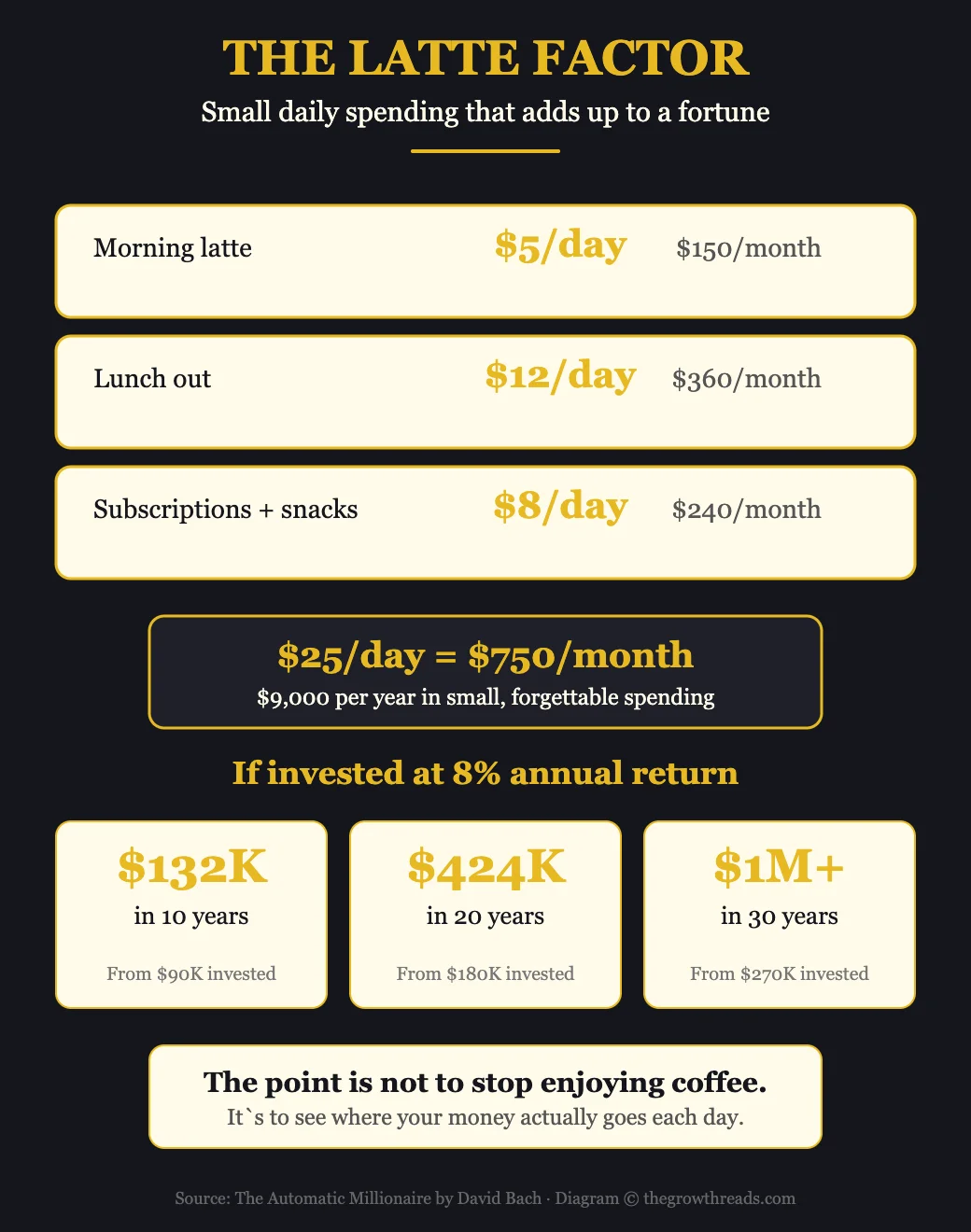
- The Latte Factor: Small daily expenditures ($5 here, $10 there) add up to enormous sums over a lifetime — tracking them reveals where your money actually goes.
- Pay Yourself First: Before you pay any bills, automatically save at least one hour`s worth of income per day (roughly 12.5% of gross income).
- Automate everything: Set up direct deposit splits, automatic 401(k) contributions, and scheduled transfers so your financial plan runs without daily decisions.
- You cannot spend what you do not see: When savings are deducted before your paycheck hits your checking account, you naturally adjust your spending downward.
- Compound interest is the real engine: Starting early matters more than starting big — $5/day invested at 8% becomes over $1 million in 40 years.
- Biweekly mortgage payments save years: Paying half your mortgage every two weeks instead of monthly results in 13 payments per year and can cut a 30-year mortgage by 5-7 years.
- The DOLP system eliminates debt: Dead On Last Payment — prioritize paying off the debt with the lowest remaining balance percentage first.
- Budgets fail because they rely on willpower: Bach`s system explicitly rejects budgeting in favor of automation — a controversial stance that works precisely because it is so simple.
- An emergency fund is non-negotiable: Three months of expenses in a separate, automatic account protects you from derailing your long-term plan.
- Generosity is part of the system: Automating charitable giving integrates purpose into wealth-building and prevents the feeling that saving is purely selfish.
What is The Automatic Millionaire about?
The Automatic Millionaire presents a system for building wealth without budgeting or willpower. David Bach argues that the key to financial freedom is automating your finances — setting up direct deposit splits, automatic retirement contributions, and scheduled savings transfers so that money flows to the right places before you can spend it. The book covers retirement accounts, emergency funds, homeownership, debt elimination, and charitable giving, all through the lens of automation.
About the author
David Bach is a financial advisor, motivational speaker, and nine-time New York Times bestselling author. He served as a senior vice president at Morgan Stanley and co-founded FinishRich Media. Bach is best known for popularizing the “Latte Factor” concept — the idea that small daily expenses, redirected toward investment, can compound into significant wealth over time. His books, including Smart Women Finish Rich and Start Late, Finish Rich, have been translated into 19 languages and sold over 7 million copies. Bach`s approach stands out for its insistence on simplicity: he believes financial plans that require daily discipline are destined to fail. Explore all David Bach book summaries →
Key concepts at a glance
| Concept | What it means | Use it when |
|---|---|---|
| The Latte Factor | Small daily expenses that drain wealth without you noticing | Identifying where discretionary money actually goes |
| Pay Yourself First | Save a fixed % of income before paying any bills | Setting up the foundation of your automation system |
| Automatic Millionaire System | All saving, investing, and debt repayment runs on autopilot | Removing willpower from the wealth equation |
| DOLP Method | Dead On Last Payment — prioritize lowest-balance-% debt | Eliminating debt systematically without a spreadsheet |
| Biweekly Mortgage | Pay half your mortgage every 2 weeks (26 half-payments/year) | Paying off your home years faster with minimal effort |
| One Hour a Day | Save the equivalent of one hour of your daily income | Calibrating your savings rate to a tangible unit |
| Dream Account | A separate automated fund for big personal goals | Saving for vacations, sabbaticals, or major purchases |
Part 1: The Latte Factor — where your money really goes
Bach opens with the story of Jim and Sue McIntyre, an ordinary couple earning modest salaries who retired millionaires. Their secret was not a stock tip or inheritance — it was that they had automated their savings from the very beginning of their careers and never looked back. Bach uses their story to set up his central argument: becoming a millionaire is not about earning more; it is about keeping more of what you earn.
The Latte Factor is Bach`s signature concept. He asks readers to track every dollar they spend for a single day — and most are shocked to discover how much flows out in small, unremarkable purchases: morning coffee, bottled water, afternoon snacks, streaming subscriptions, impulse buys. A $5 daily latte habit, invested instead at 8% annual returns, grows to roughly $948,000 over 40 years. The Latte Factor is not about deprivation; it is about awareness. Most people have no idea where their money goes, and the first step to building wealth is simply seeing the leaks.
Part 2: Pay Yourself First — the one-hour-a-day formula
Bach`s central mechanism is deceptively simple: before you pay your landlord, your utility company, or your credit card, pay yourself. He frames this as working “one hour a day for yourself” — if you work eight hours a day, save the equivalent of one hour`s income (12.5%) before doing anything else. The reason most people fail to save is not that they lack income; it is that they pay everyone else first and hope something will be left over. It never is.
The key is that this saving happens automatically — via direct deposit splits, automatic 401(k) contributions, and scheduled bank transfers. Bach insists that once you set up the system, you should not touch it. The automation removes the daily decision to save, which is precisely the decision most people get wrong. He cites research showing that employees enrolled in automatic 401(k) programs save at dramatically higher rates than those who must opt in manually — even when the contribution amount is identical.
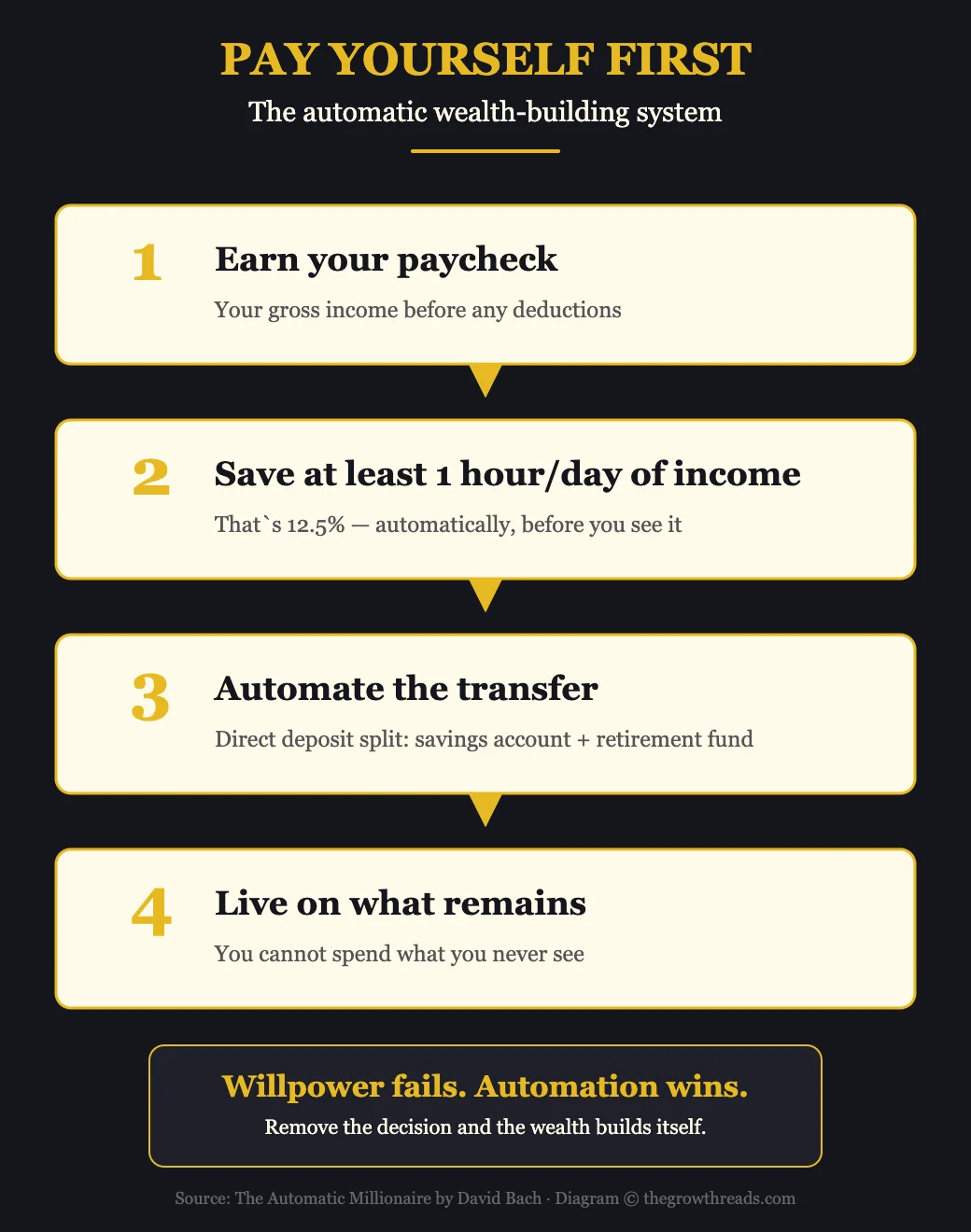
Bach provides specific percentage targets: save at least 10% of gross income (12.5% or more is better), contribute enough to get your full employer 401(k) match, build a three-month emergency fund, and then direct additional savings toward debt repayment and a “dream account” for personal goals. The genius is that these are not budgeting categories — they are automated flows. You set them once and adjust only when your income changes.
Part 3: The complete automation blueprint
In the second half of the book, Bach walks through each pillar of his system in detail. For retirement, he strongly advocates maximizing pre-tax contributions to 401(k)s and IRAs — the tax advantage amounts to an instant return on your money. He explains Roth versus traditional accounts and provides step-by-step instructions for setting up automatic contributions with specific financial institutions.
For homeownership, Bach makes the case that owning a home — specifically, paying it off early — remains one of the most powerful wealth-building tools for average families. His biweekly mortgage strategy is elegant: instead of paying once a month (12 payments/year), pay half the amount every two weeks (26 half-payments/year, which equals 13 full payments). That one extra payment per year can shave five to seven years off a 30-year mortgage and save tens of thousands in interest.
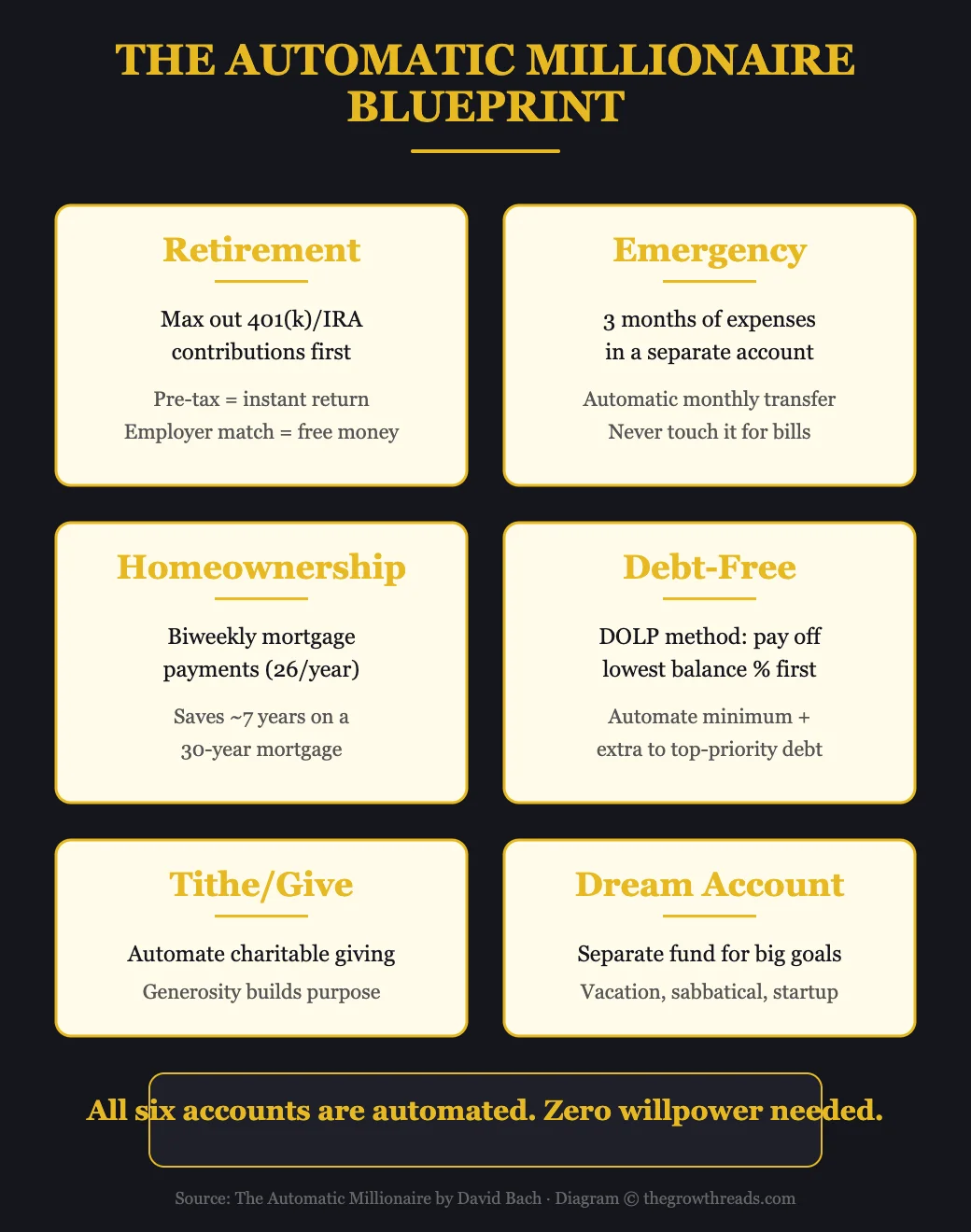
For debt elimination, Bach introduces the DOLP method (Dead On Last Payment). You list all your debts, divide each balance by the minimum payment to get a DOLP number, then attack the debt with the lowest DOLP number first while making minimums on everything else. Once that debt is gone, roll its payment into the next one. The system is similar to the debt snowball method but uses a mathematical ranking rather than pure balance size.
Finally, Bach addresses charitable giving and what he calls the “dream account” — a separate savings fund for big personal goals (a sabbatical, a business, a once-in-a-lifetime trip). By automating these alongside retirement and emergency savings, you build a complete financial life that runs on autopilot.
Who is The Automatic Millionaire best for — and who should read something else first?
The Automatic Millionaire is ideal for people who have tried and failed with budgets, who know they should be saving but keep putting it off, or who want a dead-simple financial system they can set up in an afternoon. It is particularly good for young professionals starting their first real jobs and for couples who want a shared financial framework without the friction of tracking every expense.
If you already have your automation in place and want to optimize your investment strategy, The Simple Path to Wealth by JL Collins or The Little Book of Common Sense Investing by John Bogle will take you further. If you want a more modern, personality-driven approach to personal finance, I Will Teach You to Be Rich by Ramit Sethi covers similar ground with more emphasis on earning and conscious spending. And if your primary challenge is debt, The Total Money Makeover by Dave Ramsey provides a more intensive debt-elimination framework.
Questions to reflect on
- If you tracked every dollar you spent today, how much would fall into the “Latte Factor” category — small purchases you will not remember by next week?
- What percentage of your income are you currently saving automatically, and how close is it to the “one hour a day” (12.5%) target?
- Are you leaving free money on the table by not contributing enough to get your full employer retirement match?
- If your financial plan requires daily willpower to maintain, is it really a plan — or is it a wish?
- What would change in your financial confidence if you knew your savings, investing, and debt repayment were all happening without you thinking about them?
🔥 Ready to automate your way to financial freedom?
The Automatic Millionaire gives you a system you can set up this weekend and never worry about again.
How to apply The Automatic Millionaire (7-day plan)
- Day 1 — Track your Latte Factor. Write down every purchase you make today, no matter how small. At the end of the day, add up the discretionary spending. This is your daily leak.
- Day 2 — Calculate your “one hour.” Divide your gross daily income by 8. That number is what you should be saving automatically each workday. Multiply by 20 for your monthly savings target.
- Day 3 — Set up automatic retirement contributions. Log into your employer`s 401(k) portal (or open an IRA if self-employed) and set your contribution to at least the employer match — ideally 10-15% of gross income.
- Day 4 — Automate your emergency fund. Open a separate high-yield savings account and set up an automatic weekly or biweekly transfer. Target three months of essential expenses.
- Day 5 — Automate debt repayment. List all debts, calculate DOLP numbers (balance / minimum payment), and set up automatic extra payments on the lowest DOLP debt.
- Day 6 — Set up your Dream Account. Open another savings account labeled with your biggest personal goal. Set up a small automatic transfer — even $25/week starts the habit.
- Day 7 — Review and lock in. Look at your full automation system: retirement, emergency fund, debt, dream account. Confirm all transfers are scheduled. Then close the apps and let the system work.
Frequently asked questions
What is the main idea of The Automatic Millionaire?
The main idea is that building wealth does not require budgeting, willpower, or a high income — it requires automation. David Bach argues that by setting up automatic transfers for saving, investing, and debt repayment, you remove the daily decision-making that causes most people to fail financially. The system works because you never see the money, so you never miss it. Once the automation is in place, wealth builds itself through compound interest over time.
What is the Latte Factor?
The Latte Factor is David Bach`s concept for the small, daily expenditures that drain wealth without you noticing — a morning coffee, a lunch out, a streaming subscription. The point is not that you should never buy coffee; it is that most people are unaware of how much money flows out in forgettable purchases each day. A $5/day habit, invested at 8% annual returns, grows to nearly $1 million over 40 years. The Latte Factor is a diagnostic tool for finding money you did not know you had.
What does Pay Yourself First mean?
Pay Yourself First means saving a fixed percentage of your income before paying any bills, expenses, or discretionary spending. Bach recommends saving at least one hour`s worth of your daily income (roughly 12.5% of gross pay). The critical element is automation: the savings are deducted from your paycheck or bank account before you can spend them. This inverts the typical approach of paying bills first and hoping to save what remains — which rarely works because there is never anything remaining.
How long does it take to read The Automatic Millionaire?
The Automatic Millionaire is approximately 256 pages and takes most readers about 3 to 4 hours to read. The writing is conversational and action-oriented — Bach explicitly designed the book to be finished in a single sitting, with readers able to implement the system immediately afterward. The audiobook runs about 4 hours and 58 minutes. Many readers report setting up their automation within the same weekend they finish the book.
What is the DOLP method for paying off debt?
DOLP stands for Dead On Last Payment. To use it, list all your debts, then divide each balance by its minimum monthly payment — this gives you the DOLP number, which represents roughly how many months until that debt is paid off at the minimum. Pay the lowest DOLP number first (the debt closest to being eliminated) while making minimums on everything else. Once it is gone, roll its payment into the next lowest DOLP debt. This creates momentum similar to the debt snowball but uses a mathematical ranking.
Is The Automatic Millionaire still relevant in 2026?
Yes, the core system is timeless. The principle of automating savings and investments is, if anything, easier to implement now than when Bach wrote the book — modern banking apps, robo-advisors, and payroll systems make automation nearly frictionless. Some specific advice (particular institutions, exact account types) has been updated in the 2016 expanded edition. The Latte Factor concept has been debated, but the automation framework remains one of the most practical personal finance systems ever published.
What should I read after The Automatic Millionaire?
For investment strategy once your automation is running, read The Simple Path to Wealth by JL Collins. For a modern take on personal finance that includes earning more and conscious spending, try I Will Teach You to Be Rich by Ramit Sethi. For the philosophy of when to spend versus save across your lifetime, Die with Zero by Bill Perkins offers a provocative counterpoint. And for the psychology behind financial decisions, The Psychology of Money by Morgan Housel is essential.
Related summaries
- The Simple Path to Wealth by JL Collins — index fund investing made simple
- I Will Teach You to Be Rich by Ramit Sethi — modern personal finance for your 20s-40s
- The Richest Man in Babylon by George Clason — the timeless principles of saving
- Best Money Books — our full ranked list
Note: This summary is for educational purposes. It is not financial advice. Consult a qualified financial advisor before making investment decisions.