

★★★☆☆ 3.5/5
One-liner: A concise, accessible playbook for staying calm and invested through market chaos — the practical companion to Money: Master the Game.
Best for: Beginning to intermediate investors who need conviction to stay the course during market downturns.
Reading time: ~4 hours (256 pages)
Difficulty to apply: Low — the core advice is simple (automate, diversify, stay invested), though the emotional discipline takes practice.
Unshakeable in one minute
The stock market will crash, and that’s exactly why you should keep investing. Tony Robbins, drawing on interviews with fifty of the world’s greatest financial minds (including Ray Dalio, Jack Bogle, and Warren Buffett), distills their collective wisdom into a playbook for ordinary investors. The core argument: market corrections are not only normal but predictable in their frequency, and the greatest danger isn’t the crash — it’s the fear that drives you to sell at the bottom. Robbins breaks down how fees silently devour your wealth, why index funds beat most active managers, and how to structure a portfolio that lets you sleep at night. Written as a shorter, more accessible follow-up to his 600-page Money: Master the Game, Unshakeable focuses specifically on the mindset and mechanics of surviving — and profiting from — market volatility.
Key takeaways
- Corrections are normal: On average, the stock market drops 10% or more about once a year. This isn’t a crisis — it’s the price of admission for long-term returns.
- Bear markets are temporary: The average bear market lasts about a year, while the average bull market lasts nearly four years and gains around 190%.
- Never try to time the market: Missing just the 10 best trading days over a 20-year period can cut your total returns in half.
- Fees are the silent killer: A seemingly small 1% annual fee can consume a third of your retirement savings over a lifetime of compounding.
- Index funds win: Over any 15-year period, 92% of actively managed funds underperform their benchmark index — after fees.
- Diversification is your armor: Spread investments across asset classes, countries, and time to protect against catastrophic loss in any single area.
- Asset allocation matters more than stock picks: How you divide your money between stocks, bonds, and alternatives determines over 90% of your returns.
- Automate everything: Set up automatic contributions so your emotions never get a vote in your investment decisions.
- Tax efficiency is free money: Maximizing tax-advantaged accounts and understanding tax-loss harvesting can add years to your retirement timeline.
- The money game is won by staying in it: The biggest risk isn’t volatility — it’s being out of the market when it recovers.
What is Unshakeable about?
Unshakeable is a practical guide to building unshakeable confidence as an investor by understanding market patterns, minimizing fees, diversifying intelligently, and developing the emotional discipline to stay invested through downturns. Robbins synthesizes insights from legendary investors to help ordinary people stop fearing market volatility and start using it to their advantage.
About the author
Tony Robbins is an American author, life coach, and philanthropist who has spent four decades helping people transform their personal and professional lives. Born Anthony J. Mahavorick in North Hollywood, California, he overcame a turbulent childhood to become one of the most recognized self-help figures in history. His seminars have reached over 50 million people across 100 countries. In the financial space, Robbins interviewed 50 of the world’s top investors — including Carl Icahn, Ray Dalio, and Jack Bogle — for his 2014 book Money: Master the Game. Unshakeable, co-written with creative wealth management CEO Peter Mallouk, condenses that research into a more accessible format focused specifically on navigating market volatility. Explore all Tony Robbins book summaries →
Key concepts at a glance
| Concept | What it means | Use it when |
|---|---|---|
| Market Corrections | Drops of 10%+ happen roughly once a year — they are normal, not emergencies | You feel panicked watching your portfolio decline |
| Bear Markets | Drops of 20%+ lasting about a year on average; always followed by recovery | News headlines are screaming about market collapse |
| The Cost of Fees | 1% annual fees compound against you and can consume decades of gains | Evaluating your current fund expenses or advisor fees |
| Asset Allocation | How you split money across stocks, bonds, and alternatives matters more than stock picks | Building or rebalancing your portfolio |
| Dollar-Cost Averaging | Investing fixed amounts at regular intervals regardless of market price | Setting up automatic investment contributions |
| Tax-Loss Harvesting | Selling losing investments to offset taxable gains elsewhere | Year-end tax planning or after a market decline |
| Index Fund Advantage | Low-cost index funds beat 92% of active managers over 15+ years | Choosing between actively managed funds and index funds |
| Emotional Mastery | Your biggest investment risk is your own fear and greed | You feel the urge to sell during a downturn or chase a hot stock |
Part 1: Unshakeable — the facts behind market volatility
Robbins opens with a statistical demolition of the fear that surrounds stock market investing. He presents decades of data showing that market corrections (drops of 10% or more) happen, on average, about once a year. Most are short-lived — the average correction lasts only 54 days. Bear markets (drops of 20% or more) are rarer, occurring roughly every three to five years, and the average bear market lasts about a year. The critical data point: the market has recovered from every single bear market in history, and bull markets (the recovery and growth periods) last an average of 3.8 years and deliver average gains of around 190%.
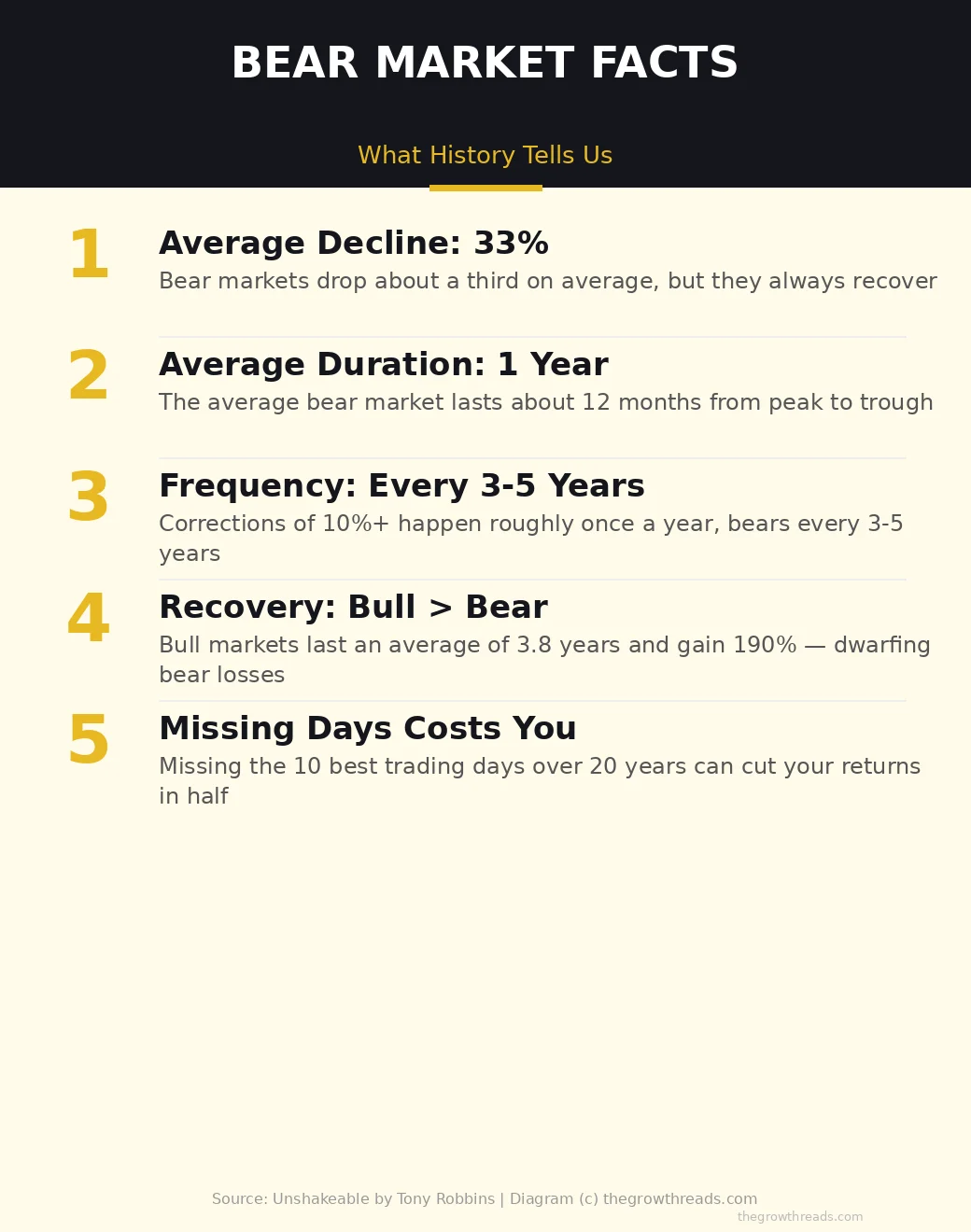
The most powerful statistic Robbins presents: if you invested $1 in the S&P 500 in 1996 and stayed invested for 20 years, you’d have earned 8.2% annually. But if you missed just the top 10 trading days during that period — ten days out of roughly 5,000 — your return would have dropped to 4.5%. Miss the top 20 days and you’d be down to 2.1%. Miss the top 30 and you’d have actually lost money. The lesson is devastating for market timers: the best days almost always occur during or immediately after the worst days, so selling during a crash means you’ll almost certainly miss the recovery.
Part 2: The invisible enemy — fees, taxes, and the industry
The second section is Robbins at his most indignant. He exposes the financial services industry’s fee structure as a wealth-destruction machine for ordinary investors. The numbers are stark: over a working lifetime, the difference between paying 1% and 0.1% in annual fees can amount to hundreds of thousands of dollars in lost compounding. A $100,000 portfolio earning 7% annually for 30 years grows to $574,000 at 0.1% fees but only $432,000 at 1% fees — the 1% fee silently consumed nearly $142,000.
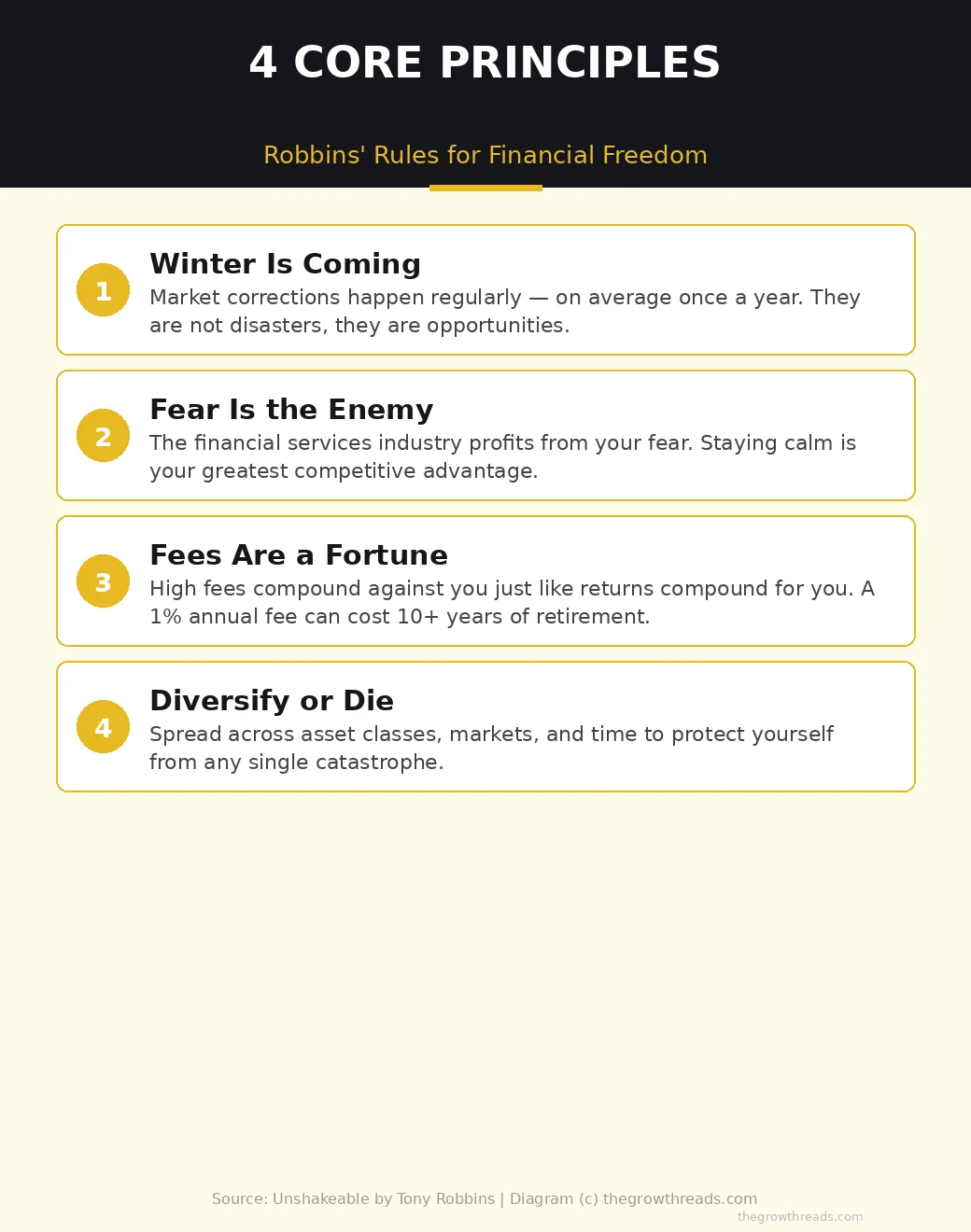
Robbins breaks down the layers of fees most investors don’t even know they’re paying: fund expense ratios, transaction costs, cash drag, tax inefficiency, soft-dollar costs, and advisor fees. Stacked together, the average actively managed mutual fund charges investors 3.17% per year when all costs are accounted for — while delivering returns that, in 92% of cases over 15 years, trail a simple index fund.
The solution, drawn heavily from Jack Bogle’s philosophy, is straightforward: use low-cost index funds, minimize trading, maximize tax-advantaged accounts, and if you use a financial advisor, make sure they are a fiduciary (legally required to act in your interest) and charge transparent, reasonable fees. Robbins also covers tax-loss harvesting — the strategy of selling losing investments to offset gains and reduce your tax bill — as a significant and underused tool for ordinary investors.
Part 3: The playbook — asset allocation and the all-weather portfolio
The third section is where Robbins gets practical about portfolio construction. He introduces Ray Dalio’s “All Weather” portfolio concept — a portfolio designed to perform reasonably well in any economic environment (growth, recession, inflation, deflation). Dalio’s original allocation, which he shared with Robbins for Money: Master the Game, splits roughly into 30% stocks, 40% long-term bonds, 15% intermediate bonds, 7.5% gold, and 7.5% commodities. The logic: different asset classes thrive in different economic conditions, so diversifying across all of them reduces volatility without sacrificing long-term returns.
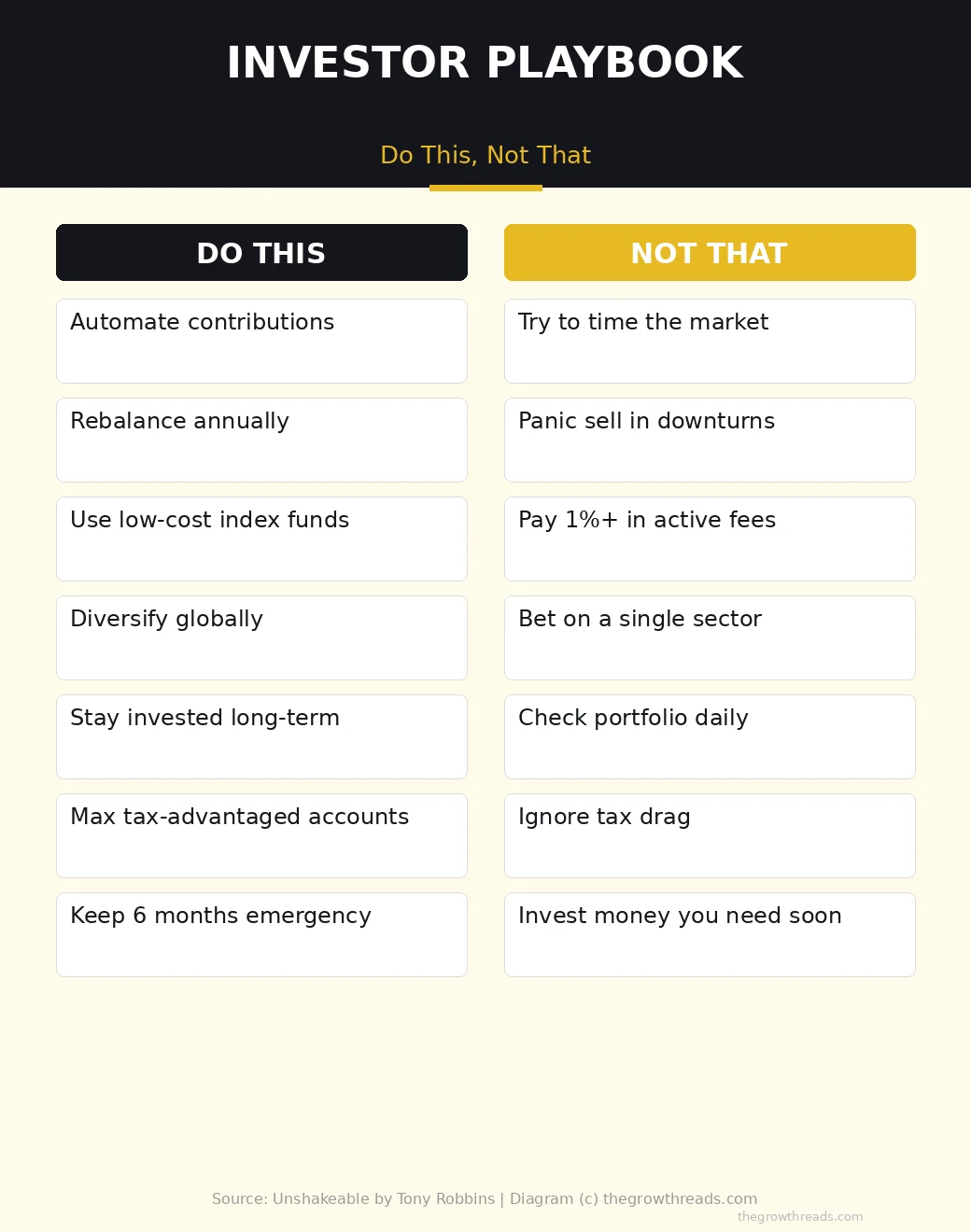
Robbins emphasizes that asset allocation — how you divide your money among stocks, bonds, and alternatives — determines over 90% of your investment returns. Individual stock picks and market timing contribute almost nothing compared to getting the big-picture allocation right. He recommends three principles for allocation: never put all your eggs in one basket (diversify across asset classes), diversify globally (not just U.S. stocks), and diversify across time (dollar-cost average rather than lump-sum investing).
He also addresses the rebalancing question. As different assets rise and fall, your portfolio drifts away from your target allocation. Annual rebalancing — selling a bit of what’s gone up and buying a bit of what’s gone down — enforces the “buy low, sell high” discipline automatically. It’s one of the few free lunches in investing.
Part 4: The real secret — emotional mastery
The final section returns to Robbins’s core expertise: psychology. He argues that the biggest threat to your financial future isn’t a market crash, bad advice, or even high fees — it’s your own emotional reactions. Fear, greed, confirmation bias, loss aversion, and herd mentality cause more wealth destruction than any bear market. Robbins cites research showing that the average equity mutual fund returned 7.1% annually from 1997 to 2016, but the average investor in those same funds earned only 4.7% — because they bought high (during euphoria) and sold low (during panic).
His prescription is both practical and philosophical: create a checklist for downturn moments (a pre-commitment strategy), automate your investments so emotions don’t get a vote, surround yourself with rational advisors, and cultivate gratitude as a daily practice. Robbins closes with a chapter on the wealth of giving — arguing that generosity, even before you’re wealthy, creates a mindset of abundance rather than scarcity, which paradoxically accelerates wealth creation.
Who is Unshakeable best for — and who should read something else first?
Unshakeable is ideal for beginning to intermediate investors who understand the basics of investing but need the conviction — backed by data and stories — to stay the course during the next market downturn. If you’ve ever panic-sold during a correction, or if you’re sitting on the sidelines because you’re afraid the market is “too high,” this book was written for you.
If you need a complete personal finance overhaul (budgeting, debt, automation), start with I Will Teach You to Be Rich by Ramit Sethi. If you want the research without the motivational tone, A Random Walk Down Wall Street covers similar ground with academic rigor. And if you’ve already mastered investing basics and want to think about wealth philosophically, The Almanack of Naval Ravikant goes deeper.
Questions to reflect on
- Have you ever sold an investment because of fear during a market downturn? What would have happened if you had held?
- Do you know the total fees (expense ratios, advisor fees, transaction costs) you’re currently paying on your investments?
- Is your current asset allocation intentional, or did it happen by accident as you added investments over time?
- If the market dropped 30% tomorrow, do you have a pre-committed plan for what you’d do — or would you react emotionally?
- Are your investments automated, or do you make manual decisions about when and how much to invest each month?
🔥 Ready to become unshakeable?
Build the confidence to stay invested through any market storm.
How to apply Unshakeable (7-day plan)
- Day 1 — Know your fees: Log into every investment account you have. Write down the expense ratio for each fund and any advisor fees you pay. Calculate the total percentage.
- Day 2 — Switch to low-cost: For any fund charging over 0.3% in expense ratio, find a comparable index fund alternative. Most major brokerages offer S&P 500 index funds at 0.03%.
- Day 3 — Write your allocation: Define your target asset allocation (stocks/bonds/alternatives split) based on your age and risk tolerance. Write it down.
- Day 4 — Automate: Set up automatic monthly contributions to your investment accounts. Remove the decision of “when to invest” from your control.
- Day 5 — Build your downturn checklist: Write a one-page plan for what you’ll do when the market drops 20%. Include the phrase “Do not sell.” Post it where you’ll see it.
- Day 6 — Tax-optimize: Check if you’re maxing your tax-advantaged accounts (401k, IRA, HSA). If not, increase contributions by at least 1% this month.
- Day 7 — Rebalance: Compare your current allocation to your target. If any asset class has drifted more than 5%, rebalance by selling the overweight and buying the underweight.
Frequently asked questions
What is the main message of Unshakeable?
The central message is that market volatility is normal, temporary, and ultimately beneficial for long-term investors. Corrections happen about once a year, bear markets every three to five years, and every single one in history has been followed by a recovery. The greatest danger to your wealth isn’t market crashes — it’s the emotional reactions (panic selling, market timing, chasing trends) that cause ordinary investors to buy high and sell low. By understanding the patterns, minimizing fees, diversifying properly, and automating your investments, you can become “unshakeable.”
Is Unshakeable worth reading if I already read Money: Master the Game?
Unshakeable works as a standalone book and as a condensed companion to Money: Master the Game. Where the earlier book was 600+ pages and covered the entire financial landscape (asset allocation, annuities, portfolio models, interviews with billionaires), Unshakeable is shorter and focuses specifically on the emotional and practical playbook for surviving market downturns. If you’ve already read Money: Master the Game, Unshakeable will feel familiar but tighter. If you haven’t read either, Unshakeable is the better starting point.
What is the All Weather portfolio from Unshakeable?
The All Weather portfolio is a concept from Ray Dalio, shared in Robbins’s earlier book and referenced in Unshakeable. It allocates roughly 30% to stocks, 40% to long-term bonds, 15% to intermediate bonds, 7.5% to gold, and 7.5% to commodities. The idea is that different asset classes perform well in different economic conditions (growth, recession, inflation, deflation), so spreading across all of them provides consistent returns with lower volatility than a stock-only portfolio. It’s designed for investors who want stability over maximum growth.
How does Unshakeable compare to The Intelligent Investor?
Both books advocate for long-term, disciplined investing and warn against market timing. Graham’s The Intelligent Investor provides the theoretical foundation with concepts like Mr. Market and the margin of safety, while Unshakeable provides the emotional playbook with modern data and accessible language. Graham writes for a sophisticated audience; Robbins writes for everyone. If you want the philosophy of value investing, read Graham. If you want the confidence to actually stay invested during a crash, read Robbins. They complement each other well.
What are the biggest investing mistakes according to Unshakeable?
Robbins identifies several critical mistakes: paying high fees on actively managed funds (which underperform index funds 92% of the time over 15 years), trying to time the market (missing the best 10 trading days can halve your returns), failing to diversify across asset classes and geographies, letting emotions drive buy and sell decisions, and ignoring tax efficiency. The overarching mistake is playing offense when you should be playing defense — protecting your downside matters more than maximizing your upside.
How long does it take to read Unshakeable?
Unshakeable is 256 pages and takes the average reader about four hours to complete. The audiobook, narrated by Tony Robbins himself, runs approximately seven hours. The writing is conversational and story-driven, making it a faster read than most finance books. Robbins uses a lot of repetition for emphasis, which some readers find reinforcing and others find unnecessary. If you prefer a denser, more concise read, try The Psychology of Money by Morgan Housel, which covers overlapping themes in fewer pages.
Is Unshakeable only relevant for U.S. investors?
The core principles — diversification, low fees, long-term thinking, emotional discipline — apply to investors everywhere. However, the specific recommendations around tax-advantaged accounts (401k, IRA, Roth IRA), tax-loss harvesting, and the emphasis on U.S. market data are U.S.-centric. International readers will still benefit from the mindset and strategy sections but should consult local resources for tax optimization and account types. The data on market recovery patterns is drawn primarily from the S&P 500, though similar patterns hold for most developed-market indices.
Related summaries
If Unshakeable resonated with you, explore these related summaries in the Money silo:
- The Psychology of Money Summary — Morgan Housel on why financial success is about behavior, not intelligence.
- The Little Book of Common Sense Investing Summary — Jack Bogle’s purest case for index funds.
- The Intelligent Investor Summary — Benjamin Graham’s foundational guide to value investing.
- The Simple Path to Wealth Summary — JL Collins on the simplest possible investing strategy.
→ See all: Best Money Books