

⭐⭐⭐⭐⭐ 4.5 / 5 — The clearest, most actionable guide to investing for financial independence — one index fund, zero complexity.
Best for: Anyone who wants a simple, proven investment strategy without the noise of stock picking, market timing, or financial advisor fees.
Reading time: ~5 hours (this guide: 14 min)
Difficulty to apply: Low — the entire strategy can be implemented in a single afternoon. Sticking with it during market downturns is the hard part.
The Simple Path to Wealth in one minute
Investing doesn’t have to be complicated — and the more complicated you make it, the worse you’ll probably do. JL Collins, a veteran investor and personal finance blogger, wrote this book as a series of letters to his daughter to give her everything she needed to know about money and investing. The entire strategy fits on an index card: spend less than you earn, avoid debt, build “F-you money” (enough savings to walk away from anything you don’t like), invest in a single total stock market index fund (VTSAX), and never sell during a downturn. Collins demolishes the financial industry’s complexity by showing that over 80% of actively managed funds underperform a simple index fund over 15+ years — meaning the simplest, cheapest approach is also the most effective.
Key takeaways
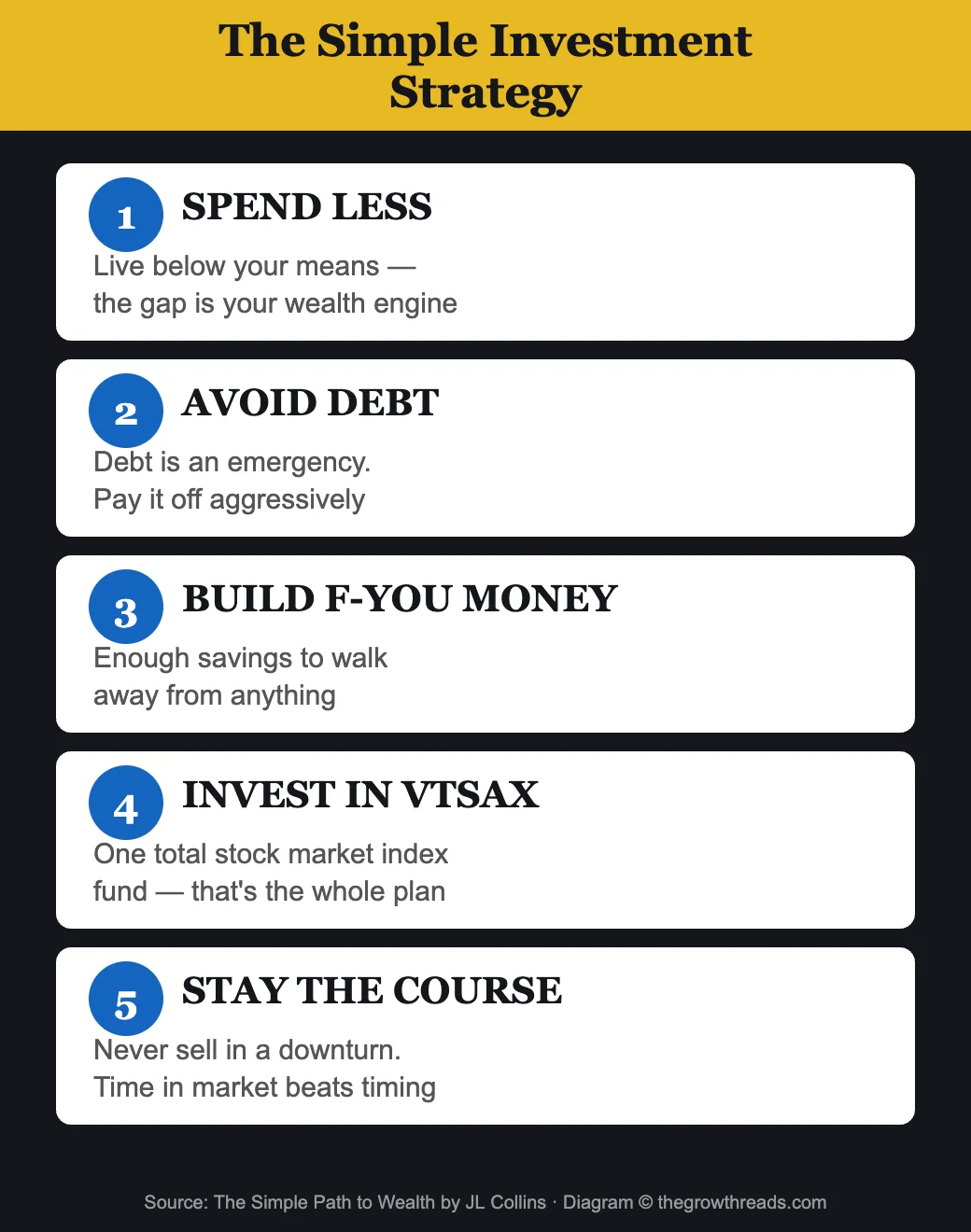
- Spend less than you earn: The gap between income and spending is your single most powerful wealth-building tool. No investment strategy can overcome spending more than you make.
- Avoid debt like the plague: Debt is a financial emergency, not a lifestyle. Pay off consumer debt aggressively before investing — the interest you avoid is a guaranteed return.
- Build F-you money: Accumulate enough savings that you can walk away from any job, relationship, or situation you find intolerable. This isn’t a specific number — it’s the point where money stops being your boss.
- Invest in VTSAX (or equivalent): Vanguard’s Total Stock Market Index Fund gives you ownership of every publicly traded US company for a fee of 0.04%. One fund. That’s the whole plan.
- Never try to time the market: Nobody can consistently predict market movements. Time IN the market beats timing the market every single time over decades.
- Market crashes are sales: When the market drops 30%, that’s a 30%-off sale on every company in America. Stay the course, keep investing, and profit from everyone else’s panic.
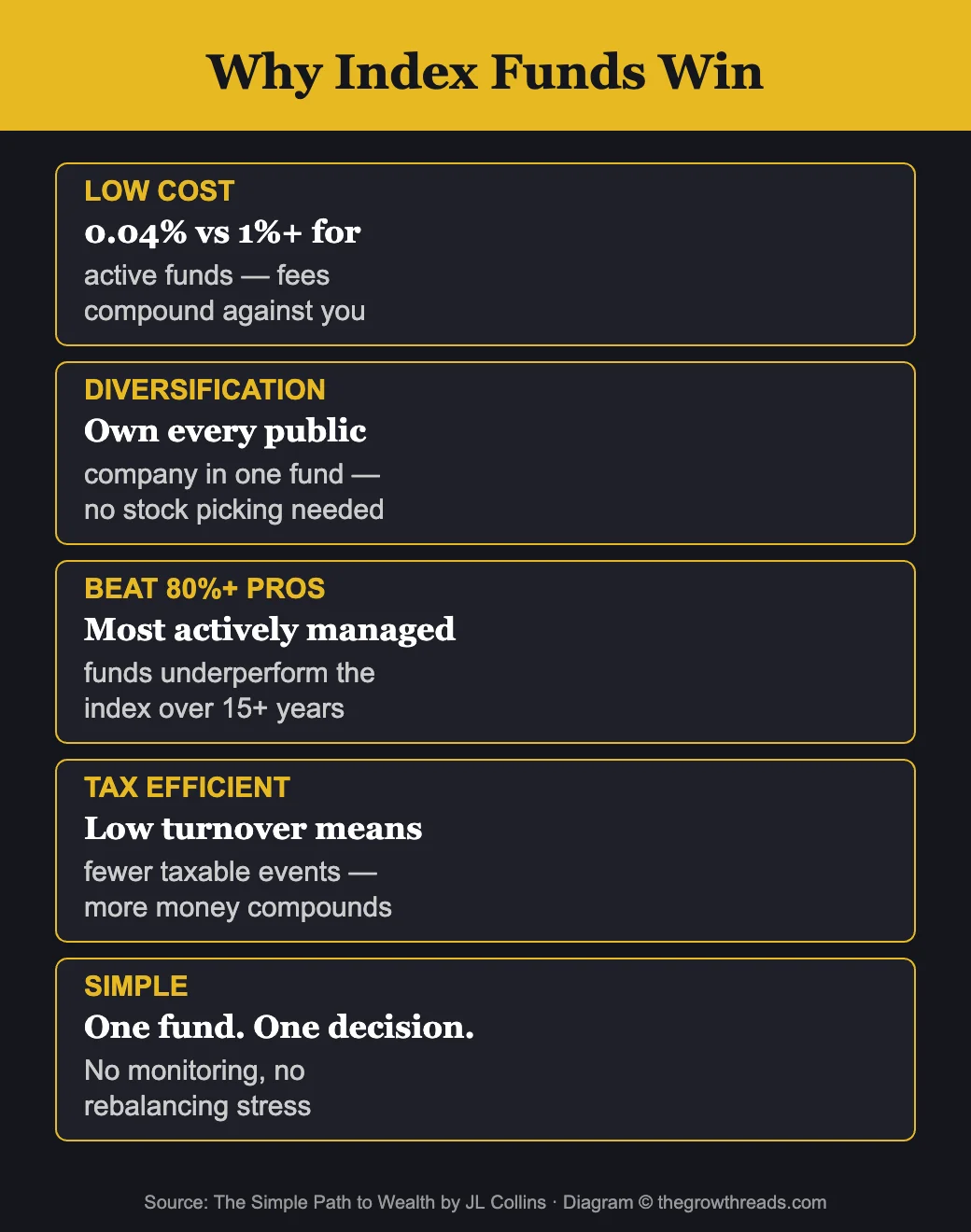
- Fees destroy wealth: A 1% annual fee difference doesn’t sound like much, but over 30 years it can cost you hundreds of thousands of dollars. Low-cost index funds protect your returns.
- 80%+ of pros lose to the index: Actively managed funds underperform passive index funds over long periods. The more you pay for “expertise,” the less you keep.
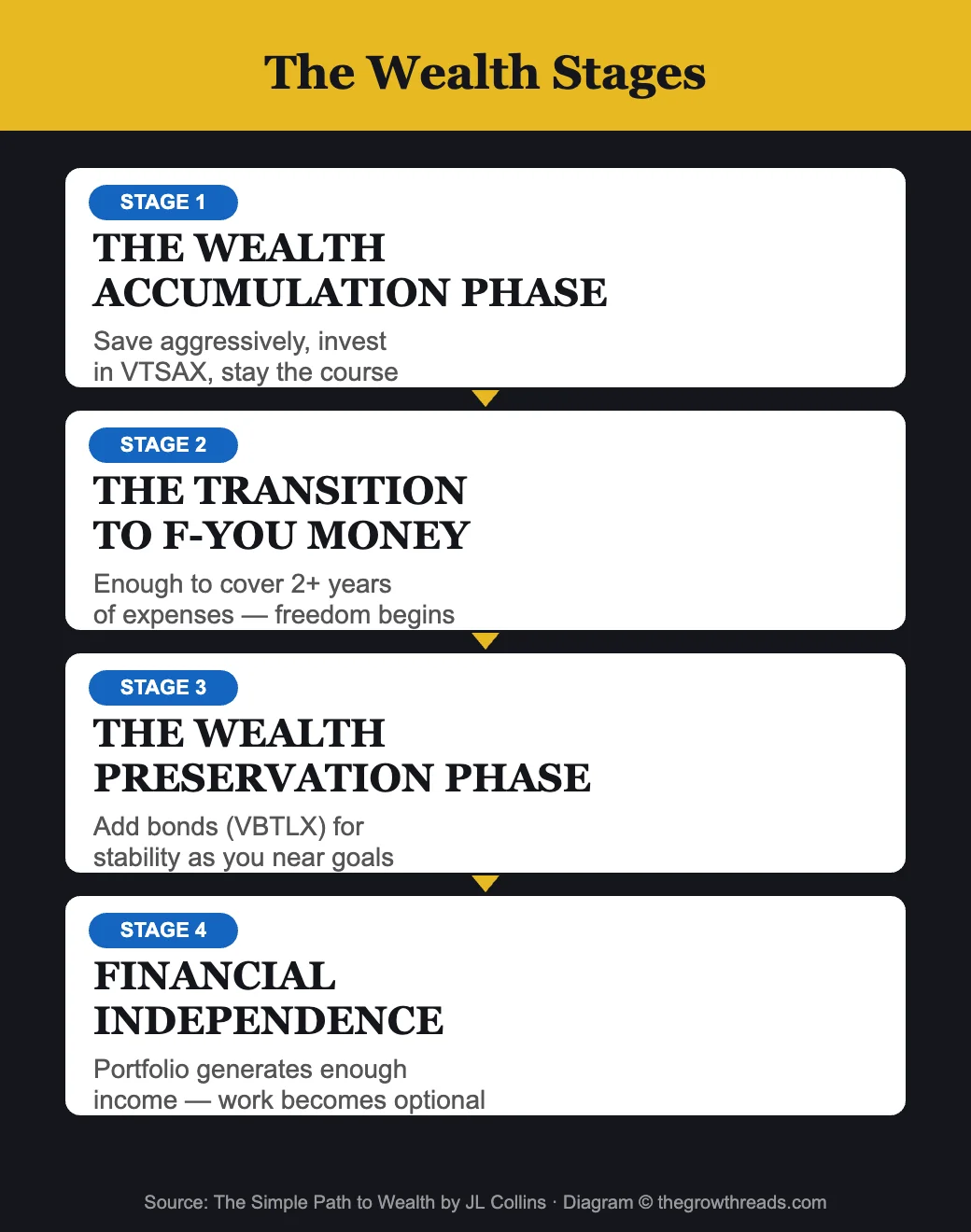
- Add bonds as you age: In the wealth preservation phase, add a total bond market index fund (VBTLX) to reduce volatility. Collins suggests your age in bonds as a rough guide.
- Financial independence is about options: The goal isn’t to stop working — it’s to make work optional. When you don’t need the paycheck, you’re free to do work that matters to you.
What is The Simple Path to Wealth about?
The Simple Path to Wealth is an investing guide that argues the best investment strategy is the simplest: live below your means, invest in a single low-cost total stock market index fund, avoid debt, ignore market noise, and let compound growth build your wealth over decades. JL Collins wrote it as financial advice to his daughter, making complex investing concepts accessible to complete beginners.
About the author
JL Collins is an American author, investor, and financial blogger who spent decades in the corporate world before achieving financial independence and “retiring” to write and speak about personal finance. He started his blog, jlcollinsnh.com, in 2011 to share the financial wisdom he wished he’d had as a young man. His “Stock Series” — a collection of blog posts explaining index fund investing — went viral in the FIRE (Financial Independence, Retire Early) community and became the foundation for The Simple Path to Wealth. Published in 2016, the book has sold hundreds of thousands of copies and is widely regarded as one of the most important personal finance books of the 2010s, particularly for its clear-eyed demolition of the financial industry’s unnecessary complexity. Explore all JL Collins book summaries →
Key concepts at a glance
| Concept | What it means | Use it when |
|---|---|---|
| F-You Money | Enough savings to walk away from anything — financial freedom’s starting line | You feel trapped by your job or financial obligations |
| VTSAX | Vanguard Total Stock Market Index Fund — ownership of every US public company | You want a single-fund investment strategy |
| The Market Always Goes Up | Despite crashes, the market has always recovered and reached new highs | You’re panicking during a market downturn |
| Wealth Accumulation Phase | The years when you’re aggressively saving and investing in stocks | You’re early in your career and have decades ahead |
| Wealth Preservation Phase | Adding bonds to reduce volatility as you approach financial independence | You’re within 5-10 years of needing your portfolio |
| The 4% Rule | Withdraw 4% of your portfolio annually and it should last 30+ years | You want to calculate your financial independence number |
| Deflation of Fees | High fees compound against you, destroying wealth over decades | A financial advisor recommends expensive managed funds |
Part 1: The philosophy — F-you money and the freedom it buys
Collins opens with the concept that drives everything else: F-you money. This isn’t about getting rich for the sake of luxury — it’s about reaching the point where money no longer controls your decisions. When you have enough savings to cover a year or two of living expenses, you gain the power to walk away from a bad boss, a toxic relationship, or any situation that makes you miserable.
The foundation is simple math: spend less than you earn. Collins argues that most people think the path to wealth runs through higher income, but it actually runs through the gap between income and spending. A person earning $50,000 and saving 50% will build wealth faster than someone earning $200,000 and saving 5%. Your savings rate, not your salary, is the primary determinant of how quickly you achieve financial independence.
Debt is the enemy of this entire system. Collins describes consumer debt as an “emergency” and prescribes aggressive payoff. The logic is mathematical: if you’re paying 15-25% interest on credit card debt, no investment will reliably outperform that guaranteed cost. Pay off the debt first, then invest. The one exception is a reasonable mortgage — but even then, Collins advises paying it off as soon as practical.
Part 2: Why index funds beat everything else
The core investing thesis of the book is radical in its simplicity: buy one total stock market index fund and hold it forever. Collins makes the case through data, logic, and a systematic dismantling of the financial industry’s incentives.
An index fund owns every stock in a market, weighted by market capitalization. The total stock market index fund (VTSAX or its ETF equivalent VTI) owns shares of every publicly traded company in the United States — over 3,700 companies. This means you own a piece of Apple, Google, the local bank, the regional retailer, and everything in between. When one company fails, others rise. The net effect over decades has been roughly 10-12% average annual returns before inflation.
Actively managed funds, by contrast, employ teams of analysts and portfolio managers who try to beat the market by picking winning stocks. Collins presents the devastating evidence: over any 15-year period, roughly 80-90% of actively managed funds underperform their benchmark index. Over 30 years, the percentage is even worse. The few that do outperform in one period rarely repeat in the next — meaning you can’t even reliably pick the winning fund managers.
The fee structure makes this even more damaging. A typical actively managed fund charges 1-2% in annual fees, while VTSAX charges 0.04%. Over 30 years, that difference compounds dramatically. Collins illustrates: $100,000 invested at 8% for 30 years yields $574,000 after a 1.5% fee but $906,000 after a 0.04% fee. The $332,000 difference went to the financial industry, not to you.
Part 3: Staying the course — the psychology of downturns
Collins devotes significant attention to market crashes because he knows that the biggest risk to a simple index fund strategy is the investor’s own behavior. The market will crash. It crashed in 2000, 2008, 2020, and it will crash again. The question isn’t if but how you’ll respond when your portfolio drops 30-50%.
The key insight: market drops are temporary. Market rises are permanent — over the long term. Every crash in history has been followed by a full recovery and new highs. The investors who lost money weren’t those who held through the crash — they were those who sold at the bottom, locking in their losses and missing the subsequent recovery.
Collins reframes crashes as sales events. When the market drops 40%, every share of VTSAX is 40% cheaper. If you’re still in the accumulation phase, this is the best thing that can happen to you — you’re buying ownership of America’s companies at a massive discount. The time to be fearful is when everyone is greedy, and the time to be greedy is when everyone is fearful.
Part 4: The wealth preservation phase and the 4% rule
As you approach financial independence, Collins introduces the wealth preservation phase. During accumulation, 100% stocks (VTSAX) is optimal because you have decades for recovery. But as you get closer to needing the money, you add bonds (VBTLX — Vanguard Total Bond Market Index Fund) to reduce portfolio volatility.
Collins presents the 4% rule, based on the Trinity Study: if you withdraw 4% of your portfolio in the first year of retirement and adjust for inflation each year after, your portfolio has historically survived for 30+ years in virtually all scenarios. This means your financial independence number is your annual expenses multiplied by 25. If you spend $40,000 per year, you need a $1,000,000 portfolio.
The book closes with practical chapters on tax-advantaged accounts (401k, IRA, Roth, HSA), Social Security optimization, and choosing the right Vanguard funds for your situation. Collins remains consistent throughout: the simpler you keep it, the better your results will be.
Who is The Simple Path to Wealth best for — and who should read something else first?
This book is perfect for anyone who wants a clear, actionable investing strategy without complexity — whether you’re a complete beginner or an experienced investor tired of overcomplicating things. It’s particularly valuable for people in the FIRE movement, young professionals just starting to invest, and anyone who suspects their financial advisor might be charging too much for too little.
If you need foundational money habits before investing, start with The Richest Man in Babylon for mindset or I Will Teach You to Be Rich for a modern automation system. For the behavioral psychology behind investing, The Psychology of Money explains why simple strategies work even when they feel too simple.
Questions to reflect on
- What is your current savings rate — and what would it take to increase it by 10 percentage points?
- How much would you need invested to have “F-you money” — enough to walk away from a bad situation without financial panic?
- If the market dropped 40% tomorrow, what would you actually do — and does your investment strategy match that honest answer?
- What fees are you currently paying on your investments, and how much will those fees cost you over the next 30 years?
- What is your financial independence number (annual expenses × 25), and how many years away is it at your current savings rate?
🔥 Ready to simplify your path to wealth?
One fund, one strategy, zero complexity — the clearest guide to financial independence ever written.
How to apply The Simple Path to Wealth (7-day plan)
- Day 1 — Calculate your savings rate. Total last month’s income minus total spending. Divide the difference by income. That percentage is your most important financial metric.
- Day 2 — List all debts. Write down every debt with its balance and interest rate. Order them from highest interest rate to lowest. Commit to attacking the highest rate first.
- Day 3 — Open a Vanguard account. Go to vanguard.com and open an individual brokerage account. If your employer offers a 401k, check if it has a total market index fund option.
- Day 4 — Set up automatic investing. Schedule a recurring monthly transfer from your bank to your Vanguard account, invested in VTSAX (or VTI if the minimum is too high initially).
- Day 5 — Calculate your FI number. Multiply your annual expenses by 25. This is your financial independence target. Calculate how many years away it is at your current savings rate.
- Day 6 — Audit your investment fees. Check the expense ratios on every fund you currently own. If any are above 0.20%, research whether a low-cost index alternative exists.
- Day 7 — Write your investment policy statement. In one paragraph, write: “I will invest X% of my income monthly in VTSAX. I will not sell during downturns. I will add bonds when I am within 10 years of my FI number.” Sign it.
Frequently asked questions
What is VTSAX and why does Collins recommend it?
VTSAX is Vanguard’s Total Stock Market Index Fund Admiral Shares. It owns shares of every publicly traded company in the United States — over 3,700 stocks — weighted by market capitalization. Collins recommends it because it provides maximum diversification, charges only 0.04% in annual fees, and has consistently outperformed 80-90% of actively managed funds over long periods. The ETF equivalent is VTI, which has no minimum investment.
What is F-you money?
F-you money is Collins’s term for having enough savings that you can walk away from any job, relationship, or situation you find intolerable — without financial consequences forcing you to stay. It’s not a specific dollar amount but a psychological threshold: the point where money stops controlling your decisions. For most people, this means having at least one to two years of living expenses saved in accessible accounts, beyond their invested portfolio.
What is the 4% rule for retirement?
The 4% rule, based on the Trinity Study, says that if you withdraw 4% of your investment portfolio in your first year of retirement and adjust for inflation each year after, your money has historically lasted 30+ years in virtually all market conditions. This means your “financial independence number” is your annual expenses multiplied by 25. If you spend $50,000 per year, you need approximately $1,250,000 invested.
Is this strategy too simple? Should I diversify more?
Collins argues that VTSAX alone IS maximally diversified — you own over 3,700 companies across every sector and size. Adding more funds increases complexity without meaningfully reducing risk. International funds, REITs, and sector funds add management burden and often underperform the total market over long periods. That said, Collins acknowledges that adding international exposure or bonds near retirement can be reasonable — but the core should always be the total market index.
What if I don’t use Vanguard?
Collins recommends Vanguard because of its unique ownership structure (investors own the company) and industry-leading low fees, but the strategy works with any brokerage that offers a total stock market index fund. Fidelity’s FSKAX, Schwab’s SWTSX, or their ETF equivalents all follow the same index. The key is the fund type (total market index), not the provider. Just ensure the expense ratio is below 0.10%.
What should I do during a stock market crash?
Nothing — or better yet, buy more. Collins repeatedly emphasizes that market crashes are temporary sales events. Every major crash in history has been followed by a full recovery and new all-time highs. The investors who lose money are those who panic-sell at the bottom, locking in losses and missing the recovery. If you’re still in the accumulation phase, a crash means you’re buying shares at a significant discount.
How long does it take to read The Simple Path to Wealth?
The book is approximately 286 pages and takes about 5 hours to read at an average pace. Collins writes in a conversational, no-nonsense style that makes complex investing concepts accessible to complete beginners. Many readers describe it as feeling like getting financial advice from a wise, straight-talking uncle. The audiobook runs about 6.5 hours and is narrated by Collins himself.
Related summaries
If you enjoyed this summary, explore more from our best money books collection:
- The Psychology of Money Summary — why behavior matters more than knowledge in investing.
- The Richest Man in Babylon Summary — timeless wealth principles through ancient parables.
- I Will Teach You to Be Rich Summary — a modern system for automating your finances.
- The Intelligent Investor Summary — the definitive guide to value investing.