

⭐⭐⭐⭐✰ 4.4/5
One-liner: A practical physical-readiness system built on 10 simple tests that reveal how well your body actually moves — and exactly how to fix what it cannot.
Best for: Desk workers, weekend athletes, anyone over 30 who wants to move pain-free for decades.
Reading time: ~7 hours (320 pages)
Difficulty to apply: Low — the exercises require no equipment and fit into daily routines without adding gym time.
Built to Move in One Minute
Your body is a machine that was designed to move — and modern life is slowly shutting it down. Kelly and Juliet Starrett, who have spent decades training elite athletes, argue that most chronic pain, stiffness, and physical decline is not caused by aging but by a catastrophic lack of basic movement. They present 10 “vital signs” — simple physical tests anyone can perform at home — that reveal how well your body actually functions. Each vital sign comes with targeted exercises and daily habits to restore what has been lost. The approach is refreshingly practical: no gym membership required, no complicated programs, just consistent daily practices that accumulate into dramatic improvements in mobility, energy, and pain-free living.
Key Takeaways
- Test before you fix: The 10 vital signs are diagnostic tools — they reveal exactly where your body is failing so you can target your efforts rather than guessing.
- Walking is the foundation: 8,000 to 10,000 daily steps is not optional — it is the minimum effective dose for metabolic health, joint function, and mental clarity.
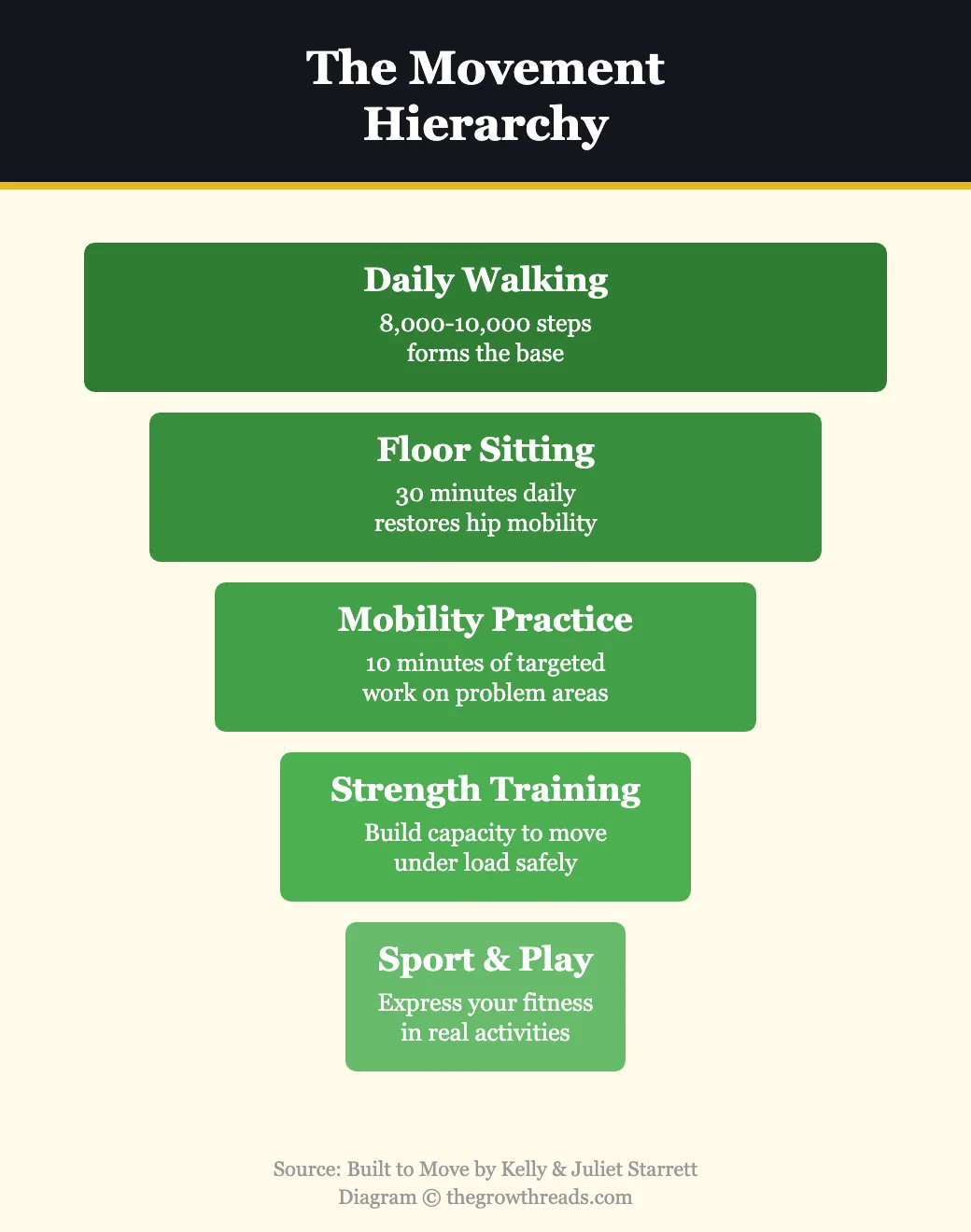
- Sitting on the floor restores hip function: Spending 30 minutes daily on the floor in various positions naturally restores the hip range of motion that chairs have stolen from you.
- Breathe through your nose: Chronic mouth breathing is a root cause of poor sleep, anxiety, and reduced athletic performance — nasal breathing is trainable and transformative.
- You should be able to squat fully: A full-depth squat held for two minutes is a baseline human capacity, not an athletic achievement — if you cannot do it, your body is sending a distress signal.
- Sleep is a physical practice: Eight hours of quality sleep requires the same intentional setup as any training session — temperature, darkness, wind-down routines, and screen management.
- Soft tissue work is not optional: Spending 10 minutes daily with a foam roller or lacrosse ball addresses the tissue stiffness that accumulates from sitting and repetitive movement.
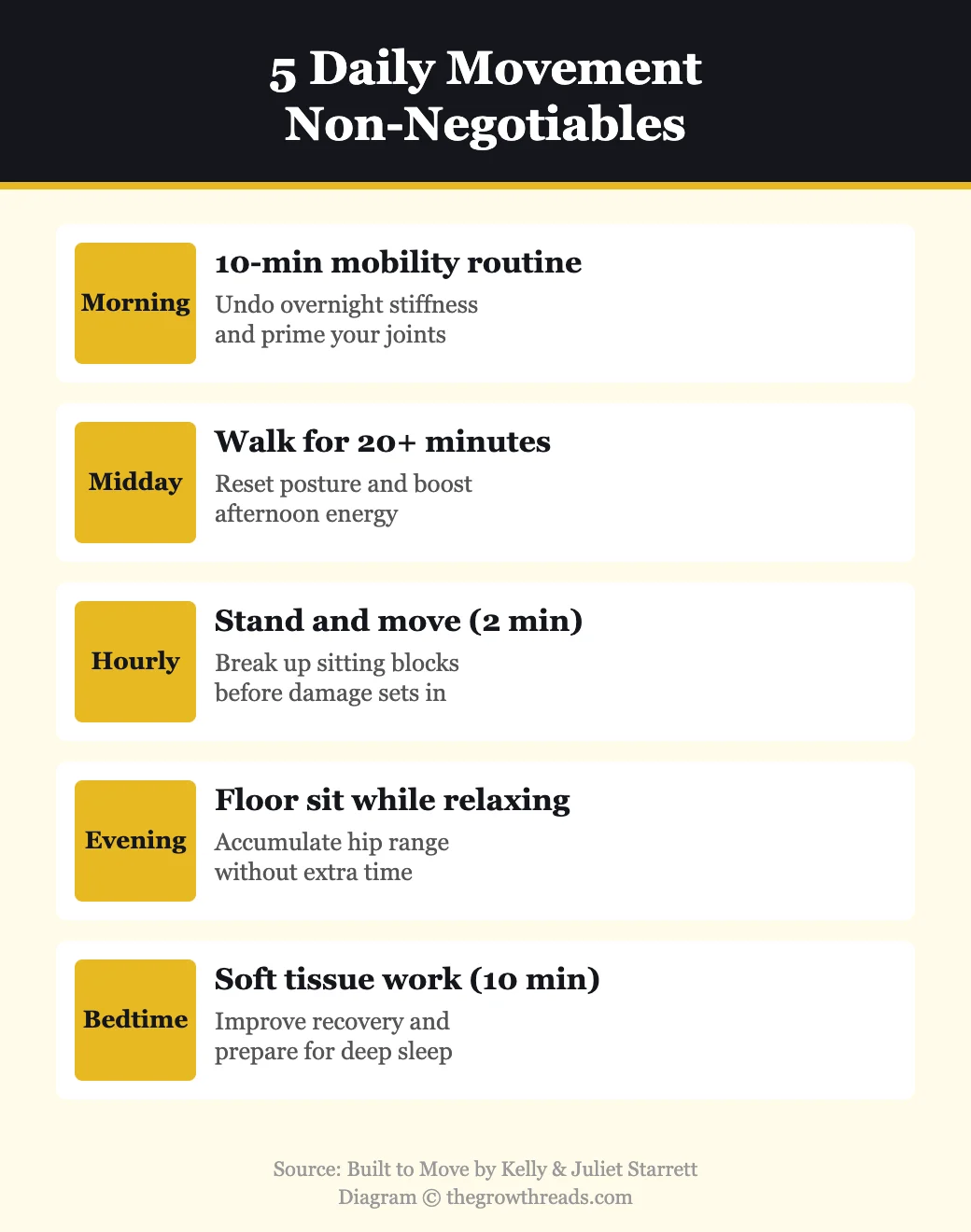
- Movement snacking beats marathon sessions: Brief movement breaks throughout the day (standing, stretching, walking) are more beneficial than a single intense workout followed by 10 hours of sitting.
- Hanging from a bar builds shoulder health: The ability to hang for 30 seconds indicates adequate shoulder function — most adults cannot do this and suffer upper-body pain as a result.
- Community and play matter: Exercising with others and incorporating play into movement increases adherence and produces better outcomes than solitary, repetitive gym work.
What Is Built to Move About?
Built to Move presents a 10-test physical assessment system designed by physical therapists Kelly and Juliet Starrett. Each test reveals a critical aspect of physical function — from hip mobility to breathing quality to sleep duration — and comes paired with simple daily practices to restore capacity. The book argues that most chronic pain and physical decline is reversible through consistent, low-effort daily movement habits rather than intense exercise programs.
About the Authors
Kelly Starrett is a doctor of physical therapy and co-founder of The Ready State (formerly MobilityWOD), which has served over 300,000 athletes, military personnel, and corporate teams. A former competitive whitewater paddler, he became one of CrossFit’s most influential movement coaches before expanding his practice to address the movement crisis in everyday populations. Juliet Starrett is a former professional whitewater paddler, attorney, and CEO of The Ready State. Together they have spent over two decades helping people — from Navy SEALs to Silicon Valley executives — move better and live without pain.
Key Concepts at a Glance
| Concept | What It Means | Use It When |
|---|---|---|
| Vital Signs | 10 physical tests that diagnose movement deficits | Starting a new movement practice or investigating chronic pain |
| Movement Snacking | Brief movement breaks throughout the day | Working a desk job or sitting for extended periods |
| Floor Sitting | 30 min/day on the ground in varied positions | Watching TV, reading, or any passive leisure time |
| Nasal Breathing | Breathing through the nose during rest and exercise | Improving sleep quality, reducing anxiety, boosting performance |
| Hip Extension Test | Can you extend your hip fully behind your body? | Diagnosing low back pain and walking dysfunction |
| Soft Tissue Mobilization | 10 min/day of foam rolling or ball work | Before bed to improve recovery and tissue quality |
Part 1: The Foundation — Walking, Breathing, and Sitting (Vital Signs 1–4)
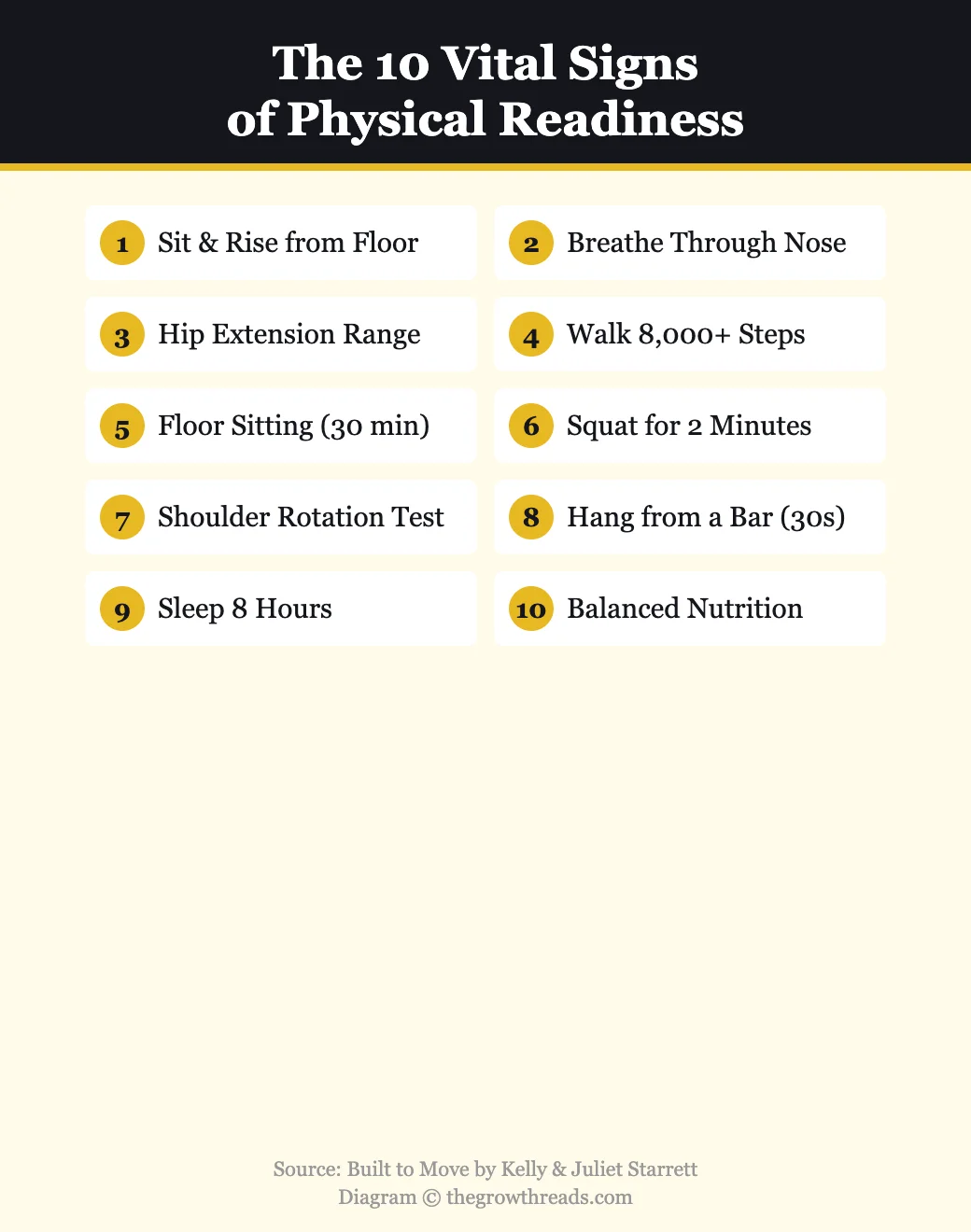
The Starretts begin with the most fundamental movement capacities. Vital Sign 1 is the sit-and-rise test: can you sit down on the floor and stand back up without using your hands? This simple test, drawn from research by Brazilian physician Claudio Gil Araujo, is a powerful predictor of longevity and all-cause mortality. If you need a hand on the floor or a knee down, your body is telling you something about its functional reserves.
Vital Sign 2 addresses breathing. The Starretts argue that chronic mouth breathing is an epidemic — one that contributes to poor sleep, increased anxiety, compromised athletic performance, and even dental problems. They prescribe nasal breathing during all activities except peak-intensity exercise, including taping the mouth during sleep (a practice they acknowledge sounds extreme but defend with substantial evidence).
Vital Sign 3 is hip extension — the ability to bring your leg behind your body. Modern sitting locks the hip flexors in a shortened position, which eventually causes low back pain, poor walking mechanics, and reduced athletic capacity. The Starretts provide couch-stretch progressions that can be done while watching television.
Vital Sign 4 is daily steps. The minimum is 8,000; the target is 10,000. The Starretts cite research showing that below 8,000 steps, metabolic health markers deteriorate significantly regardless of how much structured exercise you perform. Walking is not optional cross-training — it is the base of the entire movement pyramid.
Part 2: Mobility and Strength (Vital Signs 5–7)
Vital Sign 5 is floor sitting: the ability to spend 30 minutes on the ground in varied positions — cross-legged, kneeling, long-sitting, side-sitting. The Starretts argue that chairs are essentially mobility-destruction devices, and that the populations with the best hip and back health are those that still sit on the floor regularly. Their prescription is simple: during any passive activity (watching TV, reading, scrolling your phone), sit on the floor instead of a couch.
Vital Sign 6 is the full squat: can you squat to full depth (hips below knees) and hold it for two minutes? Every toddler can do this naturally. Most adults over 30 cannot. The Starretts trace this loss to decades of chair sitting and provide a progression from holding onto a doorframe to an unsupported full squat. They emphasize that this is a baseline human capacity, not a fitness goal.
Vital Sign 7 addresses shoulder function through the ability to raise both arms fully overhead and to hang from a bar for 30 seconds. Desk work, driving, and phone use all pull the shoulders forward and restrict overhead range. The Starretts prescribe dead hangs (simply hanging from a pull-up bar with relaxed shoulders) as the single most effective shoulder-health exercise available. Thirty seconds of hanging daily can reverse years of postural damage.
Part 3: Recovery and Lifestyle (Vital Signs 8–10)
Vital Sign 8 is soft tissue maintenance. The Starretts prescribe 10 minutes of daily “body maintenance” using foam rollers, lacrosse balls, or similar tools. They compare this to brushing your teeth — a non-negotiable daily practice that prevents much larger problems from developing. The emphasis is on the calves, quads, upper back, and hip flexors — the areas most affected by sitting.
Vital Sign 9 is sleep: eight hours minimum, in a cool, dark room, with a consistent wind-down routine. The Starretts treat sleep as a physical practice, not a passive state. They prescribe specific pre-sleep protocols: no screens for 30 minutes before bed, room temperature below 68 degrees, blackout curtains, and a consistent bedtime. They argue that poor sleep undermines every other physical practice — you cannot out-mobilize or out-exercise sleep deprivation.
Vital Sign 10 is nutrition, approached through a simple framework rather than a specific diet. The Starretts prescribe protein at every meal (roughly 0.7 grams per pound of body weight daily), vegetables at every meal, and adequate hydration. They deliberately avoid diet wars (paleo vs. vegan vs. keto) and instead focus on the principles that every nutritional approach agrees on: eat real food, get enough protein, and eat vegetables. This pragmatic stance makes the book accessible regardless of dietary preference.
Who Is Built to Move Best For — and Who Should Read Something Else First?
This book is ideal for desk-bound professionals who experience chronic stiffness and pain, people over 30 who want to maintain physical function for decades, and recreational athletes who want to bulletproof their bodies against injury. It is exceptionally practical — you can implement the first vital sign test and its corrective within five minutes of reading.
If you want a deeper understanding of why the human body needs movement, start with Exercised by Daniel Lieberman for the evolutionary context. If your primary concern is longevity medicine, try Outlive by Peter Attia, which covers similar movement principles alongside metabolic and cardiovascular health. For breathing specifically, Breath by James Nestor goes much deeper.
Questions to Reflect On
- How many of the 10 vital signs can you currently pass? Which failures surprise you most?
- How many hours per day do you spend sitting, and what would change if you replaced half of that with floor sitting?
- Are you a chronic mouth breather — especially during sleep? What would nasal breathing change for your energy and recovery?
- Where in your daily routine could you insert “movement snacks” without adding time to your schedule?
- If you tracked your daily steps for a week, would you consistently hit 8,000? What would it take to close the gap?
🔥 Ready to Reclaim Your Body?
Take the 10 vital-sign tests and build daily movement habits that last.
How to Apply Built to Move (7-Day Plan)
- Day 1 — Take all 10 tests. Block 30 minutes and run through every vital sign. Record pass or fail for each. This is your baseline — no judgment, just data.
- Day 2 — Start walking. Track your steps today using your phone. If you are below 8,000, identify two 15-minute walking windows you can protect daily (morning walk, post-lunch walk).
- Day 3 — Switch to floor sitting. Tonight, watch TV or read on the floor instead of the couch. Alternate between cross-legged, kneeling, and long-sitting every 10 minutes.
- Day 4 — Practice nasal breathing. Tape your mouth during sleep tonight (use surgical tape, leaving a small gap for safety). During the day, consciously breathe through your nose during all low-intensity activities.
- Day 5 — Add a morning mobility routine. Spend 10 minutes on the Starretts’ recommended hip and shoulder mobilizations. Couch stretch (2 minutes per side) plus dead hangs (3 sets of 10 seconds).
- Day 6 — Begin soft tissue work. Spend 10 minutes before bed with a foam roller on your calves, quads, and upper back. This is your new nightly “movement hygiene” practice.
- Day 7 — Retest your worst vital signs. Take the tests you failed on Day 1 again. Note any improvements — even small ones confirm that the practices are working and build momentum for the long term.
Frequently Asked Questions
Do I need any equipment to follow Built to Move?
Almost none. The 10 vital sign tests can all be performed with your body and a floor. For the corrective exercises, the only equipment recommended is a foam roller and a lacrosse ball — both inexpensive and available at any sporting goods store. A pull-up bar or doorway bar is helpful for the hanging test and exercise, but a playground bar or tree branch works just as well. The book was deliberately designed for people who do not have gym access.
Is Built to Move just for athletes?
The opposite, actually. While the Starretts built their reputation training elite athletes and military operators, Built to Move was written specifically for everyday people who are struggling with the physical consequences of modern sedentary life. The vital signs test basic human capacities — sitting on the floor, squatting, breathing properly — that every human should be able to do regardless of athletic ambition. Athletes will benefit too, but the book is most valuable for people who have never followed a structured movement practice.
How long does it take to see results from the vital sign practices?
Most people notice measurable improvements within two to four weeks of consistent daily practice. Hip mobility from floor sitting and couch stretches tends to improve fastest — many readers report noticeable changes within the first week. Step count improvements are immediate once you commit to walking. Breathing and sleep changes take longer, typically three to six weeks, because they involve retraining deeply ingrained habits. The Starretts emphasize that consistency matters more than intensity.
Is mouth taping during sleep actually safe?
The Starretts and breathing experts like James Nestor argue that mouth taping is safe for most healthy adults. They recommend using surgical tape (not duct tape) and leaving a small gap or using specially designed mouth tape products. If you have sleep apnea, a deviated septum, or significant nasal obstruction, consult a doctor before trying mouth taping. For most people, the practice significantly improves sleep quality by maintaining nasal breathing throughout the night. This is not medical advice — discuss with your healthcare provider if you have concerns.
How is Built to Move different from the Starretts’ earlier book Becoming a Supple Leopard?
Becoming a Supple Leopard was a dense, technical manual primarily aimed at athletes and coaches — it catalogued hundreds of mobilization techniques organized by movement pattern. Built to Move is simpler, broader, and designed for general populations. It focuses on daily habits and lifestyle changes rather than exercise-specific mobilizations. Think of Supple Leopard as the advanced textbook and Built to Move as the practical lifestyle guide — they complement each other, but Built to Move is the better starting point for most people.
Can I do the practices if I have chronic pain or injuries?
The Starretts designed the vital signs to be accessible to people with existing pain — in fact, many of the practices are specifically intended to address chronic pain. However, they recommend starting with the easiest versions of each exercise and progressing slowly. If a particular test or practice causes sharp pain (as opposed to the discomfort of stretching tight tissues), skip it and consult a physical therapist. The book is a complement to professional medical care for chronic pain, not a replacement for it.
What should I read after Built to Move?
For the evolutionary science behind why movement matters, read Exercised by Daniel Lieberman. For a comprehensive longevity framework that includes movement alongside metabolic and cardiovascular health, try Outlive by Peter Attia. For deeper breathing practices, James Nestor’s Breath is the definitive guide. And for sleep optimization, Matthew Walker’s Why We Sleep provides the scientific foundation that supports the Starretts’ sleep vital sign.
Related Summaries
- Exercised by Daniel Lieberman — The evolutionary science explaining why our bodies were built to move and what happens when they do not.
- Breath by James Nestor — A deep dive into the science and practice of breathing that complements the Starretts’ nasal-breathing vital sign.
- Outlive by Peter Attia — A comprehensive longevity framework covering exercise, metabolic health, and the science of aging well.
- The Comfort Crisis by Michael Easter — Why modern comfort is destroying our bodies and minds, and what to do about it.
For more health book summaries, visit our Best Health Books pillar page.