

★★★★☆ 4.4/5 — Eat food, mostly plants, not too much, explained with real science.
Best for: Anyone confused by conflicting nutrition headlines and ready to trust whole food over food-science claims.
Reading time: ~5 hrs (256 pages) · Summary read time: ~14 min
Difficulty to apply: Low — the core rules are simple; the hard part is unlearning nutrition-label thinking.
In Defense of Food in one minute
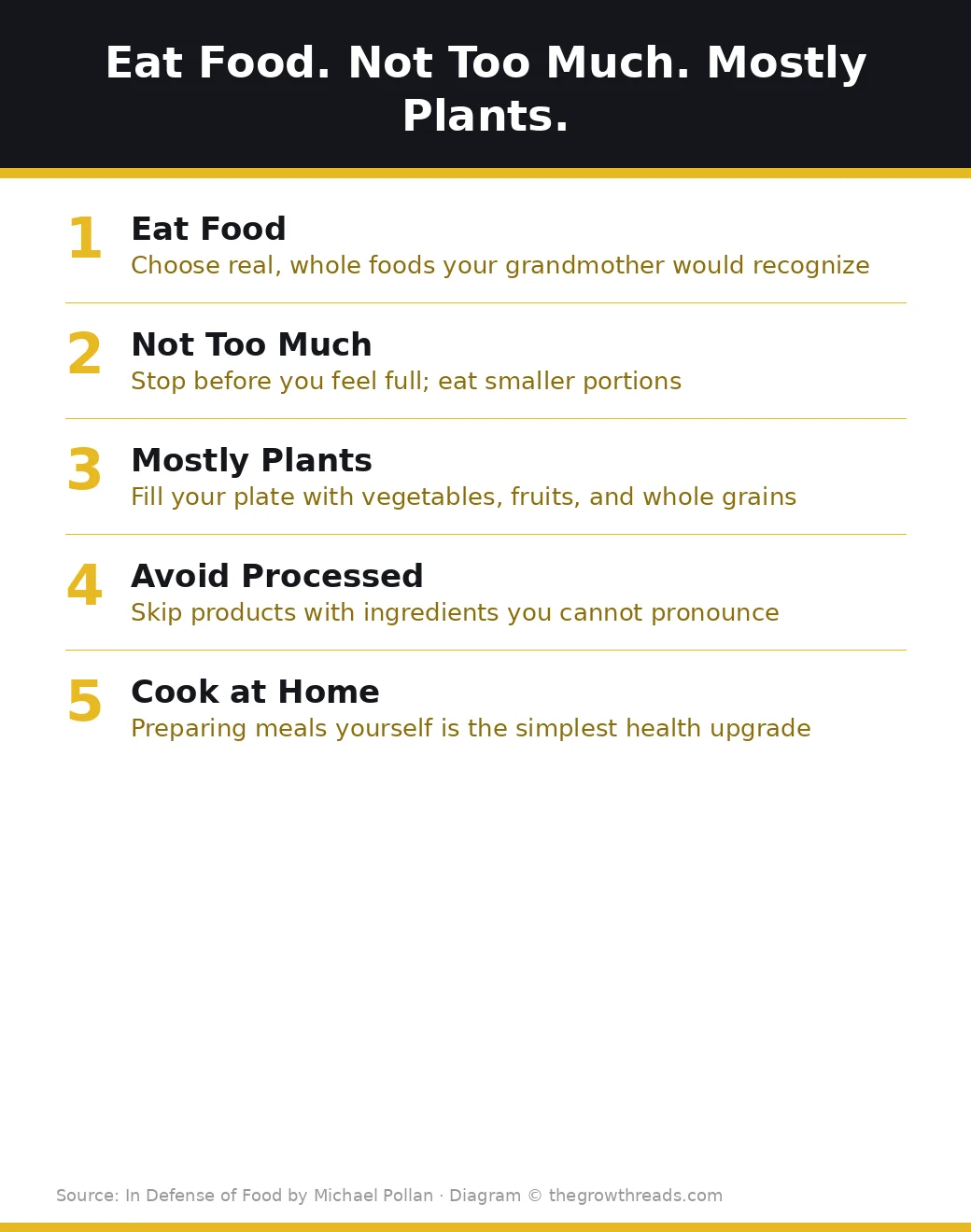
Michael Pollan’s famous seven-word thesis says it all: “Eat food. Not too much. Mostly plants.” Everything else in In Defense of Food is Pollan explaining why that simple instruction got so complicated, and how a science-obsessed food culture talked us out of following it.
TL;DR: For the last several decades, Western eating has been hijacked by what Pollan calls “nutritionism” — an ideology that reduces food to its nutrient parts (fat, carbs, omega-3s, antioxidants) and lets food scientists, marketers, and even well-meaning dietitians redesign what we eat around isolated compounds instead of whole foods. The result is a “Western diet” of processed, nutrient-fortified food-like substances that correlates strongly with the rise of diabetes, heart disease, obesity, and cancer. Pollan’s fix isn’t a new diet — it’s a return to eating actual food, prepared and shared the way humans did for most of history, before nutrition science convinced us we needed its help.
Key takeaways
- Nutritionism is an ideology, not a science: the belief that foods are simply the sum of their nutrients, and that nutrients (not whole foods) are what matter for health.
- “Eat food” is harder than it sounds: Pollan defines real food as what your great-grandmother would recognize — not the 17,000 new products that appear in supermarkets every year.
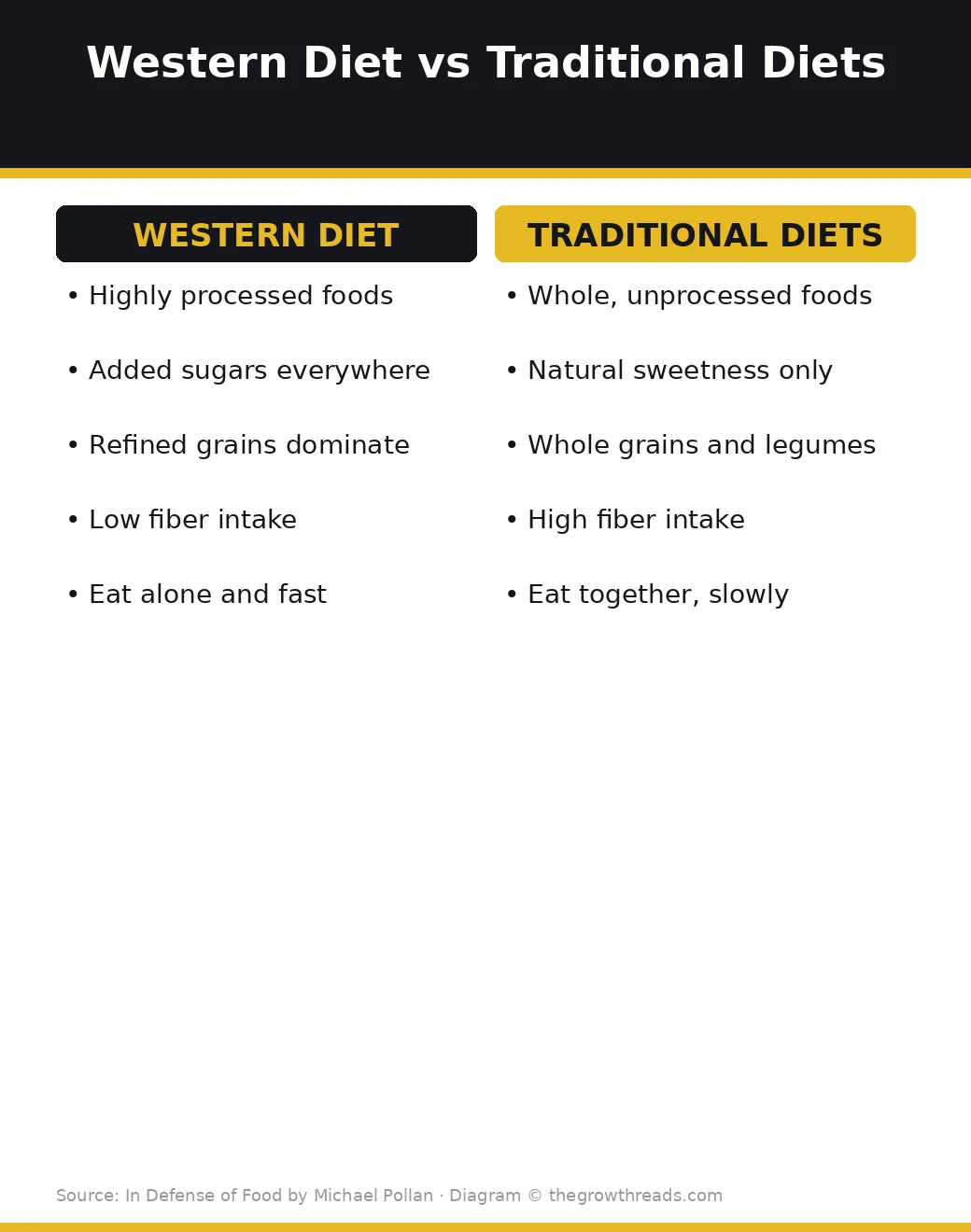
- The Western diet is a recent, radical experiment: refined grains, added sugar, industrial vegetable oils, and animal products from grain-fed livestock, eaten in place of traditional whole foods.
- “Diseases of civilization” track the Western diet: heart disease, type 2 diabetes, obesity, and many cancers are rare or absent in populations eating traditional diets, then rise within a generation of adopting Western food.
- Food science keeps getting reductionist nutrition wrong: the low-fat campaign of the 1980s-90s replaced fat with refined carbs and sugar — and the population got fatter and sicker, not healthier.
- Food industry marketing exploits nutrition claims: health claims on a box (“low fat,” “high fiber,” “contains omega-3s”) are a reliable sign the product is processed, not a reason to trust it.
- Traditional food cultures encode real wisdom: French, Italian, Japanese, and other long-standing food cultures built in rules — small portions, real ingredients, shared meals — that protect health without any nutrition science at all.
- You don’t need a nutritionist to eat well: your grandmother, a farmers market, and a general suspicion of anything with a health claim will get you further than most diet science.
- Eating is an ecological and social act, not just a biochemical one: how food is grown, cooked, and eaten together matters as much as its nutrient profile.
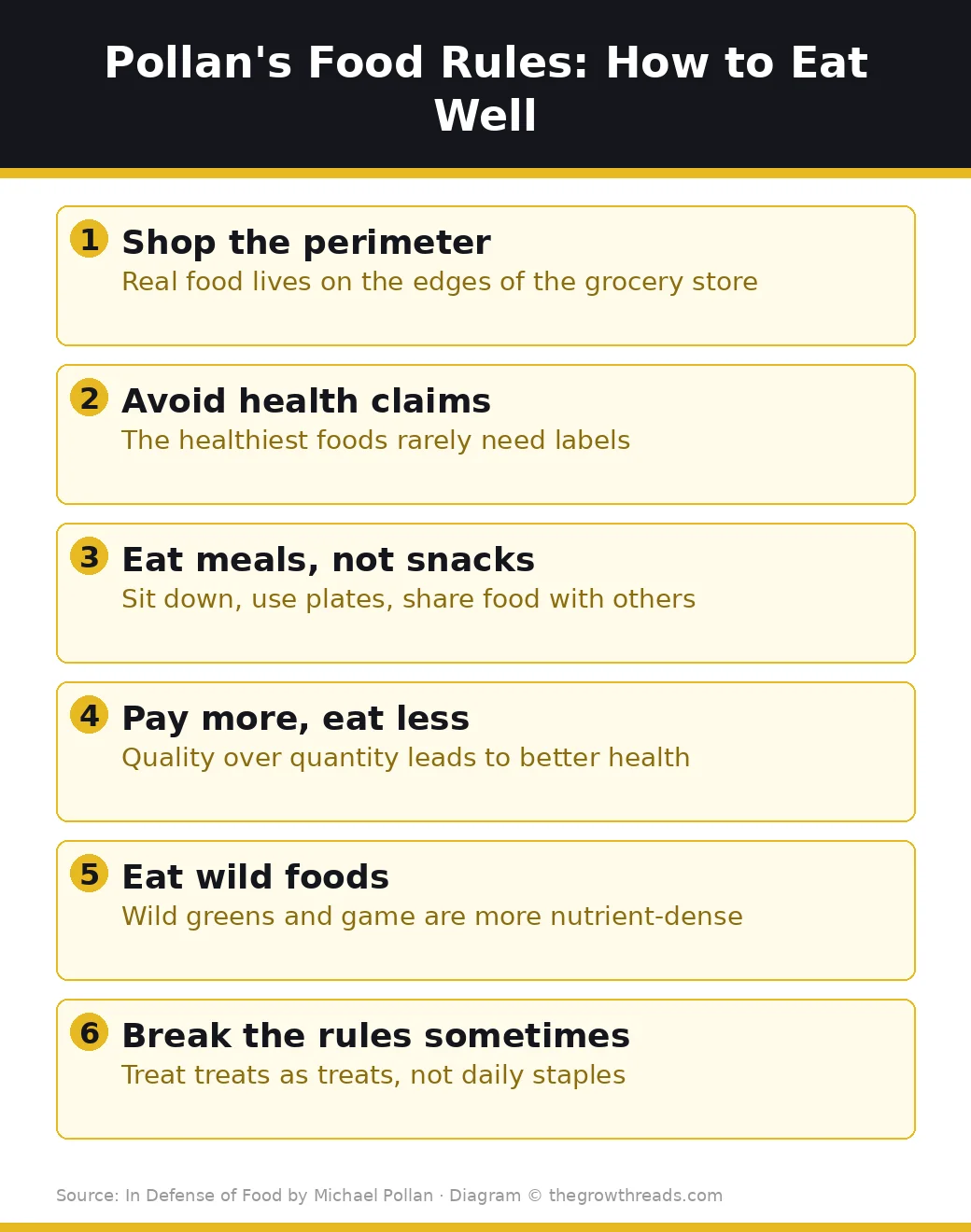
- Pollan’s rules are deliberately simple and memorable: shop the edges of the supermarket, avoid ingredient lists you can’t pronounce, eat mostly plants, and enjoy meals rather than optimizing them.
What is In Defense of Food about?
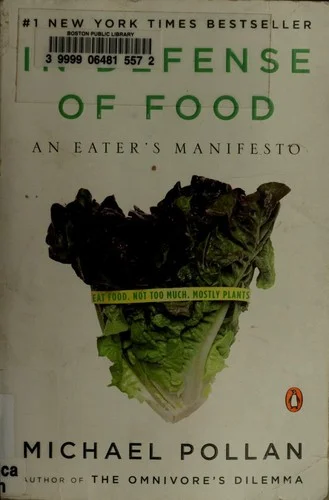
In Defense of Food argues that decades of reducing food to isolated nutrients — “nutritionism” — created a confusing, unhealthy Western diet of processed products. Pollan’s answer is a return to whole, recognizable food, guided by traditional eating cultures rather than shifting nutrition science, summed up in seven words: eat food, not too much, mostly plants.
About the author
Michael Pollan is an American author, journalist, and professor best known for changing how mainstream readers think about food and agriculture. A longtime contributor to The New York Times Magazine, he first reached a wide audience with The Botany of Desire (2001), then became a household name in food writing with The Omnivore’s Dilemma (2006), which traced four meals back to their sources — industrial corn, industrial organic, local sustainable, and hunted-and-gathered. Explore all Michael Pollan book summaries →
In Defense of Food (2008) followed as a shorter, more prescriptive companion: if Omnivore’s Dilemma asked “what should I eat?”, this book answers it directly. Pollan later extended the same ideas in Food Rules (2009) and Cooked (2013). He has taught journalism and science writing at UC Berkeley and Harvard, and his food-systems reporting has influenced U.S. food policy debates, school lunch reform, and the broader “real food” movement.
Key concepts at a glance
| Concept | What it means | Use it when |
|---|---|---|
| Nutritionism | Treating food as a delivery system for nutrients rather than as food itself | You catch yourself choosing a product because of a health claim on the label |
| Western diet | Refined grains, added sugar, industrial oils, and feedlot meat, eaten in place of whole foods | You’re auditing what dominates your weekly groceries |
| Diseases of civilization | Chronic illnesses (heart disease, diabetes, obesity, some cancers) that rise with adoption of the Western diet | You want a reason to prioritize prevention through diet |
| The “eat food” rule | Only eat things your great-grandmother would recognize as food | You’re standing in a supermarket aisle deciding what to buy |
| Traditional food cultures | Inherited, tested-over-generations eating patterns (French, Japanese, Mediterranean, etc.) | You want a ready-made template instead of designing a diet from scratch |
| “Mostly plants” | Building meals around vegetables, fruits, whole grains, and legumes, with meat as a side | You’re planning what fills the center of your plate |
| Food, not food-like substances | Ingredient lists you recognize and can pronounce, five ingredients or fewer | You’re comparing two packaged products |
Part 1: The Age of Nutritionism
Pollan opens by asking a question that sounds almost absurd: why do Americans need a book telling them what to eat? Every other culture on earth manages this through habit, memory, and taste, passed down without a single calorie count. His answer is that America’s relationship with food was captured, over the 20th century, by “nutritionism” — the idea that a food is nothing more than the sum of its known nutrients, and that eating well means engineering your intake of those nutrients rather than simply eating well-chosen whole foods.
Nutritionism didn’t arrive by accident. It suited three groups perfectly: food scientists, who could now claim expertise over eating; the food industry, which could reformulate cheap processed products around whatever nutrient was fashionable and slap a health claim on the box; and government dietary guidelines, which found it easier to warn against “fat” as a category than to say “eat less meat” and risk offending powerful agricultural lobbies. The result, Pollan argues, was a nutrition establishment that keeps discovering new villains and heroes — fat, then carbs, then trans fats, then gluten — while the food supply itself gets more processed with every cycle.
The deeper problem with nutritionism is that it assumes we already understand food well enough to break it into interchangeable parts. We don’t. Nutrition science is still young, foods interact with our bodies in combinations scientists can’t fully isolate, and reducing an apple to “fiber plus vitamin C plus antioxidants” throws away information we don’t yet know how to measure. Pollan’s term for the fix is disarmingly simple: eat food, not nutrients.
Part 2: The Western Diet and Diseases of Civilization
Having named the ideology, Pollan turns to its consequences. He builds his case largely from epidemiology: whenever a population shifts from a traditional diet to a Western one — as happened to Native Americans, Aboriginal Australians, Pacific Islanders, and postwar Japan — rates of obesity, type 2 diabetes, and heart disease climb sharply within a generation, sometimes within a decade. These aren’t slow genetic changes; they’re fast responses to a new way of eating, which is strong evidence the diet itself, not just genes or lifestyle in the abstract, is doing the damage.
He walks through what actually changed in the Western diet over the 20th century: a shift from whole grains to refined flour, from naturally occurring fats to industrially processed vegetable oils, from occasional sweetness to a constant stream of added sugar (especially high-fructose corn syrup), and from pasture-raised to grain-fed, feedlot meat with a different fat profile than the meat our ancestors ate. Portions grew. Meals moved from the table to the car, the desk, and the couch. Whole food gave way to reformulated, nutrient-fortified products designed to look healthy on a label while being engineered for shelf life and profit margins rather than health.
Pollan is careful not to pin the blame on any single nutrient — that, he says, is exactly the nutritionist trap. It’s not fat’s fault, or carbs’ fault, or any one villain’s fault; it’s the cumulative effect of processing, refining, and marketing food until it barely resembles what it started as. The “diseases of civilization” aren’t a mystery requiring more nutrient science — they’re the predictable result of a food system optimized for everything except the eater’s long-term health.
Part 3: Getting Over Nutritionism
The middle section of the book is Pollan’s argument for why we should trust culture and tradition over nutrition science when the two conflict. Traditional food cultures — French, Italian, Japanese, Mediterranean, and countless others — evolved over centuries through trial and error at a scale no lab study can replicate. They encode rules that happen to protect health: eat until you’re not hungry rather than full (Japan’s “hara hachi bu”), treat meat as a flavoring rather than the center of the plate, drink wine only with food, snack rarely, and cook meals from scratch and eat them together, slowly.
None of these rules were designed by nutritionists. They emerged from the practical experience of communities that had to keep eating the same foods for generations and noticed, informally, what worked. Pollan contrasts this with the fate of a culture that abandons its food traditions in favor of nutritional science and marketing — America being his central example — and ends up with more nutrition information than any society in history and some of the worst diet-related health outcomes among wealthy nations.
He’s not arguing science is worthless; he’s arguing it’s a poor substitute for accumulated cultural wisdom when it comes to something as complex as eating, and that we’ve let it displace tradition rather than supplement it. The practical upshot is a kind of humility: when in doubt, eat the way a food culture with generations of practice eats, not the way this month’s nutrition headline suggests.
Part 4: Eat Food: Food Defined
The final part is the most actionable: Pollan’s practical rules for identifying real food in a supermarket built to obscure the difference. His most repeated heuristics include: don’t eat anything your great-grandmother wouldn’t recognize as food; avoid products with more than five ingredients, or with ingredients you can’t pronounce; avoid products that make health claims (real food, he notes, rarely needs to advertise how healthy it is); shop the edges of the supermarket, where fresh produce, meat, and dairy live, and be wary of the center aisles full of shelf-stable processed products.
He also revisits “mostly plants” in concrete terms: build meals around vegetables, treat meat as a side dish or flavoring rather than the main event, favor whole grains over refined ones, and eat a wide variety of plant foods rather than relying on the same few staples. And he closes with “not too much” — advice that’s less about counting calories and more about eating more slowly, in company, without distraction, and stopping before you’re stuffed, echoing the traditional cultures discussed earlier.
Taken together, the four parts build one argument: stop trying to out-engineer your dinner with nutrition science, and start eating the way humans successfully ate for most of history — real, minimally processed food, mostly plants, in reasonable amounts, enjoyed rather than optimized.
Who is In Defense of Food best for — and who should read something else first?
In Defense of Food is best for readers who feel overwhelmed by conflicting nutrition advice and want a simple, trustworthy default to fall back on — especially anyone who grew up on processed convenience food and wants a cultural, not clinical, reset. It’s also a great pick for home cooks who want a philosophy to organize grocery shopping and meal planning around.
If you want deep clinical detail on specific diseases and the research behind them, start with How Not to Die instead. If your main concern is weight and blood sugar specifically, Glucose Revolution or The Obesity Code will get you to actionable advice faster.
Questions to reflect on
- How many items in your kitchen right now would your great-grandmother recognize as food?
- Which “health claims” on packaging have influenced a purchase you made this month — and were they on a processed product?
- What does “mostly plants” look like on your actual dinner plate this week, realistically?
- Which traditional food habit (slow meals, smaller portions, cooking from scratch) would be easiest for you to adopt first?
- Where in your week could you replace a processed, convenience meal with something simpler and less engineered?
🔥 Ready to rethink what’s on your plate?
Grab a copy of In Defense of Food and start applying Pollan’s seven-word rule this week.
How to apply In Defense of Food (7-day plan)
- Day 1: Audit your pantry and fridge. Set aside anything with more than five ingredients or a health claim on the front of the package.
- Day 2: Shop only the edges of the supermarket — produce, meat, dairy, bakery — for today’s meals.
- Day 3: Cook one meal entirely from scratch using whole ingredients, and eat it at a table without screens.
- Day 4: Build a plate around vegetables first, then grains, with meat as a smaller side rather than the centerpiece.
- Day 5: Practice “not too much” — eat slowly, and stop when you’re satisfied rather than full.
- Day 6: Try one traditional-food-culture habit that isn’t your own (a Mediterranean, Japanese, or French mealtime rule) and notice how it feels.
- Day 7: Plan next week’s groceries using Pollan’s rules as a checklist, and share one meal with someone else, unhurried.
Frequently asked questions
What is the main message of In Defense of Food?
The main message is captured in Pollan’s seven-word rule: “Eat food. Not too much. Mostly plants.” He argues that decades of nutrition science reduced food to isolated nutrients, an ideology he calls “nutritionism,” and that this shift helped drive the rise of processed foods and diet-related chronic disease. His solution isn’t a new diet plan but a return to eating whole, recognizable food guided by traditional food cultures rather than shifting nutritional claims and marketing.
What does Michael Pollan mean by “nutritionism”?
Nutritionism is Pollan’s term for the ideology that food is essentially a delivery system for nutrients, and that health comes from managing intake of those individual nutrients (fat, fiber, antioxidants, and so on) rather than simply eating whole foods. He argues this framing suits food scientists, marketers, and policymakers more than it suits eaters, since it lets processed products earn health halos through fortification and labeling while whole, unprocessed foods get no comparable marketing advantage.
Is In Defense of Food based on solid science?
Pollan draws heavily on epidemiology, food history, and journalism rather than randomized clinical trials, and some of the specific claims and statistics he cites have been debated by nutrition researchers in the years since publication. That said, his core, practical advice — eat whole foods, favor plants, avoid heavily processed products, and watch portions — remains broadly uncontroversial and consistent with mainstream dietary guidance from major health organizations.
What are Michael Pollan’s food rules in the book?
Key rules include: don’t eat anything your great-grandmother wouldn’t recognize as food; avoid products with more than five ingredients or ones you can’t pronounce; avoid foods that make health claims on the package; shop the edges of the supermarket rather than the center aisles; eat mostly plants, treating meat as a side rather than the main course; and eat meals slowly, in company, stopping before you’re full rather than counting calories.
How is In Defense of Food different from The Omnivore’s Dilemma?
The Omnivore’s Dilemma (2006) traces four different meals back to their origins in the food system — industrial corn, industrial organic, local sustainable, and hunted-and-gathered — to ask where our food comes from. In Defense of Food (2008) is shorter and more prescriptive, taking the lessons from that investigation and turning them into direct, practical advice on what to actually eat, built around the seven-word rule.
Does In Defense of Food recommend a specific diet, like keto or vegan?
No. Pollan deliberately avoids prescribing a named diet plan, arguing that most diets fail for the same nutritionist reasons he criticizes — they focus on restricting or emphasizing specific nutrients rather than changing what kind of food you eat. His advice works across a wide range of eating styles, from omnivorous to largely plant-based, as long as the food is whole and minimally processed and plants make up the bulk of the plate.
Who should read In Defense of Food?
It’s best for readers overwhelmed by conflicting nutrition headlines who want one simple, memorable framework to guide everyday food choices, as well as home cooks looking for a philosophy to organize grocery shopping around. Readers who want deep clinical or disease-specific detail may want to pair it with a more research-dense book, but as an accessible starting point for eating better, it remains one of the most widely recommended food books of the last two decades.
Related summaries
See all our picks on the best health books pillar page.