

★★★★½ 4.4/5 — a fascinating, urgent, and readable case for taking sleep seriously. Some of its most dramatic claims have been contested, but the central message — that sleep is non-negotiable for health — is sound and life-changing.
Best for: anyone who sacrifices sleep for work or scrolling and wants to understand exactly what that costs them · Reading time: ~7 hours (this guide: 15 min) · Difficulty to apply: Easy — the habits are simple; the discipline of prioritizing sleep is the hard part
Why We Sleep in one minute
Sleep is not an optional luxury or lost productivity — it is the single most effective thing you can do to reset your brain and body health each day, and skimping on it silently damages nearly every system you have. Neuroscientist Matthew Walker makes the case that a full night’s sleep is essential for memory, learning, emotional stability, immune function, metabolism, and long-term health, and that chronic sleep loss is linked to a frightening list of consequences — impaired memory and focus, weakened immunity, weight gain, and elevated risk of conditions from heart disease to dementia. He explains the two kinds of sleep, NREM (deep sleep) and REM (dream sleep), and the two systems — your circadian rhythm and rising “sleep pressure” — that govern when you feel tired. He debunks common myths, like the idea that you can get by on a few hours or fully “catch up” on lost sleep at the weekend, and he documents a modern epidemic of sleep deprivation driven by artificial light, caffeine, alcohol, screens, and a culture that treats sleep as expendable. The takeaway is blunt and practical: protect roughly seven to nine hours of sleep, respect a handful of simple sleep-hygiene habits, and you dramatically improve how you think, feel, and age.
Key takeaways
- Sleep is foundational, not optional: it underpins memory, mood, immunity, metabolism, and longevity.
- Two types of sleep: NREM (deep sleep) consolidates memory and restores the body; REM (dream sleep) processes emotions and fuels creativity.
- Two systems set your clock: your circadian rhythm and rising sleep pressure (adenosine) together decide when you feel sleepy.
- Caffeine masks tiredness: it blocks the sleepiness signal without removing the underlying sleep debt.
- Sleep locks in learning: you need sleep both before learning (to prepare the brain) and after (to save the memory).
- You can’t fully “catch up”: lost sleep can’t simply be banked or repaid at the weekend.
- Deprivation is dangerous: chronic short sleep is linked to weakened immunity, weight gain, and higher disease risk.
- Alcohol and screens harm sleep: alcohol fragments sleep and blocks REM; evening light delays your body clock.
- Consistency is king: a regular sleep-wake schedule is the most important sleep-hygiene habit.
- Society is sleep-deprived: modern life systematically robs us of sleep — and it’s a public-health problem.
What is Why We Sleep about?
Why We Sleep is a popular-science book by neuroscientist Matthew Walker about the vital importance of sleep. It explains what sleep does for the brain and body, how NREM and REM sleep work, the serious health consequences of sleep deprivation, and how to sleep better. Its core message is that sleep is essential — not expendable — for memory, mood, immunity, and long-term health.
About the author
Matthew Walker is a neuroscientist and professor of neuroscience and psychology at the University of California, Berkeley, where he founded and directs the Center for Human Sleep Science; he previously taught psychiatry at Harvard Medical School. He has spent his career researching the effects of sleep on human health and disease, and Why We Sleep, published in 2017, brought decades of that research to a general audience, becoming an international bestseller and turning Walker into perhaps the world’s most prominent public advocate for sleep. His writing is vivid, urgent, and packed with striking studies and statistics. It’s worth noting that the book’s very persuasiveness has also drawn scrutiny: some scientists have argued that Walker overstates certain findings and that a number of specific claims contain errors — a debate we cover honestly in the FAQ below. That criticism is a caveat about particular details, not a refutation of the book’s central, well-supported thesis that sufficient sleep is essential to health. Explore all Matthew Walker book summaries →
Key concepts at a glance
| Concept | What it means | Why it matters |
|---|---|---|
| NREM sleep | Deep, dreamless sleep | Consolidates memory, restores body |
| REM sleep | Dreaming sleep | Emotional processing, creativity |
| Circadian rhythm | Your ~24-hour body clock | Sets when you feel awake or sleepy |
| Sleep pressure | Adenosine building up while awake | Creates the drive to sleep |
| Sleep debt | Accumulated lost sleep | Can’t be fully repaid later |
| Sleep hygiene | Habits that support good sleep | The practical fix |
Part 1: What sleep is — NREM, REM, and the two systems that time it
Walker begins by explaining that sleep is not a single uniform state but comes in two main types that alternate through the night.
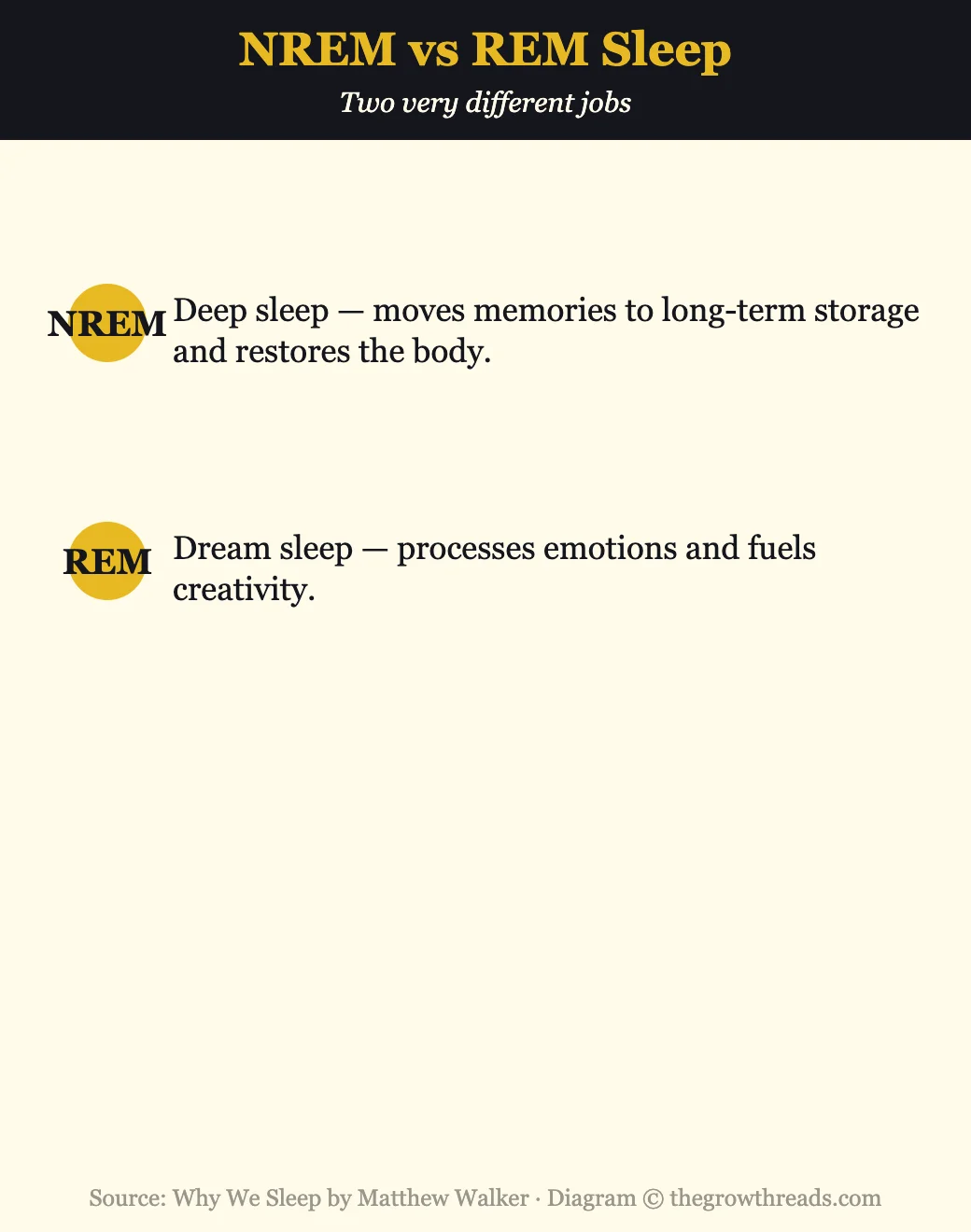
NREM (non-rapid eye movement) sleep is deep, slow-wave sleep; among other things, it helps move memories from short-term into long-term storage and carries out physical restoration and repair. REM (rapid eye movement) sleep is when most vivid dreaming occurs, and it plays a key role in processing emotions, integrating memories, and fueling creativity and problem-solving. Across a night, you cycle through these stages repeatedly, but the balance shifts: earlier cycles are richer in deep NREM sleep, while later cycles (toward morning) contain proportionally more REM. This has a practical consequence Walker stresses — cutting your night short, even by an hour or two, doesn’t just trim a slice off the end; it disproportionately robs you of REM sleep, so shortchanging sleep starves your brain of the emotional and creative processing it needs. Two internal systems decide when you feel sleepy: your circadian rhythm, an internal roughly 24-hour clock (tuned by light) that regulates your energy across the day, and sleep pressure, driven by a chemical called adenosine that steadily builds up in the brain the longer you’re awake and makes you feel increasingly tired. Caffeine works, Walker explains, by blocking adenosine’s signal — it doesn’t remove your tiredness or sleep debt, it just temporarily hides them, which is why a “crash” often follows.
Part 2: What a full night’s sleep does for you
The book’s most motivating sections detail everything a good night’s sleep accomplishes — a remarkable amount of essential biological housekeeping.
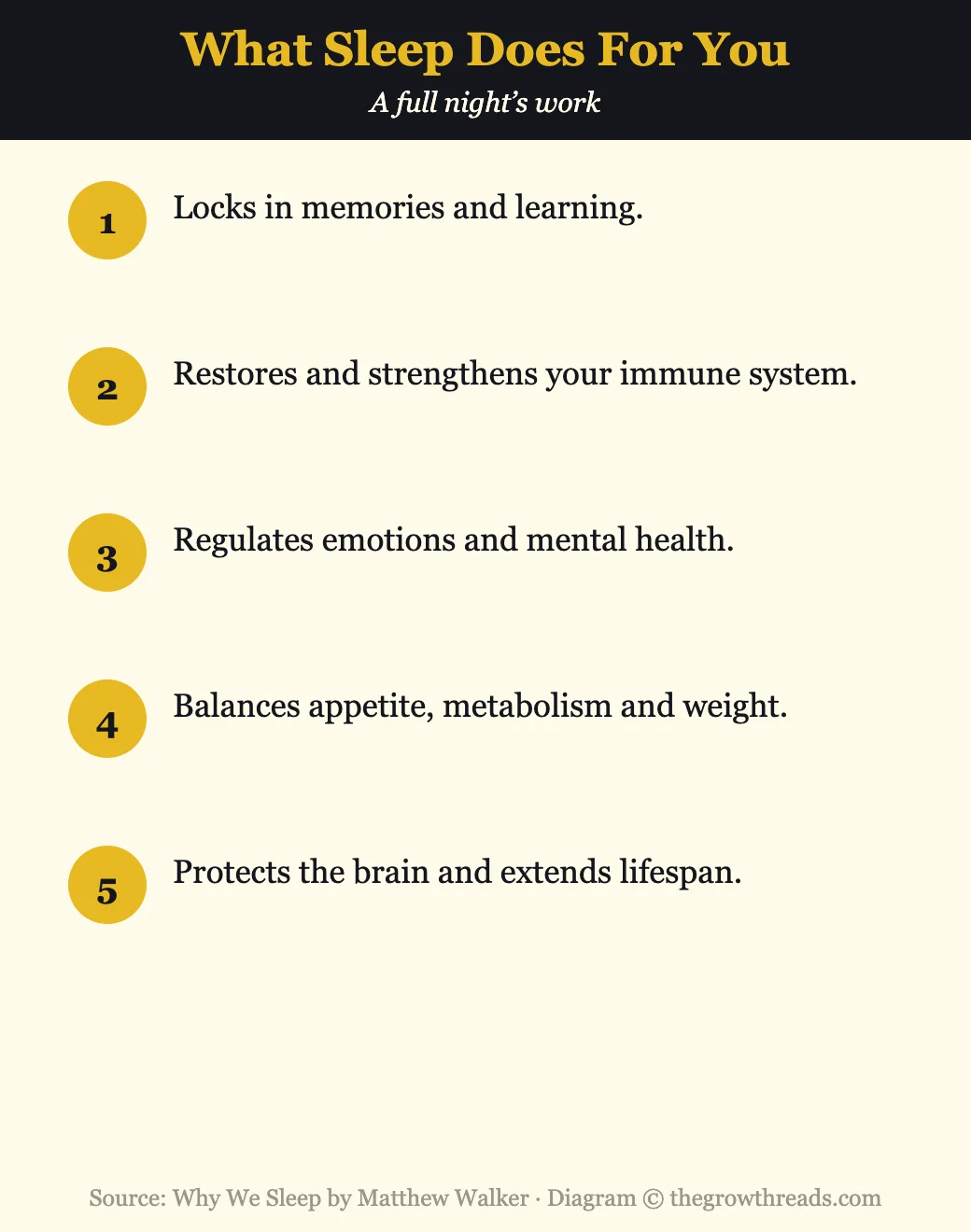
For the brain, sleep is critical for learning and memory. Walker describes sleep as necessary both before learning, to prepare the brain to absorb new information, and after learning, to consolidate and lock in what you’ve taken in — which is why pulling an all-nighter to cram is counterproductive. REM sleep and dreaming, meanwhile, help defuse the emotional charge of difficult experiences and foster creative insight, so that problems can genuinely look better “in the morning.” For the body, sleep supports and strengthens the immune system, helps regulate metabolism and appetite hormones (so sleep loss tends to increase hunger and weight gain), maintains cardiovascular health, and contributes to overall longevity. Sleep, in Walker’s framing, is not downtime; it is an active, essential process during which the brain and body repair, reorganize, and prepare for the day ahead. This is why he argues so forcefully that a full night’s sleep is one of the most powerful, and most underrated, tools available for health and performance.
TGR Note: Sleep is the pillar Peter Attia builds his longevity strategy on in Outlive — where Walker explains the science of why sleep protects the brain and heart, Attia integrates it into a practical plan for living better, longer. Read them together and sleep stops being negotiable.
Part 3: The devastating cost of sleep deprivation
The counterpart to sleep’s benefits is Walker’s alarming account of what happens when you don’t get enough — and this is the part of the book designed to change your behavior. Chronic sleep deprivation, he argues, is far more damaging than most people realize. In the short term, too little sleep impairs concentration, reaction time, judgment, learning, and emotional regulation, and Walker is especially forceful about drowsy driving, which he compares to driving drunk in its danger. Over the longer term, he links insufficient sleep to a weakened immune system, disrupted blood sugar and a higher risk of type 2 diabetes, weight gain, cardiovascular problems, mental-health difficulties, and — in his most-discussed claims — an elevated risk of serious diseases including Alzheimer’s and certain cancers.
He is also determined to demolish comforting myths. You cannot, he argues, truly adapt to running on very little sleep — people who feel “fine” on five or six hours are typically impaired without realizing it. Nor can you fully repay a week of sleep debt with a long weekend lie-in; lost deep sleep in particular is gone. And the widespread badge-of-honor attitude that treats sleeping less as a sign of toughness or dedication is, in his view, dangerously misguided. Walker widens the lens to society, describing a modern sleep-loss epidemic fueled by electric light and screens, caffeine and alcohol, long working hours, and social norms that devalue rest — with real consequences for public health, safety, and even the economy. Whatever one makes of the precise figures, the cumulative effect is a powerful argument for treating sleep as a genuine priority.
Part 4: How to sleep better — and how to read the science
Having made the case, Walker turns practical, distilling the research into concrete sleep-hygiene habits.
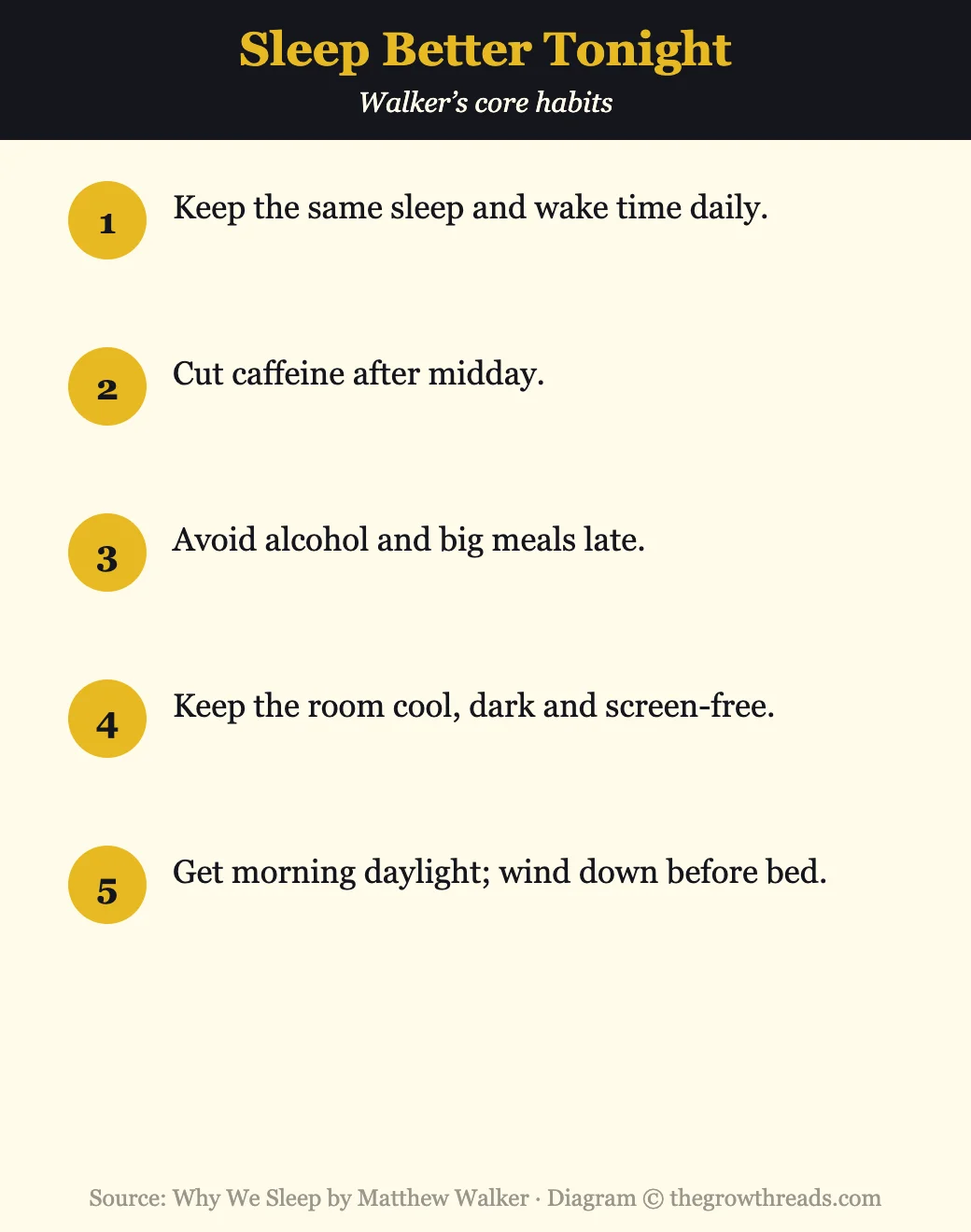
The most important, he stresses, is regularity: go to bed and wake up at the same times every day, including weekends, to keep your body clock stable. Beyond that, he advises limiting caffeine (especially after midday, given how long it lingers), avoiding alcohol near bedtime (it fragments sleep and suppresses REM, so a “nightcap” harms sleep quality even if it helps you fall asleep), and keeping the bedroom cool, dark, and quiet, since a drop in body temperature helps trigger sleep. He recommends getting natural daylight during the day and dimming lights and avoiding screens in the evening to protect melatonin release, winding down with a relaxing routine, not lying awake in bed for long stretches, and being cautious with sleeping pills, which he argues don’t produce natural, restorative sleep. At a societal level he advocates for changes like later school start times and more sleep-aware medical and workplace practices.
A fair review has to hold two things at once. On one hand, Why We Sleep is a genuinely valuable, engaging, and important book that has done more than almost any other to make people take sleep seriously, and its central thesis — that sufficient sleep is essential to physical and mental health — is well supported. On the other hand, its rhetorical force is also its risk: independent analysts have identified factual errors and argued that Walker overstates some findings and presents the most dramatic interpretation of contested research as settled fact. The honest conclusion is that you should absolutely take the book’s core message to heart and act on its practical advice, while treating its scariest specific statistics with appropriate caution and not as the final scientific word. As motivation to protect your sleep and as a readable tour of sleep science, it earns its place — just read it as a persuasive advocate rather than a neutral textbook.
TGR Note: Walker gives you the “why,” but turning better sleep into a permanent habit is a job for Atomic Habits — a consistent bedtime, a wind-down routine, and a screen-free bedroom are exactly the kind of small, stackable systems James Clear teaches you to build and keep.
Who is Why We Sleep best for — and who should read it critically?
This book is ideal for anyone who routinely trades sleep for work, study, or screens and needs a compelling reason to stop — it’s motivating, accessible, and genuinely useful, and its practical tips can improve your sleep starting tonight. It’s especially good for people curious about the science of the brain and body. Read it a little more critically if you’re the type to take every statistic as gospel: some of its most dramatic claims are contested, so pair your reading with a healthy awareness of that debate. For turning its advice into lasting routines, use Atomic Habits; for fitting sleep into a bigger longevity picture, read Outlive.
Questions to reflect on
- How many hours are you really sleeping — and how do you feel on the days you get more?
- Where are caffeine, alcohol, or screens quietly sabotaging your sleep?
- Do you treat sleeping less as a badge of honor? What is it actually costing you?
- Is your sleep and wake time consistent, or all over the place?
- What is the single easiest change you could make to protect your sleep tonight?
🔥 Ready to unlock the power of sleep?
This guide is the map — Walker’s studies and stories are what make you finally take sleep seriously.
How to apply Why We Sleep (7-day plan)
- Day 1 — Set a fixed schedule. Pick a consistent bedtime and wake time and keep them, even on weekends.
- Day 2 — Cut afternoon caffeine. Have your last coffee before midday and notice the difference.
- Day 3 — Skip the nightcap. Avoid alcohol in the evening to protect your REM sleep.
- Day 4 — Cool and darken your room. Lower the temperature and block out light for deeper sleep.
- Day 5 — Get morning light. Spend time in daylight early to anchor your body clock.
- Day 6 — Build a wind-down. Dim lights and stop screens 30–60 minutes before bed.
- Day 7 — Protect the full night. Aim for seven to nine hours and stop treating sleep as expendable.
Frequently asked questions
Is Why We Sleep worth reading?
Yes. It’s an engaging, eye-opening, and genuinely important book that has done more than almost any other to make people take sleep seriously. Walker explains the science clearly and makes a powerful case for prioritizing sleep, and his practical tips can improve your rest immediately. The one caveat is that some of his most dramatic claims have been contested by other scientists, so it’s best read as a persuasive advocate for sleep rather than a perfectly neutral textbook. Take its core message and habits to heart while treating its scariest specific statistics with a little caution.
What is the main message of Why We Sleep?
That sleep is essential — not optional — for nearly every aspect of health, and that chronic sleep deprivation is far more damaging than most people realize. Walker argues that a full night’s sleep is foundational for memory, learning, emotional stability, immune function, metabolism, and longevity, while too little sleep impairs the mind and raises the risk of serious disease. His practical bottom line is to protect roughly seven to nine hours a night and follow simple sleep-hygiene habits, because doing so dramatically improves how you think, feel, and age.
What is the difference between NREM and REM sleep?
NREM (non-rapid eye movement) sleep is deep, slow-wave sleep that helps move memories into long-term storage and carries out physical restoration and repair. REM (rapid eye movement) sleep is when most vivid dreaming happens, and it plays a key role in processing emotions, integrating memories, and boosting creativity. You cycle through both across the night, but earlier cycles hold more deep NREM sleep and later ones more REM — which is why cutting your night short disproportionately robs you of REM.
Can you catch up on lost sleep?
Not fully, according to Walker. He argues that sleep debt can’t simply be banked or repaid with a long weekend lie-in — lost deep sleep in particular is gone and can’t be reclaimed later. He also challenges the idea that people can adapt to running on very little sleep; those who feel “fine” on five or six hours are usually impaired without realizing it. The practical implication is that consistently getting enough sleep every night matters far more than trying to make up for shortfalls afterward.
How can I sleep better according to Why We Sleep?
Walker’s top tip is regularity: go to bed and wake up at the same time every day, including weekends. Beyond that, limit caffeine (especially after midday), avoid alcohol near bedtime since it fragments sleep and suppresses REM, and keep your bedroom cool, dark, and quiet. Get natural daylight during the day, dim lights and avoid screens in the evening, wind down with a relaxing routine, and don’t lie awake in bed for long stretches. He’s also cautious about sleeping pills, arguing they don’t produce natural, restorative sleep.
How long does it take to read Why We Sleep?
The book runs around 360 pages and most readers finish it in about seven hours. It’s written for a general audience, so it reads more like engaging popular science than a dense textbook, though some of the later chapters are detailed. Our summary above captures the essentials — what sleep does, NREM versus REM, the cost of sleep loss, and how to sleep better — in roughly 15 minutes, which is enough to start applying the key habits tonight.
Is Why We Sleep scientifically accurate?
Mostly, with important caveats. The book’s central thesis — that sufficient sleep is essential to physical and mental health — is well supported by research. However, some scientists have publicly argued that Walker overstates certain findings and that a number of specific claims and statistics in the book contain errors or present contested research as settled fact. This doesn’t refute the core message, but it’s a reason to treat the most dramatic individual claims with caution. The fair reading is to act on the book’s sound overall advice while not taking every scary statistic as the final scientific word.
Related summaries
- Outlive Summary — sleep as a pillar of a full longevity strategy.
- Atomic Habits Summary — build the routines that protect your sleep.
- The Power of Habit Summary — how sleep and other habits form and change.
- Browse all our best health books.
How we analyze books: We work from the full book — reconstructing its core arguments in our own words, adding commentary that connects it to related research and other books in our library, and pressure-testing the advice against how it plays out in real life. We never reproduce the text; we synthesize it. Read our full methodology.
Disclosure: The Growth Reads is reader-supported. When you buy through links on our site we may earn an affiliate commission at no extra cost to you. We only recommend books we believe are worth your time, and our summaries and opinions are written independently. This is general information, not medical advice.