

★★★★ 4.3/5 — the definitive modern manual for living longer and better. Dense and technical in places, but genuinely paradigm-shifting.
Best for: anyone in their 30s–60s who wants to add healthy, capable years — not just avoid dying · Reading time: ~11 hours (this guide: 17 min) · Difficulty to apply: Moderate — the framework is clear; the discipline (and the exercise) is the work
Outlive in one minute
The goal is not just to live longer, but to live better for longer — to extend your healthspan, not merely your lifespan. Physician Peter Attia argues that conventional “Medicine 2.0” waits for disease to appear and then treats it, which is far too late for the slow-building chronic diseases that kill most of us. He proposes “Medicine 3.0”: a proactive, personalized, prevention-first approach that starts decades before symptoms. His targets are the “Four Horsemen” of chronic disease — heart disease, cancer, neurodegenerative disease, and metabolic dysfunction — which share deep roots in metabolic health. The good news is that the most powerful levers for a long, capable life are largely within your control: exercise (which he calls the single most potent longevity drug), nutrition, sleep, and emotional health. The book’s aim is to help you arrive at your final decade strong, sharp, and able to do the things you love, rather than frail.
Key takeaways
- Healthspan beats lifespan: the goal is more good years, not just more years — quality of life matters as much as length.
- Medicine 3.0 is proactive: prevent and delay chronic disease decades early, personalized to your risk, rather than treating it once it appears.
- The Four Horsemen kill most people: heart disease, cancer, neurodegeneration, and metabolic dysfunction — and they share metabolic roots.
- Metabolic health is the foundation: insulin resistance and poor metabolic health quietly drive all four diseases.
- Exercise is the most powerful longevity drug: nothing else moves the needle on lifespan and healthspan as much.
- Train the four pillars of fitness: aerobic base (zone 2), peak aerobic capacity (VO2 max), strength, and stability.
- Define your Centenarian Decathlon: decide the physical tasks you want to do at the end of life, then train backward from them now.
- Nutrition is individual: there is no one perfect diet; focus on enough protein, adequate but not excess calories, and your own metabolic markers.
- Sleep is non-negotiable: poor sleep undermines metabolism, brain health, and nearly everything else.
- Emotional health is the missing pillar: a long life is not worth much if you are miserable; tend your mind, not just your body.
What is Outlive about?
Outlive is a longevity book by physician Peter Attia that reframes health around extending “healthspan” — the years you live well — rather than just lifespan. It argues for a proactive, prevention-first approach to the chronic diseases that kill most people, and lays out the most powerful levers: exercise, nutrition, sleep, and emotional health.
About the author
Peter Attia is a physician who focuses on the science of longevity and the host of the popular health podcast The Drive. He trained in medicine at Stanford, completed surgical residency at Johns Hopkins, and worked at the National Institutes of Health, before shifting his practice toward preventing chronic disease and optimizing long-term health. Co-written with the journalist Bill Gifford, Outlive was published in 2023 and became a landmark bestseller, widely credited with bringing the emerging science of longevity to a general audience. Attia writes with the rigor of a clinician and the candor of someone who has changed his own mind repeatedly — including a striking late section on his own emotional health. He is careful to present his framework as a way of thinking rather than a rigid prescription, and to acknowledge the limits of the evidence. Explore all Peter Attia book summaries →
Key concepts at a glance
| Concept | What it means | Use it when |
|---|---|---|
| Healthspan | The years you live in good health | Setting your real health goal |
| Medicine 3.0 | Proactive, personalized prevention | Planning your long-term health |
| The Four Horsemen | The main chronic killers | Understanding your real risks |
| Centenarian Decathlon | The tasks you want to do at the end | Designing how you train now |
| Zone 2 / VO2 max | Aerobic base and peak capacity | Structuring your cardio |
| Emotional health | Tending the mind, not just the body | Defining what a long life is for |
Part 1: Medicine 3.0 — from treating disease to preventing it
Attia opens by distinguishing lifespan from healthspan. Lifespan is how long you live; healthspan is how long you live well — free of disability, disease, and decline. Modern medicine has extended lifespan impressively but done far less for healthspan, so many people spend their final years frail and unwell. His central reframing is a shift from what he calls Medicine 2.0 to Medicine 3.0.
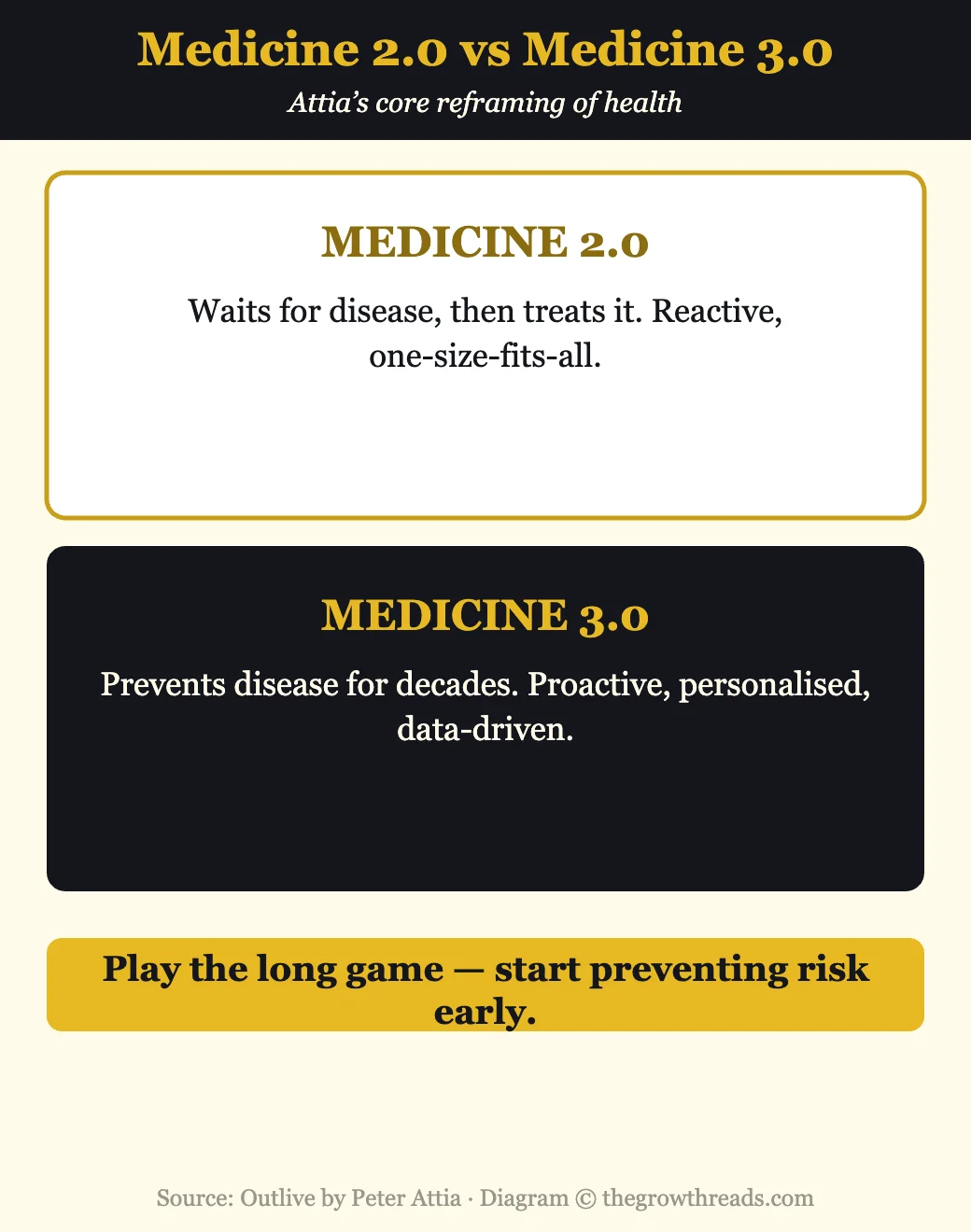
Medicine 2.0 — today’s default — is reactive. It waits for a disease to become diagnosable and then intervenes, which works well for acute problems like infections and injuries but poorly for the slow chronic diseases that build silently over decades. By the time these are detectable, much of the damage is done. Medicine 3.0, as Attia describes it, is proactive, personalized, and prevention-first: it treats risk factors long before disease appears, uses richer data about the individual, and plays a long game measured in decades. The mindset is to picture your “marginal decade” — your final ten years — and to work backward from the person you want to be then, making choices in your 30s, 40s, and 50s that stack the odds in your favor.
Part 2: The Four Horsemen and the metabolic root
Attia argues that if you want to live longer and better, you should understand what actually kills most people: not accidents, but a handful of chronic diseases he calls the Four Horsemen.
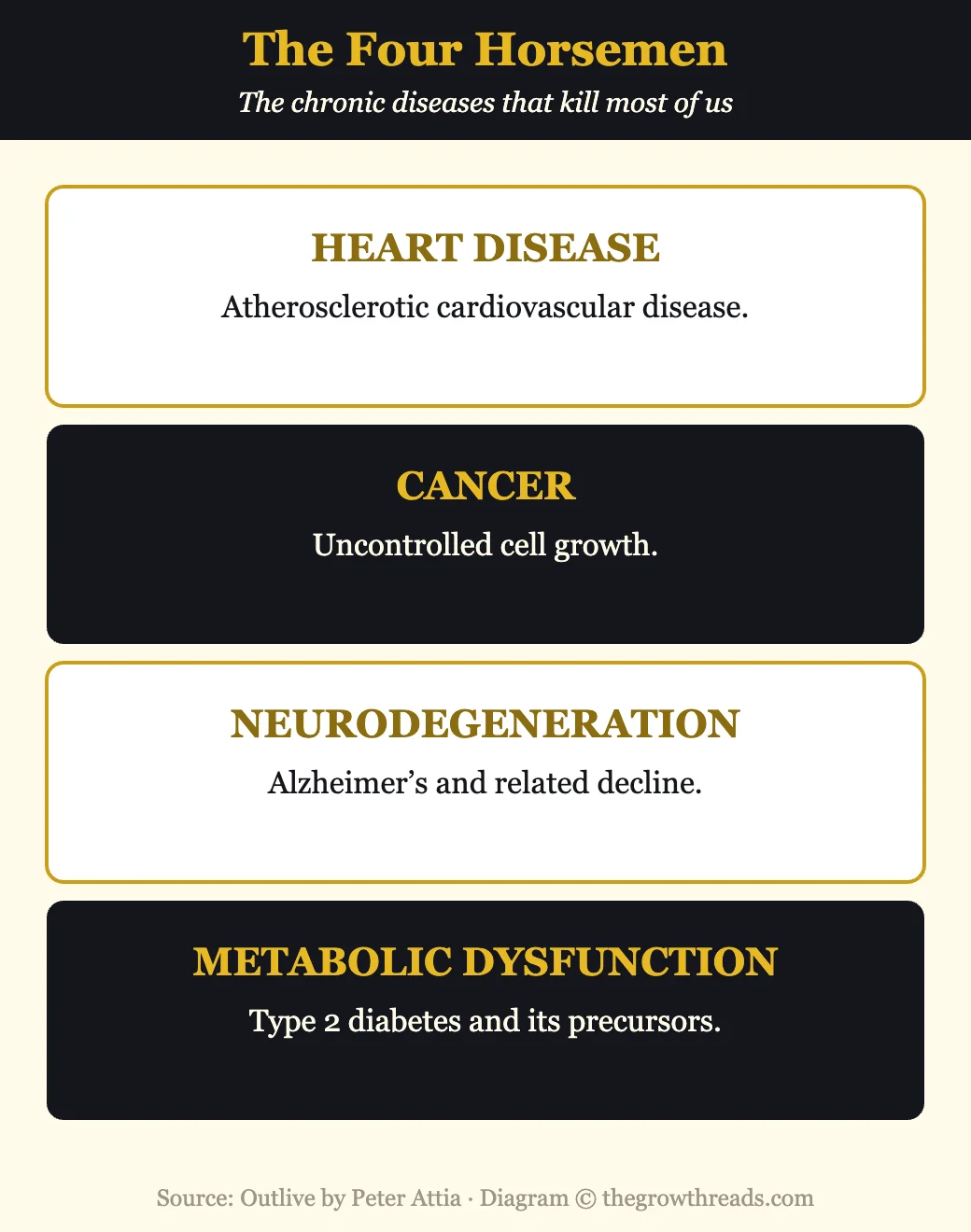
They are atherosclerotic cardiovascular disease (heart disease and stroke), cancer, neurodegenerative disease (such as Alzheimer’s), and metabolic dysfunction (type 2 diabetes and its precursors). His crucial insight is that these are not four unrelated problems but a web with common roots — above all, poor metabolic health and insulin resistance, which quietly increase the risk of all of them. This is why he treats metabolic health as foundational, and why he pushes prevention so far upstream: for heart disease, for instance, he argues you should start managing risk factors like ApoB (a marker of cholesterol-carrying particles) early, rather than waiting for a heart attack to reveal the problem. The unifying message is that the Four Horsemen advance slowly and silently for decades, which is both the danger — you feel fine while risk accumulates — and the opportunity, because that long runway is exactly what makes prevention so powerful.
TGR Note: Attia’s emphasis on sleep as a pillar of metabolic and brain health is the applied companion to Matthew Walker’s Why We Sleep, which lays out the science of why sleep protects against exactly the diseases Attia targets. Read together, they make an overwhelming case that protecting your sleep is one of the highest-leverage longevity moves available.
Part 3: Exercise — the most powerful longevity drug
If the book has one headline intervention, it is exercise. Attia states flatly that exercise is the single most potent tool we have for extending both lifespan and healthspan — no drug comes close. But he pushes past vague encouragement to a specific framework built on four pillars of fitness. The first is a strong aerobic base, trained through “zone 2” work — sustained, moderate effort at which your mitochondria efficiently burn fat, forming the metabolic foundation. The second is peak aerobic capacity, or VO2 max, the maximum rate at which your body can use oxygen, which is one of the strongest predictors of longevity and is trained through short, intense intervals. The third is strength, because muscle mass and the ability to generate force protect you from frailty and metabolic decline as you age. The fourth is stability — the often-neglected ability to control your body and avoid the falls and injuries that derail older people.
To make this concrete, Attia offers one of the book’s most useful ideas: the Centenarian Decathlon. Rather than training abstractly, you decide on the specific physical tasks you want to be able to do in your final decade — lift a grandchild, hike a favorite trail, get up off the floor unassisted, carry your own groceries — and then “backcast,” training now for the far harder version of those tasks, because physical capacity declines with age. If you want to be able to do something at 85, you need a large reserve built decades earlier. It turns a vague wish for health into a concrete, motivating training plan.
TGR Note: Knowing exercise is the master longevity lever is one thing; actually training four pillars for decades is a habit problem, which is where Atomic Habits earns its place beside Outlive. Attia gives you the what and why of longevity training; James Clear’s cue-craving-response-reward system is how you make the zone-2 sessions and strength work stick long enough to matter.
Part 4: Nutrition, sleep, and the emotional pillar
On nutrition, Attia is refreshingly undogmatic: he argues there is no single perfect diet, and that the endless diet wars miss the point. What matters is the outcome — your body composition, muscle mass, and metabolic markers — not the tribal label. In practice he emphasizes getting enough protein to preserve muscle, avoiding chronic caloric excess, and paying attention to how your body responds, using data rather than ideology. He treats nutrition as one lever among several rather than a magic bullet, and he groups the practical levers of longevity into a small, memorable set.
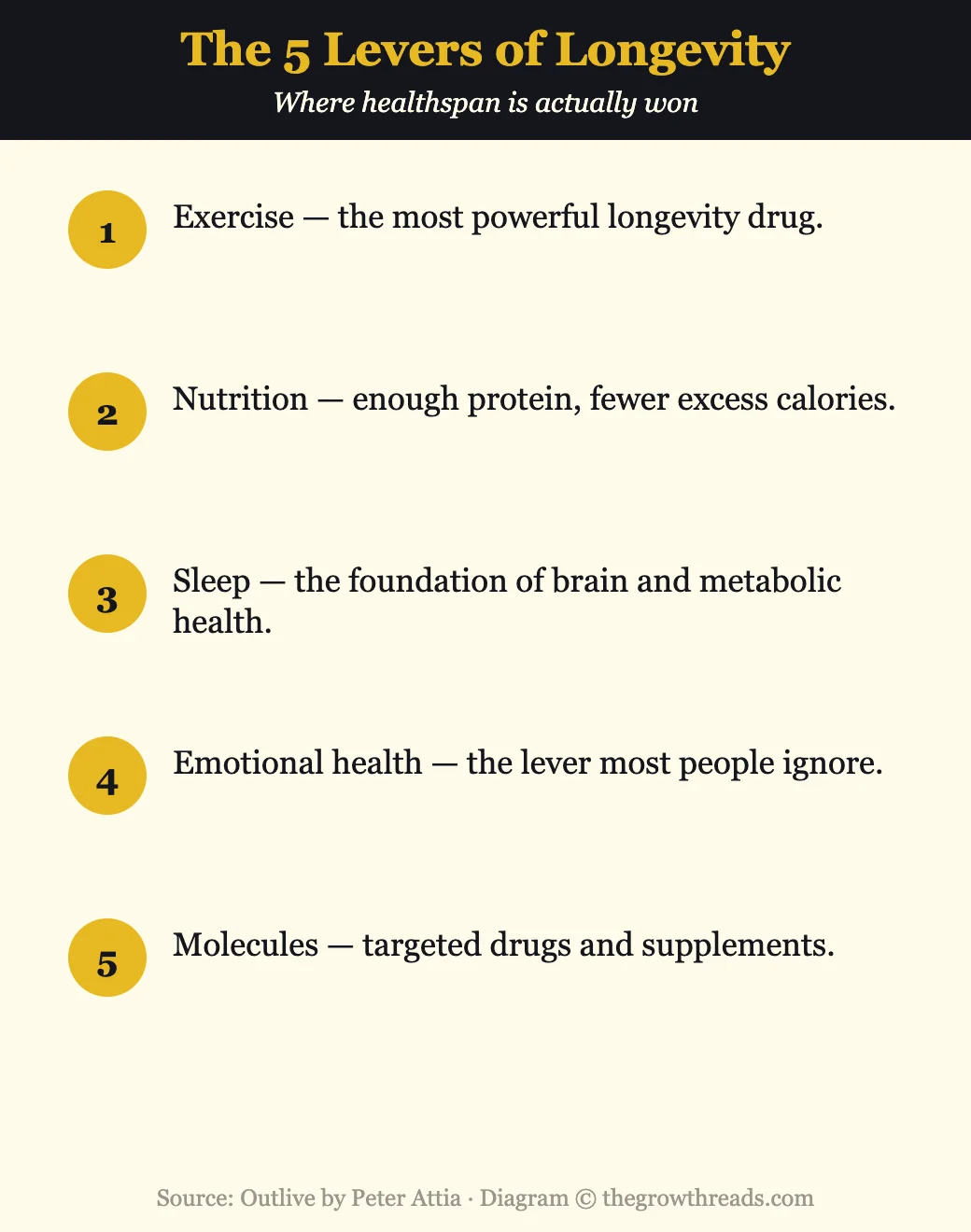
Sleep gets its own emphasis as a foundational pillar: poor sleep degrades metabolic health, cognition, and mood, undermining every other effort, so protecting it is non-negotiable. Attia also discusses “exogenous molecules” — drugs and supplements that may help at the margins — but frames them as secondary to the behavioral basics. The most surprising and moving part of the book is its final pillar: emotional health. Attia writes candidly about his own struggles and a period of intensive therapy, and concludes that a long life spent unhappy, angry, or disconnected is not the win he was chasing. Longevity, he argues, is meaningless without a life worth extending. That reframing — that healthspan includes emotional and relational health, not just the physical — is what elevates the book from a fitness manual to a genuine philosophy of living well for a long time.
A word of caution fitting the subject: Outlive is a framework and an education, not a personalized prescription. Attia repeatedly stresses individual variation and the limits of current evidence, and real decisions about testing, medication, or training should be made with your own doctor. Read as a way of thinking about long-term health, though, few books are as clarifying.
Who is Outlive best for — and who should read something else first?
This book is ideal for anyone in midlife who wants to take a serious, evidence-informed approach to aging well — and for younger readers who grasp that prevention started decades early pays the biggest dividends. It is not a quick, breezy read: parts are dense and technical, and readers who want simple rules rather than mechanisms may find it heavy. If you want the sleep science that underpins it in depth, read Why We Sleep; if you want a gentler, meaning-centered take on longevity, pair it with Ikigai.
Questions to reflect on
- Are you optimizing for lifespan or healthspan — and do your habits reflect that?
- What does your “Centenarian Decathlon” look like: what do you want to physically do in your final decade?
- Which of the Four Horsemen runs in your family, and are you managing its risk early enough?
- Of exercise, nutrition, sleep, and emotional health, which pillar are you most neglecting?
- What would it mean to treat your emotional health as seriously as your physical health?
🔥 Ready to invest in your healthspan?
This guide is the map — Attia’s depth and case studies are what make the framework actionable.
How to apply Outlive (7-day plan)
- Day 1 — Define your healthspan goal. Write what you want to physically and mentally be able to do at 85 — your Centenarian Decathlon.
- Day 2 — Add zone 2. Schedule a sustained, moderate cardio session you could hold a conversation through.
- Day 3 — Start strength. Do a basic strength session; muscle is your defense against frailty.
- Day 4 — Protect sleep. Set a consistent bedtime and a wind-down routine tonight.
- Day 5 — Audit protein. Estimate your protein intake and adjust toward preserving muscle.
- Day 6 — Know your numbers. Plan to discuss key risk markers (like ApoB and glucose) with your doctor.
- Day 7 — Tend the mind. Take one concrete step for your emotional health — a conversation, a boundary, or support.
Frequently asked questions
Is Outlive worth reading?
Yes, for most people serious about aging well. It is widely regarded as the definitive modern book on longevity, and it genuinely reframes how to think about health — around extending your healthspan and preventing chronic disease decades early rather than treating it late. The main caveat is depth: parts are technical and demanding, and it is longer than a typical health book. But for anyone willing to engage, the framework of Medicine 3.0, the Four Horsemen, and the exercise pillars is clarifying and actionable.
What is the main message of Outlive?
That the real goal is healthspan, not just lifespan — living better for longer, not merely longer. Peter Attia argues we should shift from reactive “Medicine 2.0” to proactive, personalized “Medicine 3.0,” preventing the chronic diseases that kill most people decades before they appear. The most powerful levers are exercise, nutrition, sleep, and emotional health, with exercise the single most potent of all.
What are the Four Horsemen in Outlive?
They are the four chronic diseases Attia says cause most deaths: atherosclerotic cardiovascular disease (heart disease and stroke), cancer, neurodegenerative disease such as Alzheimer’s, and metabolic dysfunction including type 2 diabetes. His key point is that these share common roots in poor metabolic health and insulin resistance, and that because they build silently over decades, prevention started early is far more effective than treatment started late.
Does Outlive give a specific exercise plan?
It gives a framework rather than a rigid program. Attia argues you should train four pillars of fitness: an aerobic base through zone 2 cardio, peak aerobic capacity (VO2 max) through intervals, strength through resistance training, and stability to prevent falls and injury. He recommends designing a “Centenarian Decathlon” — the physical tasks you want to do in your final decade — and training backward from them. The specifics are meant to be personalized, ideally with professional guidance.
Is Outlive medical advice?
No. Outlive is an educational framework and a way of thinking about long-term health, not a personalized prescription. Attia repeatedly emphasizes individual variation and the limits of current evidence, and real decisions about testing, medications, or training should be made with your own physician. It is best used to become a more informed, proactive partner in your own health rather than as a set of instructions to follow blindly.
How long does it take to read Outlive?
The book is around 480 pages and fairly dense, so most readers take about eleven hours or more, often spread over weeks because of the technical detail. Many treat it as a reference to revisit rather than a single sitting. Our summary above captures the core framework in roughly 17 minutes, which is a good way to grasp the big ideas before deciding how deeply to dive into the science.
Is Outlive good for beginners to health and fitness?
It is excellent for the mindset, but it can be demanding for total beginners. The concepts — Medicine 3.0, the Four Horsemen, the fitness pillars — are genuinely accessible and motivating, but the depth of the medical discussion may feel heavy if you just want simple starting rules. Beginners can take the big principles (exercise is paramount, protect sleep, prioritize strength and cardio, tend your emotional health) and layer in the detail over time.
Related summaries
- Why We Sleep Summary — the science behind Attia’s sleep pillar.
- Ikigai Summary — a gentler, meaning-centered view of long life.
- Atomic Habits Summary — the habit system to sustain longevity training.
- Browse all our best health books.
How we analyze books: We work from the full book — reconstructing its core arguments in our own words, adding commentary that connects it to related research and other books in our library, and pressure-testing the advice against how it plays out in real life. We never reproduce the text; we synthesize it. Read our full methodology.
Disclosure: The Growth Reads is reader-supported. When you buy through links on our site we may earn an affiliate commission at no extra cost to you. We only recommend books we believe are worth your time, and our summaries and opinions are written independently. This summary is for information only and is not medical advice.