

⭐⭐⭐⭐✬ 4.5/5 — A compelling, research-backed argument that modern comfort is making us physically weaker, mentally softer, and spiritually emptier.
Best for: Anyone feeling restless or numb in their daily routine, outdoor enthusiasts looking for scientific validation, and people who sense that “something is missing” despite having everything they need.
Reading time: ~6 hours (288 pages) | Difficulty to apply: Low to moderate — the suggestions range from taking a walk outside to spending days in the wilderness.
The Comfort Crisis in one minute
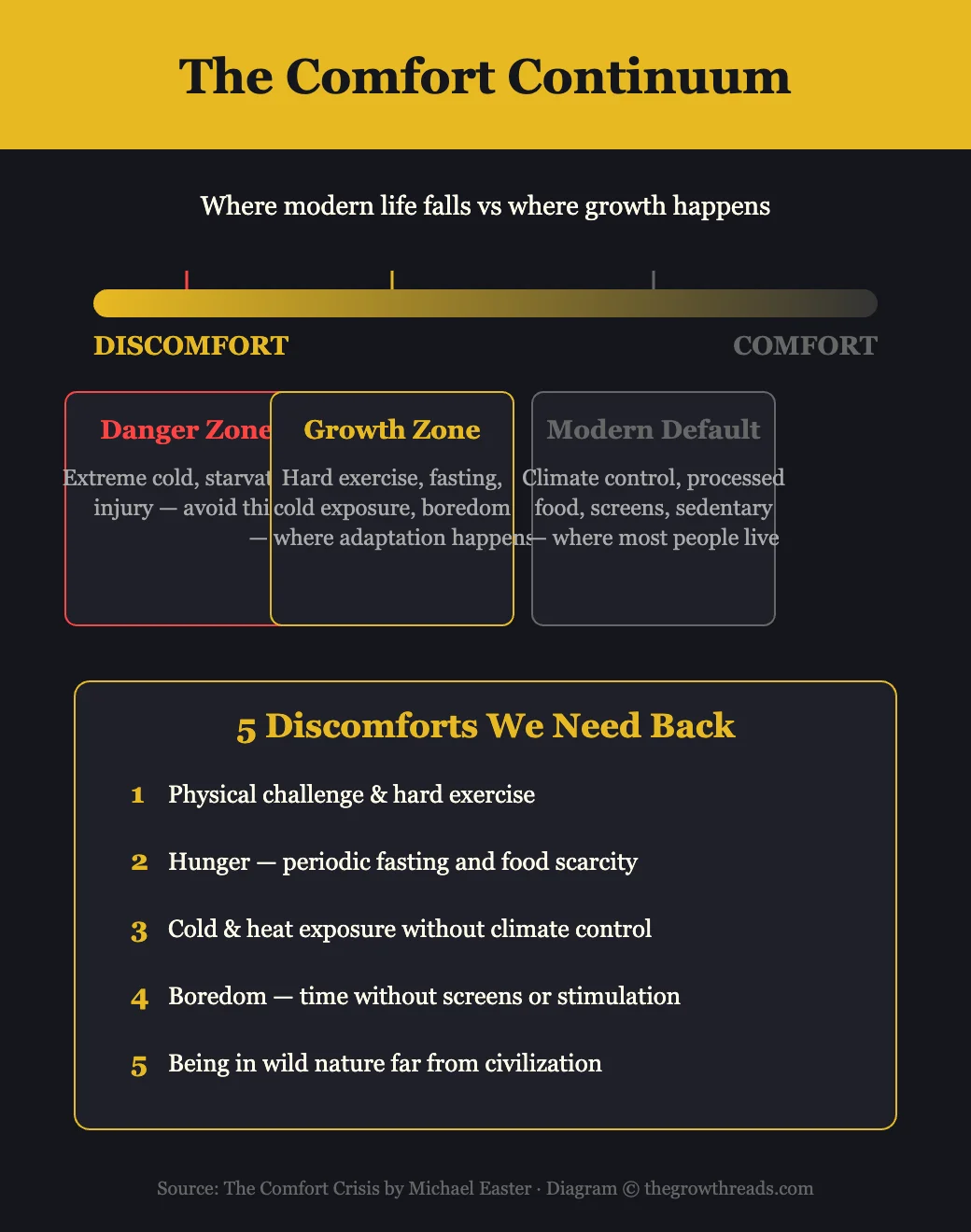
We’ve engineered discomfort out of our lives — and it’s slowly destroying us. Michael Easter, a health and fitness journalist and professor at UNLV, spent a month in the Alaskan backcountry hunting caribou to understand what happens when you strip away every modern convenience. Along the way, he weaves together evolutionary biology, psychology, and cutting-edge research to argue that our bodies and minds were built for challenges we no longer face: hunger, cold, physical exertion, boredom, and exposure to wild nature. The removal of these stressors hasn’t made us happier — it’s driven epidemics of anxiety, obesity, chronic disease, and existential restlessness. The prescription isn’t to abandon modern life, but to strategically reintroduce discomfort: carry heavy things, spend time in nature using the 20-5-3 rule, embrace boredom, fast occasionally, and complete one annual challenge (a “Misogi”) that pushes you to the edge of your capability.
Key takeaways
- Comfort is the new crisis: for the first time in human history, most of our suffering comes from having too much, not too little — too much food, too much temperature control, too much stimulation, too much sitting.
- We evolved for discomfort: our physiology was shaped by two million years of scarcity, cold, heat, and physical struggle — removing those stressors doesn’t eliminate the need for them, it creates new problems.
- The 20-5-3 rule for nature exposure: spend 20 minutes daily in any green space, 5 hours monthly in semi-wild nature, and 3 days yearly in true wilderness — each tier provides distinct and cumulative health benefits.
- Rucking is the ideal modern exercise: carrying weight while walking (rucking) burns significantly more calories than walking alone, strengthens the entire body, and is accessible to almost everyone.
- Boredom is a feature, not a bug: our constant stimulation addiction (phones, podcasts, music during every activity) prevents the default mode network from activating — the brain state responsible for creativity, self-reflection, and problem-solving.
- Hunger has benefits: periodic fasting triggers cellular repair processes (autophagy), improves insulin sensitivity, and reconnects us with a relationship to food that extends beyond constant snacking.
- The Misogi: one annual physical challenge with a roughly 50% chance of failure that resets your sense of what’s possible and recalibrates your comfort threshold for the rest of the year.
- Death awareness improves life: cultures that openly discuss mortality tend to live with more intentionality — confronting your own finitude clarifies what actually matters.
- Counting is the unrecognized epidemic: our obsession with tracking and quantifying every aspect of health and fitness (steps, calories, heart rate) often undermines the benefits of simply doing the activity.
- Wild spaces change your brain: time in true wilderness shifts brain activity, reduces rumination, and produces lasting improvements in mood and cognitive function that persist for weeks after returning.
What is The Comfort Crisis about?
The Comfort Crisis argues that modern conveniences — climate control, processed food, sedentary lifestyles, and constant digital stimulation — have removed the physical and mental challenges humans evolved to need. Easter combines personal narrative, evolutionary science, and field research to show that strategically reintroducing discomfort through exercise, nature exposure, fasting, boredom, and physical challenges can reverse chronic disease, improve mental health, and restore a sense of meaning.
About the author
Michael Easter is a contributing editor at Men’s Health and a professor at the University of Nevada, Las Vegas, where he teaches courses on media and health communication. His journalism career took a personal turn when he used outdoor adventure as part of his recovery from alcohol addiction — an experience that sparked his interest in the relationship between discomfort and human flourishing. Easter has reported from some of the most remote places on Earth, including the Alaskan Arctic, the jungles of Bhutan, and the deserts of the American Southwest. His writing has also appeared in Esquire, Vice, and Outside magazine. The Comfort Crisis, his first book, became a bestseller and has been widely adopted by military, athletic, and corporate organizations seeking to build resilience. Explore all Michael Easter book summaries →
Key concepts at a glance
| Concept | What it means | Use it when |
|---|---|---|
| The Comfort Crisis | The paradox that removing all discomfort creates new forms of suffering — obesity, anxiety, purposelessness | You sense that comfort is making you weaker, not happier |
| 20-5-3 Rule | Weekly nature prescription: 20 min daily in green space, 5 hrs monthly in semi-wild, 3 days yearly in wilderness | Building a sustainable nature habit for health |
| Misogi | One annual physical challenge with ~50% failure rate that resets your sense of what’s possible | You’ve become too comfortable and need a reset |
| Rucking | Walking with a weighted pack — burns 2-3x more calories than regular walking with low injury risk | You want a simple, effective, accessible exercise |
| Boredom Deficit | Constant stimulation prevents the brain’s default mode network from activating, killing creativity and self-reflection | You can’t sit without reaching for your phone |
| Evolutionary Mismatch | Our ancient biology clashing with our modern environment — designed for scarcity, living in abundance | Understanding why healthy behavior feels so unnatural |
| Death Awareness | Cultures that openly discuss mortality live with more purpose and less anxiety about minor stressors | You want to clarify what actually matters in your life |
Part 1: The problem with comfort — evolutionary mismatch and modern disease
Easter opens the book in the Arctic National Wildlife Refuge, where he’s arrived for a 33-day backcountry caribou hunt with a veteran guide. The contrast between this environment — freezing temperatures, no shelter, hauling heavy packs across trackless tundra — and his normal life in Las Vegas sets up the book’s central tension. He’s physically suffering, yet he feels more alive than he has in years.
The scientific framework follows quickly. Easter draws on evolutionary biology to explain the mismatch between our ancient hardware and modern software. For roughly two million years, humans faced constant physical challenges: walking 6 to 16 miles daily, carrying heavy loads, enduring temperature extremes, going through periods without food, and spending virtually all their time outdoors. Our physiology adapted to these stressors — we need them the way a muscle needs resistance to grow. Remove the stressors, and the system atrophies.
He cites research from the University of Virginia showing that modern Americans spend 95% of their time indoors. The average person sits for 13 hours a day and sleeps for 8, leaving just 3 hours of any movement at all. Meanwhile, our food environment has been engineered for hyperconsumption: the average American now eats 3,600 calories per day, up from 2,100 in the 1970s, with most of the increase coming from ultra-processed foods designed to override satiety signals. The result is a population that is simultaneously overfed and undernourished, overprotected and underresilient.
Part 2: Rucking, carrying, and the power of physical challenge
One of Easter’s most practical contributions is his advocacy for rucking — walking with a weighted backpack. He traces the practice from military training (where it’s been a staple for centuries) to a growing civilian fitness movement, and presents the research: rucking burns two to three times more calories than walking at the same pace, strengthens the posterior chain (back, glutes, hamstrings), improves posture, and has a dramatically lower injury rate than running.
The deeper point is about carrying as a fundamental human movement pattern. For most of human history, carrying heavy loads was a daily reality — food from a hunt, water from a river, firewood to camp, children on your back. Our bodies are literally designed for it, with musculoskeletal features (long Achilles tendons, wide shoulders, upright posture) that optimize load-bearing locomotion. Modern life has eliminated virtually all carrying from daily life, and the musculoskeletal consequences — weak backs, poor posture, fragile bones — follow predictably.
Easter also explores what he calls “gear creep” — the fitness industry’s tendency to make exercise ever more comfortable and equipment-dependent. He argues that the most effective exercise is often the simplest: walk more, carry heavy things, and occasionally push yourself to the point of genuine physical discomfort. The elaborate gym routines, tracking devices, and optimization protocols are often solutions to problems that wouldn’t exist if we simply moved more like our ancestors did.
Part 3: Nature, boredom, and the 20-5-3 rule
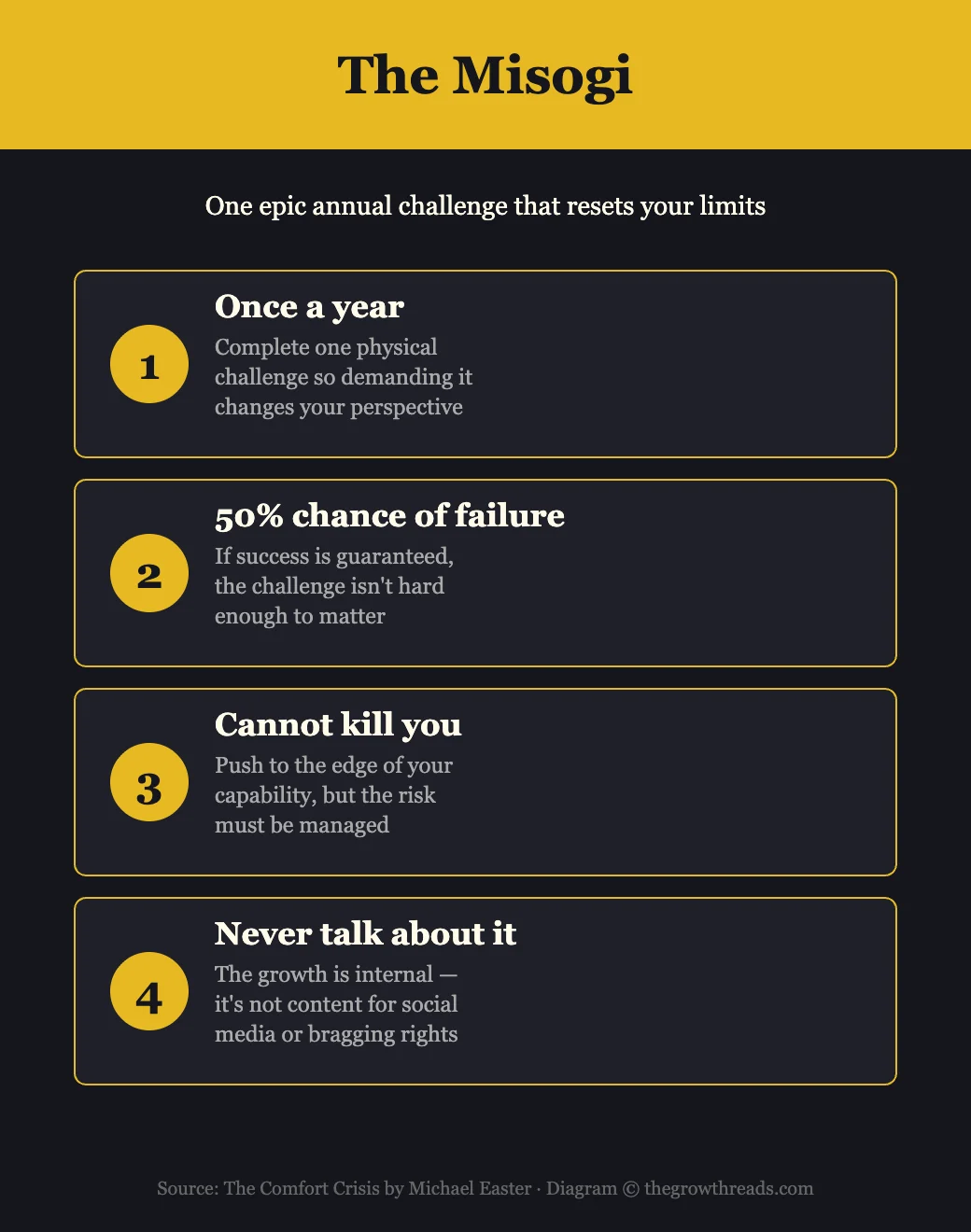
Perhaps the book’s most actionable framework is the 20-5-3 rule for nature exposure, which Easter builds from three separate bodies of research. The “20” comes from a University of Michigan study showing that just 20 minutes in any natural setting (even an urban park) reduces cortisol levels by 20% and lowers blood pressure and heart rate. The “5” comes from Finnish research on forest bathing demonstrating that five hours per month in semi-wild nature (forests, trails, lakes) produces significant improvements in mood, creativity, and immune function — including a 50% increase in natural killer cell activity that persists for up to a month. The “3” comes from wilderness psychology research showing that three days in true backcountry (no cell service, no built environment) produces measurable shifts in brain wave patterns, with participants showing increased alpha wave activity (associated with calm alertness) and decreased rumination for weeks afterward.
Easter’s treatment of boredom is equally compelling. He argues that our addiction to constant stimulation — checking phones 96 times per day, filling every moment with podcasts, music, or social media — has effectively disabled the brain’s default mode network (DMN). The DMN activates during periods of unstimulated mind-wandering and is responsible for creativity, long-term planning, self-reflection, and the integration of disparate ideas. Every time you fill a moment of boredom with your phone, you abort a cognitive process that takes minutes to fully engage. The solution isn’t to ban technology but to create deliberate periods of unstimulated time: walks without earbuds, meals without screens, commutes in silence.
Part 4: Hunger, mortality, and the meaning of enough
Easter devotes a fascinating section to hunger — not chronic food insecurity, but the periodic absence of food that characterized virtually all of human evolution. He covers the science of fasting, including the activation of autophagy (cellular recycling), improved insulin sensitivity, and the cognitive clarity that many fasters report. But his deeper point is cultural: we’ve pathologized hunger. The sensation of an empty stomach, which for most of human history was a normal and frequent experience, now triggers alarm. We eat not because we’re hungry but because food is available, a clock says it’s mealtime, or we’re seeking comfort.
The final section on death awareness may be the book’s most philosophically ambitious. Easter visits Bhutan, where death is considered five times daily as a cultural practice, and interviews researchers who study the psychology of mortality salience. The findings are consistent: people who regularly contemplate their own death report higher life satisfaction, make more intentional decisions, and experience less anxiety about trivial daily stressors. The mechanism isn’t morbidity — it’s clarity. When you remember that your time is finite, the question “is this worth my limited days?” becomes a powerful filter.
Easter closes by returning to the Arctic, where his caribou hunt has forced him to be cold, hungry, exhausted, bored, and far from any safety net for 33 days. He’s lost weight, his phone has been dead for weeks, and he hasn’t spoken to anyone outside his small group. Yet he describes the experience as one of the most meaningful of his life — not despite the discomfort, but because of it. The comfort crisis, he concludes, isn’t about rejecting modernity. It’s about recognizing that the human organism needs challenge the way it needs oxygen, and deliberately building discomfort back into a life that has optimized it away.
Who is The Comfort Crisis best for — and who should read something else first?
This book is ideal for desk-bound professionals who feel physically stagnant and emotionally numb, outdoor enthusiasts looking for scientific validation of what they intuitively feel in nature, anyone curious about the FIRE-for-the-body concept (minimizing physical comfort to maximize physical resilience), and readers who enjoy narrative nonfiction that blends adventure writing with health science. It’s also a strong recommendation for parents wondering how to raise resilient kids in an age of overprotection.
If you want a deeper dive into the exercise science Easter references, Exercised by Daniel Lieberman is more rigorous. If your primary interest is the mental health angle (dopamine, addiction, overstimulation), Dopamine Nation by Anna Lembke goes deeper on the neuroscience. And if you want the longevity framework that connects many of Easter’s individual findings, Outlive by Peter Attia is the comprehensive medical perspective.
Questions to reflect on
- When was the last time you were genuinely, uncomfortably cold, hungry, or physically exhausted — and what did it feel like afterward?
- How many minutes today did you spend outside? How does that compare to the 20-5-3 rule’s minimum of 20 minutes in green space?
- Can you go for a 30-minute walk without earbuds, music, or a podcast? What comes up when you let your mind wander with nothing to fill the silence?
- What would your personal Misogi be — a physical challenge with a genuine 50% chance of failure that would reset your sense of what’s possible?
- If you truly believed you had a finite number of days left, which of your current daily habits would you keep — and which would you drop immediately?
🔥 Ready to reclaim the discomfort your body was built for?
Get the science-backed guide to becoming wilder, harder, and more alive.
How to apply The Comfort Crisis (7-day plan)
- Day 1 — Take a 20-minute outdoor walk with no phone: Leave your earbuds at home. Walk in the nearest green space and let your mind wander. Notice what thoughts and feelings emerge when there’s nothing to fill the silence.
- Day 2 — Try rucking: Put 20 pounds in a backpack (books, water bottles, anything heavy) and walk for 30 minutes. Focus on posture — shoulders back, core engaged. Notice how different it feels from a normal walk.
- Day 3 — Skip a meal intentionally: Fast through breakfast or lunch (whichever feels more challenging). Drink water and observe the sensation of hunger without reacting to it. Notice how your energy and focus shift.
- Day 4 — Take a cold shower: End your shower with 60 seconds of cold water. Start warm and switch to as cold as it goes. Breathe through it. The discomfort is temporary; the alertness and mood boost last for hours.
- Day 5 — Go phone-free for 3 hours: Choose a 3-hour block and put your phone in another room. No social media, no news, no texting. Do something with your hands, cook a meal, or sit outside and do nothing.
- Day 6 — Plan your 20-5-3 nature schedule: Identify your daily 20-minute green space, plan a 5-hour nature outing for this month (a long hike, a day at a lake), and research a 3-day wilderness trip for this year.
- Day 7 — Define your Misogi: Brainstorm one physical challenge you could attempt this year that has a genuine 50% chance of failure. Write it down. Tell no one. Start training.
Frequently asked questions
What is the comfort crisis?
The comfort crisis is Michael Easter’s term for the paradox of modern life: by engineering virtually all physical discomfort out of our daily existence — through climate control, processed food, sedentary work, and constant digital stimulation — we’ve created new forms of suffering. Our bodies evolved over two million years to need physical challenge, periodic hunger, temperature variation, and wild nature. Removing these stressors doesn’t eliminate the need for them; it creates epidemics of obesity, anxiety, chronic disease, and a pervasive sense that something is missing despite having material abundance.
What is the 20-5-3 rule?
The 20-5-3 rule is Easter’s nature prescription, synthesized from three research streams. Spend 20 minutes daily in any green space (even an urban park) to reduce cortisol and blood pressure. Spend 5 hours monthly in semi-wild nature (forests, trails, lakes) to boost immune function, creativity, and mood. Spend 3 days yearly in true wilderness (remote backcountry, no cell service) to produce lasting shifts in brain activity and stress response. Each tier provides distinct physiological benefits, and the effects are cumulative — you can’t replace wilderness time with extra park visits.
What is a Misogi?
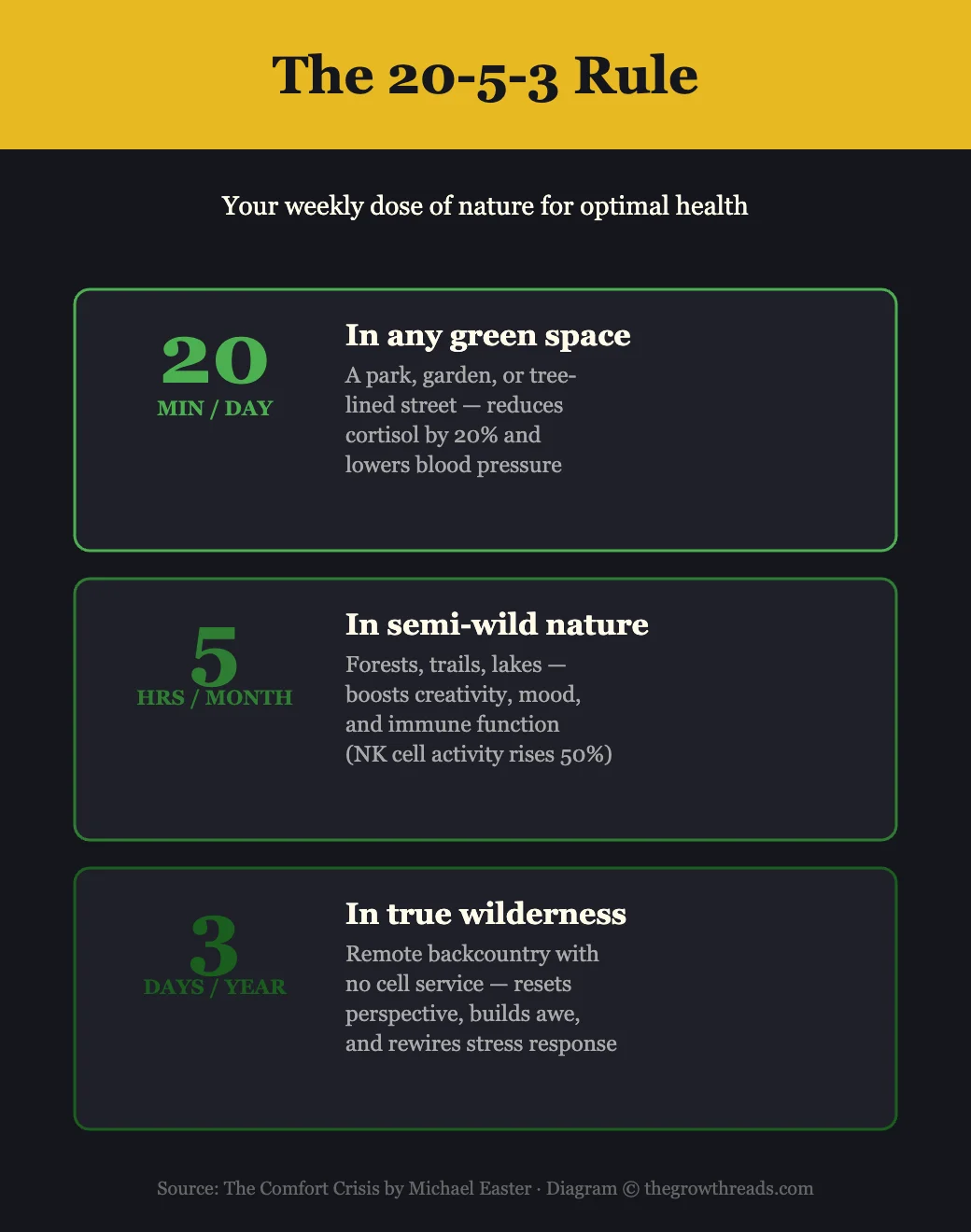
A Misogi is an annual physical challenge with four rules: do it once a year, it must have roughly a 50% chance of failure, it cannot kill you, and you never talk about it publicly. The concept comes from Marcus Elliott, a sports scientist who works with professional athletes. Examples include swimming across a large body of water, completing an ultramarathon, or hauling an 80-pound stone 25 miles through the desert. The purpose isn’t athletic achievement — it’s resetting your internal sense of what’s possible and recalibrating your comfort threshold for the entire year that follows.
What is rucking and why does Easter recommend it?
Rucking is walking with a weighted backpack, typically 20 to 50 pounds. Easter recommends it because it burns two to three times more calories than walking at the same pace, strengthens the posterior chain (back, glutes, hamstrings, calves), improves posture, and has a dramatically lower injury rate than running. It’s also how humans evolved to move — carrying loads over distance was a daily survival activity for millions of years. Easter argues that it’s the single most underrated exercise: simple, accessible, requires no gym, and scales from beginner to elite by adjusting weight and distance.
Does Easter recommend extreme lifestyle changes?
No — this is one of the book’s strengths. Easter explicitly argues against abandoning modern life or pursuing extreme discomfort. His prescriptions are moderate and accessible: 20-minute daily walks outside, periodic fasting (not chronic caloric restriction), cold shower finishes (not ice baths), phone-free hours (not digital abstinence), and one annual challenge (not weekly sufferfests). The goal is to strategically reintroduce the types of discomfort our bodies evolved to need, at doses that produce adaptation without injury or burnout. He’s prescribing the minimum effective dose, not the maximum tolerable one.
How does The Comfort Crisis compare to Outlive?
Both books argue that modern lifestyles are shortening our healthspans, but they approach the problem differently. Peter Attia’s Outlive is a clinical, data-heavy medical guide to longevity focused on the four major diseases of aging and the specific exercise, nutrition, and screening protocols to prevent them. Easter’s book is a narrative-driven exploration of the broader comfort-discomfort spectrum, with more emphasis on the psychological and spiritual dimensions — boredom, nature, mortality awareness, meaning. Outlive tells you what to do in the gym and the doctor’s office; The Comfort Crisis tells you why you feel restless despite doing everything right.
Is The Comfort Crisis based on real science?
Yes — Easter interviews and cites researchers from Harvard, Stanford, the University of Michigan, Finnish forestry institutes, and military performance labs, among others. The studies he references on nature exposure, fasting, exercise physiology, and boredom are published in peer-reviewed journals. That said, the book is written as narrative nonfiction, not a scientific text — Easter synthesizes research through the lens of his personal Arctic experience, which makes it engaging but means some findings are presented with more certainty than the underlying evidence strictly supports. The overall direction of the evidence, however, is robust and consistent across multiple fields.
Related summaries
- Exercised Summary — Daniel Lieberman’s evolutionary biology of why we’re designed to move.
- Dopamine Nation Summary — Anna Lembke on the neuroscience of overstimulation and the case for deliberate deprivation.
- Outlive Summary — Peter Attia’s comprehensive medical framework for longevity.
- Best Health Books — Our full ranked list of the most impactful health and wellness reads.