

⭐⭐⭐⭐⭐ 4.4 / 5 — The definitive case that exercise is the single most powerful tool for brain health — backed by neuroscience, not gym-bro motivation.
Best for: Anyone dealing with stress, anxiety, depression, ADHD, or cognitive decline — or anyone who wants a science-based reason to move their body daily.
Reading time: ~6 hours (this guide: 14 min)
Difficulty to apply: Low — you already know how to move; this book gives you the neuroscience reason to actually do it consistently.
Spark in one minute
Exercise is not just good for your body — it is the single most powerful thing you can do for your brain. Harvard psychiatrist John Ratey presents overwhelming evidence that aerobic exercise triggers a cascade of neurochemical changes that improve learning, reduce anxiety, combat depression, sharpen focus, slow aging, and even treat addiction — often as effectively as medication. The key molecule is BDNF (brain-derived neurotrophic factor), which Ratey calls “Miracle-Gro for the brain” because it promotes the growth of new neurons and strengthens existing neural connections. The book’s most powerful example: a school district in Naperville, Illinois, that made vigorous exercise the first class of every day and went from average to near the top of international science and math rankings. Ratey’s prescription is clear: 30-45 minutes of vigorous cardiovascular exercise, five to six days per week, is the optimal dose for brain health — and no pill can replicate what movement does for your mind.
Key takeaways
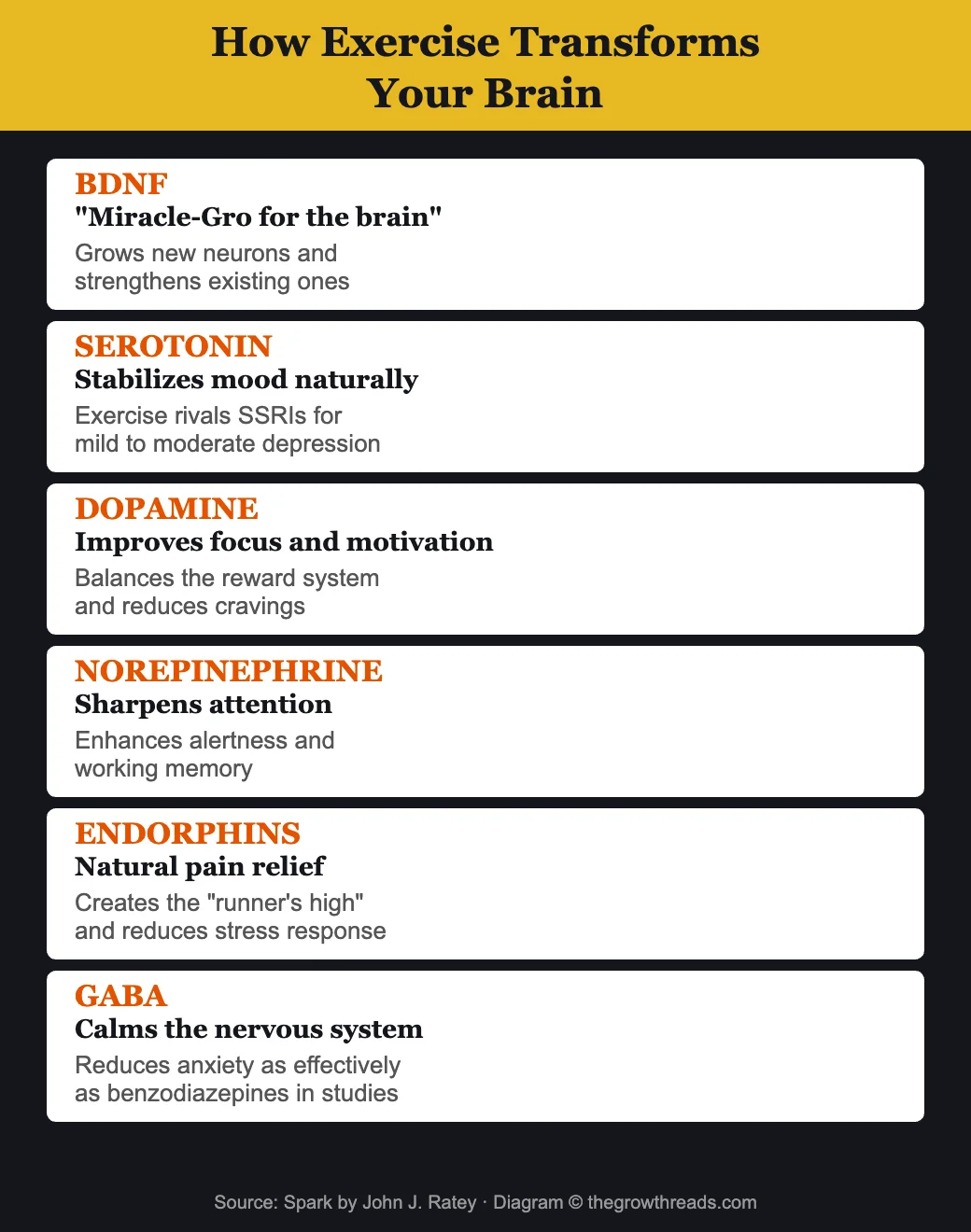
- BDNF is “Miracle-Gro for the brain”: Exercise triggers the release of brain-derived neurotrophic factor, which grows new neurons and strengthens synaptic connections — literally making your brain bigger and more capable.
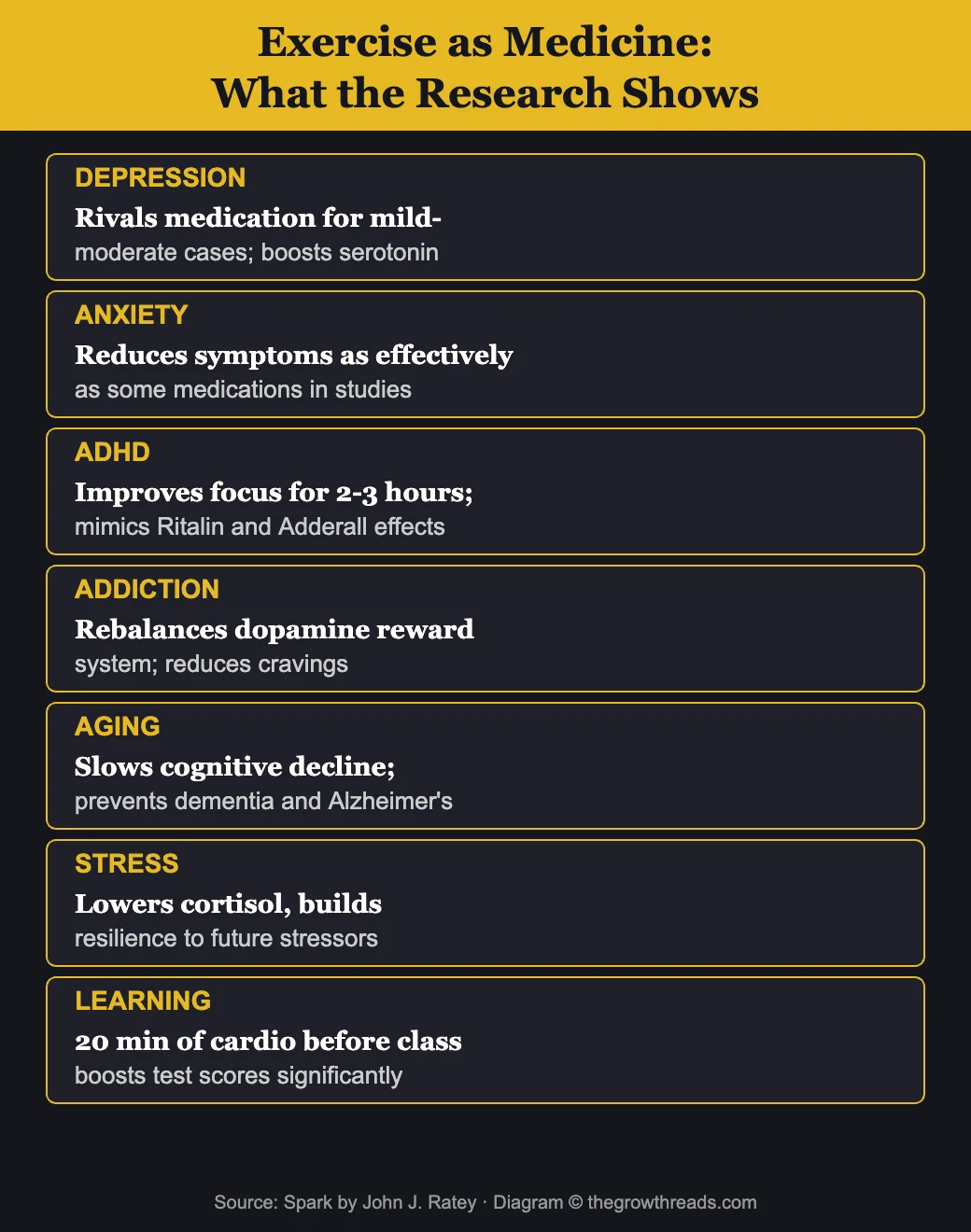
- Exercise rivals antidepressants: For mild to moderate depression, regular aerobic exercise has been shown to be as effective as SSRIs — without the side effects and with dozens of additional health benefits.
- Anxiety responds to movement: Exercise lowers baseline anxiety levels by regulating the stress response, burning off cortisol, and increasing calming neurotransmitters like GABA and serotonin.
- ADHD is treatable with exercise: A single bout of cardio improves focus and executive function for 2-3 hours, mimicking the effects of medications like Ritalin by increasing dopamine and norepinephrine.
- Exercise is the best brain aging defense: Regular aerobic exercise reduces the risk of dementia by 60% in some studies and slows cognitive decline more effectively than any known intervention.
- The Naperville experiment proved it works: When a school district made vigorous exercise the first class of the day, students went from average to ranking 1st in the world in science and 6th in math.
- Complex movement adds extra benefit: Activities that challenge coordination and learning (martial arts, dance, rock climbing) build additional neural connections beyond what simple cardio provides.
- Timing matters for learning: Exercise immediately before learning maximizes BDNF levels and primes the brain for memory formation. The 2-hour window after exercise is the optimal learning period.
- Intensity matters: Moderate exercise improves mood; vigorous exercise (75-90% max heart rate) maximizes BDNF production and neuroplasticity.
- Consistency beats intensity: Daily moderate exercise produces better brain results than occasional intense workouts. The brain benefits compound with regular practice.
What is Spark about?
Spark presents the neuroscience of exercise, showing how physical activity fundamentally transforms brain chemistry, structure, and function. John Ratey reviews research on exercise’s effects on learning, stress, anxiety, depression, ADHD, addiction, hormonal health, and aging, making the case that movement is the most underutilized tool in mental health and cognitive performance.
About the author
John J. Ratey, MD, is a clinical associate professor of psychiatry at Harvard Medical School and an internationally recognized expert in neuropsychiatry. He has published over 60 peer-reviewed articles and eight books on the connection between the brain, behavior, and exercise. Before Spark, he co-authored Driven to Distraction, one of the most influential books on ADHD. Ratey runs a private psychiatric practice in Cambridge, Massachusetts, and speaks regularly at medical conferences, schools, and corporate events about exercise as medicine. His advocacy for movement-based mental health interventions has influenced school programs, workplace wellness initiatives, and clinical treatment protocols across the United States and internationally. Explore all John J. Ratey book summaries →
Key concepts at a glance
| Concept | What it means | Use it when |
|---|---|---|
| BDNF | “Miracle-Gro for the brain” — a protein that grows and strengthens neurons | You want to understand why exercise improves cognition |
| Naperville Model | School district that used morning exercise to dramatically improve academic results | You want proof that exercise enhances learning |
| Exercise as Antidepressant | Regular cardio rivals SSRIs for mild-moderate depression | You or someone you know struggles with depression |
| The ADHD Workout | Cardio boosts dopamine and norepinephrine, mimicking stimulant medications | You need focus without (or in addition to) medication |
| Neuroplasticity | The brain’s ability to grow, adapt, and form new connections throughout life | You believe your brain is “fixed” and can’t improve |
| Complex Movement | Activities requiring coordination (dance, martial arts) build extra neural pathways | You want maximum brain benefit from your workouts |
Part 1: The Naperville revolution — exercise and learning
Ratey opens with the most compelling case study in the book: Naperville Central High School in Illinois. The district implemented a program called Zero Hour PE — a vigorous exercise class held before the first academic period. Students ran, played active games, and worked out at 80-90% of their maximum heart rate. The results were staggering: Naperville students scored first in the world in science and sixth in math on the TIMSS (Trends in International Mathematics and Science Study) assessment — competing against countries like Singapore, Japan, and South Korea.
The neuroscience behind this result is BDNF, brain-derived neurotrophic factor. Ratey calls BDNF “Miracle-Gro for the brain” because it stimulates neurogenesis (the growth of new brain cells) in the hippocampus — the brain region responsible for learning and memory. Exercise triggers a surge of BDNF that peaks immediately after vigorous activity and remains elevated for hours. Students who exercised before class were literally growing new neurons and priming existing ones for learning during the most cognitively demanding part of their day.
Beyond BDNF, exercise increases cerebral blood flow (delivering more oxygen and glucose to brain cells), triggers the release of neurotransmitters that improve mood and focus (serotonin, dopamine, norepinephrine), and strengthens the synaptic connections between neurons. The combined effect is a brain that learns faster, retains more, and processes information more efficiently.
Part 2: Exercise as medicine — stress, anxiety, and depression
The heart of the book examines exercise as treatment for specific mental health conditions. For stress, Ratey explains how exercise metabolizes cortisol and adrenaline while building resilience to future stressors. People who exercise regularly don’t experience less stress — they recover from it faster because their stress response system is better regulated.
For anxiety, the evidence is particularly strong. Exercise increases GABA, the brain’s primary calming neurotransmitter — the same target as anti-anxiety medications like benzodiazepines, but without the addiction risk or side effects. Ratey cites studies showing that regular aerobic exercise reduces anxiety sensitivity (the fear of anxiety symptoms themselves) as effectively as cognitive behavioral therapy in some populations.
For depression, Ratey presents the landmark Duke University study that compared exercise to the antidepressant Zoloft. After four months, the exercise group had the same improvement rates as the medication group. But at ten months, the exercise group had significantly lower relapse rates — just 8% compared to 38% for the medication-only group. The implication: exercise doesn’t just treat depression; it may prevent its return more effectively than medication alone.
Part 3: ADHD, addiction, and hormonal health
Ratey devotes a chapter to ADHD that is particularly compelling given his expertise as co-author of Driven to Distraction. He explains that ADHD is fundamentally a problem of dopamine and norepinephrine regulation in the prefrontal cortex — and that exercise increases both neurotransmitters in exactly the same brain regions targeted by stimulant medications like Ritalin and Adderall.
A single bout of moderate-to-vigorous cardio improves ADHD symptoms (focus, impulse control, working memory) for approximately 2-3 hours. For children, this means exercising before school can dramatically improve classroom performance. For adults, exercising before work provides a natural focus boost that reduces the need for stimulant medications (though Ratey is careful to note that exercise should complement medication, not replace it, for severe cases).
The addiction chapter presents exercise as a way to rebalance the brain’s dopamine reward system, which is hijacked by substances and addictive behaviors. Regular exercise naturally increases baseline dopamine levels, reducing the neurological craving for artificial spikes. Studies with substance abuse treatment programs show that adding exercise significantly reduces relapse rates across all substance types.
Part 4: Aging, the brain, and the exercise prescription
The aging chapter presents perhaps the most urgent case for exercise. Ratey cites studies showing that regular aerobic exercise reduces the risk of Alzheimer’s disease by up to 60%, increases hippocampal volume (which typically shrinks with age), and maintains cognitive function decades longer than sedentary lifestyles. The mechanism is again BDNF — the same protein that helps students learn also protects aging neurons from degeneration.
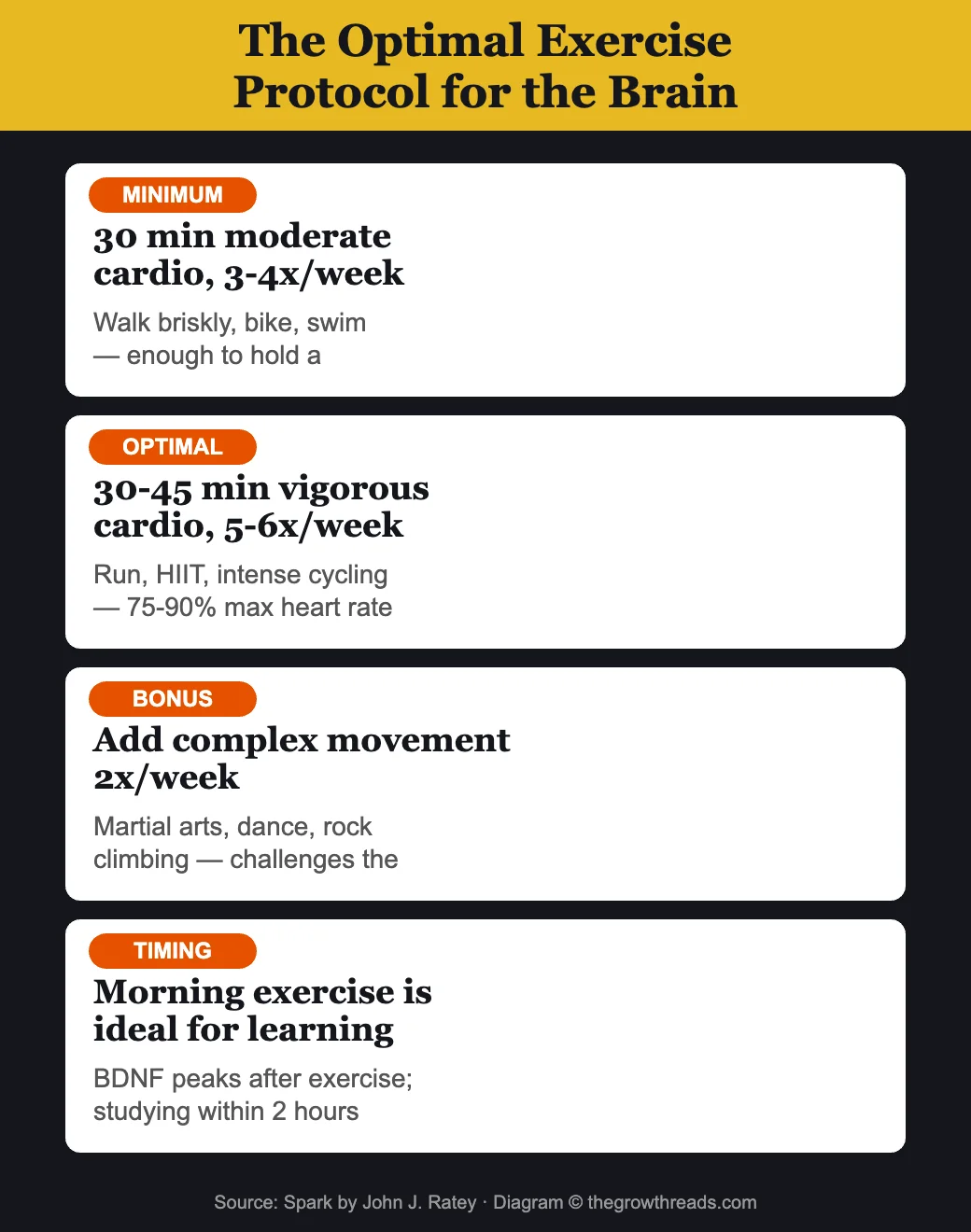
Ratey concludes with a practical exercise prescription. The minimum effective dose for brain health is 30 minutes of moderate aerobic exercise (brisk walking, cycling, swimming) three to four times per week. The optimal dose is 30-45 minutes of vigorous exercise (running, HIIT, intense cycling at 75-90% max heart rate) five to six times per week. For additional brain benefits, he recommends adding complex movement activities twice weekly — martial arts, dance, rock climbing, or any activity that challenges both coordination and cardio simultaneously.
Who is Spark best for — and who should read something else first?
This book is for anyone who wants a science-based reason to exercise regularly — and for anyone dealing with stress, anxiety, depression, ADHD, or cognitive concerns. It’s particularly powerful for people who exercise only for physical appearance and don’t realize the dramatic mental health benefits they’re also getting (or missing). Parents and educators will find the learning chapter especially valuable.
If you already exercise consistently and want broader health optimization, Why We Sleep addresses the other pillar of brain health. For nutrition’s role, Glucose Revolution shows how food affects energy and cognition. For the complete longevity picture, Outlive integrates exercise with all other modifiable health factors.
Questions to reflect on
- How would your mental health, focus, and energy change if you exercised vigorously for 30 minutes before starting your workday?
- Are you using exercise only for physical goals while ignoring its potential as your most powerful mental health tool?
- If exercise could replace or reduce your reliance on medication for mood, anxiety, or focus — would you commit to the consistency required?
- What form of complex movement (dance, martial arts, climbing) could you add to your routine for the dual brain-body benefit?
- When in your day would exercising have the biggest impact on your subsequent cognitive performance?
🔥 Ready to unlock your brain’s full potential?
The neuroscience proof that exercise is the most powerful tool for your mind — not just your body.
How to apply Spark (7-day plan)
- Day 1 — Establish your baseline. Rate your current mood, focus, energy, and anxiety on a 1-10 scale. Record what exercise you did today (if any). This is your comparison point.
- Day 2 — Morning cardio experiment. Do 20-30 minutes of brisk walking or jogging before your workday begins. Rate your mood, focus, and energy at noon and 5 PM. Compare to yesterday.
- Day 3 — Increase intensity. Push to vigorous intensity — 75-90% max heart rate for at least 20 minutes. Run, cycle hard, or do HIIT. Notice any difference in your mental sharpness throughout the day.
- Day 4 — Exercise before learning. If you have anything to study or learn, schedule your workout immediately before. Use the post-exercise BDNF window for the most cognitively demanding task of your day.
- Day 5 — Try complex movement. Add a coordination challenge: a YouTube dance tutorial, shadow boxing, rock climbing, or even juggling practice. Complex movement builds neural pathways beyond what simple cardio provides.
- Day 6 — Anxiety reduction test. If you experience any anxiety today, use a 20-minute vigorous exercise session as your first intervention instead of other coping mechanisms. Note how you feel 30 minutes after.
- Day 7 — Design your weekly protocol. Based on this week’s experiments, write your exercise prescription: what type, what intensity, what time of day, how many days per week. Commit to four weeks of consistency.
Frequently asked questions
What is BDNF and why does it matter?
BDNF (brain-derived neurotrophic factor) is a protein that promotes the growth of new neurons and strengthens existing neural connections. Ratey calls it “Miracle-Gro for the brain.” Exercise is the most potent natural trigger of BDNF production. Higher BDNF levels are associated with better memory, faster learning, improved mood, and reduced risk of neurodegenerative diseases. BDNF peaks immediately after vigorous exercise and remains elevated for several hours.
Can exercise really replace antidepressants?
For mild to moderate depression, research shows that regular aerobic exercise can be as effective as SSRIs. The Duke University study Ratey cites found equal improvement rates at four months and significantly lower relapse rates for the exercise group at ten months (8% vs 38%). However, Ratey does not recommend replacing medication without medical guidance, especially for severe depression. Exercise is most powerful as a complement to professional treatment or as a first-line intervention for milder cases.
How much exercise do I need for brain benefits?
The minimum effective dose is 30 minutes of moderate aerobic exercise (brisk walking, easy cycling) three to four times per week. The optimal dose for maximum brain benefits is 30-45 minutes of vigorous exercise (running, HIIT, intense cycling at 75-90% max heart rate) five to six times per week. Adding complex movement activities (dance, martial arts) twice weekly provides additional neural pathway development beyond what simple cardio offers.
What was the Naperville experiment?
Naperville Central High School in Illinois implemented “Zero Hour PE” — vigorous exercise before the first academic class. Students ran and worked out at 80-90% of their maximum heart rate before starting their school day. The results: Naperville students ranked 1st in the world in science and 6th in math on the TIMSS international assessment, competing against education powerhouses like Singapore and South Korea. The experiment demonstrated that exercise dramatically enhances learning capacity.
Does exercise help with ADHD?
Yes — exercise increases dopamine and norepinephrine in the prefrontal cortex, the same neurotransmitters and brain region targeted by ADHD medications like Ritalin and Adderall. A single bout of moderate-to-vigorous cardio improves focus, impulse control, and working memory for approximately 2-3 hours. Ratey recommends exercise as a complement to medication for ADHD management, not necessarily a replacement — but for mild cases, exercise alone may be sufficient under medical supervision.
What kind of exercise is best for the brain?
Aerobic exercise (running, cycling, swimming, brisk walking) provides the core brain benefits through BDNF production and neurotransmitter regulation. But activities that combine cardio with complex movement — martial arts, dance, rock climbing, racquet sports — provide additional benefits because they challenge the brain to learn new motor patterns while simultaneously triggering the neurochemical cascade. The combination of aerobic and complex movement is the gold standard for brain fitness.
How long does it take to read Spark?
The book is approximately 294 pages and takes about 6 hours to read. Ratey writes in an accessible style that makes neuroscience concepts understandable to non-scientists, with plenty of case studies and research summaries. Some readers find the middle chapters (individual conditions) somewhat repetitive, as the exercise-as-medicine argument is similar across conditions. The audiobook runs about 8 hours.
Related summaries
If you enjoyed this summary, explore more from our best health books collection:
- Why We Sleep Summary — the other pillar of brain health alongside exercise.
- Glucose Revolution Summary — how food affects energy, focus, and brain health.
- Lifespan Summary — the science of aging and how exercise extends healthspan.
- Breath Summary — how breathing techniques complement exercise for optimal health.