

★★★★☆ 4.1 / 5
One-liner: A Harvard evolutionary biologist dismantles exercise myths and reveals why humans never evolved to work out — but why doing it anyway is the single best thing you can do for your health.
Best for: Anyone who struggles with exercise motivation, fitness sceptics, runners worried about their knees, and readers who want the evolutionary science behind why movement matters.
Reading time: ~8 hrs (guide: 28 min)
Difficulty to apply: Low–Moderate (the advice is simple; the challenge is consistency)
Exercised in one minute
You were never designed to exercise — and that is exactly why you need to. Daniel Lieberman, a Harvard professor of evolutionary biology and the researcher featured in Born to Run, makes a counterintuitive argument: exercise — voluntary physical activity done for the sake of health — is a uniquely modern invention. Our ancestors never jogged or did push-ups; they were physically active because survival demanded it, and they rested whenever possible to conserve precious calories. The mismatch between our Stone Age bodies and our chair-bound modern lives explains the epidemic of chronic disease. But Lieberman goes further than a simple “move more” prescription — he systematically debunks exercise myths (sitting is the new smoking, 10,000 steps, running destroys knees) using evolutionary evidence, anthropological fieldwork, and clinical research. The result is a more compassionate, scientifically grounded understanding of why exercise is hard, why it matters, and what actually works.
Key takeaways
- We never evolved to exercise: Physical activity was always a means to an end (food, water, shelter), never an end in itself. The instinct to rest when possible is adaptive, not lazy — your ancestors needed to conserve calories.
- The mismatch is the problem: Our genes expect daily physical activity (walking, carrying, climbing) that our environment no longer requires. Exercise is the voluntary replacement for the forced activity we lost.
- Sitting is not the new smoking: Prolonged sitting is mildly harmful, but comparing it to smoking vastly overstates the risk. What matters is total daily physical activity, not whether you sit at a desk.
- 10,000 steps is a marketing invention: The number originated from a 1965 Japanese pedometer marketing campaign, not science. Health benefits plateau around 7,500 steps for most adults.
- Running does not ruin your knees: Moderate running is associated with less knee osteoarthritis, not more. The loading from running actually strengthens cartilage when done progressively.
- Walking is the most underrated exercise: 150 minutes per week of brisk walking reduces all-cause mortality by approximately 30%. It is the single most accessible and effective form of physical activity.
- Strength training matters increasingly with age: After 30, you lose roughly 3–5% of muscle mass per decade. Resistance training 2–3 times per week is the most effective countermeasure.
- Some exercise is dramatically better than none: Even 15 minutes per day of moderate activity significantly reduces mortality risk. The biggest health gain comes from moving from zero to a little, not from a lot to a lot more.
- Social exercise is more sustainable: Humans evolved to move in groups. Exercising with others increases adherence, enjoyment, and adds the health benefits of social connection.
- Exercise is medicine — literally: Physical activity reduces the risk of heart disease, cancer, diabetes, depression, dementia, and osteoporosis with effect sizes comparable to or exceeding many drugs, and with no negative side effects at moderate doses.
What is Exercised about?
Exercised uses evolutionary biology, anthropology, and clinical research to explain why humans never evolved to exercise voluntarily but why doing it anyway is essential for health. Daniel Lieberman debunks common exercise myths and provides a compassionate, evidence-based framework for understanding why movement is hard and what actually works.
About the author
Daniel Lieberman, PhD, is the Edwin M. Lerner II Professor of Biological Sciences and Professor of Human Evolutionary Biology at Harvard University. His research on the evolution of the human body — particularly the biomechanics of running, walking, and throwing — has been published in Nature, Science, and dozens of other peer-reviewed journals. He is the scientist featured in Christopher McDougall’s Born to Run who demonstrated that humans evolved specifically for endurance running. Lieberman has conducted fieldwork with hunter-gatherer populations in Africa and Mexico, giving him direct observational data on how humans move when their environment requires it. Exercised applies this research to the modern epidemic of physical inactivity, making an academic argument accessible to general readers. Explore all Daniel Lieberman book summaries →
Key concepts at a glance
| Concept | What it means | Use it when |
|---|---|---|
| Evolutionary mismatch | The gap between the physical demands our bodies evolved for and the sedentary environment we now inhabit | You want to understand why chronic disease is epidemic |
| NEAT | Non-exercise activity thermogenesis — calories burned through daily movement that is not formal exercise | You want to increase daily activity without hitting the gym |
| Adaptive rest | The evolved instinct to conserve energy when possible — explaining why exercise feels like a chore | You feel guilty about being “lazy” |
| Dose-response curve | The relationship between exercise amount and health benefit — steep at low doses, flattening at high doses | You want to know the minimum effective dose |
| Mechanotransduction | How physical stress on bones and cartilage stimulates them to grow stronger | You are worried about running or lifting damaging your joints |
| Myokines | Anti-inflammatory molecules released by working muscles that reduce chronic inflammation throughout the body | You want to understand how exercise fights disease |
Part 1 — The evolutionary argument
Lieberman opens with a provocation: exercise is weird. No other animal voluntarily expends energy without an immediate survival purpose. Lions rest 20 hours a day. Even our closest primate relatives, chimpanzees, are far less active than the most sedentary humans. The idea that we should voluntarily run on a treadmill or lift heavy objects for fun is, from an evolutionary perspective, bizarre.
This is not an argument against exercise — it is an argument for compassion toward people who find it difficult. The instinct to rest when you can is not a character flaw; it is an adaptation that kept your ancestors alive when calories were scarce. Understanding this changes the conversation from “why are you so lazy?” to “how do we design environments and social structures that make movement the path of least resistance?” — which is exactly what the Blue Zones accomplished naturally.
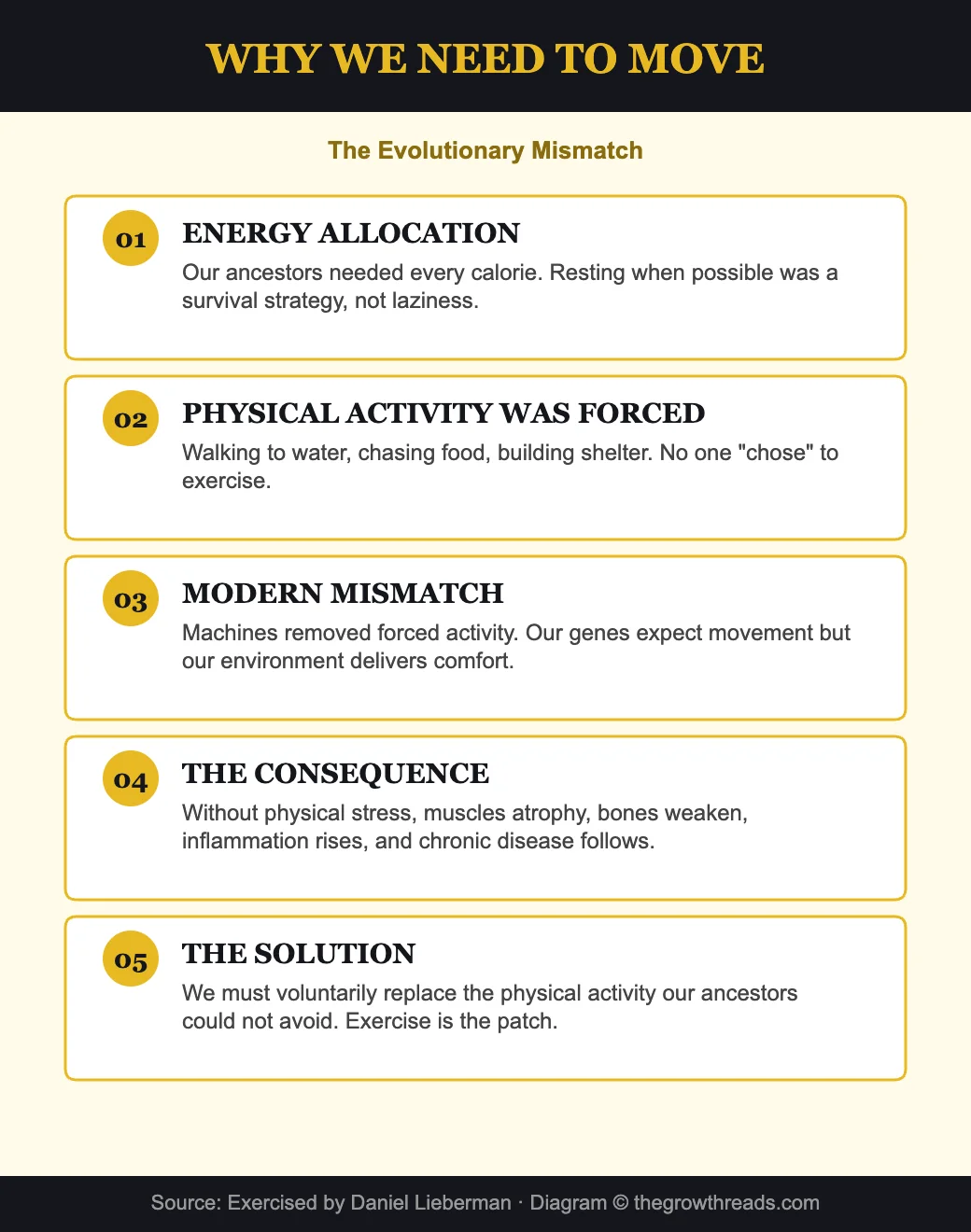
Lieberman draws on his fieldwork with the Hadza, a hunter-gatherer population in Tanzania, to illustrate what “natural” human physical activity looks like. Hadza adults walk an average of 6–9 miles per day, interspersed with bursts of digging, climbing, carrying, and occasional running. But they also rest extensively — sitting and lying down for long periods between bouts of activity. They are not athletes; they are active when they need to be and sedentary when they can be. This pattern — moderate daily activity with lots of rest — is what our bodies evolved to expect, and it is dramatically different from both the modern desk-worker lifestyle and the modern gym-warrior lifestyle.
Part 2 — Myth-busting
The myth-busting section is the book’s most practically useful contribution. Lieberman takes on exercise beliefs that have become gospel and tests them against evidence.
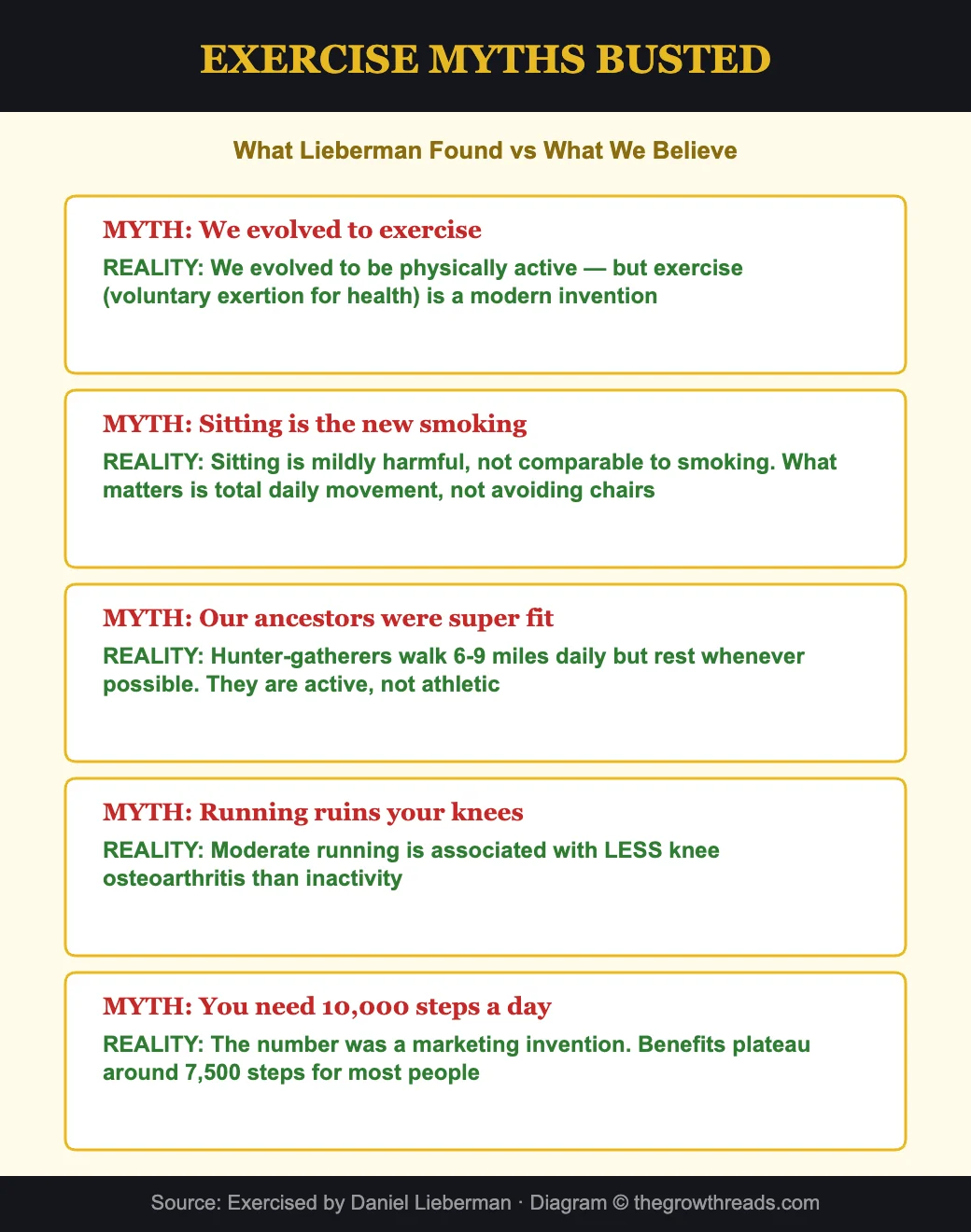
“Sitting is the new smoking” is perhaps the most overstated health claim of the decade. Lieberman shows that while prolonged, uninterrupted sitting is associated with modestly increased health risks, the effect size is nowhere near comparable to smoking. A meta-analysis of 47 studies found that people who sit the most have a 24% higher risk of dying prematurely than those who sit least — but smoking increases that risk by 80–180%. More importantly, the negative effects of sitting are substantially offset by moderate physical activity. The problem is not sitting per se but sitting all day without any counterbalancing movement.
“10,000 steps a day” originated from a 1965 Japanese marketing campaign for a pedometer called Manpo-kei (literally “10,000-step meter”). The number had no scientific basis. Recent research shows that health benefits from walking increase steeply from zero to about 7,500 steps per day, after which the curve flattens. For older adults, the plateau may be even lower — around 4,400 steps per day. The message: any walking is good, more is generally better up to a point, and the specific target of 10,000 is arbitrary.
“Running destroys your knees” is contradicted by large-scale evidence. A 2017 meta-analysis found that recreational runners had lower rates of knee and hip osteoarthritis than both sedentary people and competitive athletes. The loading from moderate running stimulates cartilage repair and strengthens the surrounding muscles and tendons — a process called mechanotransduction. The risk comes from sudden increases in volume (too much, too fast), not from running itself.
Part 3 — What actually works
The final section lays out what the evidence actually supports, stripped of marketing and gym-culture mythology. The dose-response curve is the key concept: health benefits from exercise increase steeply at the low end (going from zero to 15 minutes a day is transformative) and flatten as volume increases (going from 60 to 90 minutes per day adds little additional benefit for most people). This is enormously important because it means the biggest gains come from the smallest commitment.
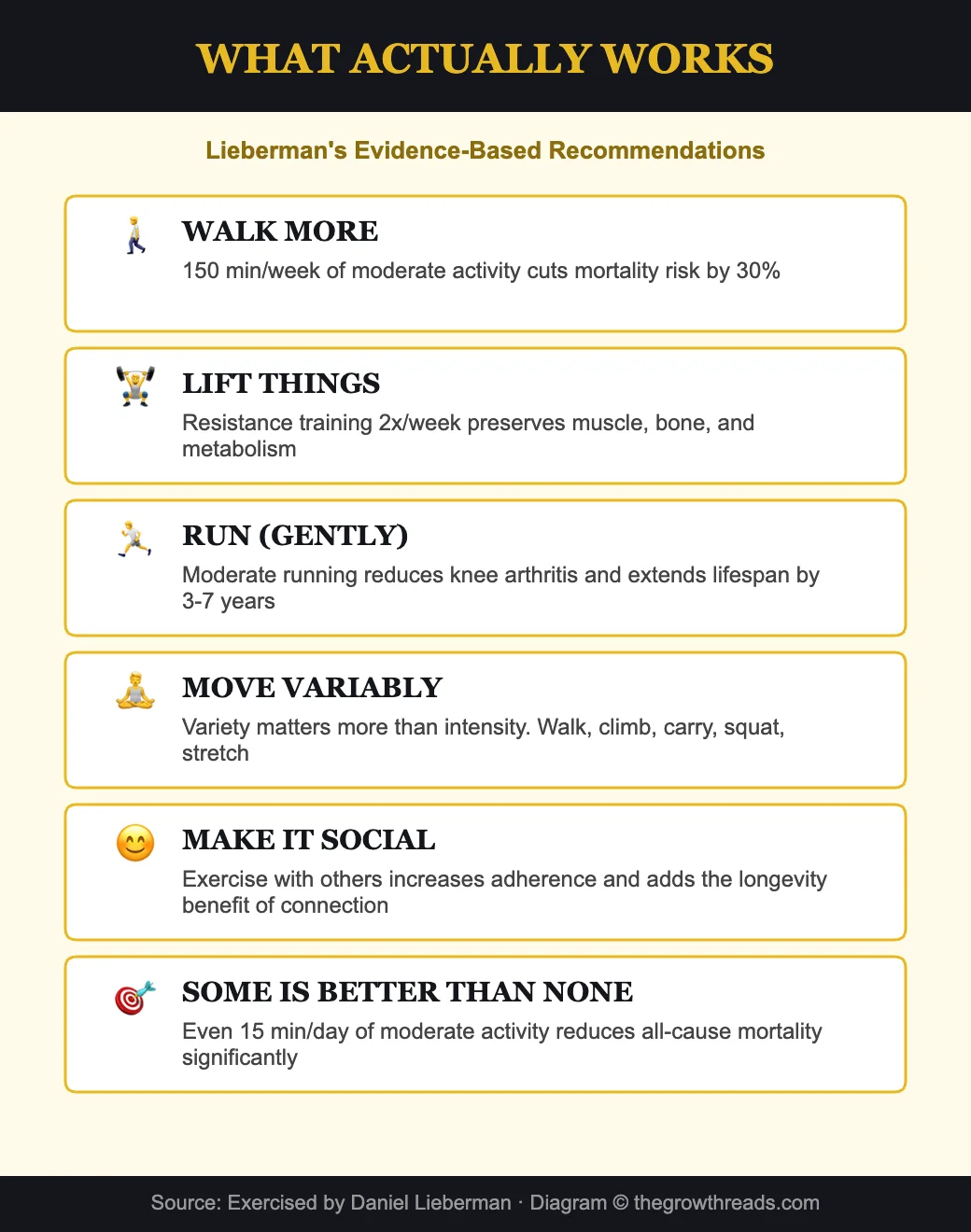
Lieberman recommends a minimum of 150 minutes per week of moderate-intensity activity (brisk walking counts) or 75 minutes of vigorous activity, plus two sessions of resistance training. This aligns with WHO guidelines but he emphasises that these are floors, not ceilings, and that variety matters more than intensity. Walking, climbing stairs, carrying groceries, gardening, dancing, swimming, cycling — all count. The Hadza do not have a “leg day”; they move in varied ways throughout the day, which loads different muscles, joints, and energy systems.
The mechanism section explains why exercise is so broadly protective. Working muscles release myokines — anti-inflammatory signalling molecules that travel through the bloodstream and reduce chronic inflammation in distant organs, including the brain. This is why exercise reduces the risk of such a wide range of seemingly unrelated conditions: heart disease, cancer, diabetes, depression, and dementia all share chronic inflammation as a common underlying driver. Exercise is not treating each disease separately — it is addressing the root inflammatory process that enables all of them.
Who is Exercised best for — and who should read something else first?
This book is ideal for anyone who knows they should exercise more but struggles with motivation, guilt, or confusion about what actually matters. Lieberman’s evolutionary perspective is uniquely compassionate — he explains why exercise feels hard, which removes the shame that keeps many people stuck. It is also excellent for runners and athletes who want to understand the science behind their sport, and for health professionals who want an evidence-based framework free of fitness-industry marketing.
If you want a more narrative, emotionally driven argument for running specifically, start with Born to Run. If you want the brain-specific benefits of exercise in clinical detail, Spark by John Ratey is the deeper dive. And if you want a comprehensive longevity protocol (exercise + nutrition + sleep + emotional health), Outlive by Peter Attia integrates exercise into a broader framework.
Questions to reflect on
- How much of your reluctance to exercise comes from genuine physical limitation versus the evolved instinct to conserve energy?
- If 15 minutes of daily moderate activity significantly reduces mortality risk, what is your excuse for not doing it?
- How does your daily activity pattern compare to the Hadza — do you walk 6–9 miles and rest frequently, or sit 8 hours and sprint 45 minutes?
- Which exercise myths have you been operating under, and how does the evidence change your approach?
- What form of physical activity would you genuinely enjoy enough to do consistently for the next decade?
🔥 Ready to understand why your body craves movement?
Learn the evolutionary science behind exercise and discover what actually works for health and longevity.
How to apply Exercised (7-day plan)
- Day 1 — Count your baseline: Track your step count and total active minutes today without changing your routine. This is your starting point. No judgment — just data.
- Day 2 — Add a 15-minute walk: Walk briskly for 15 minutes at any point in the day. If 15 minutes of moderate activity reduces mortality by 22%, this is the highest-return health investment you can make.
- Day 3 — Stand and move hourly: Set a timer to stand and move for 2–3 minutes every hour during work. Walk to the kitchen, do a few squats, stretch. Break up sitting without obsessing over it.
- Day 4 — Try a bodyweight strength session: Do three sets each of squats, push-ups, and planks. Start with whatever number you can manage. Resistance training preserves muscle and bone as you age.
- Day 5 — Walk with someone: Invite a friend, partner, or colleague for a walking meeting or after-dinner stroll. Social exercise increases adherence and adds the longevity benefit of connection.
- Day 6 — Vary your movement: Do something you have not done recently: swim, cycle, dance, garden, climb stairs, or carry heavy bags. Variety is more important than intensity.
- Day 7 — Design your minimum viable routine: Based on the week, identify the simplest sustainable exercise routine: 150 min/week of walking + 2 strength sessions. Schedule them like meetings. Consistency over intensity.
Frequently asked questions
Is Exercised anti-exercise?
No — it is pro-exercise but anti-exercise-mythology. Lieberman is emphatic that exercise is one of the most powerful health interventions available. His argument is that we have surrounded exercise with misleading claims, unrealistic expectations, and shame-based motivation that makes it harder for people to actually do it. By explaining the evolutionary reasons exercise feels difficult and debunking common myths, he makes the case for exercise more accessible and compassionate, not weaker.
How much exercise do I actually need?
The WHO recommends 150 minutes per week of moderate-intensity activity (brisk walking) or 75 minutes of vigorous activity, plus two sessions of resistance training. Lieberman supports these guidelines but emphasises two key nuances: (1) the biggest health gain comes from going from zero to something — even 15 minutes a day is transformative; and (2) the benefits plateau around 300 minutes per week for most people. More is generally better up to that point, but the returns diminish sharply beyond it.
Does running really not damage your knees?
A 2017 meta-analysis in the Journal of Orthopaedic and Sports Physical Therapy found that recreational runners had a 3.5% rate of knee and hip osteoarthritis compared to 10.2% in sedentary people and 13.3% in competitive athletes. Moderate running stimulates cartilage repair through mechanotransduction. The risk comes not from running itself but from sudden increases in volume, poor form, or pre-existing injuries. If you progress gradually and listen to your body, running is protective, not destructive.
Where did 10,000 steps come from?
The 10,000-step target originated from a 1965 Japanese marketing campaign for a pedometer called Manpo-kei, which translates to “10,000-step meter.” The number was chosen because the Japanese character for 10,000 (万) looks like a person walking, making it memorable for advertising. There was no scientific basis for the specific number. Research published in JAMA Internal Medicine (2019) found that health benefits plateau around 7,500 steps per day for women over 60. The right target varies by age and fitness level.
What does Lieberman say about gym culture?
Lieberman is respectful but critical of modern gym culture. He argues that gyms commodify movement in a way that makes exercise feel like an obligation rather than a natural part of life. The equipment, the mirrors, the performance metrics — all reinforce the idea that exercise is work, not play. He contrasts this with hunter-gatherer populations who move throughout the day in varied, purposeful, often social ways. His recommendation: find ways to be active that feel meaningful and enjoyable, whether or not they involve a gym membership.
How does Exercised relate to Born to Run?
Lieberman is the Harvard scientist featured in Born to Run whose research on barefoot running biomechanics became a central part of McDougall’s narrative. Exercised is, in a sense, the academic expansion of the evolutionary argument Born to Run introduced to a popular audience. Where Born to Run is a narrative about running specifically, Exercised covers all forms of physical activity with systematic evidence. If Born to Run made you want to run, Exercised will help you understand why any form of movement matters — and why it is okay to find it hard.
What is the most important exercise recommendation?
If forced to choose one recommendation, Lieberman would say: walk more. Walking is free, requires no equipment, carries minimal injury risk, can be done at any age, and delivers the majority of exercise’s health benefits. 150 minutes per week of brisk walking (about 22 minutes per day) reduces all-cause mortality by approximately 30%. Add two weekly sessions of basic resistance training (squats, push-ups, planks) and you have covered the essentials. Everything beyond this is optimisation, not survival.
Related summaries
- Born to Run by Christopher McDougall — The narrative companion: the story of natural running that features Lieberman’s research.
- Spark by John Ratey — The neuroscience of exercise: how physical activity grows and protects the brain.
- The Blue Zones by Dan Buettner — Natural movement as a core longevity habit in the world’s healthiest communities.
- Outlive by Peter Attia — Exercise as one pillar of a comprehensive longevity protocol.
- See all Health book summaries on our Best Health Books pillar page.