

★★★★☆ 4.4 / 5 — A riveting investigation into how something as simple as changing how you breathe can transform your health, sleep, and performance.
Best for: Anyone with a nose and lungs — seriously. Athletes, chronic snorers, anxiety sufferers, biohackers, and anyone curious about why modern humans breathe so badly.
Reading time: ~6 hours (304 pages) · This summary: 18 min
Difficulty to apply: Low — the core practice (breathe through your nose, slow down) can start tonight.
Breath in one minute
Modern humans have become the worst breathers in the animal kingdom — and fixing it requires nothing more than shutting your mouth. James Nestor combines investigative journalism, historical research, and a dramatic self-experiment at Stanford to reveal that how we breathe matters far more than how much we exercise or what we eat. Chronic mouth breathing reshapes the face, worsens sleep, spikes blood pressure, and amplifies anxiety. Nasal breathing, slow breathing, and simple practices drawn from ancient traditions can reverse these effects. The book is part science thriller, part personal transformation story, and a wake-up call that the most powerful health tool we have is the one we use 25,000 times a day without thinking.
Key takeaways
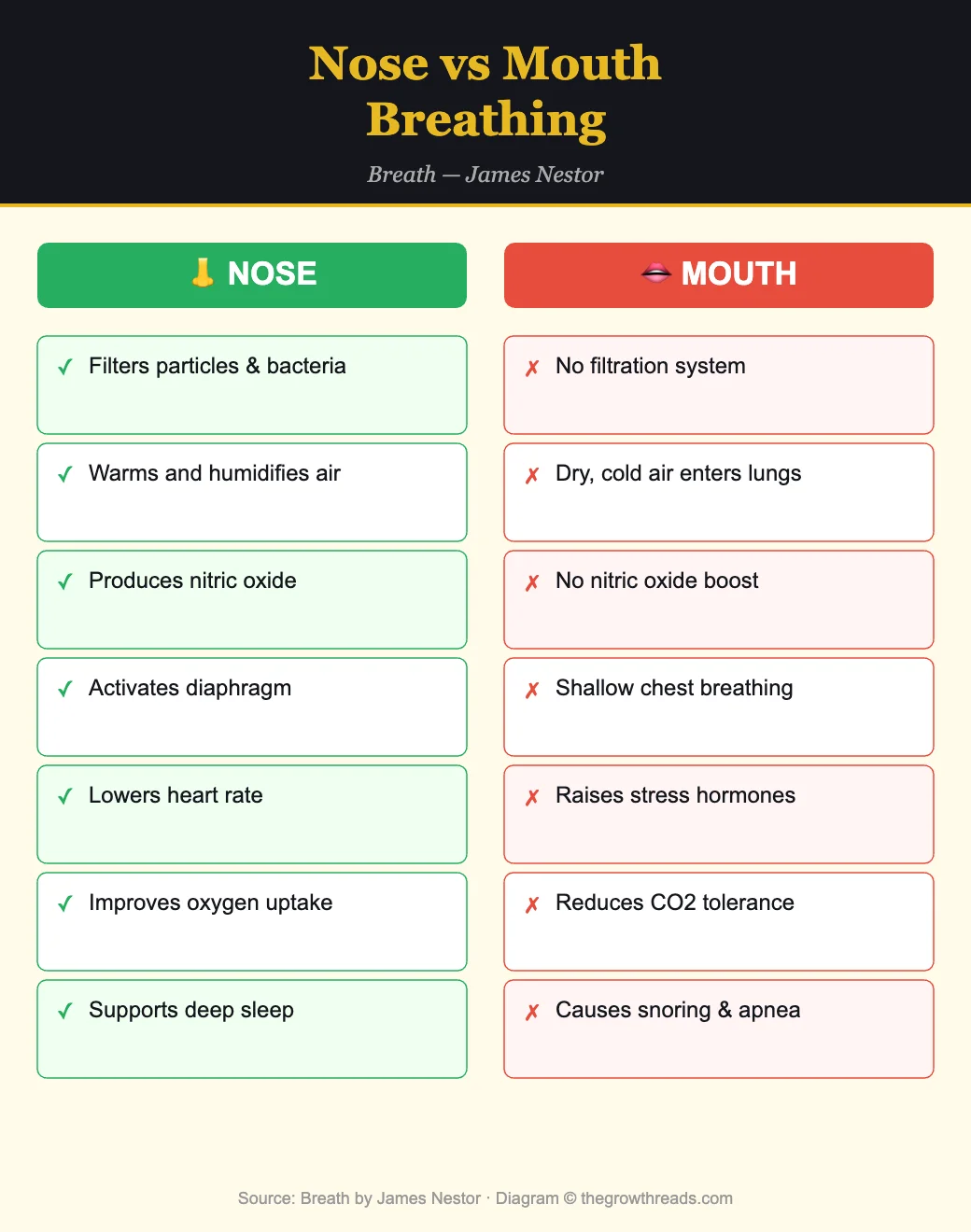
- Nose breathing is non-negotiable: The nose filters, warms, humidifies, and pressurizes air while releasing nitric oxide — a molecule that increases oxygen absorption by up to 18%.
- Mouth breathing rewires your body for the worse: It narrows airways, dries the throat, raises blood pressure, worsens snoring, and triggers the fight-or-flight response.
- The perfect breath exists: 5.5 seconds in, 5.5 seconds out, through the nose — roughly 5.5 breaths per minute. This rhythm optimizes heart rate variability, blood pressure, and CO2 balance.
- CO2 is not just waste: Carbon dioxide is essential for oxygen delivery to cells (the Bohr effect). Training your CO2 tolerance improves athletic performance and reduces anxiety.
- Modern faces are shrinking: Soft processed food has caused human jaws to narrow over generations, crowding teeth and collapsing airways — the root cause of much sleep apnea.
- Chewing matters more than you think: Hard food strengthens the jaw, widens the palate, and opens airways — essentially reversing the structural damage of modern diets.
- Ancient breathing practices were right all along: Techniques from yoga (pranayama), Buddhism, and Taoist traditions align precisely with modern respiratory science.
- Overbreathing is epidemic: Most people breathe 2–3 times more than necessary, which depletes CO2, constricts blood vessels, and reduces oxygen delivery to tissues.
- Breathing can change your nervous system state instantly: Extended exhales activate the parasympathetic response; rapid inhales activate the sympathetic response. You choose.
- Mouth taping at night works: Nestor and multiple researchers found that taping the mouth during sleep dramatically reduces snoring and improves sleep quality.

What is Breath about?
Breath investigates the lost science and art of breathing. James Nestor traces how modern humans developed poor breathing habits, documents a dramatic Stanford experiment comparing mouth and nose breathing, and profiles ancient and modern techniques that can improve health, athletic performance, and longevity — all by changing how you move air through your body.
About the author
James Nestor is a journalist and author whose work has appeared in Scientific American, The New York Times, The Atlantic, and Outside magazine. He became fascinated with breathing after a doctor recommended a breathing class for a recurring pneumonia problem — the class worked better than any medication. His previous book, Deep, explored the science of freediving and the ocean. Nestor spent ten years researching Breath, traveling to ancient burial sites, modern labs, choir rehearsals, and a polluted pulmonology clinic at Stanford University to understand why humans lost the ability to breathe well and how to get it back. Explore all James Nestor book summaries →
Key concepts at a glance
| Concept | What it means | Use it when |
|---|---|---|
| Nasal breathing | Breathing exclusively through the nose, which filters and conditions air while boosting nitric oxide | You catch yourself mouth breathing during exercise, work, or sleep |
| The perfect breath | 5.5 seconds in, 5.5 seconds out — the rhythm that optimizes cardiopulmonary function | You want a single daily practice that improves blood pressure, HRV, and calm |
| The Bohr effect | CO2 is required for hemoglobin to release oxygen to cells — less CO2 means less oxygen delivery | You hyperventilate during stress and feel lightheaded or tingly |
| Overbreathing | Taking in more air than the body needs, depleting CO2 and reducing oxygen uptake | You feel anxious, dizzy, or short of breath despite breathing rapidly |
| Mouth taping | Taping the lips during sleep to enforce nasal breathing and reduce snoring | You snore, wake with dry mouth, or have mild sleep apnea |
| Facial remodeling | Modern soft diets have shrunk human jaws, crowding teeth and narrowing airways | You or your children have crowded teeth, receding chins, or chronic congestion |
| Tummo / Wim Hof | Controlled hyperventilation followed by breath holds to generate heat and control autonomic functions | You want to explore the extreme edges of breathing science (with caution) |
Part 1: The experiment — what happens when you stop breathing through your nose
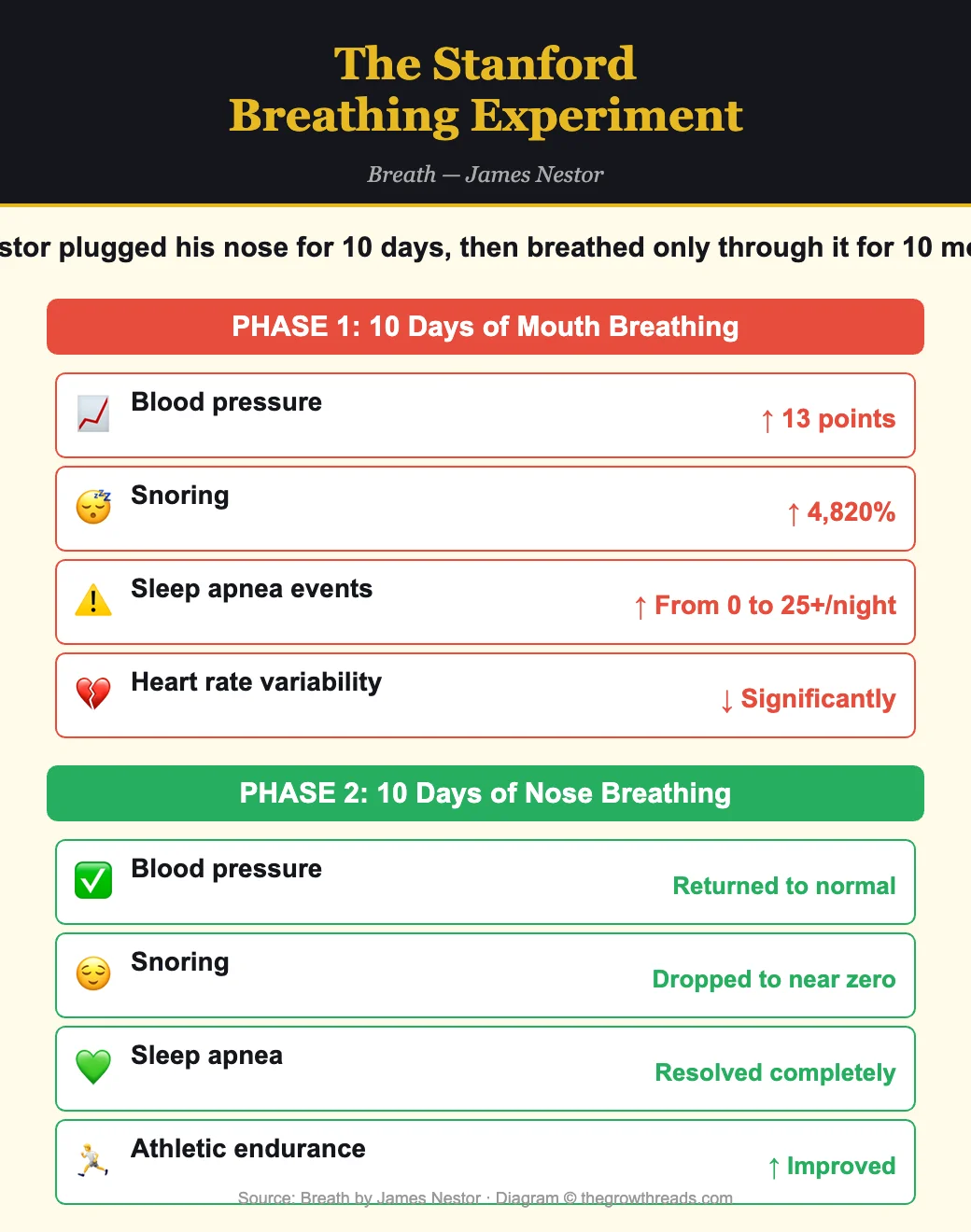
The book’s most dramatic sequence is Nestor’s self-experiment at Stanford University. Working with rhinologist Dr. Jayakar Nayak, Nestor and a fellow subject had their noses completely plugged with silicone and surgical tape for ten days, forcing them to breathe exclusively through their mouths. The results were staggering and immediate.
Within the first 24 hours, Nestor’s snoring increased by 4,820 percent. His blood pressure rose 13 points into stage-one hypertension. He developed sleep apnea events — pauses in breathing during sleep — going from zero episodes to more than 25 per night. His heart rate variability plummeted, his blood oxygen dropped, and his cognitive performance declined. He felt terrible: anxious, foggy, and exhausted.
Then they switched. For the next ten days, Nestor breathed only through his nose, incorporating slow breathing techniques. Every metric reversed. Blood pressure normalized. Snoring nearly disappeared. Sleep apnea resolved. Athletic performance improved. The experiment, while small, made a visceral case that the channel through which air enters the body is at least as important as the air itself.
Part 2: The lost art — why modern humans breathe so badly
Nestor’s historical investigation reveals a startling pattern: human skulls from even a few hundred years ago had wider jaws, straighter teeth, and larger airways than modern skulls. The cause was not genetics but diet. When humans shifted to soft, processed food — starting with milled flour and cooked grains — we stopped chewing hard enough to maintain jaw width. The result: narrower palates, crowded teeth, receding chins, and constricted airways.
This structural change is why orthodontics, sleep apnea, chronic congestion, and even ADHD-like symptoms have exploded in the modern era. Nestor visits researchers who study indigenous populations that still eat traditional hard diets and finds virtually no crooked teeth, no sleep apnea, and no mouth breathing. The implication is radical: many “diseases” of modern breathing are actually diseases of modern eating.
Nestor also traces the history of breathing research, from ancient yoga texts that described precise breath ratios thousands of years ago to George Catlin, a 19th-century painter who spent years with Native American tribes and documented their universal practice of nasal breathing and lip-sealing during sleep. The science was there all along — Western medicine simply chose not to look at it.
Part 3: The science of slow breathing and CO2
The most counterintuitive chapter in the book concerns carbon dioxide. Most people think of CO2 as a waste product — something to expel as quickly as possible. In reality, CO2 is the molecule that triggers hemoglobin to release oxygen to cells (the Bohr effect). When you overbreathe — taking rapid, shallow breaths — you expel too much CO2, which paradoxically reduces oxygen delivery to your brain and muscles.
This explains a phenomenon that has puzzled physiologists: why do anxious people feel short of breath even though they are breathing more than usual? The answer is they are breathing too much, depleting CO2, and constricting blood vessels. The solution is counterintuitive: breathe less. Slow down. Extend the exhale. Allow CO2 to rise back to optimal levels.
Nestor profiles the “perfect breath” identified independently by multiple researchers and spiritual traditions: approximately 5.5 seconds in and 5.5 seconds out, through the nose, for a total of about 5.5 breaths per minute. This rhythm — which happens to match the cadence of many prayers and chants across religions — optimizes heart rate variability, balances the autonomic nervous system, and maximizes gas exchange in the lungs.
He also explores the extreme end of breathing science through practitioners like Wim Hof, who uses controlled hyperventilation and breath holds to influence his immune system and generate body heat in freezing conditions. While Nestor is careful to note that these advanced techniques carry risks, the underlying science suggests that breathing is a far more powerful lever on human physiology than modern medicine has acknowledged.
Part 4: Ancient practices meet modern science
The final section explores breathing techniques that have been used for centuries — pranayama, Sudarshan Kriya, Tummo, and Buteyko — and shows how modern research has validated their physiological mechanisms. Nestor visits practitioners, participates in training, and interviews the researchers studying these methods.
Pranayama, the yogic breathing system, codified techniques thousands of years ago that match what respiratory scientists now identify as optimal breathing patterns. The alternate nostril breathing technique (nadi shodhana), for example, has been shown to balance blood pressure and calm the nervous system in randomized controlled trials. Sudarshan Kriya, a rhythmic breathing practice, has demonstrated antidepressant effects comparable to medication in peer-reviewed studies.
The Buteyko method, developed by a Ukrainian physician in the 1950s, focuses on reducing overbreathing and building CO2 tolerance. It has shown particular promise for asthma management — some studies found that patients using Buteyko techniques reduced their inhaler use by up to 90 percent, though Nestor notes that the medical establishment has been slow to embrace these findings.
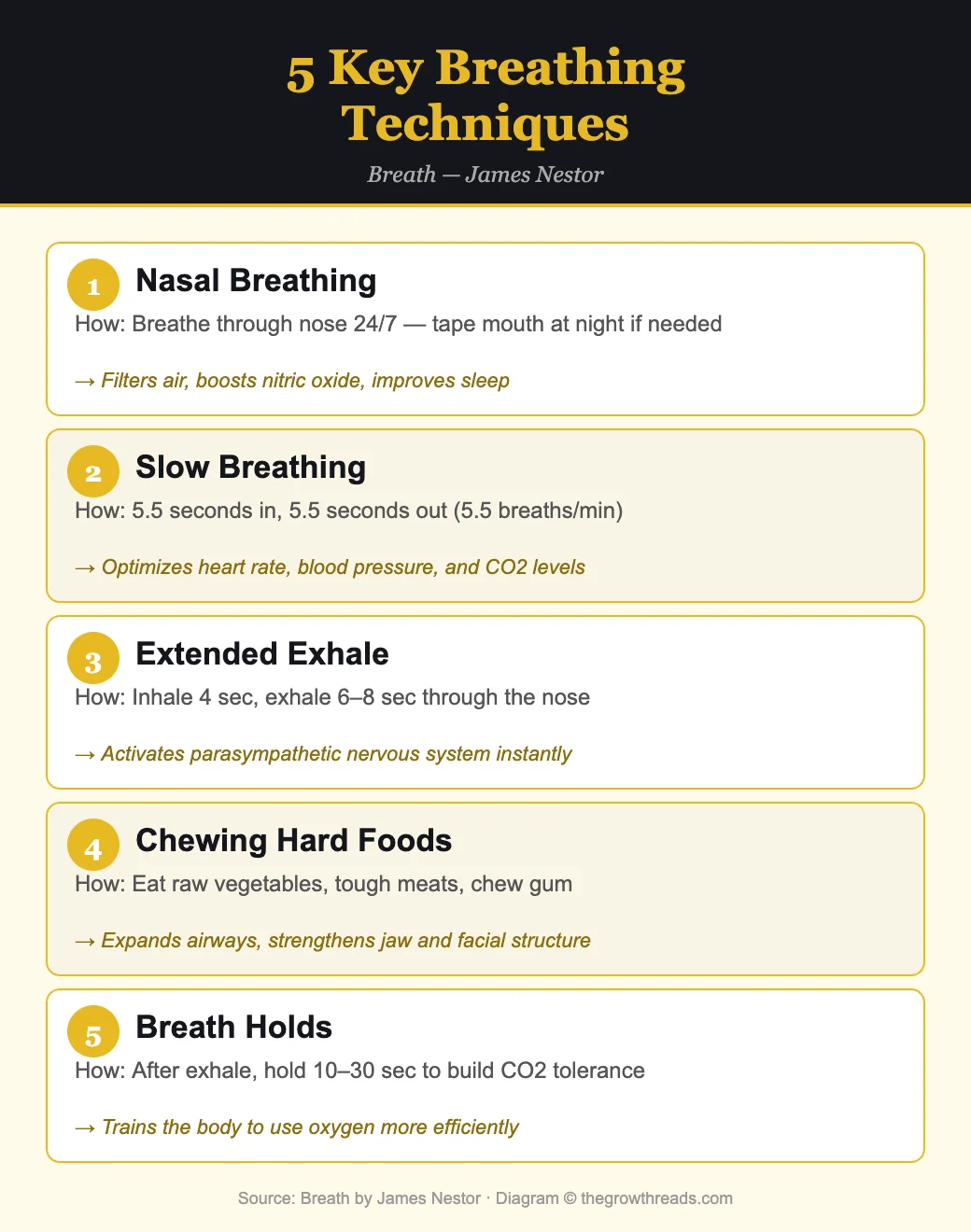
Nestor closes with a practical message: the most important changes are also the simplest. Breathe through your nose. Slow your breathing down. Extend your exhale. Chew harder food. These free, accessible interventions can improve sleep, reduce anxiety, lower blood pressure, and enhance athletic performance — and they require nothing more than paying attention to what you are already doing 25,000 times a day.
Who is Breath best for — and who should read something else first?
This book is for anyone who breathes — which is to say, everyone. It is especially valuable for people dealing with snoring, anxiety, poor sleep, asthma, or exercise limitations. Athletes looking for a legal performance edge will find the CO2 tolerance training particularly interesting. Parents concerned about their children’s dental and airway development will gain practical insights.
If your primary interest is sleep science broadly, start with Why We Sleep by Matthew Walker for the full picture, then add Breath for the airway dimension. If you want a broader longevity framework, Outlive by Peter Attia provides the strategic context into which breathing optimization fits. And if you are drawn to the meditative aspects of breathing, The Power of Now by Eckhart Tolle explores breath as a gateway to present-moment awareness.
Questions to reflect on
- Right now, are you breathing through your nose or your mouth? How often during the day are you actually aware of your breathing?
- Do you wake up with a dry mouth or sore throat? What might that tell you about how you breathe at night?
- Try the “perfect breath” (5.5 seconds in, 5.5 seconds out through the nose) for two minutes. How does your body feel afterward compared to your normal breathing pattern?
- What is your relationship with discomfort around breathing — do you tend to gasp for air during exercise, or can you maintain nasal breathing at moderate intensity?
- How has your diet changed the physical structure of your jaw and airway compared to your grandparents’ or great-grandparents’ generation?
🔥 Ready to transform your health with the simplest tool you already have?
Breath will change how you sleep, exercise, and manage stress — starting with your very next inhale.
How to apply Breath (7-day plan)
- Day 1 — Become aware. Set three phone alarms throughout the day. When they ring, notice: am I breathing through my nose or mouth? Simply notice without judging.
- Day 2 — Switch to nasal breathing during easy activity. Walk, commute, or do light chores while keeping your mouth closed. Notice how long you can maintain it comfortably.
- Day 3 — Practice the perfect breath. Set a timer for 5 minutes. Breathe in for 5.5 seconds, out for 5.5 seconds, through the nose. Do this before bed.
- Day 4 — Try mouth taping at night. Use surgical tape (3M Micropore) to gently tape your lips closed during sleep. Start with a small vertical strip and remove if uncomfortable.
- Day 5 — Extend your exhale. During three stressful moments today, consciously inhale for 4 seconds and exhale for 6–8 seconds through the nose. Notice the calming effect.
- Day 6 — Build CO2 tolerance. After a normal exhale, hold your breath and walk. Count your steps. Repeat three times, trying to increase your step count each round.
- Day 7 — Upgrade your chewing. Add one hard-chewing food to your diet today (raw carrots, tough jerky, gum). Notice your jaw muscles working — this is facial fitness.
Frequently asked questions
What is the main message of Breath?
The central argument is that how we breathe is more important than most people realize, and modern humans have developed catastrophically bad breathing habits. Chronic mouth breathing reshapes facial structure, worsens sleep, raises blood pressure, and amplifies anxiety. Switching to nasal breathing, slowing the breath rate, and building CO2 tolerance can reverse many of these effects with no cost and no equipment.
Is Breath worth reading in 2026?
More than ever. Since publication, peer-reviewed research has continued to validate Nestor’s central claims about nasal breathing and slow breathing. The rise of wearable health trackers has made it easier to measure the effects personally. If you have not yet addressed your breathing habits, Breath remains the most accessible and compelling introduction to the science.
Is mouth taping safe?
For most healthy adults, mouth taping during sleep with surgical tape (such as 3M Micropore) is safe and effective. Many ENT doctors and sleep specialists now recommend it for mild snoring. However, people with severe sleep apnea, nasal obstruction, or breathing disorders should consult a healthcare professional before trying it. Start with a small strip and remove it if you feel uncomfortable.
What is the perfect breath?
Based on research Nestor reviewed and his own experimentation, the “perfect breath” is approximately 5.5 seconds of inhalation followed by 5.5 seconds of exhalation, through the nose, for a rate of about 5.5 breaths per minute. This rhythm has been shown to optimize heart rate variability, balance the autonomic nervous system, and maximize gas exchange in the lungs. Interestingly, this cadence matches the rhythm of many religious prayers and chants across cultures.
What is the Bohr effect and why does it matter?
The Bohr effect describes how carbon dioxide facilitates the release of oxygen from hemoglobin to body tissues. When CO2 levels drop (from overbreathing), hemoglobin holds onto oxygen more tightly, reducing delivery to cells. This means rapid, shallow breathing can paradoxically reduce oxygen availability — explaining why hyperventilating makes you feel lightheaded rather than energized. Building CO2 tolerance through slow breathing and breath holds improves oxygen delivery.
Can breathing exercises help with anxiety?
Yes — this is one of the most robustly supported applications of breathing science. Extended exhale techniques (inhaling for 4 seconds and exhaling for 6–8 seconds) activate the vagus nerve and shift the autonomic nervous system toward parasympathetic dominance within seconds. Multiple clinical studies have shown that structured breathing practices can reduce anxiety symptoms comparably to some medications, with no side effects.
How long does it take to read Breath?
The paperback is approximately 304 pages. Most readers finish it in 5 to 7 hours. The audiobook runs about 7 hours and 18 minutes. Nestor’s investigative journalism style — part adventure story, part science report — keeps the pace brisk. Many readers report finishing it in a weekend because the personal experiment narrative is genuinely hard to put down.
Related summaries
- Why We Sleep Summary & Review — Matthew Walker on the science of sleep and its impact on every dimension of health
- Outlive Summary & Review — Peter Attia on the science of longevity and proactive health
- Ikigai Summary & Review — The Japanese secret to a long and happy life
- The Body Keeps the Score Summary & Review — Bessel van der Kolk on how trauma lives in the body
- Best Health Books — Our complete ranked guide