

⭐⭐⭐⭐✰ 4.3/5
One-liner: A fierce, personal manifesto for breaking free from the expectations that keep women (and everyone) caged — and learning to trust the voice inside.
Best for: Women navigating major life transitions, anyone feeling trapped by others’ expectations, and people ready to prioritize authenticity over approval.
Reading time: ~6 hours (333 pages)
Difficulty to apply: Emotionally demanding — the concepts are intuitive, but acting on them requires confronting deeply ingrained patterns of people-pleasing.
Untamed in One Minute
We are all born wild, and then we are taught to be good. Glennon Doyle writes that from the moment girls enter the world, they are trained to be pleasant, compliant, and small — to cage their truest selves in exchange for approval. Untamed is Doyle’s account of learning to trust her own inner “Knowing” — the deep, quiet voice that tells you what is true before fear and conditioning drown it out. Through her own story of leaving a marriage, falling in love with a woman, and rebuilding her life on her own terms, Doyle presents a framework for recognizing when you are performing rather than living, and for finding the courage to choose authenticity even when it costs you everything comfortable.
Key Takeaways
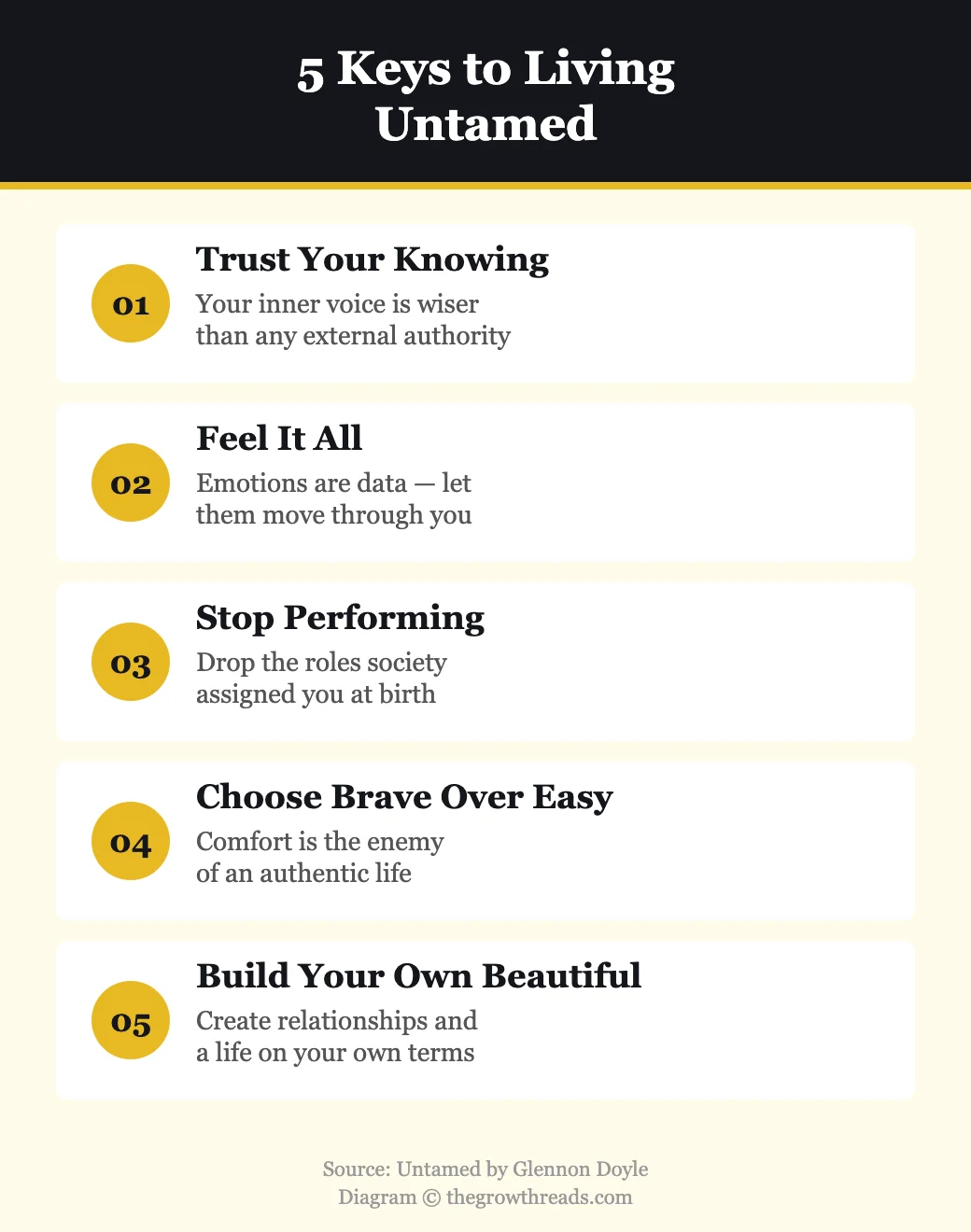
- You were born untamed: Before the world trained you, you knew exactly who you were and what you wanted — recovering that wildness is the work of adult life.
- The Knowing is your compass: Deep inside every person is a quiet voice that speaks truth — learning to hear and trust it, despite fear, is the core skill of an authentic life.
- Good is the enemy of free: Society rewards women who are pleasant, accommodating, and selfless — but being “good” often means being caged.
- Feel everything fully: Emotions are not problems to solve but information to receive — let them move through you rather than numbing or suppressing them.
- Stop meeting expectations: Most of the rules you follow were created by people who benefit from your compliance — question every “should” in your life.
- Brave always beats easy: Choosing authenticity often means losing approval, comfort, and relationships — but the alternative is losing yourself.
- Your body knows before your mind: Physical sensations — tightness, expansiveness, peace, dread — are data about what is true for you before your rational mind catches up.
- Marriage is not your identity: A relationship should be a place where two whole people come together — not where one disappears into the other.
- Mothering requires wildness: The most important thing you can give your children is a mother who lives with integrity — not one who sacrifices her identity for them.
- Do the next right thing: Transformation does not require a grand plan — it requires one brave choice at a time, followed by the next brave choice.

What Is Untamed About?
Untamed is Glennon Doyle’s memoir and manifesto about breaking free from societal conditioning — the invisible cage of expectations, roles, and people-pleasing that keeps women from living authentically. Through personal stories of leaving her marriage, falling in love with soccer star Abby Wambach, and rebuilding her family, Doyle presents a framework for trusting your inner “Knowing” and choosing courage over comfort in relationships, parenting, faith, and identity.
About the Author
Glennon Doyle is a bestselling author, activist, and founder of Together Rising, a nonprofit that has raised over $30 million for women, families, and children in crisis. She first gained public attention through her blog Momastery and her memoir Love Warrior, an Oprah’s Book Club selection. Untamed (2020) became an immediate number-one New York Times bestseller and Reese’s Book Club pick, resonating with millions of readers navigating questions of identity, marriage, sexuality, and authenticity. Doyle is married to retired professional soccer player Abby Wambach, and together they host the “We Can Do Hard Things” podcast, one of the most popular podcasts in the world. Explore all Glennon Doyle book summaries →
Key Concepts at a Glance
| Concept | What It Means | Use It When |
|---|---|---|
| The Knowing | Your deep inner voice that speaks truth before fear intervenes | Facing a major life decision, feeling conflicted, or sensing something is off |
| The Cage | Societal conditioning that keeps you performing instead of living | Noticing you are living for approval rather than authenticity |
| Being Good vs Being Free | Compliance earns approval but costs your identity | Feeling resentful, exhausted, or invisible in your relationships |
| Feel It All | Let emotions be information rather than threats to suppress | The urge to numb through food, screens, alcohol, or busyness |
| Do the Next Right Thing | Transformation happens one brave choice at a time | Feeling paralyzed by the size of a needed change |
| Imagine Your Brave | Visualize the version of you who acts from knowing | When fear of judgment is keeping you from speaking your truth |
Part 1: Caged — How We Lose Ourselves
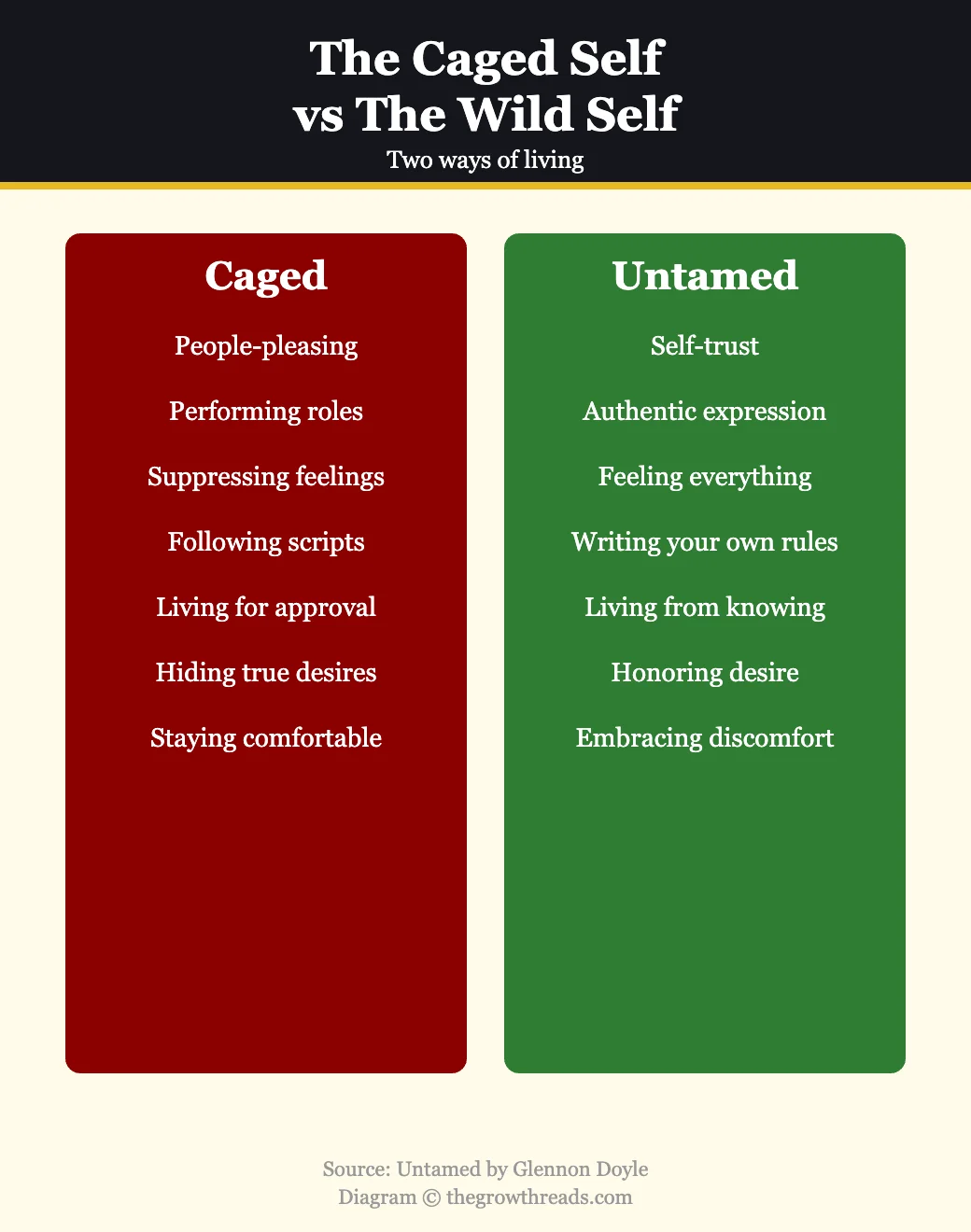
Doyle opens with the image of a cheetah in a zoo — trained to chase a stuffed pink bunny around a track for the entertainment of spectators. The cheetah has been tamed: it has forgotten what it was built for. Doyle uses this as a metaphor for what happens to women (and many men) from childhood onward. We are trained to perform — to chase the pink bunnies of approval, success as others define it, and relationship roles we never chose.
She traces her own caging: growing up in a family where she learned to be easy, pleasant, and undemanding. Developing bulimia and alcoholism as ways of numbing the pain of living inauthentically. Building a marriage around the image of the “good Christian wife” that left no room for who she actually was. Each of these, Doyle argues, was a sophisticated coping mechanism for the unbearable discomfort of being caged — of knowing, somewhere deep, that the life she was living was not her own.
The cultural critique is pointed: Doyle argues that society systematically trains women to abandon their inner Knowing in favor of external approval. Girls learn to monitor how they are perceived rather than how they feel. They learn to ask “What do you think I should do?” instead of “What do I know?” By adulthood, most women have lost access to their own compass entirely.
Part 2: Keys — Finding the Way Out
The turning point in Doyle’s story is meeting Abby Wambach at a conference and experiencing an immediate, overwhelming Knowing — a certainty that transcended logic, fear, and every expectation she had built her life around. She was married. She had three children. She was the face of a “love wins” marriage-redemption story. And her Knowing told her, unmistakably, to burn it all down.
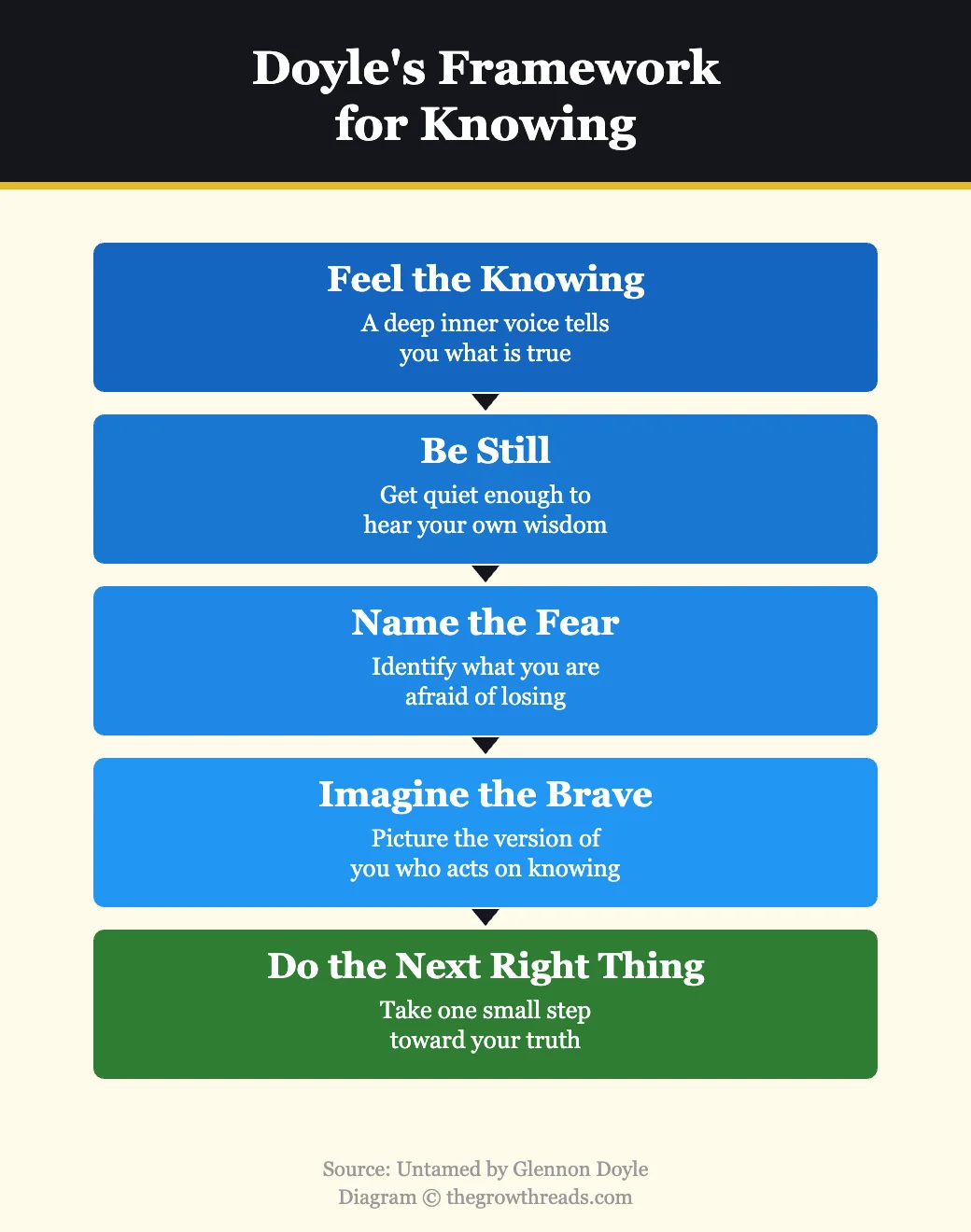
Doyle introduces her framework for accessing the Knowing: get still, feel what arises, name the fear, imagine the version of yourself who acts bravely, and then do the next right thing. She emphasizes that the Knowing is not dramatic — it is quiet. It does not argue or defend itself. It simply presents what is true, and then waits for you to choose it or ignore it.
She distinguishes the Knowing from emotion, impulse, or desire. Emotions are storms that pass. Impulses are reactions. The Knowing is different — it is the calm beneath the storm, the voice that remains after the anxiety subsides. Doyle compares it to a lake: the surface churns with waves (emotions), but the bottom is always still (Knowing). The practice is learning to sink below the surface.
Part 3: Free — Building an Untamed Life
The final section addresses the practical reality of living untamed — which includes pain, loss, and the hard work of rebuilding. Doyle left her marriage, came out publicly, married Wambach, and faced both celebration and severe backlash. She lost friendships, disappointed family members, and had to rebuild her public identity from the ground up.
Her chapter on parenting is particularly powerful. She rejects the cultural narrative that good mothers sacrifice themselves completely for their children. Instead, she argues that children need to see their mothers living with integrity — that a mother who abandons her own desires to serve her family teaches her daughters to do the same, perpetuating the cage across generations. The most radical act of mothering, she writes, is to live as your truest self so your children learn that they can too.
On relationships, Doyle writes about building a marriage from scratch with Wambach — one without inherited scripts about who does what, who leads, or who accommodates. She argues that the best relationships are built by two people who are willing to be uncomfortable, honest, and accountable rather than two people who are performing “happy” for each other.
Who Is Untamed Best For — and Who Should Read Something Else First?
This book is ideal for women at a crossroads — facing a major life decision, trapped in a relationship or career that does not fit, or sensing that something fundamental needs to change. It is also powerful for anyone who recognizes patterns of people-pleasing, over-functioning, or self-abandonment in their relationships.
If you want the science behind why we lose ourselves in relationships, start with Attached by Amir Levine and Rachel Heller. If you need practical boundary-setting tools, try Set Boundaries, Find Peace by Nedra Glover Tawwab. And if you want Brené Brown’s research-backed take on similar themes, Daring Greatly is the natural companion.
Questions to Reflect On
- Where in your life are you performing “good” at the expense of being free?
- When was the last time you felt a deep Knowing about something — and did you act on it or override it?
- What expectations from family, culture, or religion are you following out of habit rather than choice?
- If you could do the bravest thing you know you need to do, what would change?
- What version of yourself would your children (or future children) most benefit from seeing?
🔥 Ready to Live Untamed?
Break free from the cage of expectations and build a life on your own terms.
How to Apply Untamed (7-Day Plan)
- Day 1 — Identify your cage. Write down three areas of your life where you are performing rather than living — where you are doing what is expected rather than what you know is true. Be specific.
- Day 2 — Practice stillness. Spend 10 minutes in silence — no phone, no music, no input. Sit with whatever arises. Write down what your Knowing says when the noise stops.
- Day 3 — Audit your “shoulds.” List every “should” that governs your week. For each, ask: Is this my value or someone else’s? Would I choose this if no one were watching?
- Day 4 — Feel without numbing. When a difficult emotion arises today — frustration, sadness, anxiety — resist the urge to fix, distract, or suppress it. Instead, name it and let it move through you.
- Day 5 — Imagine your brave. Visualize the most courageous version of yourself. What would she do about the situation you have been avoiding? Write her response down.
- Day 6 — Say one honest thing. In a relationship where you have been performing, say one true thing you have been withholding. Start small — it does not need to be the biggest truth, just a real one.
- Day 7 — Do the next right thing. Identify the single bravest action your Knowing is asking you to take. Take one concrete step toward it today — send the email, make the call, have the conversation.
Frequently Asked Questions
Is Untamed only for women?
While Doyle writes primarily from and to the female experience, the core themes — people-pleasing, self-abandonment, societal conditioning, and the courage to live authentically — are universal. Many male readers have found the book transformative, particularly around questions of emotional suppression and performing social roles. The caging mechanism Doyle describes operates on everyone, though the specific forms differ by gender and culture.
Is this a self-help book or a memoir?
Both. Untamed weaves Doyle’s personal story — leaving her marriage, coming out, rebuilding her family — with broader principles about authenticity, courage, and breaking free from conditioning. The memoir elements make the principles visceral and relatable, while the framework sections (the Knowing, the cage, imagining your brave) give you practical tools. Readers who prefer pure self-help may find the personal narrative occasionally meandering, but most find that the story makes the principles land harder.
What is “the Knowing” and how do I access it?
The Knowing is Doyle’s term for the deep inner voice that speaks truth before fear, conditioning, and social pressure drown it out. It differs from impulse or emotion — it is the calm certainty beneath the surface noise. You access it through stillness: removing input (screens, noise, other people’s opinions), sitting with discomfort, and noticing what remains when the external voices quiet down. Most people have experienced Knowing but have learned to override it. Doyle’s practice is learning to trust it again.
Does Untamed encourage people to leave their marriages?
Not specifically. Doyle shares her own experience of leaving a marriage, but the book’s message is broader: trust your own Knowing about what is true for you, whatever that means. For some readers, that leads to saving a marriage by finally being honest within it. For others, it means recognizing that they have been performing a relationship rather than living in one. Doyle does not prescribe outcomes — she prescribes the process of listening to yourself and having the courage to act on what you hear.
How is Untamed different from Daring Greatly by Brené Brown?
Both books champion authenticity and courage, but they approach the topic differently. Brown is a researcher — her arguments are built on data, studies, and theoretical frameworks about vulnerability and shame. Doyle is a storyteller — her arguments are built on personal narrative, metaphor, and emotional resonance. Brown provides the evidence for why vulnerability works; Doyle provides the lived experience of what it feels like to choose it. Many readers find them deeply complementary.
How long does it take to read Untamed?
At 333 pages of conversational, emotionally rich prose, most readers finish Untamed in five to seven hours. Many readers report needing to pause frequently — not because the writing is difficult, but because certain passages trigger deep personal reflection. The audiobook, read by Doyle herself, is particularly powerful and takes approximately seven hours. Many readers recommend the audio version for the emotional weight Doyle brings to her own words.
What should I read after Untamed?
For the research behind Doyle’s ideas, try Daring Greatly by Brené Brown. For practical boundary-setting tools, read Set Boundaries, Find Peace by Nedra Glover Tawwab. For a deeper dive into how childhood conditioning shapes adult relationships, try Adult Children of Emotionally Immature Parents by Lindsay Gibson. And for Doyle’s own earlier work, Love Warrior tells the story that preceded Untamed — her first marriage, addiction, and the identity crisis that set the stage for her transformation.
Related Summaries
- Daring Greatly by Brené Brown — The research-backed case for vulnerability as the path to courage, connection, and belonging.
- Set Boundaries, Find Peace by Nedra Glover Tawwab — Practical tools for establishing healthy boundaries in every relationship.
- Adult Children of Emotionally Immature Parents by Lindsay Gibson — Understanding how childhood conditioning creates the patterns Doyle describes.
- The Courage to Be Disliked by Kishimi & Koga — An Adlerian psychology approach to freeing yourself from others’ expectations.
For more relationship book summaries, visit our Best Relationship Books pillar page.