

⭐⭐⭐⭐⭐ 4.5/5
One-liner: A therapist goes to therapy after a devastating breakup and discovers that the painful, beautiful, messy process of being human connects us all far more than we realise.
Best for: Anyone curious about therapy, people navigating major life transitions, and readers who love deeply human storytelling that quietly reshapes how you see yourself and your relationships.
Reading time: ~9 hours (432 pages)
Difficulty to apply: Low — the book works on you as you read it; the insights arrive through story, not instruction.
Maybe You Should Talk to Someone in one minute
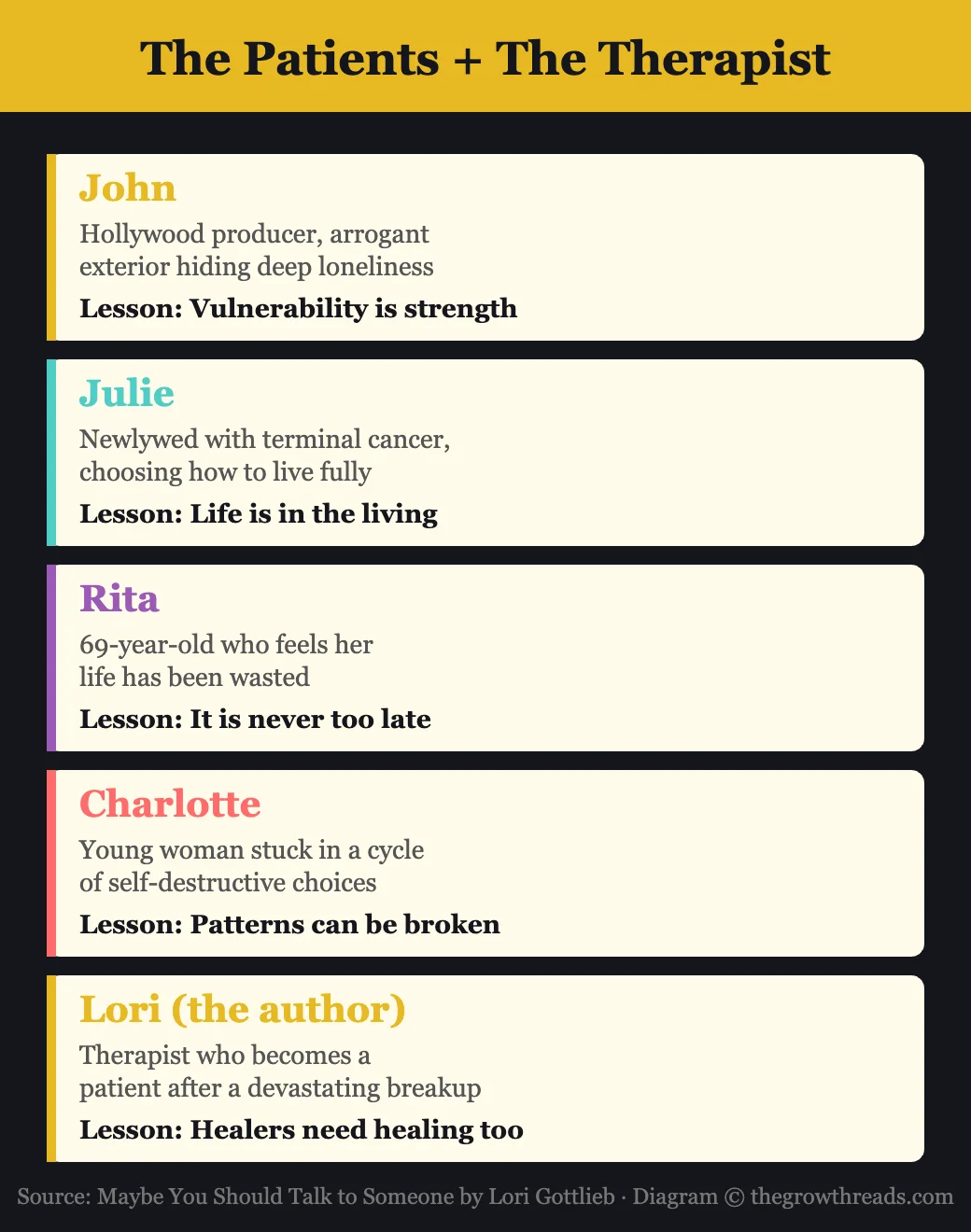
A therapist who helps people rewrite their stories suddenly cannot see the plot of her own. Lori Gottlieb is a psychotherapist in private practice when her boyfriend abruptly ends their relationship and her carefully constructed life cracks open. She does what she tells her patients to do — she finds a therapist of her own. The book interweaves Gottlieb’s personal journey with the stories of four patients: John, a narcissistic Hollywood producer hiding profound loneliness; Julie, a newlywed diagnosed with terminal cancer choosing how to live her remaining time; Rita, a sixty-nine-year-old woman convinced she has wasted her life; and Charlotte, a young woman trapped in self-destructive patterns. Through their parallel transformations, Gottlieb reveals what therapy actually is — not advice-giving or problem-solving, but a relationship that teaches you to see yourself honestly, grieve what needs grieving, and edit the story you tell about your life so that a new chapter becomes possible.
Key takeaways
- Everyone is an unreliable narrator of their own life: We all construct stories about why things happened to us, what people meant, and who we are. These stories feel like truth, but they are interpretations — and interpretations can be revised.
- The presenting problem is rarely the real problem: People come to therapy for one reason but the deeper issue is usually something else entirely. The surface complaint is the door; the real work is what lies behind it.
- Therapists are human beings, not oracles: Gottlieb shatters the myth of the all-knowing therapist by showing her own messiness — her denial, her jealousy, her desperate googling of her ex. Therapists need therapy too.
- Connection heals more than insight: The therapeutic relationship itself — being truly seen, heard, and accepted by another person — is the primary mechanism of change, not the specific technique or theoretical framework.
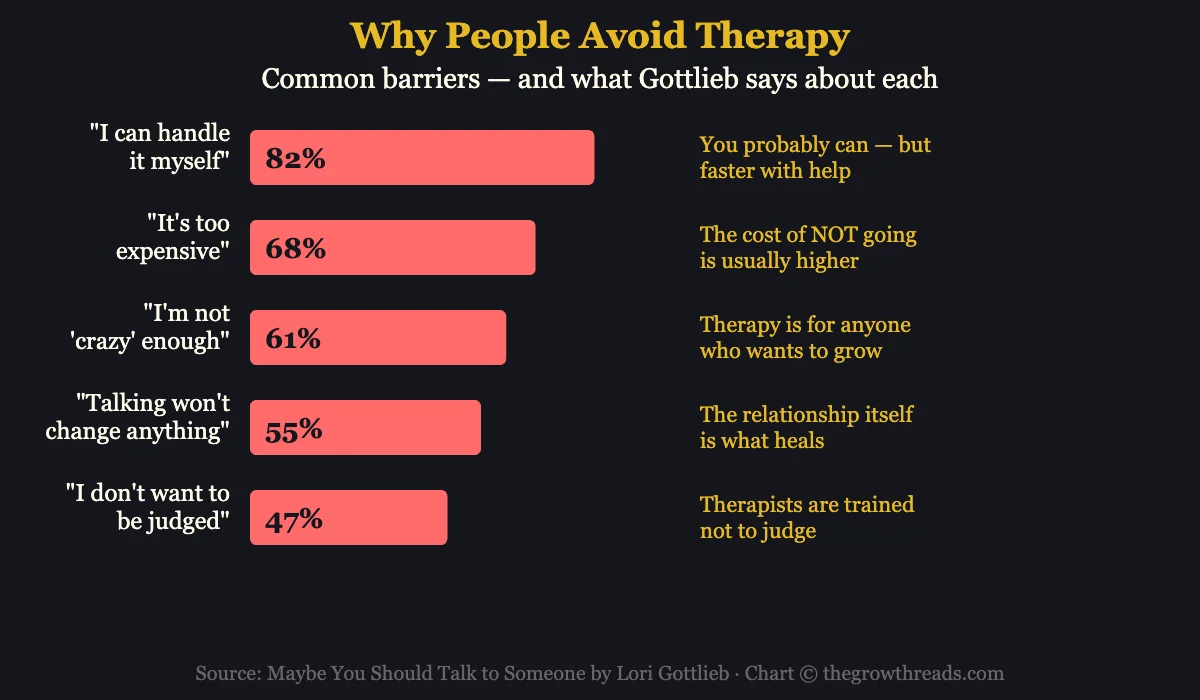
- Change requires grief: To become who you want to be, you must grieve who you thought you were and the future you imagined. Most people avoid therapy not because they fear the pain of change, but because they fear this grief.
- Feelings are not facts, but they contain information: Anxiety, anger, sadness — these emotions are not problems to be eliminated. They are signals pointing to something important that deserves attention.
- We are all more alike than different: A billionaire, a cancer patient, a retiree, and a self-destructive twenty-something all struggle with the same fundamental human concerns: love, loss, meaning, mortality, and freedom.
- Avoidance is the most common form of suffering: What we refuse to feel does not go away. It goes underground and drives behaviour from the shadows — often in the form of addiction, anxiety, or relationship sabotage.
- It is never too late to change your story: Rita’s transformation at sixty-nine demonstrates that age does not determine your capacity for growth. The only deadline is death.
- Asking for help is not weakness — it is wisdom: The strongest thing you can do when you are struggling is to acknowledge it and seek support. Gottlieb’s own willingness to become a patient models this beautifully.

What is Maybe You Should Talk to Someone about?
Maybe You Should Talk to Someone is a memoir by psychotherapist Lori Gottlieb that interweaves her own experience as a therapy patient with the stories of four of her patients. Through their parallel journeys, the book demystifies the therapeutic process, explores the universal human struggles of love, loss, meaning, and mortality, and makes a compelling case that the willingness to be vulnerable and ask for help is the foundation of genuine change.
About the author
Lori Gottlieb is a psychotherapist, author, and contributing writer for The Atlantic. Before becoming a therapist, she worked as a journalist and television producer, and she holds degrees from Stanford, Yale, and the Stanford School of Medicine. She is the author of the “Dear Therapist” advice column in The Atlantic and the co-host of the podcast Dear Therapists. Gottlieb’s unusual career path — from entertainment industry to therapy office — gives her writing a narrative flair rare in the psychological literature. Maybe You Should Talk to Someone became a New York Times bestseller and has been translated into 45 languages, with a television adaptation in development. She maintains a private practice in Los Angeles. Explore all Lori Gottlieb book summaries →
Key concepts at a glance
| Concept | What it means | Use it when |
|---|---|---|
| The unreliable narrator | Everyone tells a version of their story that leaves out inconvenient truths | You notice you keep telling the same story about a situation without it changing |
| Presenting problem vs real problem | What brings you to therapy is often a gateway to a deeper issue | You think you know exactly what is wrong but solutions do not seem to help |
| Idiom of distress | The particular way a person expresses emotional pain (anger, anxiety, numbness) | You want to understand why your emotional responses take the specific form they do |
| The therapeutic frame | The boundaries and structure that make the therapy space safe and productive | You wonder why therapists have strict policies about time, payment, and contact |
| There-is-no-there-there | The belief that happiness exists at some future destination (“when I get promoted/married”) | You keep postponing contentment until conditions are perfect |
| Editing your story | Revising the narrative you tell about your life to include what you have been leaving out | You realise your story has become a cage rather than a framework for growth |
Part 1: A therapist walks into a therapist’s office
The book opens with Gottlieb’s world falling apart. Her boyfriend — a man she expected to marry — abruptly ends their relationship, and she finds herself in the position she has helped hundreds of patients navigate: suddenly unable to see her own situation clearly. She knows, intellectually, that she should talk to a therapist. But she also knows how hard it is to be on the other side of the couch.
She finds Wendell, a therapist whose calm, gentle presence and occasional irreverence slowly dismantle her carefully constructed defences. Gottlieb is a skilled avoider — she can talk about her feelings articulately and at length while never actually touching the feelings themselves. Wendell sees through this immediately. The dynamic between them becomes one of the book’s most compelling threads: a therapist learning to be a patient, discovering that the advice she gives her own patients is far easier to say than to live.
Simultaneously, Gottlieb introduces her patients. John, a brash Hollywood showrunner, arrives in therapy only because his wife threatened to leave him. He treats Gottlieb dismissively, expects her to agree that everyone else is the problem, and gradually — over months — reveals the terrified, lonely child beneath the armour. Julie, recently married and recently diagnosed with terminal cancer, comes to therapy not to process dying but to figure out how to live fully in whatever time she has left.
Part 2: The process of therapy
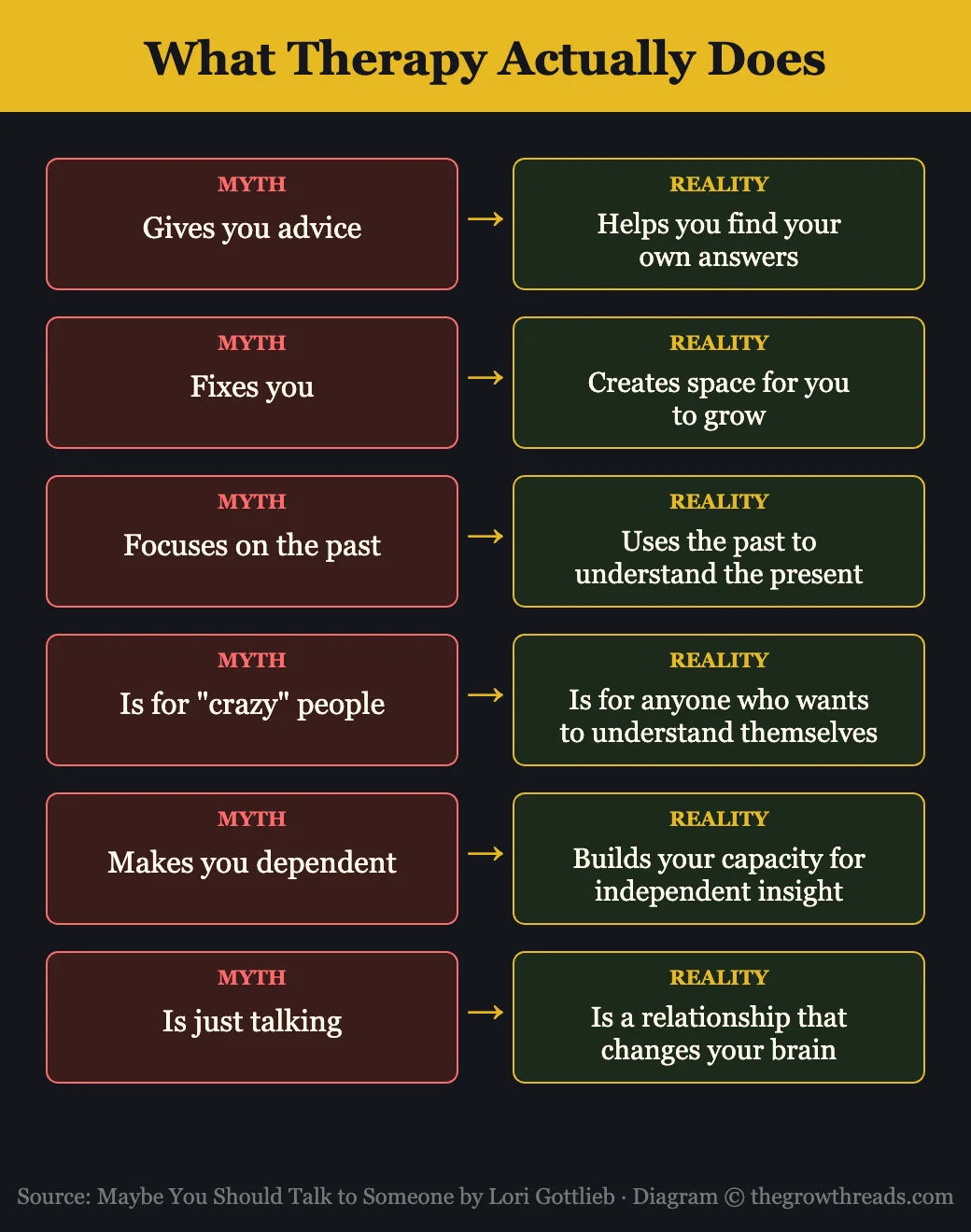
The middle section of the book demystifies what actually happens in therapy — and why it works. Gottlieb explains that therapy is not about giving advice or solving problems. It is about creating a relationship in which a person can be truly seen, without judgment, and in that seeing begin to see themselves more clearly.
She describes the therapeutic process through her patients’ stories. Rita, the sixty-nine-year-old, comes in convinced she has wasted her life in a bad marriage and a soul-crushing career. She wants validation for her suffering. What she discovers, through months of careful excavation, is that she has been so busy playing the victim of her own story that she never noticed her role in creating it — or the power she has to write a different ending. Rita’s transformation, from bitter resignation to genuine vitality, is one of the book’s most moving arcs.
Charlotte, the youngest patient, presents with a pattern of chaotic relationships and self-sabotage. Gottlieb’s work with Charlotte illustrates one of the book’s central insights: the presenting problem is rarely the real problem. Charlotte thinks she needs help choosing better partners. What she actually needs is to understand why she gravitates toward chaos — and that understanding requires going back to a childhood she has carefully sealed off from conscious memory.
Throughout, Gottlieb weaves in the science and theory behind therapy without ever becoming academic. She explains transference (projecting feelings from past relationships onto the therapist), resistance (the unconscious forces that fight against change), and the “therapeutic rupture and repair” process (when the therapeutic relationship breaks down and the repair becomes the healing). But she always grounds these concepts in the lived experience of her patients and her own journey with Wendell.
Part 3: Editing your story
The book’s emotional climax arrives through the concept of “editing your story.” Gottlieb argues that we are all walking around with a narrative about who we are and why our lives look the way they do. These stories feel like objective truth, but they are actually interpretations — constructed from selective memory, unexamined assumptions, and protective blind spots.
John’s story says he is a winner surrounded by idiots. Julie’s story says she should not burden others with her illness. Rita’s story says she is a victim of circumstances. Charlotte’s story says she is fundamentally unlovable. Gottlieb’s own story says she is fine — she is the helper, not the one who needs help.
Therapy, Gottlieb shows, is the process of becoming a more reliable narrator of your own life. This does not mean replacing a negative story with a positive one — toxic positivity is its own form of avoidance. It means expanding the story to include what you have been editing out: the grief you have not processed, the responsibility you have not taken, the vulnerability you have not allowed, the desire you have not admitted. When you can hold the full complexity of your experience, a wider range of choices becomes visible.
The transformations are not dramatic Hollywood moments. They are quiet, incremental shifts in perspective that accumulate into a fundamentally different relationship with yourself and others. John begins to cry in session and discovers that vulnerability does not destroy him. Rita starts a creative project she has been postponing for forty years. Charlotte begins to recognise the pattern before she acts on it. And Gottlieb herself gradually releases her grip on the story of who she was supposed to be and begins to discover who she actually is.

Who is Maybe You Should Talk to Someone best for — and who should read something else first?
This book is for anyone who has ever been curious about therapy, anyone currently in therapy who wants to understand the process more deeply, and anyone navigating a painful transition — a breakup, a loss, a career change, an identity crisis. It is also remarkable as pure storytelling: the character portraits are as compelling as any literary fiction.
If you are looking for a more structured self-help approach rather than narrative memoir, Boundaries by Henry Cloud offers practical relational tools, and Nonviolent Communication by Marshall Rosenberg provides a specific communication framework. If the attachment science behind relationships is your primary interest, Attached by Amir Levine goes deeper into that research.
Questions to reflect on
- What is the story you tell yourself about your life — and what might you be editing out of that story?
- Which of the four patients do you identify with most, and what does that tell you about your own struggles?
- Is there a grief you have been avoiding — a lost relationship, an unlived dream, a version of yourself you had to let go — that might deserve your attention?
- If you went to therapy tomorrow, what would you say is the reason — and what do you suspect might be the real reason?
- Who in your life truly sees you as you are, not as you perform yourself to be?
🔥 Ready to explore the stories shaping your life?
Get Lori Gottlieb’s extraordinary memoir about therapy, vulnerability, and the courage to change.
How to apply Maybe You Should Talk to Someone (7-day plan)
- Day 1 — Write your story in 500 words. Sit down and write the story of your life as you currently tell it. Include the major events, turning points, and the narrative thread that connects them. Do not edit or censor — write the version you would tell a stranger at a dinner party.
- Day 2 — Find the unreliable narrator. Reread your story from yesterday. Where might you be an unreliable narrator? What are you emphasising? What are you leaving out? Where do you cast yourself as hero, victim, or supporting character? Write notes in the margins.
- Day 3 — Identify your presenting problem vs your real problem. Think about the thing that is bothering you most right now. Write it down. Then ask yourself: “If this problem disappeared overnight, what would I still be struggling with?” Write that down too. Notice the gap.
- Day 4 — Practice being seen. Have one honest conversation today in which you share something you normally keep to yourself — a fear, an insecurity, an ambition, a regret. It does not need to be dramatic. Notice how it feels to be known rather than performed.
- Day 5 — Sit with a difficult feeling. The next time you feel an uncomfortable emotion — anxiety, sadness, irritation — do not distract yourself. Set a timer for five minutes and simply sit with the feeling. Notice where you feel it in your body. Ask what it might be telling you.
- Day 6 — Research a therapist. Whether or not you think you “need” therapy, spend thirty minutes researching therapists in your area or online. Read their profiles. Notice what draws you to certain descriptions. You do not have to make an appointment — but lower the barrier by gathering information.
- Day 7 — Rewrite one chapter. Choose one story from your life that you have told the same way for years. Write a new version that includes something you have been leaving out — responsibility you have not claimed, grief you have not processed, or a perspective you have not considered. Notice how the new version feels different.
Frequently asked questions
What is Maybe You Should Talk to Someone about?
It is a memoir by psychotherapist Lori Gottlieb that interweaves her own experience as a therapy patient with the stories of four of her patients. The book demystifies the therapeutic process, explores universal human struggles — love, loss, meaning, mortality — and makes a compelling case that vulnerability and the willingness to ask for help are the foundation of genuine personal change. It is simultaneously a page-turner, a therapy primer, and a profound meditation on what it means to be human.
Is this a self-help book?
Not in the traditional sense. It does not contain exercises, worksheets, or a step-by-step programme. It is a narrative memoir that happens to be deeply therapeutic to read. Many readers report that the book changed how they think about themselves and their relationships — not because it told them what to do, but because the stories illuminated patterns they recognised in their own lives. It is more like a novel that rewires your perspective than a manual that assigns homework.
Do I need to be in therapy to benefit from reading this book?
Not at all. The book is valuable regardless of whether you have ever been to therapy. For people who have never tried therapy, it demystifies the process and addresses common misconceptions. For people currently in therapy, it deepens understanding of what is happening in the room. And for people who have completed therapy, it often re-illuminates insights that have faded. Many readers say it motivated them to start therapy, but the book itself provides significant insight on its own.
Are the patient stories real?
The patients are composites — their stories are drawn from Gottlieb’s clinical experience but altered significantly to protect confidentiality. She has been transparent about this, and the composite approach actually allows her to illustrate therapeutic principles more clearly than any single real case could. Gottlieb’s own story — including her breakup, her therapy with Wendell, and her personal evolution — is presented as autobiography, though Wendell is also a pseudonym.
What kind of therapy does Lori Gottlieb practice?
Gottlieb is trained in multiple modalities but her approach is primarily psychodynamic and relational — meaning she focuses on the patterns in the therapeutic relationship as a mirror for patterns in the patient’s other relationships. She also draws on cognitive-behavioural techniques, attachment theory, and existential therapy. The book does not advocate for one specific school of therapy; instead, it argues that the relationship between therapist and patient is more important than the theoretical framework.
How do I find a good therapist?
Gottlieb recommends looking for someone you feel comfortable with — the research consistently shows that the quality of the therapeutic relationship matters more than the therapist’s specific technique or credentials. Start by checking directories like Psychology Today, asking for referrals from your doctor, or checking your insurance provider’s list. Try a few initial sessions with different therapists and pay attention to whether you feel heard, safe, and gently challenged. A good therapist should make you feel understood but not always comfortable.
How does this book compare to other therapy memoirs?
What sets Maybe You Should Talk to Someone apart is the dual perspective — Gottlieb writes simultaneously as a therapist treating patients and as a patient in her own therapy. This creates a rare honesty: she cannot hide behind professional authority because the reader sees her own struggles in parallel. Compared to more clinical books like The Gift of Therapy by Irvin Yalom (which Gottlieb cites as an influence), it is more accessible, more narrative, and more emotionally immediate. It reads like a novel but lands like a therapy session.
Related summaries
- Attached by Amir Levine — Summary & Review
- Daring Greatly by Brene Brown — Summary & Review
- The Courage to Be Disliked by Ichiro Kishimi — Summary & Review
- Boundaries by Henry Cloud — Summary & Review
- Best Relationship Books — The Complete TGR List