

★★★★★ 4.5/5 — The definitive case for why vulnerability is not weakness but the birthplace of connection, creativity, and courage.
Best for: Anyone who struggles to open up, fears judgment, or wonders why their relationships feel surface-level despite looking fine from the outside.
Reading time: ~5.5 hours (320 pages)
Difficulty to apply: Hard — the concepts are simple but the emotional work is genuinely challenging.
Daring Greatly in one minute
The people who feel the most connected, creative, and alive are not the ones without fear — they are the ones who show up anyway. Brené Brown, a research professor who spent over a decade studying vulnerability, shame, and human connection, makes a research-backed argument that vulnerability — the willingness to be seen when there are no guarantees — is the single most important ingredient in meaningful relationships, effective leadership, and wholehearted living. The title comes from Theodore Roosevelt’s famous “Man in the Arena” speech: it is not the critic who counts, but the person who is actually in the arena, face marred by dust and sweat and blood. Brown’s central insight is that most of us spend our lives in the stands, armored against vulnerability, and that this armor protects us from pain but also blocks us from the very experiences that make life worth living.
Key takeaways
- Vulnerability is not weakness: It is the most accurate measure of courage. Every meaningful act — saying “I love you” first, starting a business, having a hard conversation — requires vulnerability.
- Shame drives disconnection: The fear of being unworthy of connection causes people to hide, perform, and withdraw from the very relationships they need most.
- Shame and guilt are different: Shame says “I am bad”; guilt says “I did something bad.” Guilt can motivate change; shame almost never does.
- We all armor up: Foreboding joy, perfectionism, and numbing are the three most common defenses against vulnerability — and they all backfire.
- Shame resilience can be learned: A four-step process — recognize, examine, reach out, speak — transforms shame from a prison into something manageable.
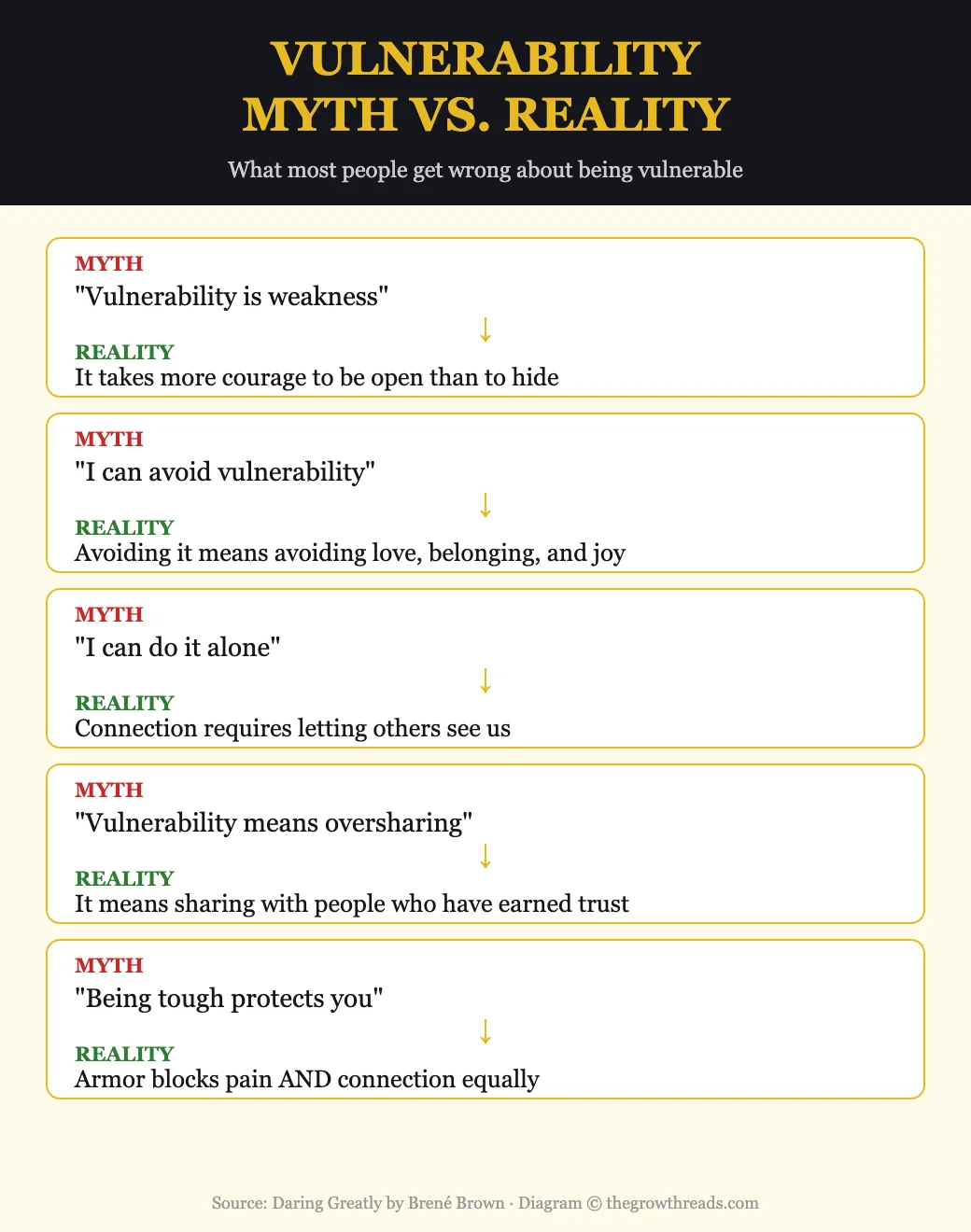
- Vulnerability requires boundaries: Being vulnerable does not mean sharing everything with everyone. It means being open with people who have earned your trust.
- Scarcity culture fuels the problem: A culture that constantly tells you “never enough” — not thin enough, rich enough, successful enough — creates the shame that makes vulnerability feel dangerous.
- Disengagement is the real danger: The opposite of vulnerability is not safety — it is disengagement. People who refuse to be vulnerable eventually stop feeling anything at all.
- Children learn vulnerability from parents: You cannot teach your children to be brave if you are not willing to be vulnerable yourself. They learn from watching, not from lectures.
- Wholehearted living is a practice: It requires daily, conscious choices to show up, be seen, and live without guarantees — not a single breakthrough moment.
What is Daring Greatly about?
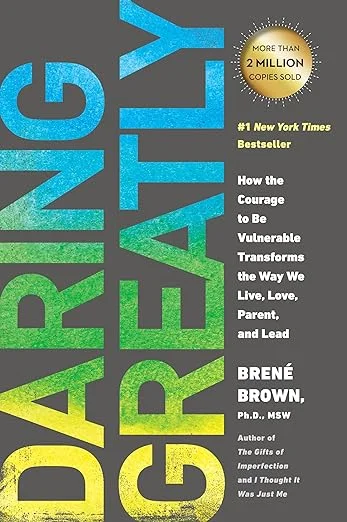
Daring Greatly is a research-based exploration of vulnerability, shame, and human connection. Brown argues that the willingness to be emotionally exposed — in relationships, at work, and as parents — is the foundation of courage, creativity, and belonging. The book provides frameworks for building shame resilience and dismantling the emotional armor that blocks authentic connection.
About the author
Brené Brown is a research professor at the University of Houston, where she holds the Huffington Foundation Endowed Chair at the Graduate College of Social Work. She has spent over two decades studying courage, vulnerability, shame, and empathy. Her 2010 TEDx Houston talk, “The Power of Vulnerability,” became one of the most-watched TED talks in history with over 60 million views, catapulting her from academic researcher to mainstream cultural figure. Brown has authored six number-one New York Times bestsellers. Her research is grounded in grounded theory methodology — thousands of interviews coded and analyzed for patterns — which gives her work an unusual combination of emotional resonance and empirical rigor. She has also produced two Netflix specials and hosts multiple podcasts. Explore all Brené Brown book summaries →
Key concepts at a glance
| Concept | What it means | Use it when |
|---|---|---|
| Vulnerability | Emotional exposure and uncertainty — the willingness to be seen without guarantees | Any moment requiring courage in relationships or work |
| Shame | The intensely painful belief that you are flawed and unworthy of connection | Recognizing the hidden driver behind withdrawal and anger |
| Shame Resilience | A four-step process for moving through shame constructively | After a shame trigger — rejection, failure, or exposure |
| Foreboding Joy | Catastrophizing during good moments to preemptively brace for loss | Noticing you cannot enjoy happiness without anxiety |
| Armor | Protective strategies (perfectionism, numbing, cynicism) that block vulnerability | Recognizing patterns keeping you from authentic connection |
| Scarcity Culture | The never-enough mindset that fuels shame and comparison | Understanding why vulnerability feels so risky in modern life |
| Wholehearted Living | Engaging with life from a place of worthiness rather than proving yourself | Setting an intention for how you want to show up daily |
| The Vulnerability Paradox | We see vulnerability as courage in others but weakness in ourselves | Catching your double standard about openness |
Part 1: Debunking the vulnerability myths
Brown opens by confronting the cultural belief that vulnerability equals weakness. Through her research — involving thousands of interviews across diverse populations — she discovered a paradox: we admire vulnerability in others (the friend who apologizes first, the colleague who admits a mistake, the partner who says “I love you” without knowing if it will be reciprocated) but view it as weakness in ourselves. This double standard, she argues, is the central barrier to living what she calls a “wholehearted” life.
The data from her research is striking. People who scored highest on measures of connection, belonging, and life satisfaction were not those who had eliminated vulnerability from their lives. They were the ones who had learned to lean into it. They did not have fewer fears or thicker skin — they had developed the courage to show up even when the outcome was uncertain. Brown calls this wholehearted living: engaging with the world from a place of worthiness rather than constantly trying to prove yourself worthy.
She also introduces the concept of scarcity culture — the pervasive social message that you are never enough. Not thin enough, not successful enough, not certain enough, not safe enough. This scarcity mindset, amplified by social media and 24-hour news cycles, creates the conditions under which vulnerability feels unbearably risky. If you already feel inadequate, showing your true self feels like handing ammunition to people who will confirm your worst fears about yourself.
Part 2: Understanding shame and building resilience
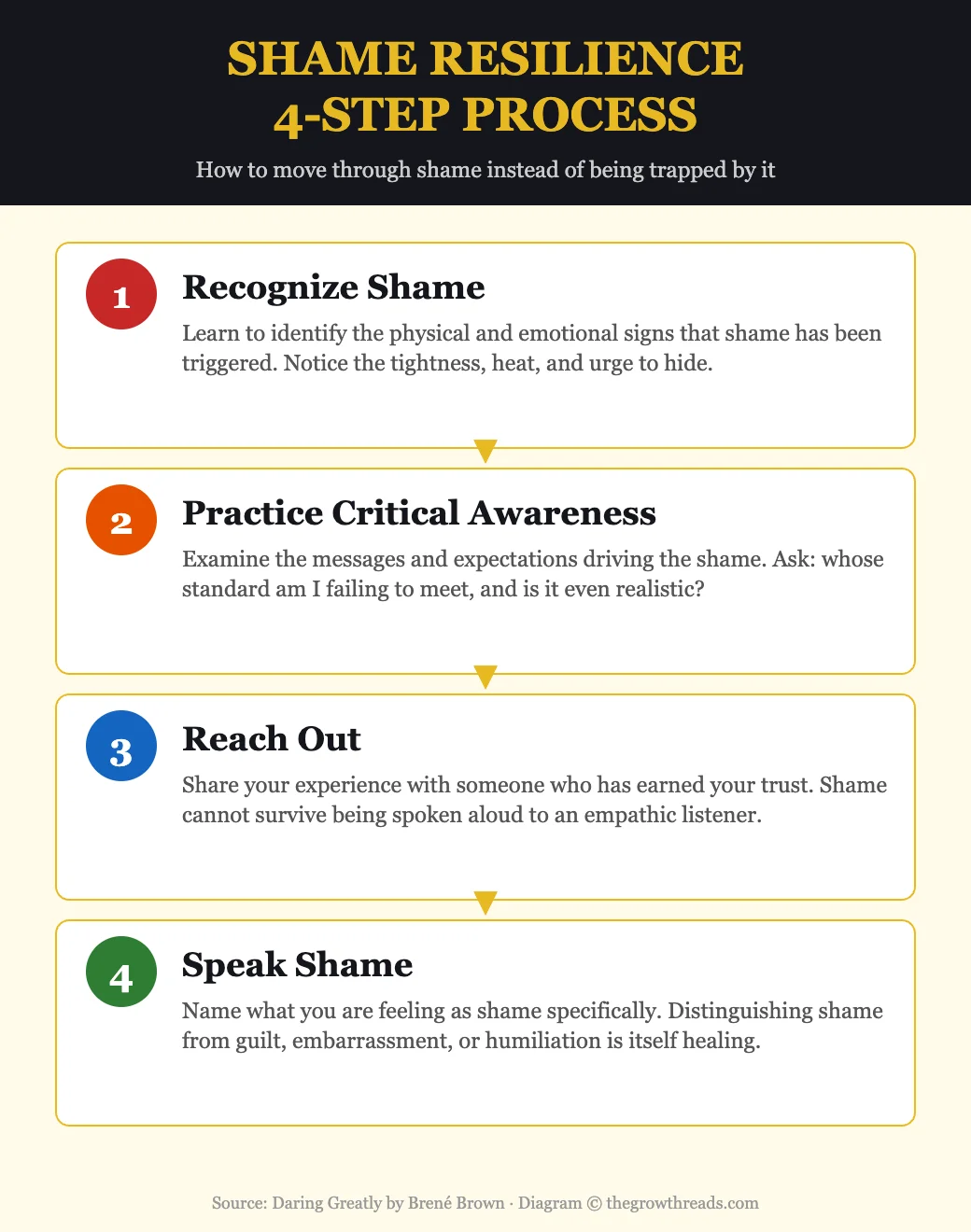
The most technically rigorous section of the book tackles shame — the emotion Brown has studied longer than any other researcher. She draws a critical distinction between shame and guilt that changes how you understand your own emotional responses. Guilt says “I did something bad” — it is about behavior and can motivate positive change. Shame says “I am bad” — it is about identity and almost always leads to destructive outcomes: withdrawal, aggression, addiction, or people-pleasing.
Brown’s research identifies shame resilience as a learnable skill with four components. First, recognize the physical and emotional symptoms of shame — the flush, the shrinking feeling, the urge to disappear or lash out. Second, practice critical awareness by examining the expectations fueling the shame: whose standards are you failing to meet, and are those standards realistic or even yours? Third, reach out to someone who has earned your trust, because shame thrives in secrecy and withers when spoken aloud to an empathic listener. Fourth, name the feeling as shame specifically — distinguishing it from guilt, embarrassment, or humiliation — because precision of language is itself therapeutic.
She acknowledges that shame operates differently across genders, though the core mechanism is the same. Her research found that women primarily experience shame around appearance, motherhood, and the expectation to “do it all,” while men primarily experience it around the expectation to show no weakness. Both patterns reflect cultural messages about who you should be, and both are dismantled through the same resilience process.
Part 3: The armor we wear and how to take it off
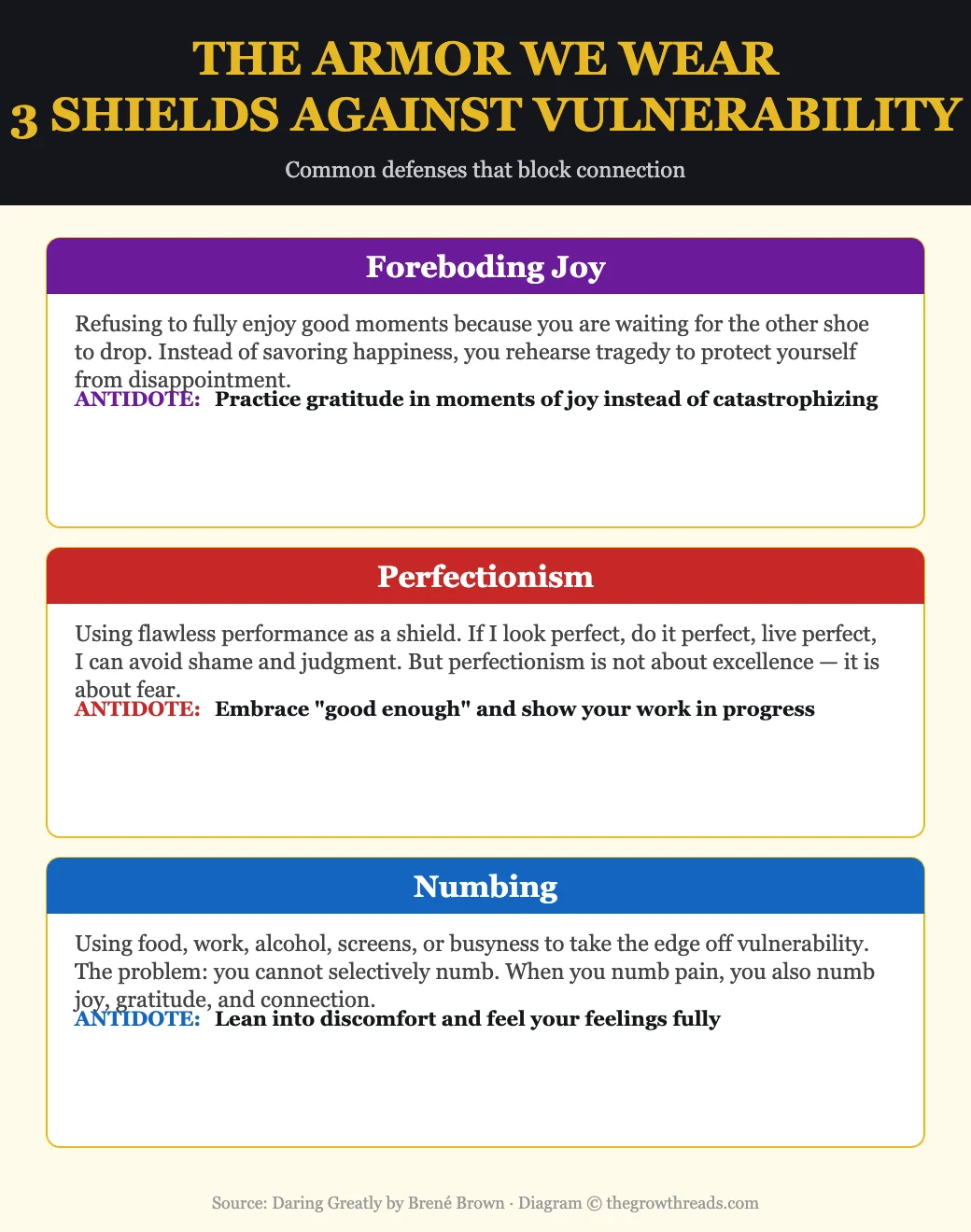
Brown identifies three primary forms of emotional armor that people use to protect themselves from vulnerability — and shows how each one, while understandable, ultimately blocks the connection it is trying to protect.
Foreboding joy is the most counterintuitive: the inability to enjoy good moments because you are bracing for disaster. Parents standing over a sleeping child, overwhelmed with love, and then immediately imagining something terrible happening. Couples in a happy moment who cannot stop the intrusive thought that it will not last. Brown’s research shows this is not preparation — it is a way of numbing joy to avoid the vulnerability of caring deeply about something you could lose. The antidote, she found, is not positive thinking but practicing gratitude in those exact moments — actively choosing thankfulness over catastrophe.
Perfectionism is the second shield, and Brown distinguishes it sharply from healthy striving. Perfectionism is not about excellence. It is a defensive strategy: if I look perfect, perform perfectly, and live perfectly, I can avoid shame, judgment, and blame. The problem is that perfectionism is a twenty-ton shield — it may protect you from criticism, but it also prevents anyone from seeing the real you. And the standards are always moving. Brown calls it “the ultimate fear” because it asks: what if I do everything right and I’m still not enough?
Numbing is the third and most common armor. Food, alcohol, work, shopping, screens, constant busyness — anything that takes the edge off emotional exposure. Brown’s critical insight is that you cannot selectively numb. When you numb vulnerability and pain, you also numb joy, gratitude, and connection. This explains why many people who appear to have good lives still feel hollow — they have numbed the negative emotions but lost the positive ones as a side effect.
Part 4: Vulnerability in practice — parenting, leadership, and culture
The final section applies the vulnerability framework to three domains where the stakes are highest: raising children, leading organizations, and shaping culture.
On parenting, Brown’s argument is simple and devastating: you cannot give your children what you do not have. If you want to raise resilient, wholehearted children, you must first do the work of becoming a wholehearted adult. Children do not learn courage, vulnerability, or empathy from lectures — they learn it from watching their parents model these qualities. This means admitting when you are wrong, saying “I don’t know,” and letting your children see you struggle and recover. The alternative — performing perfection for your children — teaches them that mistakes are unacceptable and that they must perform, too.
On leadership, Brown challenges the command-and-control model that dominates most organizations. Leaders who refuse to be vulnerable — who never admit uncertainty, never ask for help, never acknowledge mistakes — create cultures of fear and disengagement. People in those cultures stop taking risks, stop innovating, and stop caring. The organizations with the highest engagement, creativity, and trust are led by people who are willing to have difficult conversations, give honest feedback, and show up without having all the answers. Vulnerability in leadership is not about emotional display — it is about intellectual honesty and the courage to sit with ambiguity.
She closes by defining wholehearted living not as a destination but as a daily practice. It is the choice, made repeatedly and imperfectly, to show up and be seen. It does not eliminate fear or guarantee acceptance. What it does is create the conditions under which real connection, real creativity, and real courage become possible.
Who is Daring Greatly best for — and who should read something else first?
This book is essential for anyone who recognizes themselves in the armor descriptions — people who struggle with perfectionism, who numb their emotions, or who cannot enjoy good things without waiting for the other shoe to drop. It is also powerful for parents who want to break cycles of emotional unavailability and for leaders who sense that their teams are disengaged but do not understand why.
If your primary challenge is communication mechanics rather than emotional openness, start with Nonviolent Communication or Crucial Conversations. If you want a deeper dive into attachment patterns and why you choose the partners you choose, Attached by Amir Levine is a better starting point.
Questions to reflect on
- Which of the three shields — foreboding joy, perfectionism, or numbing — do I use most often, and what specific situations trigger it?
- When was the last time I let someone see me without performing or editing — and what happened?
- Am I modeling vulnerability for the people I love, or am I teaching them that they must always appear strong and certain?
- What would I do differently this week if I believed I was already worthy of love and belonging, exactly as I am?
- Where in my life am I sitting in the stands criticizing instead of stepping into the arena?
🔥 Ready to step into the arena?
Brown’s research proves that vulnerability is not weakness — it is the birthplace of everything that matters.
How to apply Daring Greatly (7-day plan)
- Day 1 — Identify your armor: Throughout the day, notice when you reach for one of the three shields. Write down three moments where you caught yourself numbing, perfecting, or catastrophizing joy. No judgment — just awareness.
- Day 2 — Practice gratitude in joy: The next time you feel a moment of genuine happiness or connection, resist the urge to catastrophize. Instead, pause and silently say “I am grateful for this moment.” Do this at least twice today.
- Day 3 — Name your shame triggers: Write down three situations that consistently trigger shame for you (e.g., making a mistake at work, feeling judged as a parent, being ignored). Naming them reduces their power.
- Day 4 — Have one vulnerable conversation: Tell someone you trust something you have been holding back — an apology, a fear, a need, or an appreciation you have been too guarded to express. Start small.
- Day 5 — Drop one perfectionist habit: Intentionally do something at 80% instead of 100%. Send the email without rereading it five times. Share the idea before it is fully polished. Notice that the world does not end.
- Day 6 — Replace numbing with feeling: The next time you reach for your phone, a snack, or alcohol to escape an uncomfortable emotion, pause for 60 seconds and let yourself feel the feeling instead. Name what it is.
- Day 7 — Write your arena statement: Complete this sentence and put it somewhere visible: “I am going to show up and be seen in _____, even though I cannot control the outcome.” This is your commitment to daring greatly.
Frequently asked questions
What does “daring greatly” actually mean?
The title comes from Theodore Roosevelt’s 1910 speech commonly called “The Man in the Arena.” The key passage: “It is not the critic who counts… The credit belongs to the man who is actually in the arena, whose face is marred by dust and sweat and blood.” For Brown, “daring greatly” means choosing to show up and be seen in situations where the outcome is uncertain — in relationships, at work, as a parent. It means stepping into the arena of your life rather than staying safely in the stands where you can observe, critique, and protect yourself from risk, but also from genuine living.
Does vulnerability mean sharing everything with everyone?
No, and Brown is explicit about this. Vulnerability is not oversharing, emotional dumping, or sharing with people who have not earned the right to hear your story. It requires discernment about who to trust and how much to share. Brown uses the metaphor of a marble jar: people earn marbles through small acts of trustworthiness over time, and you share vulnerability proportionally. Being vulnerable with someone who has not earned trust is not courage — it is recklessness. The goal is not radical openness with everyone but authentic connection with the people who matter most.
What is the difference between shame and guilt according to Brown?
This distinction is one of Brown’s most important contributions. Guilt focuses on behavior: “I did something bad.” It can be productive because it motivates repair and change. Shame focuses on identity: “I am bad.” It is almost always destructive because it leads to withdrawal, aggression, or self-medication rather than constructive action. Research consistently shows that shame is correlated with addiction, depression, violence, bullying, and eating disorders, while guilt is inversely correlated with these outcomes. The practical implication: when you make a mistake, telling yourself “I did a bad thing and I can fix it” leads to better outcomes than “I am a bad person.”
What is foreboding joy and how do you overcome it?
Foreboding joy is the experience of feeling genuine happiness and immediately imagining the worst — standing over a sleeping child and thinking about accidents, enjoying a good relationship and waiting for betrayal, celebrating success and expecting failure. Brown found this to be one of the most common vulnerability shields in her research. People unconsciously rehearse tragedy to protect themselves from the vulnerability of caring deeply about something they could lose. The antidote is not positive thinking but practicing gratitude in those exact moments. Instead of letting your mind jump to catastrophe, actively acknowledge what you are grateful for right now. Brown’s research found that people who practice gratitude consistently experience less foreboding joy over time.
How is Daring Greatly different from The Gifts of Imperfection?
Both books are by Brené Brown and cover related territory, but they serve different purposes. The Gifts of Imperfection is a more personal, guidebook-style work focused on the ten “guideposts” for wholehearted living — it is about cultivating self-worth and letting go of what others think. Daring Greatly goes deeper into the research on vulnerability and shame, and extends the application to relationships, parenting, leadership, and organizational culture. If Gifts of Imperfection is the “what” (the qualities of wholehearted people), Daring Greatly is the “how” and “why” (the mechanics of vulnerability and the research behind it). Most readers find Daring Greatly to be the more challenging and transformative of the two.
Can vulnerability really work in professional settings?
Brown presents substantial evidence that it does, though with important caveats. Vulnerability in the workplace does not mean crying in meetings or sharing personal trauma with colleagues. It means intellectual honesty: admitting when you do not have the answer, asking for help, giving and receiving honest feedback, and being willing to take creative risks without guarantees of success. Her research found that teams led by leaders who model these behaviors have significantly higher engagement, innovation, and trust. The key distinction is between vulnerability and emotional flooding — a vulnerable leader says “I do not have all the answers, but here is what I know and what I need from you,” not “I am overwhelmed and do not know what to do.” Context and boundaries matter.
Is Daring Greatly backed by real research?
Yes. Brown’s work is grounded in grounded theory methodology, a qualitative research approach involving systematic analysis of thousands of interviews. She conducted over 12,000 interviews across her career, coded and analyzed for patterns. While qualitative research has different strengths and limitations than quantitative studies (it excels at identifying patterns and generating theory rather than proving causation), Brown’s methodology is rigorous within its paradigm and widely cited in academic literature. She also references quantitative studies from psychology and neuroscience to support her findings. The book is substantially more research-grounded than most popular self-help books, though readers should understand that “research-based” is not the same as “clinically proven.”
Related summaries
- The Four Agreements by Don Miguel Ruiz — a philosophical companion for not taking things personally in a scarcity culture.
- Nonviolent Communication by Marshall Rosenberg — the practical conversation toolkit for the vulnerable communication Brown advocates.
- Attached by Amir Levine — the science of why vulnerability feels safer with some partners than others.
- Best Relationship Books — our complete ranked guide to relationship reading.