

★★★★½ 4.5 / 5
One-liner: Two parenting experts provide a deceptively simple communication framework — acknowledge feelings first, describe problems instead of blaming, praise specifically instead of generically — that transforms the parent-child relationship and works equally well with adults.
Best for: Parents of children at any age, teachers, childcare professionals, and anyone who wants to communicate more effectively with the people they love.
Reading time: ~5 hrs (guide: 22 min)
Difficulty to apply: Moderate (simple to understand, hard to do consistently when triggered)
How to Talk So Kids Will Listen in one minute
The single most powerful thing you can do for your child is acknowledge their feelings before doing anything else. Adele Faber and Elaine Mazlish, students of the legendary child psychologist Haim Ginott, distilled decades of workshop experience into five core communication skills: acknowledge feelings (name the emotion before fixing the problem), engage cooperation (describe the situation instead of blaming the child), offer alternatives to punishment (natural consequences teach better than imposed penalties), encourage autonomy (let children make decisions and learn from mistakes), and use descriptive praise (say what you see instead of evaluating with “good job”). The book has sold over four million copies and remained in print since 1980 because the techniques work — not just with children, but with any human being who wants to feel heard before being corrected.
Key takeaways
- Feelings must be acknowledged before problems can be solved: A child (or adult) who does not feel heard will resist any solution you offer. “I can see you are really upset about that” opens the door; “Stop crying, it’s no big deal” slams it shut.
- Describing beats blaming: “I see a wet towel on the bed” is more effective than “How many times do I have to tell you to hang up your towel?” Description focuses attention on the problem; blame focuses attention on the child’s inadequacy.
- Information beats orders: “Milk goes sour when it’s left out” teaches something. “Put the milk away!” demands compliance. Children are more likely to cooperate when they understand why, not just what.
- One word can replace a lecture: Instead of a five-minute speech about responsibility, try: “Backpack.” The child knows what it means, and brevity respects their intelligence.
- Punishment teaches avoidance, not responsibility: A punished child learns to avoid getting caught, not to make better choices. Natural consequences and collaborative problem-solving teach actual judgment.
- Autonomy builds competence: Every time you solve a problem your child could solve, you send the message: “You cannot handle this.” Letting them struggle, make mistakes, and recover builds the confidence that hovering prevents.
- Descriptive praise builds intrinsic motivation: “Good job” is evaluative and creates dependence on external approval. “You used three colours and filled the whole page” is descriptive and helps the child see their own accomplishment.
- Children resist labels — even positive ones: Calling a child “the smart one” or “the athletic one” creates a cage. Describe behaviour and effort instead of assigning traits.
- These skills work on adults too: The techniques are not “parenting tricks” — they are fundamental communication principles. Acknowledging feelings, describing problems, and offering choices are effective in marriages, workplaces, and friendships.
- Consistency matters more than perfection: You will not get it right every time. Faber and Mazlish are clear: the goal is not perfect communication but a shift in default patterns that creates a more respectful, connected relationship over time.
What is How to Talk So Kids Will Listen about?
This book teaches five communication skills — acknowledging feelings, engaging cooperation, alternatives to punishment, encouraging autonomy, and descriptive praise — that transform the parent-child relationship by replacing blame, orders, and generic praise with respect, information, and genuine connection.
About the authors
Adele Faber and Elaine Mazlish were students of child psychologist Haim Ginott, whose pioneering work on adult-child communication at New York University influenced a generation of parenting experts. After Ginott’s death in 1973, Faber and Mazlish continued developing his methods through workshops for parents, eventually systematising the approach into the books that made them internationally recognised. How to Talk So Kids Will Listen has sold over four million copies worldwide, been translated into over 30 languages, and remains a recommended text in parenting programmes and education courses globally. Their approach is notable for being deeply practical — every principle is illustrated with cartoon dialogues showing the “wrong” and “right” way side by side, making the techniques immediately applicable.
Key concepts at a glance
| Concept | What it means | Use it when |
|---|---|---|
| Acknowledging feelings | Naming and accepting a child’s emotion before addressing behaviour | Your child is upset and you instinctively want to fix or dismiss |
| Engaging cooperation | Using description, information, one-word cues, and notes instead of orders and blame | You need your child to do something and lectures are not working |
| Alternatives to punishment | Natural consequences, problem-solving, and expressed feelings instead of penalties | You are about to punish and want a more effective approach |
| Encouraging autonomy | Allowing choices, respecting struggle, and not solving problems the child can handle | You catch yourself rescuing or over-helping |
| Descriptive praise | Saying what you see rather than evaluating (“you organised all your books” vs “good job”) | You want praise that builds competence rather than dependence |
| Giving the wish in fantasy | Validating a child’s desire by granting it in imagination (“I wish I could make it snow right now!”) | You cannot give your child what they want but want them to feel understood |
Part 1 — Acknowledging feelings
Faber and Mazlish open with the skill that underpins everything else: acknowledging feelings. Most parents, with the best intentions, respond to a child’s distress by dismissing, minimising, or immediately problem-solving. “It’s not that bad.” “You’ll be fine.” “Here’s what you should do.” Each of these responses, while well-meaning, communicates: “Your feelings are wrong or unimportant.” The child learns to suppress rather than process emotions — a pattern that, unchecked, follows them into adult relationships.
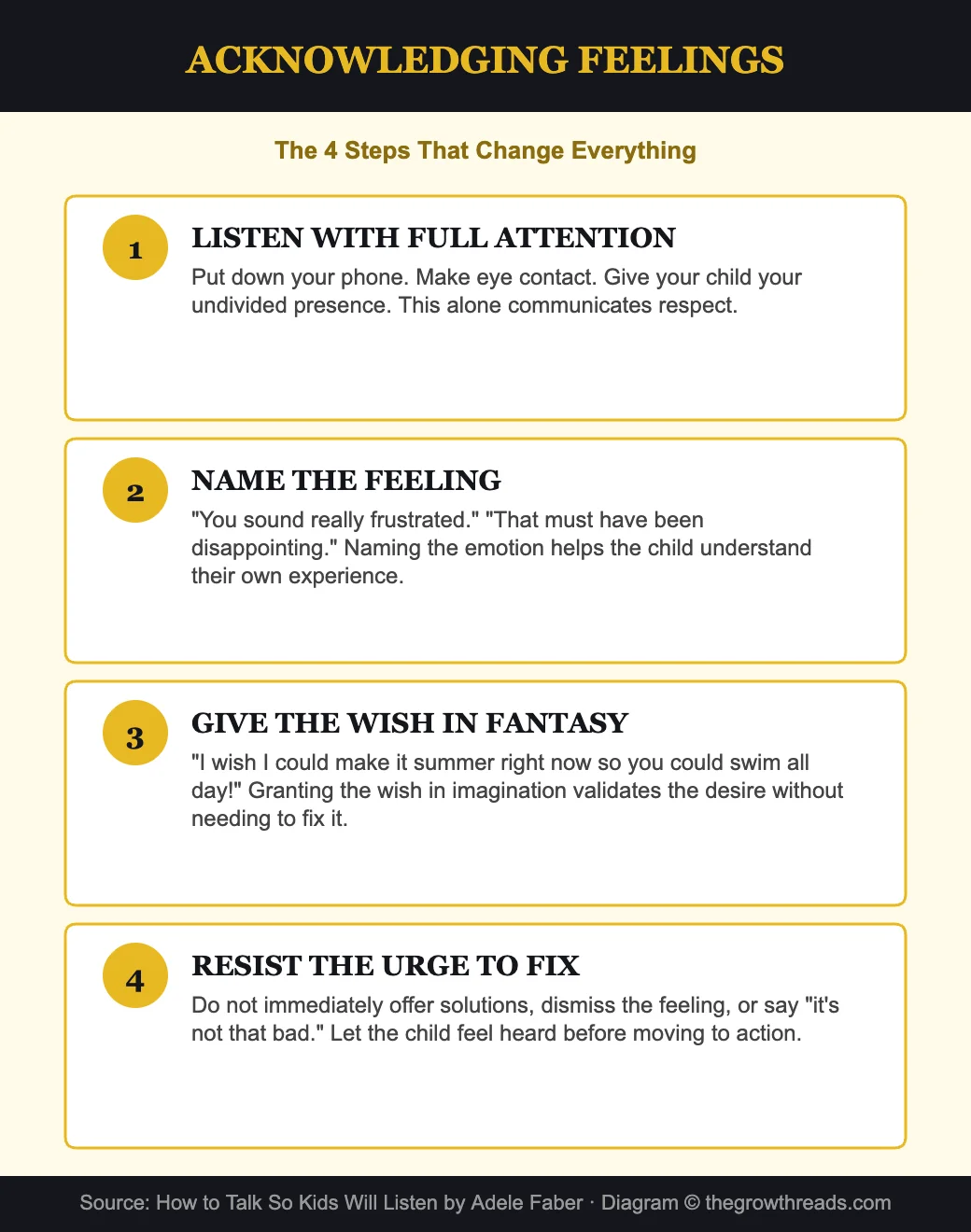
The alternative is deceptively simple: listen with full attention, name what you see (“You sound really frustrated”), and resist the urge to fix. A child who feels heard becomes calm enough to think. A child who feels dismissed becomes more agitated, requiring more parental energy to manage — the exact opposite of what the parent intended. The authors’ most memorable technique is “giving the wish in fantasy”: when your child wants something impossible (“I want ice cream for dinner!”), instead of a flat “no,” try: “I wish I could give you a mountain of ice cream so high you could climb it!” This validates the desire without granting it, and children almost always laugh and move on — because they felt understood, which was what they actually needed.
Part 2 — Engaging cooperation and alternatives to punishment
The cooperation chapter replaces the default parenting script (order → resistance → louder order → conflict) with a set of alternatives that respect the child’s dignity while still achieving the desired outcome. The five tools: describe what you see (“There’s a wet towel on the bed”), give information (“Wet towels make the bedspread mouldy”), say it with a word (“Towel!”), describe what you feel (“I get frustrated when I find wet towels on furniture”), and write a note (a sticky note on the towel rack: “Please hang me up! — Your Towel”).
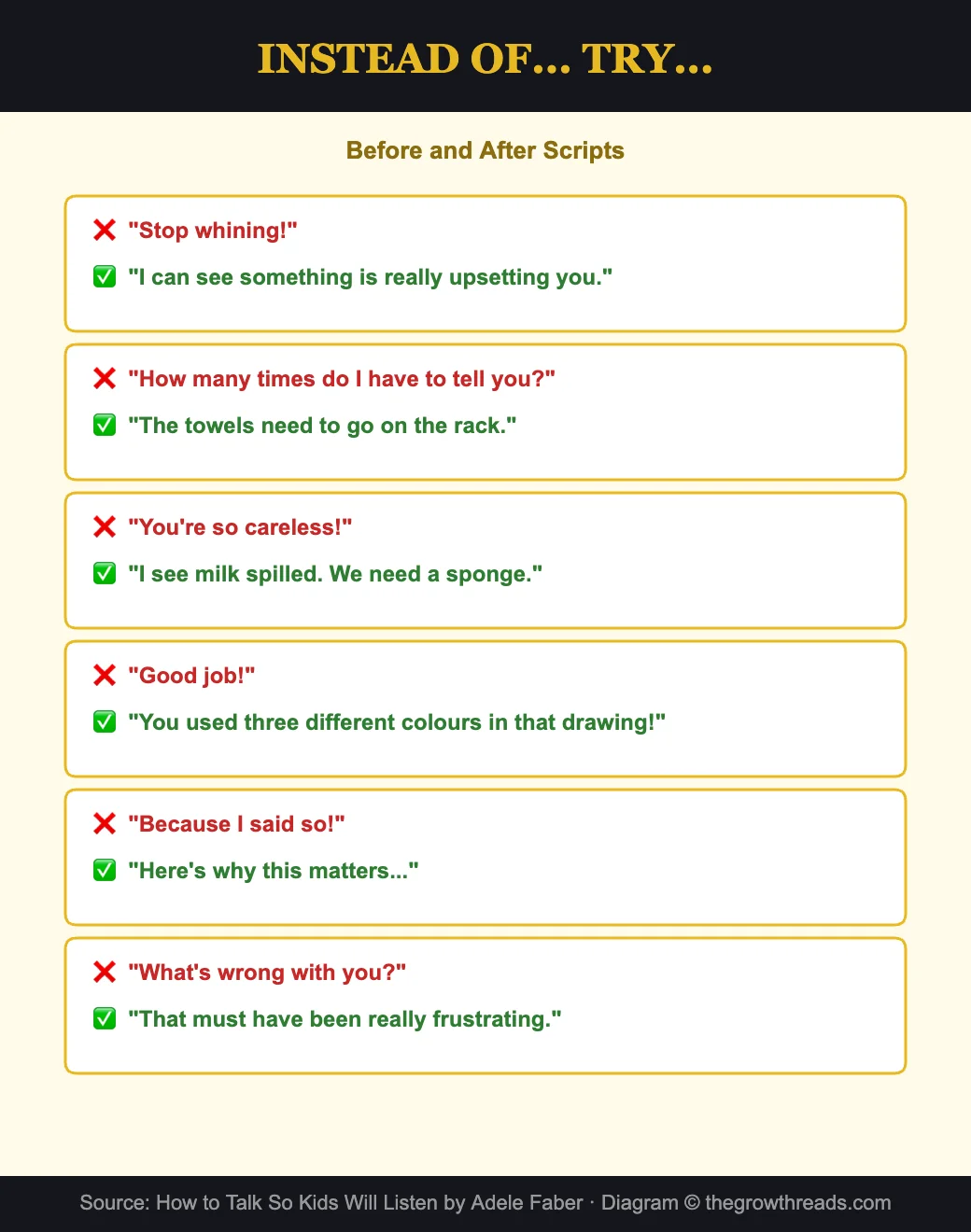
Each tool works because it focuses attention on the problem rather than on the child’s character. “How many times do I have to tell you?” attacks the child’s competence. “There’s a wet towel on the bed” states a fact that the child can respond to without defensiveness. The distinction seems small but its cumulative effect is enormous: over years of interactions, the child raised with description develops problem-solving skills, while the child raised with blame develops either compliance or defiance — neither of which is genuine responsibility.
The punishment chapter is where many parents feel most challenged. Faber and Mazlish argue that punishment — time-outs, grounding, removing privileges — teaches children to avoid getting caught, not to make better choices. The alternative is not permissiveness; it is structured accountability: express your feelings clearly (“I’m upset that the toys are all over the floor”), state your expectations (“Toys need to be put away before dinner”), offer a choice (“Would you like to start with the blocks or the cars?”), and when consequences are necessary, make them related and reasonable rather than arbitrary.
Part 3 — Autonomy and praise
The autonomy chapter addresses a pattern that is increasingly common in modern parenting: over-involvement. Every time you tie a shoe your child could tie, solve a problem they could solve, or make a decision they could make, you communicate: “You are not capable.” Faber and Mazlish advocate letting children struggle within safe limits — choosing their own clothes, resolving their own peer conflicts, making their own mistakes — because competence is built through practice, not protection.
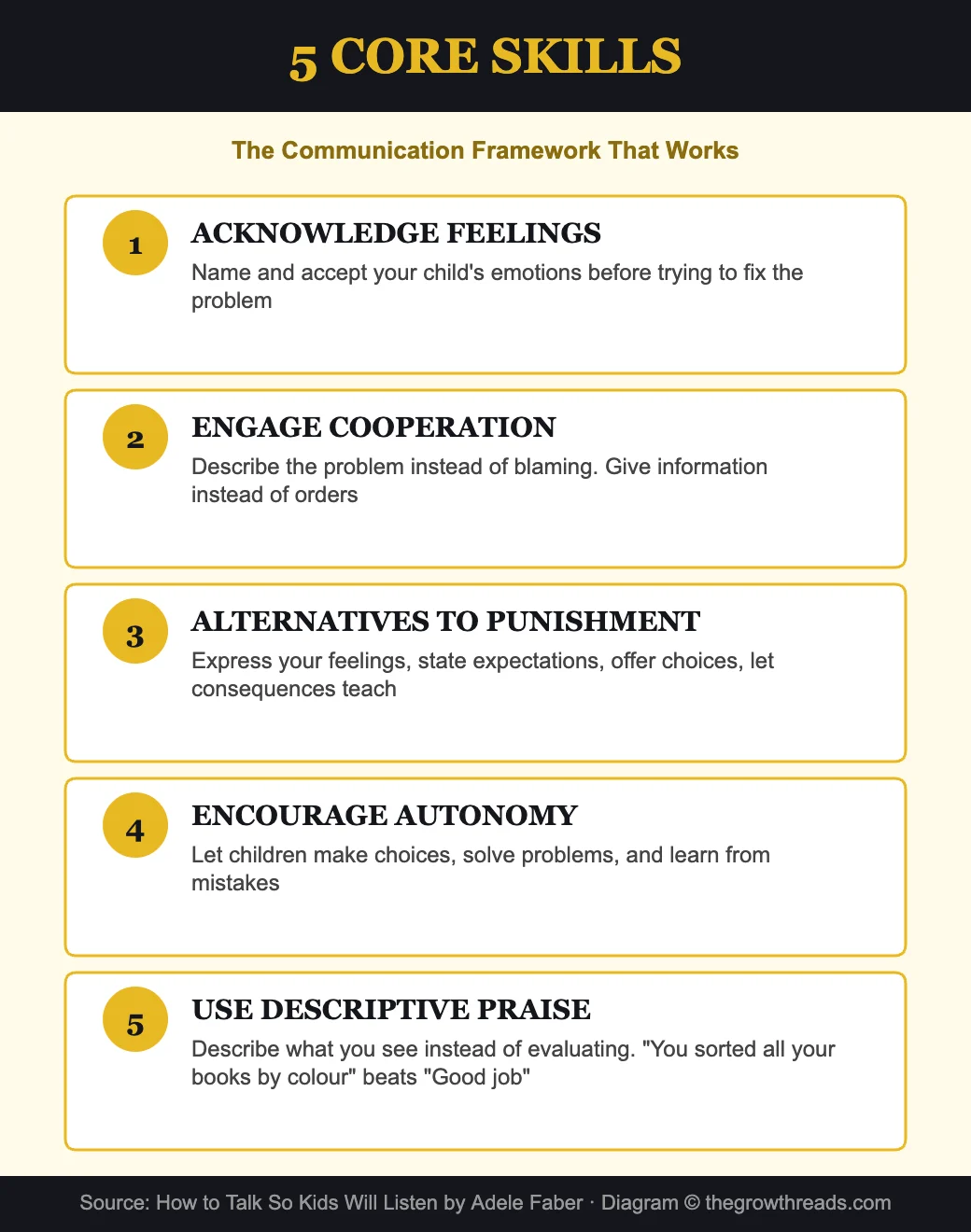
The praise chapter is the book’s most counterintuitive section. Most parents praise generously (“Good job!” “You’re so smart!” “What a good girl!”), believing they are building self-esteem. Faber and Mazlish show that evaluative praise creates dependence on external validation — the child learns to perform for approval rather than developing intrinsic motivation. The alternative is descriptive praise: instead of judging, describe what you see. “You sorted all your books by colour and size” lets the child draw their own conclusion about their accomplishment. “You spent 20 minutes on that math problem even when it was hard” highlights effort rather than talent, building the growth mindset that Carol Dweck would later research formally.
The label chapter extends this principle. Even positive labels — “the smart one,” “the creative one,” “the good kid” — create a cage. The child becomes anxious about maintaining the label and avoids situations where they might fail. Describing behaviour (“You tried three different approaches to that puzzle”) is always safer than assigning identity (“You’re a great problem-solver”) because behaviour can grow while labels must be defended.
Who is this book best for — and who should read something else first?
This is one of the most universally useful books ever written about human communication, disguised as a parenting book. It is essential for any parent, but it is also invaluable for teachers, managers, partners, and anyone who wants to communicate with more respect and less reactivity. If you are a new parent, read it before your child can talk — the habits you build early are the easiest to maintain.
If your communication challenges are primarily with a romantic partner rather than children, Nonviolent Communication covers similar principles in a broader relational context. If your child’s behaviour stems from attachment insecurity or emotional immaturity in the family system, Adult Children of Emotionally Immature Parents addresses the root cause.
Questions to reflect on
- How often do you dismiss your child’s feelings (“it’s not that bad”) versus acknowledge them (“that sounds really frustrating”)?
- When you need cooperation, do you describe the problem or blame the person?
- What would change in your household if you replaced punishment with natural consequences and collaborative problem-solving?
- How much do you praise effort versus talent — and what message does each send about intelligence and growth?
- Which of these five skills would transform your relationship with your child if you practised it consistently for one month?
🔥 Ready to transform how you talk to your kids?
Learn five communication skills that build connection, cooperation, and genuine confidence.
How to apply How to Talk So Kids Will Listen (7-day plan)
- Day 1 — Acknowledge one feeling: The next time your child is upset, resist fixing and say: “That sounds really [frustrating/disappointing/scary].” Watch what happens when they feel heard.
- Day 2 — Describe instead of blame: When you need cooperation, describe the problem without mentioning the child: “I see shoes in the hallway” instead of “You left your shoes out again.”
- Day 3 — Give information instead of orders: Replace one command with information: “Teeth get cavities from sugar that stays on them overnight” instead of “Go brush your teeth!”
- Day 4 — Use one word: When your child knows what to do but is not doing it, use a single word: “Backpack.” “Dishes.” “Homework.” Brevity respects their intelligence.
- Day 5 — Offer a choice instead of punishment: When behaviour needs correcting, give two acceptable options: “Would you like to clean up now or after this show ends?” Choice creates buy-in.
- Day 6 — Praise descriptively: Replace “Good job!” with a description of what you see: “You wrote three full paragraphs and included examples for each point.” Let your child evaluate themselves.
- Day 7 — Give the wish in fantasy: When your child wants something impossible, grant it imaginatively: “I wish I could build you a swimming pool right in the living room!” Watch the mood transform.
Frequently asked questions
What age range is this book for?
The techniques work from toddlerhood through the teenage years and beyond. The book’s examples span ages 2–15, and many readers report that the principles are equally effective with adult partners, employees, and elderly parents. The specific language adapts (you would not say “Backpack!” to a colleague), but the principles — acknowledge feelings before fixing, describe instead of blame, offer choices — are universal communication skills.
Is this book against discipline?
No. Faber and Mazlish are against punishment but strongly in favour of discipline — a distinction many parents miss. Discipline means teaching responsibility through natural consequences, clear expectations, expressed feelings, and problem-solving. Punishment means imposing suffering to deter behaviour. The book provides specific tools for holding boundaries firmly while treating the child with respect. Children raised with these methods are often more cooperative, not less, because they develop internal motivation rather than external compliance.
Does descriptive praise really work better than “Good job”?
Research supports this consistently. Carol Dweck’s work at Stanford showed that children praised for effort (“you worked really hard on that”) are more likely to embrace challenges and persist through difficulty than children praised for ability (“you’re so smart”), who become risk-averse and fragile when they encounter failure. Descriptive praise (“you used five different types of evidence in that essay”) gives the child specific information about what they did well, which is more useful for learning than a vague evaluation.
What if my child is used to a different parenting style?
Transitions take time. Children who are used to orders and punishments may initially be confused by the new approach. Some will test boundaries to see if the change is real. Faber and Mazlish recommend being patient and consistent: the new patterns typically produce visible results within 2–4 weeks. You may also need to acknowledge the transition explicitly: “I’ve been learning some new ways to talk to you because I want us to get along better.” Children are remarkably adaptable when they sense genuine respect.
Can these techniques work with teenagers?
Yes, and they may be even more important with teenagers than with younger children. Adolescents are hypersensitive to being controlled, lectured, or treated as incompetent. The autonomy-encouraging and feelings-acknowledging techniques align perfectly with teenagers’ developmental need for independence and respect. Faber and Mazlish published a companion book, How to Talk So Teens Will Listen & Listen So Teens Will Talk, which adapts the principles for adolescent-specific situations.
Is this book dated?
First published in 1980 and updated in 2012, the communication principles are timeless. Some cultural references and family structures in the examples reflect their era, but the core techniques have been validated by decades of subsequent research in developmental psychology, communication science, and education. The principles align with current positive parenting frameworks, attachment-informed approaches, and growth mindset research. It remains one of the most frequently recommended parenting books by child psychologists.
How does this compare to other parenting books?
How to Talk So Kids Will Listen is the most practical and immediately applicable parenting communication book available. The Whole-Brain Child by Daniel Siegel adds neuroscience explanations for why these techniques work. Unconditional Parenting by Alfie Kohn takes a more philosophical approach. No-Drama Discipline by Siegel integrates brain science with discipline strategies. For most parents, Faber and Mazlish is the best starting point because the cartoon-format before/after examples make the techniques instantly usable, with no theory required.
Related summaries
- Nonviolent Communication by Marshall Rosenberg — The same principles applied to all relationships, not just parent-child.
- Mindset by Carol Dweck — The research behind why effort-based praise outperforms ability-based praise.
- Boundaries by Cloud and Townsend — The structural framework for holding limits with love.
- Adult Children of Emotionally Immature Parents by Lindsay Gibson — What happens when children do not receive the emotional attunement this book teaches.
- See all Relationships book summaries on our Best Relationship Books pillar page.